Daily, maximum and trailing drawdown: three different limits
Use original hypothetical examples to distinguish loss allowances, equity floors and moving checkpoints.
A percentage is only the beginning
Seeing a 10% loss limit tells you little until you know its base, measurement, update time and breach condition. Does it use initial capital, yesterday’s balance or the highest equity reached? Is it checked continuously or only at a checkpoint? What happens after a withdrawal? These questions turn a marketing percentage into an operational rule that can be compared.
FTMO’s objectives page distinguishes product-specific static and trailing mechanisms. That is why FINEX keeps the product name beside a drawdown figure rather than publishing one universal FTMO rule. The examples below are invented teaching scenarios, not a description of any selected provider’s contract.
FTMO product-specific loss-limit definitions
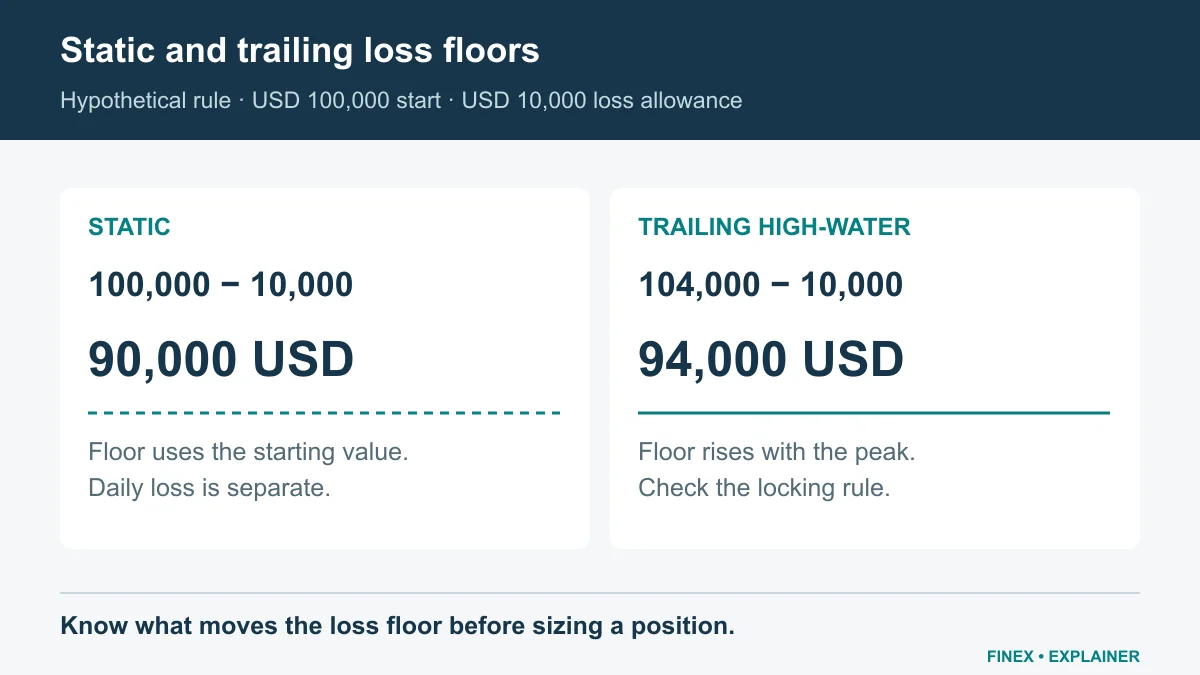
Diagram explained
Know what moves the loss floor before sizing a position.
- Hypothetical static rule: initial USD 100,000 minus a fixed USD 10,000 allowance gives a USD 90,000 floor.
- Hypothetical high-water trailing rule with the same fixed allowance: a USD 104,000 peak gives a USD 94,000 floor. This example assumes the floor has not reached a locking cap.
- Actual programs differ: balance or equity, intraday or end-of-day peaks, locking caps, and reset time. Daily loss is a separate rule; this is not a quote for FTMO or another firm.
Static total and daily limits can coexist
Assume a fictional $10,000 account has a fixed total floor of $9,000. Whether balance rises to $10,700 or falls to $9,600, that floor stays $9,000 under this invented rule. Equity of $9,400 leaves $400 of room. That room is not an invitation to lose $400; it simply measures distance to the stated boundary.
Now add a fictional daily allowance of $300 below the balance at the daily checkpoint. With a checkpoint balance of $9,600, the daily floor would be $9,300. Current equity of $9,400 has only $100 of daily room, although $400 remains above the total floor. The tighter rule governs the immediate constraint.
A trailing floor follows a defined high
In a different fictional programme, suppose a floor trails the highest end-of-day balance by $1,000 and never moves down. Starting at $10,000 gives a $9,000 floor. An end-of-day balance of $10,800 raises it to $9,800. If balance subsequently drops, the floor does not fall back. An intraday-high version could produce another result from the same trading path.
For example, a temporary intraday balance high of $11,200 would matter to an intraday-high calculation but not necessarily to an end-of-day one. Do not infer one from the word trailing. Also ask whether the rule stops trailing at a cap, uses equity instead of balance, or changes after a reward. Each is a separate contractual feature.
Turn the rule into a small worksheet
Keep one row for each limit: formula, checkpoint, current floor and remaining room. Include open exposure and costs. Label assumptions so a later reader can reproduce the result. If a provider changes the rule, update the formula and date rather than editing only the displayed percentage. This exercise explains the arithmetic; it does not recommend position size or guarantee execution at a planned exit.
Sources and scope
Sources are provider publications. Conditions may vary by entity, country, account and program. Recheck before signing up.