Basics
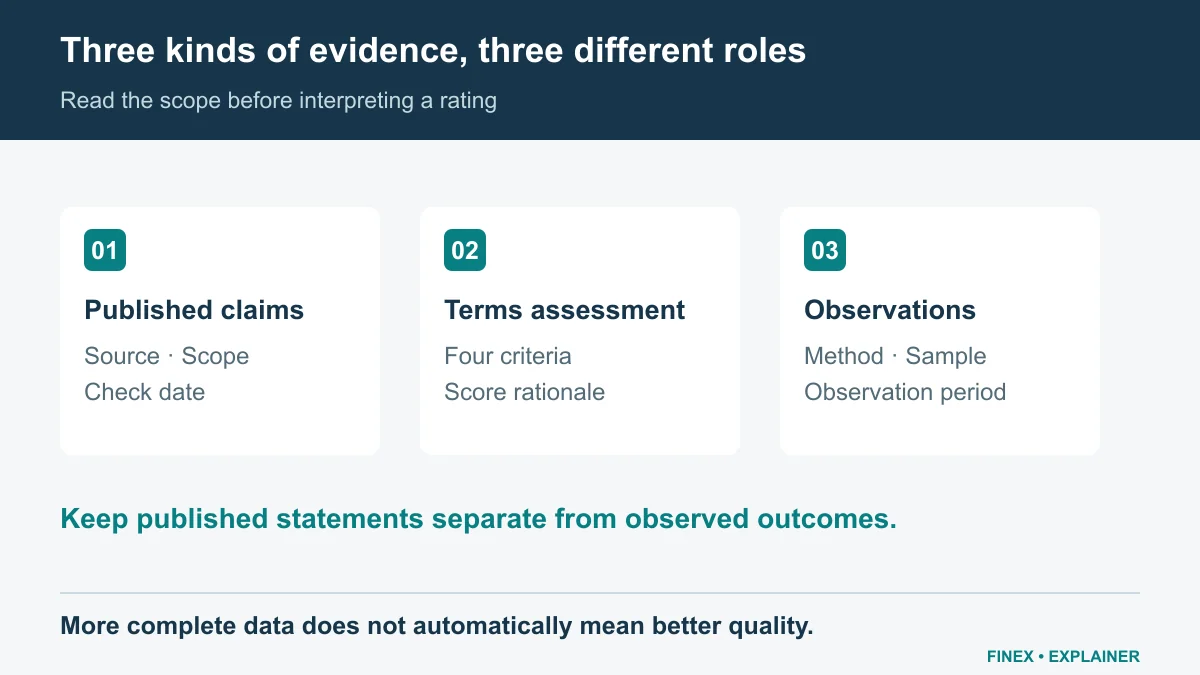
How to read a FINEX review: facts, opinions and unanswered questions
A practical reading order for source labels, entity scope, dates and provisional ratings.
Read guideFINEX · RESEARCH LIBRARY
Sourced guides to costs, legal entities, withdrawals and prop trading rules.
FEATURED REVIEW
MT4, MT5, cTrader and TradingView. Get a concise view of trading costs, strengths and trade-offs before opening an account.
Partner link · FINEX may earn commission from trading on referred accounts. Forex/CFDs carry a risk of capital loss.
Showing 641 guides across 4 topics.
Basics
A practical reading order for source labels, entity scope, dates and provisional ratings.
Read guide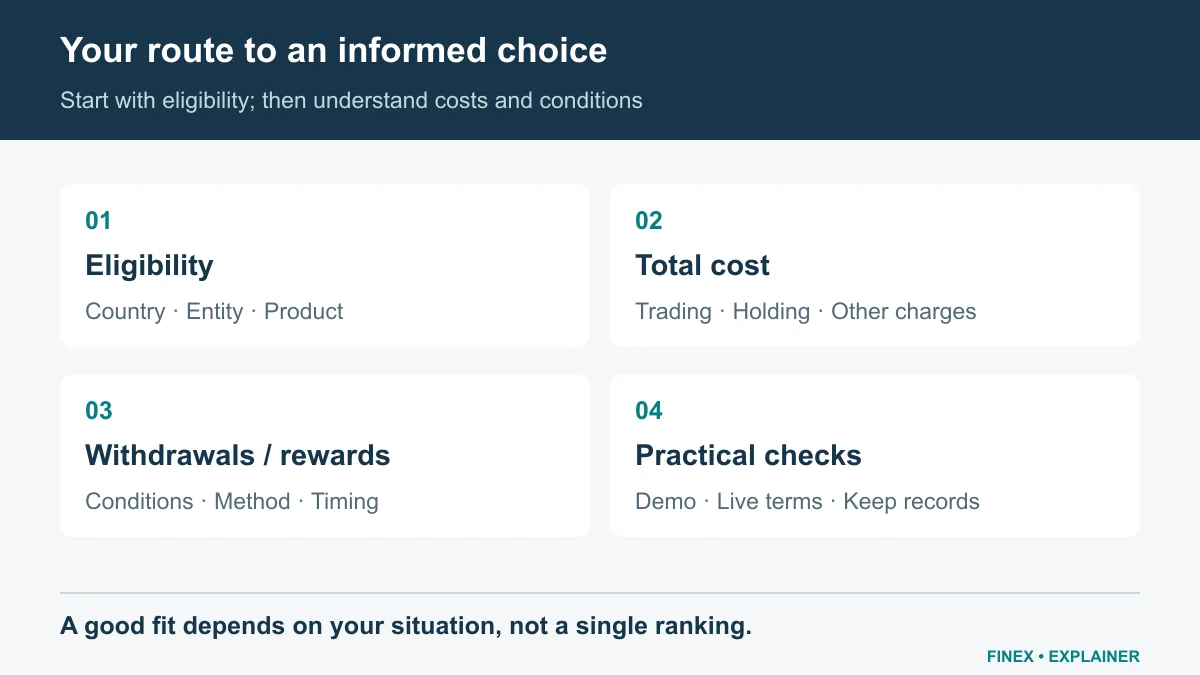
Basics
Understand the product, your counterparty and the difference between a platform and a financial service.
Read guide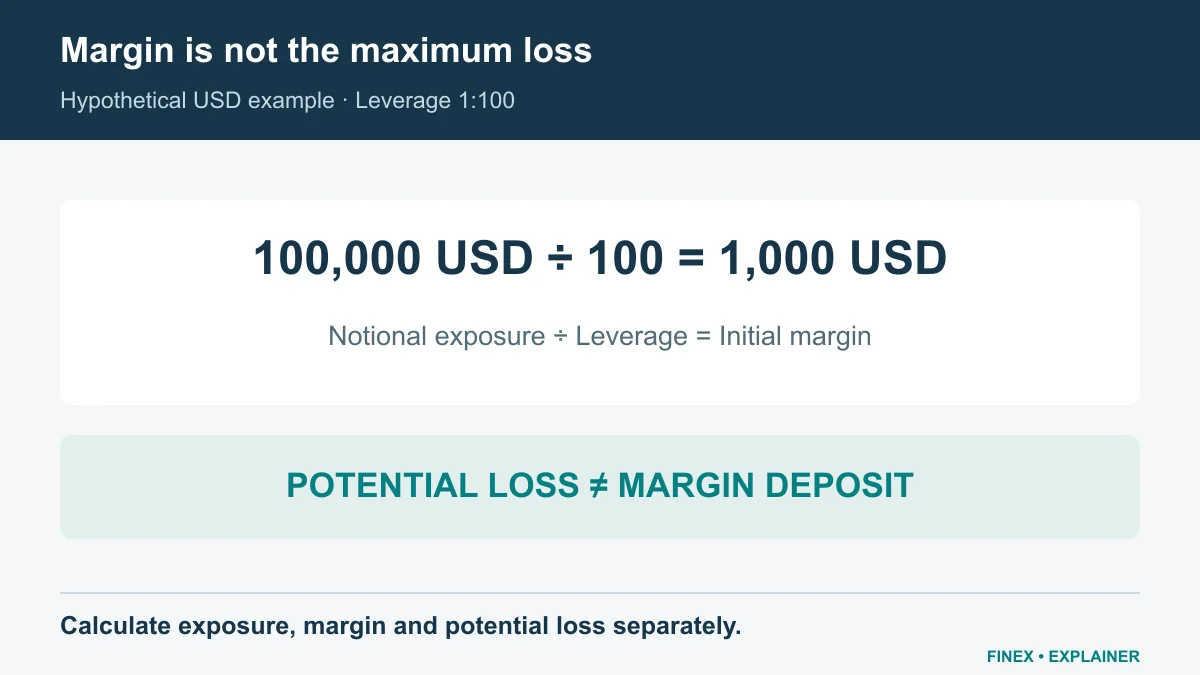
Basics
A hypothetical example separates required margin from the amount you could lose.
Read guide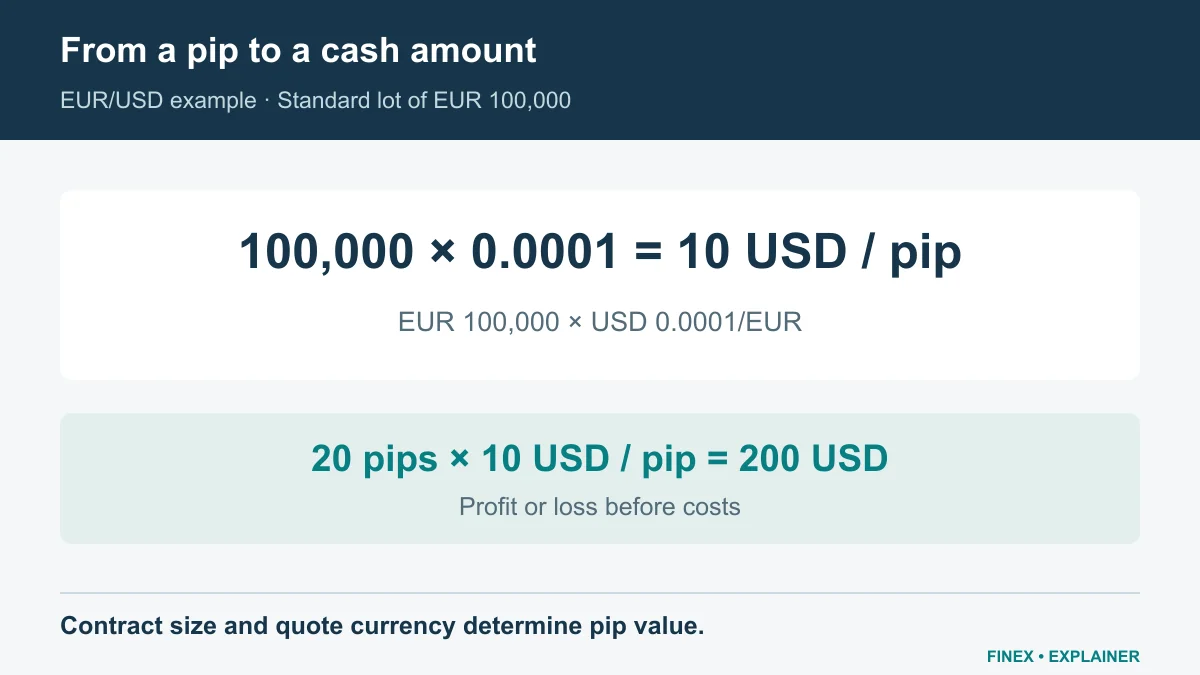
Basics
Work through units, contract size and account currency before estimating costs or risk.
Read guide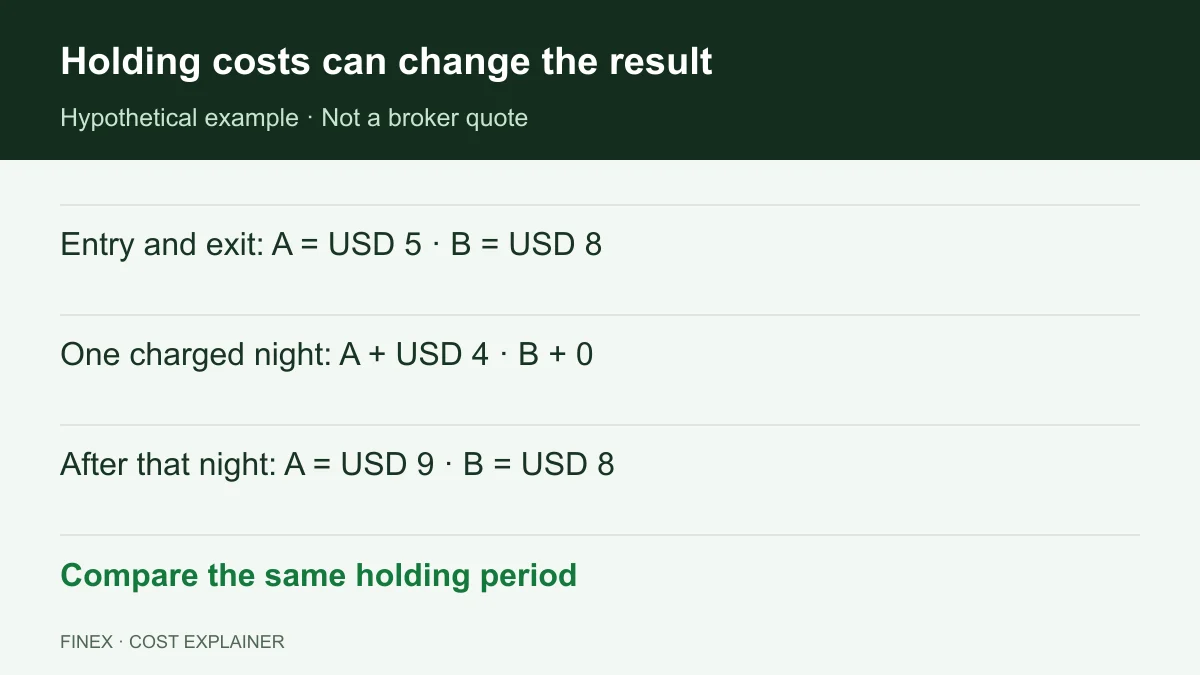
Basics
Understand holding costs without assuming a swap-free label means every cost disappears.
Read guide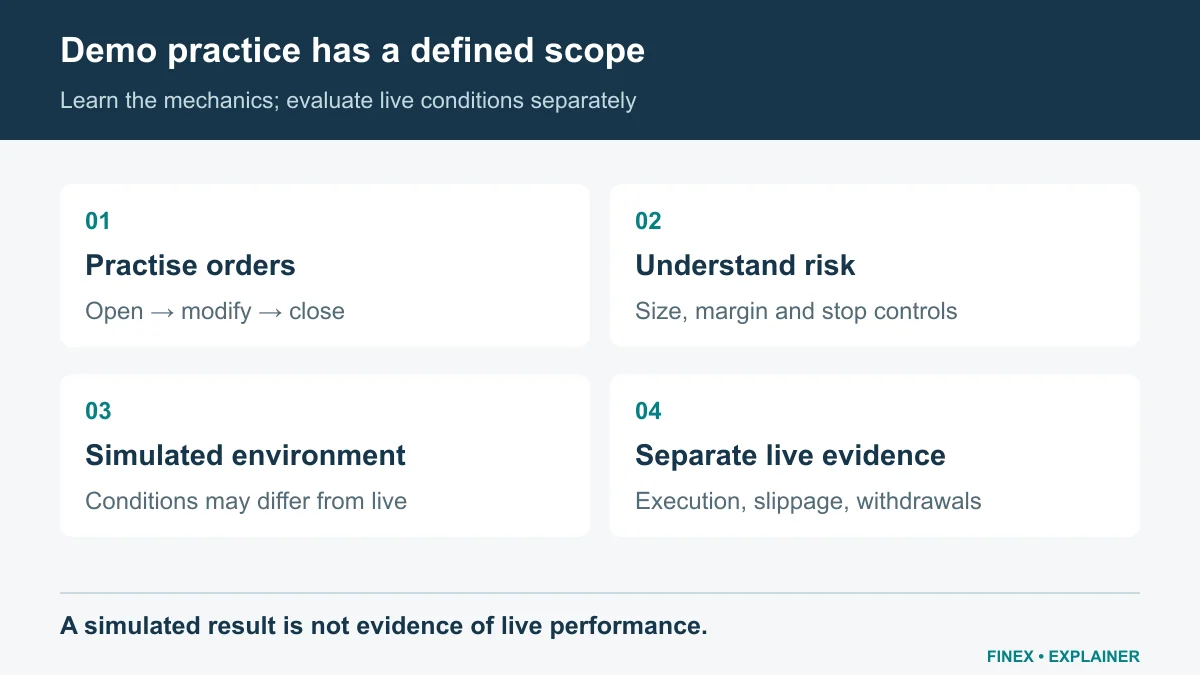
Basics
Use a demo to learn mechanics while separating practice outcomes from execution and withdrawal evidence.
Read guide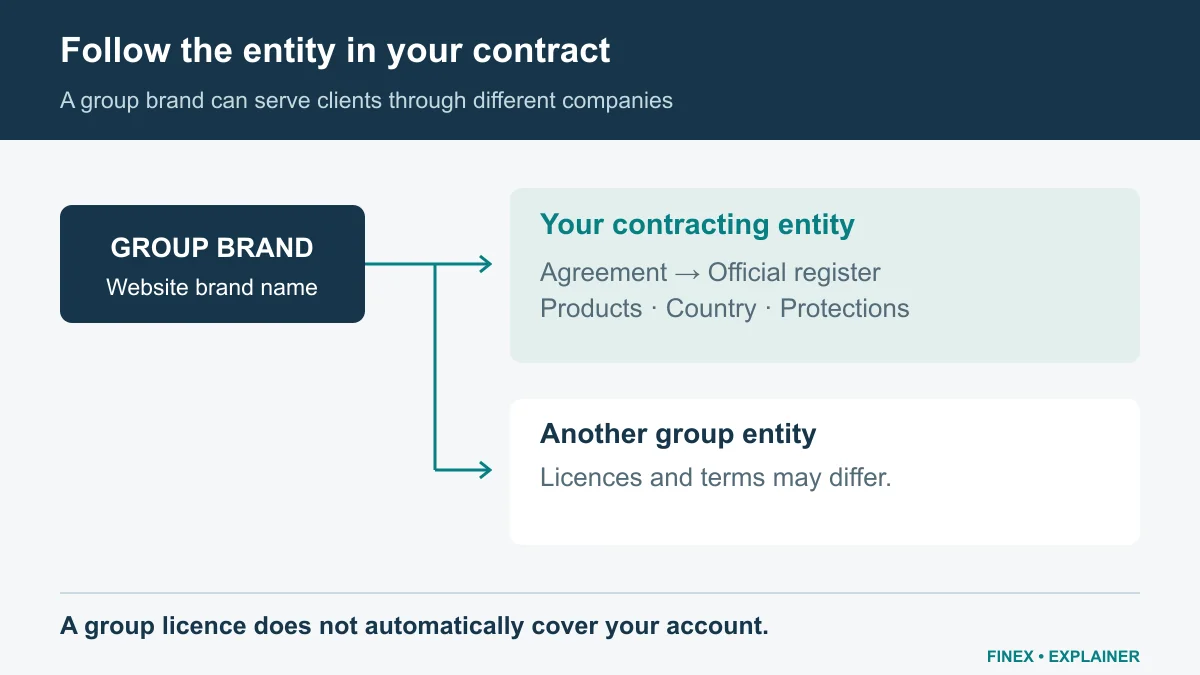
Basics
Match the contract, register entry, domain and client category before drawing a protection conclusion.
Read guide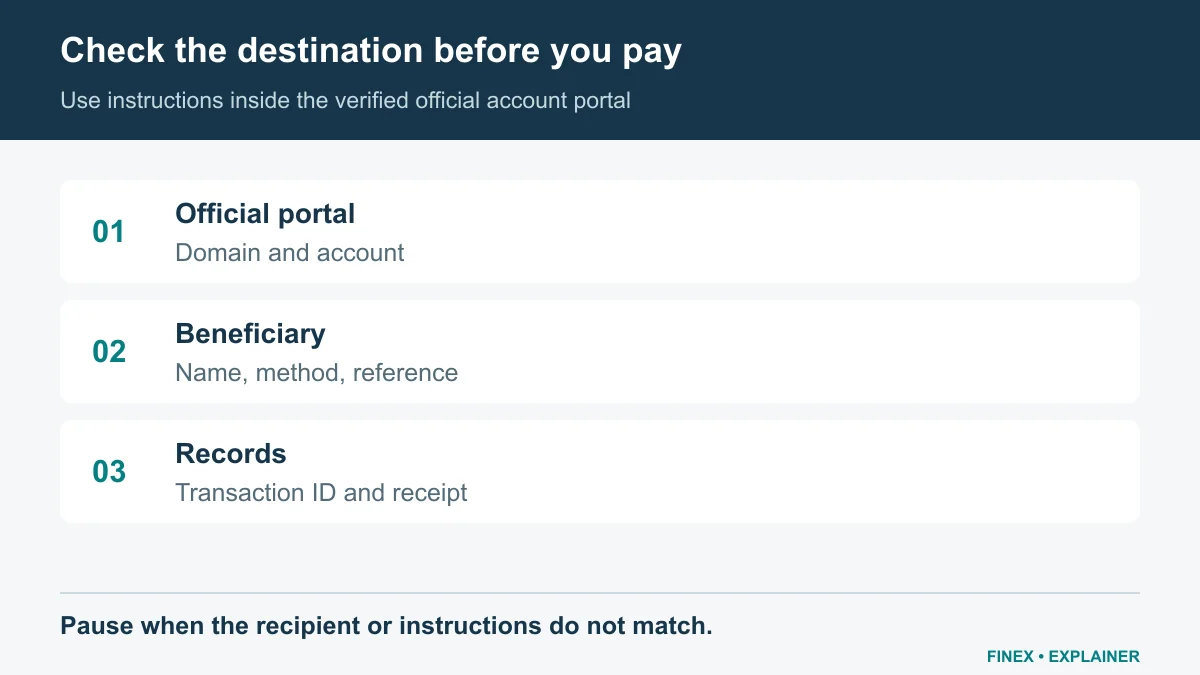
Basics
Check the destination, account ownership and support channel before sharing data or moving money.
Read guideBasics
Read scoring scope, coverage and evidence instead of treating a star total as a guarantee.
Read guideBasics
A repeatable workflow for narrowing options, using filters and checking the original conditions.
Read guide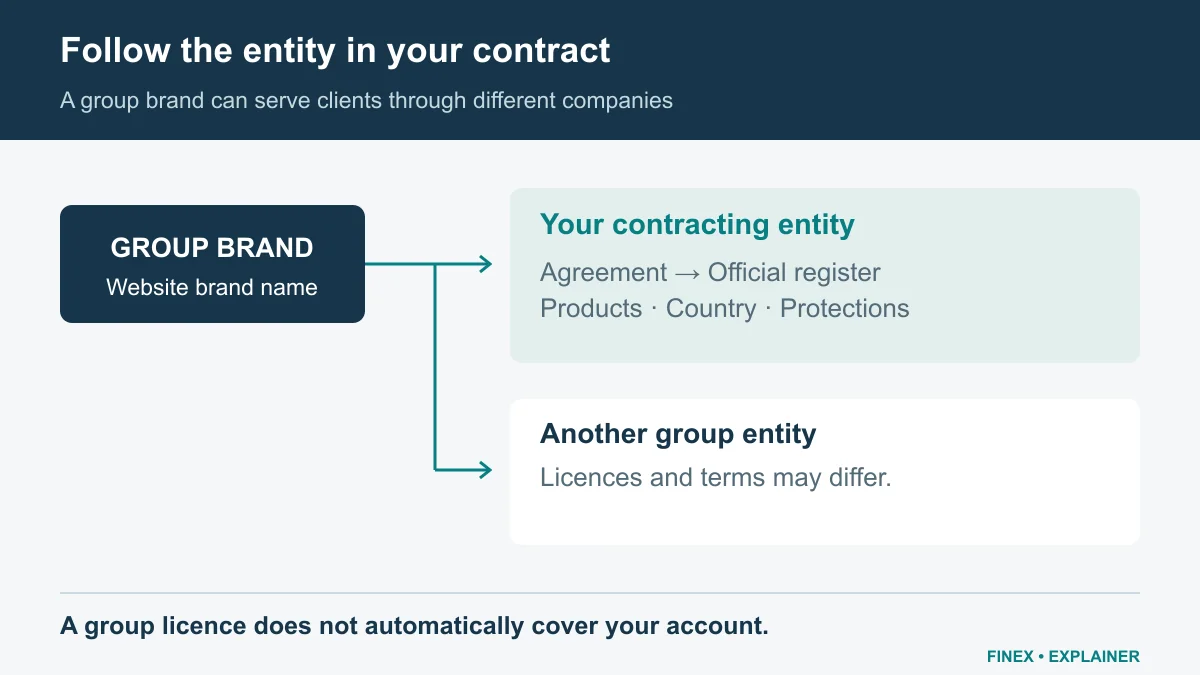
Basics
Learn what a trading-fee rebate can cover, what “up to 100%” does and does not mean, and how to check the terms before choosing an account.
Read guideBasics
Match platform records to the program’s unit, distinguish per-lot and commission-share formulas, and verify the amount before relying on it.
Read guide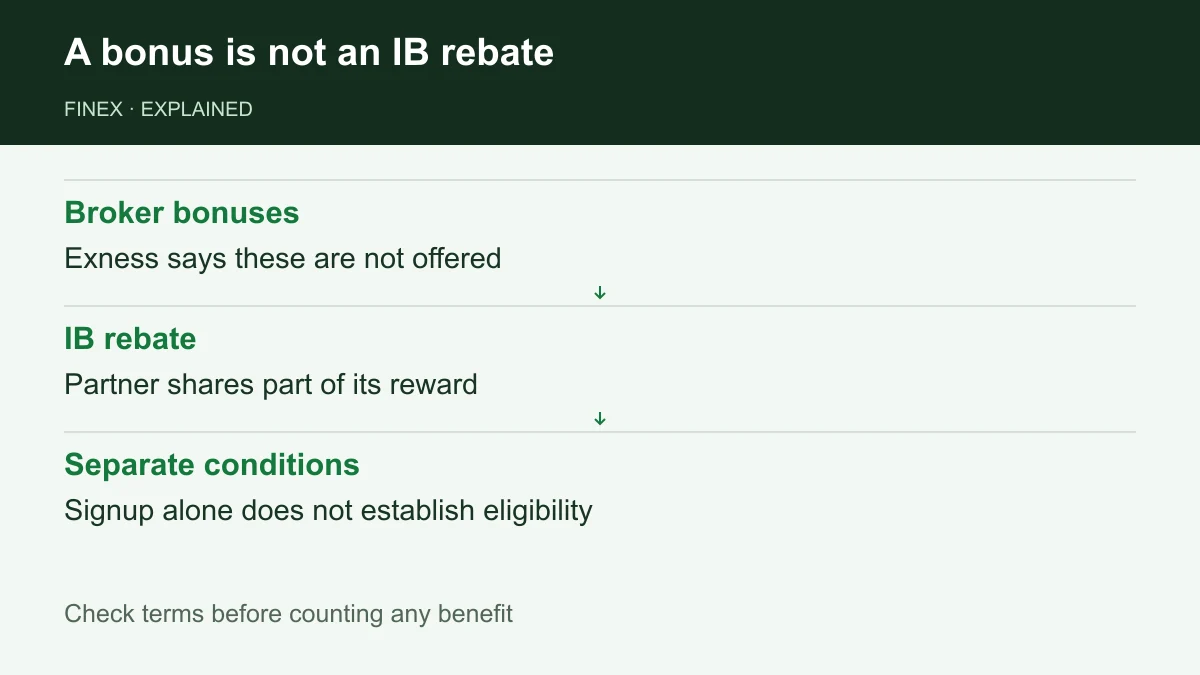
Guide
Explore Exness promotions, country limits and reward conditions from official publications before opening an account.
Read guide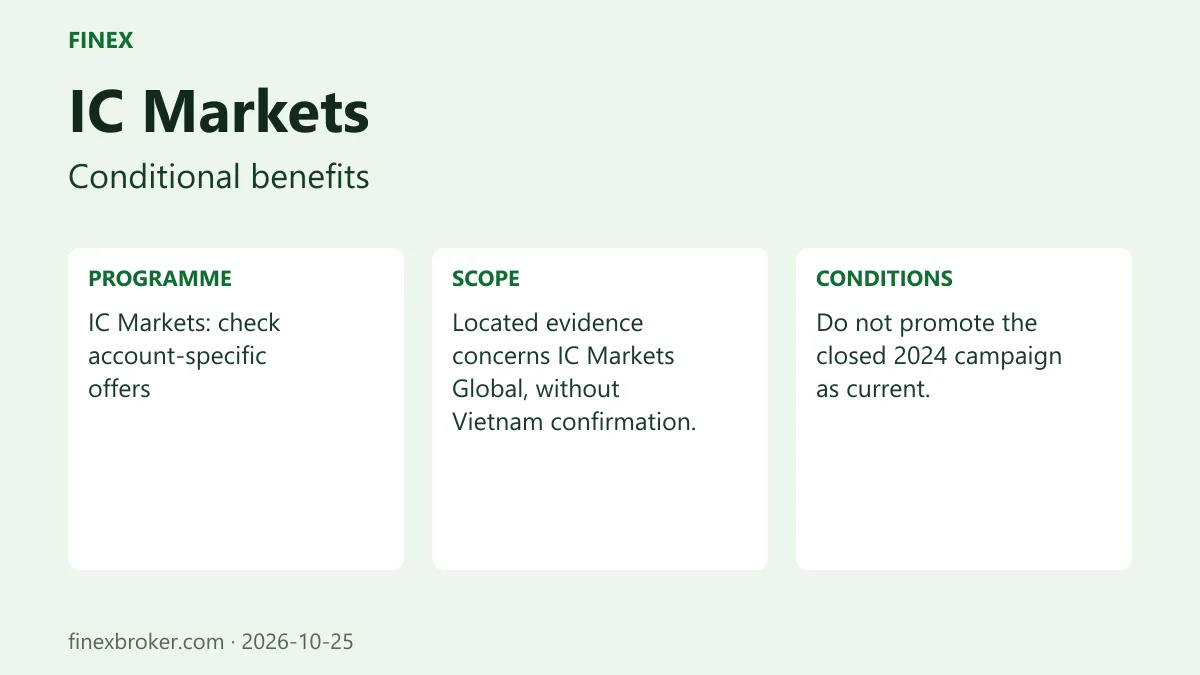
Guide
Explore IC Markets promotions, country limits and reward conditions from official publications before opening an account.
Read guide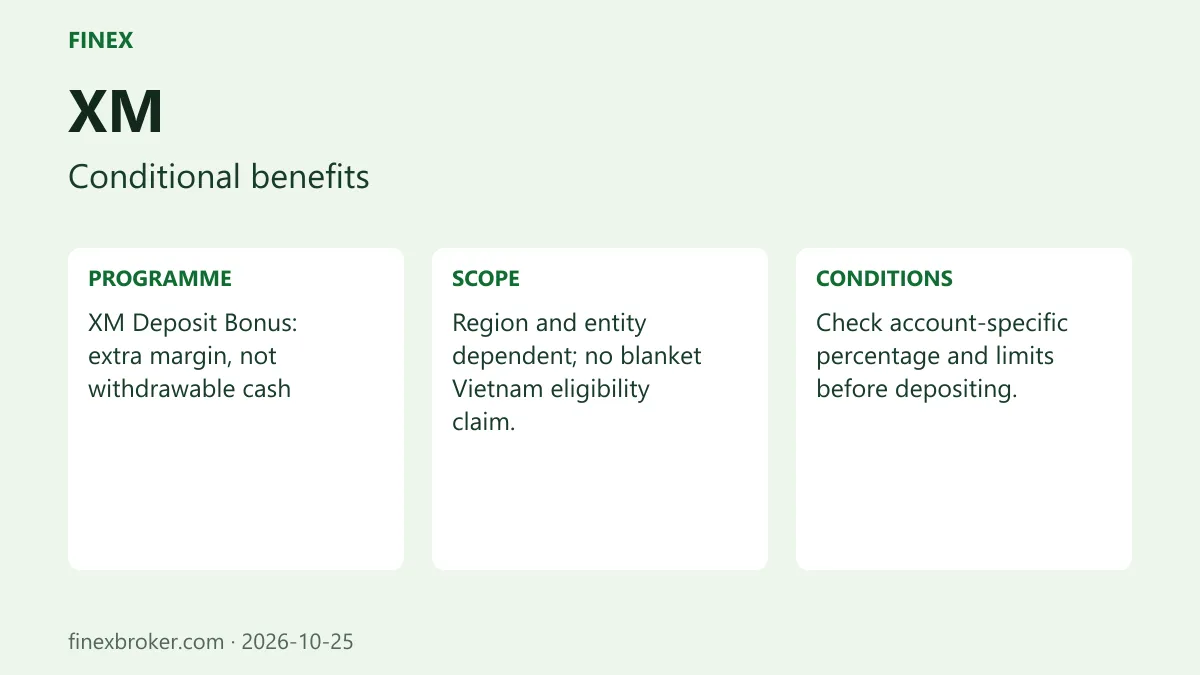
Guide
Explore XM promotions, country limits and reward conditions from official publications before opening an account.
Read guide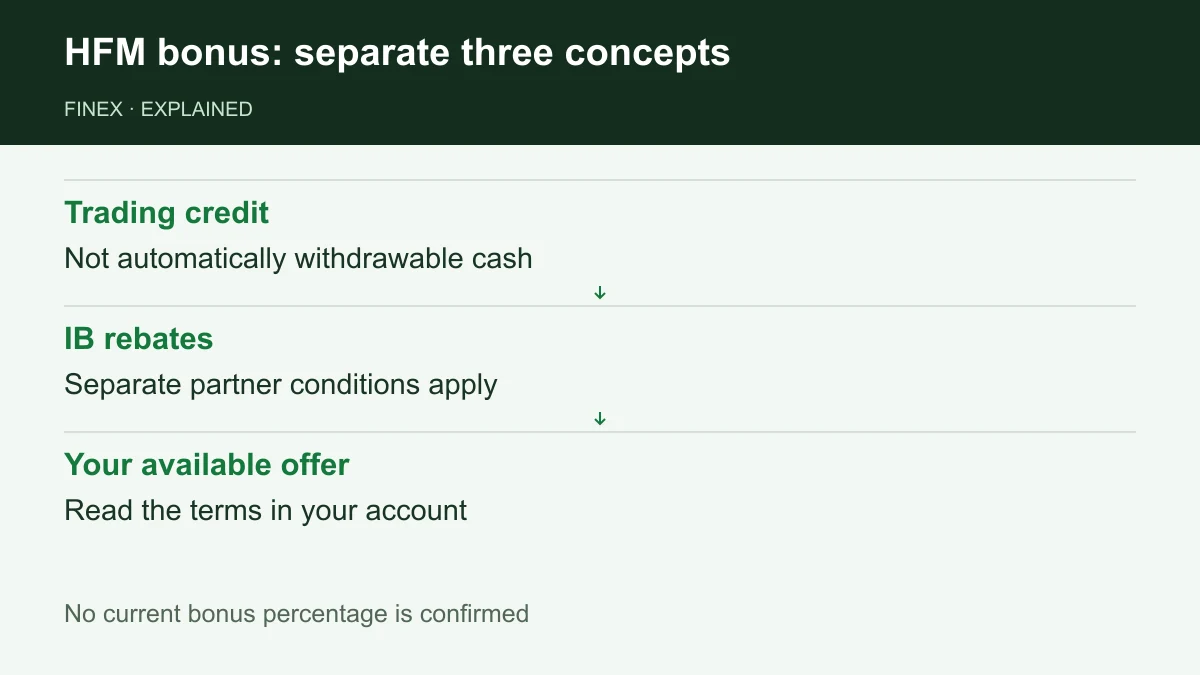
Guide
Explore HFM promotions, country limits and reward conditions from official publications before opening an account.
Read guide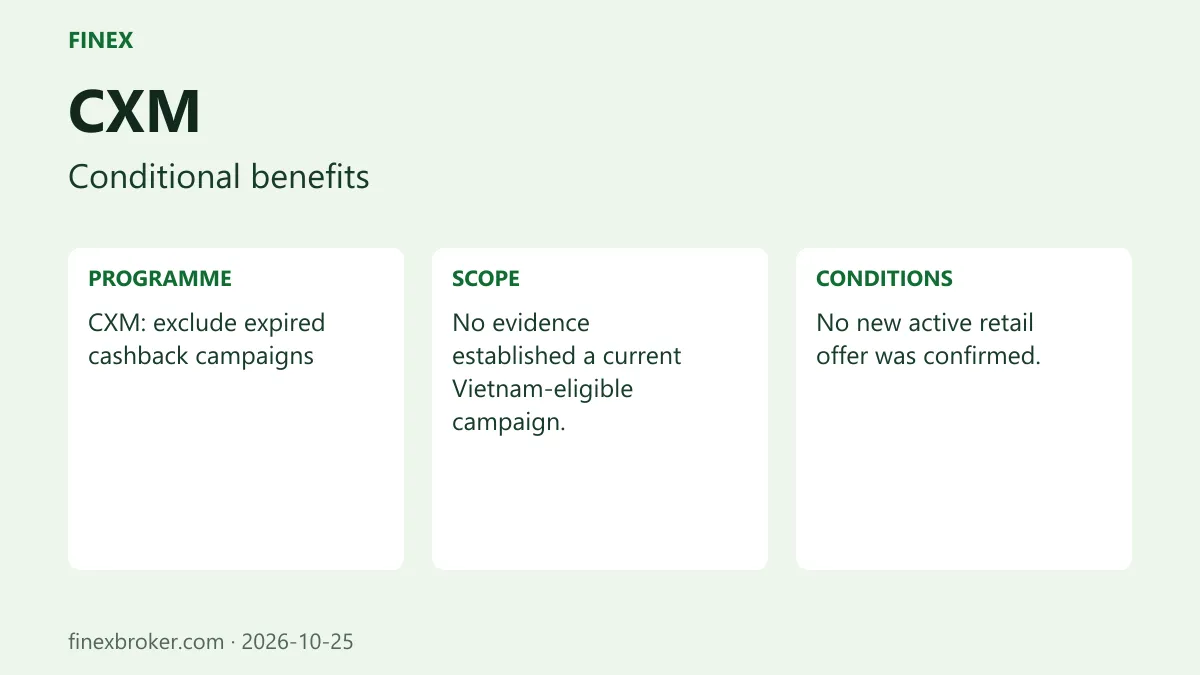
Guide
Explore CXM promotions, country limits and reward conditions from official publications before opening an account.
Read guide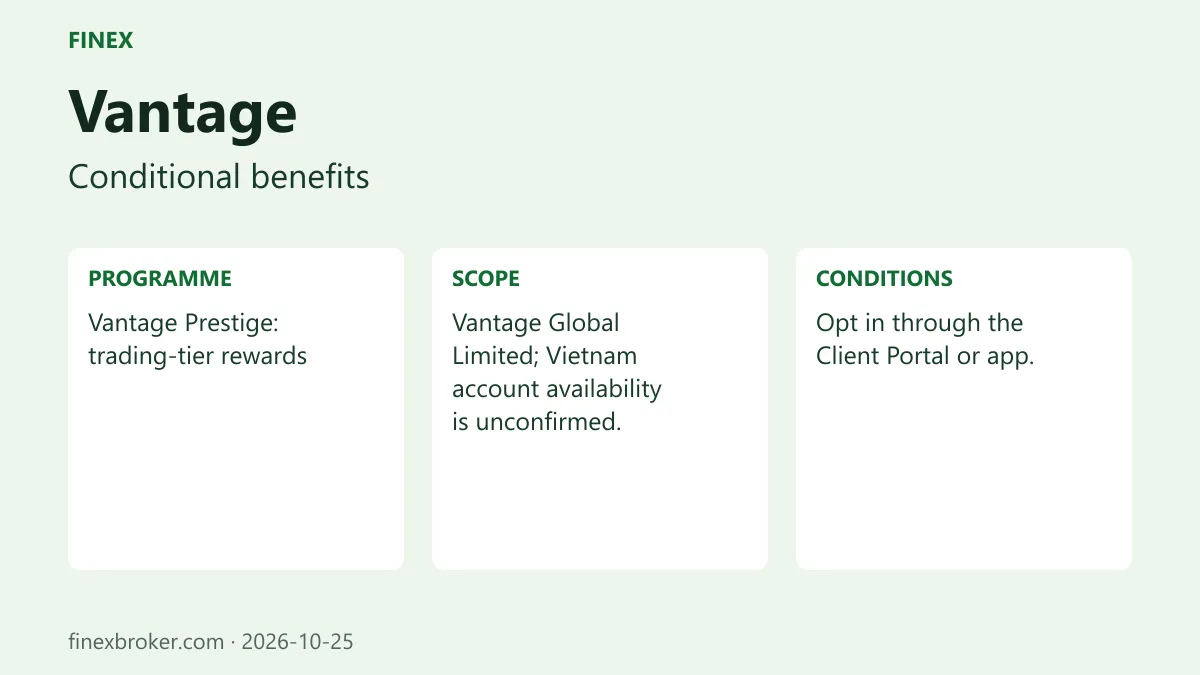
Guide
Explore Vantage promotions, country limits and reward conditions from official publications before opening an account.
Read guide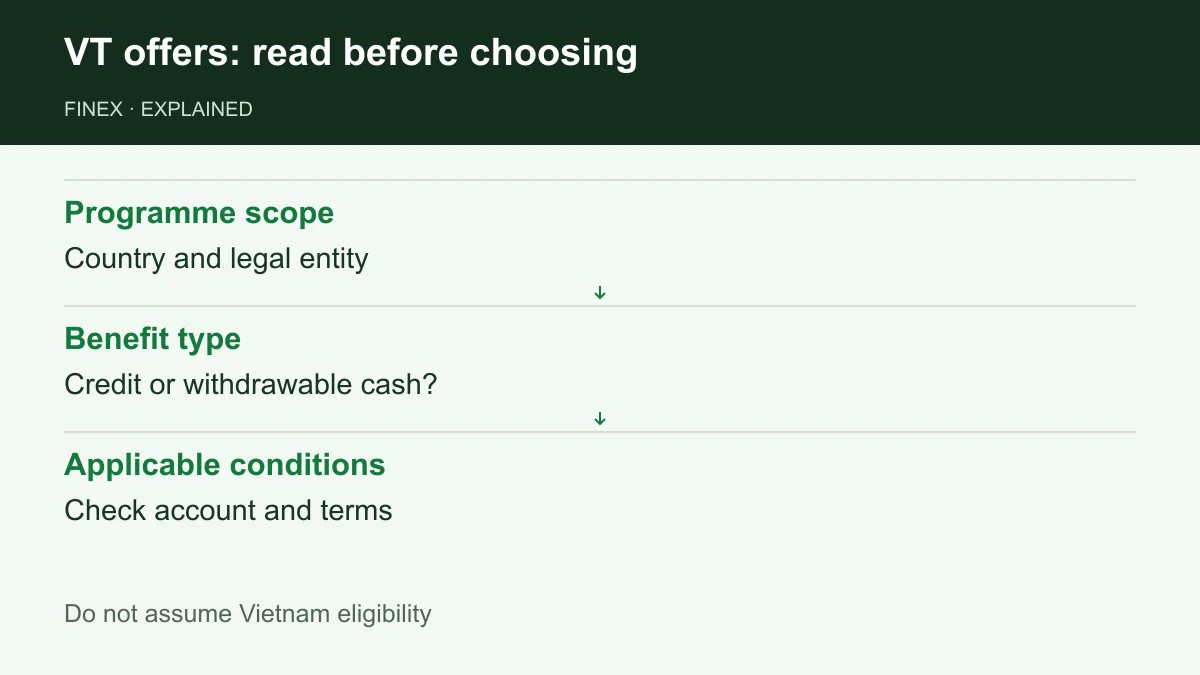
Guide
Explore VT Markets promotions, country limits and reward conditions from official publications before opening an account.
Read guide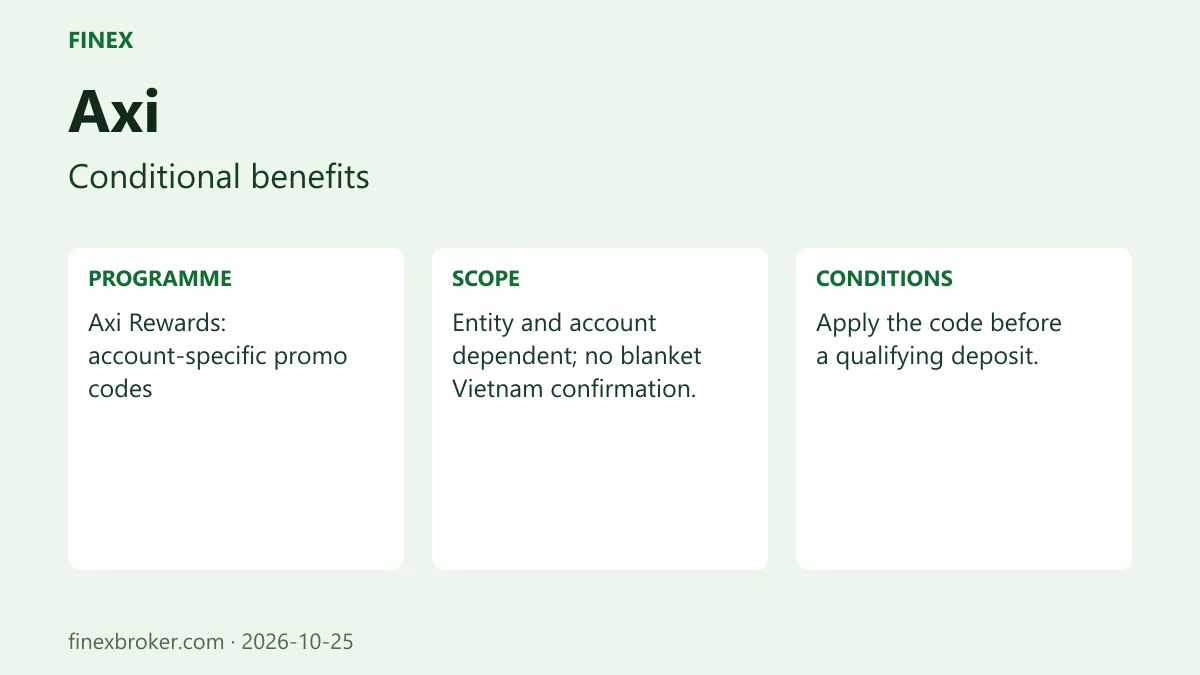
Guide
Explore Axi promotions, country limits and reward conditions from official publications before opening an account.
Read guide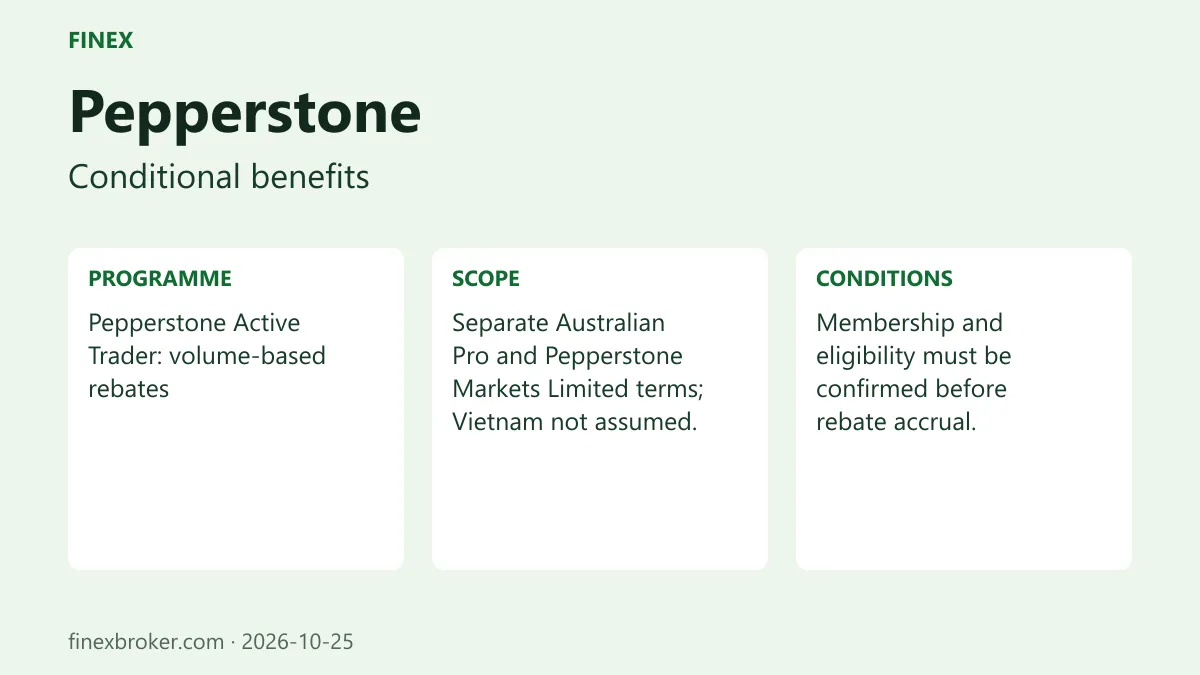
Guide
Explore Pepperstone promotions, country limits and reward conditions from official publications before opening an account.
Read guide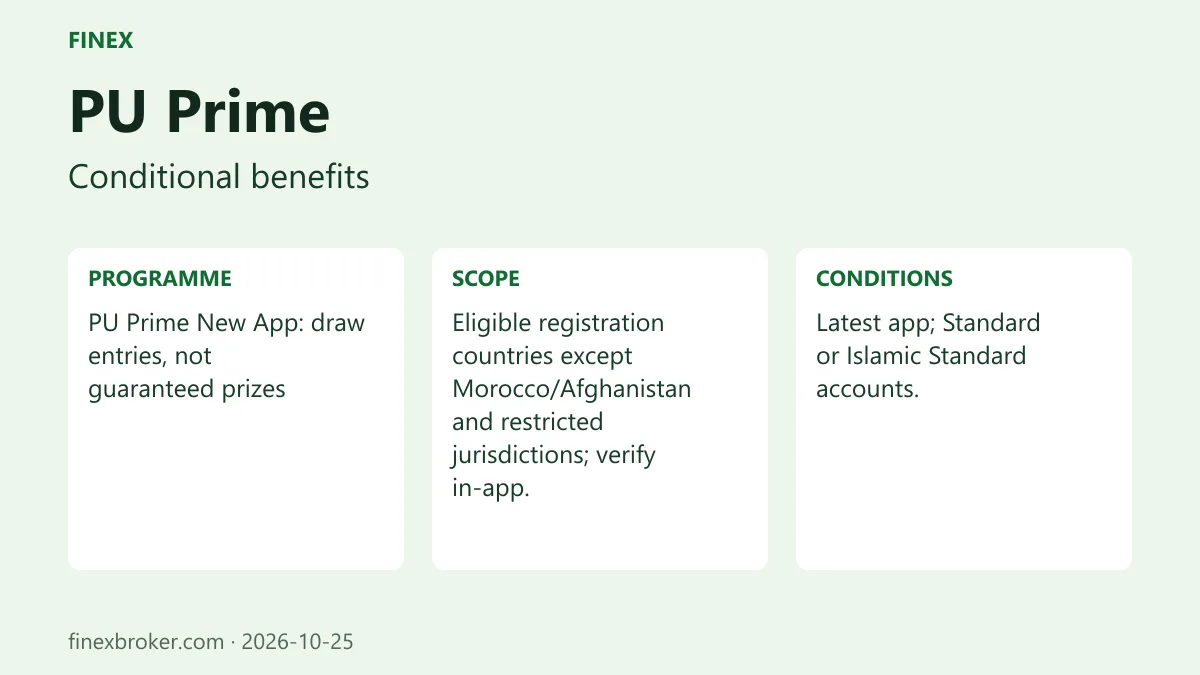
Guide
Explore PU Prime promotions, country limits and reward conditions from official publications before opening an account.
Read guide
Guide
Explore JustMarkets promotions, country limits and reward conditions from official publications before opening an account.
Read guide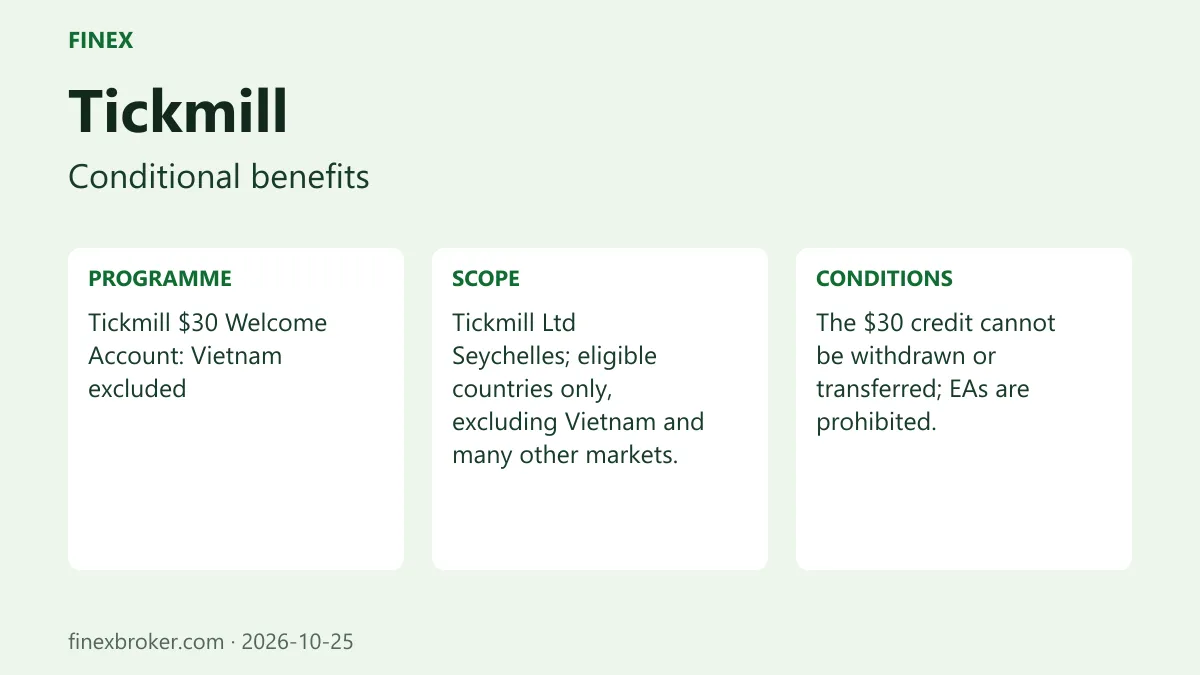
Guide
Explore Tickmill promotions, country limits and reward conditions from official publications before opening an account.
Read guide
Guide
Explore Valetax promotions, country limits and reward conditions from official publications before opening an account.
Read guide
Guide
Explore ETO Markets promotions, country limits and reward conditions from official publications before opening an account.
Read guide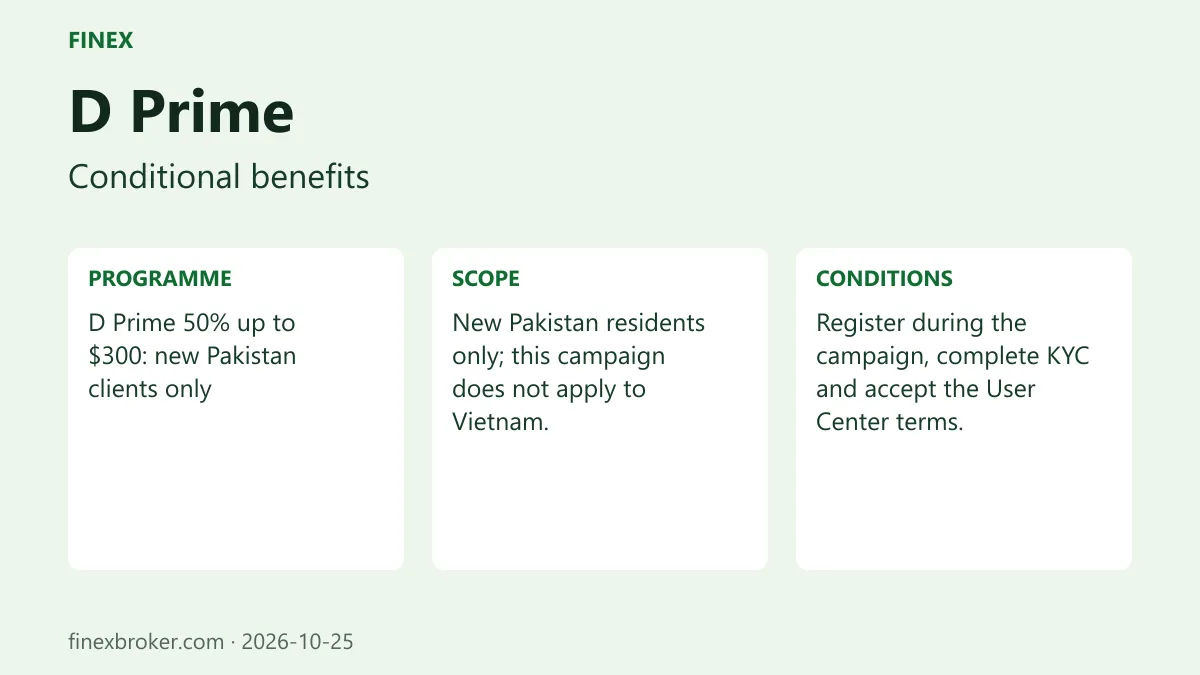
Guide
Explore D Prime promotions, country limits and reward conditions from official publications before opening an account.
Read guide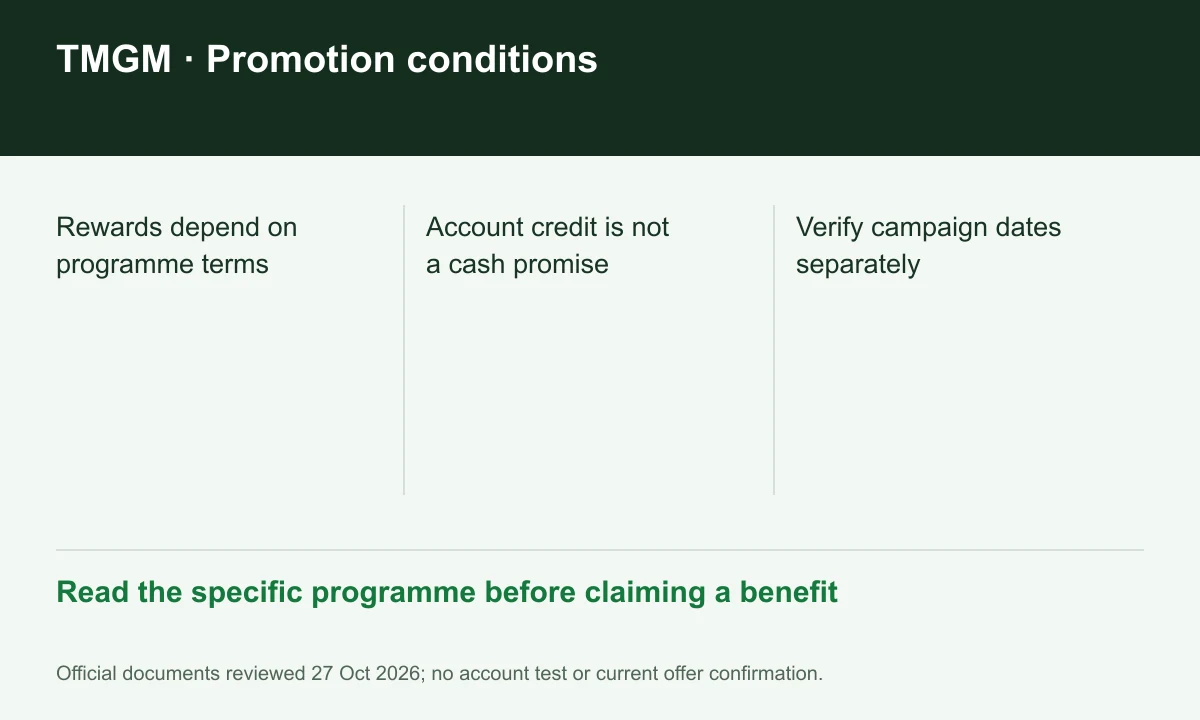
Guide
Explore TMGM promotions, country limits and reward conditions from official publications before opening an account.
Read guide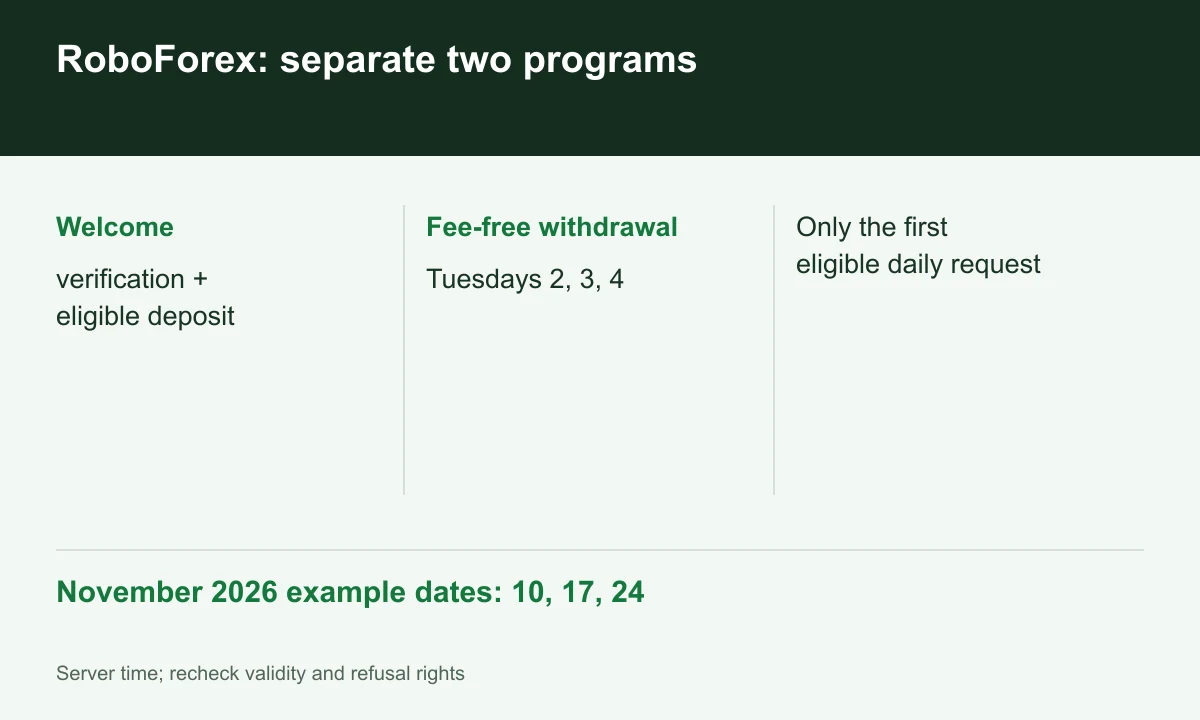
Guide
Explore RoboForex promotions, country limits and reward conditions from official publications before opening an account.
Read guide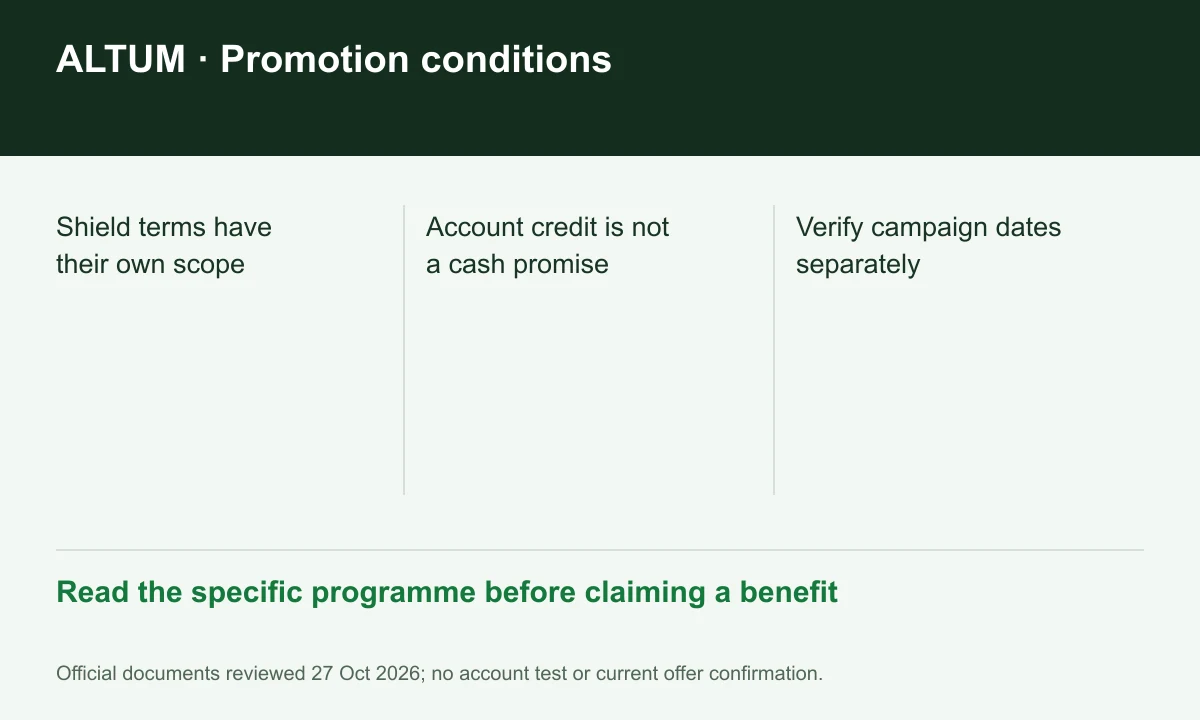
Guide
Explore Altum promotions, country limits and reward conditions from official publications before opening an account.
Read guide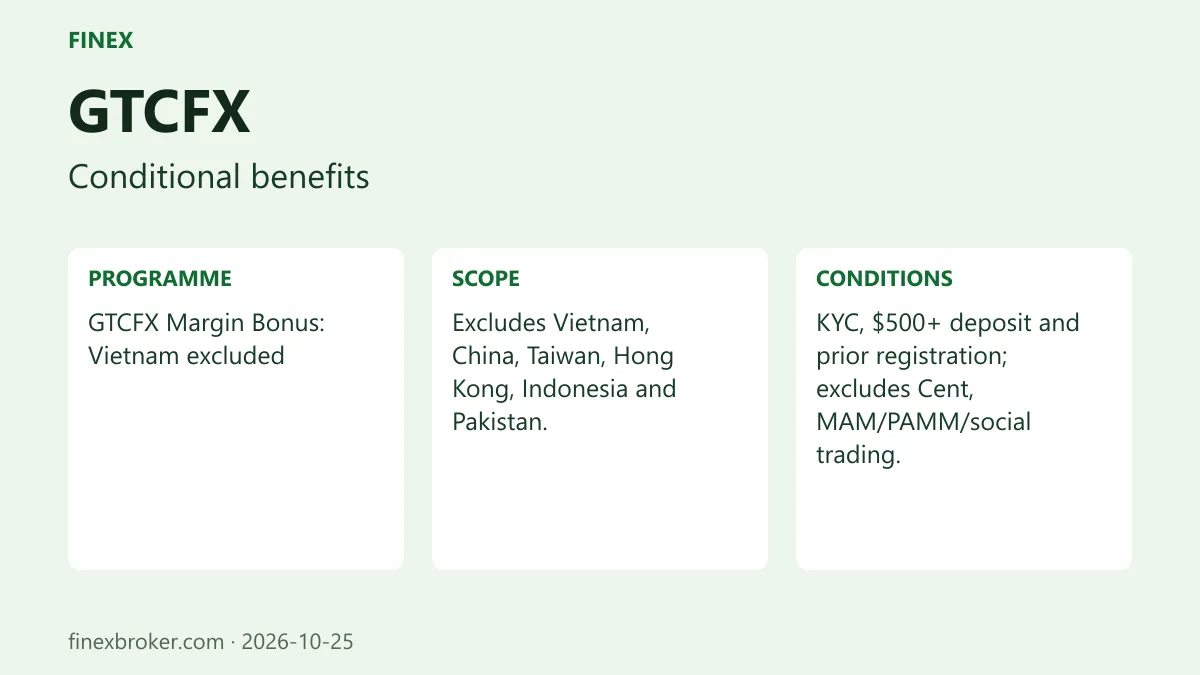
Guide
Explore GTCFX promotions, country limits and reward conditions from official publications before opening an account.
Read guide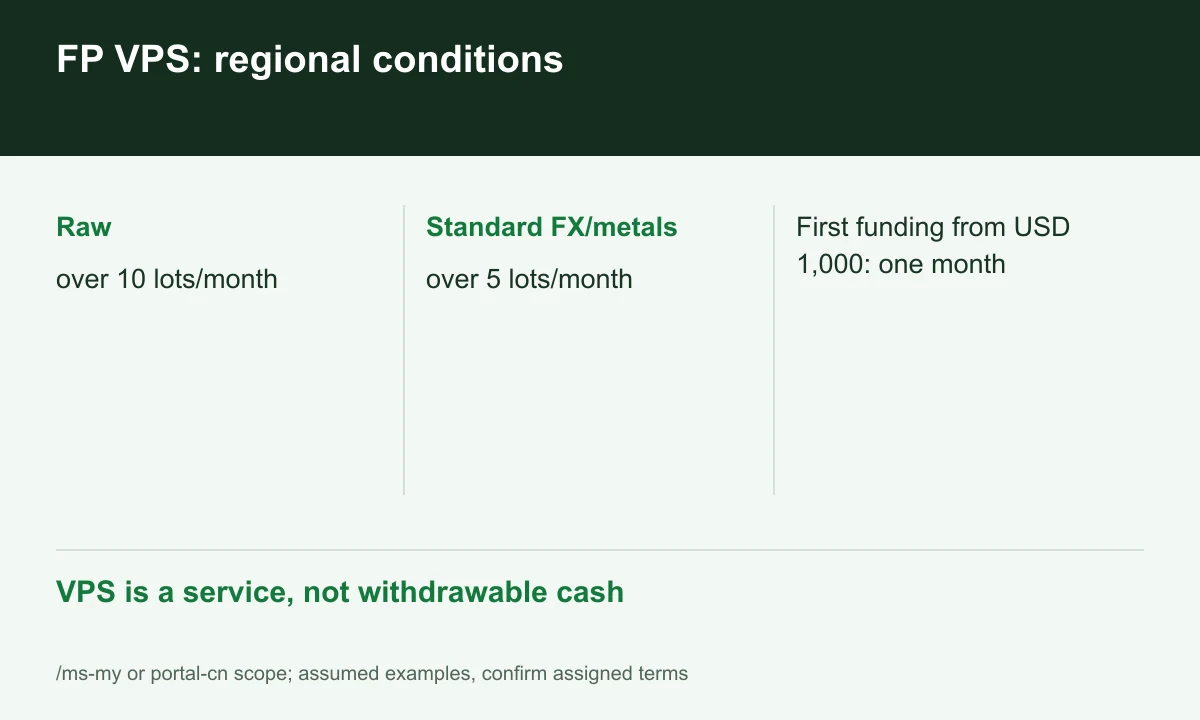
Guide
Explore FP Markets promotions, country limits and reward conditions from official publications before opening an account.
Read guide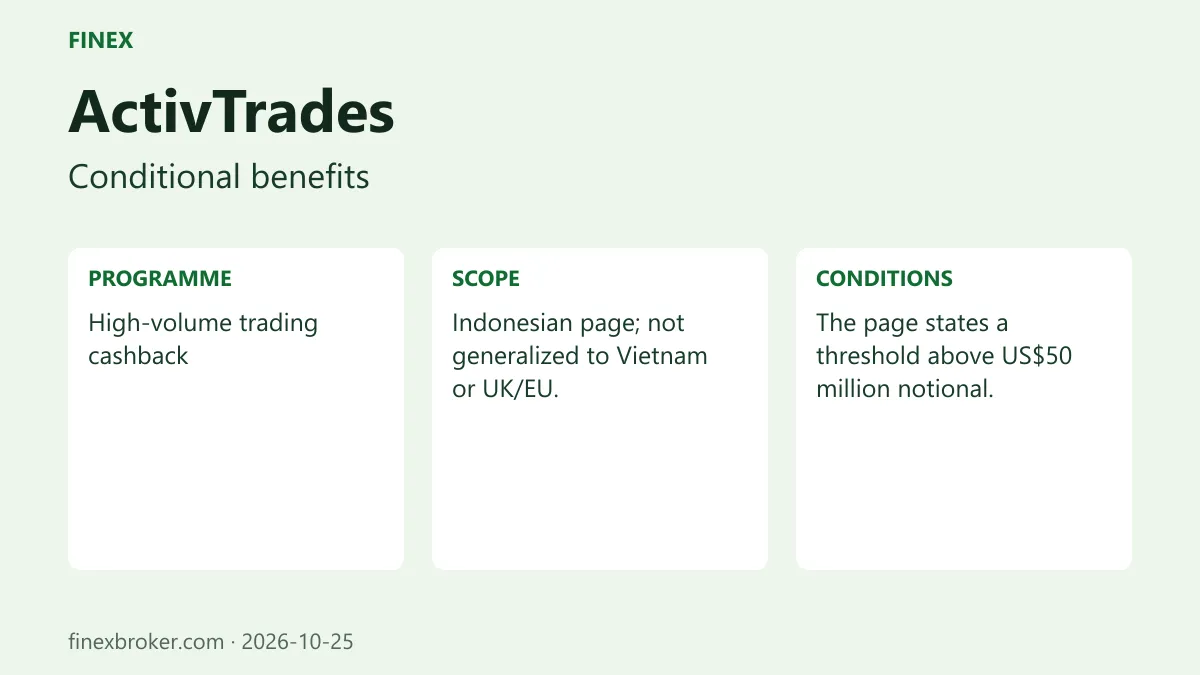
Guide
Explore ActivTrades promotions, country limits and reward conditions from official publications before opening an account.
Read guide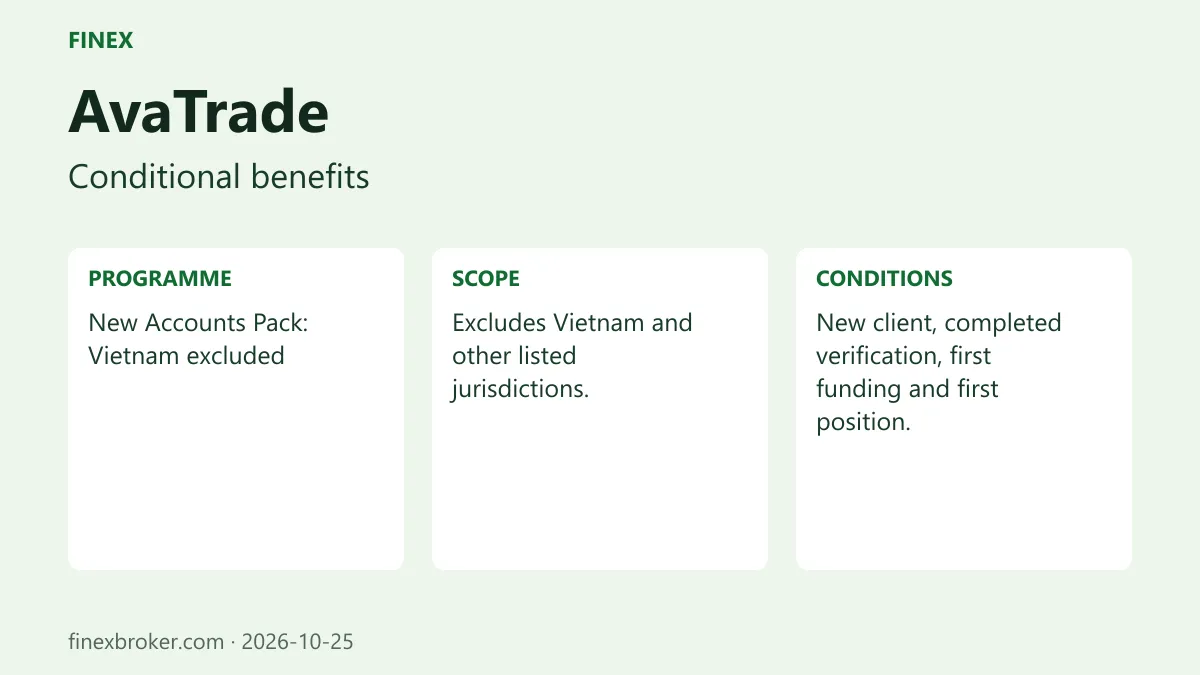
Guide
Explore AvaTrade promotions, country limits and reward conditions from official publications before opening an account.
Read guide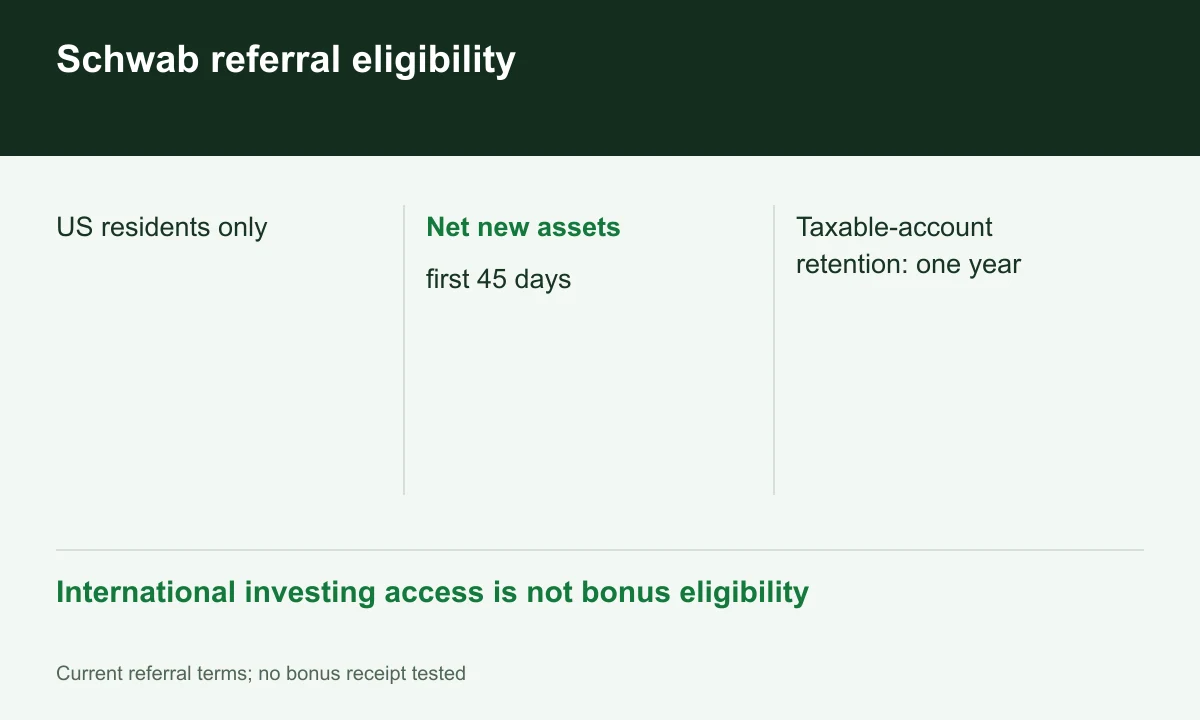
Guide
Explore Charles Schwab promotions, country limits and reward conditions from official publications before opening an account.
Read guide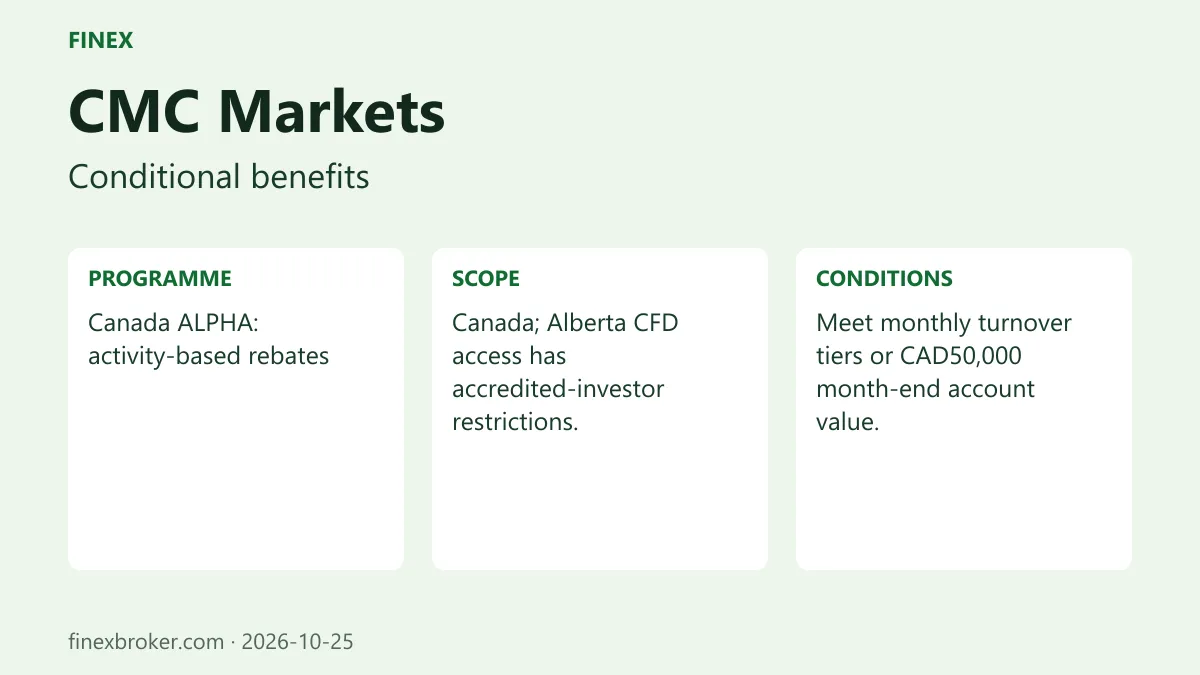
Guide
Explore CMC Markets promotions, country limits and reward conditions from official publications before opening an account.
Read guide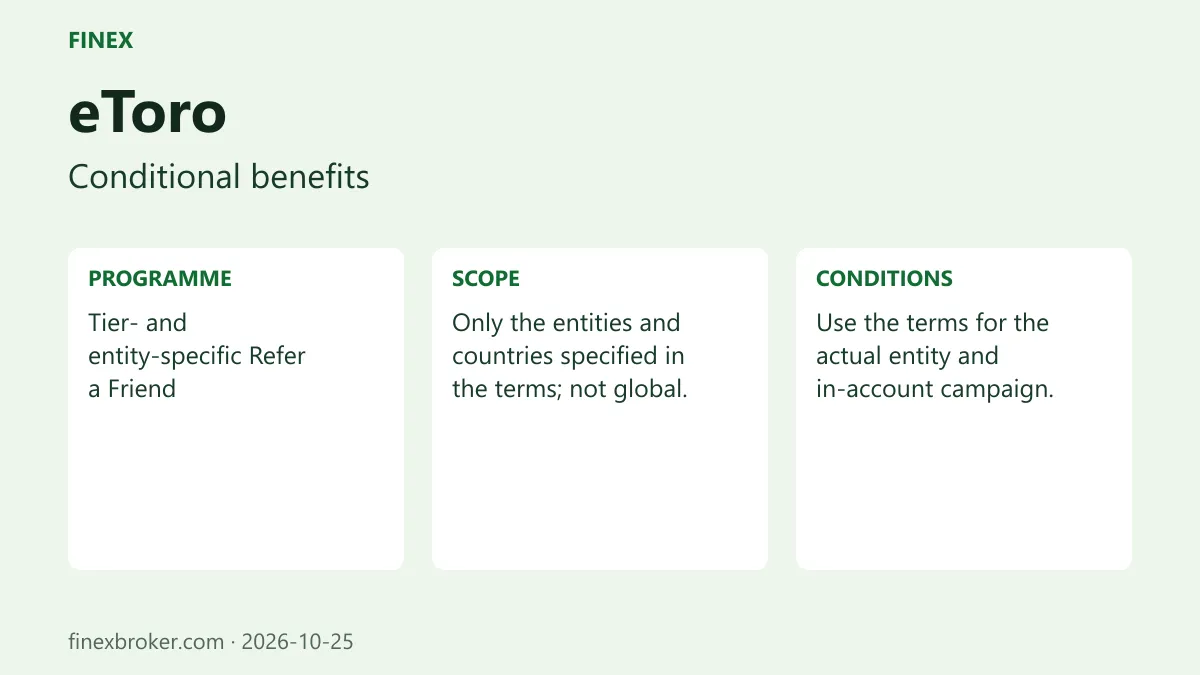
Guide
Explore eToro promotions, country limits and reward conditions from official publications before opening an account.
Read guide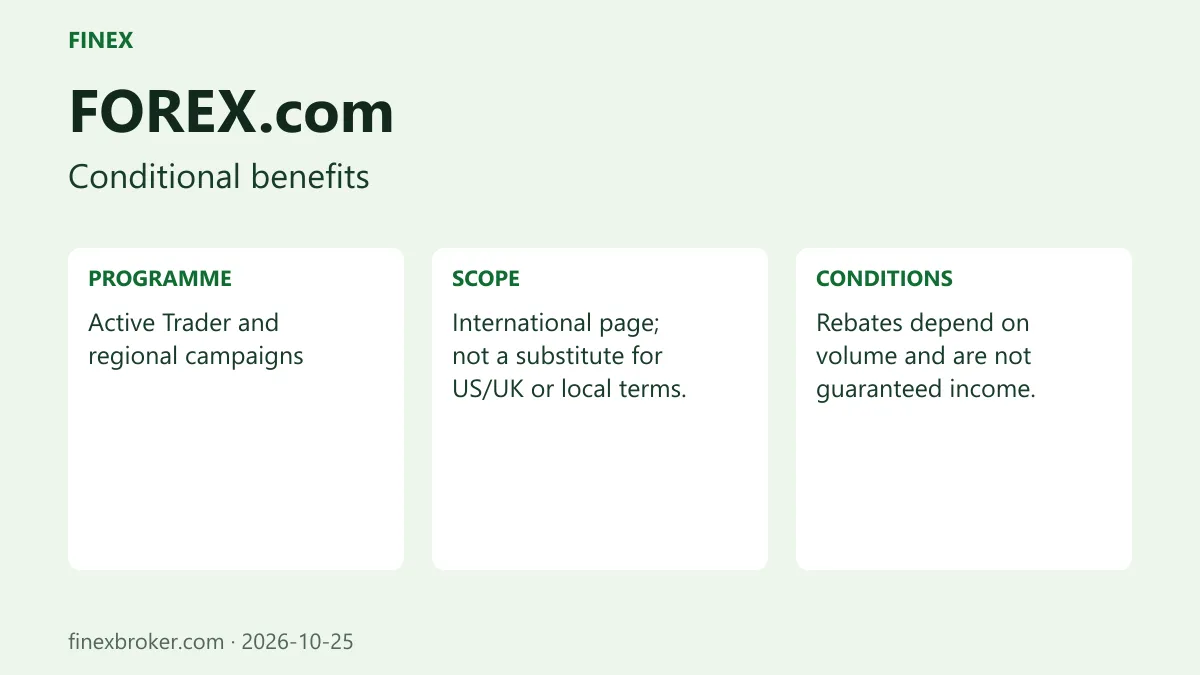
Guide
Explore FOREX.com promotions, country limits and reward conditions from official publications before opening an account.
Read guide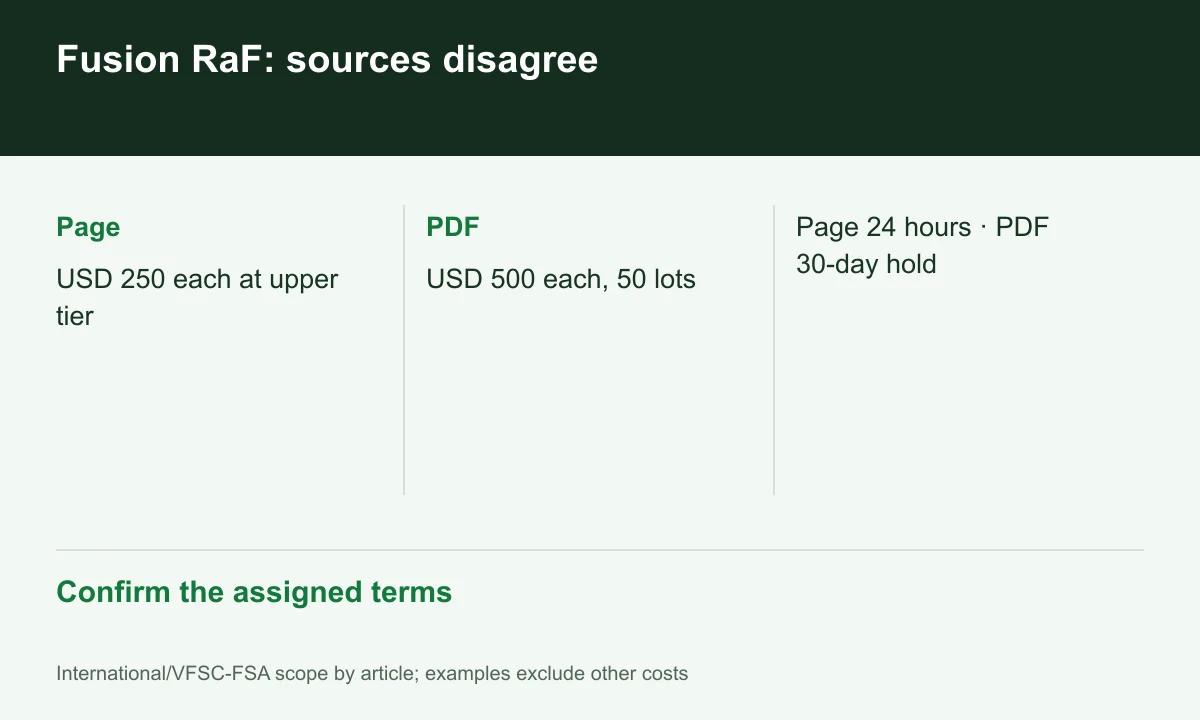
Guide
Explore Fusion Markets promotions, country limits and reward conditions from official publications before opening an account.
Read guide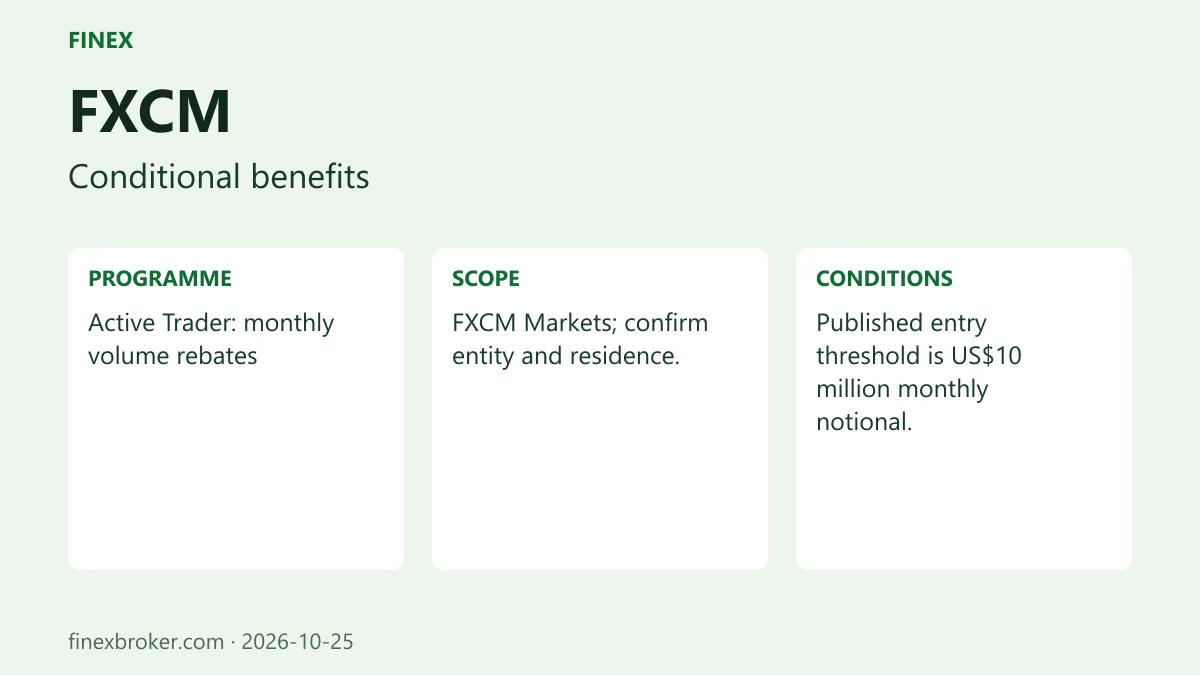
Guide
Explore FXCM promotions, country limits and reward conditions from official publications before opening an account.
Read guide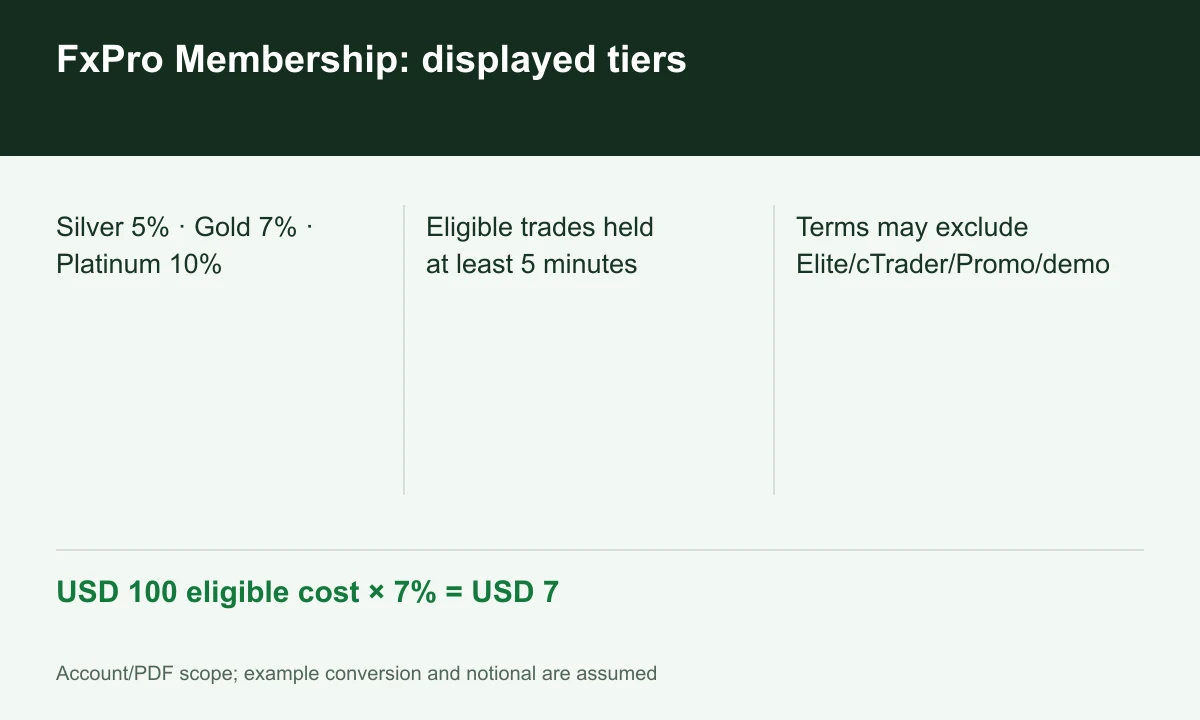
Guide
Explore FxPro promotions, country limits and reward conditions from official publications before opening an account.
Read guide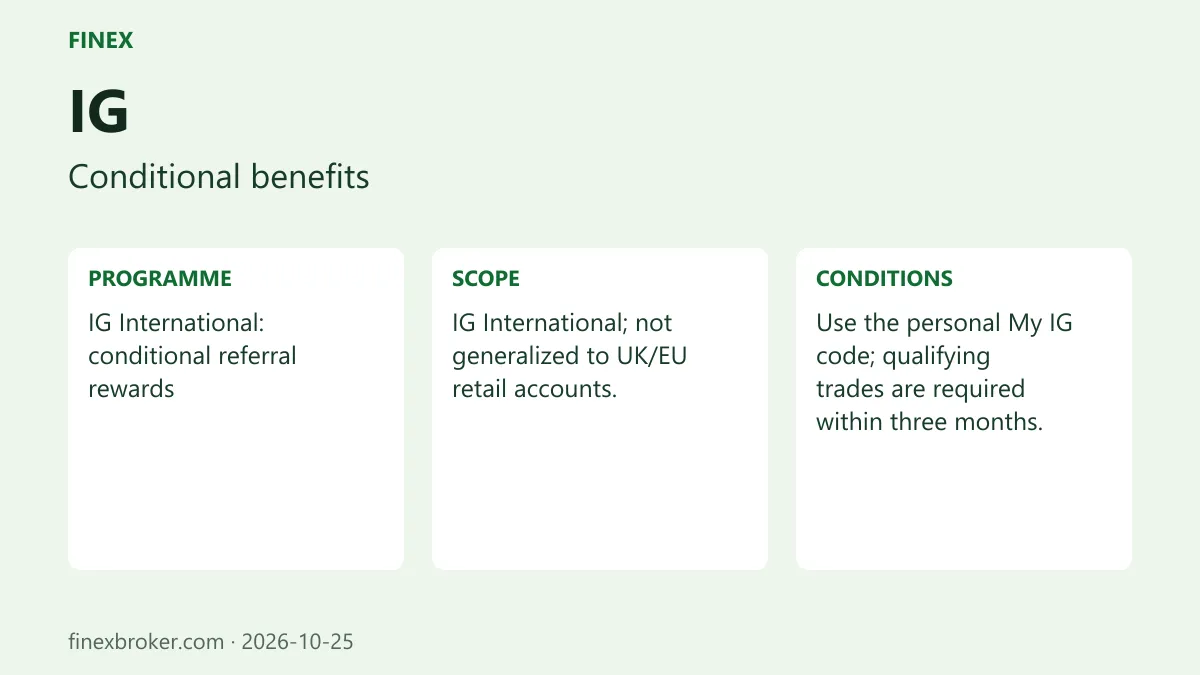
Guide
Explore IG promotions, country limits and reward conditions from official publications before opening an account.
Read guide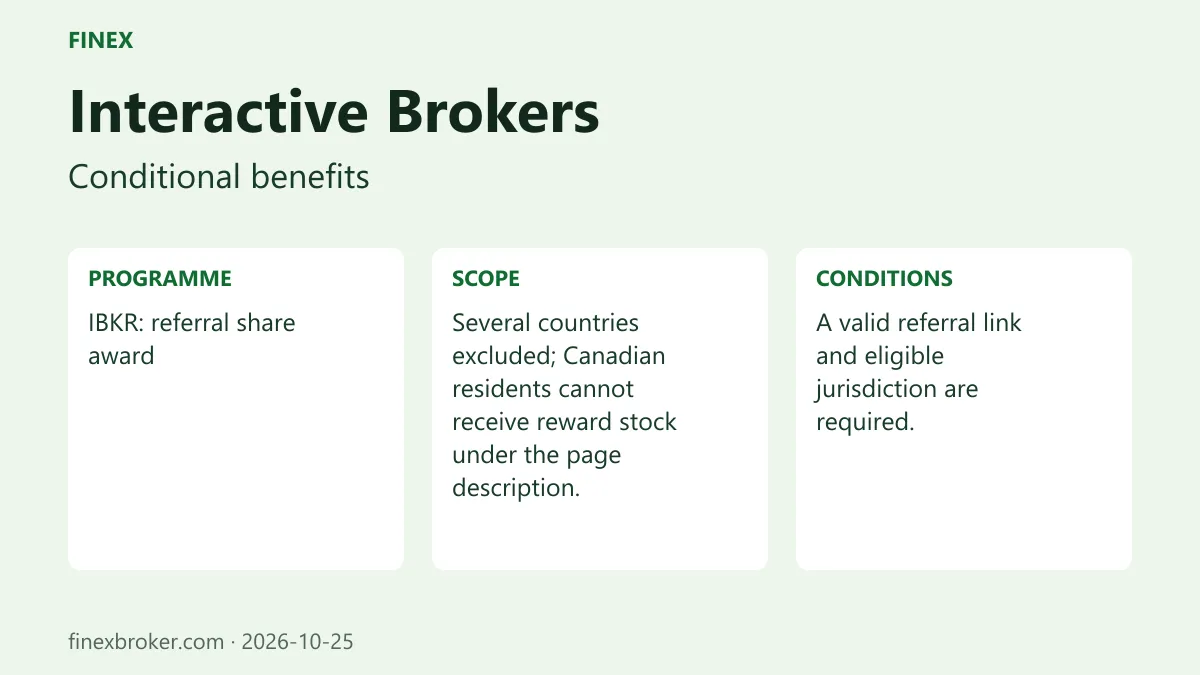
Guide
Explore Interactive Brokers promotions, country limits and reward conditions from official publications before opening an account.
Read guide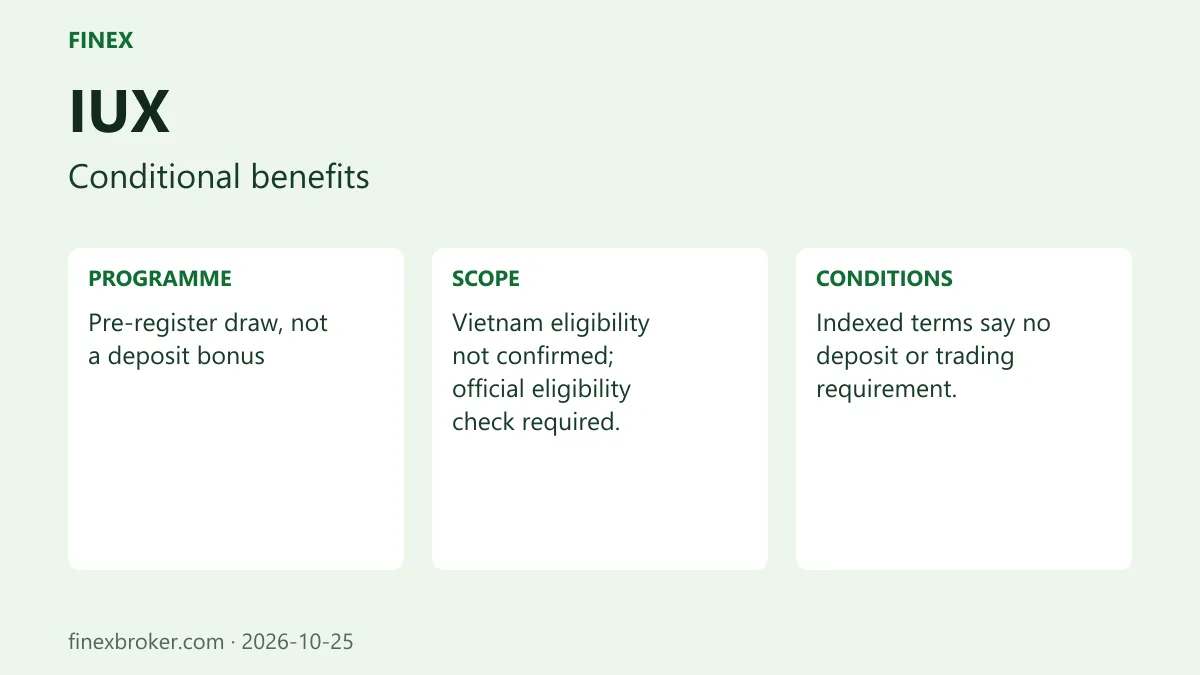
Guide
Explore IUX promotions, country limits and reward conditions from official publications before opening an account.
Read guide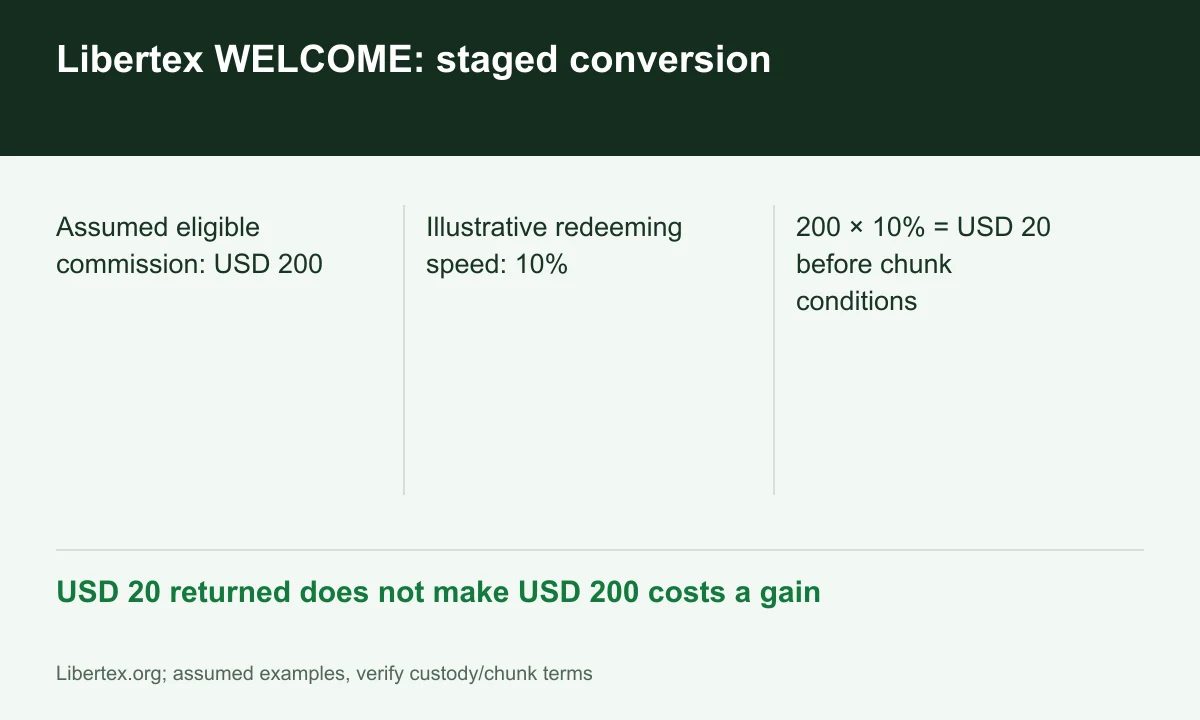
Guide
Explore Libertex promotions, country limits and reward conditions from official publications before opening an account.
Read guide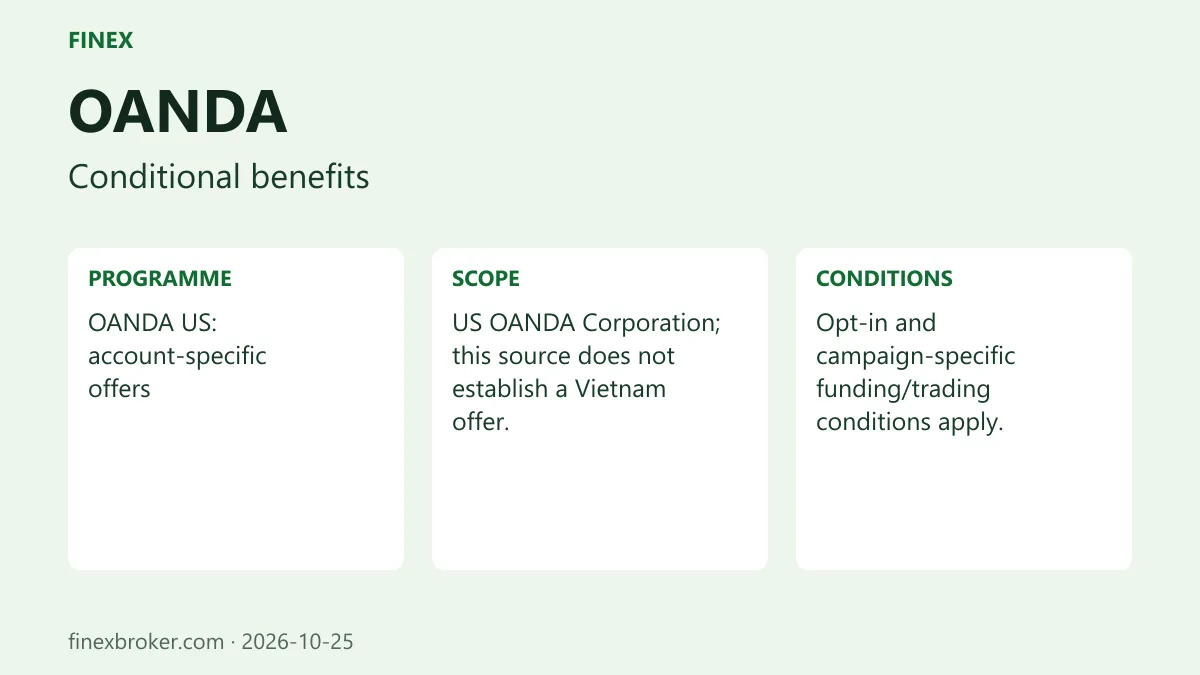
Guide
Explore OANDA promotions, country limits and reward conditions from official publications before opening an account.
Read guide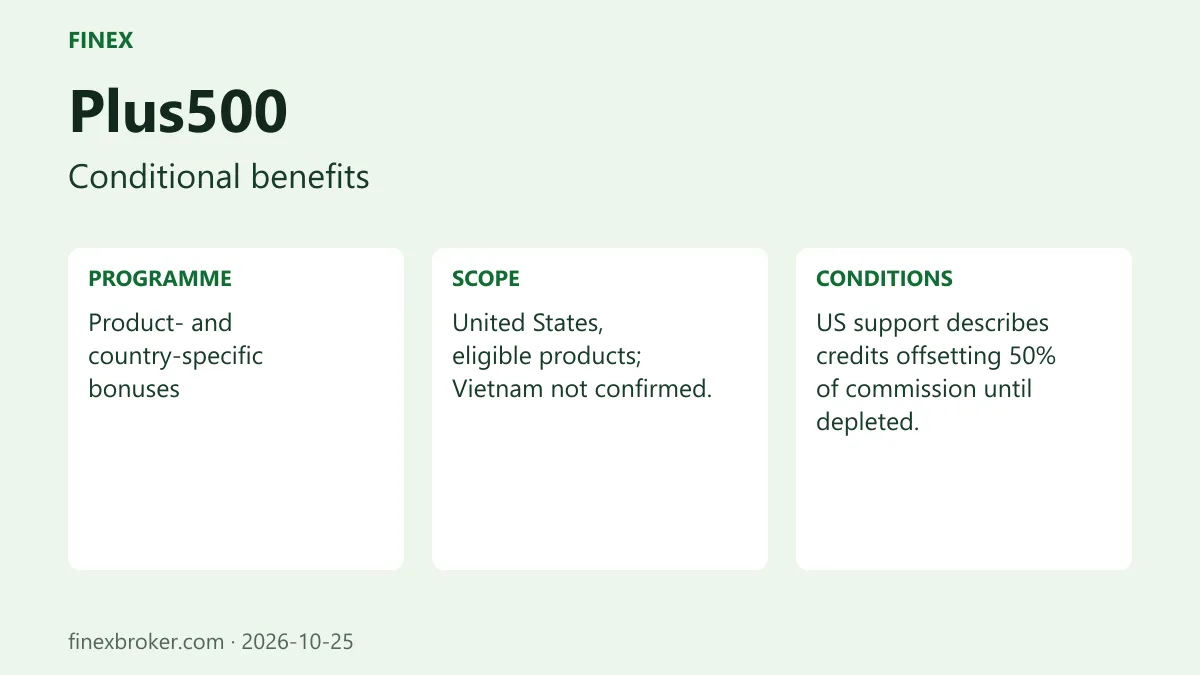
Guide
Explore Plus500 promotions, country limits and reward conditions from official publications before opening an account.
Read guide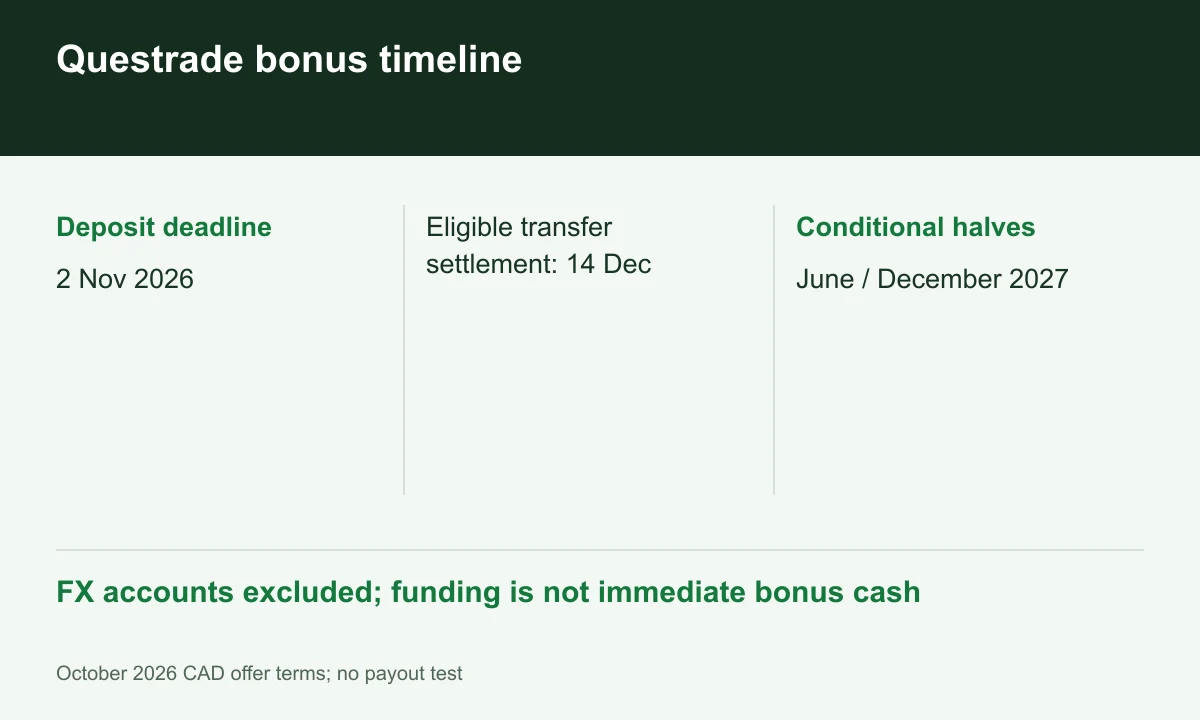
Guide
Explore Questrade promotions, country limits and reward conditions from official publications before opening an account.
Read guide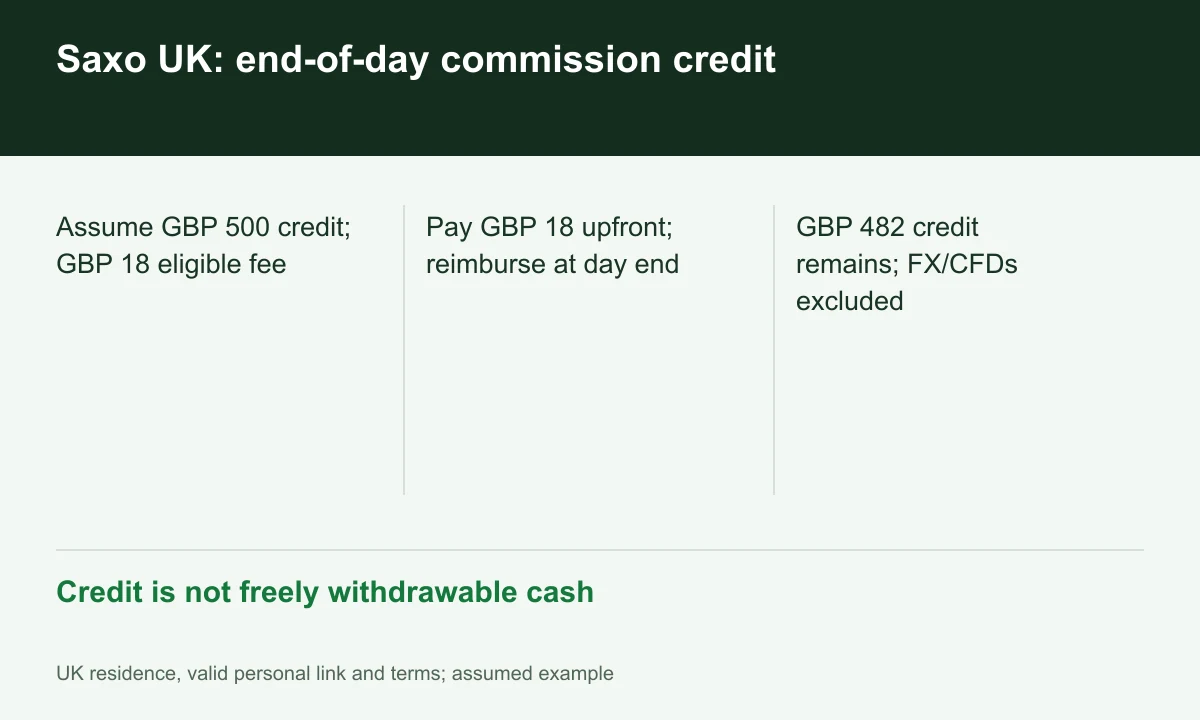
Guide
Explore Saxo promotions, country limits and reward conditions from official publications before opening an account.
Read guide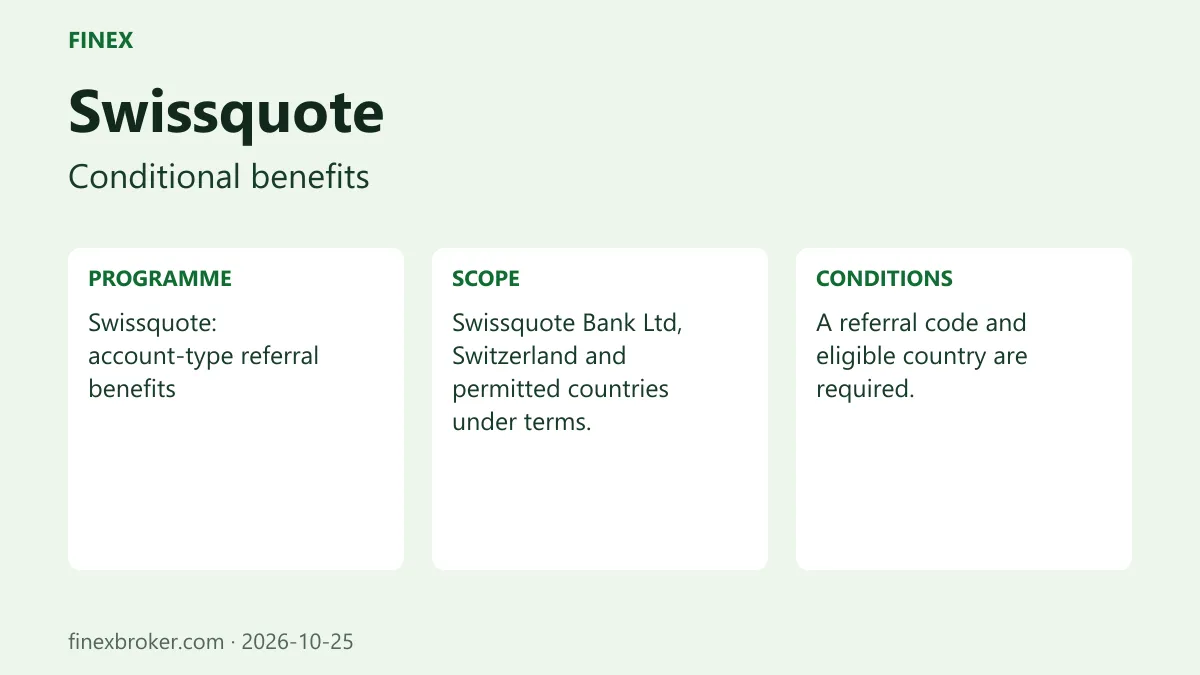
Guide
Explore Swissquote promotions, country limits and reward conditions from official publications before opening an account.
Read guide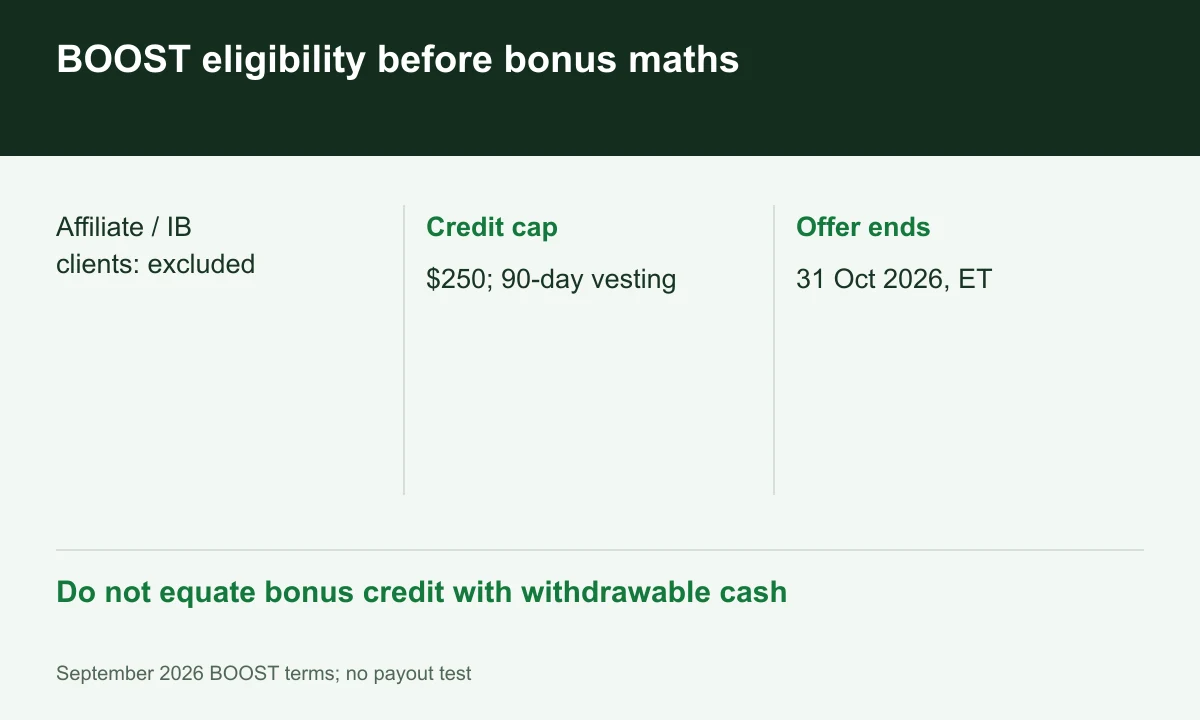
Guide
Explore tastyfx promotions, country limits and reward conditions from official publications before opening an account.
Read guide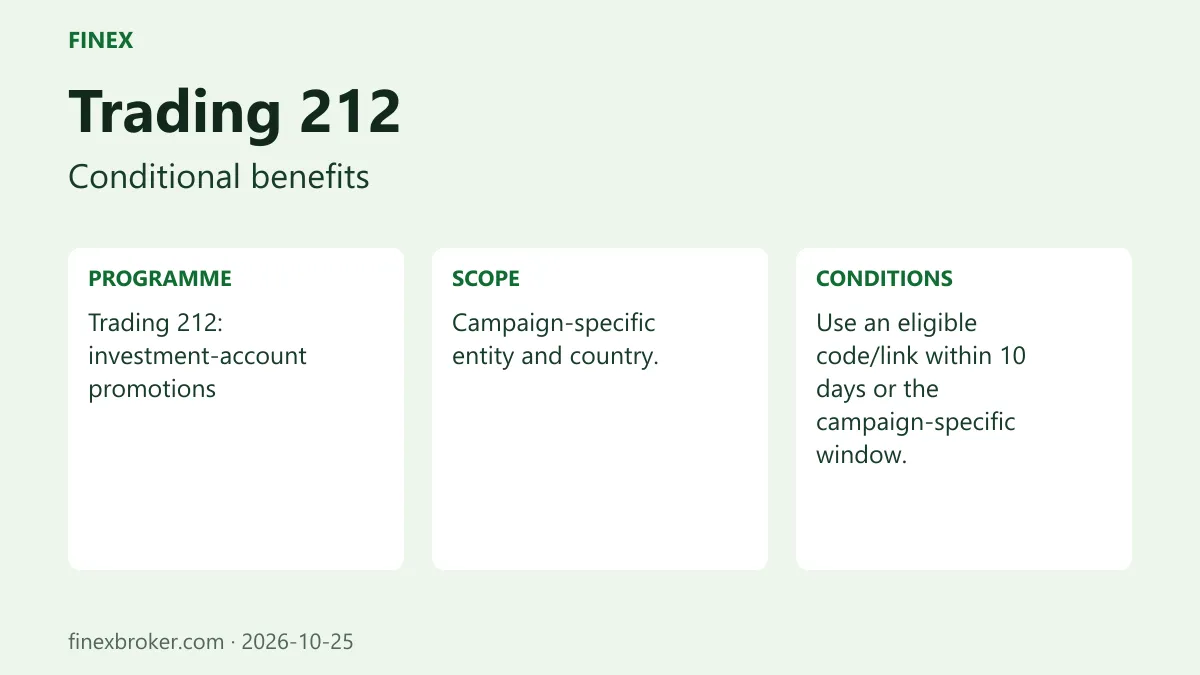
Guide
Explore Trading 212 promotions, country limits and reward conditions from official publications before opening an account.
Read guide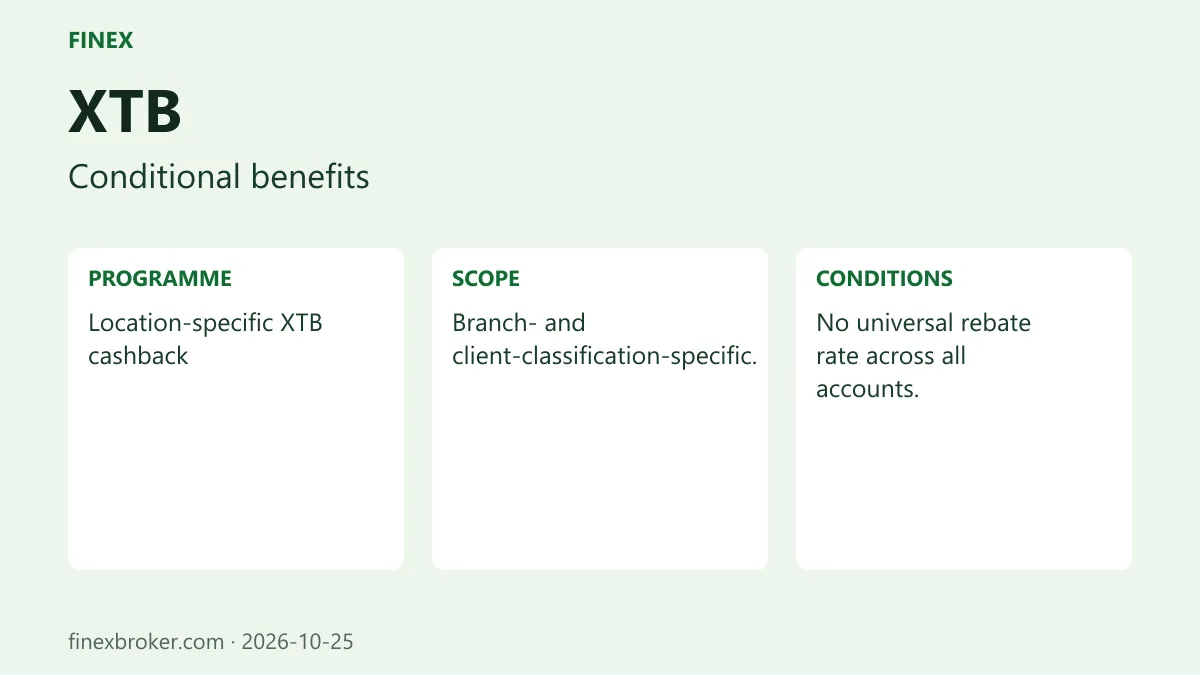
Guide
Explore XTB promotions, country limits and reward conditions from official publications before opening an account.
Read guide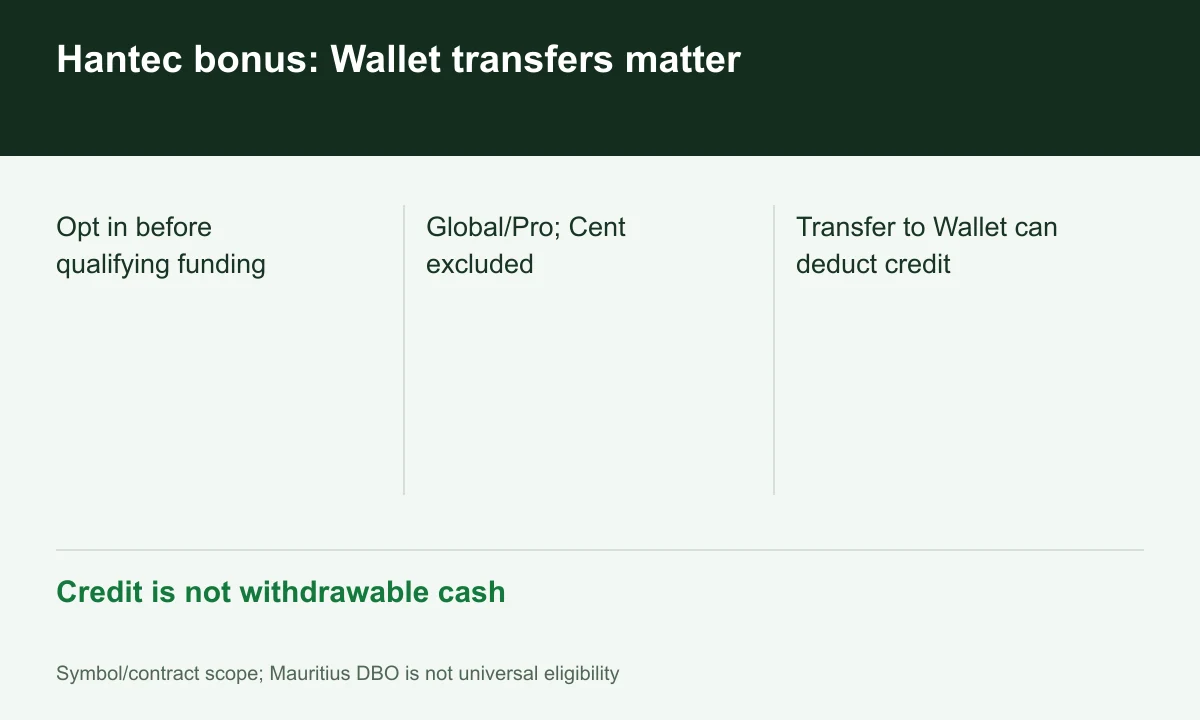
Guide
Explore Hantec Markets promotions, country limits and reward conditions from official publications before opening an account.
Read guide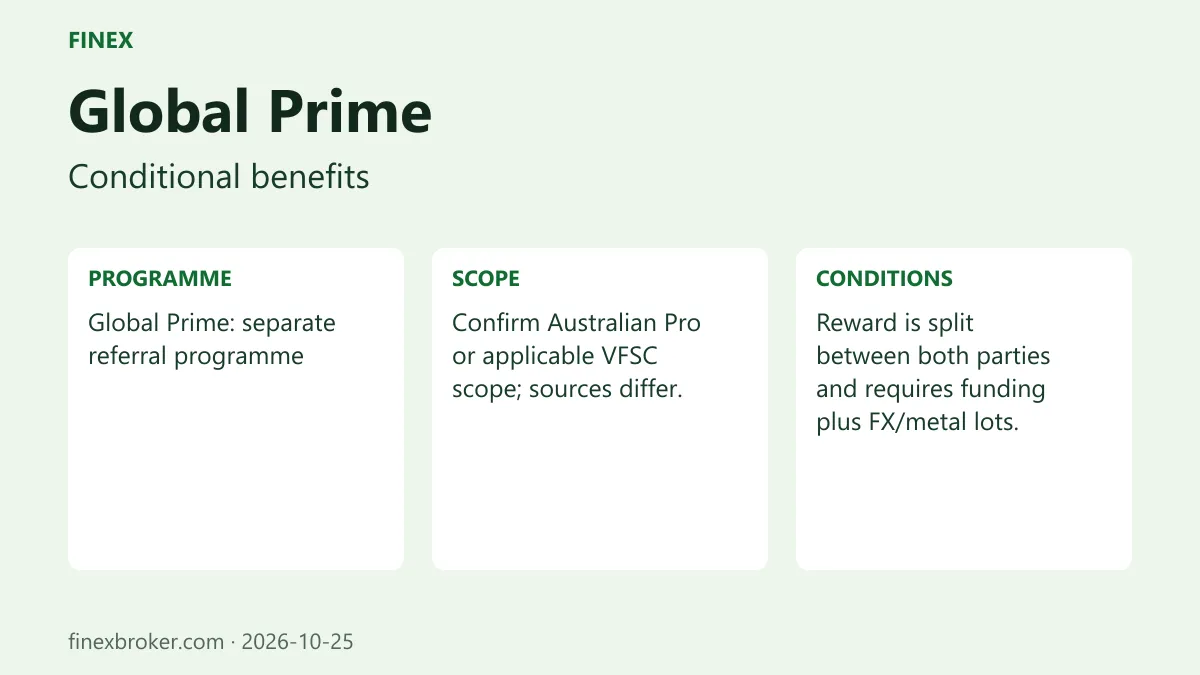
Guide
Explore Global Prime promotions, country limits and reward conditions from official publications before opening an account.
Read guide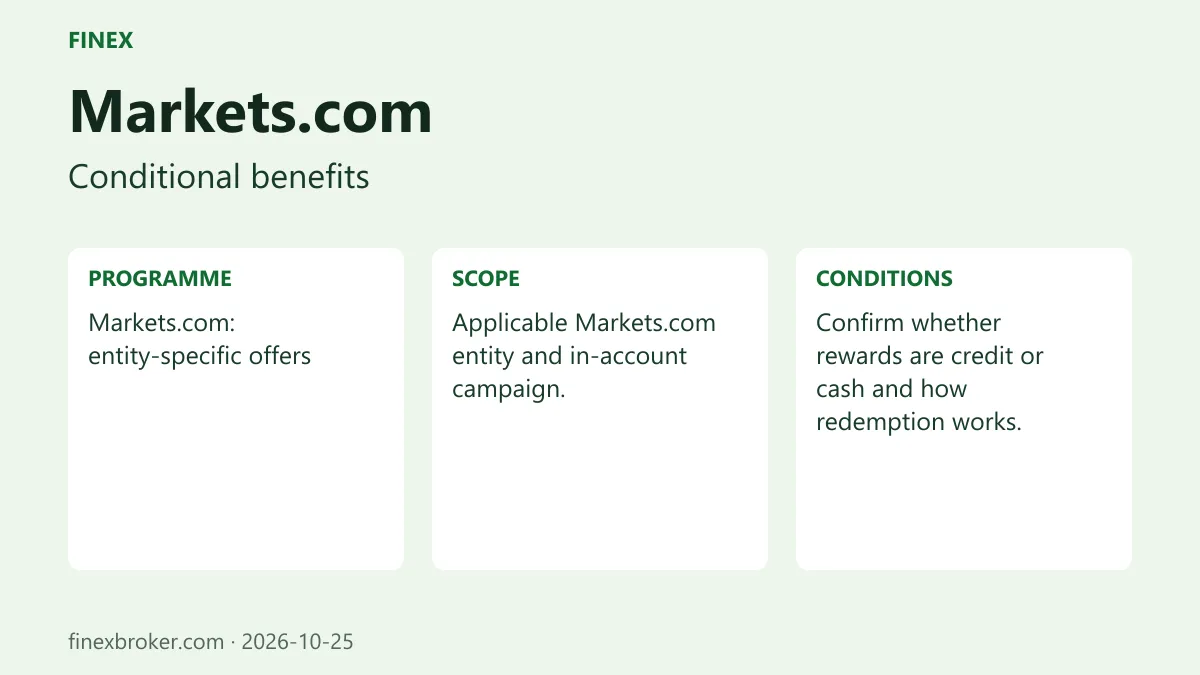
Guide
Explore Markets.com promotions, country limits and reward conditions from official publications before opening an account.
Read guide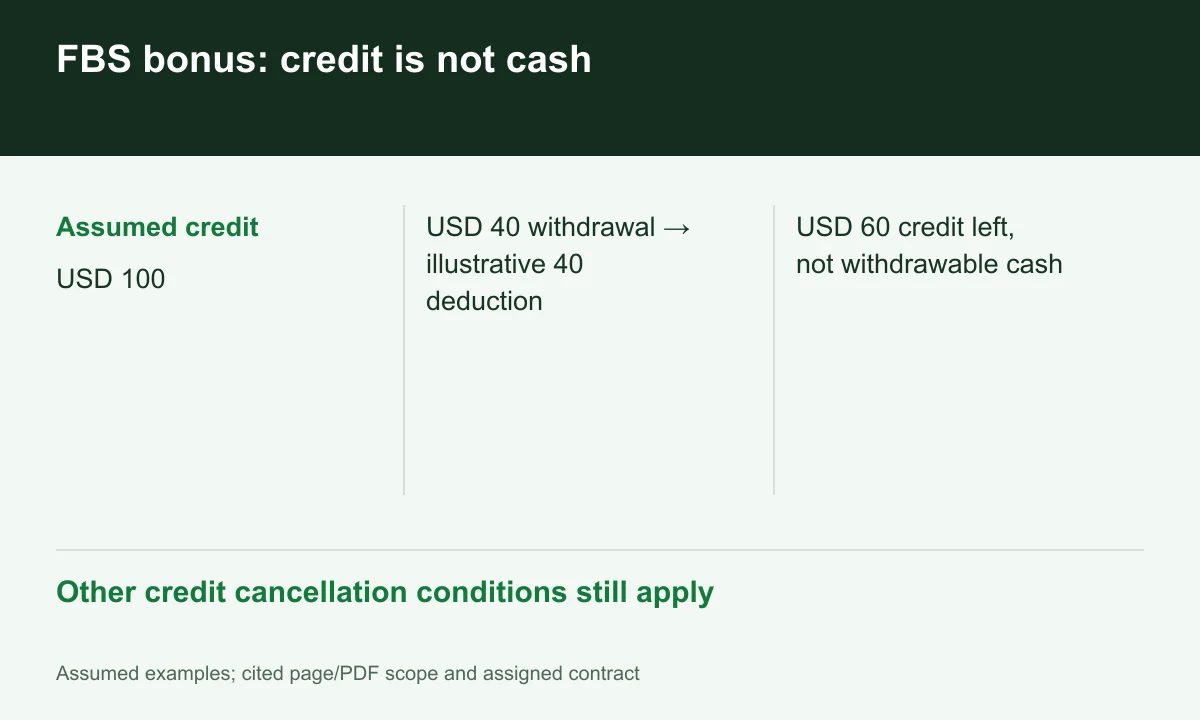
Guide
Explore FBS promotions, country limits and reward conditions from official publications before opening an account.
Read guide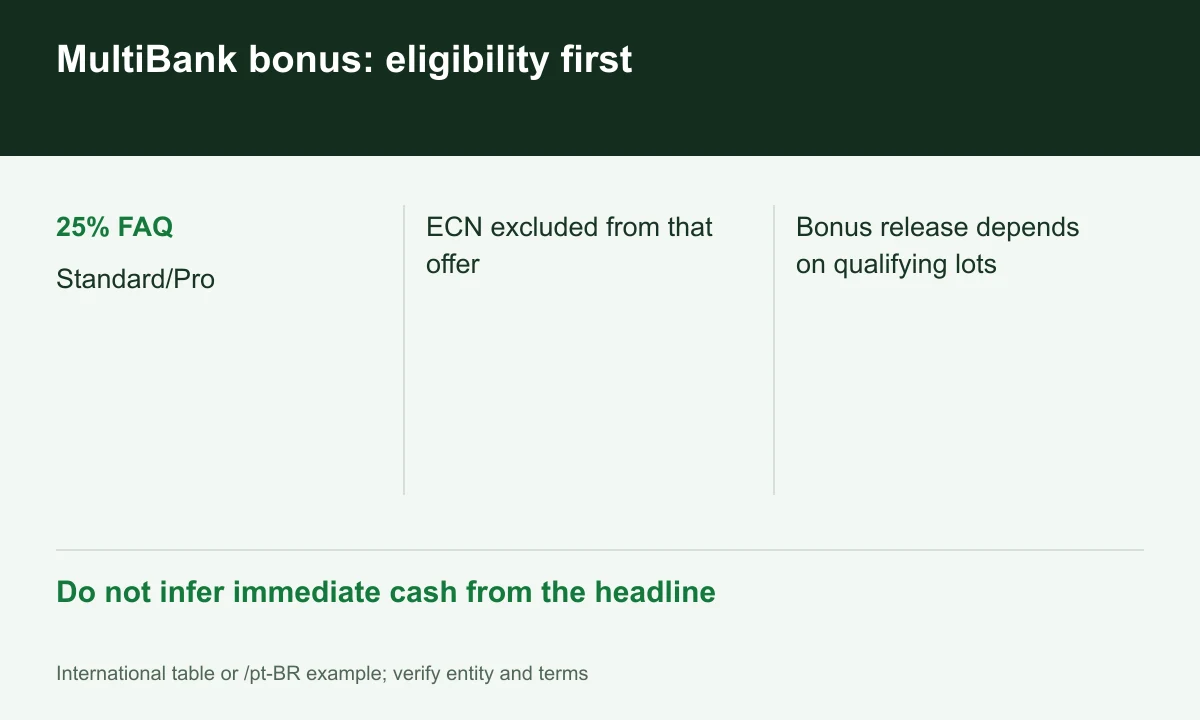
Guide
Explore MultiBank Group promotions, country limits and reward conditions from official publications before opening an account.
Read guide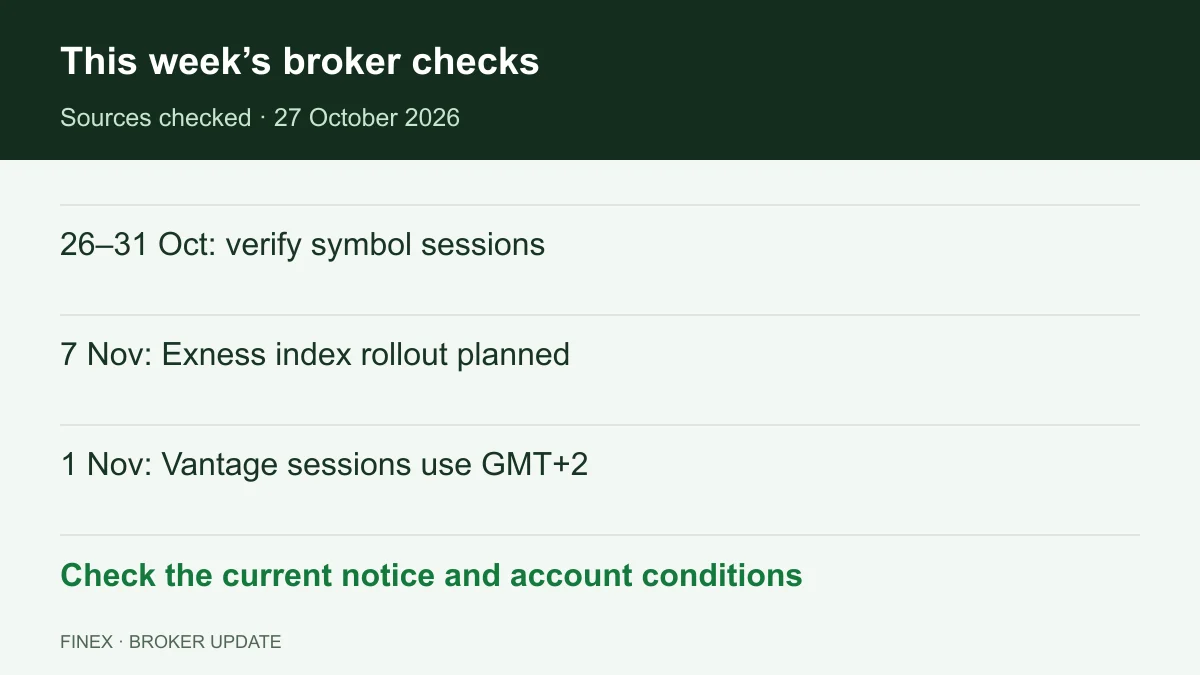
Provider guide
VT Markets DST hours, Exness’s planned 7 November index-margin rollout, and current XM/Exness bonus policies. What account holders should check.
Read guide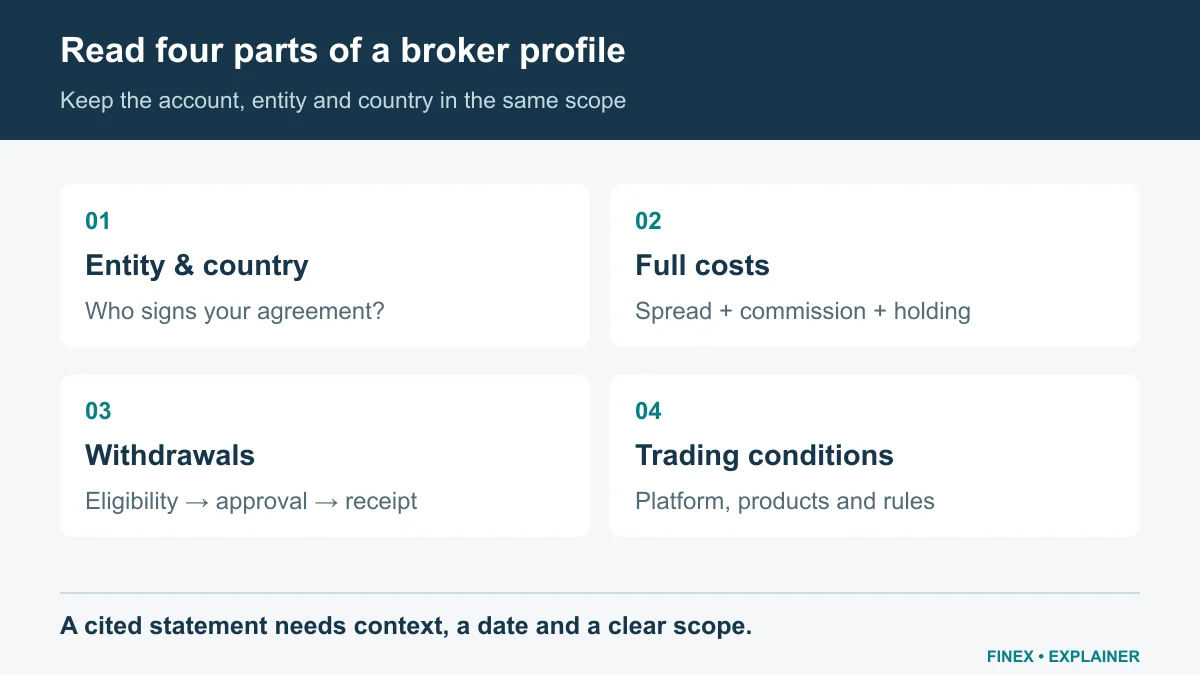
Comparison
A practical comparison of Raw account commissions, payment processing and legal-entity checks, with a worked hypothetical trade.
Read guide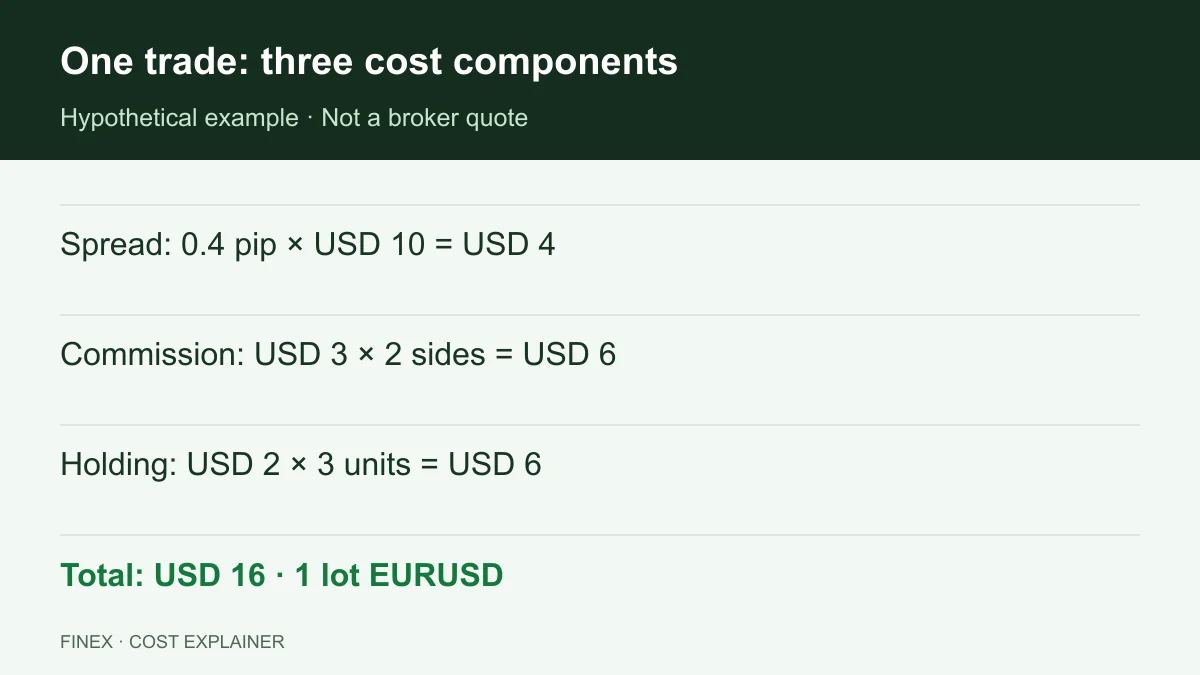
Guide
Calculate illustrative Forex costs, compare Standard and Raw pricing, and understand commission units, overnight swaps and gold contract sizes.
Read guide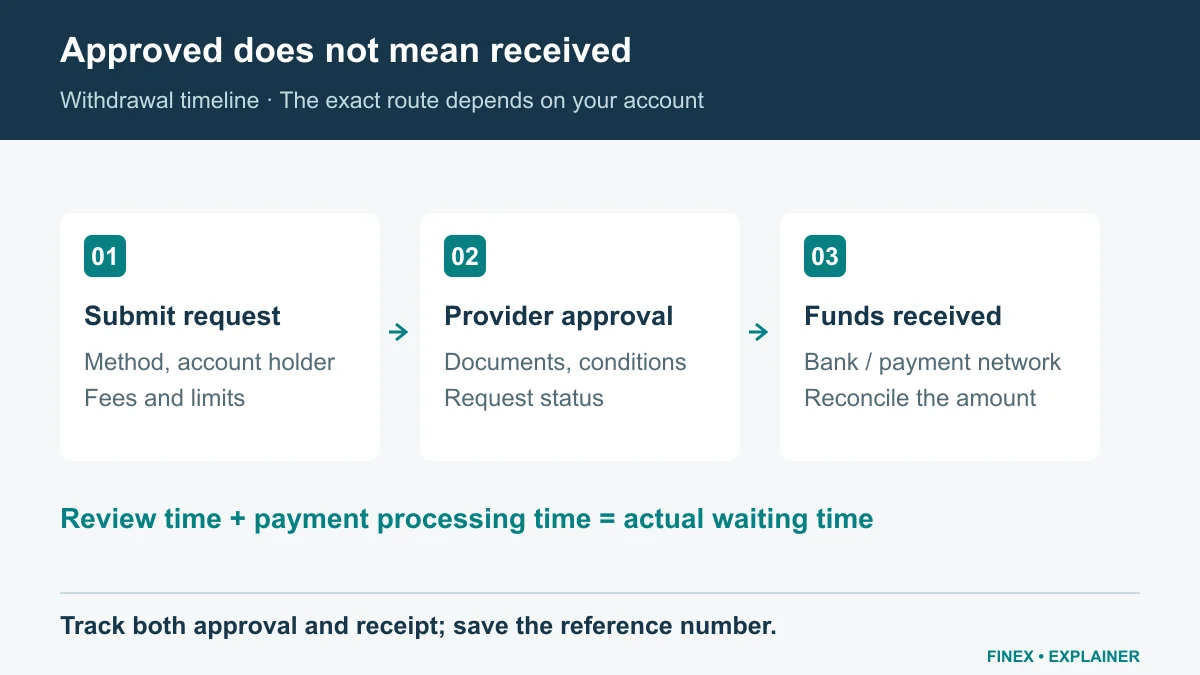
Withdrawals
A practical checklist for choosing payment routes, verifying ownership and tracking a delayed broker withdrawal.
Read guide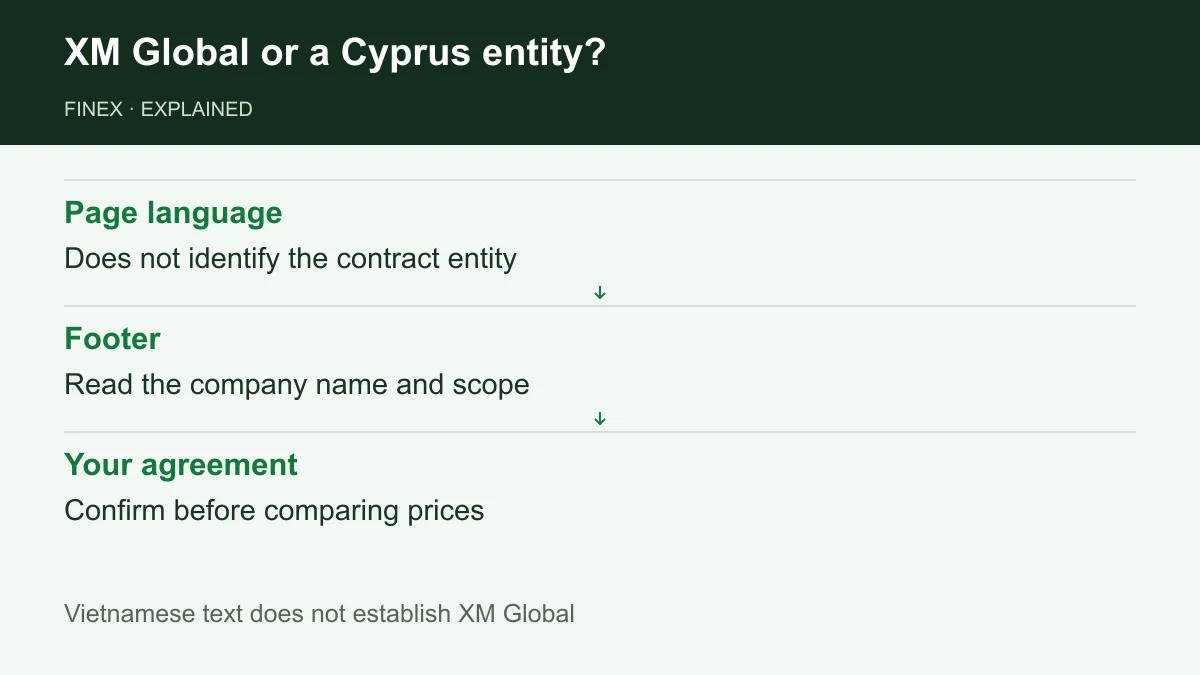
Comparison
Why an XM language page is not enough to identify your account, and how to avoid mixing Global and EEA account terms.
Read guide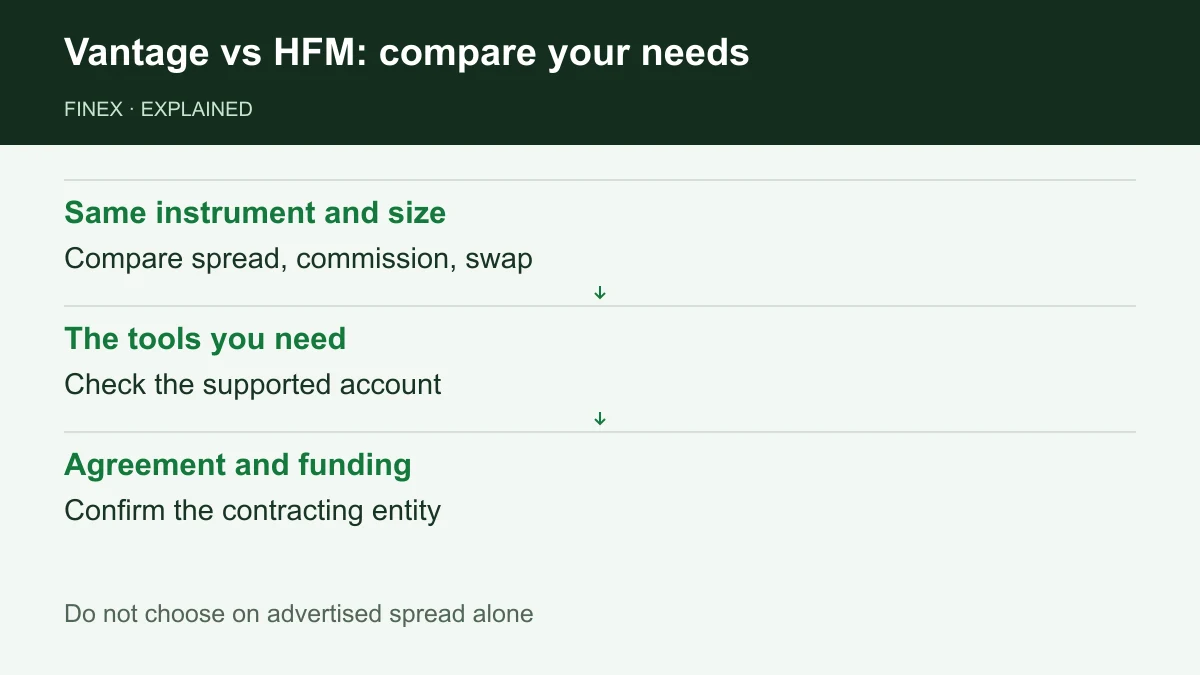
Comparison
A scoped comparison of RAW and Zero charges, legal-entity uncertainty and withdrawal conditions, with practical decision steps.
Read guideGuide
A beginner's decision process covering residence, legal entity, cost, demo practice and payment routes before funding.
Read guide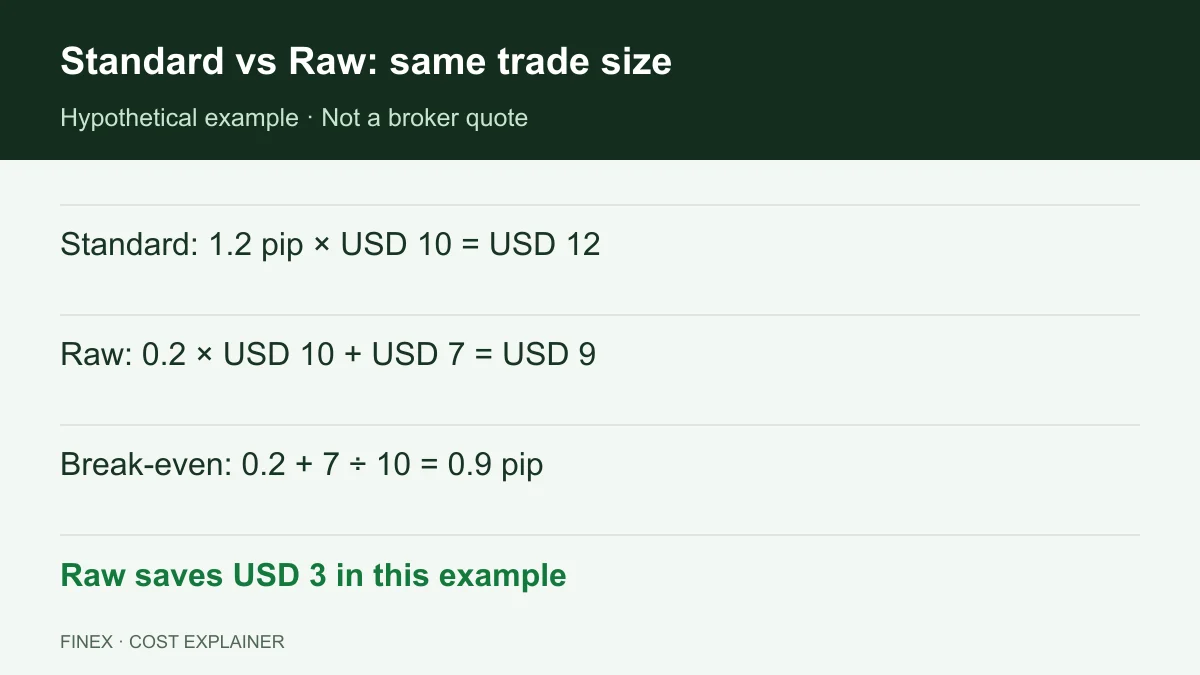
Comparison
A hypothetical calculation helps compare spread-only and commission-based pricing without assuming one account is always cheaper.
Read guide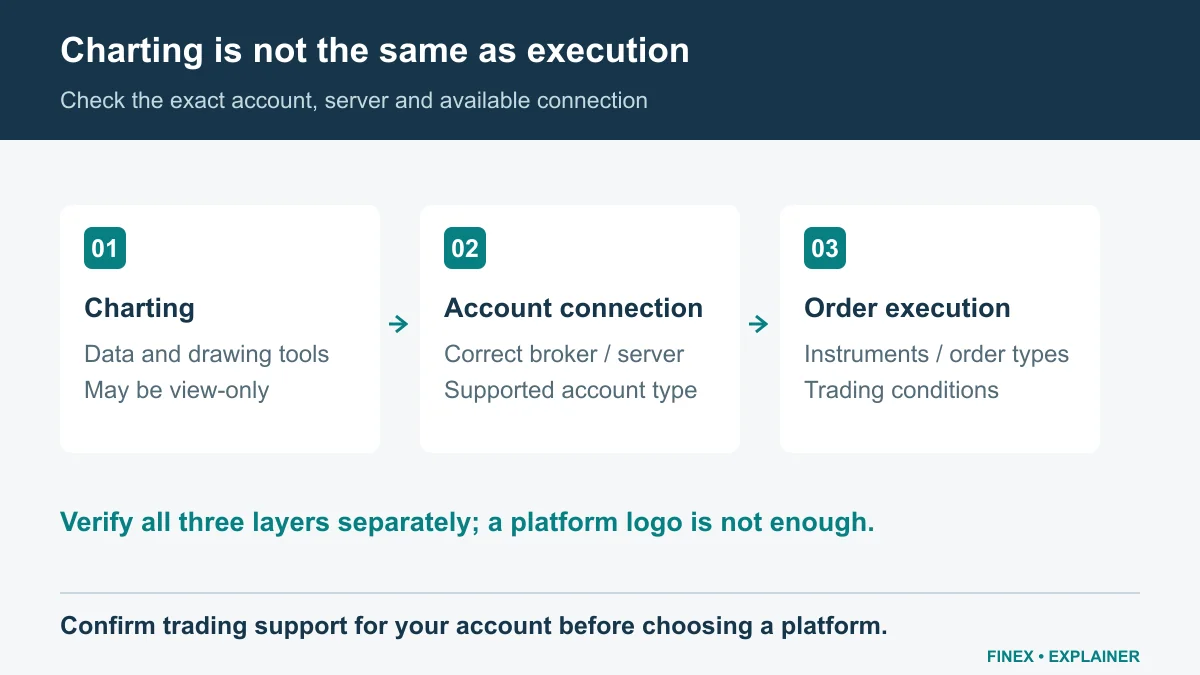
Guide
A practical platform selection checklist that distinguishes charts, execution access and account-specific availability.
Read guideWithdrawals
Identify return-to-source rules, fee ownership, verification and exceptions using a structured policy-reading method.
Read guideGuide
Compare the reason for switching, contracts, payment logistics and existing affiliate eligibility before making a commitment.
Read guide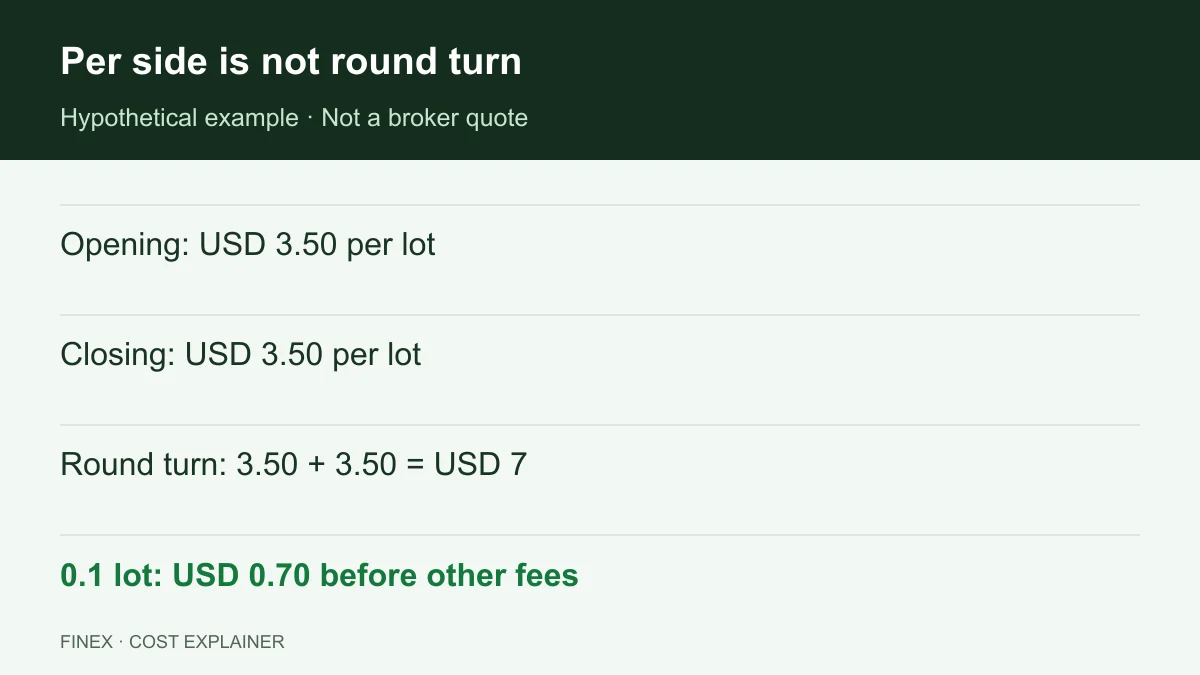
Provider guide
Convert commission quotes to the same basis before comparing accounts: per side, round turn, lot size, turnover and account currency.
Read guide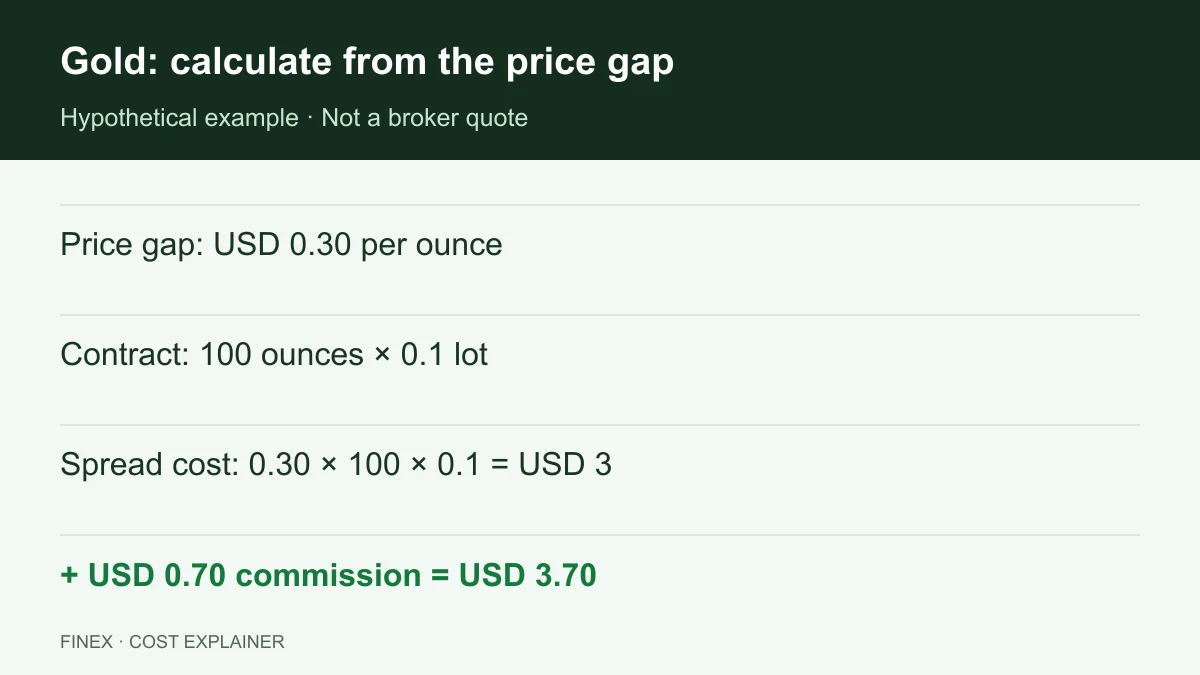
Provider guide
Calculate gold CFD spread costs from the price gap and contract size, add commission and swap, and avoid confusing pips with points.
Read guide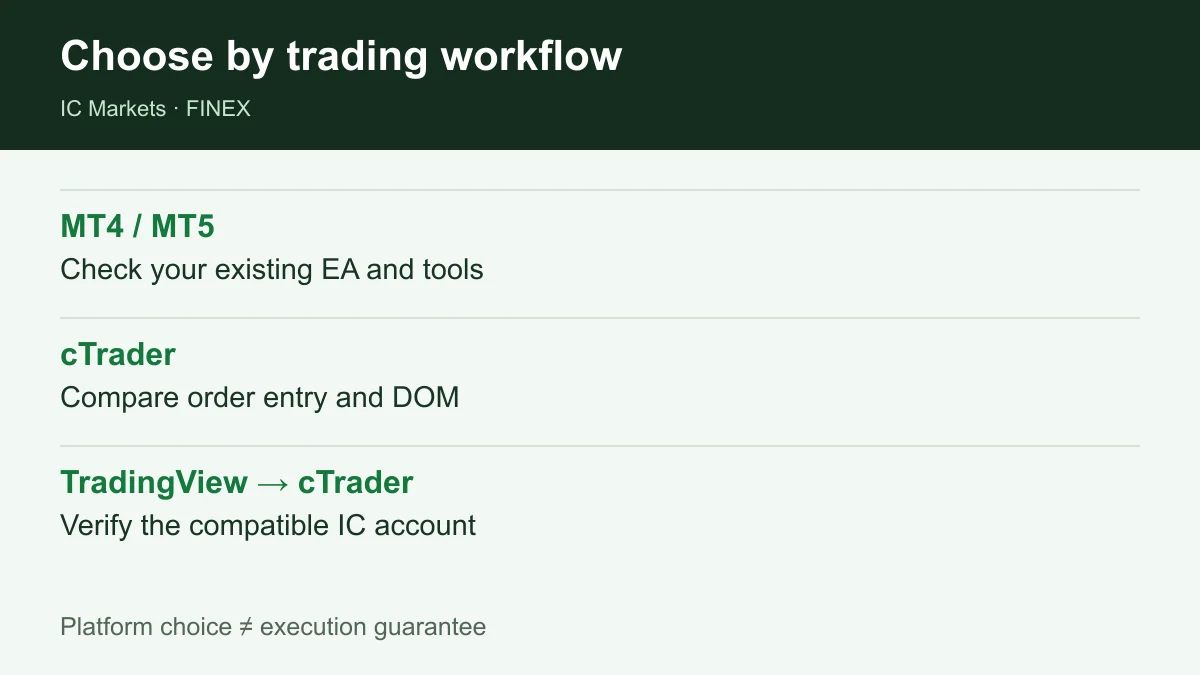
Guide
Choose an IC Markets platform by workflow, account compatibility and automation needs. Understand the cTrader connection before using TradingView.
Read guide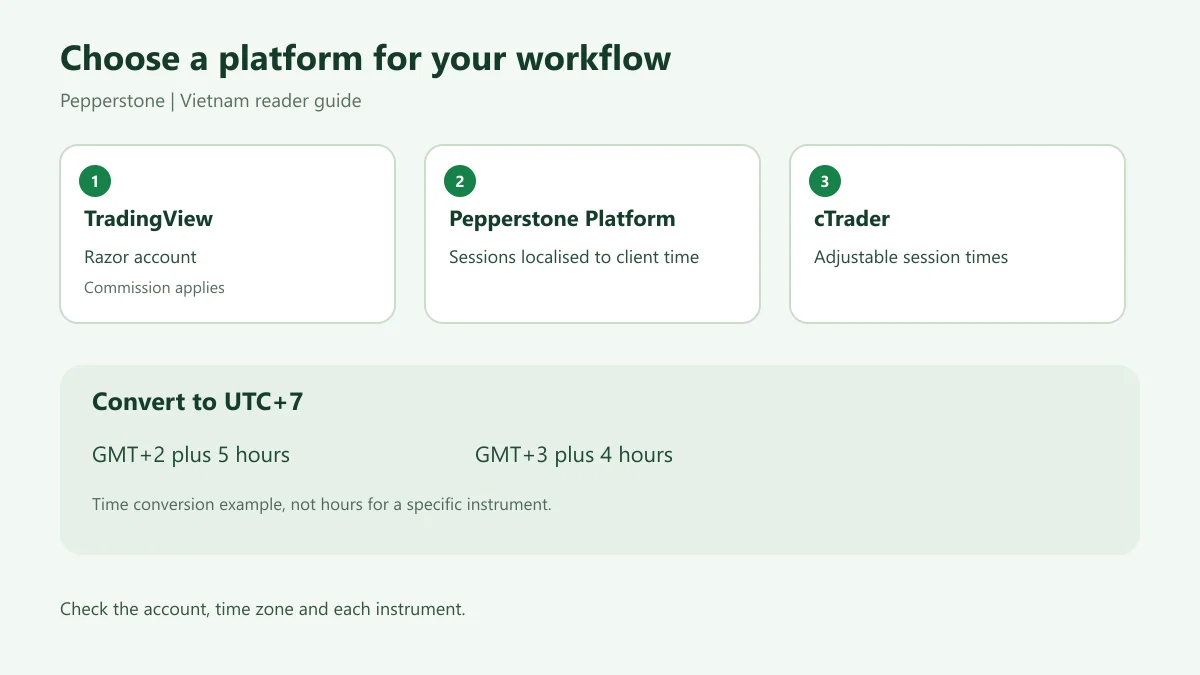
Provider guide
Compare Razor eligibility, your existing tools and local session-time displays before choosing a Pepperstone platform.
Read guide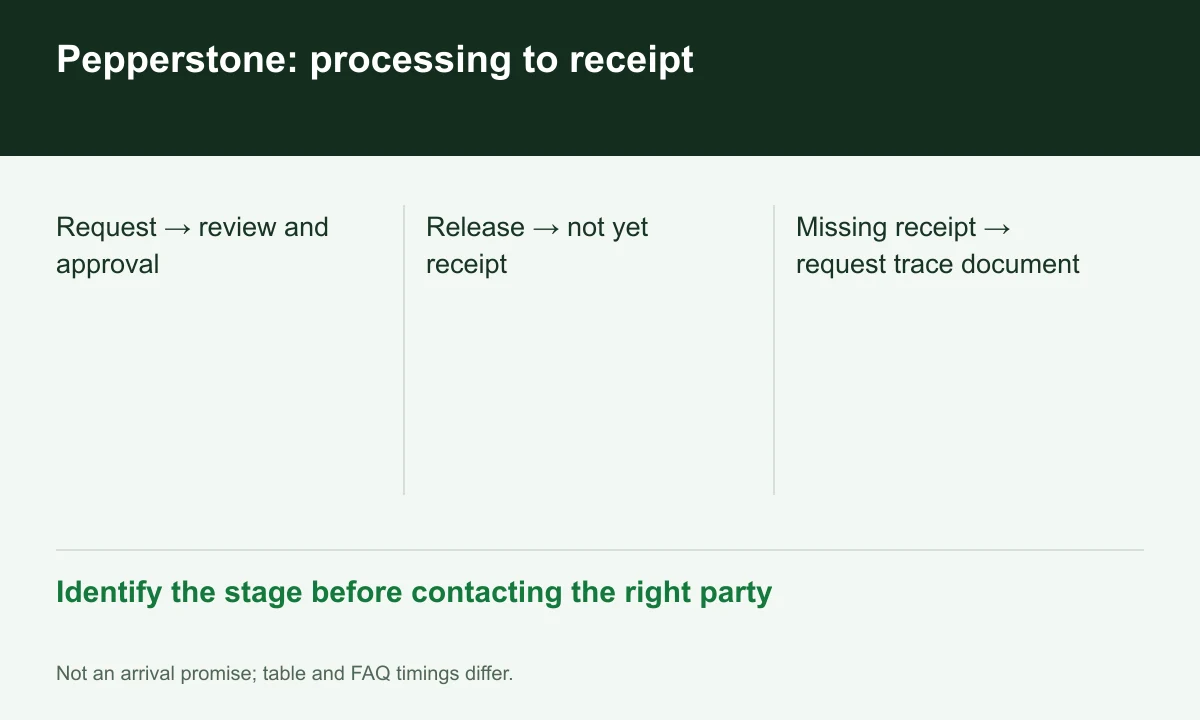
Provider guide
Read processing times, international bank fees and inconsistent source wording.
Read guide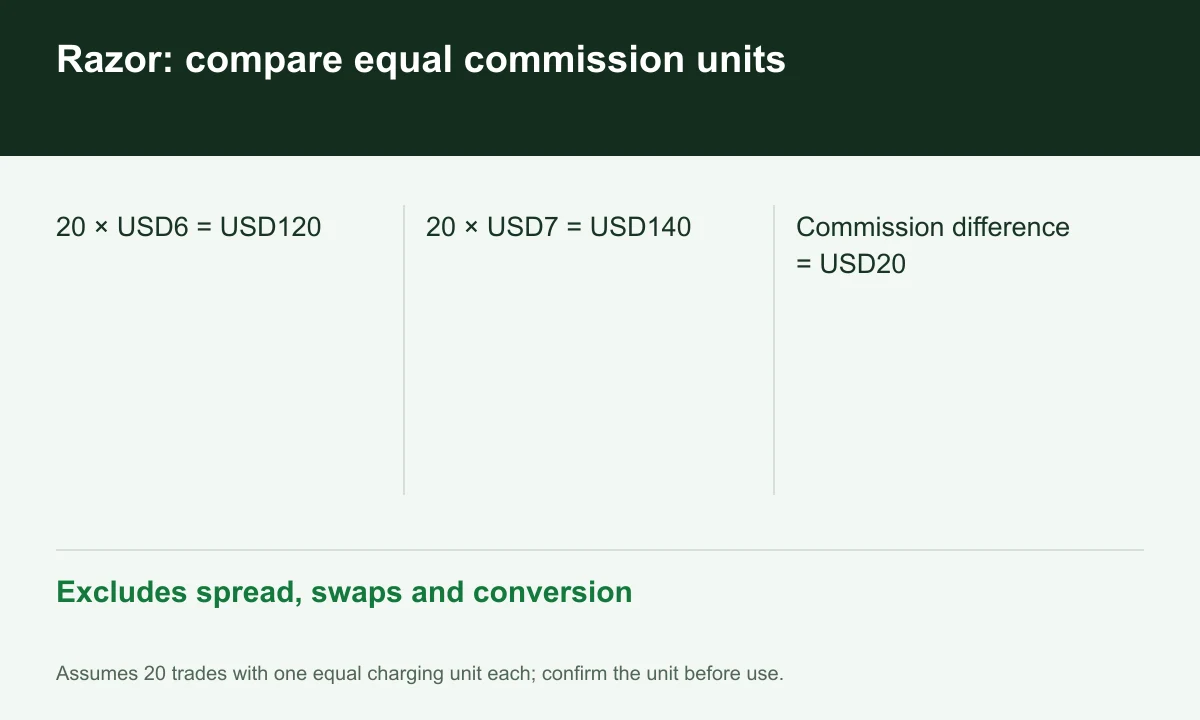
Provider guide
Calculate the cTrader–TradingView commission difference at an illustrative size.
Read guide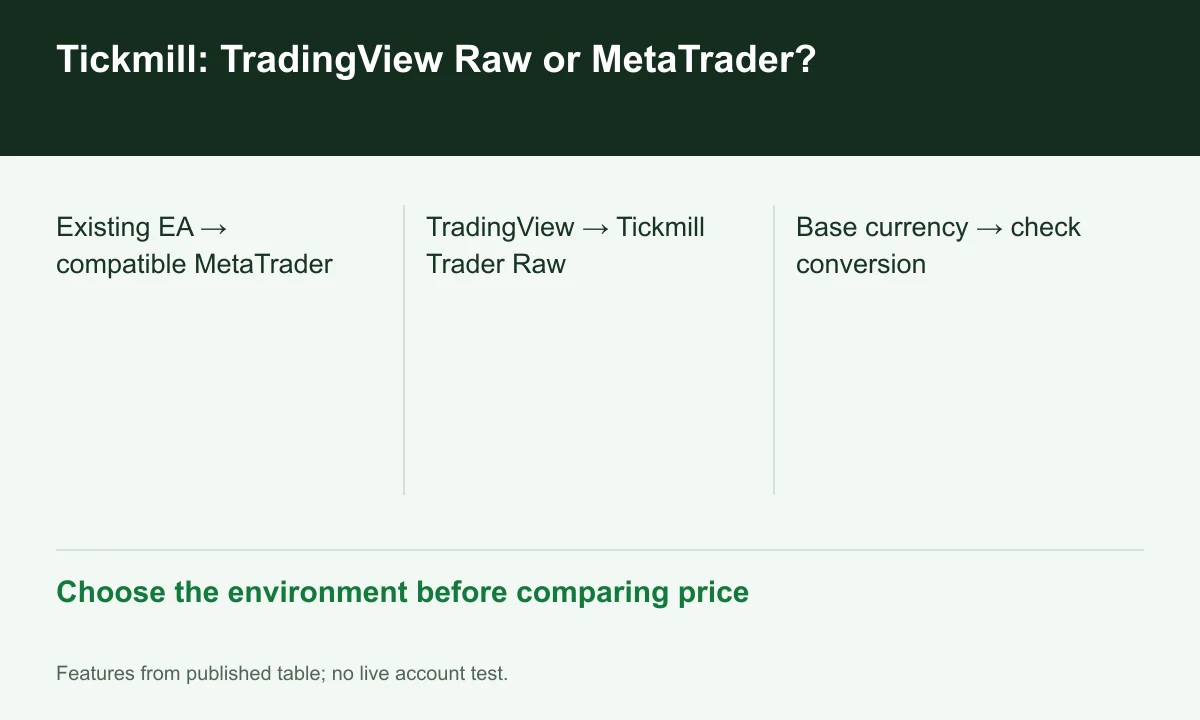
Provider guide
Separate connections, account currency, EAs and commission schedules.
Read guide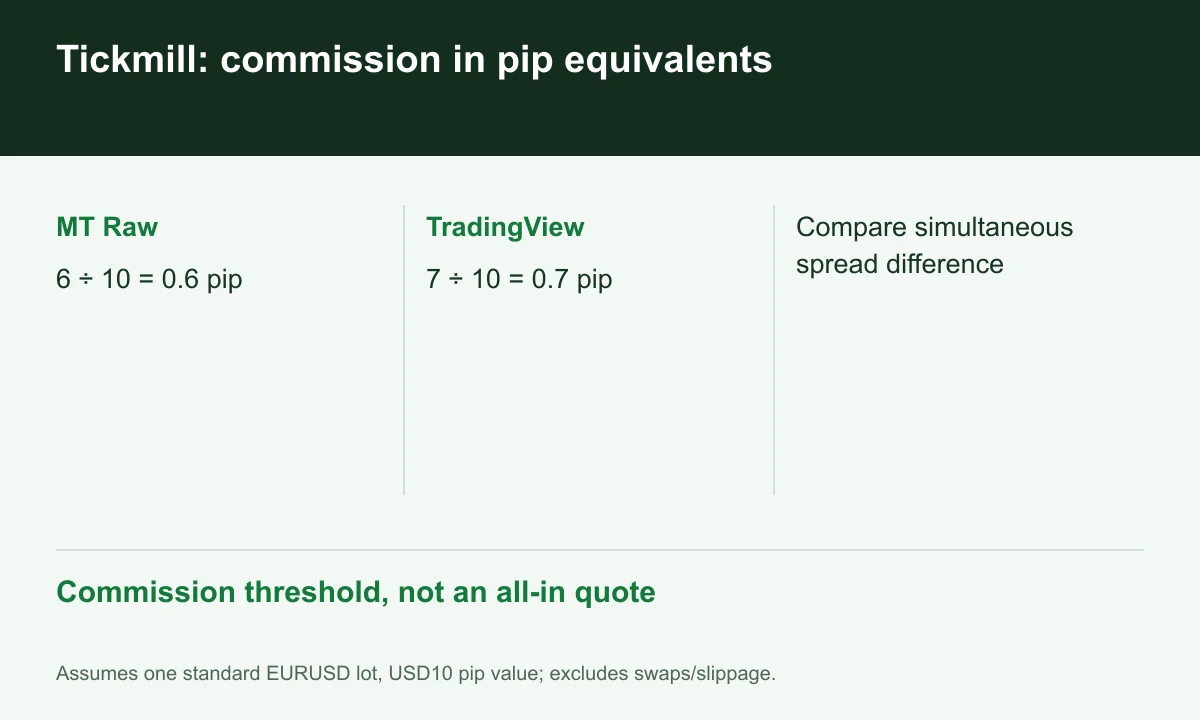
Provider guide
An illustrative EURUSD example explains USD3 and USD3.50 per-side charges.
Read guide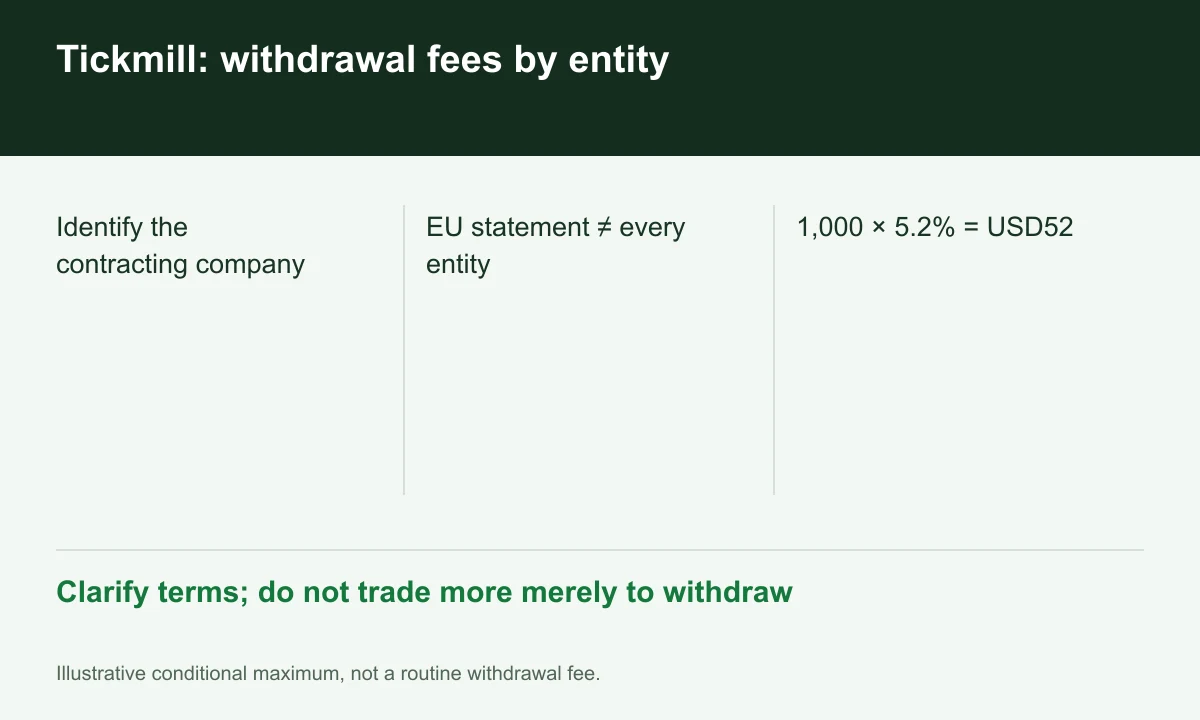
Provider guide
Separate the EU public fee statement from a Seychelles contractual exception.
Read guide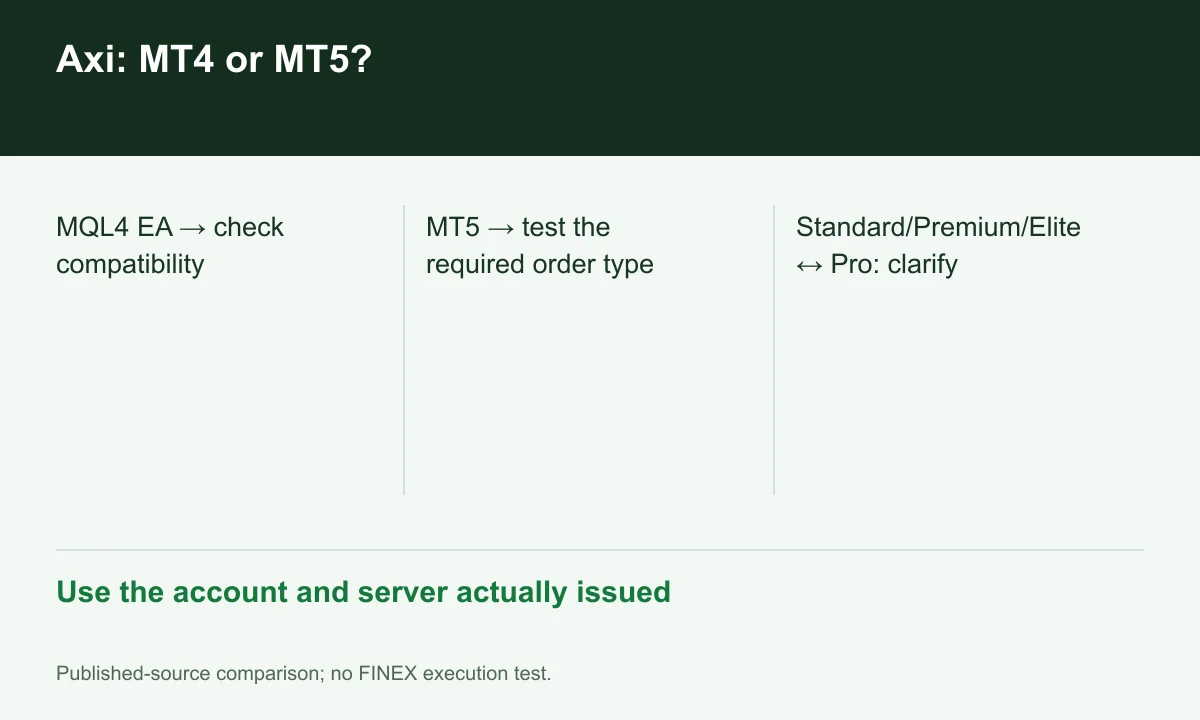
Provider guide
Match existing tools, server details and the account labels in the client portal.
Read guide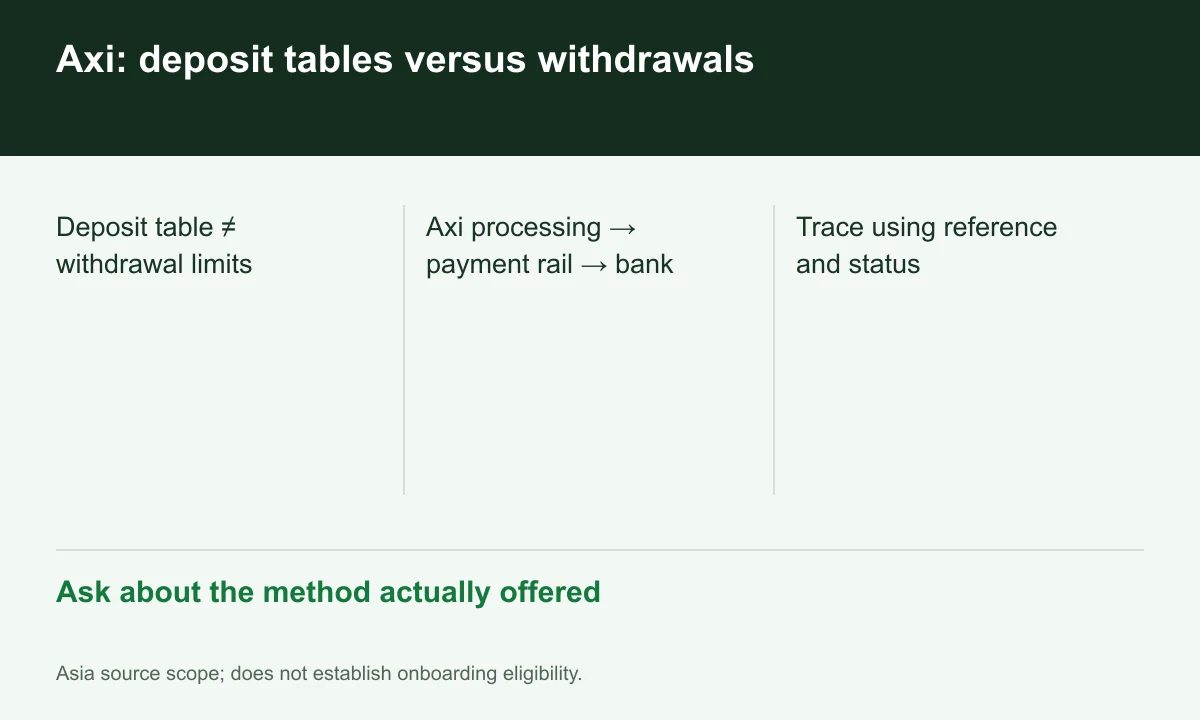
Provider guide
Distinguish the deposit table, broker processing and bank credit.
Read guide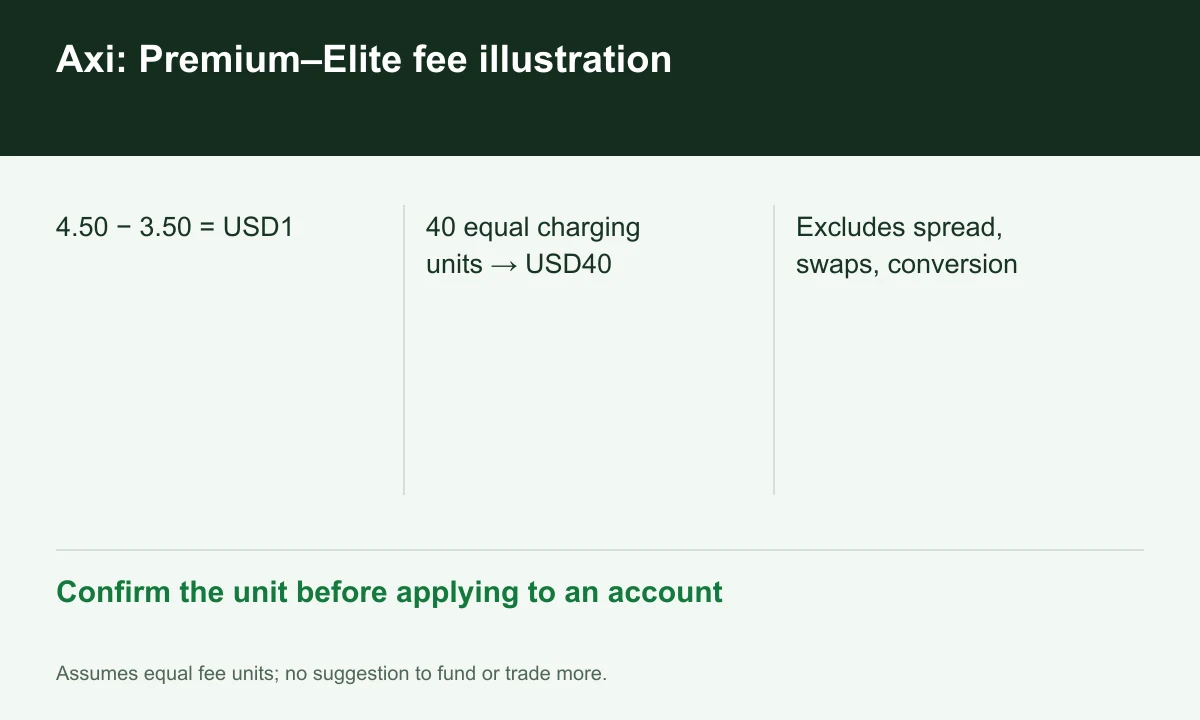
Provider guide
Illustrate the published difference without turning recommended funding into a requirement.
Read guide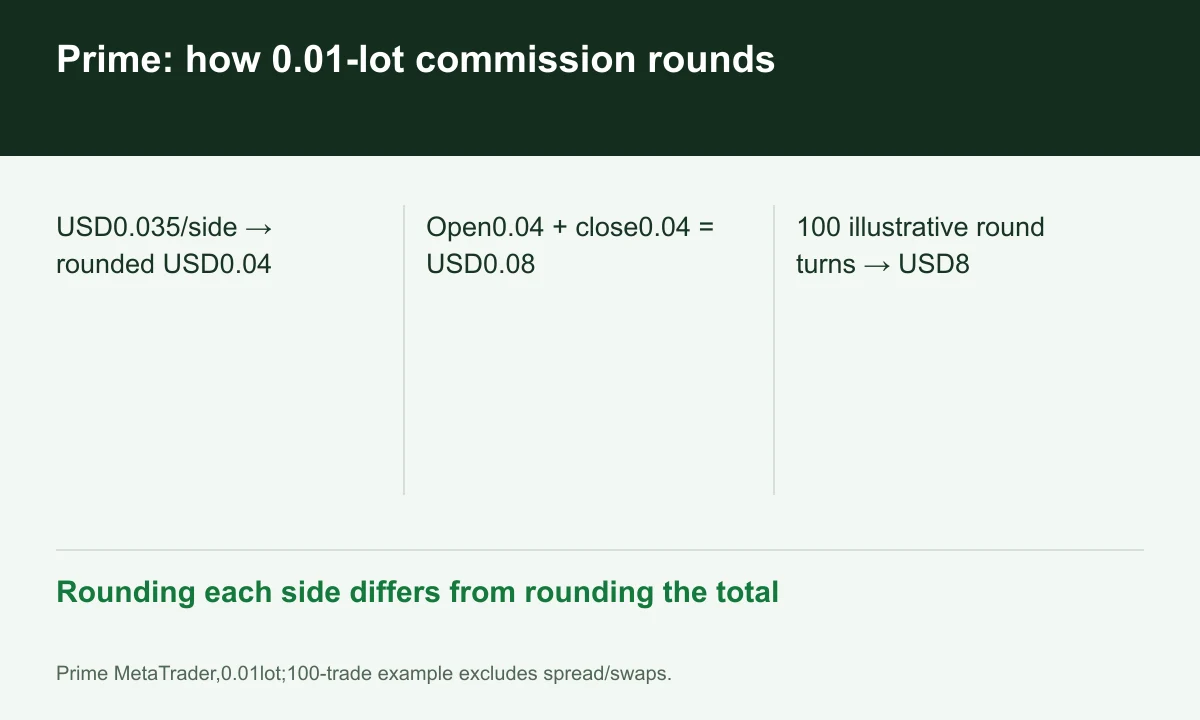
Provider guide
Check each trade side to understand nominal versus rounded commission.
Read guide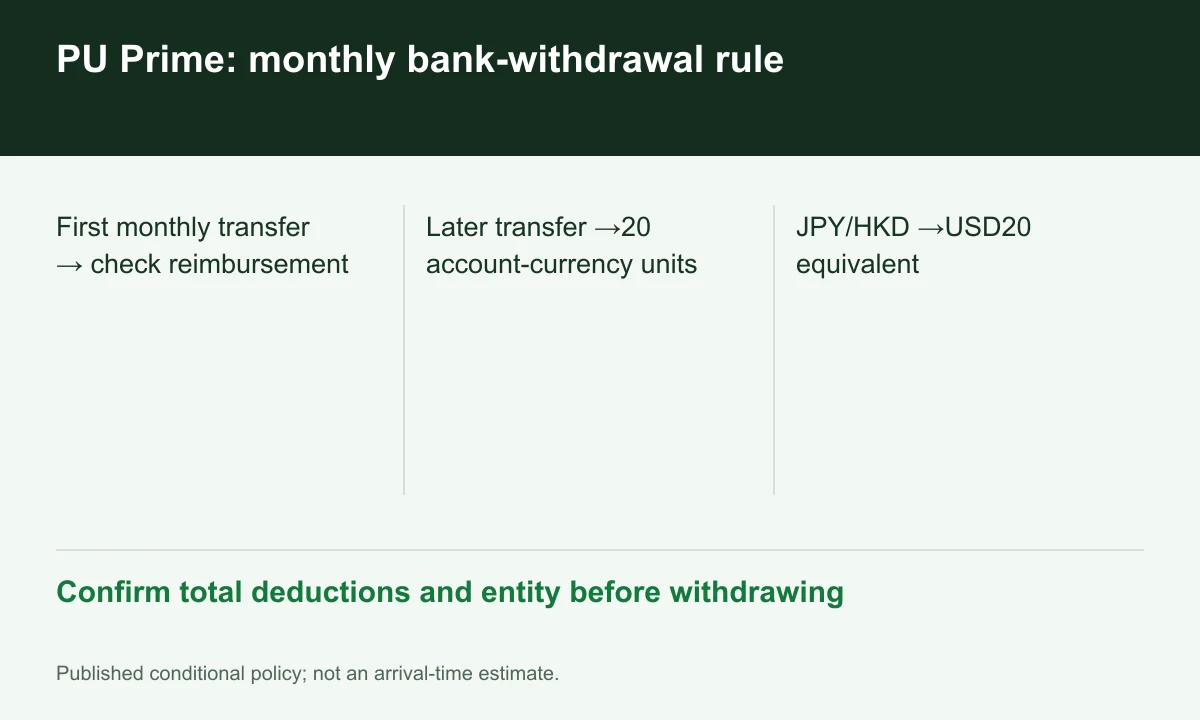
Provider guide
Read account-currency handling charges without mistaking deposit timings for withdrawal timings.
Read guide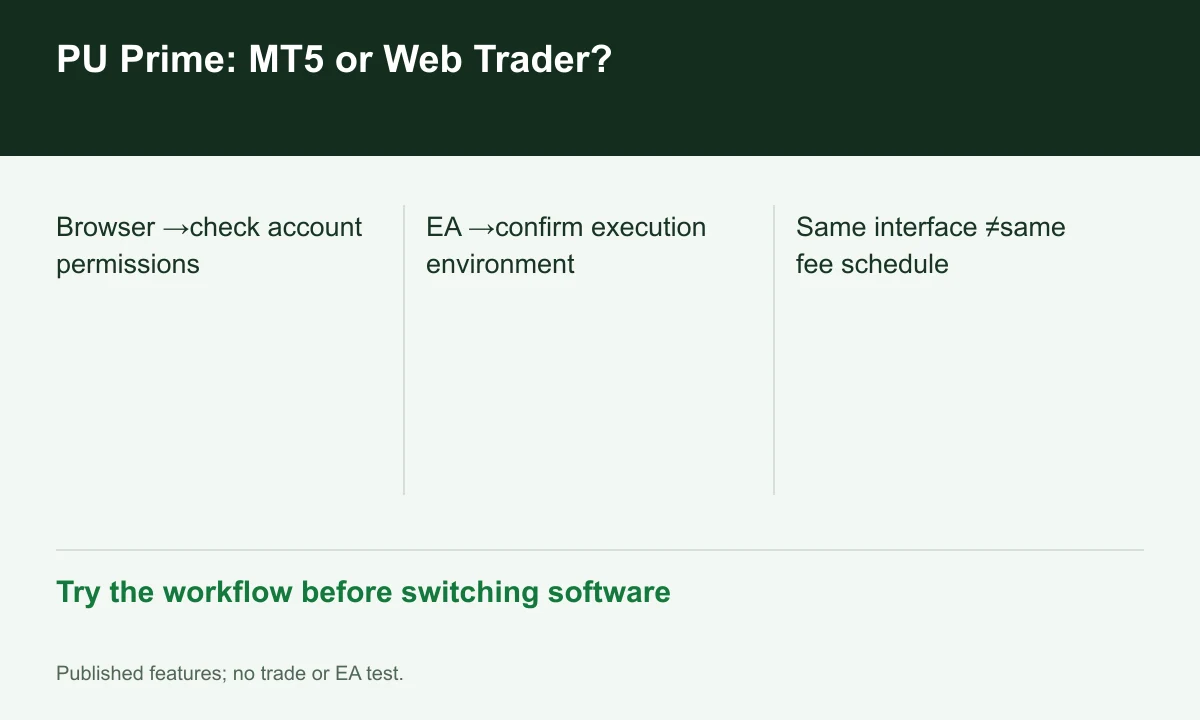
Provider guide
Separate account permissions from software and check EAs before switching.
Read guide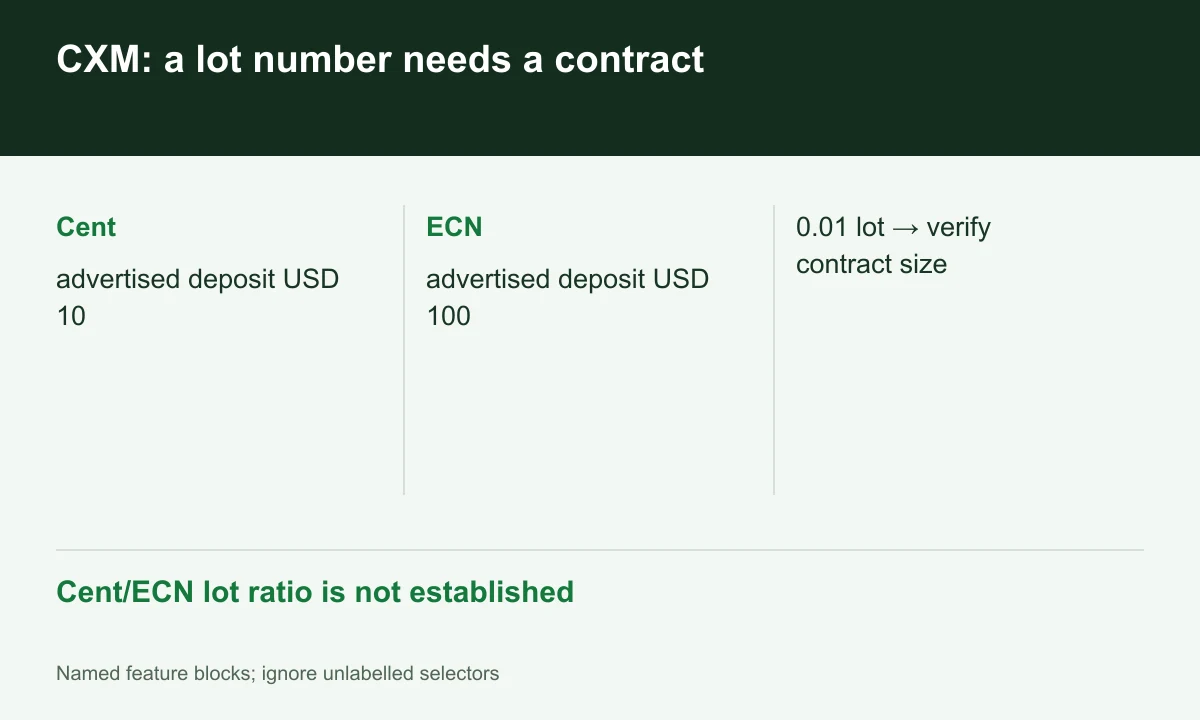
Provider guide
Separate account-specific deposits from the dynamic comparison widget before sizing exposure.
Read guide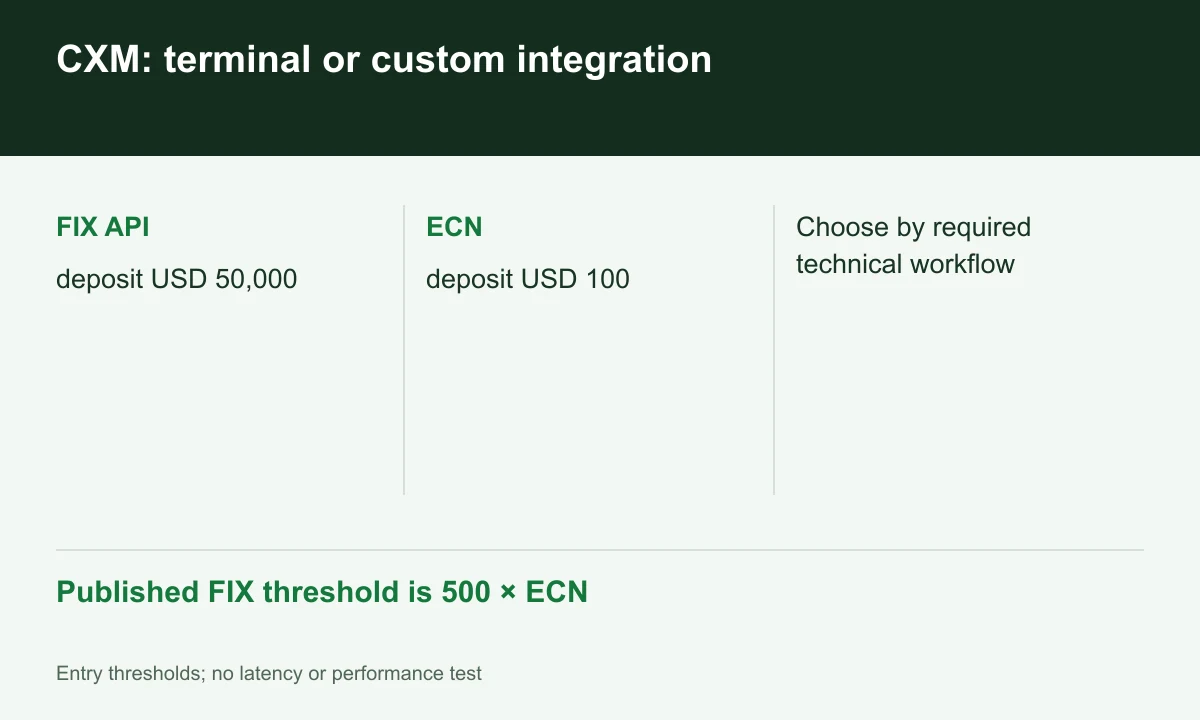
Provider guide
Put the USD 50,000 threshold in the context of a custom trading system.
Read guide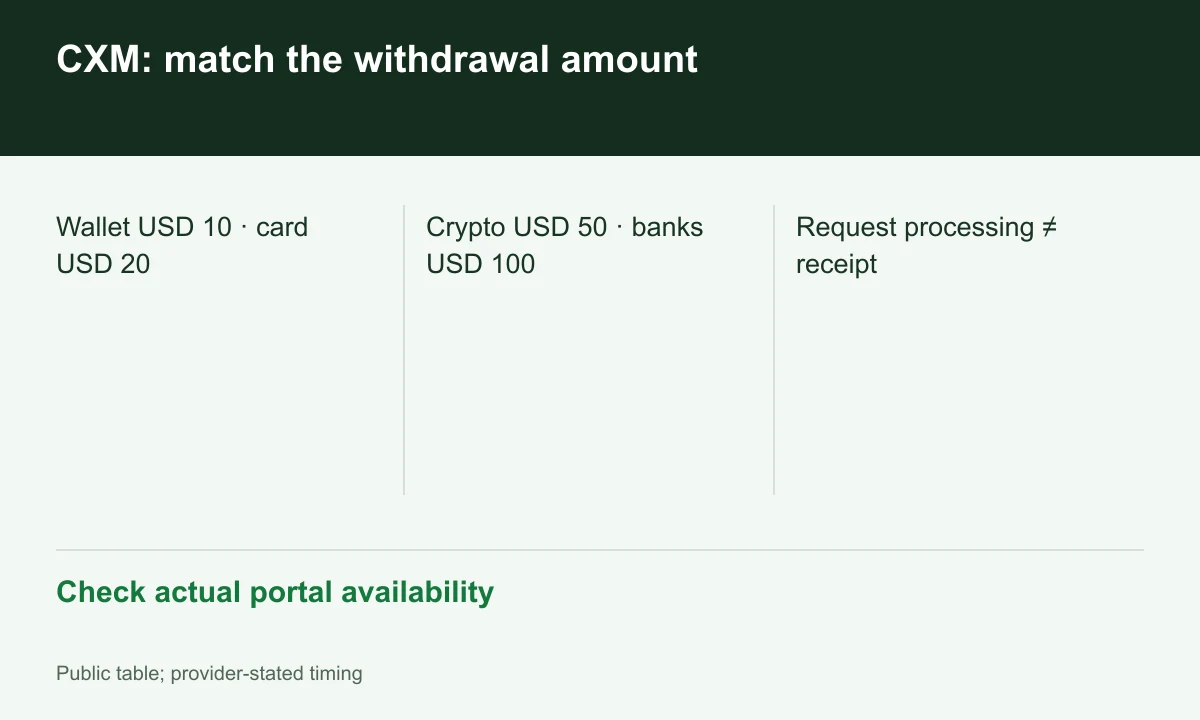
Provider guide
Distinguish payment-channel limits, advertised processing statistics and actual receipt.
Read guide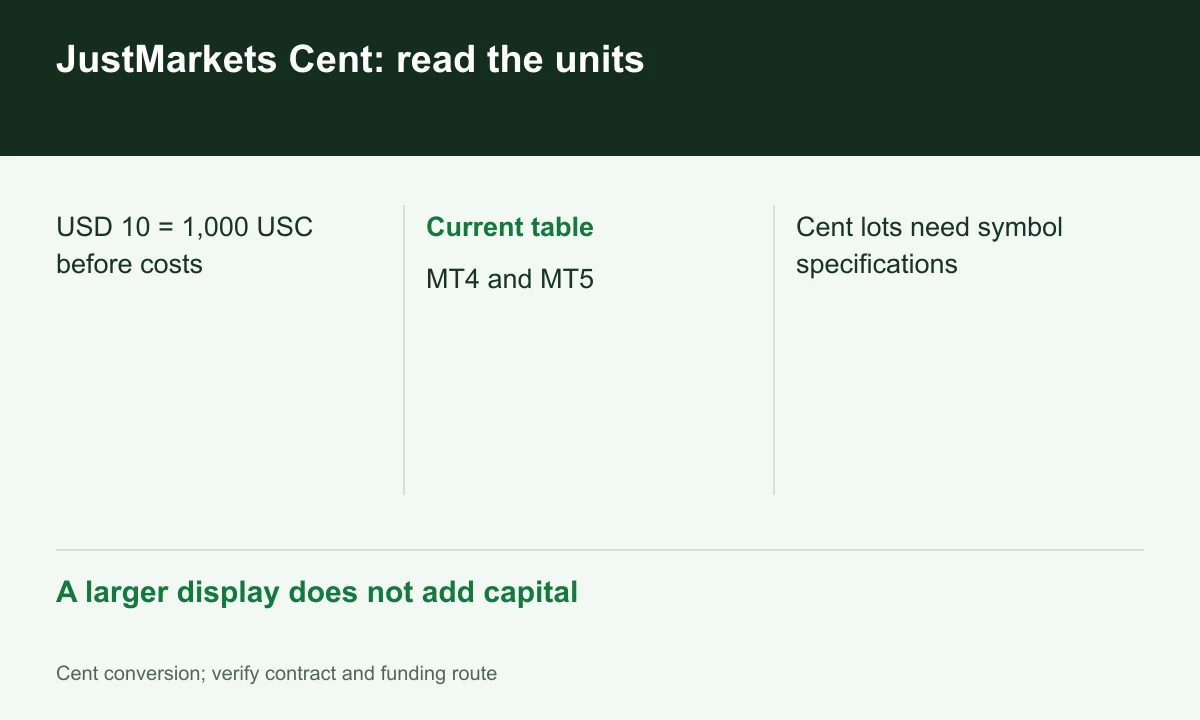
Provider guide
Read cent balances, volumes and product coverage before moving an EA from Standard.
Read guide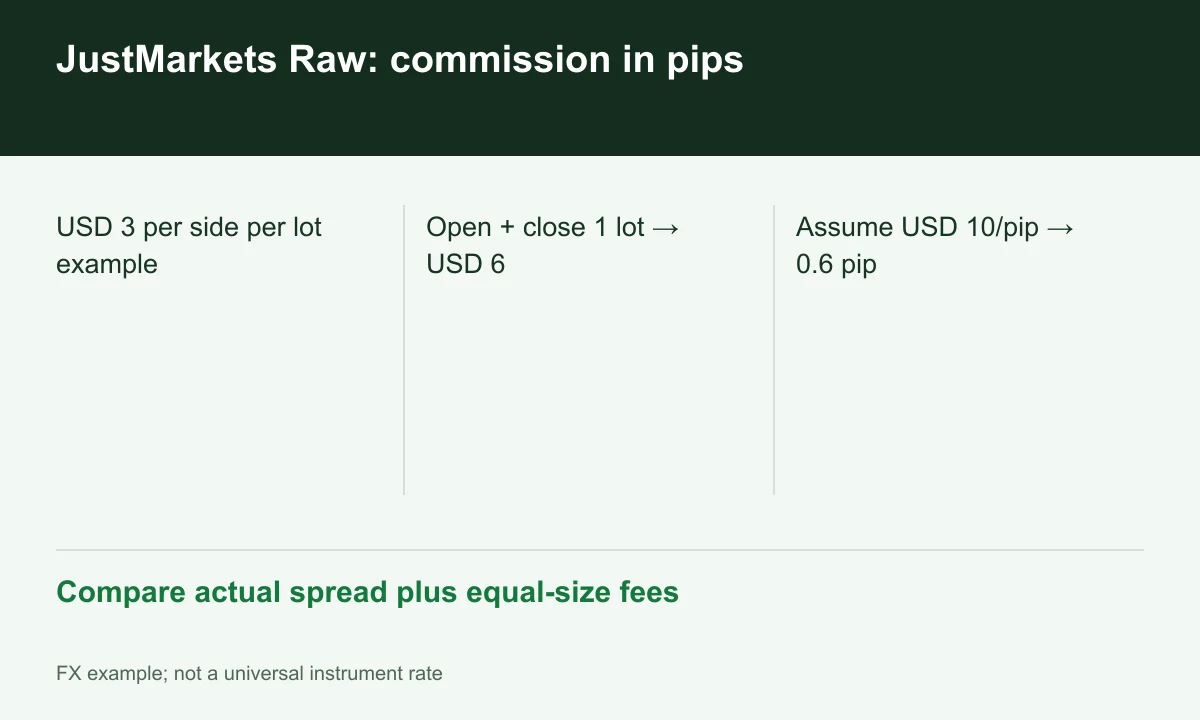
Provider guide
Compare total cost using observed spread differences and an explicit pip-value assumption.
Read guide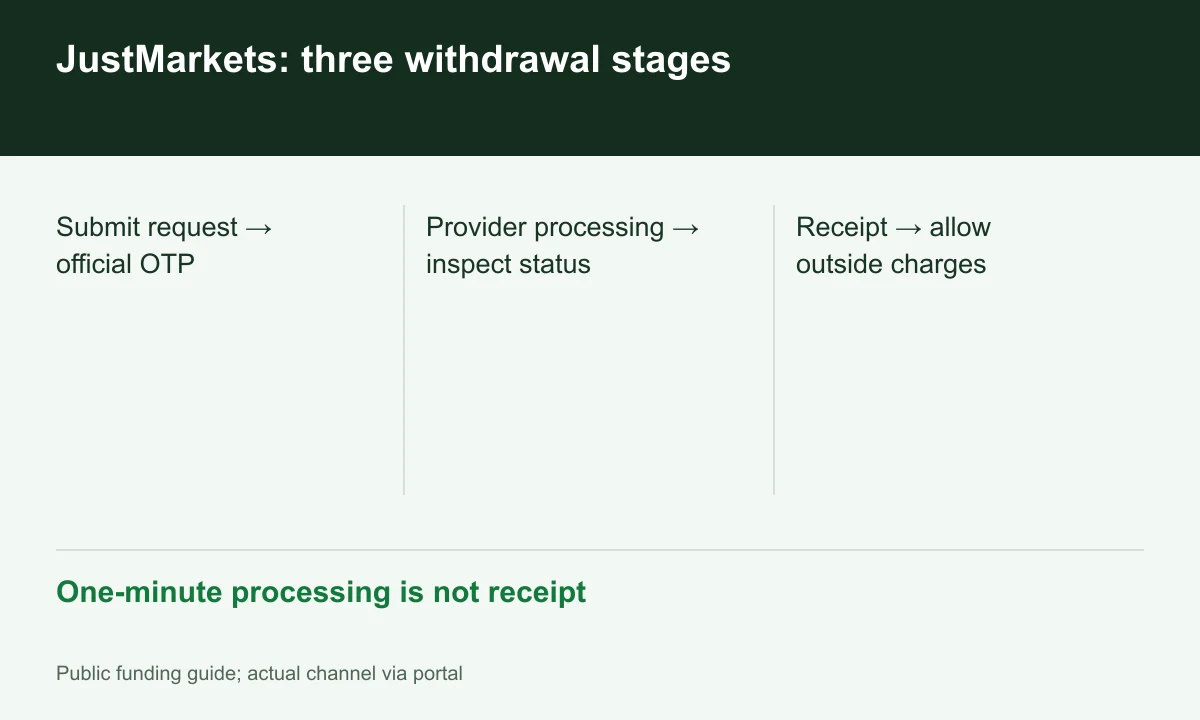
Provider guide
One-minute provider processing is separate from receipt; trace status and the net amount.
Read guide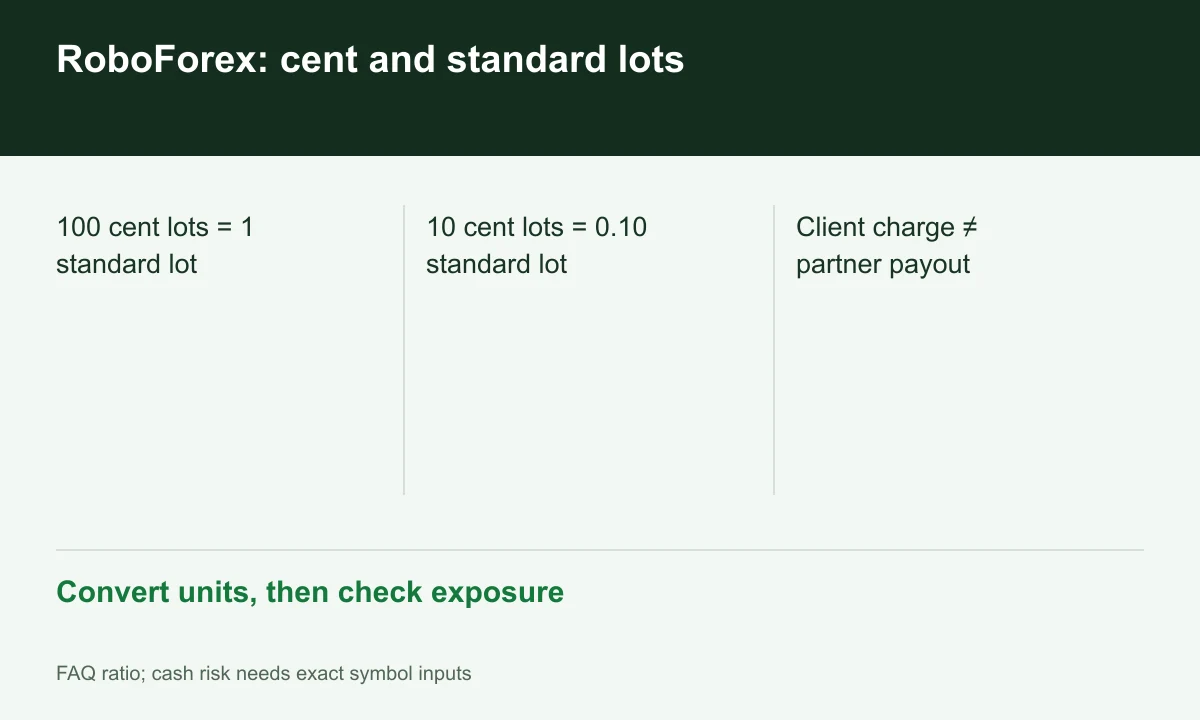
Provider guide
Separate trading-volume units from partner payouts in the FAQ before choosing position size.
Read guide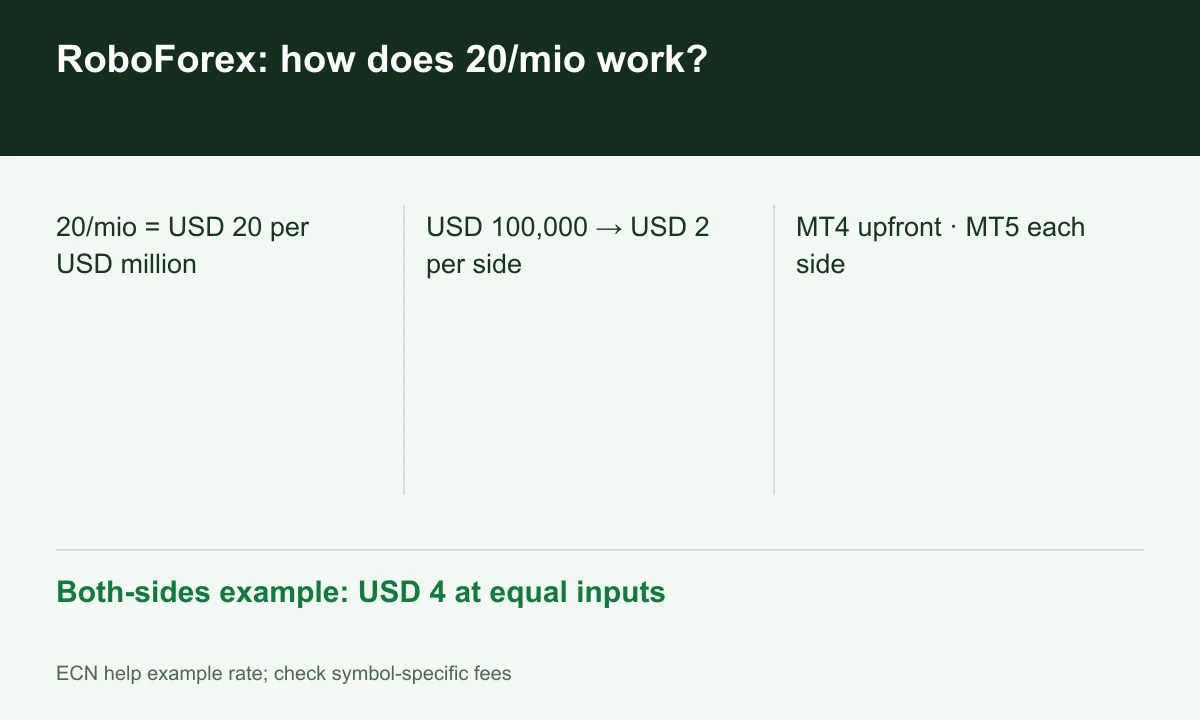
Provider guide
Decode the USD-million unit with two base-currency examples and separate cost from booking time.
Read guide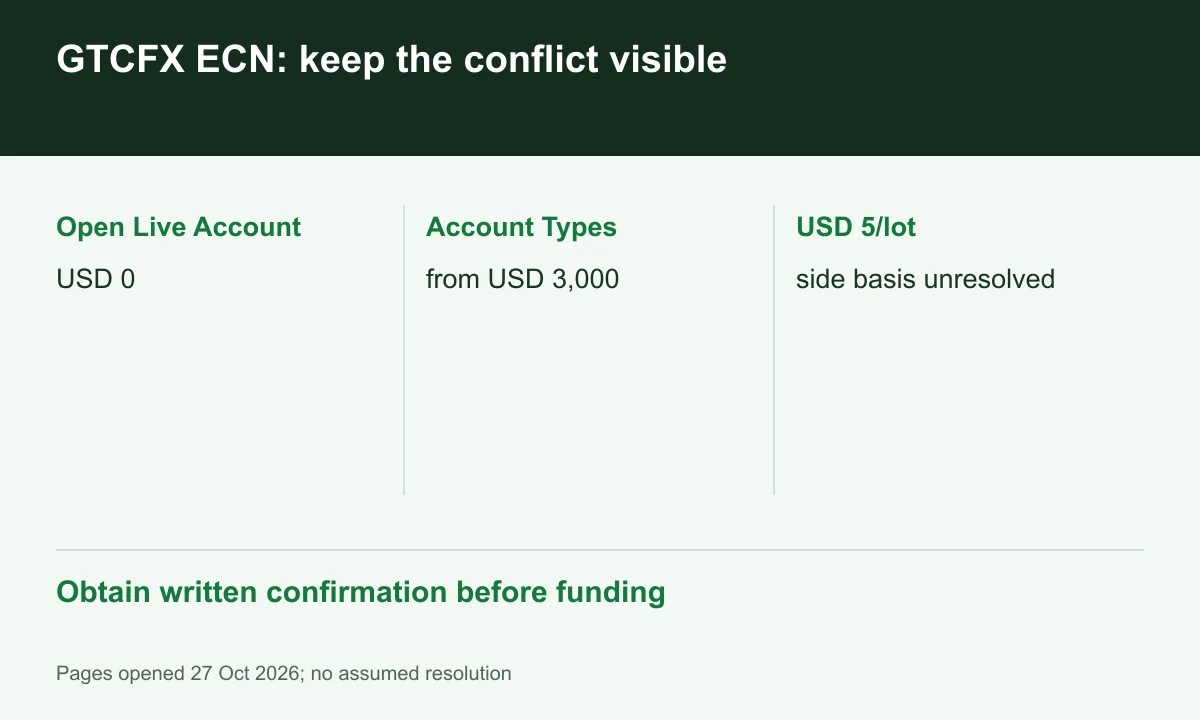
Provider guide
Preserve the source conflict and establish the account-specific entity and funding offer.
Read guide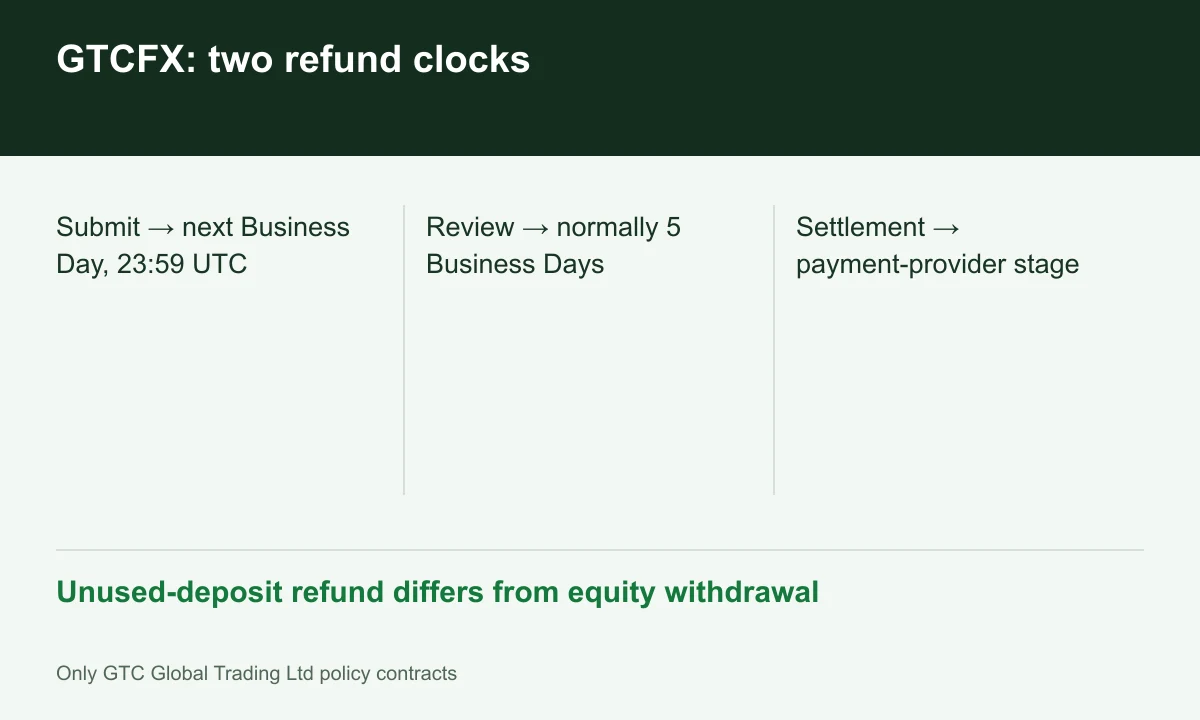
Provider guide
The /en-intl policy sets a distinct unused-deposit window with entity-specific scope.
Read guide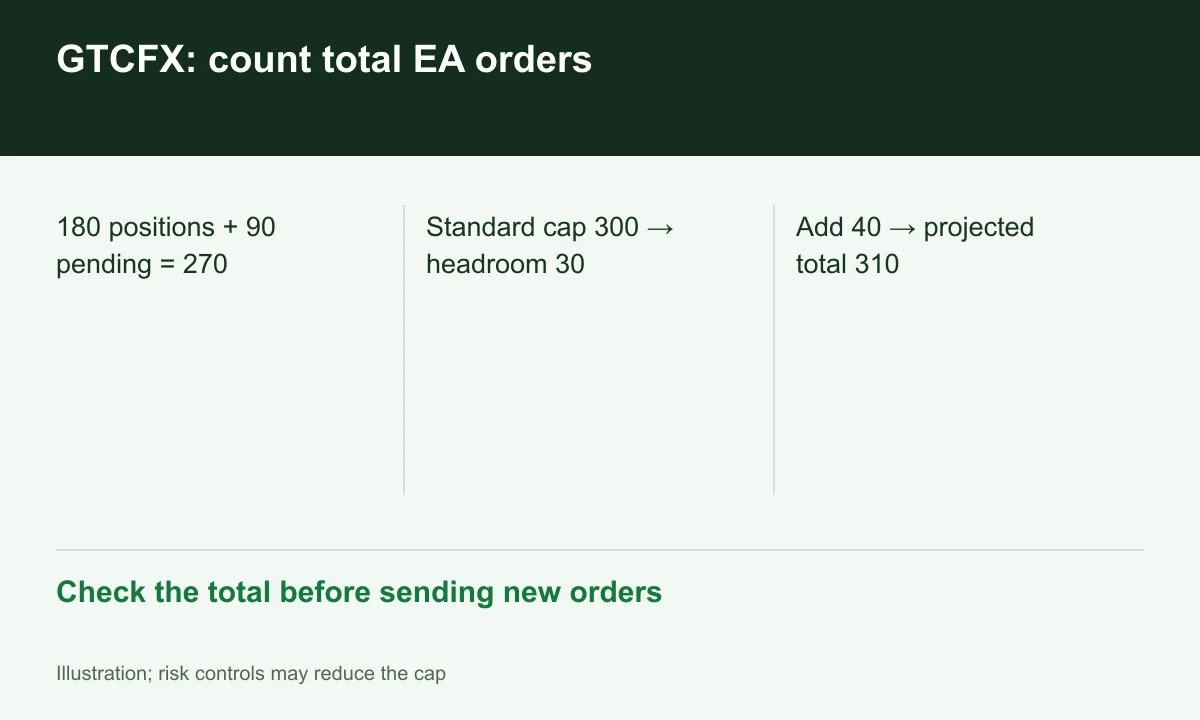
Provider guide
Count open positions and pending orders together; the published ceiling may be reduced.
Read guide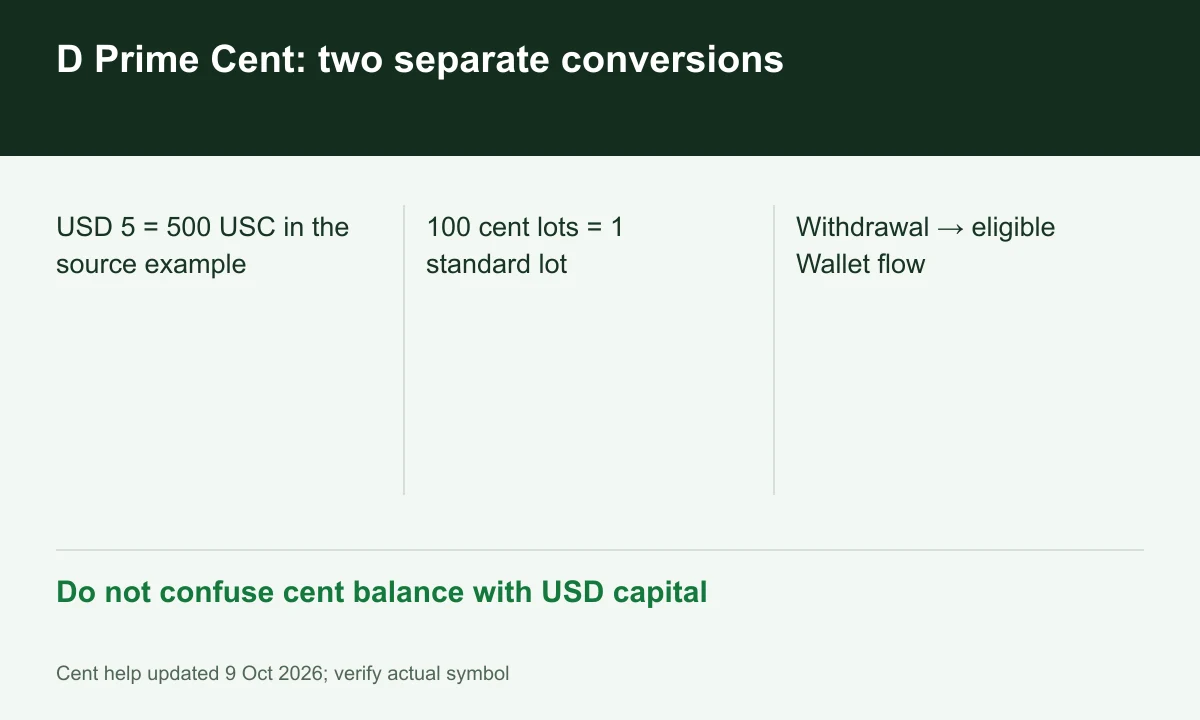
Provider guide
A larger cent balance does not increase capital; separate currency units, contract units and Wallet withdrawals.
Read guide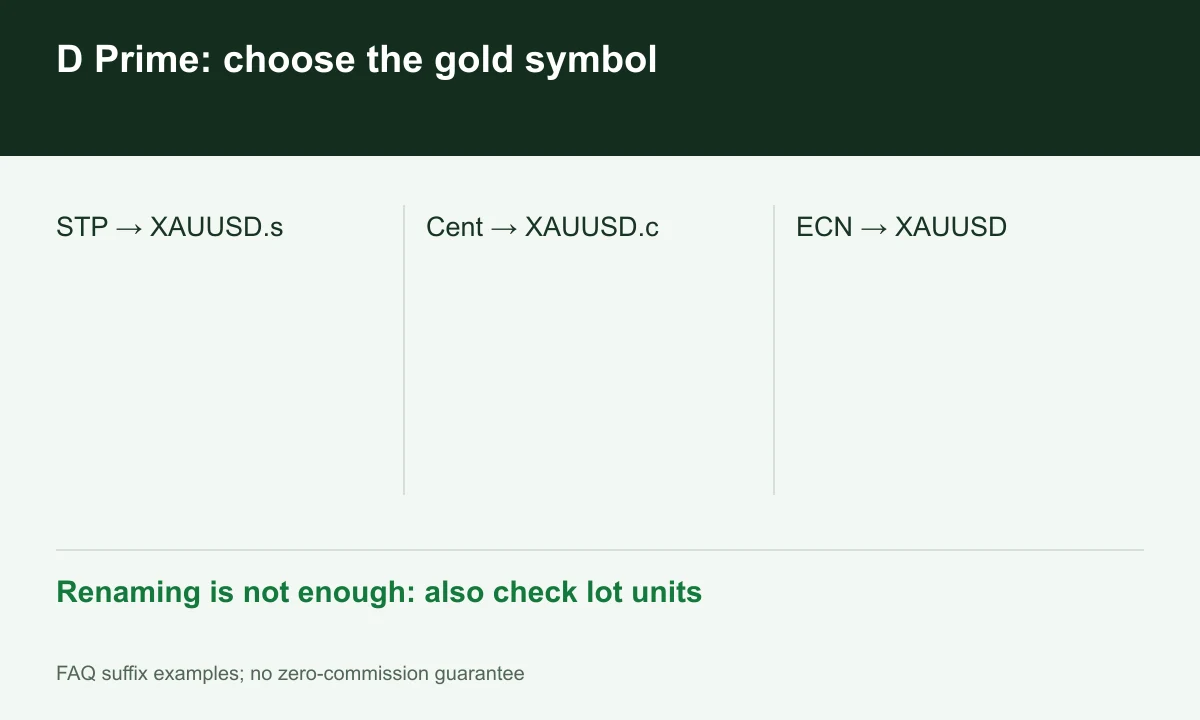
Provider guide
Match suffix to account type before routing an order or migrating an EA.
Read guide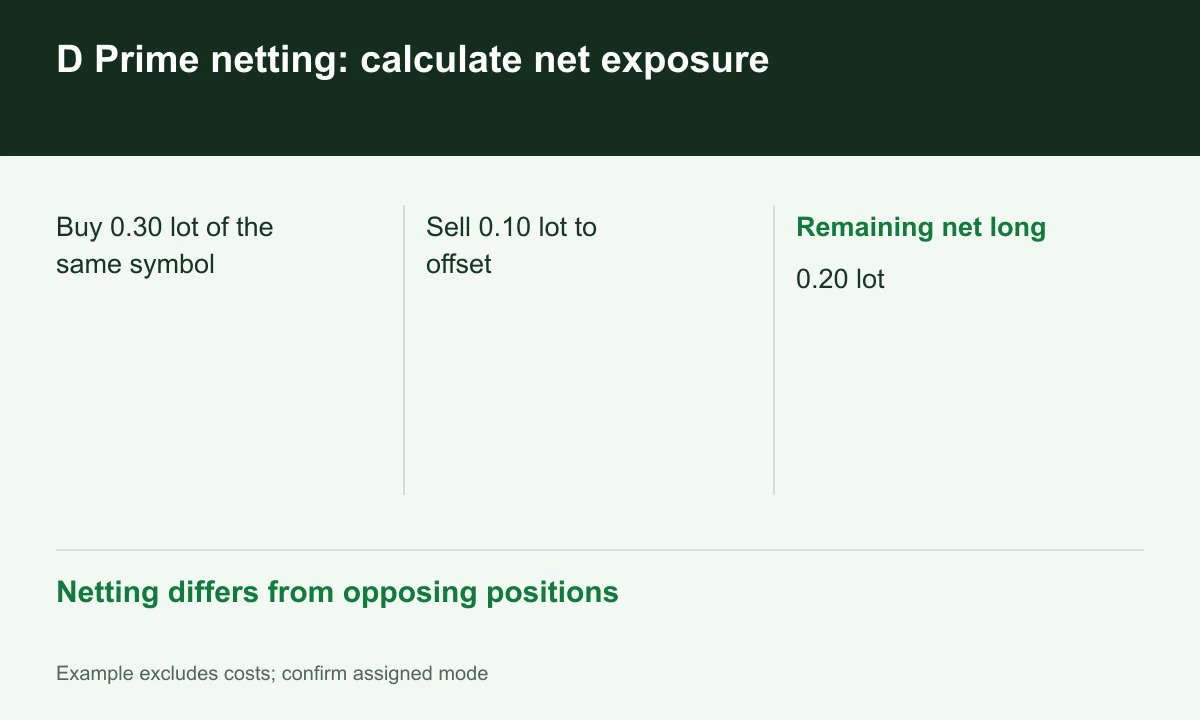
Provider guide
Track net volume when changing position mode while keeping account and symbol identity separate.
Read guide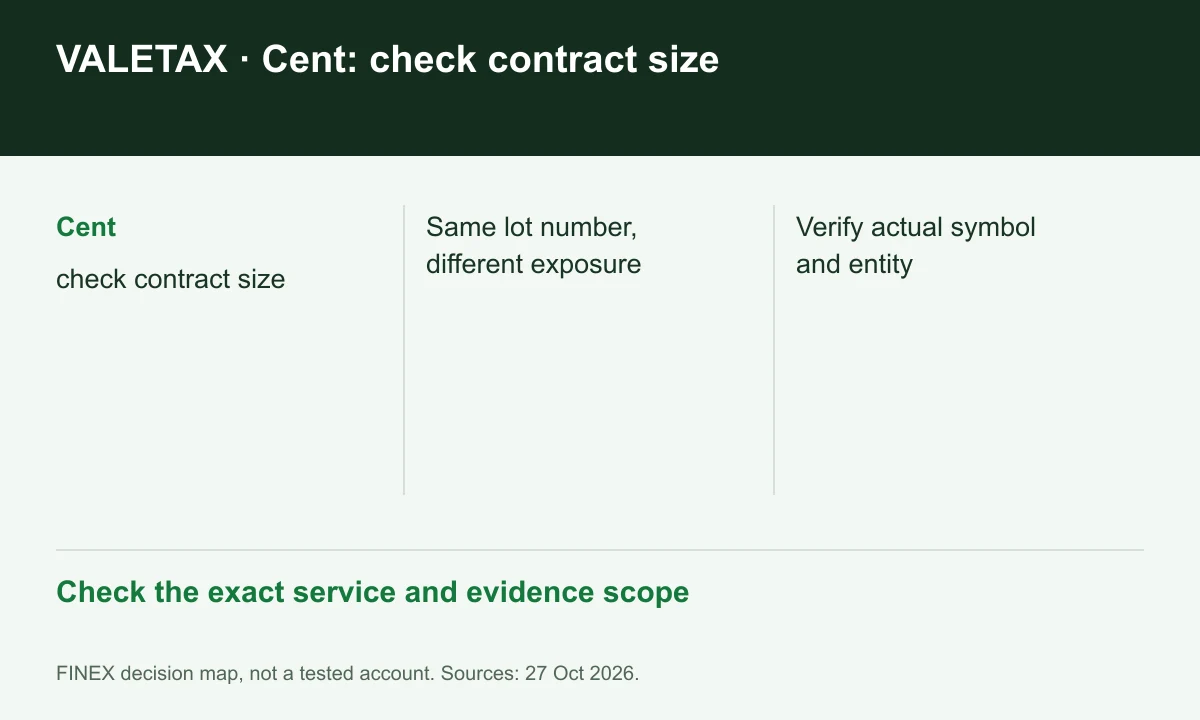
Provider guide
Read Valetax Cent and Standard contract sizes before copying a lot amount, and use a transparent hypothetical size comparison without assuming pip value.
Read guide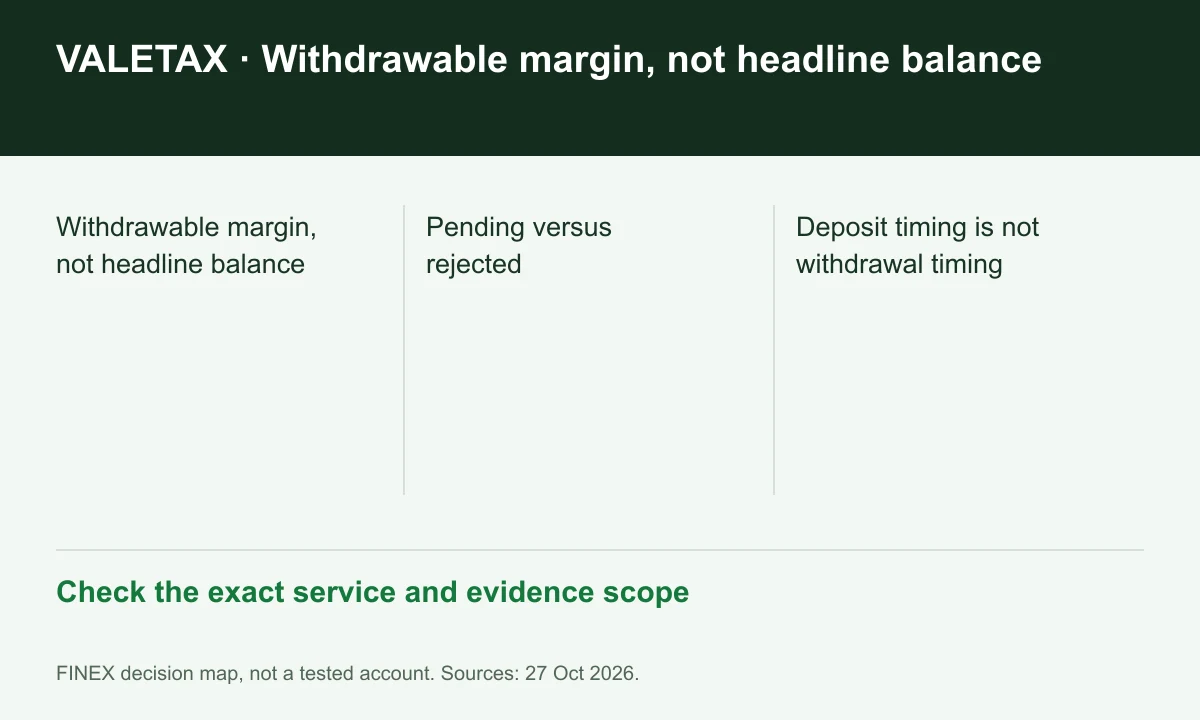
Provider guide
Separate Valetax withdrawal eligibility from deposit-page timings, check available margin and preserve the right evidence when a request remains pending.
Read guide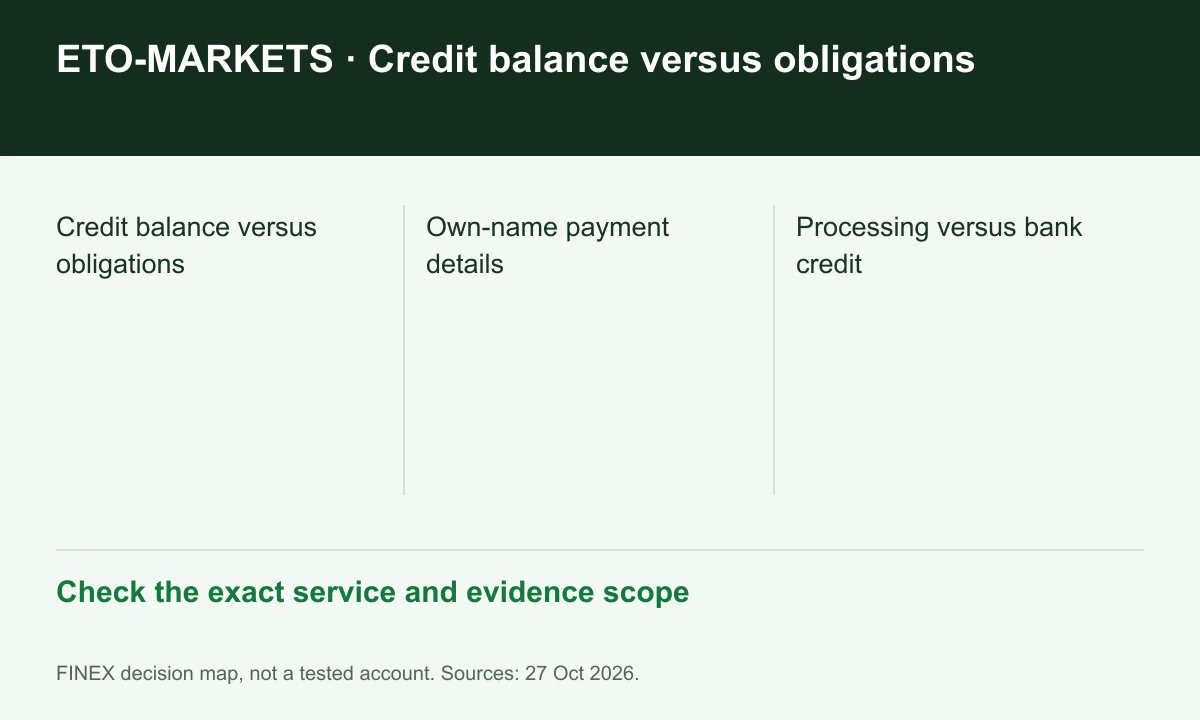
Provider guide
Read ETO Market Limited's margin, same-name funding and transfer-processing clauses before treating an account credit as immediately withdrawable cash.
Read guide
Provider guide
Follow ETO Market Limited's confirmation clauses, preserve an order evidence trail and distinguish missing trade confirmation from a platform connectivity issue.
Read guide
Provider guide
Understand TMGM Cent balances and contract sizes, then identify the platform and rebate conversion details that need confirmation before placing an order.
Read guide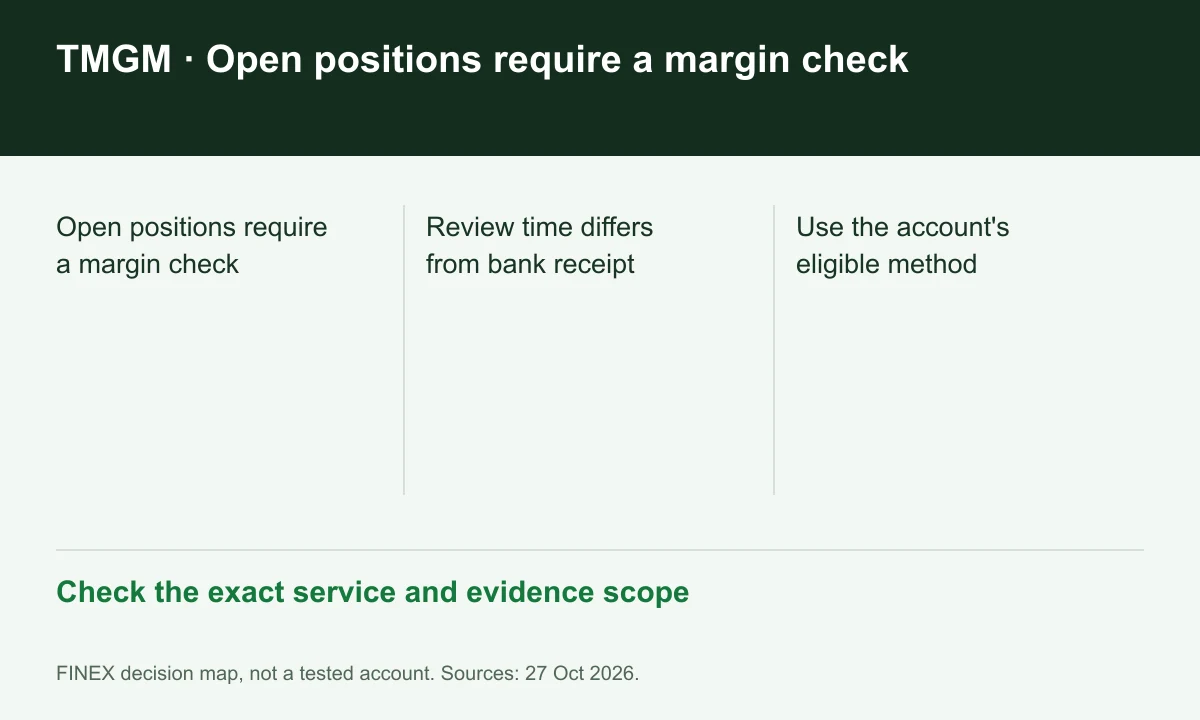
Provider guide
Work through TMGM's withdrawal margin check, beneficiary status and review timing, while separating general guidance from Cent-specific payment thresholds.
Read guide
Provider guide
Convert Altum Cent balances into dollars, compare forex and metal contract sizes, and spot the minimum-deposit and entity differences in official documents.
Read guide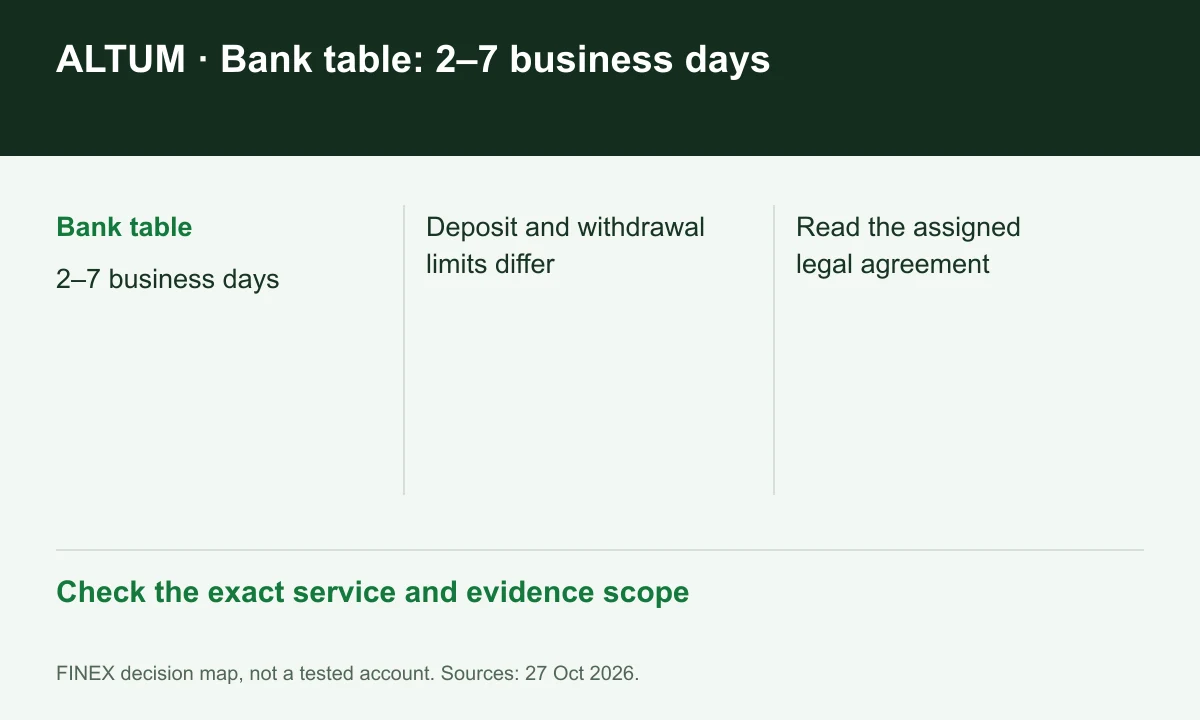
Provider guide
Read Altum's separate withdrawal table, distinguish bank timing from marketing language, and check which legal entity and payment limits govern your account.
Read guide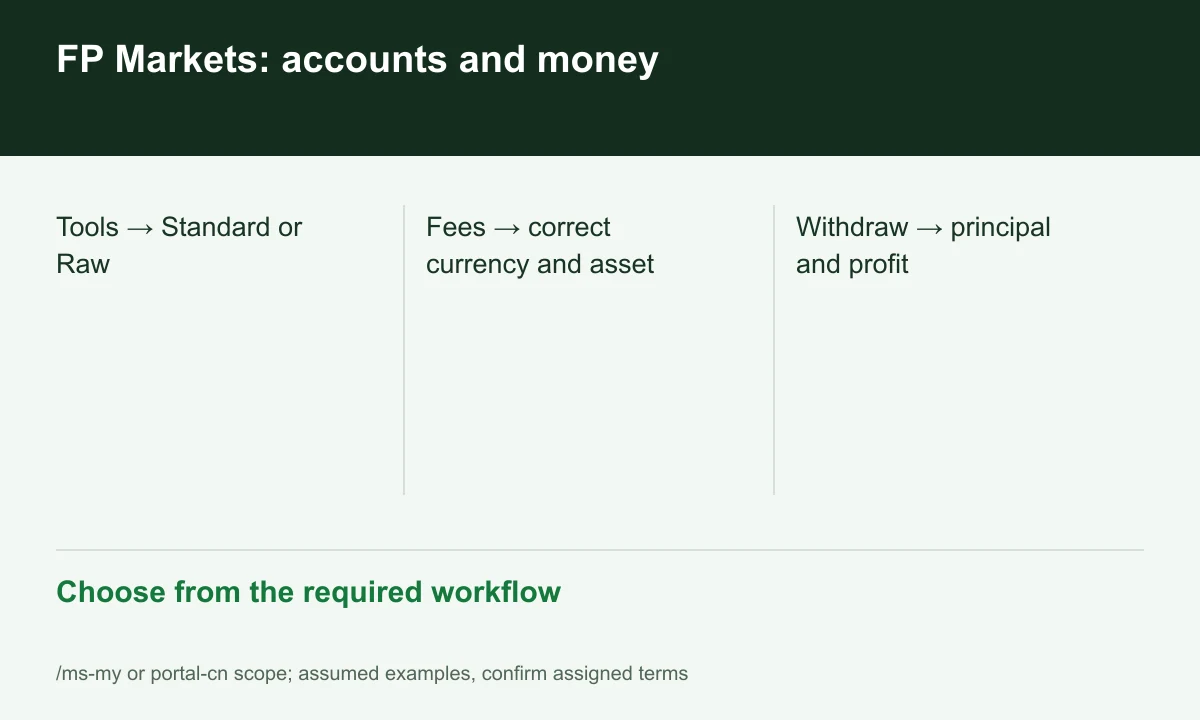
Provider guide
Match Standard/Raw to the required tools and regional documents before estimating costs.
Read guide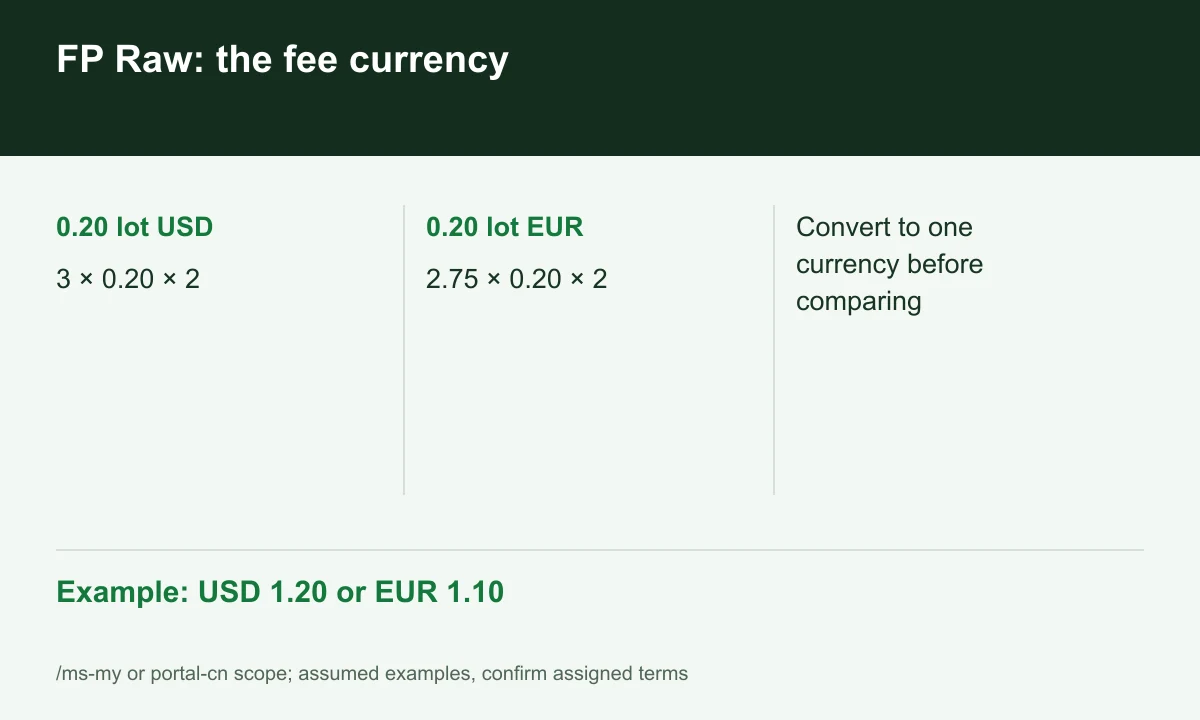
Provider guide
Calculate both trading sides with the specific currency schedule rather than treating every dollar sign as USD.
Read guide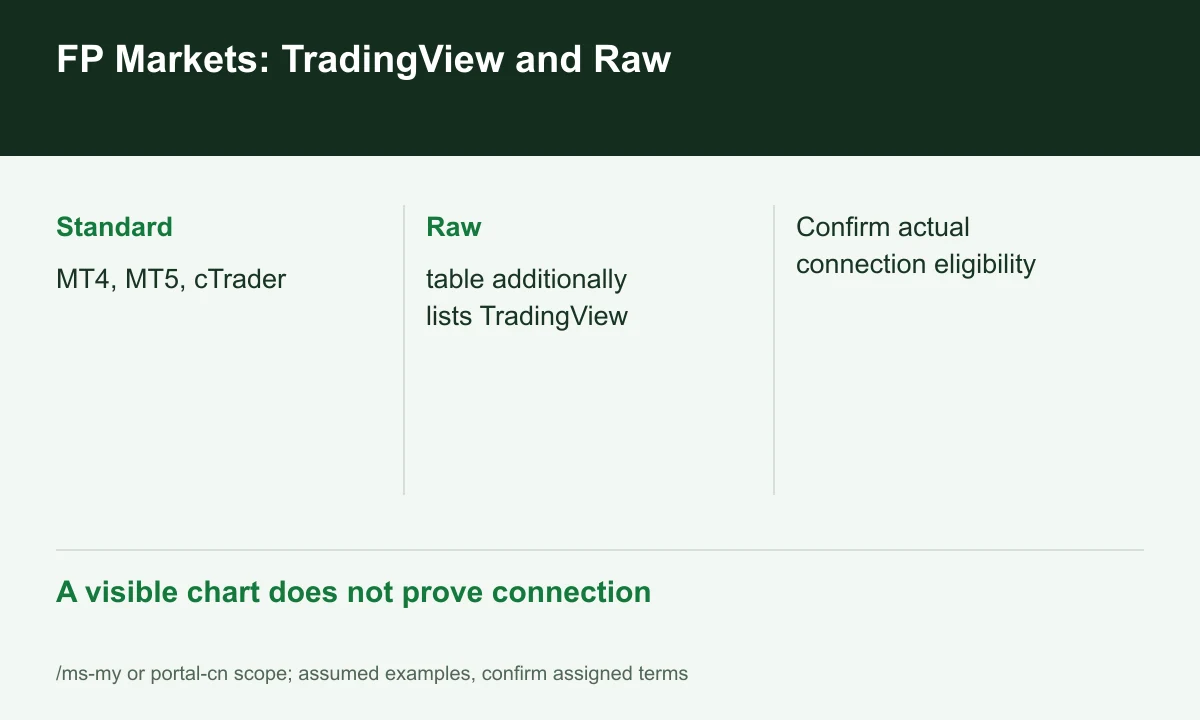
Provider guide
Start with account-table connectivity, then examine pricing and automation compatibility.
Read guide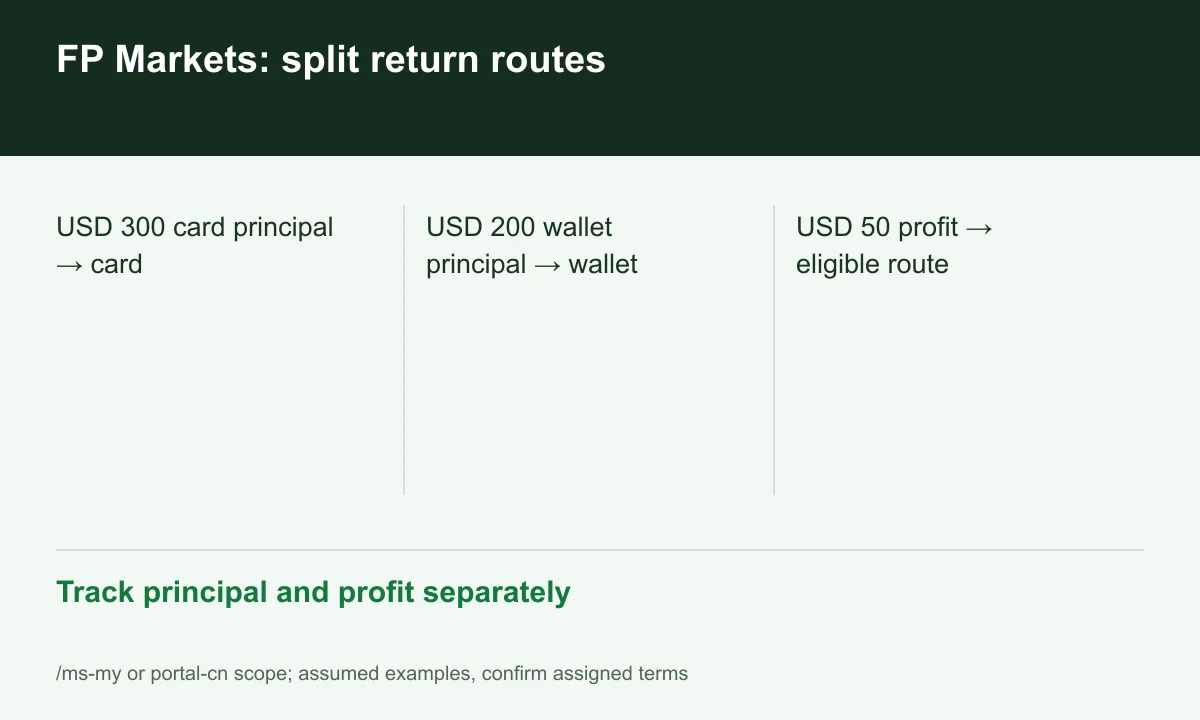
Provider guide
Keep deposited capital, profit and transfer status separate when tracing a withdrawal.
Read guide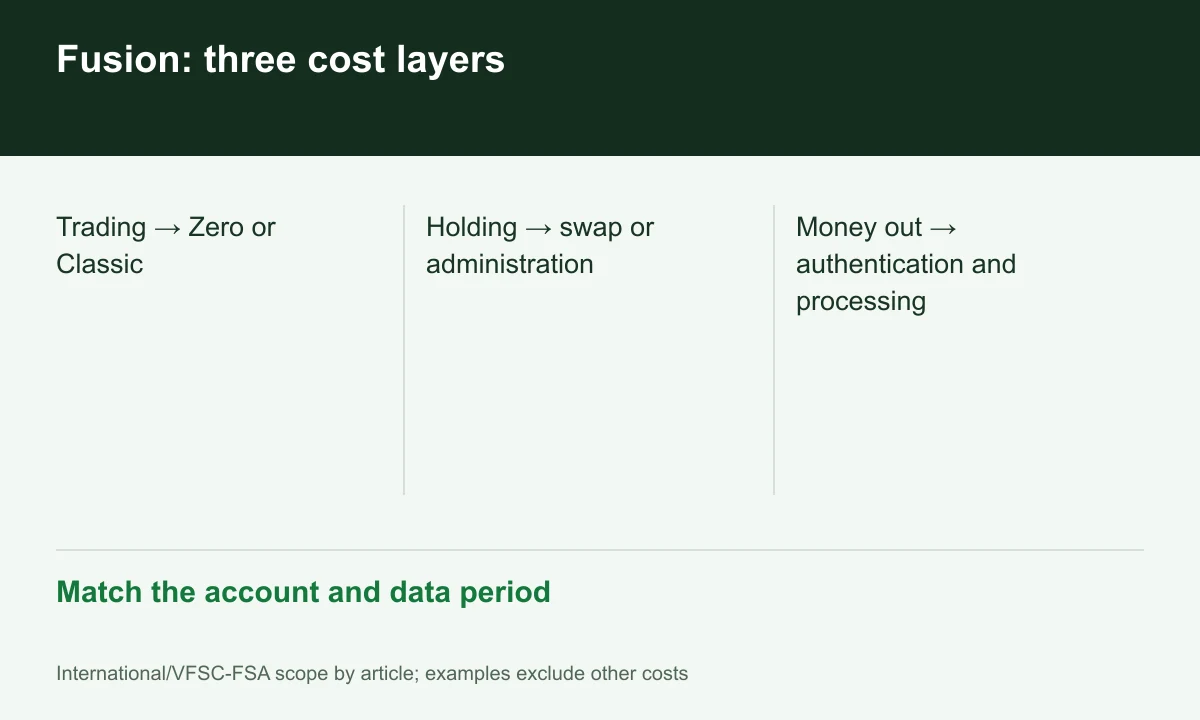
Provider guide
Separate pricing, holding costs and payment workflow before choosing an account.
Read guide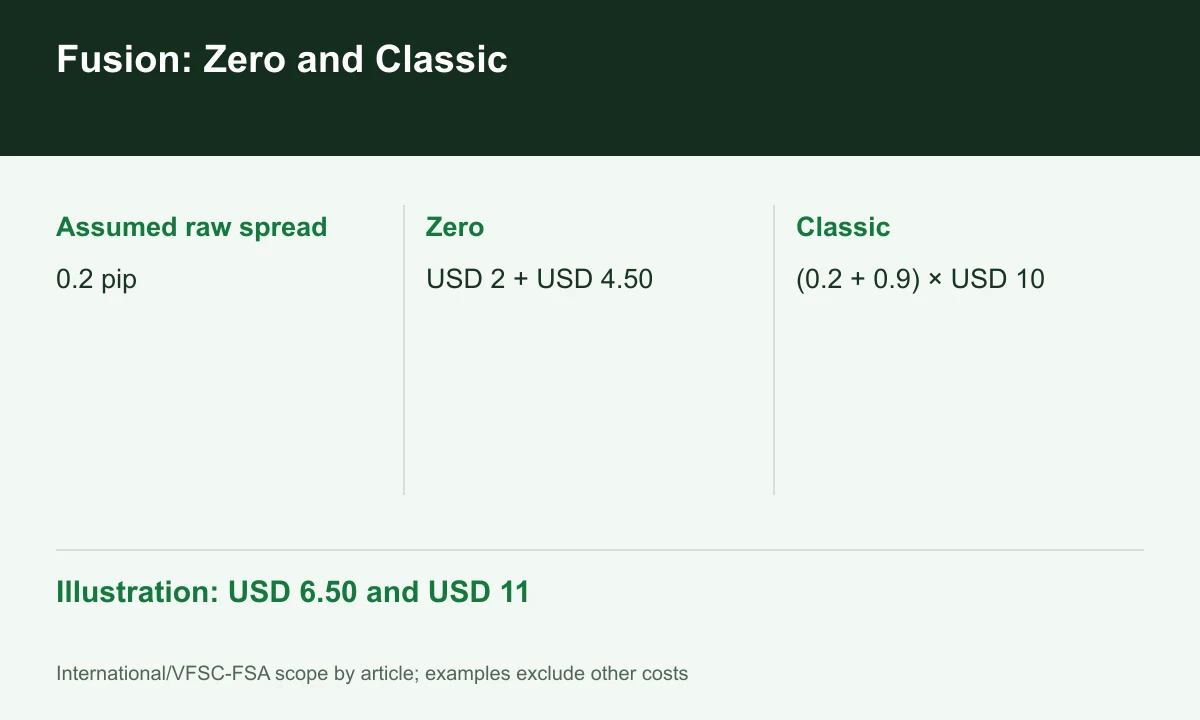
Provider guide
Use the same underlying spread and volume to compare explicit commission against a markup.
Read guide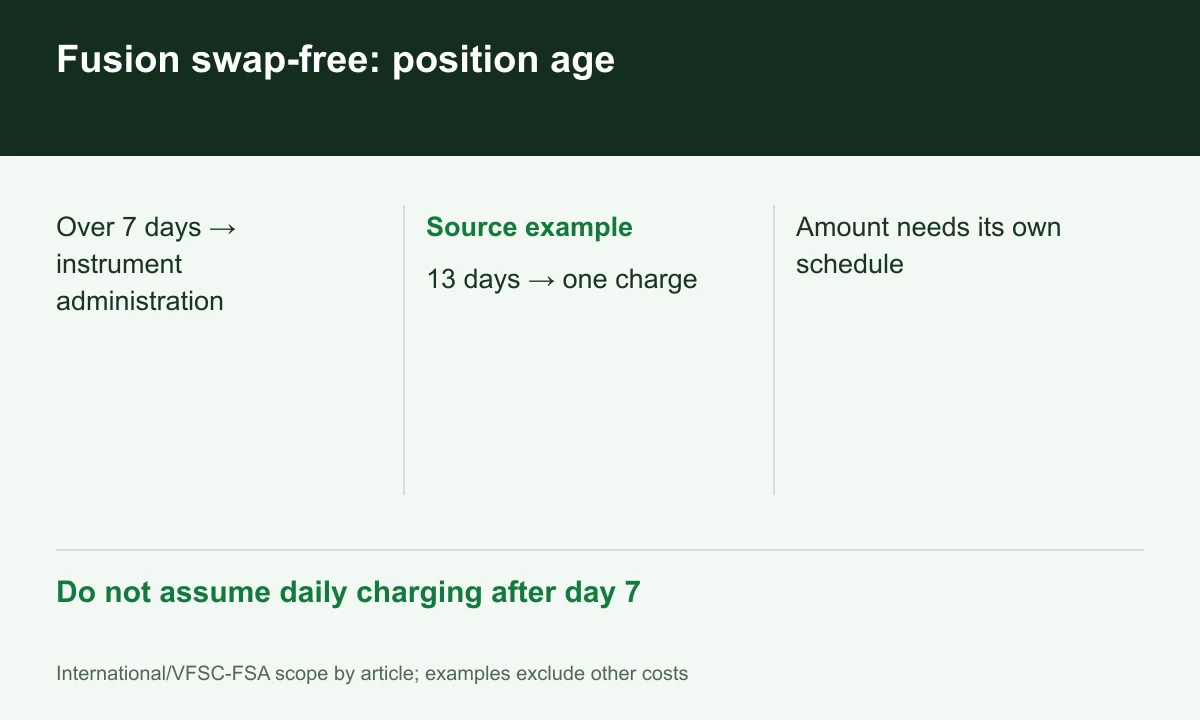
Provider guide
Track position age, server time and account eligibility rather than reading swap-free as cost-free.
Read guide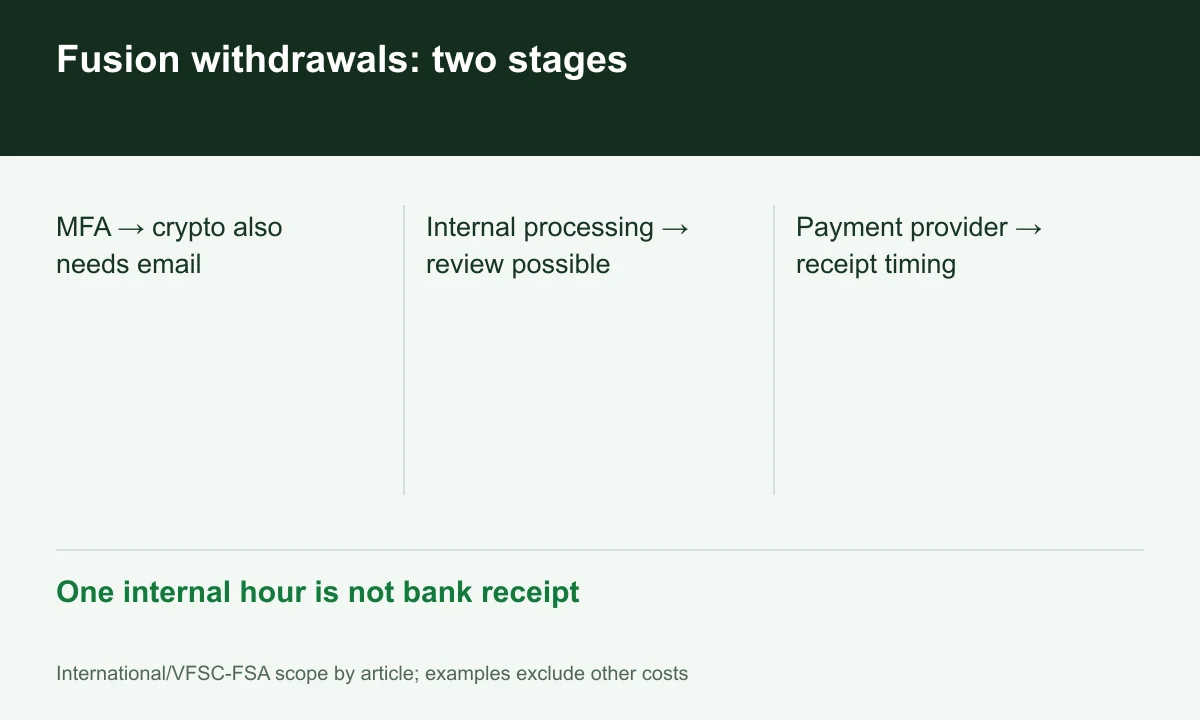
Provider guide
Distinguish internal completion from receipt and prepare the correct fiat or crypto authentication.
Read guide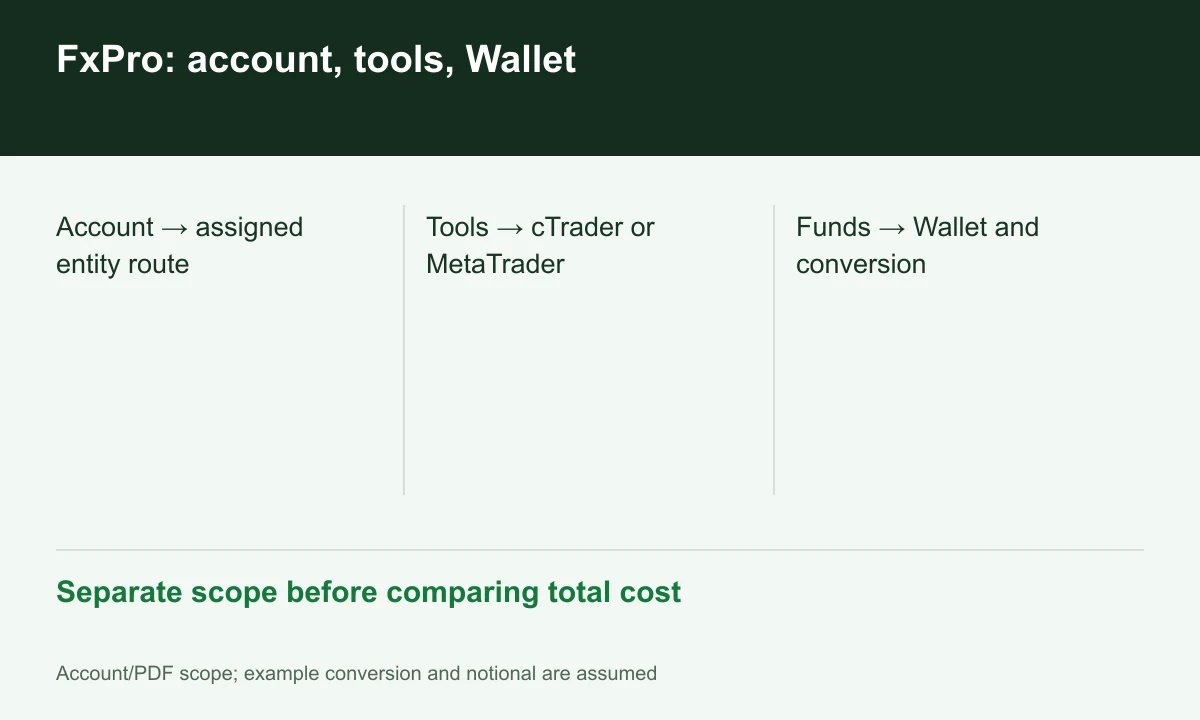
Provider guide
Start with the required tools, then price the account and money flow within one entity route.
Read guide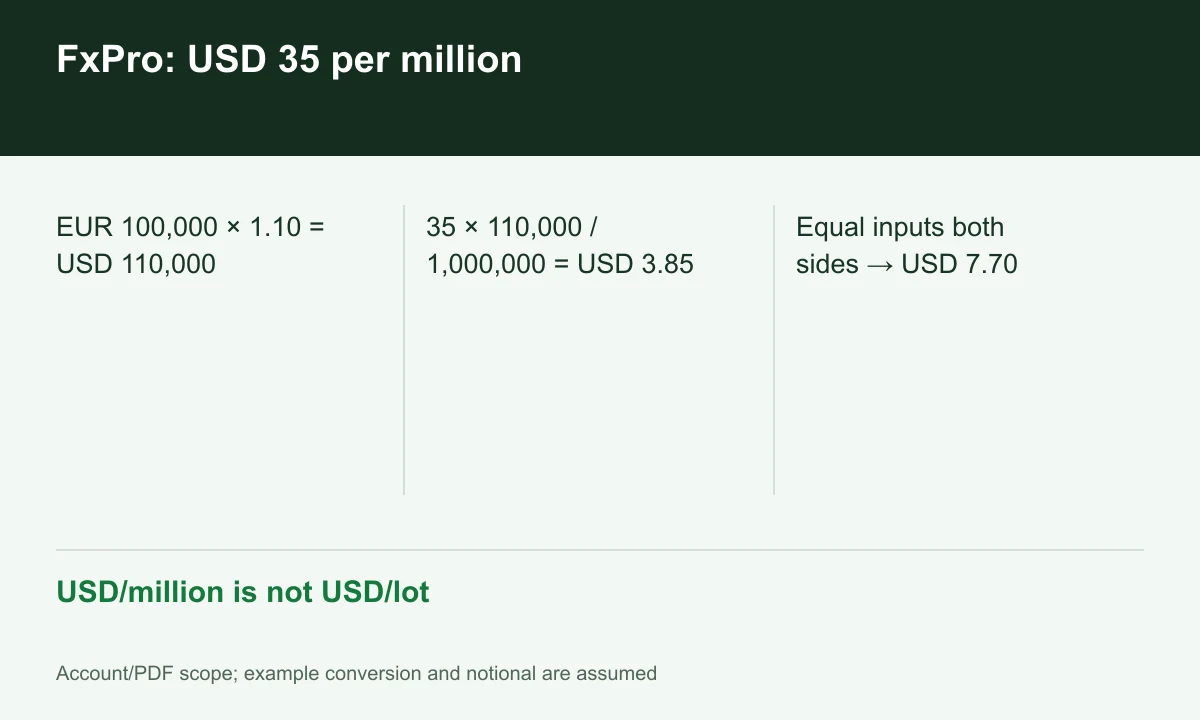
Provider guide
Price each side and convert base-currency notional rather than applying one USD-per-lot figure to every pair.
Read guide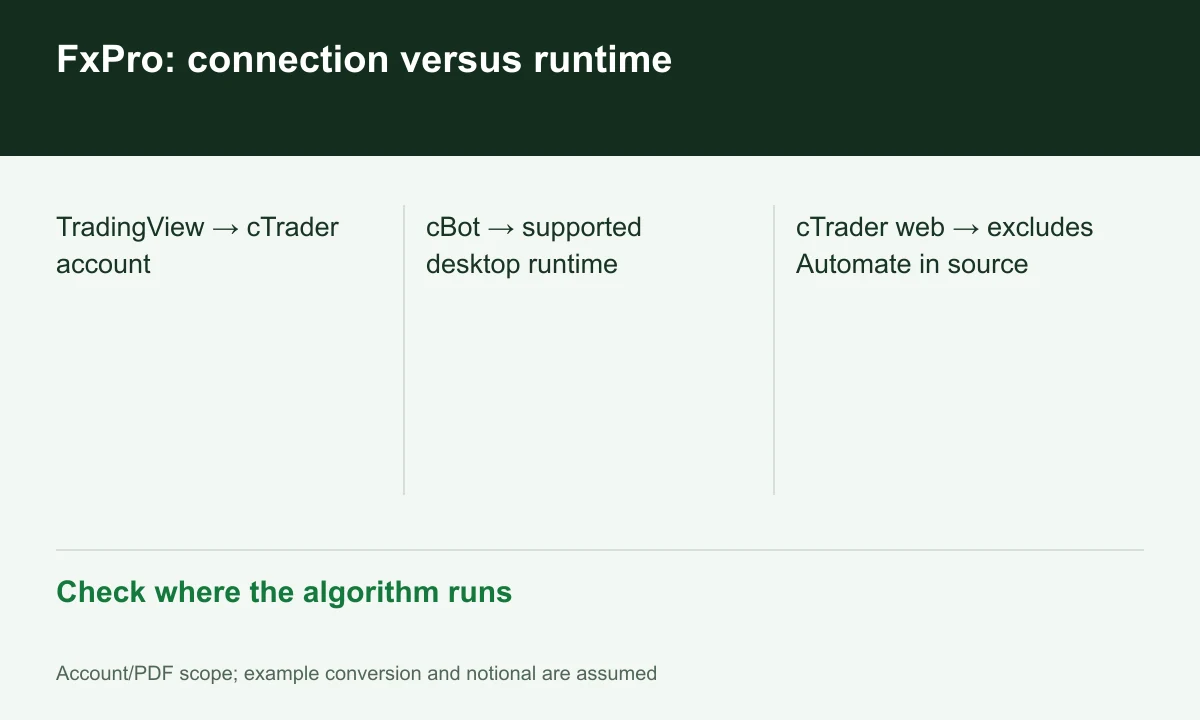
Provider guide
Distinguish account connectivity from the automation runtime when choosing desktop or web.
Read guide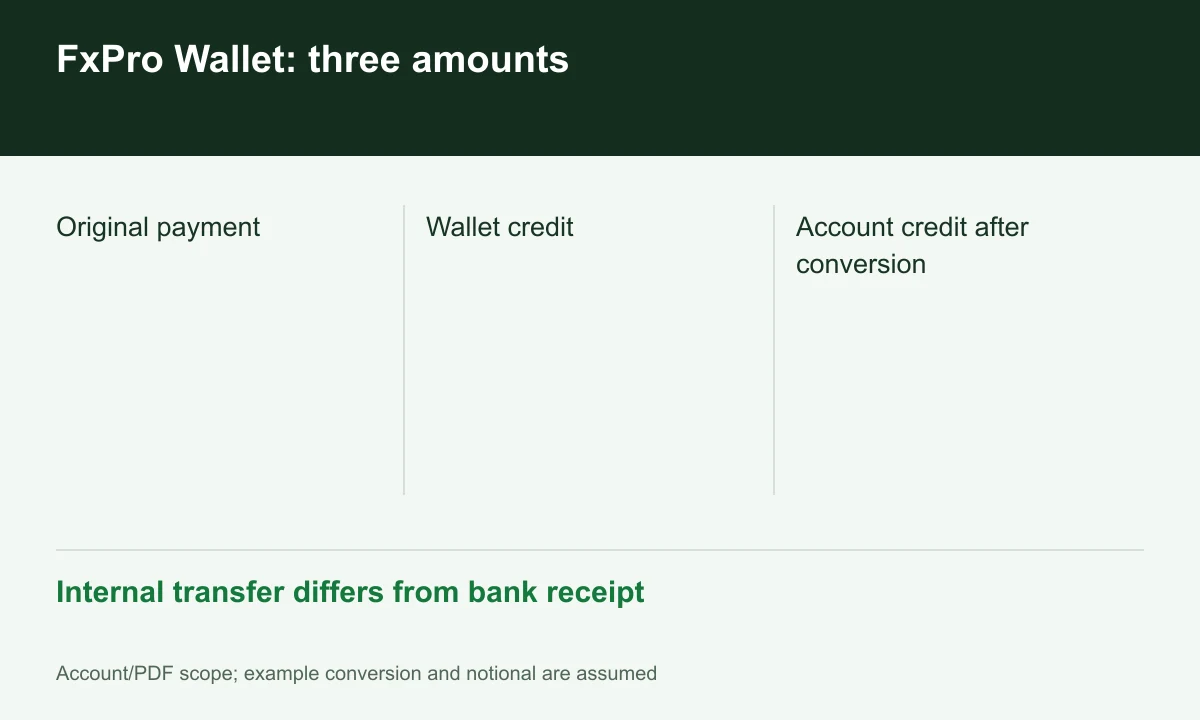
Provider guide
Separate internal transfers from bank settlement and check the no-trading e-wallet exception.
Read guide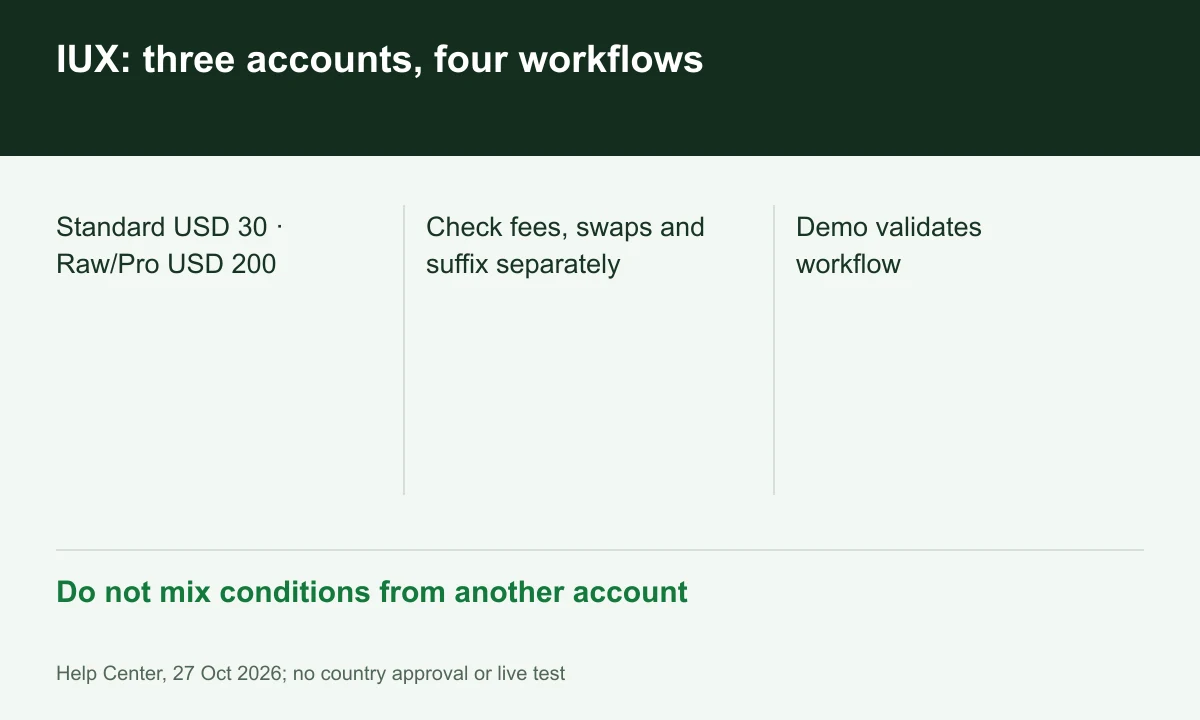
Provider guide
Match funding, fee units, suffixes and swap status using the current Help Center.
Read guide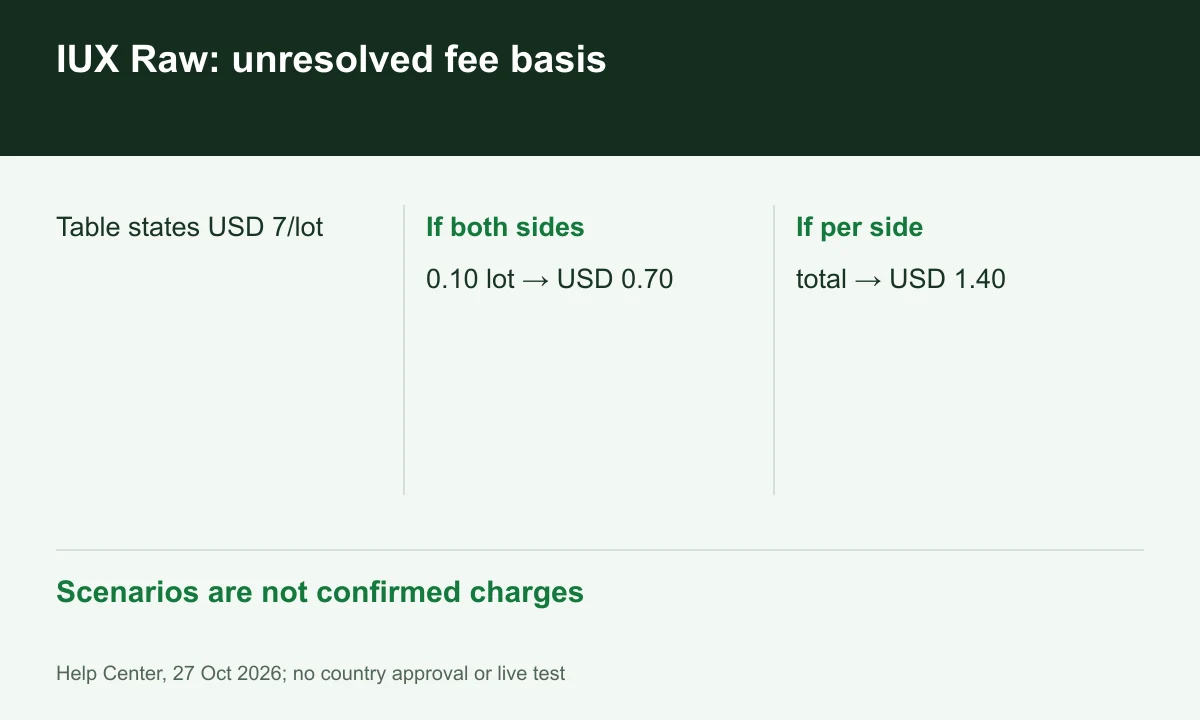
Provider guide
Keep two explicit fee scenarios until the applicable charging basis is confirmed.
Read guide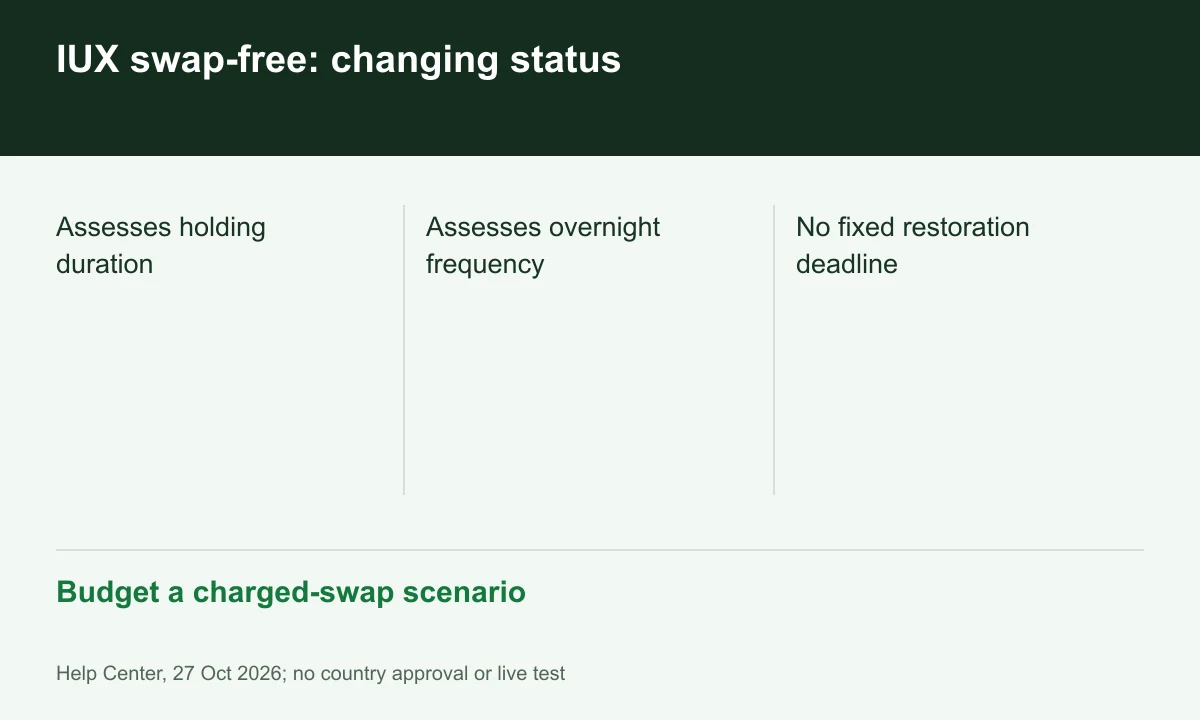
Provider guide
Track overnight frequency and charges; the source gives no fixed restoration deadline.
Read guide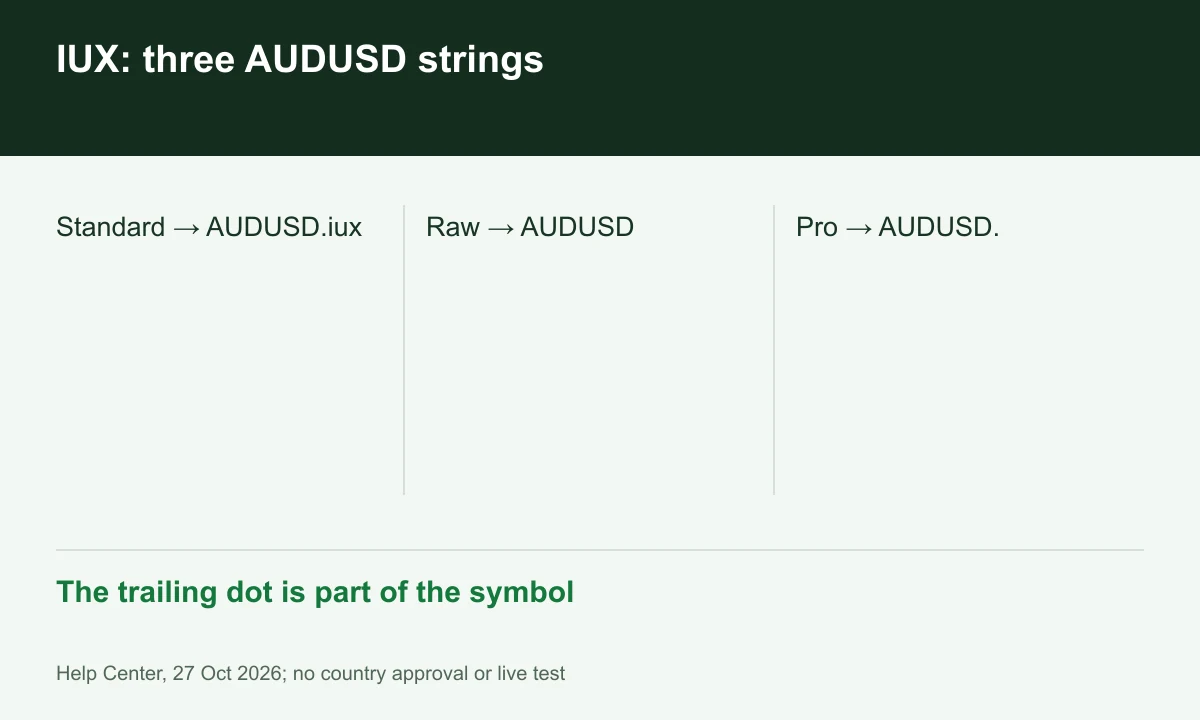
Provider guide
The Pro symbol ends with a dot; inspect exact strings before moving automated configurations.
Read guide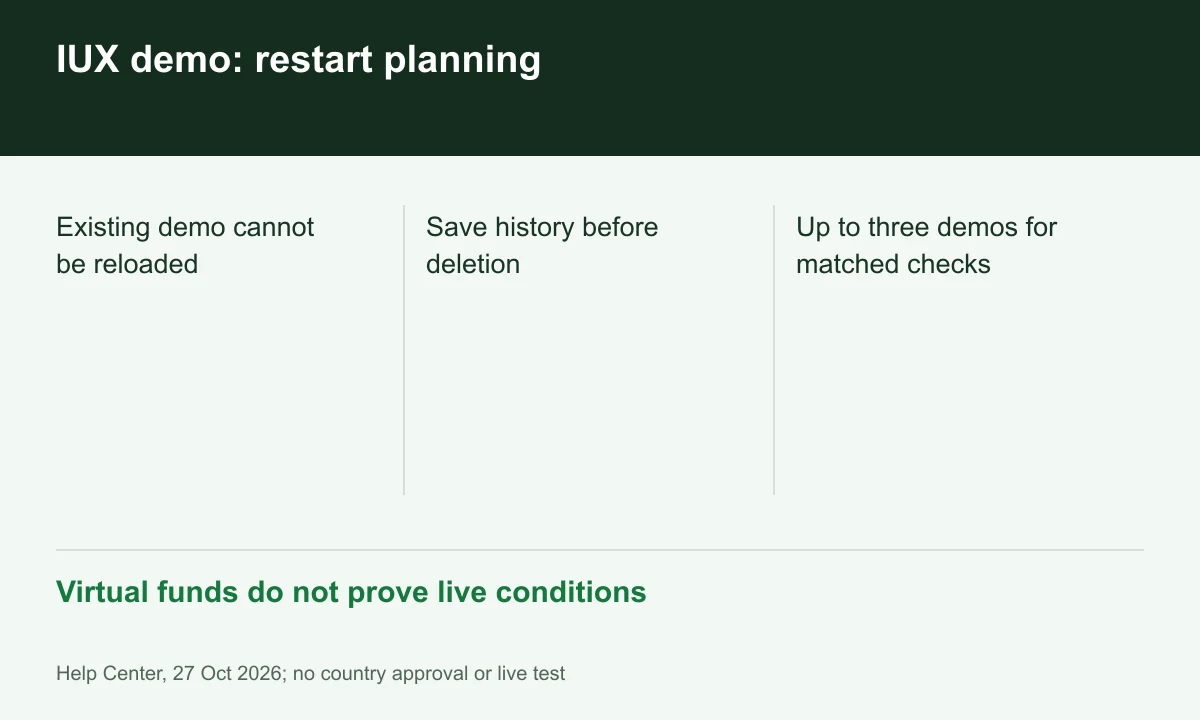
Provider guide
The current demo cannot be topped up; plan reproducible checks before virtual funds run out.
Read guide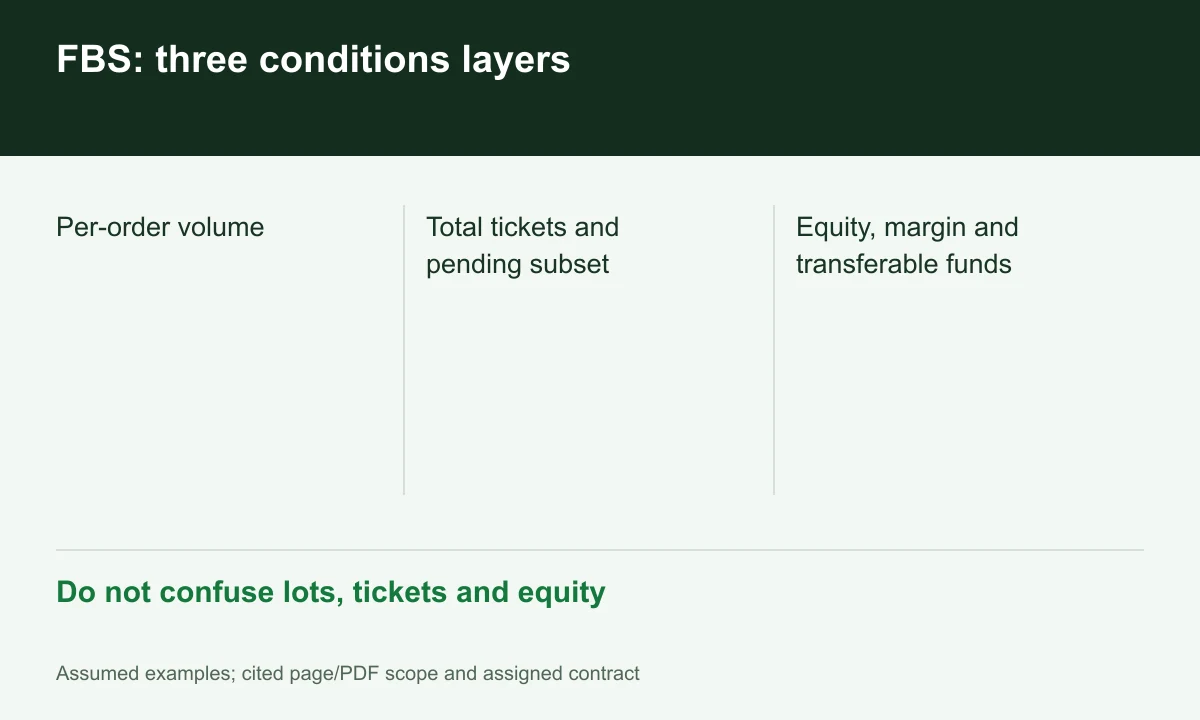
Provider guide
Read order limits, exposure-dependent leverage and source returns before using headline figures.
Read guide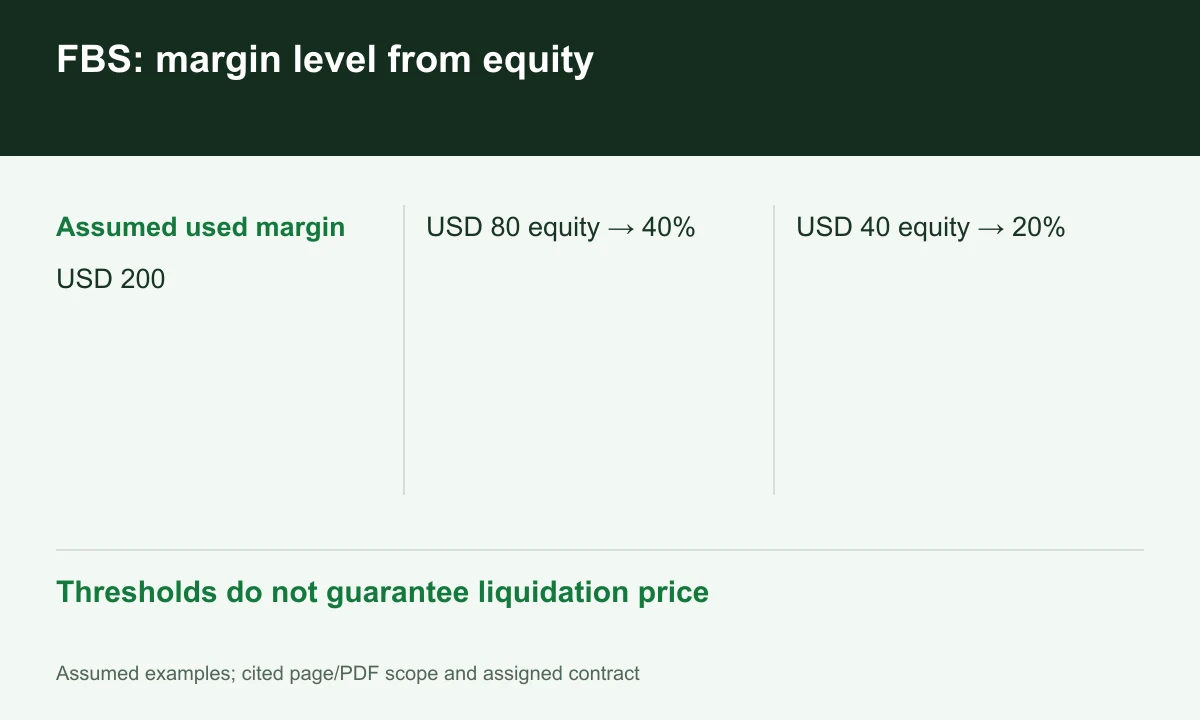
Provider guide
Use one used-margin input to understand the 40% and 20% thresholds, then inspect margin changes.
Read guide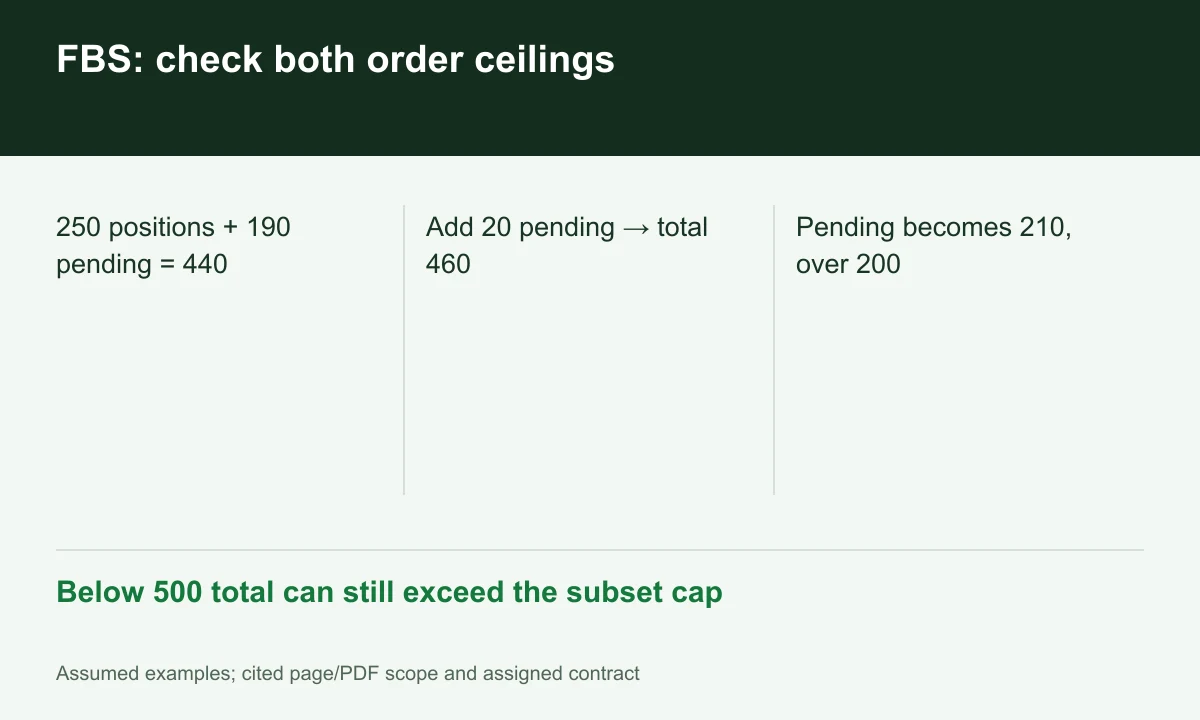
Provider guide
Count both limits before an EA submits batches; lots and tickets are different units.
Read guide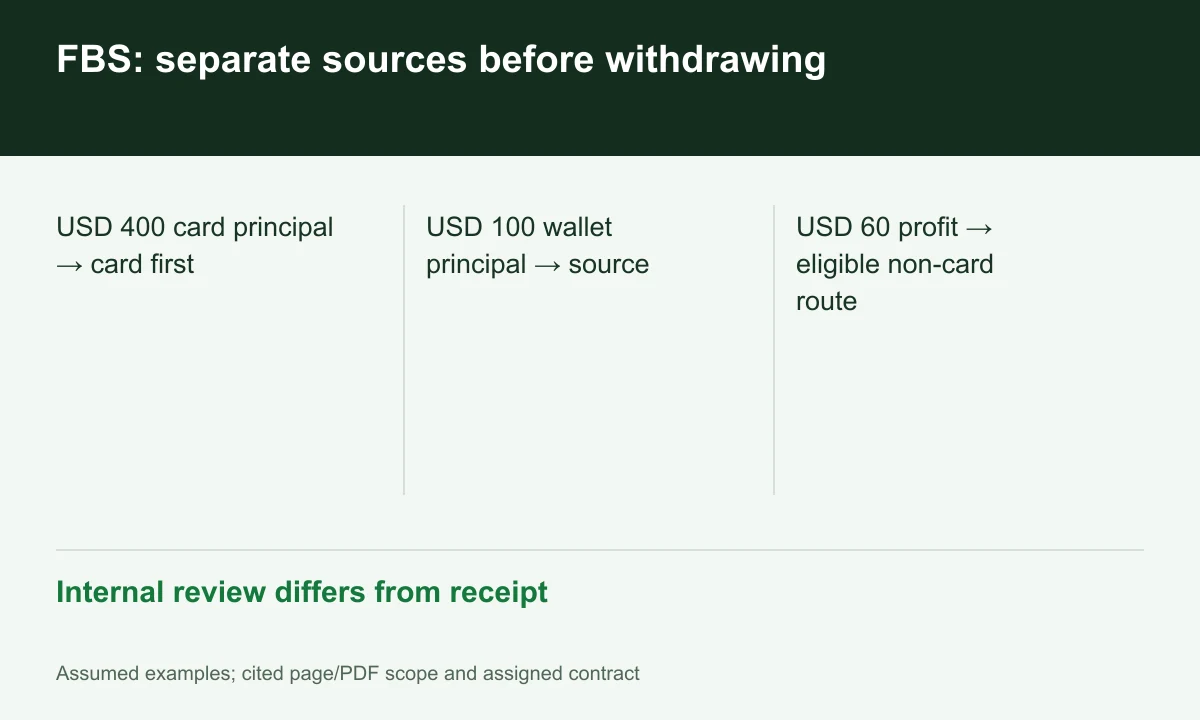
Provider guide
Track principal by deposit source, then separate review from bank receipt.
Read guide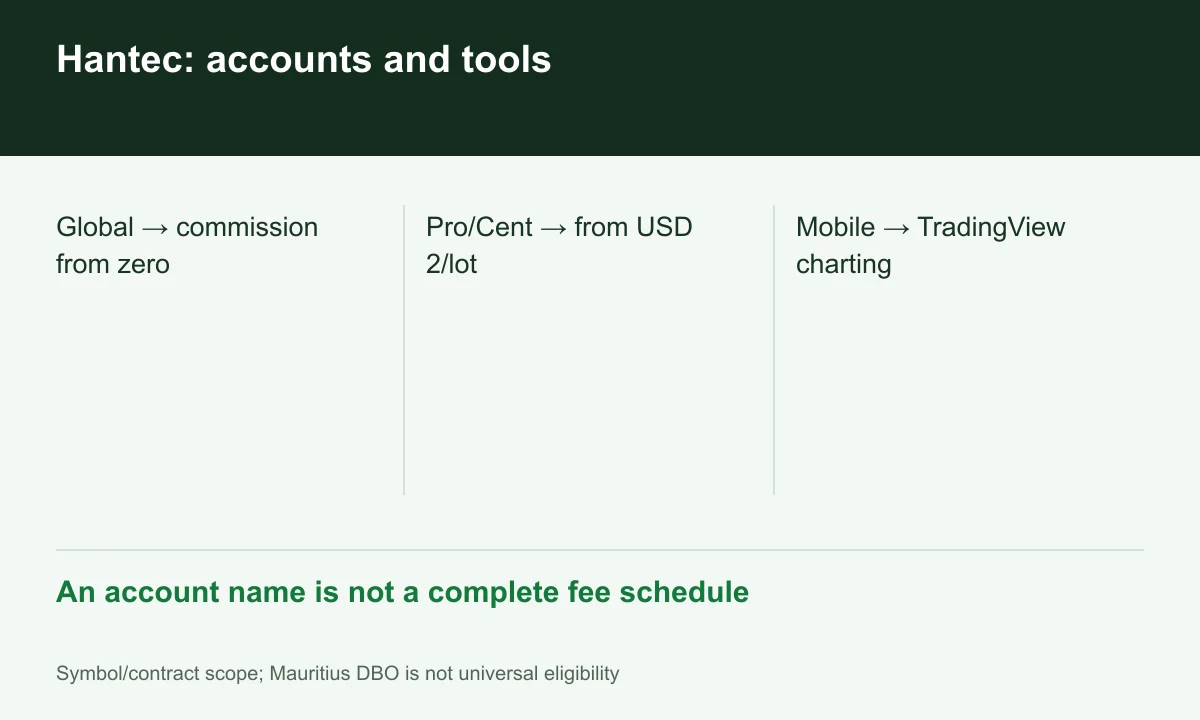
Provider guide
Read each account page rather than combining starting figures into one universal schedule.
Read guide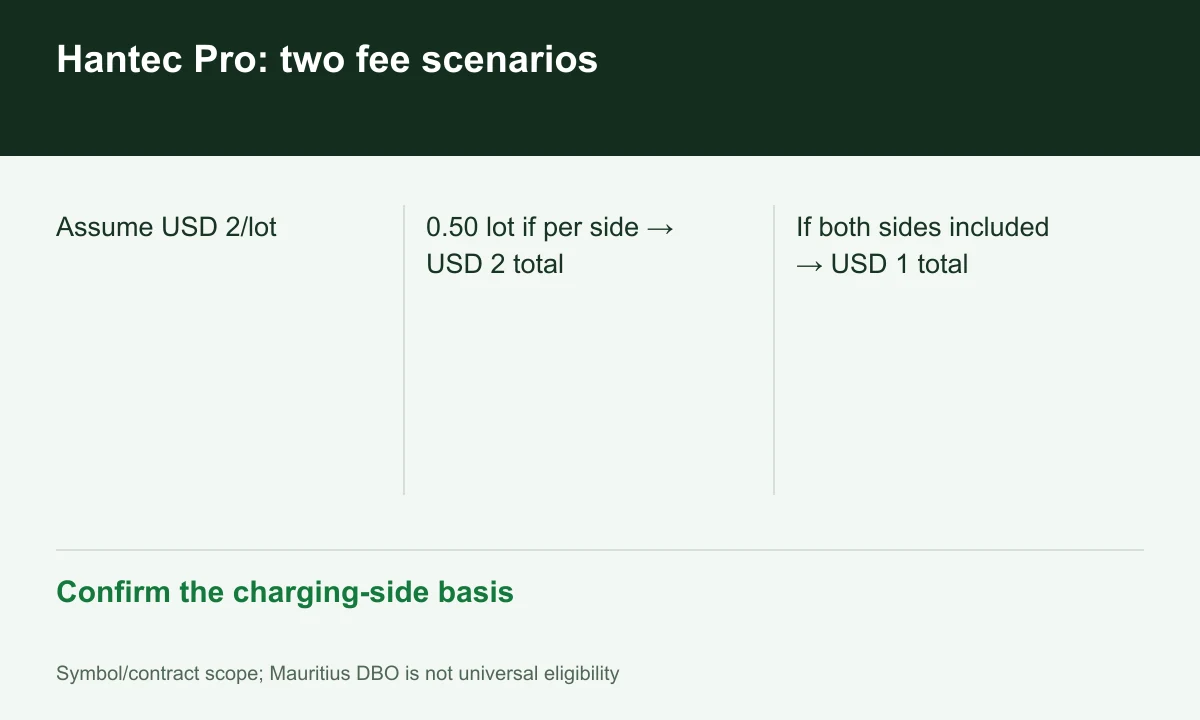
Provider guide
Model two side-basis scenarios and obtain instrument-specific pricing before comparing Global.
Read guide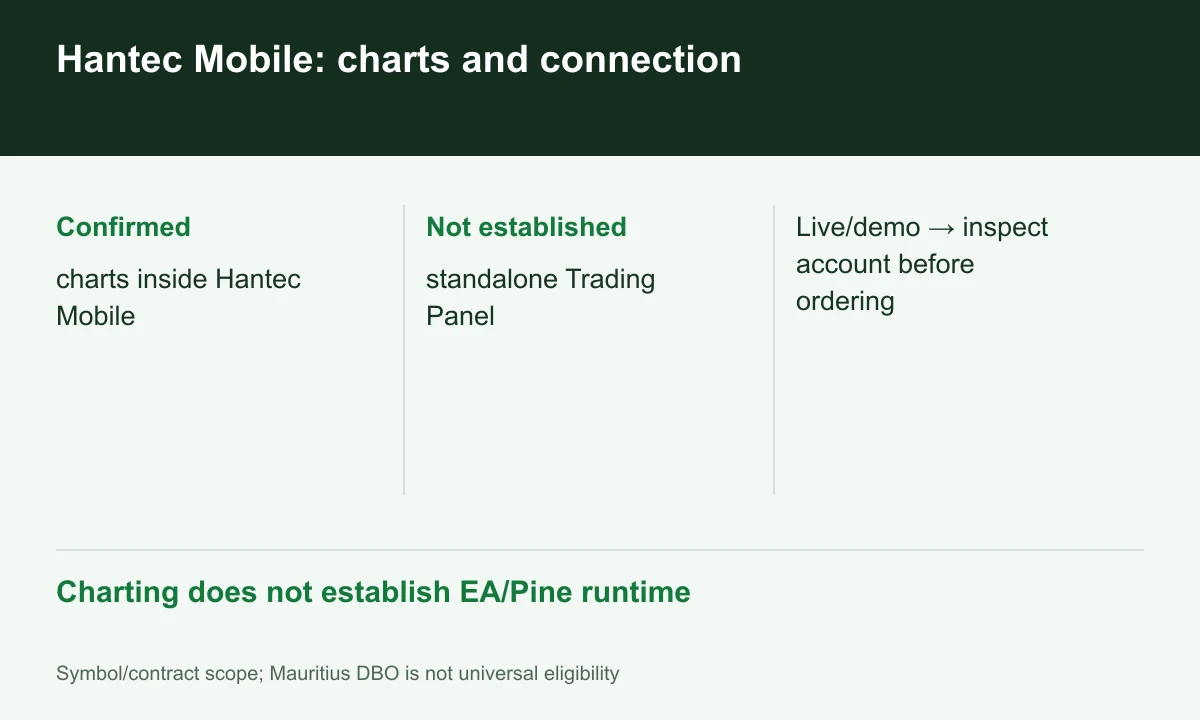
Provider guide
Identify whether you need in-app charts or standalone TradingView order entry before migrating.
Read guide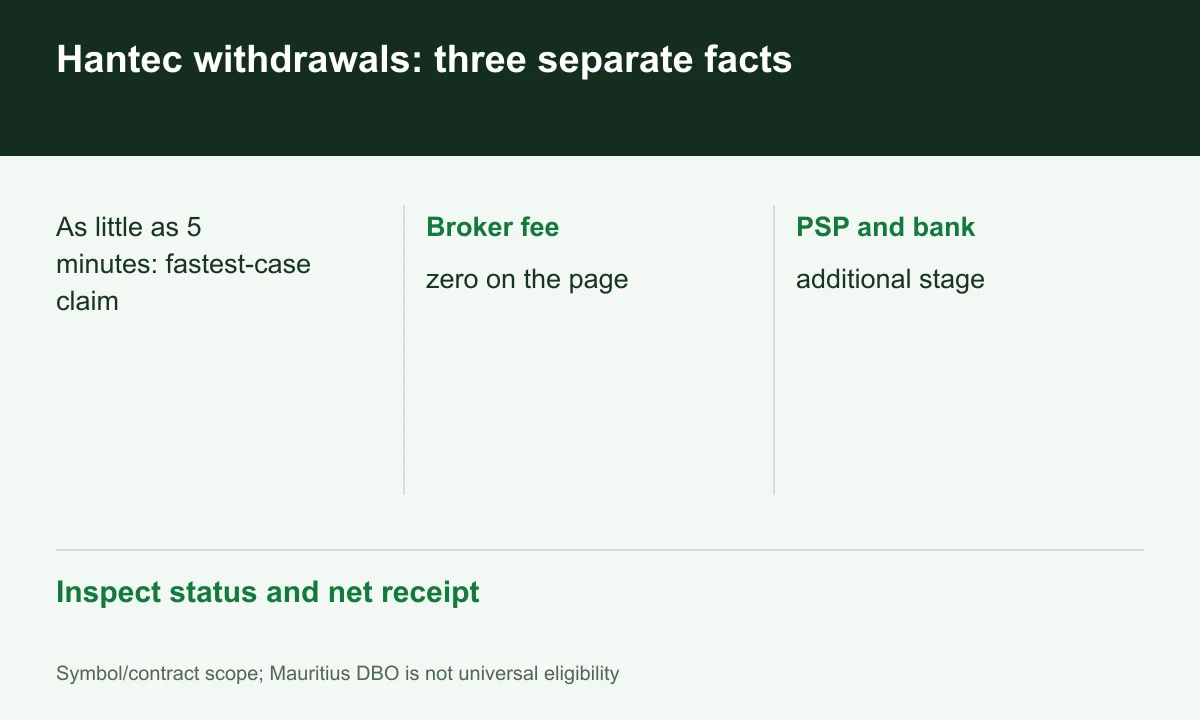
Provider guide
Separate an as-little-as-five-minute claim, zero broker charges and provider settlement.
Read guide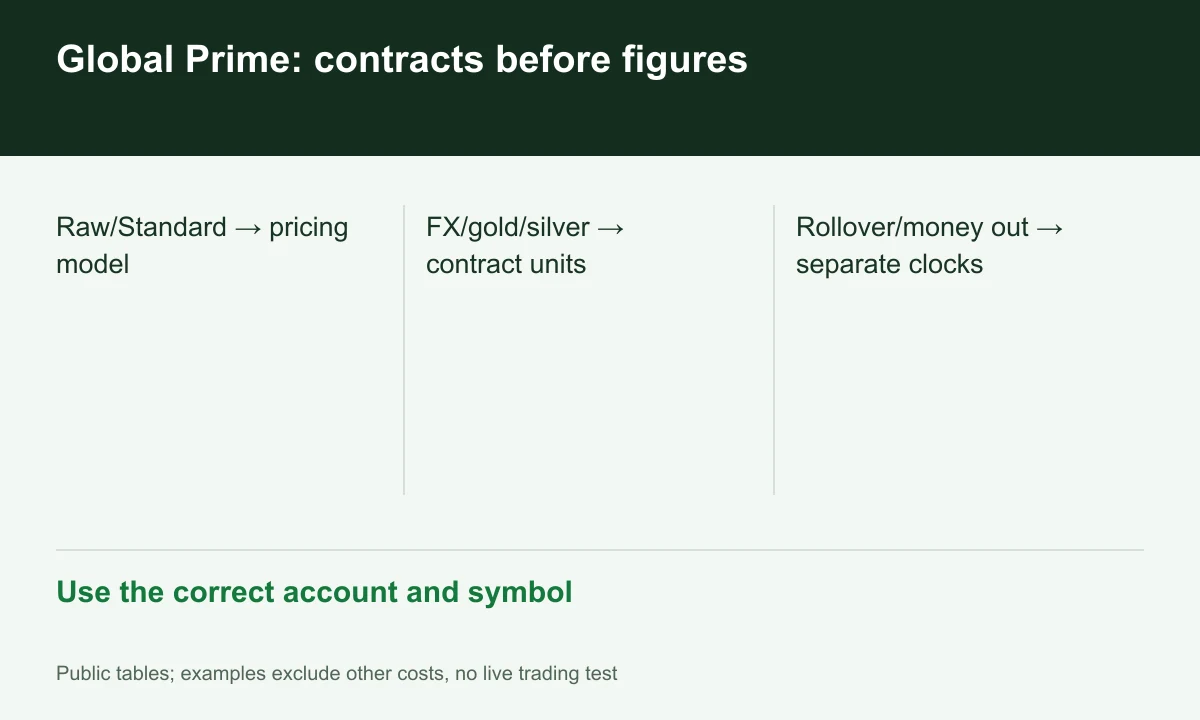
Provider guide
Separate account pricing from contract units, rollover timing and payment-channel limits.
Read guide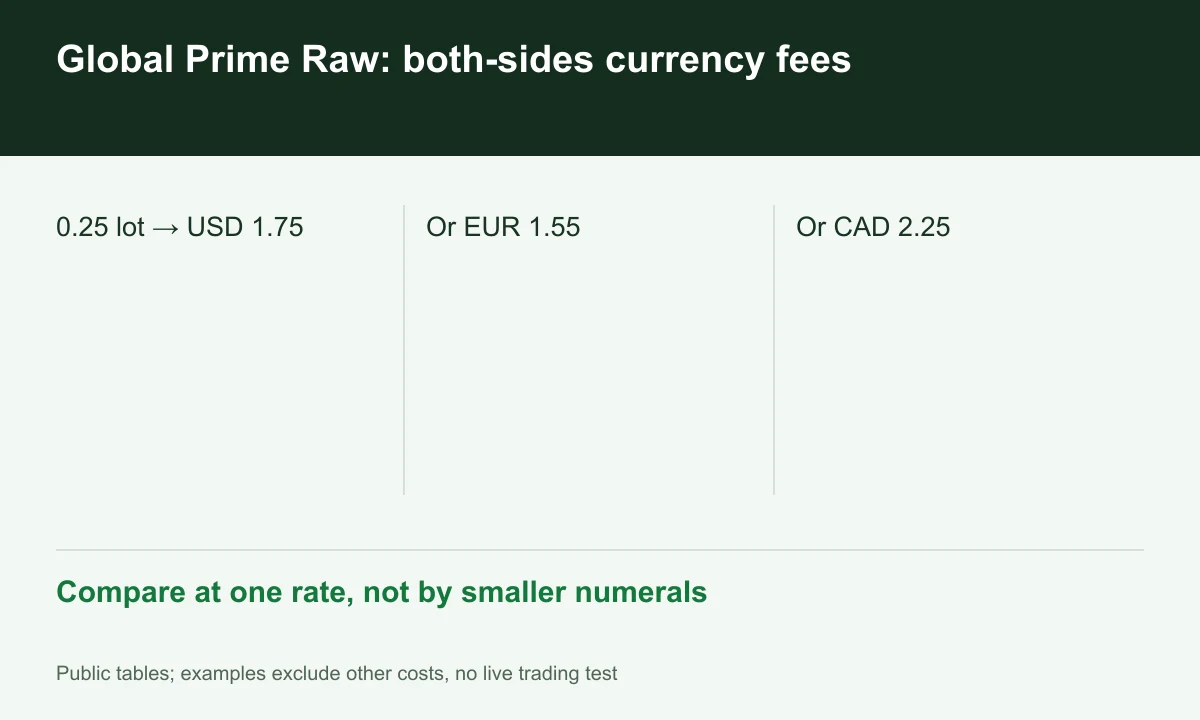
Provider guide
Price an open/close cycle in the correct account currency before converting for comparison.
Read guide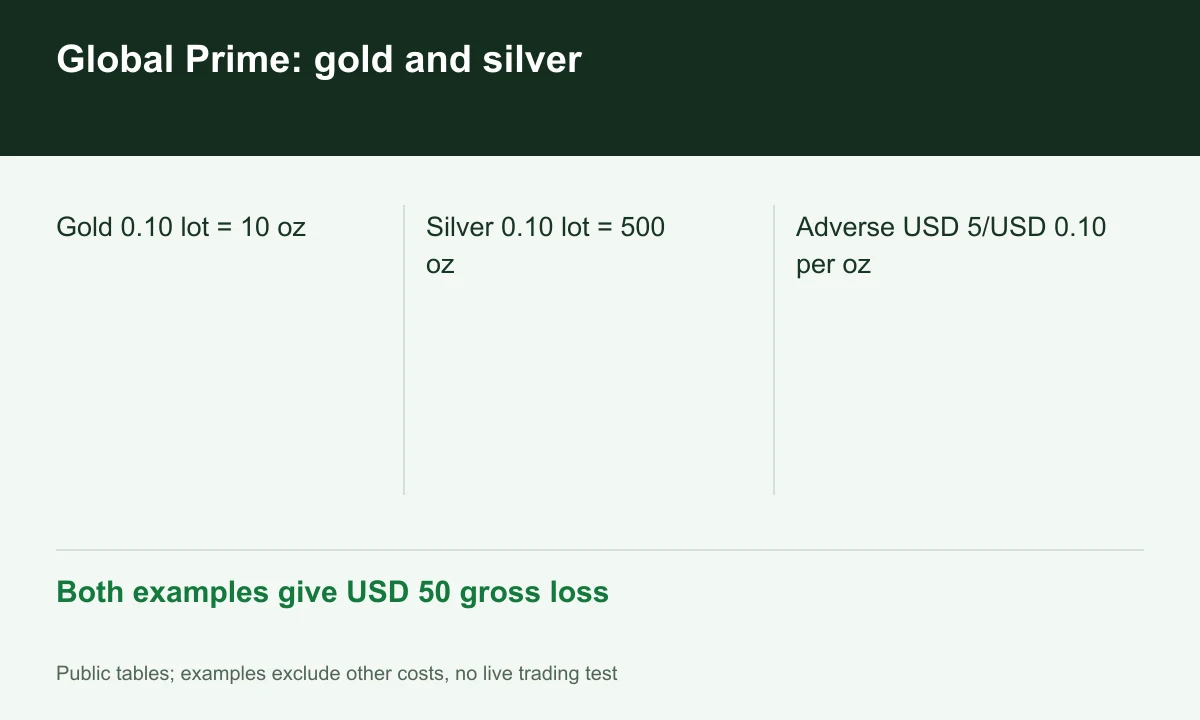
Provider guide
Use the listed 100-ounce gold and 5,000-ounce silver contracts to calculate cash movement.
Read guide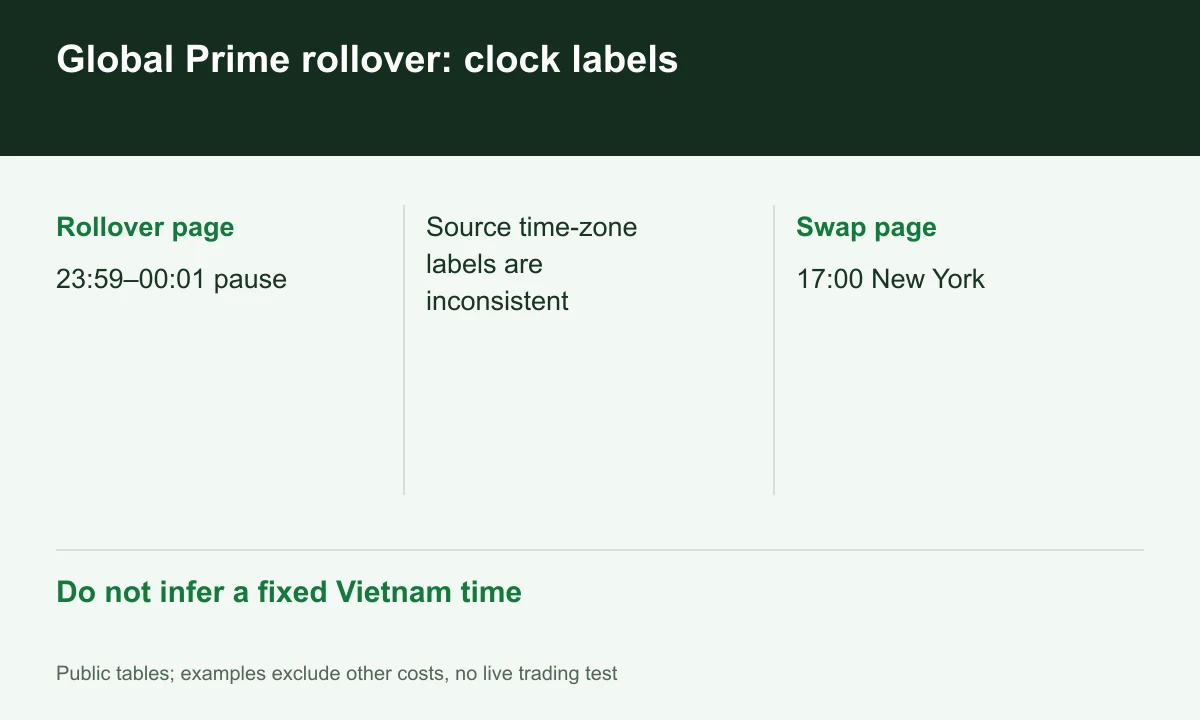
Provider guide
Preserve inconsistent clock labels and separate financing from order execution.
Read guide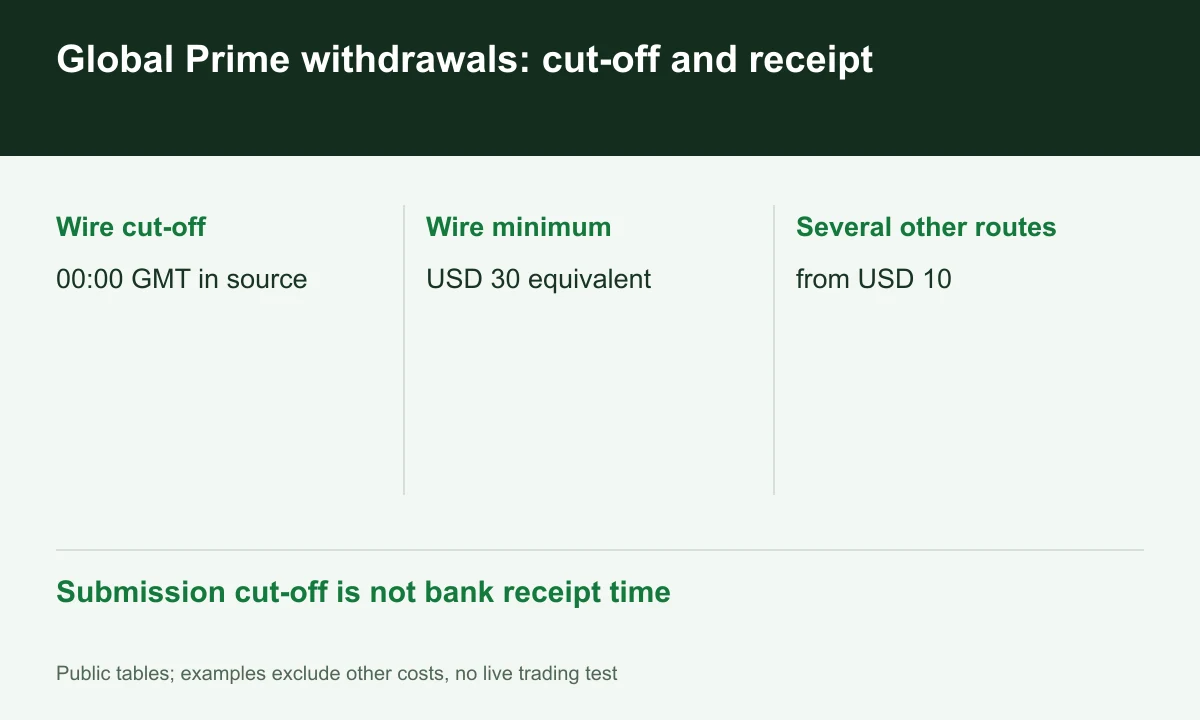
Provider guide
Separate wire submission cut-offs from receipt and inspect the minimal-trading fee exception.
Read guide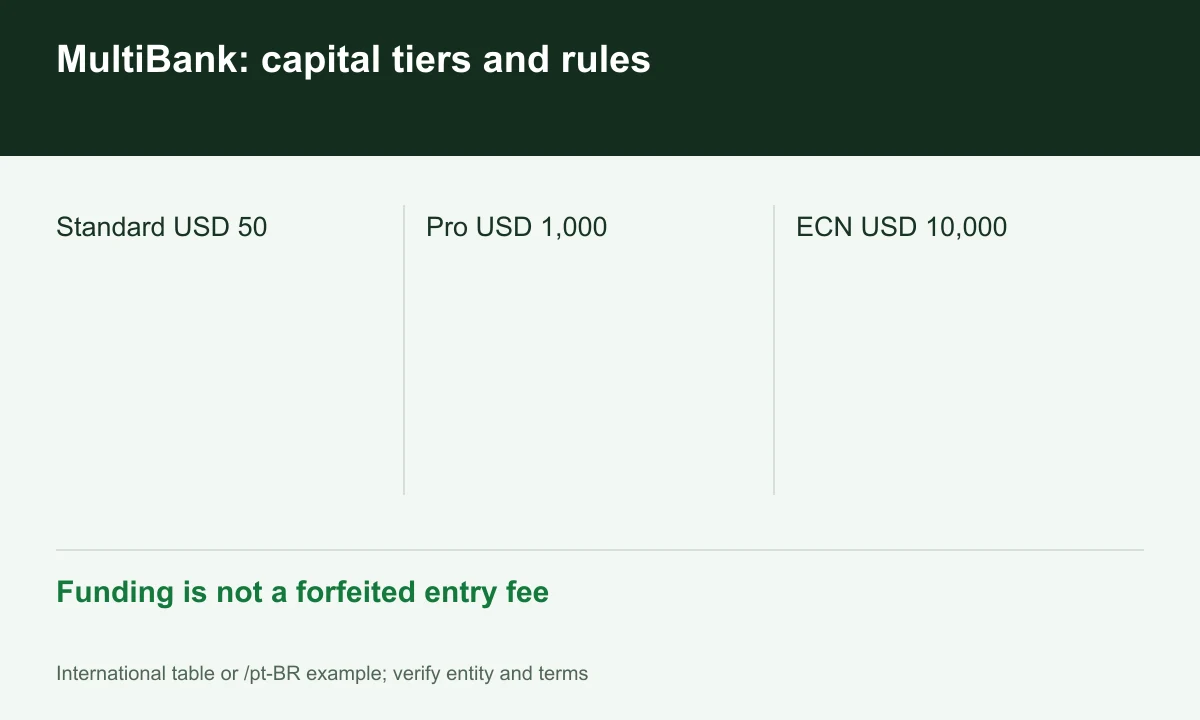
Provider guide
Compare Standard/Pro/ECN through capital gates, strategy rules and actual payment routes.
Read guide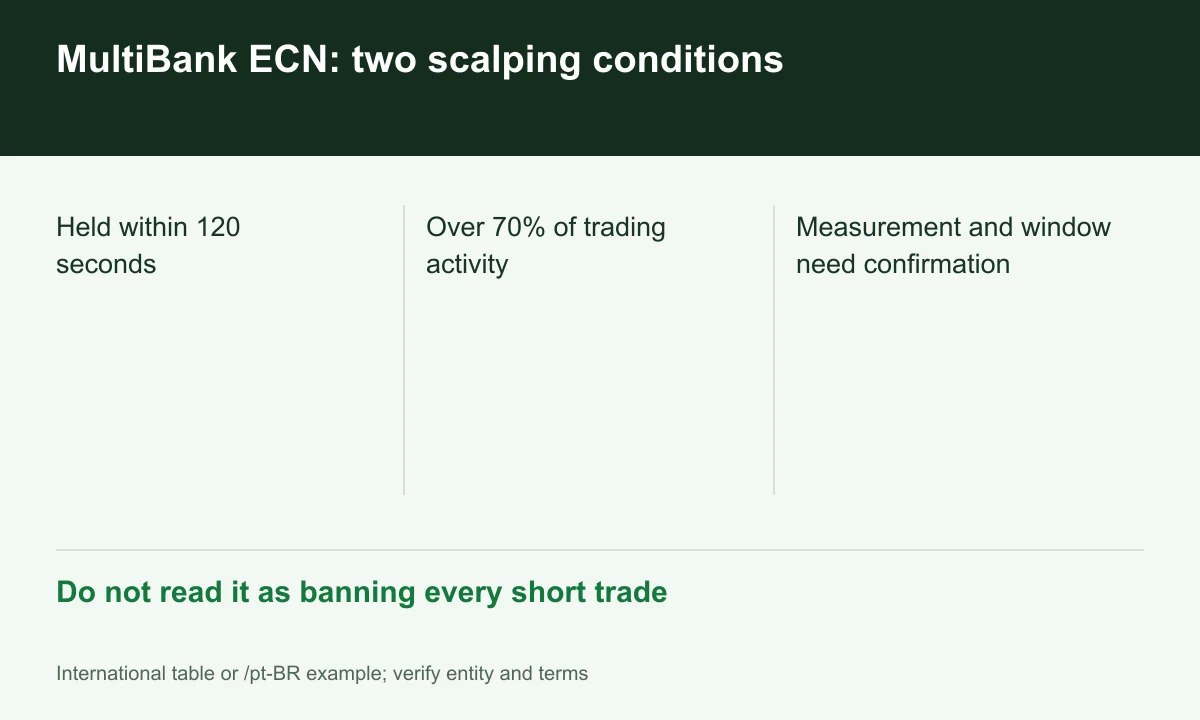
Provider guide
Read duration and activity share together rather than banning every short trade on every account.
Read guide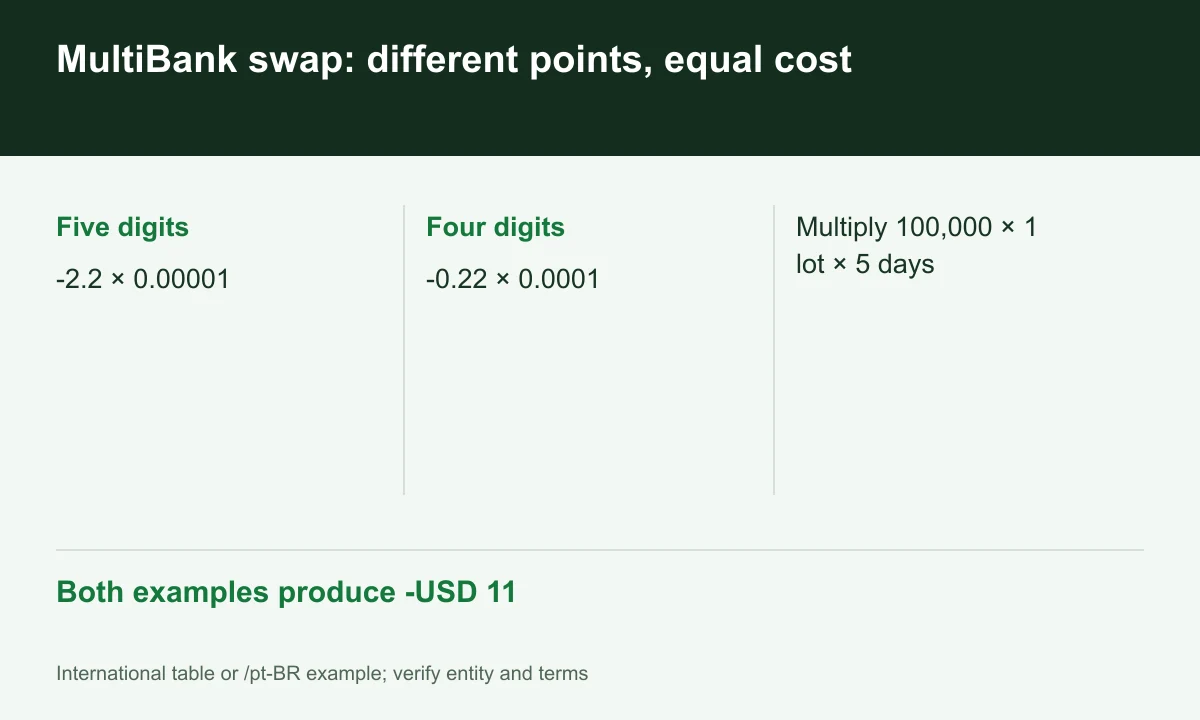
Provider guide
Different point displays can produce the same cost; use actual tick size and the rollover calendar.
Read guide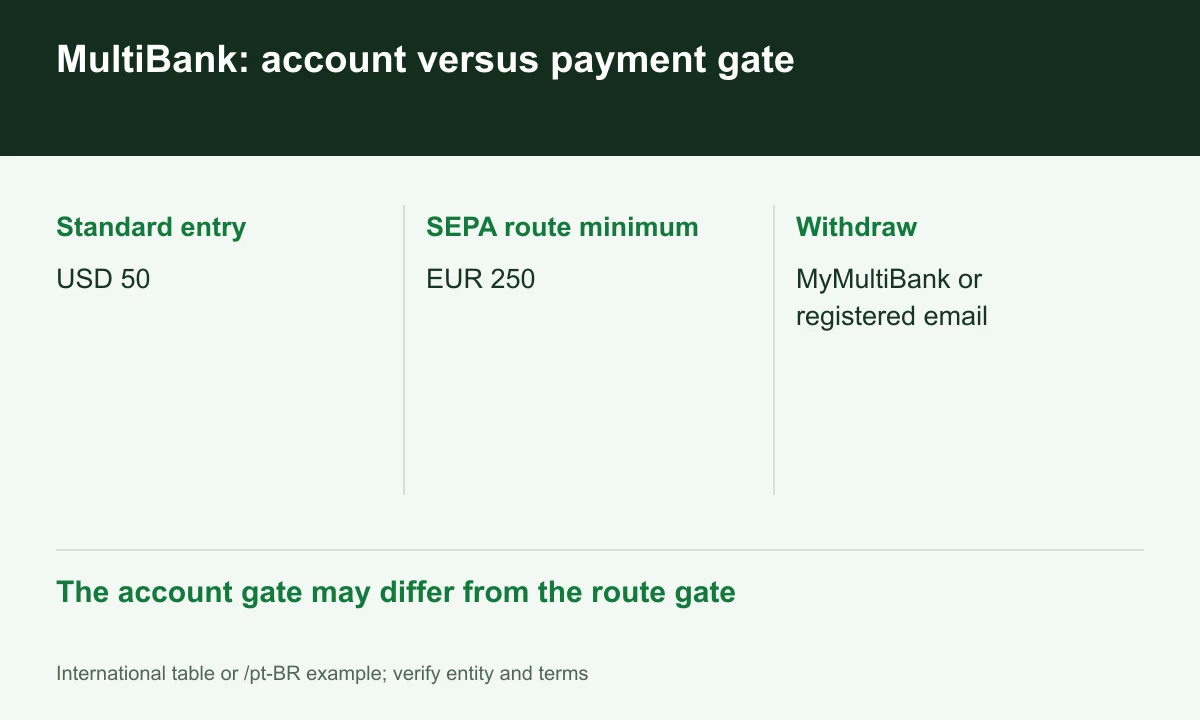
Provider guide
Separate account funding gates, payment-route minima and entity-specific withdrawal evidence.
Read guide
Provider guide
Connect ActivTrades spread mechanics, currency conversion and withdrawal routing before moving funds; distinguish published help guidance from account terms.
Read guide
Provider guide
Prepare ActivTrades' cancelled-card evidence and bank destination correctly, while keeping its review steps separate from the time a bank credits your funds.
Read guide
Provider guide
Understand ActivTrades' main account and individual trading balances, and distinguish money available for withdrawal from funds securing positions on a platform.
Read guide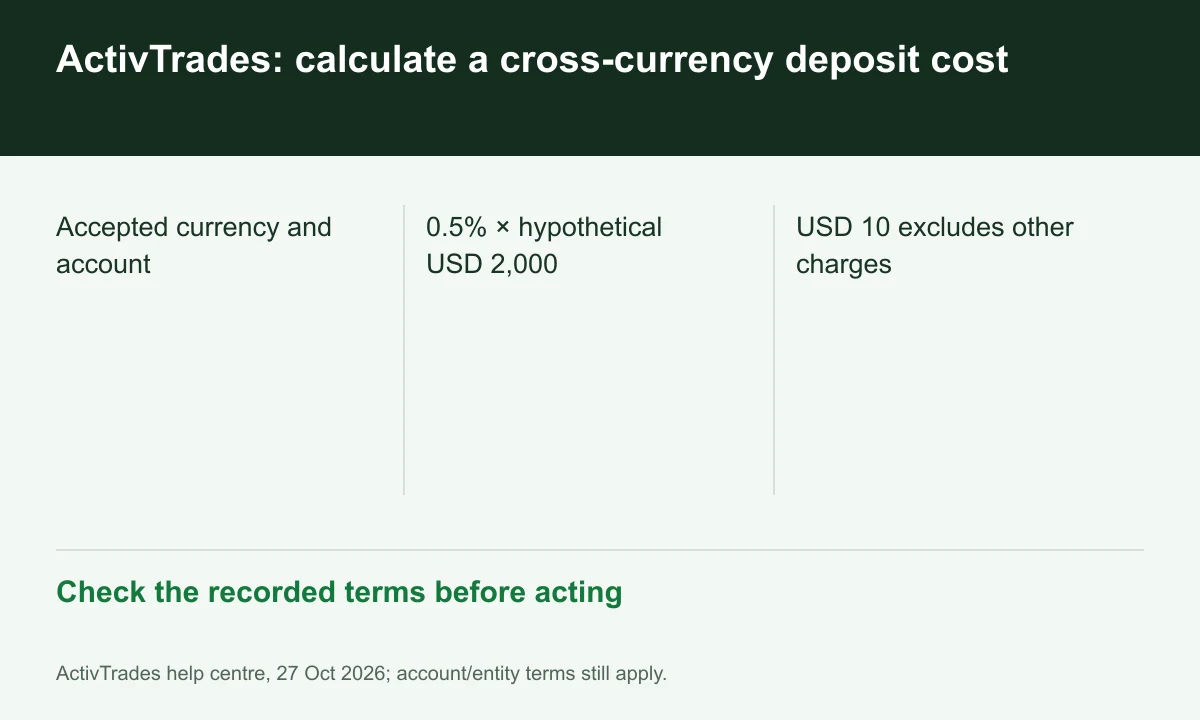
Provider guide
Use ActivTrades' published conversion percentage in a clearly hypothetical deposit example, without confusing the conversion fee with spread or bank charges.
Read guide
Provider guide
Explain why an ActivTrades position may start below zero, how widening affects a quote, and which records help distinguish spread from other trading costs.
Read guide
Provider guide
Follow AvaTrade's official cost, identity and withdrawal checkpoints, separating a group footer from the company and payment methods assigned to your account.
Read guide
Provider guide
Use AvaTrade's Finance or WebTrader withdrawal route, understand original-source priority, and separate its processing estimate from actual receipt by your bank.
Read guide
Provider guide
Prepare AvaTrade identity and address evidence with matching details and readable full documents, while retaining regional verification conditions and privacy.
Read guide
Provider guide
Read the AvaProtect trade-level premium and expiry workflow, including what happens to a still-open position; avoid treating paid time-limited cover as account insurance.
Read guide
Provider guide
Distinguish AvaTrade's published three-month inactivity charge from the annual administration charge, and keep a hypothetical budget separate from actual eligibility.
Read guide
Provider guide
Map CMC UK's Next Generation order controls, from entry instructions to guaranteed stops and account close-out settings, with explicit product and regional scope.
Read guide
Provider guide
Check CMC UK's guaranteed stop requirements and premium refund conditions, including how adding a GSLO can alter the position's margin requirement.
Read guide
Provider guide
Understand when CMC UK's boundary range can reject an order, and distinguish that execution filter from a limit price or a guaranteed exit instruction.
Read guide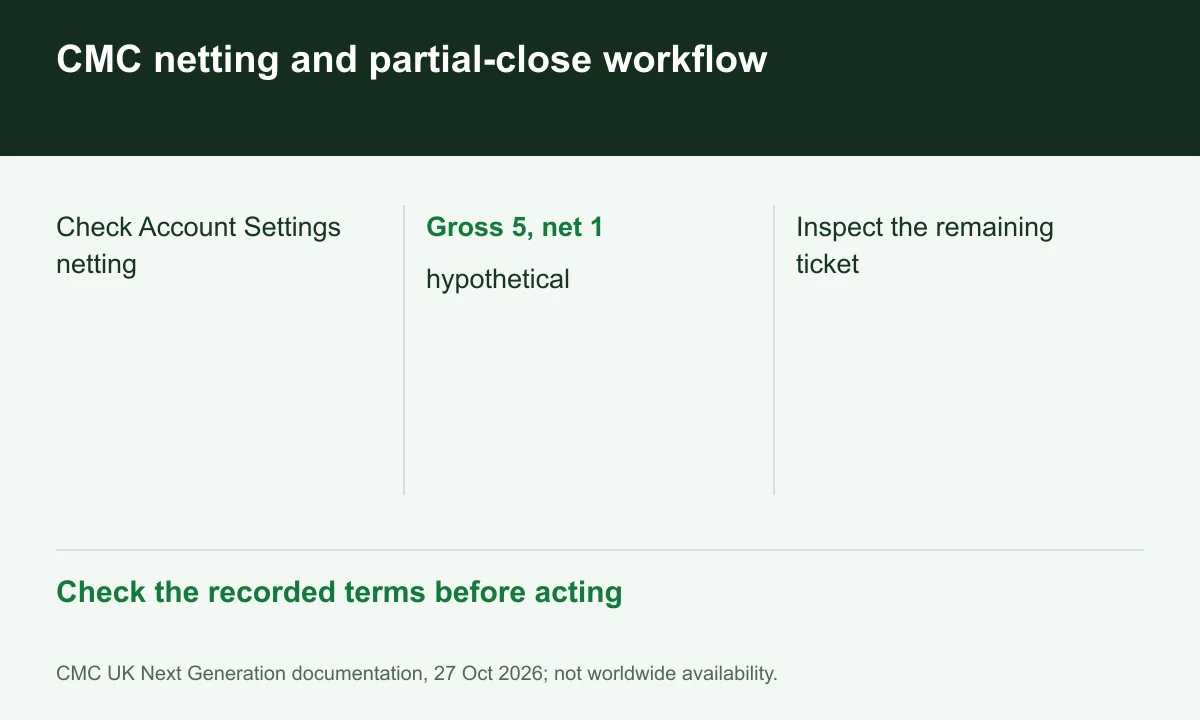
Provider guide
Read CMC UK's netting preference and trade-level partial closure before placing opposite-direction tickets; distinguish gross open trades from net exposure.
Read guide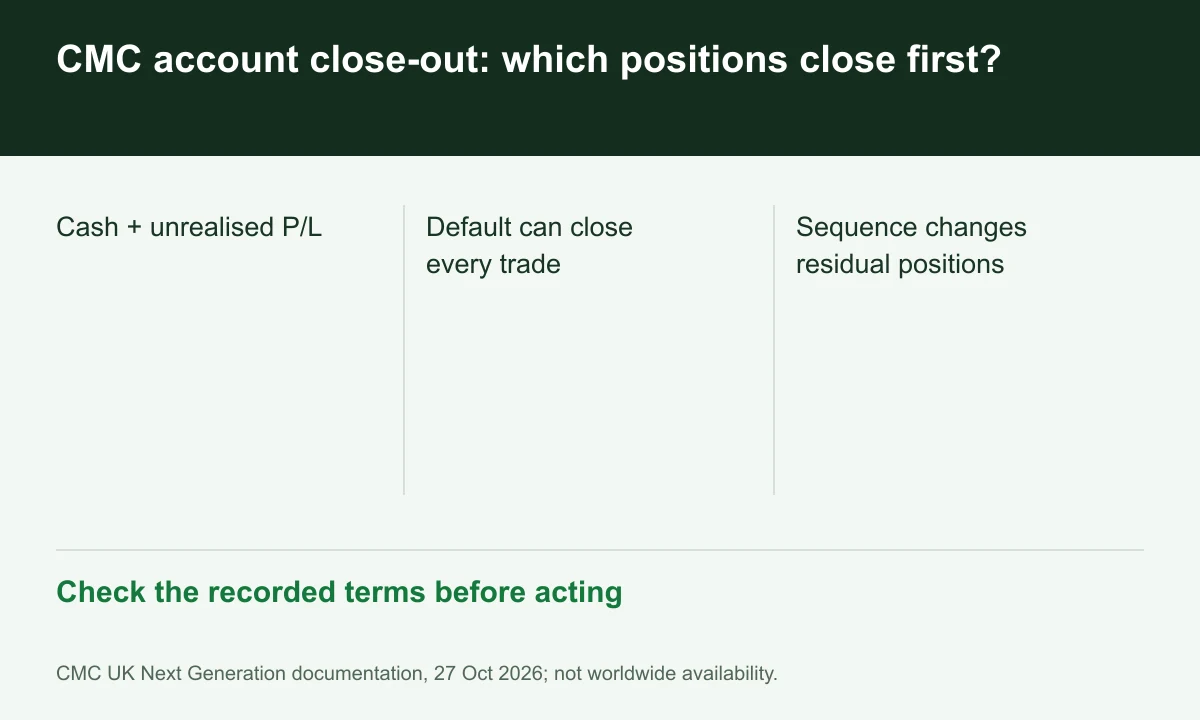
Provider guide
Compare CMC UK's account close-out sequence options and the distinction between standard and prime margin, without assuming a guaranteed liquidation price.
Read guide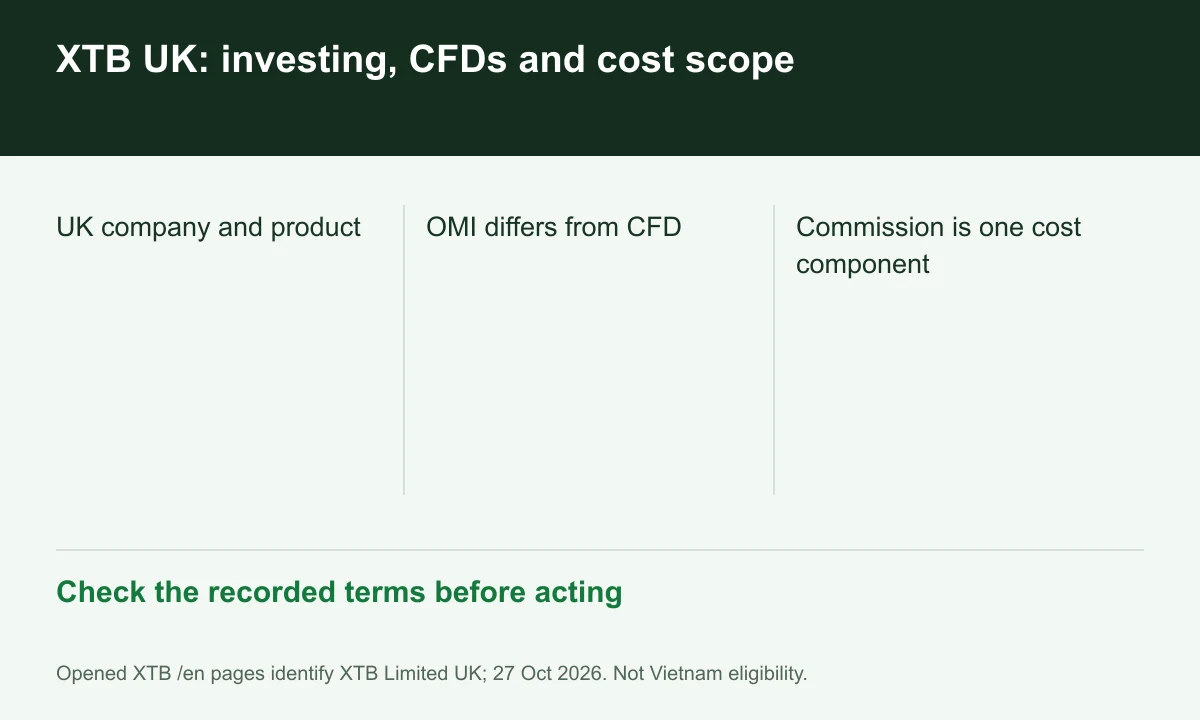
Provider guide
Separate XTB UK's exchange-traded investing from CFDs, then check turnover, conversion and inactivity conditions without borrowing terms from another XTB entity.
Read guide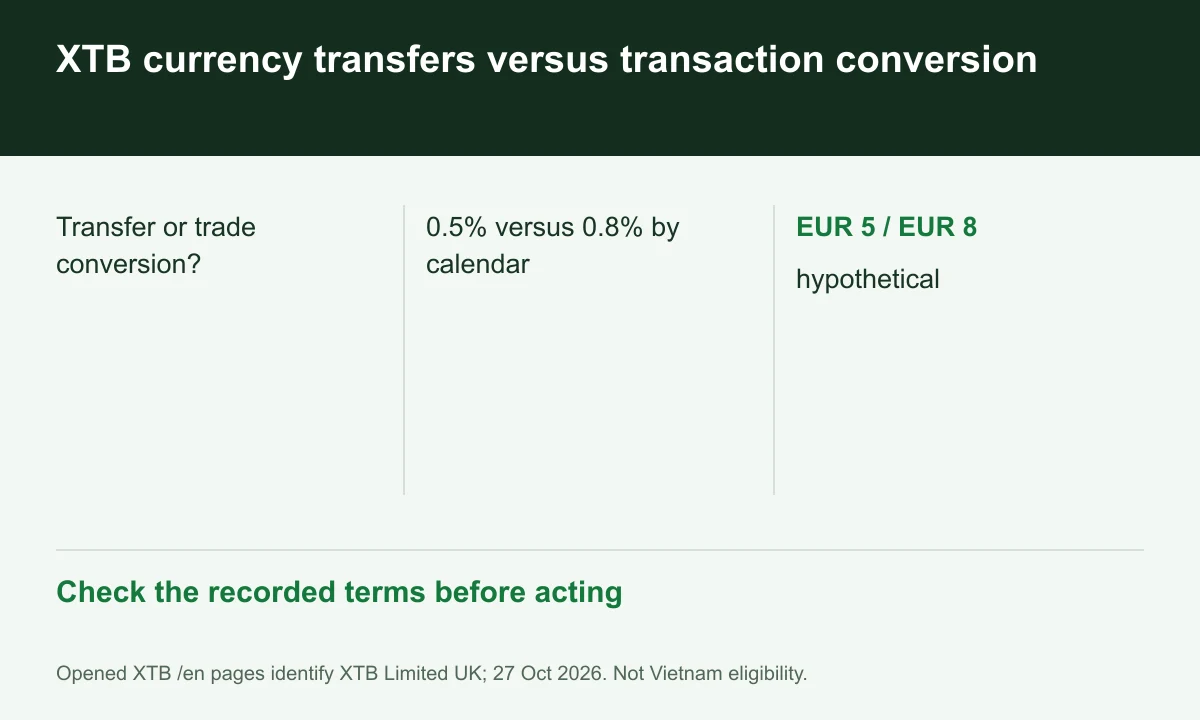
Provider guide
Distinguish XTB UK's inter-account exchange charge from transaction conversion, using hypothetical arithmetic and a clear record of account and instrument currencies.
Read guide
Provider guide
Work through XTB UK's published trading and deposit inactivity tests together, including cash-balance and open-position exceptions, without suggesting unnecessary trades.
Read guide
Provider guide
Review XTB UK's plan composition and recurring payment setup, distinguishing a target allocation from a return guarantee and account fees from underlying transaction costs.
Read guide
Provider guide
Read XTB UK's monthly turnover threshold without extending zero commission to every cost, and recognize the currency mismatch between two official fee descriptions.
Read guide
Provider guide
Connect FXCM Markets' account reporting and Trading Station tools with explicitly separate UK rollover guidance, without borrowing regional protection or fee terms.
Read guide
Provider guide
Follow FXCM Markets' withdrawal report and notification trail, including card-source routing and the distinction between provider processing and personal bank receipt.
Read guide
Provider guide
Read FXCM UK's overnight holding trigger and Trading Station rate display without fixing a Vietnam clock conversion or applying the UK's terms to another FXCM entity.
Read guide
Provider guide
Make FXCM Trading Station Desktop backtests easier to review by recording strategy inputs, test ranges and separate validation, without claiming FINEX tested a strategy.
Read guide
Provider guide
Interpret FXCM Trading Station's SSI and Real Volume as provider-specific observations, while keeping market-depth access and mobile execution limitations explicit.
Read guide
Provider guide
Read Markets.com's platform and payment guidance with instrument-specific conditions, distinguishing global FAQ statements from the separate South African inactivity article.
Read guide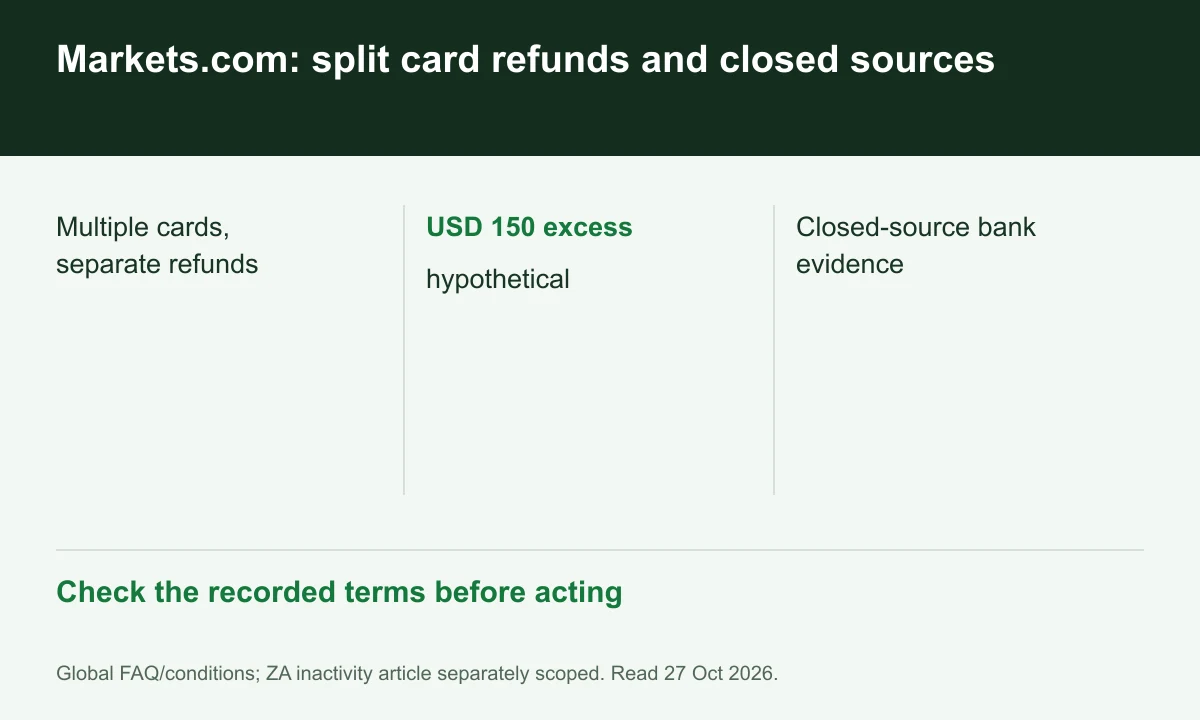
Provider guide
Understand Markets.com's card-refund priority, excess-profit route and closed-account evidence, then track payment timing separately from provider completion.
Read guide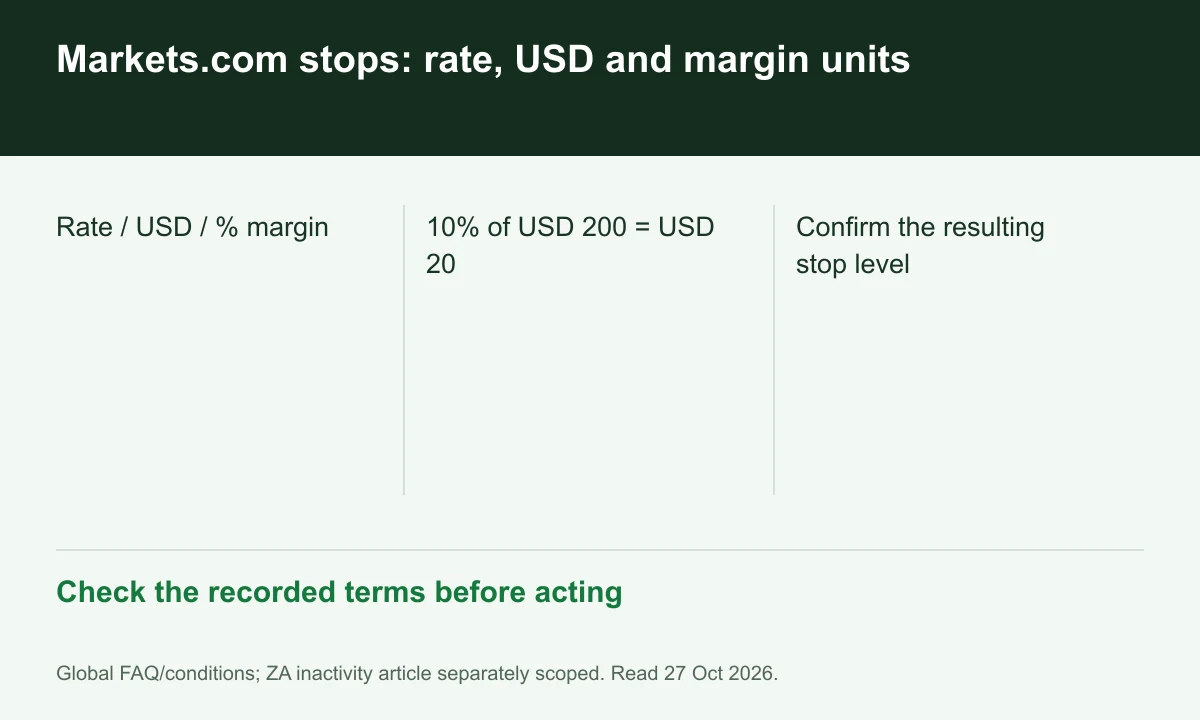
Provider guide
Read Markets.com's stop-loss input modes without confusing a percentage of margin with a percentage of total equity, and check the order confirmation before relying on it.
Read guide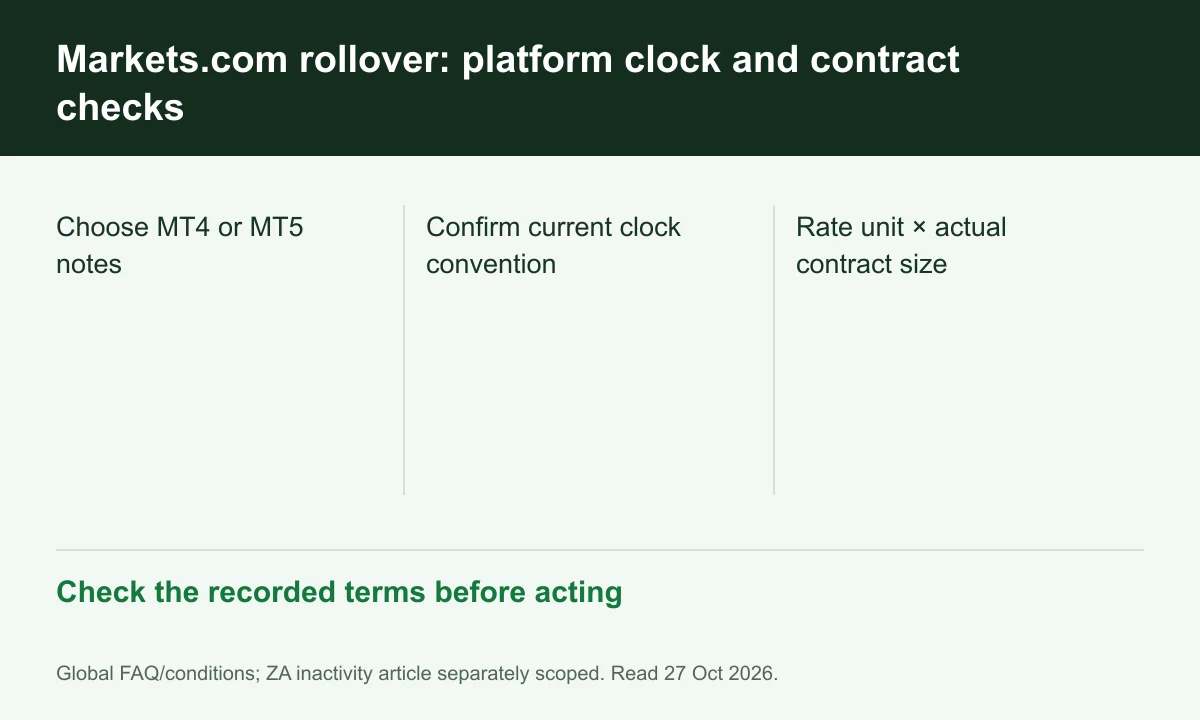
Provider guide
Compare Markets.com's MT4 and MT5 rollover notes and instrument rows, avoiding a universal local reset time or a copied financing rate from another product.
Read guide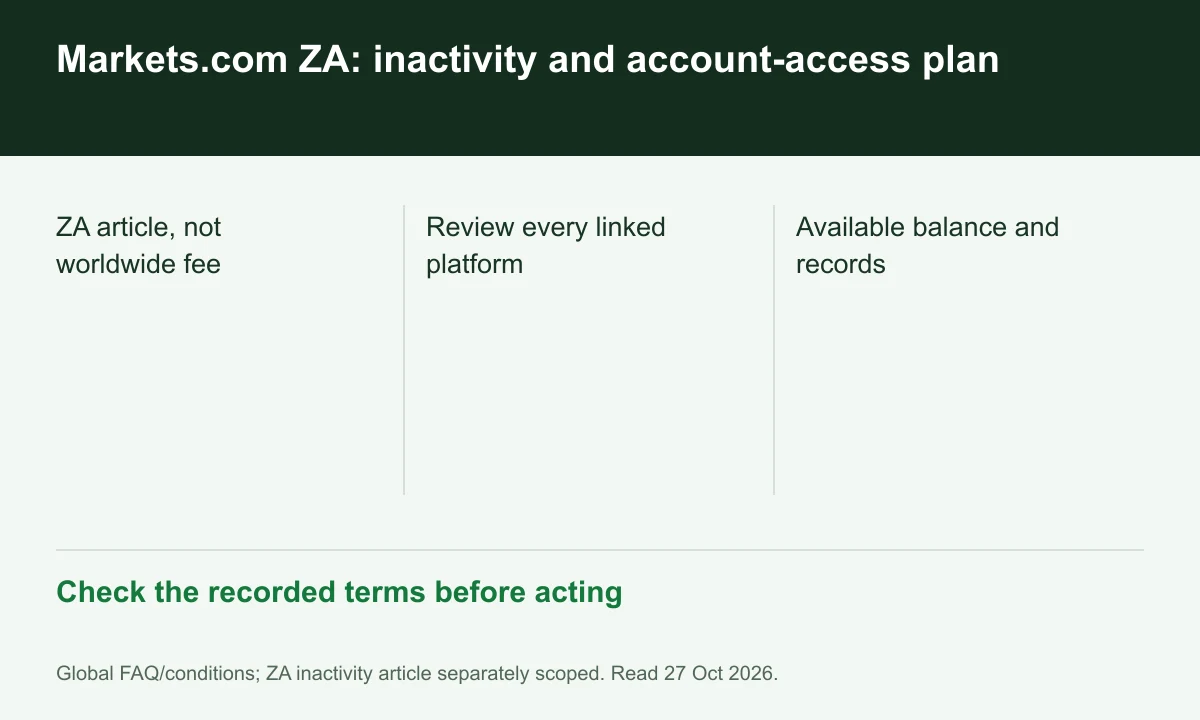
Provider guide
Read the South African Markets.com inactivity article in its own scope, including multiple-platform treatment and a practical records checklist before leaving an account idle.
Read guide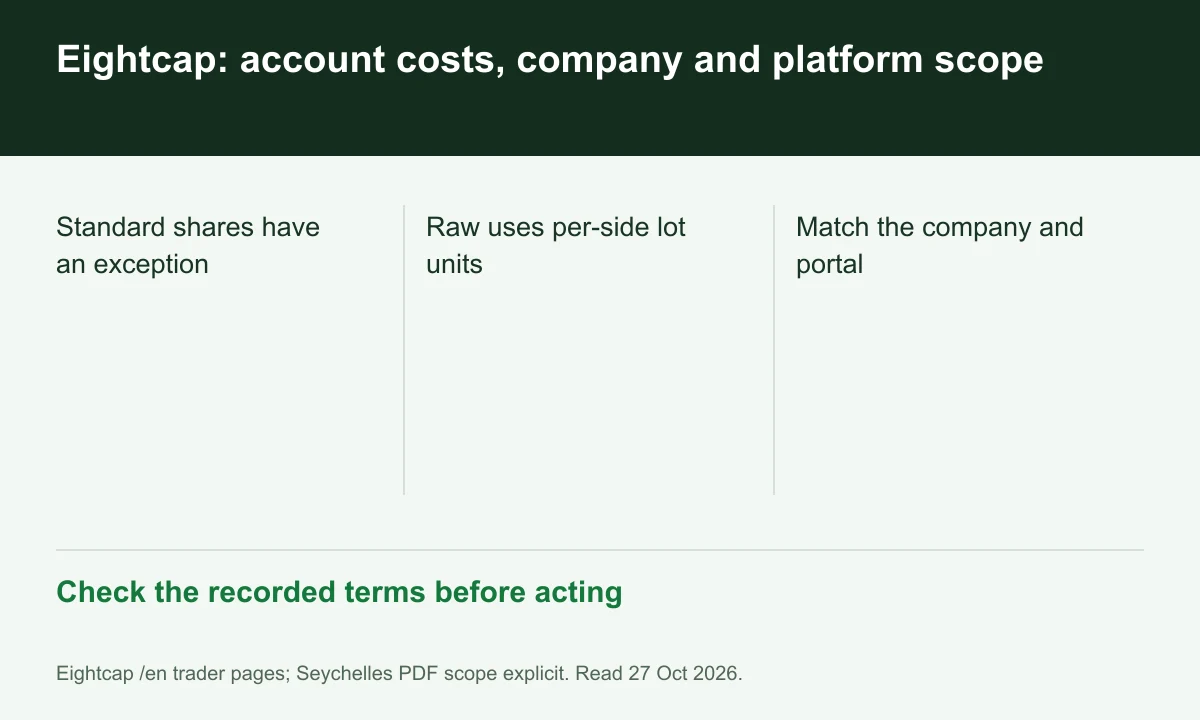
Provider guide
Match Eightcap's account pricing with the assigned company and platform, keeping share commission exceptions and payment processing stages visible before funding.
Read guide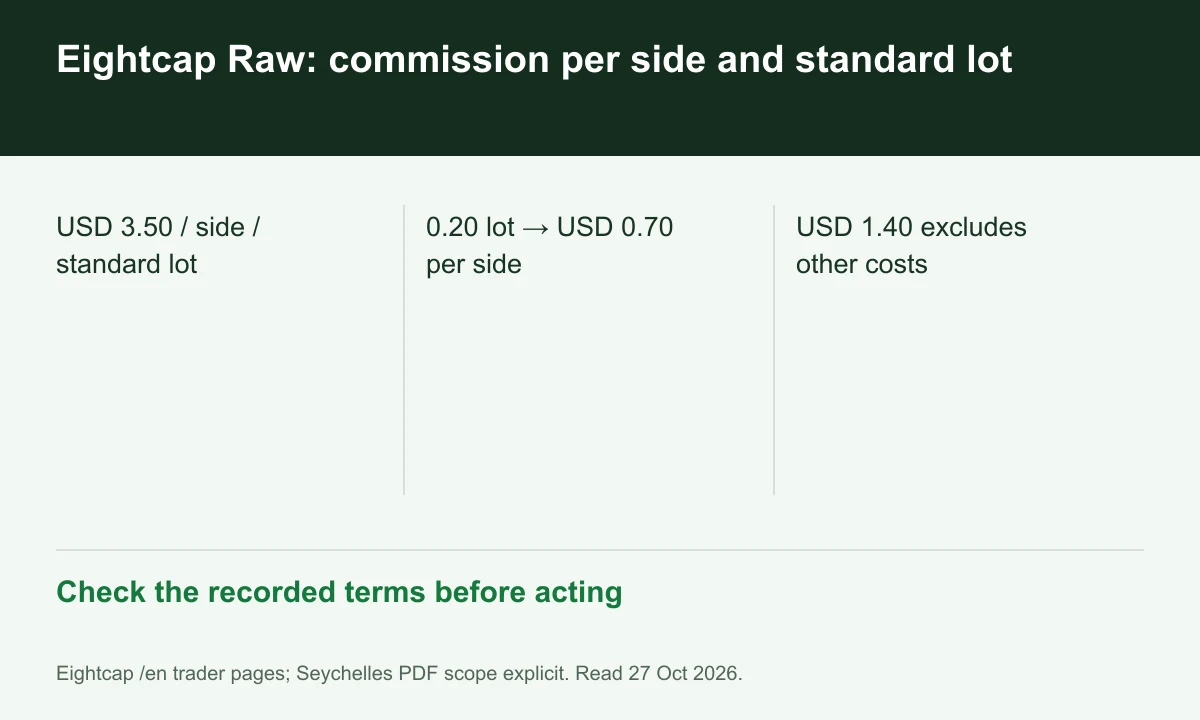
Provider guide
Calculate Eightcap Raw's published USD commission on a hypothetical trade size, separating the round-trip amount from spread, financing and other account currencies.
Read guide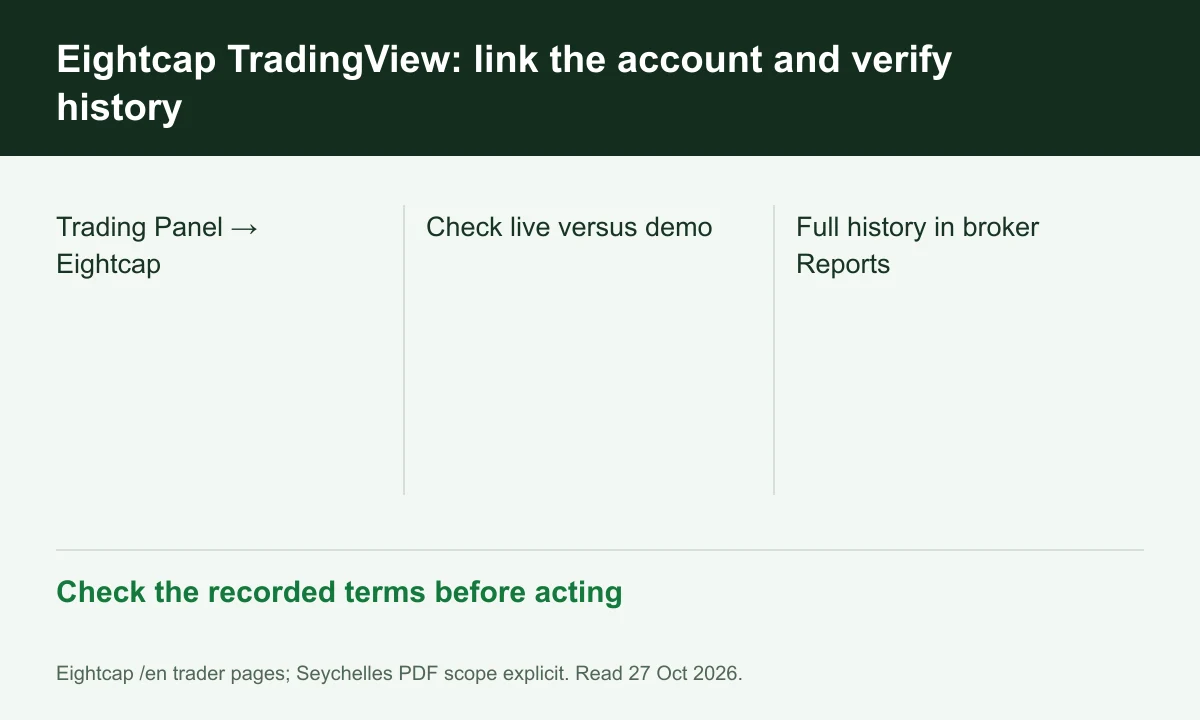
Provider guide
Use Eightcap's TradingView connection steps with separate charting and broker credentials, live/demo checks and the broker Reports tab for the full account record.
Read guide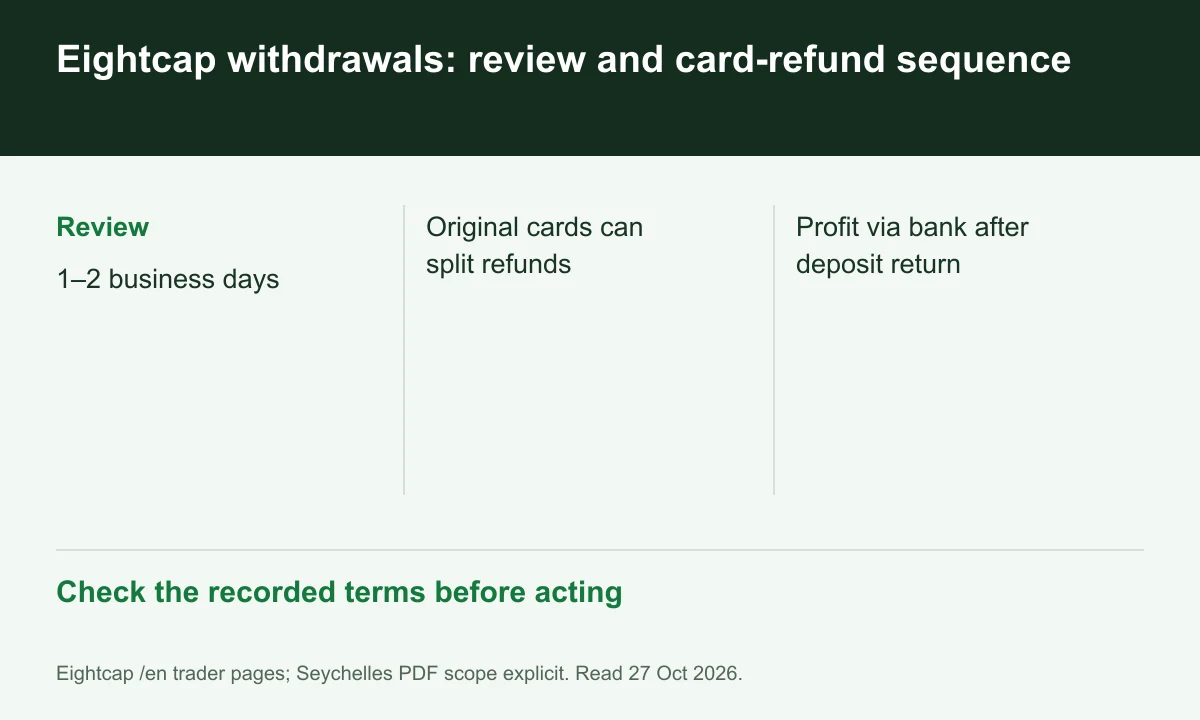
Provider guide
Trace Eightcap's finance review and payment-provider stages, including split original-card refunds, profit routing and evidence for a closed funding method.
Read guide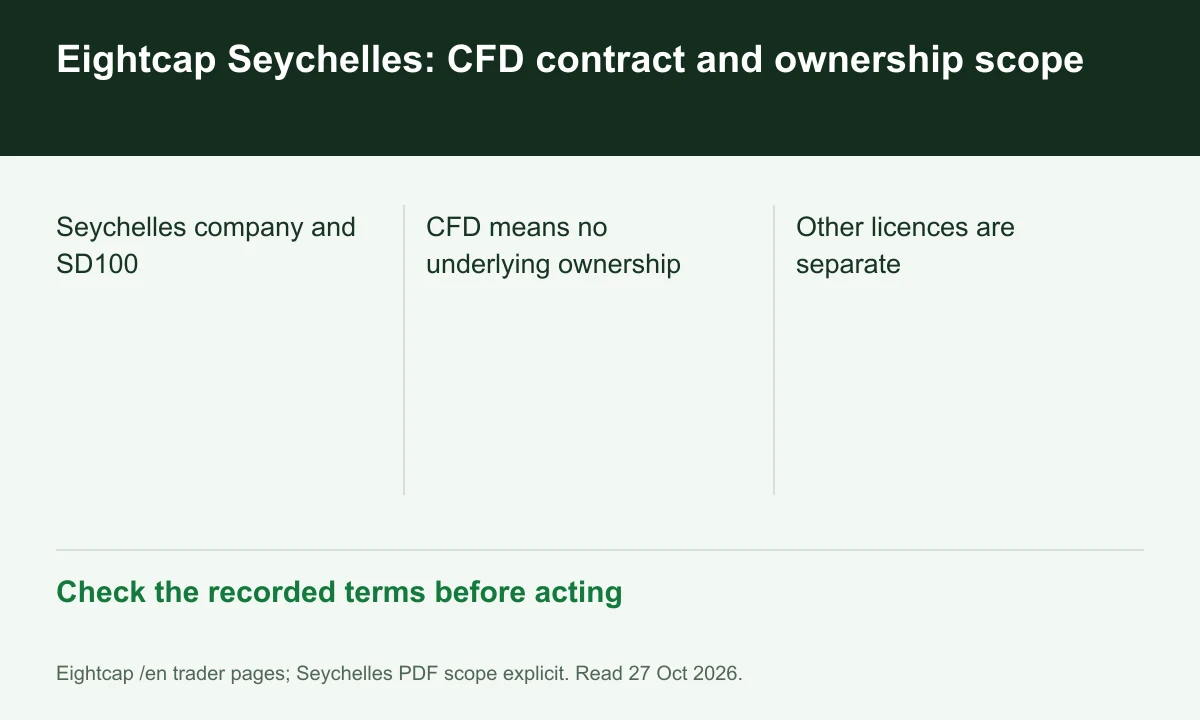
Provider guide
Read the Eightcap International Ltd agreement's CFD definition and entity scope before interpreting a share-named instrument or group licence list as ownership rights.
Read guide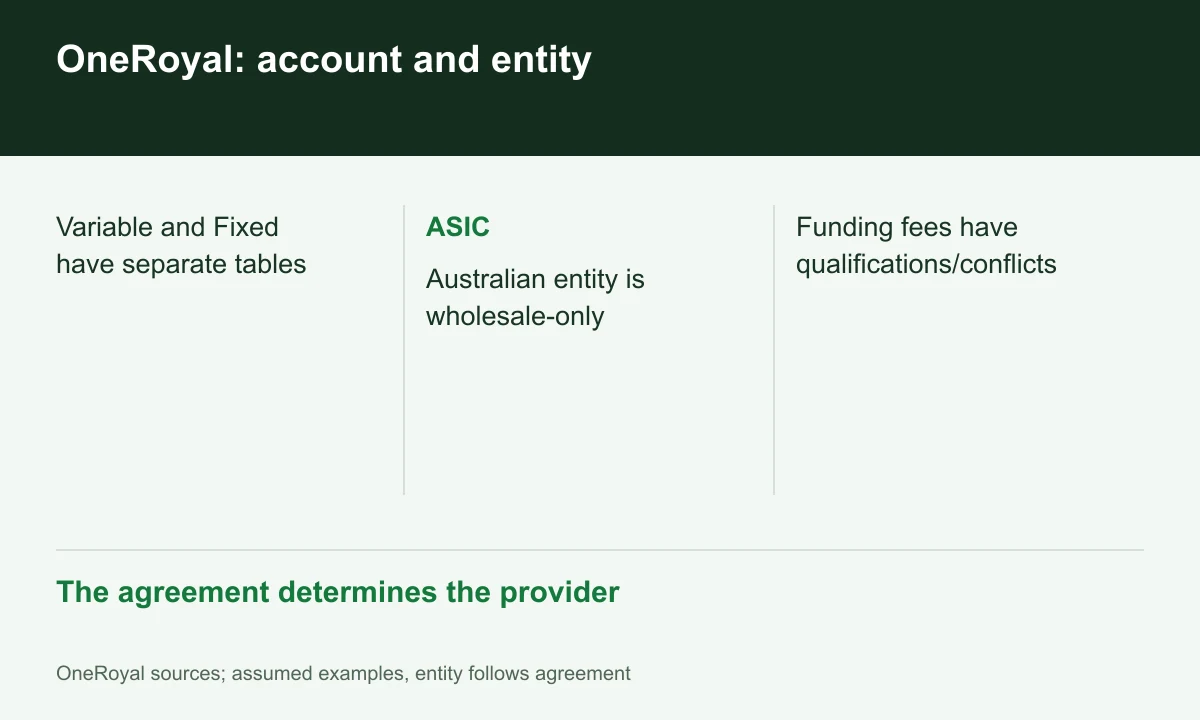
Provider guide
Read oneroyal.com account pricing separately from each group company’s licence scope.
Read guide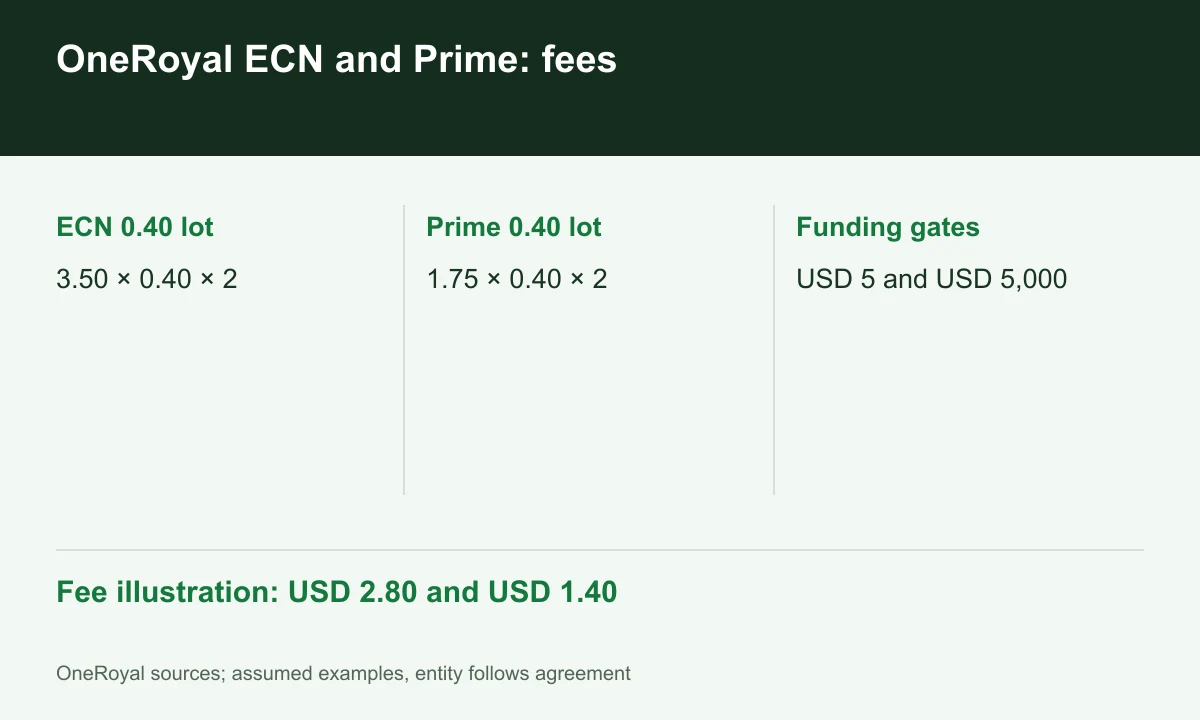
Provider guide
Calculate equal-volume commission while separating deposited capital from an actual fee.
Read guide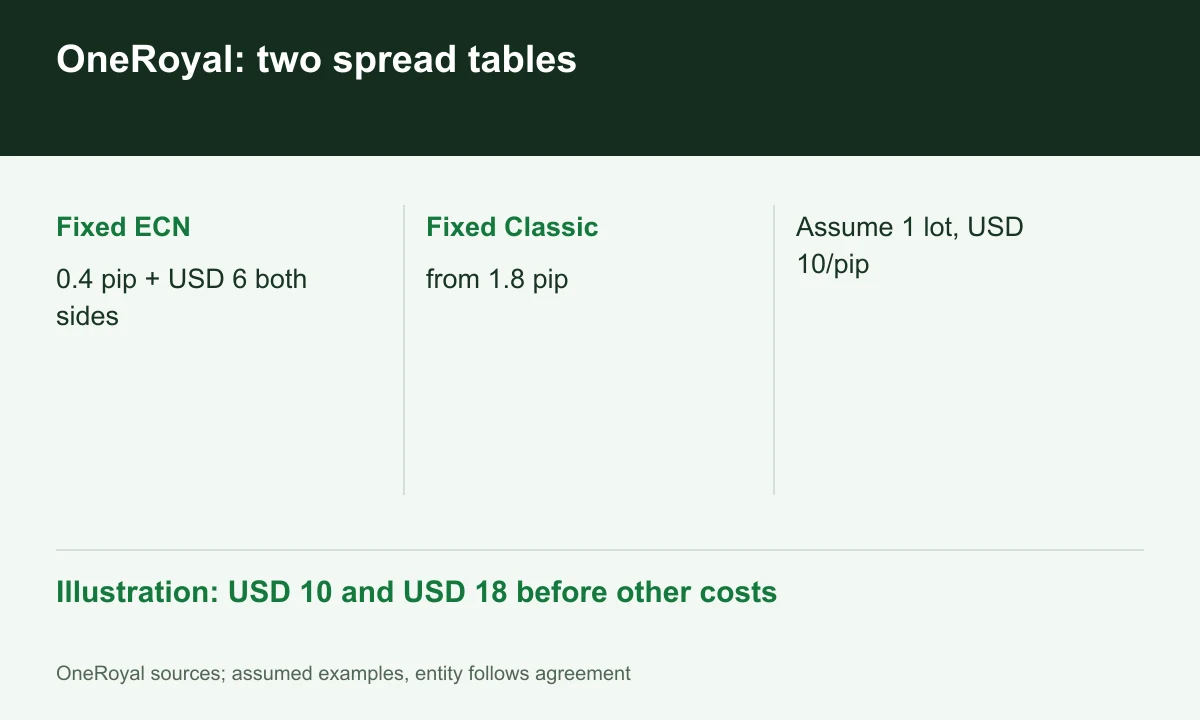
Provider guide
Use an equal pip value to separate spread from commission rather than treating fixed as fixed total cost.
Read guide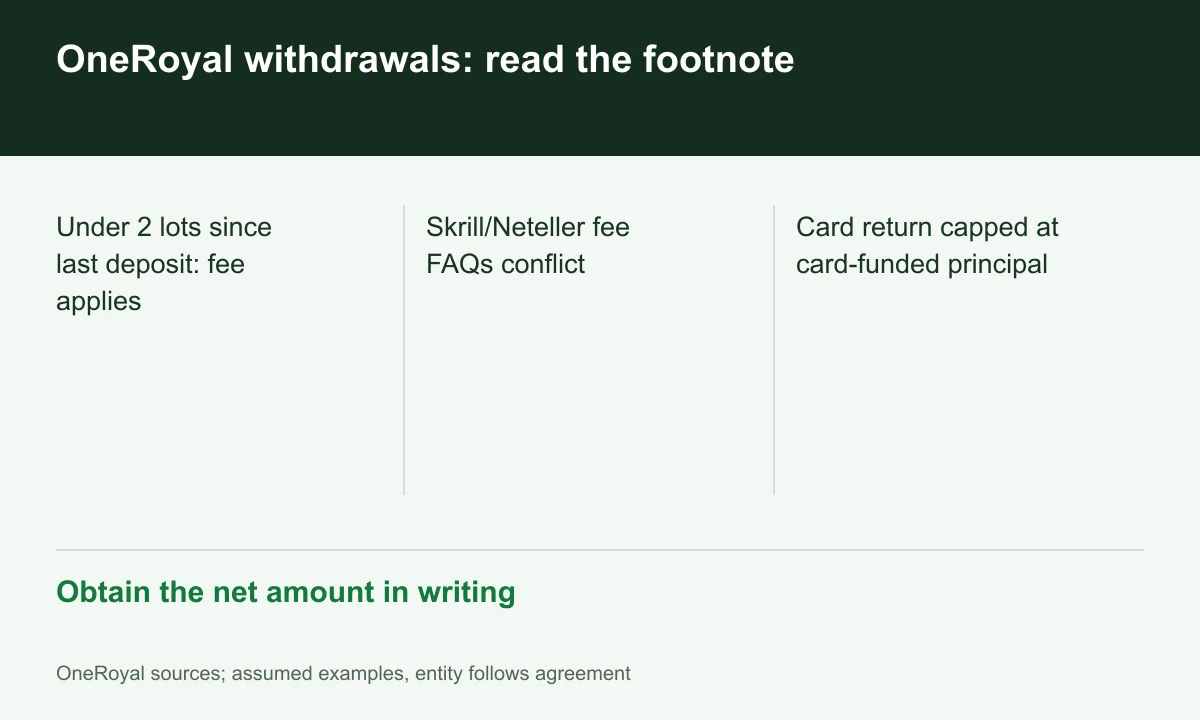
Provider guide
Check trading-activity conditions and inconsistent FAQ wording before estimating net receipt.
Read guide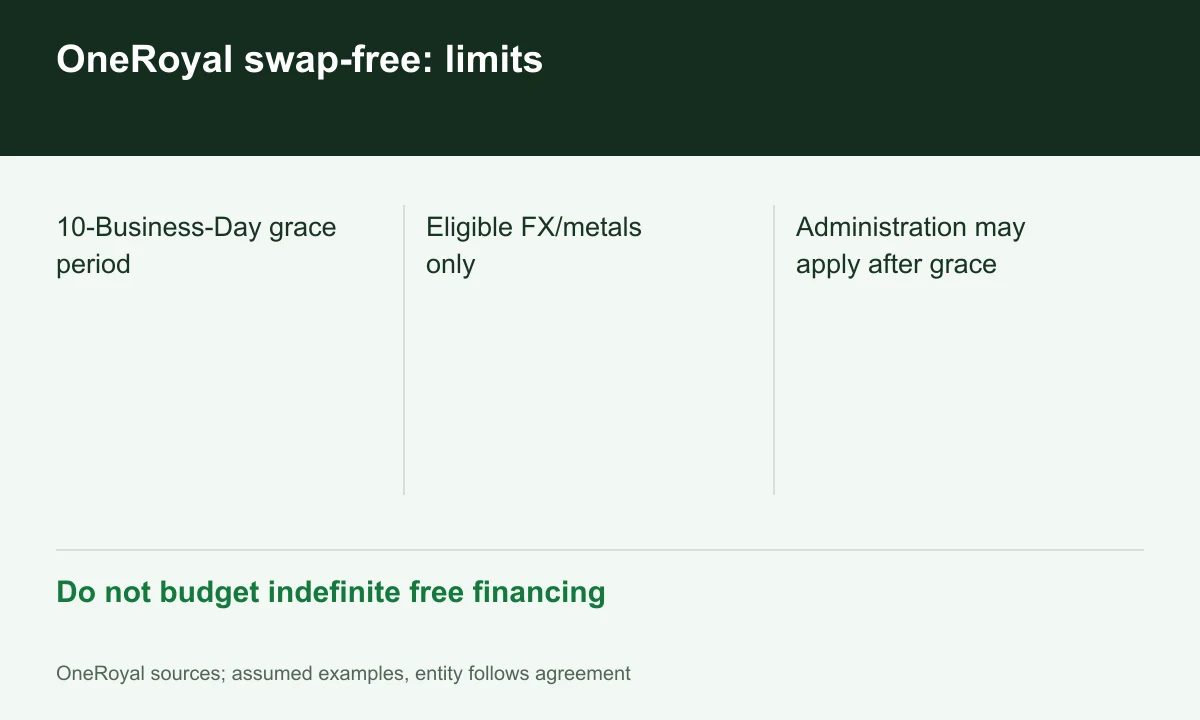
Provider guide
Read eligible symbols and post-grace administration charges rather than assuming permanent free financing.
Read guide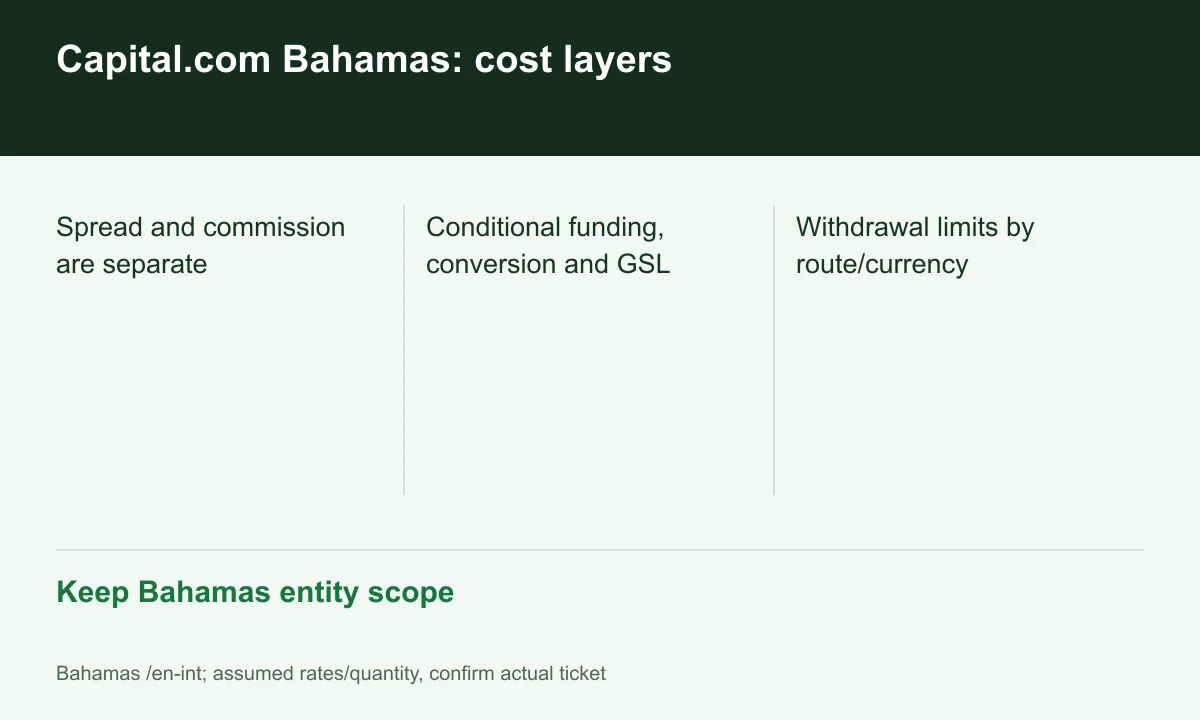
Provider guide
Keep /en-int scope and separate spread, financing, conversion, guaranteed stops and withdrawal limits.
Read guide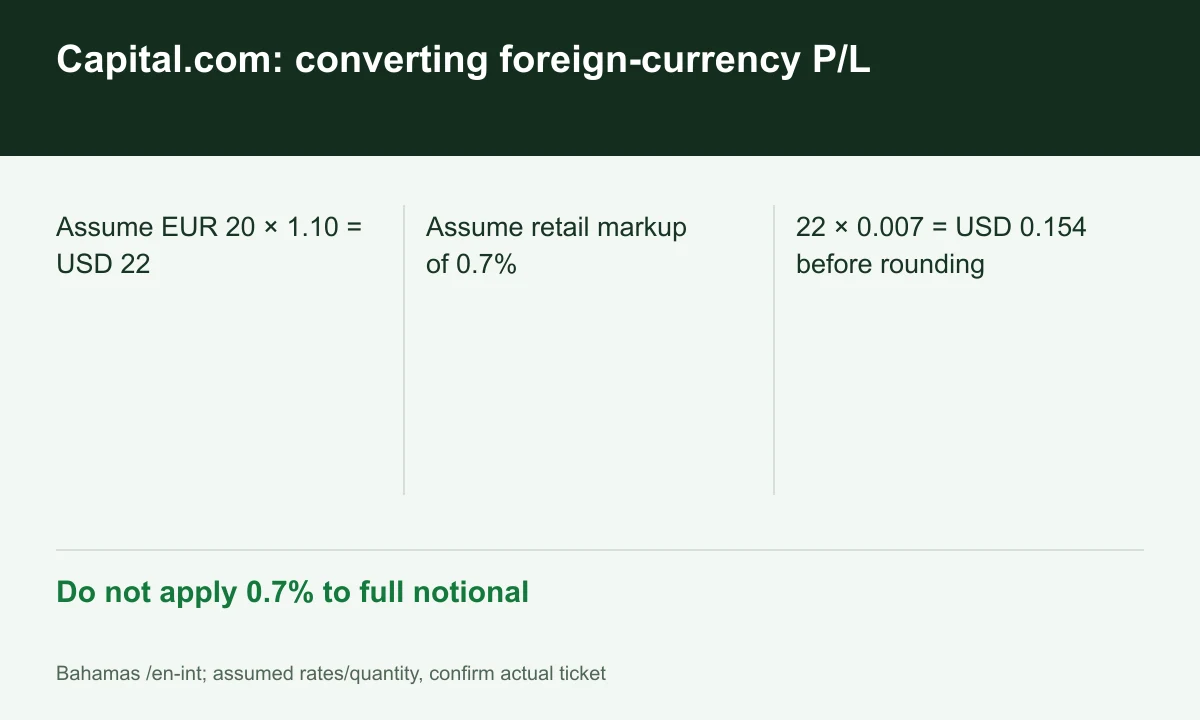
Provider guide
Distinguish an exchange-rate markup from commission on the entire position value.
Read guide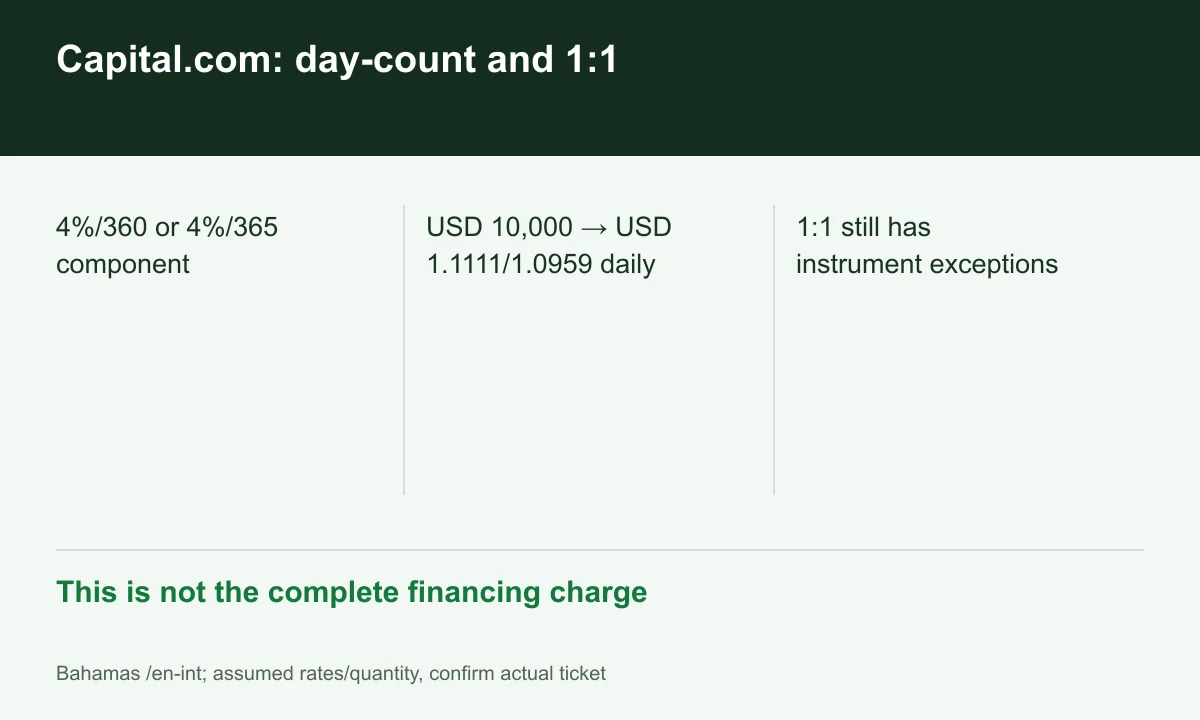
Provider guide
Read the day-count and product together; unleveraged does not universally mean financing-free.
Read guide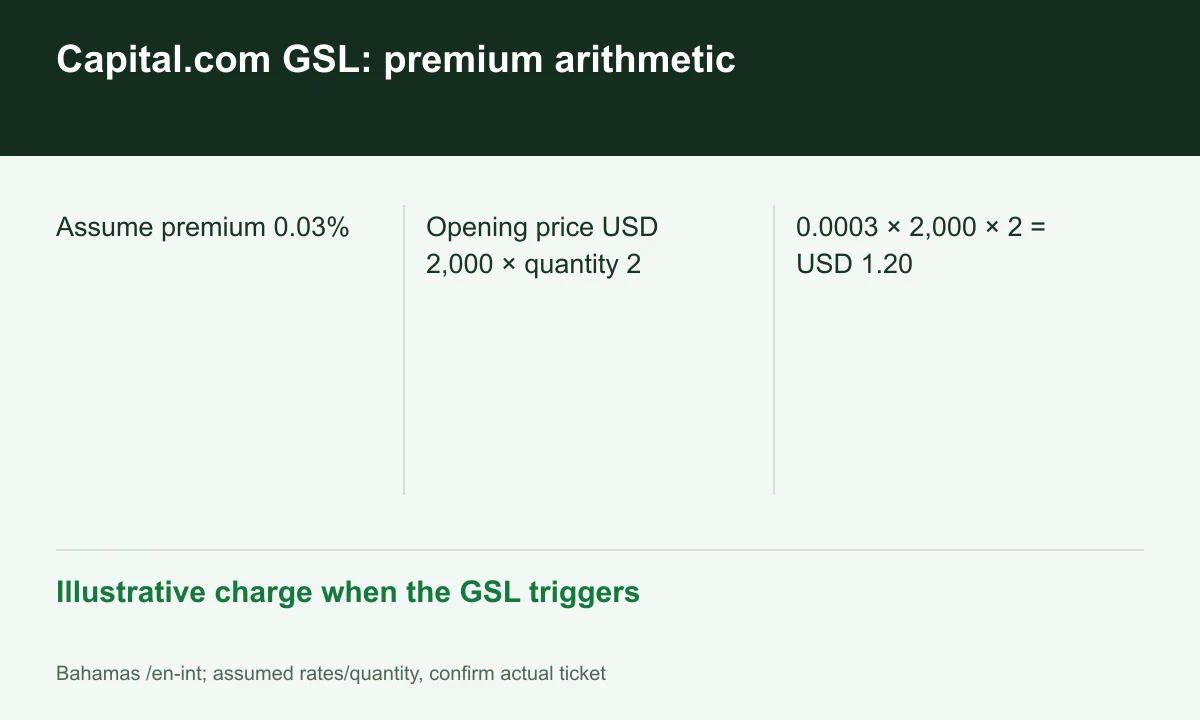
Provider guide
Separate the premium from spread and stop-distance P/L using explicit assumptions.
Read guide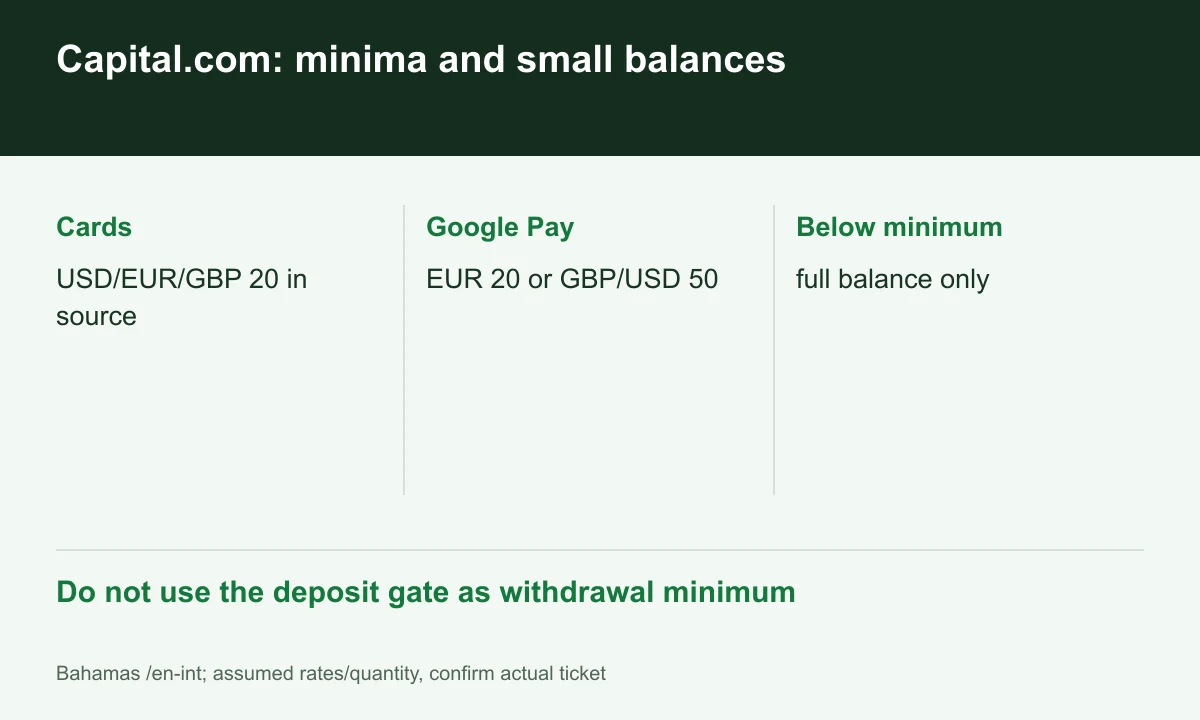
Provider guide
Read each method together with its currency, including Google Pay and small-balance treatment.
Read guide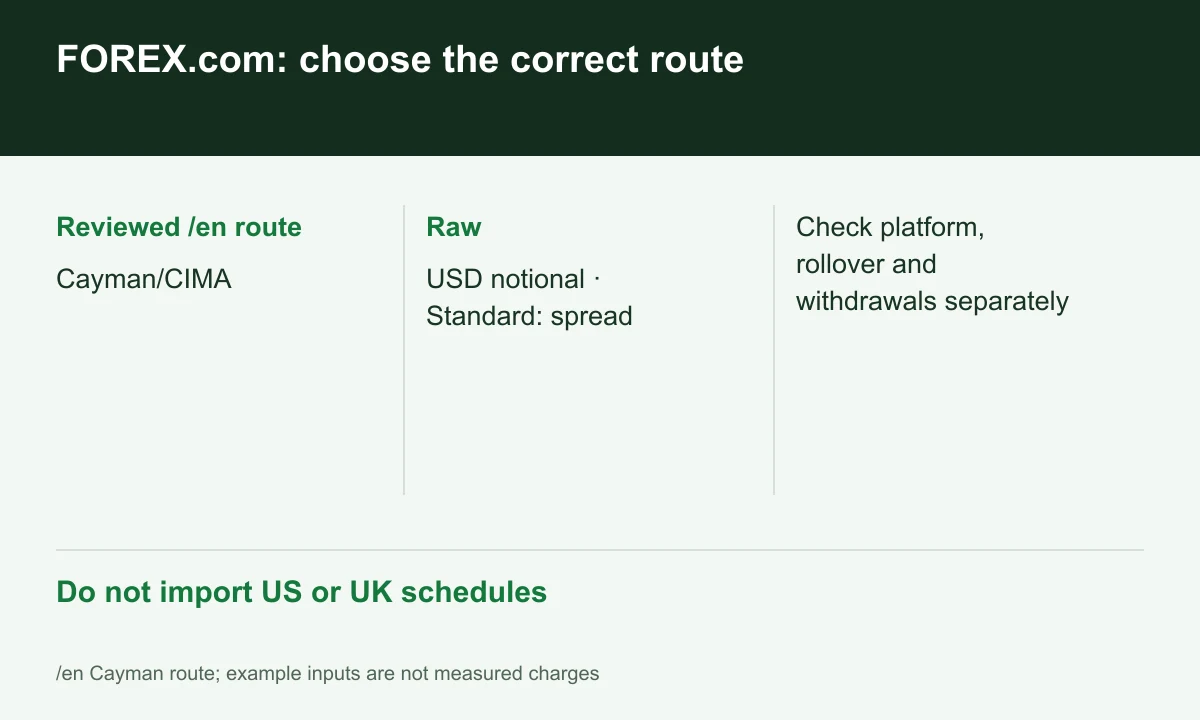
Provider guide
Keep the /en Cayman route separate while matching account pricing and platform capabilities.
Read guide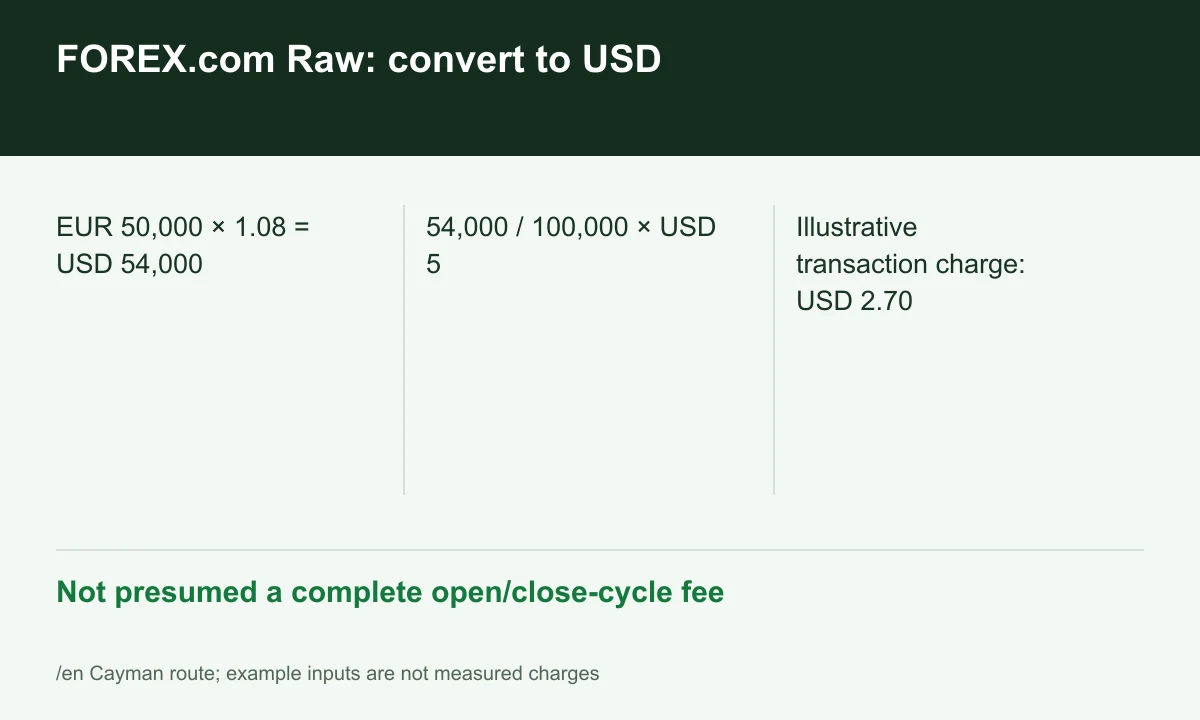
Provider guide
Convert equal base-currency quantities into USD and keep charging-side interpretation explicit.
Read guide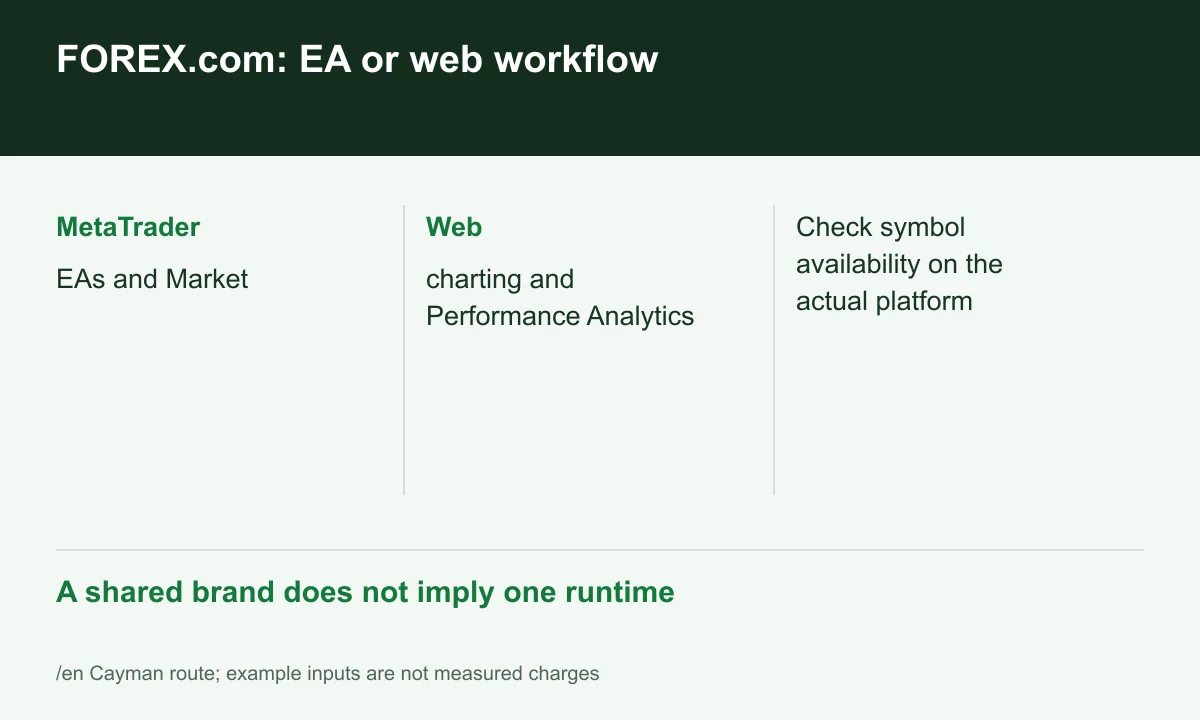
Provider guide
Compare required tools and symbol coverage before migrating an account or automated setup.
Read guide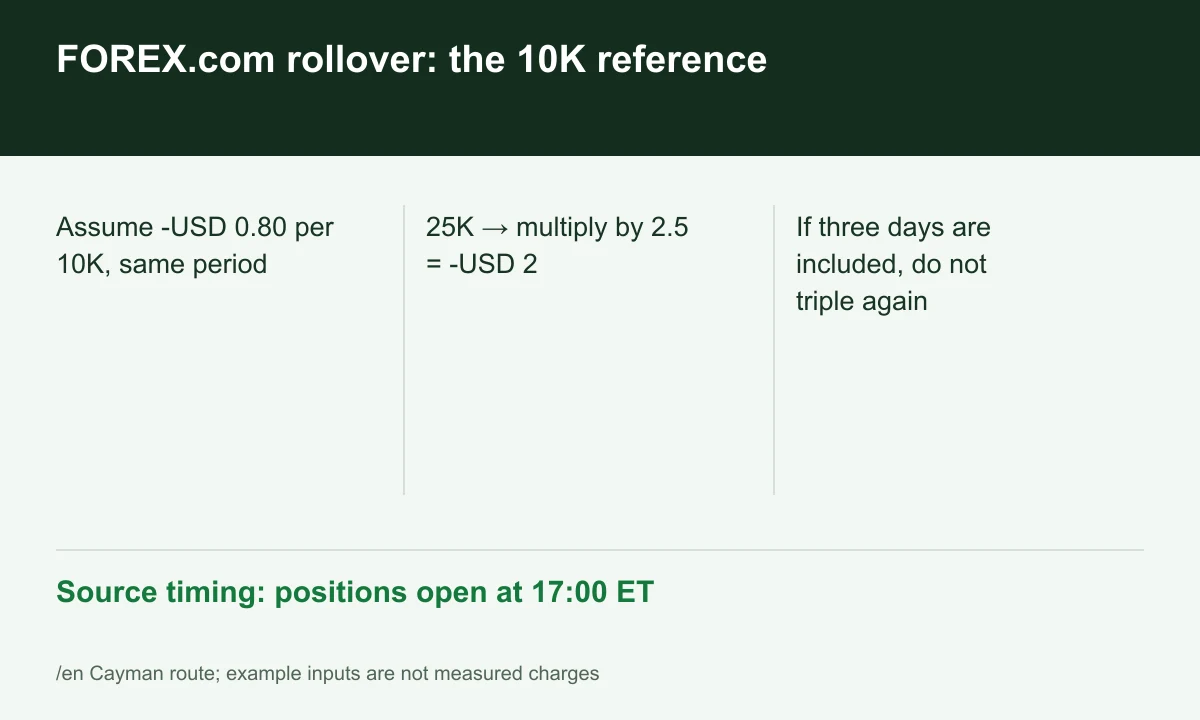
Provider guide
Separate reference volume, rolled days and ET timing before budgeting financing.
Read guide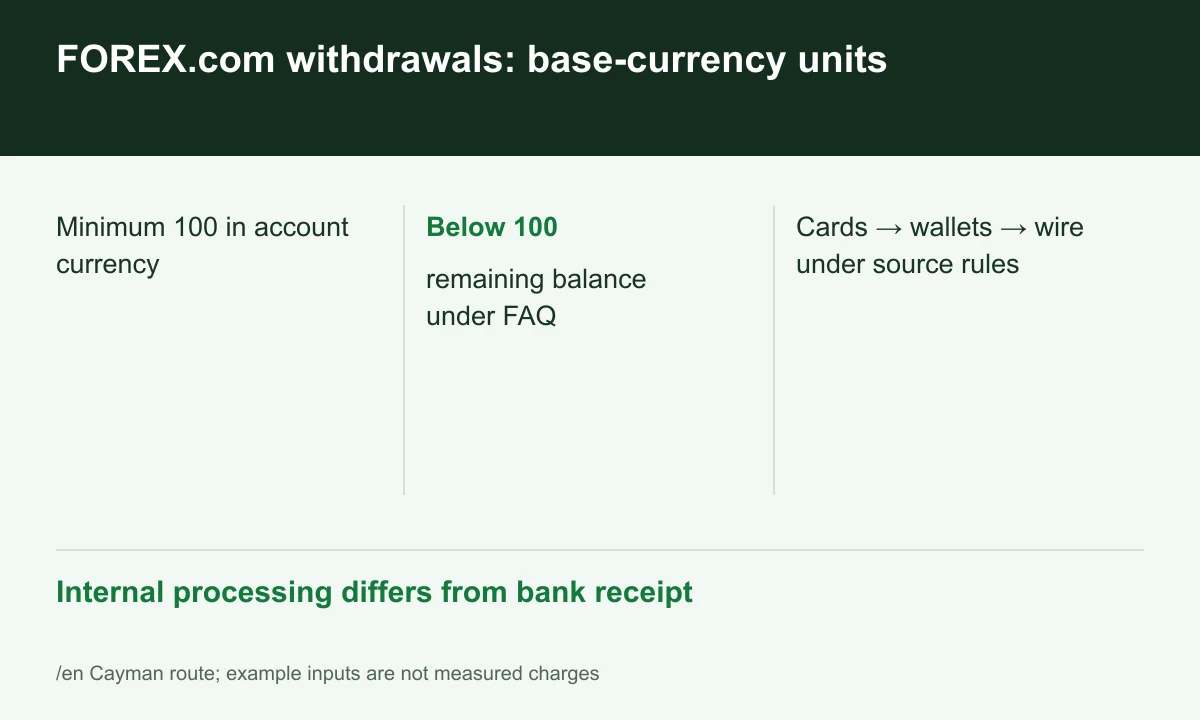
Provider guide
A 100-unit account-currency minimum is not always USD 100; inspect the small-balance exception.
Read guide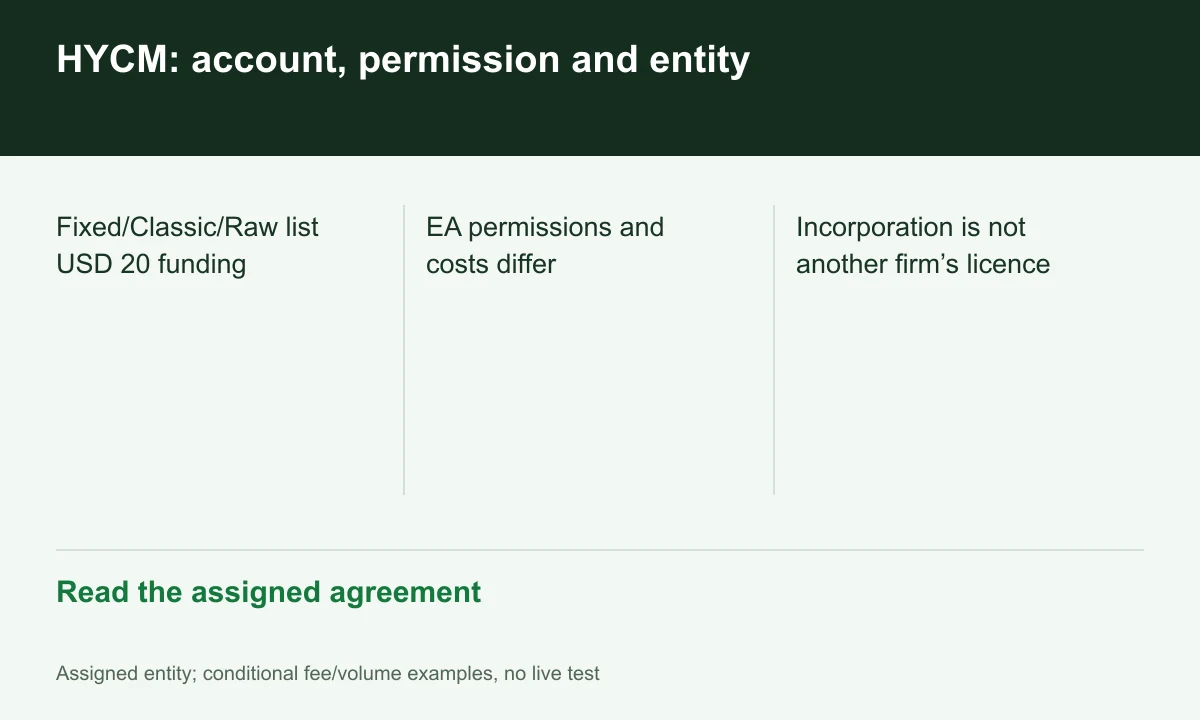
Provider guide
Separate Fixed/Classic/Raw, EA permission and legal scope before selecting pricing or withdrawal rules.
Read guide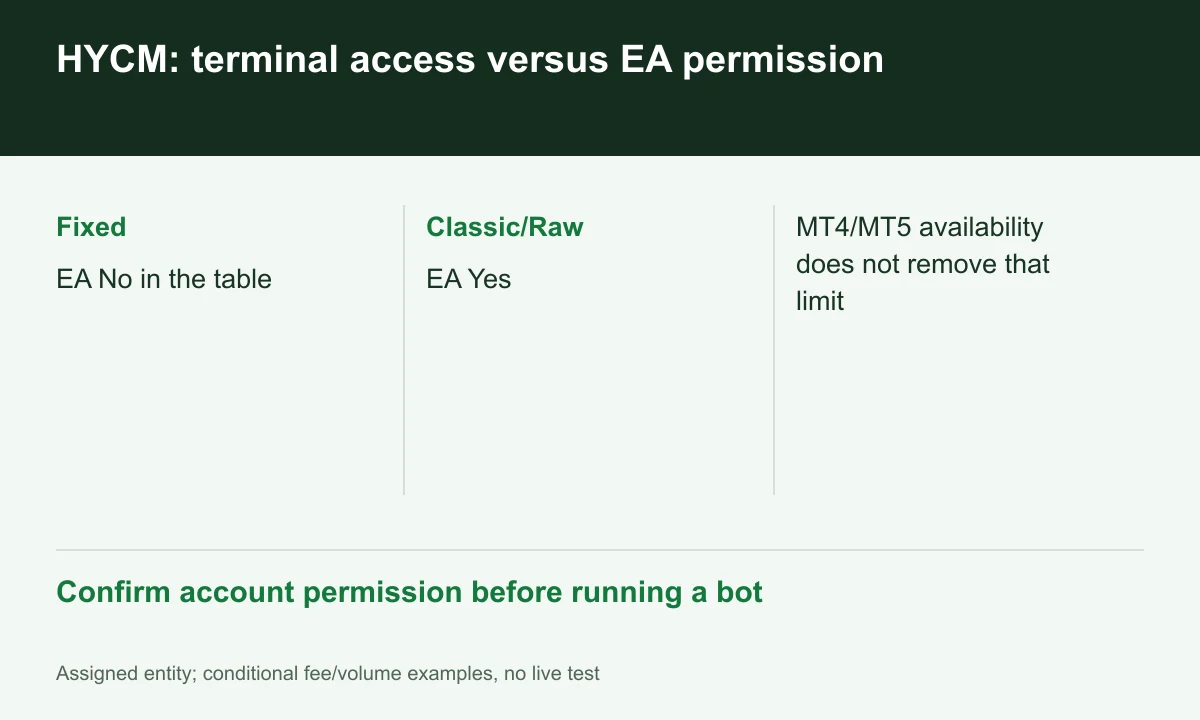
Provider guide
Start with account permission before checking EA code and terminal features.
Read guide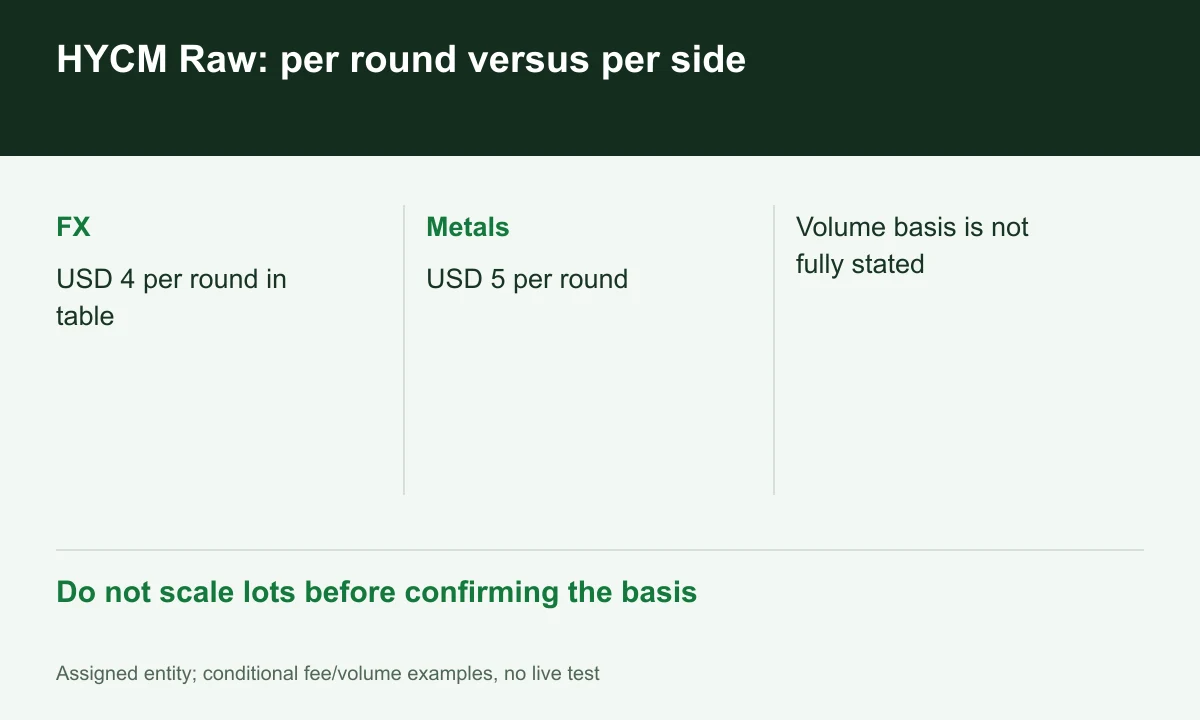
Provider guide
Keep the table’s USD 4/5 distinction while confirming volume basis before scaling lots.
Read guide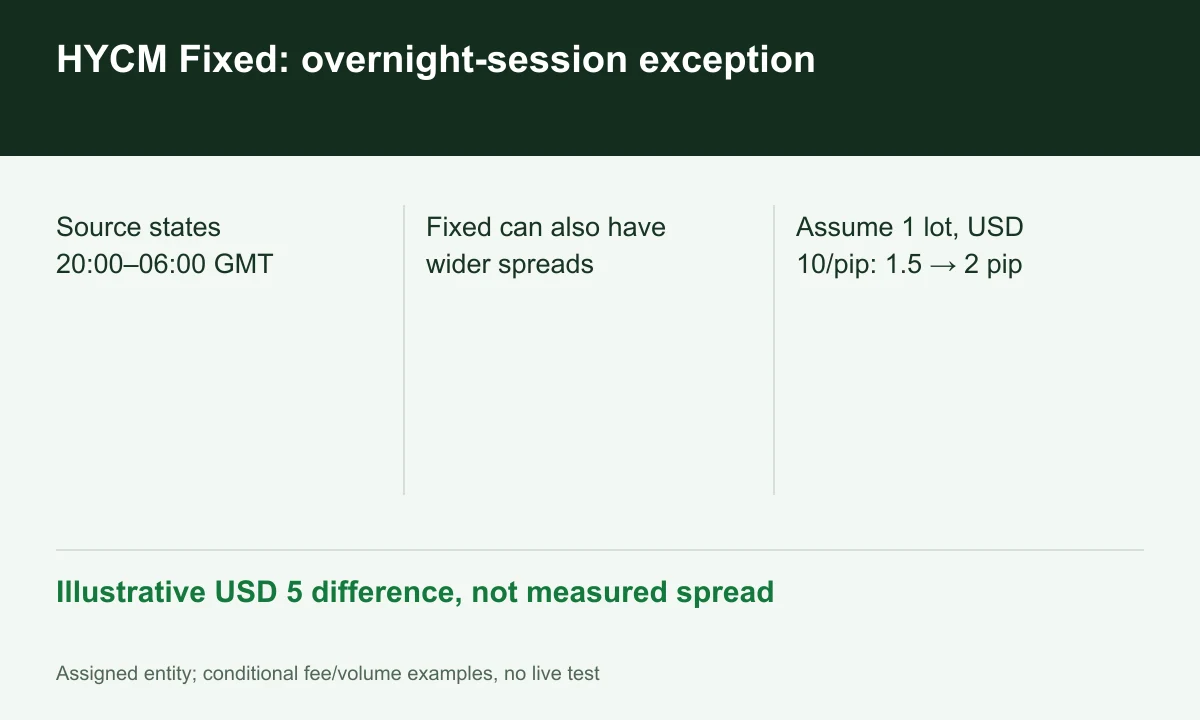
Provider guide
Fixed does not promise an unchanged spread all day; preserve the time window and symbol exceptions.
Read guide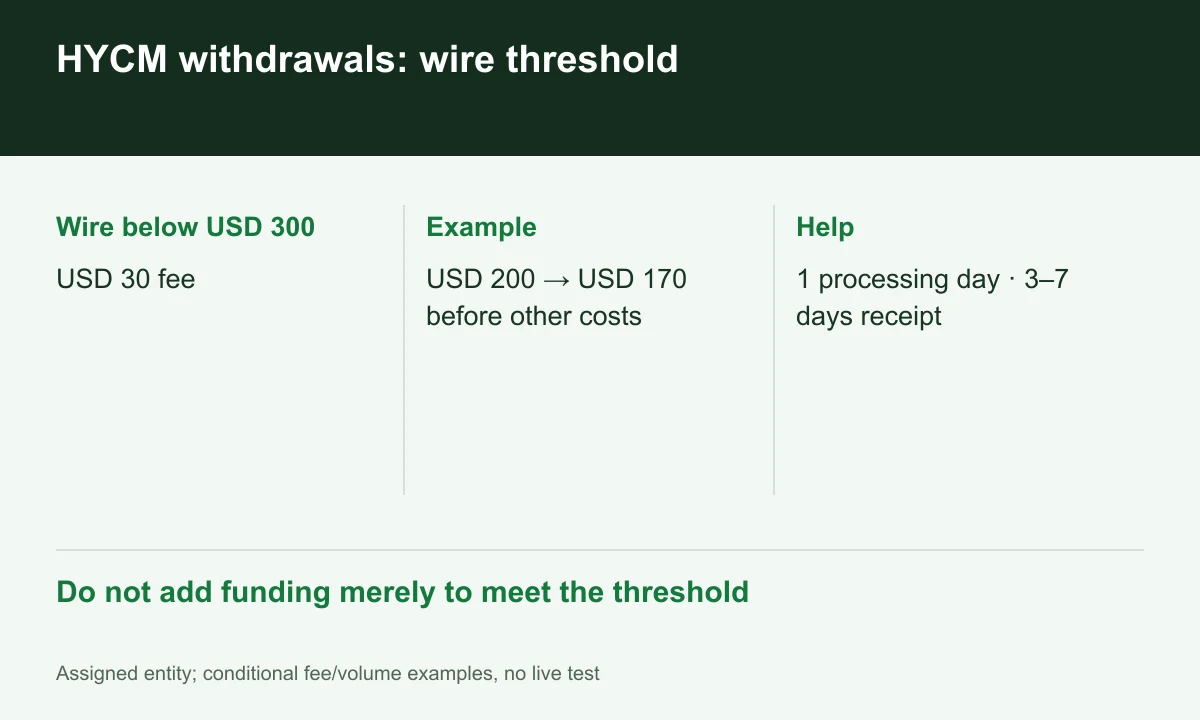
Provider guide
Separate the below-threshold charge, principal/profit routes and published processing time.
Read guide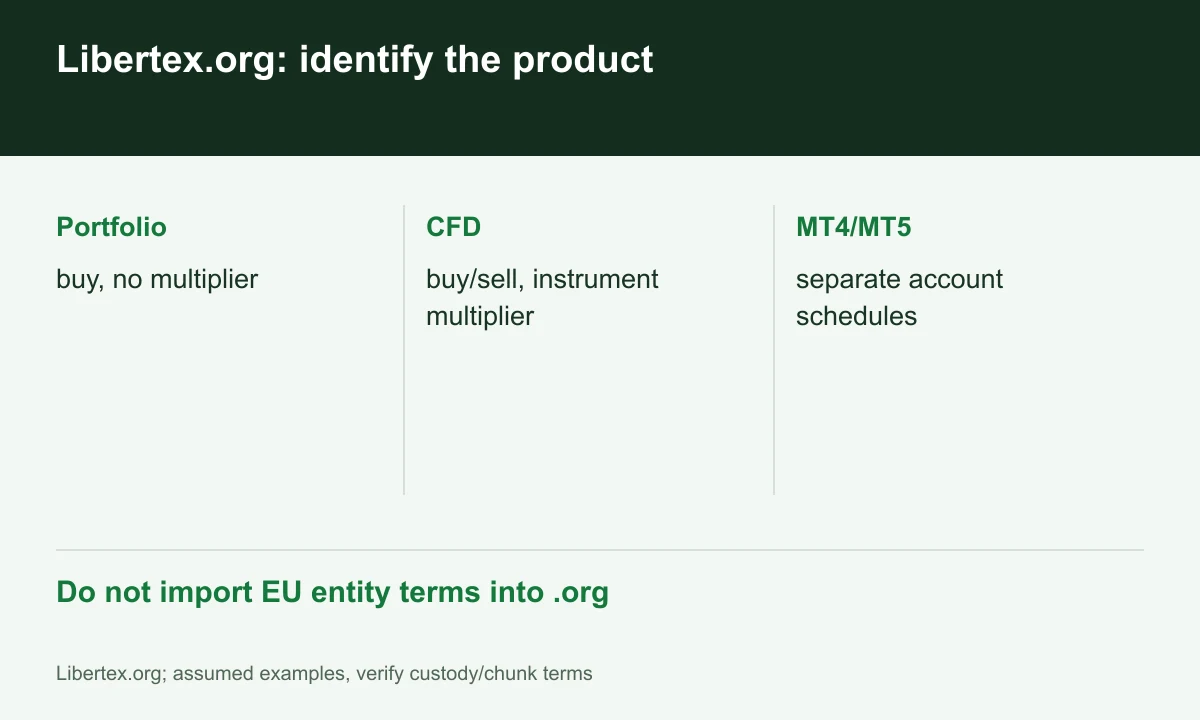
Provider guide
Keep international .org scope separate from Portfolio, CFDs and EU entity terms.
Read guide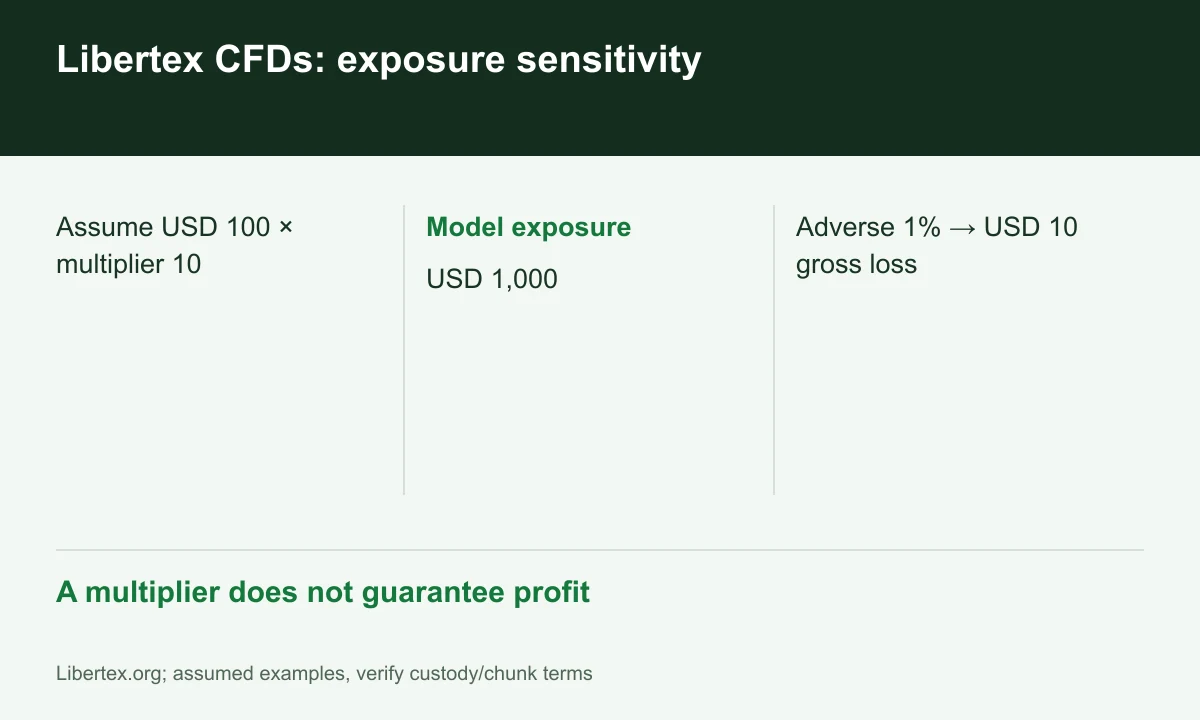
Provider guide
Use explicit assumptions to separate allocated funds from sensitivity to price movement.
Read guide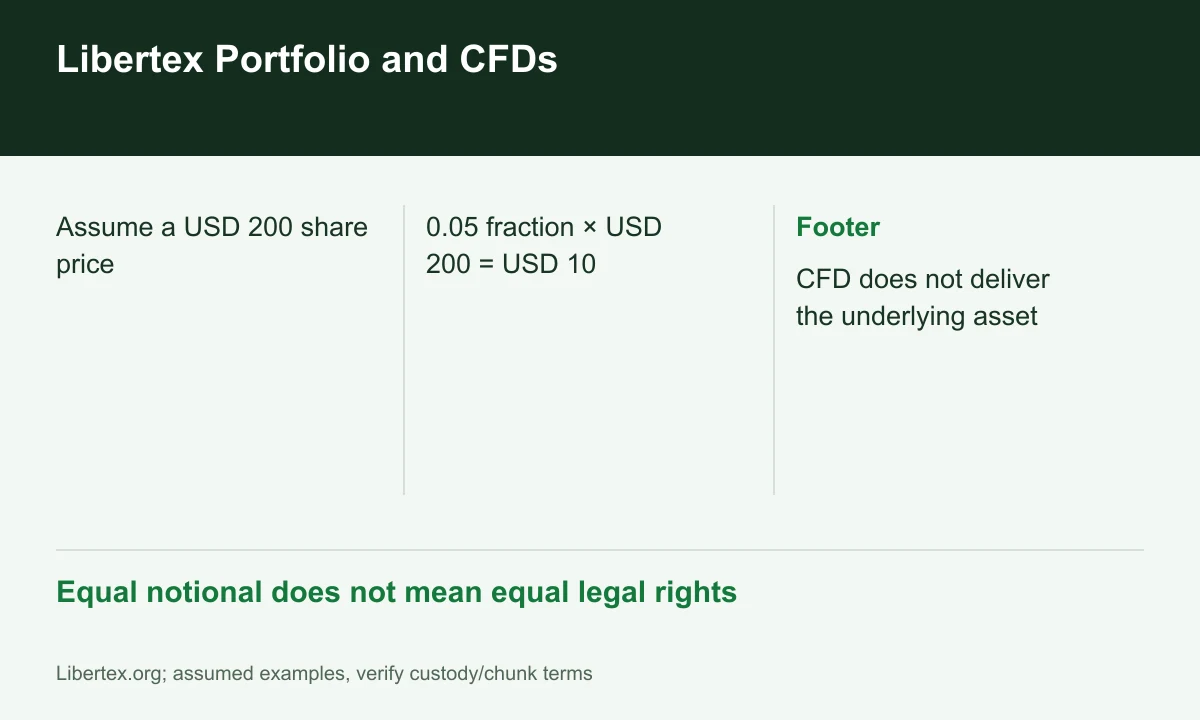
Provider guide
Read product mechanics before treating two stock exposures as identical ownership or fee arrangements.
Read guide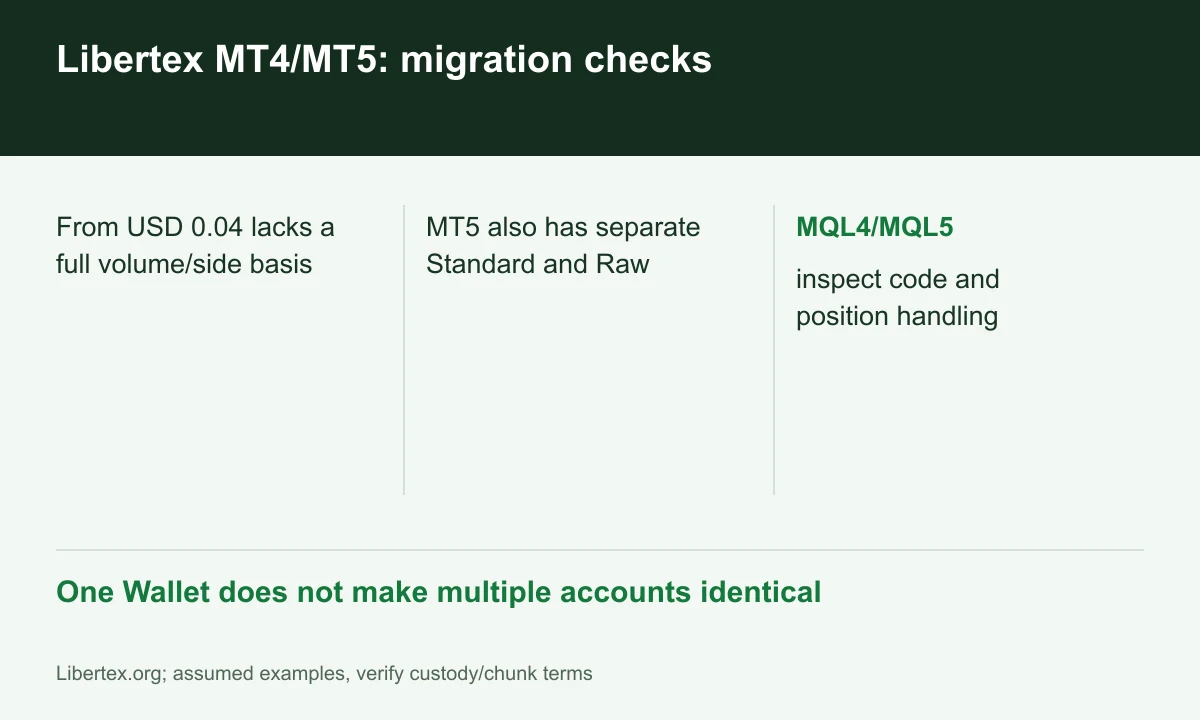
Provider guide
Distinguish starting-fee headlines from symbol schedules and MQL4/MQL5 position handling.
Read guide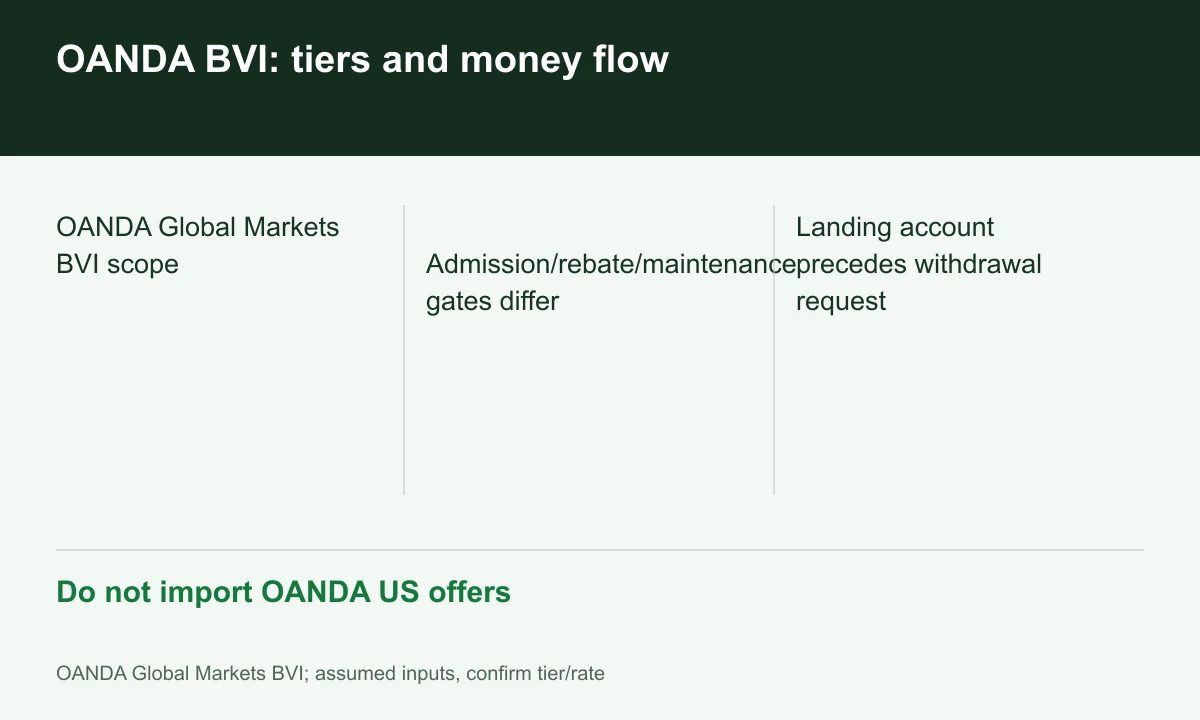
Provider guide
Use Global Markets BVI scope and separate tier eligibility from financing, withdrawals and inactivity.
Read guide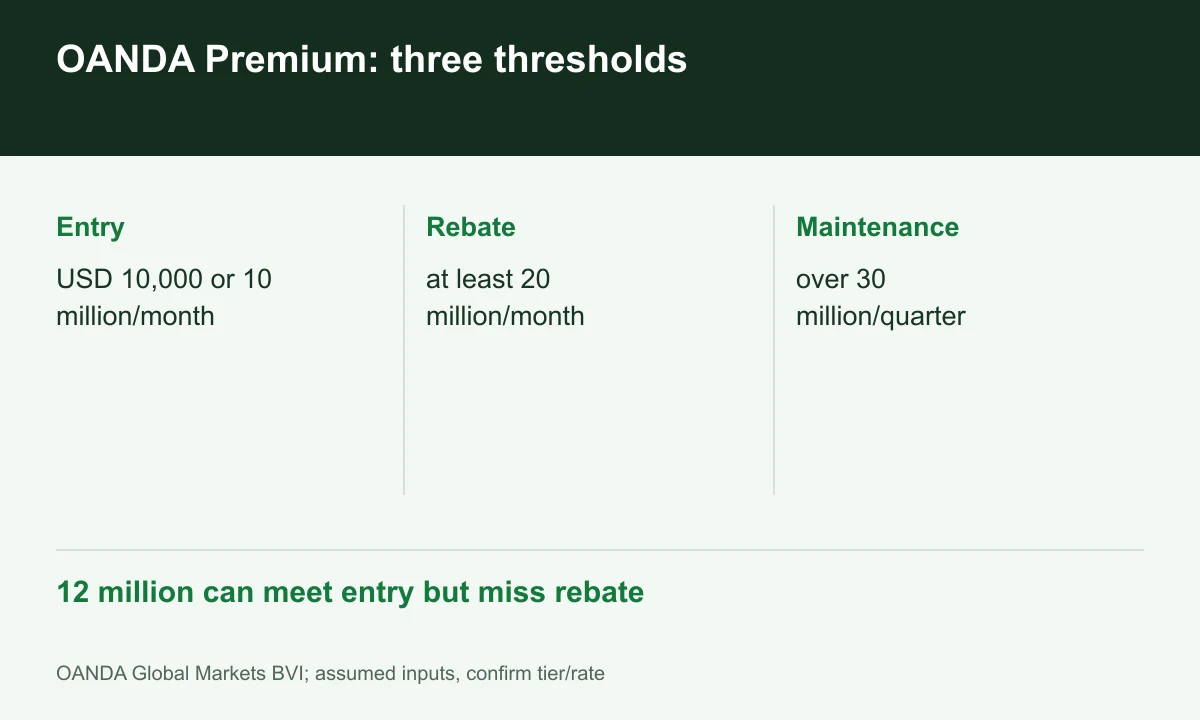
Provider guide
Read three separate thresholds rather than treating a qualifying deposit as guaranteed rebates.
Read guide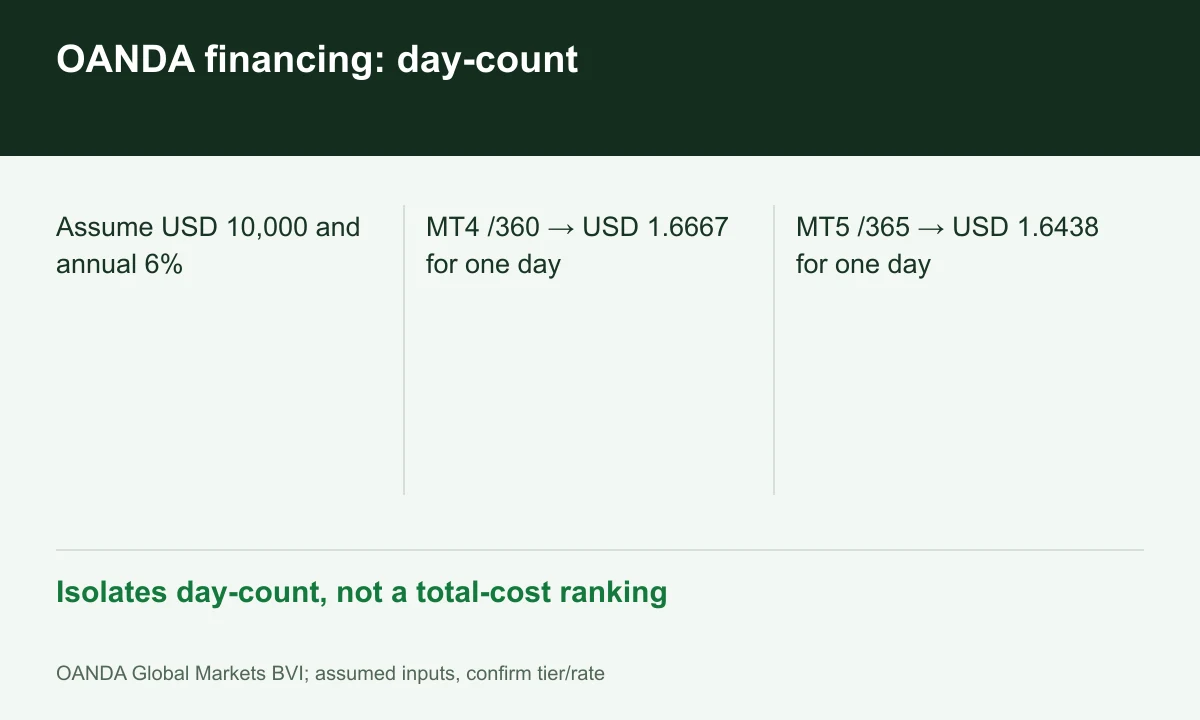
Provider guide
Separate the day-count from annual rate and account-currency conversion with a one-day example.
Read guide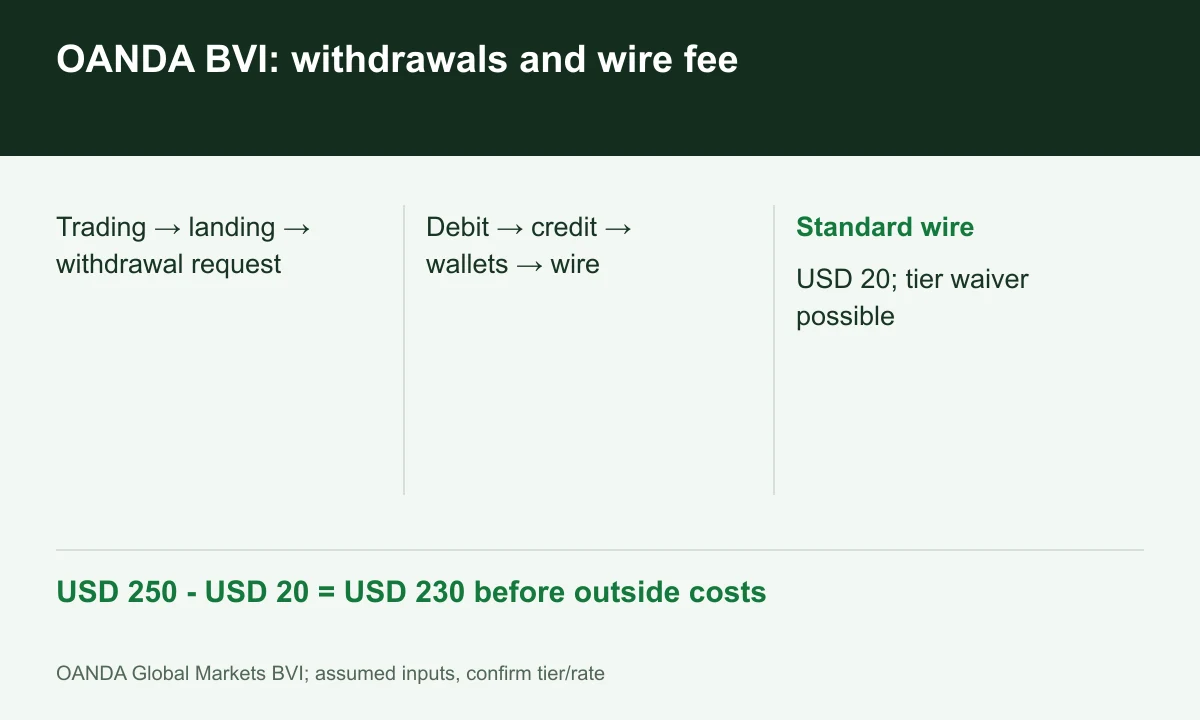
Provider guide
Track funding sources in order and confirm tier waivers before estimating net receipt.
Read guide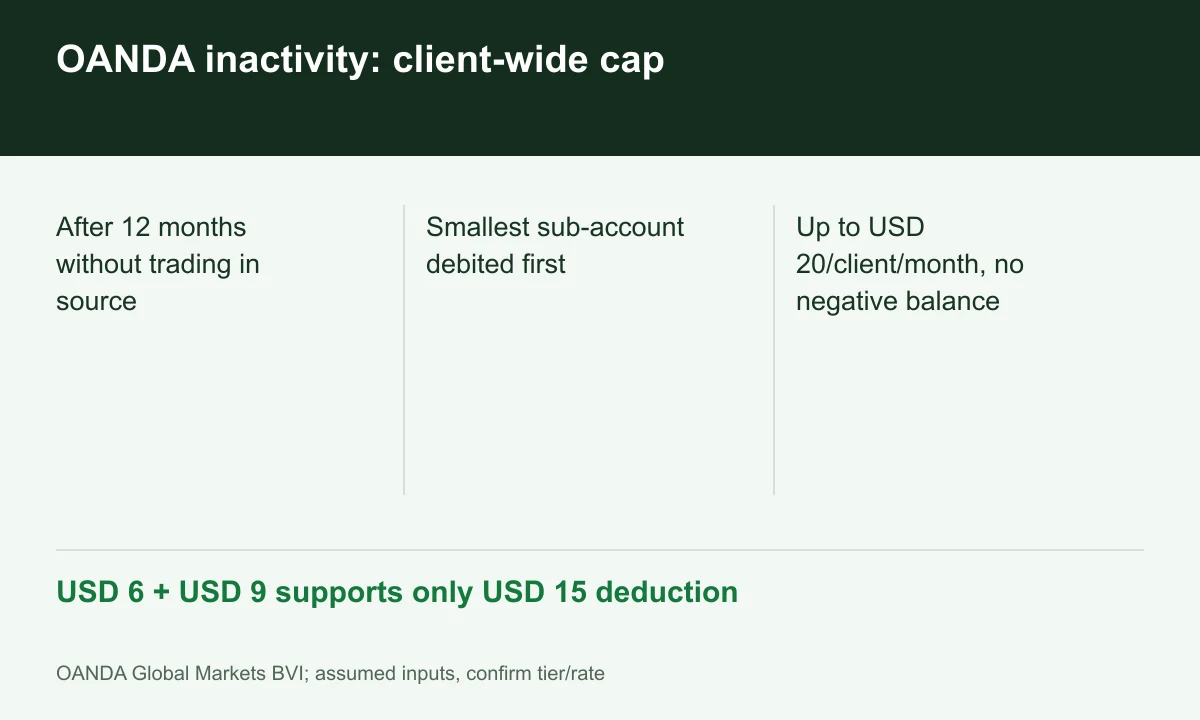
Provider guide
Read the twelve-month no-trading condition, sub-account deductions and open-position exception.
Read guide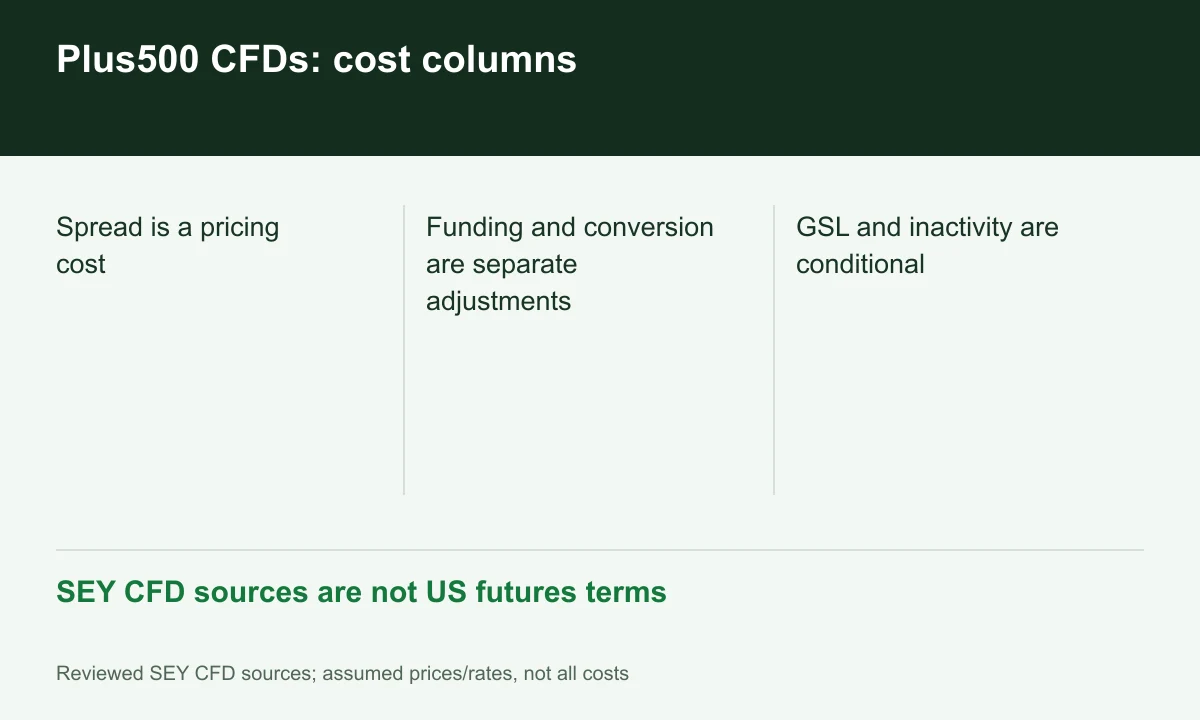
Provider guide
Use the reviewed CFD route without importing US commission-credit promotions.
Read guide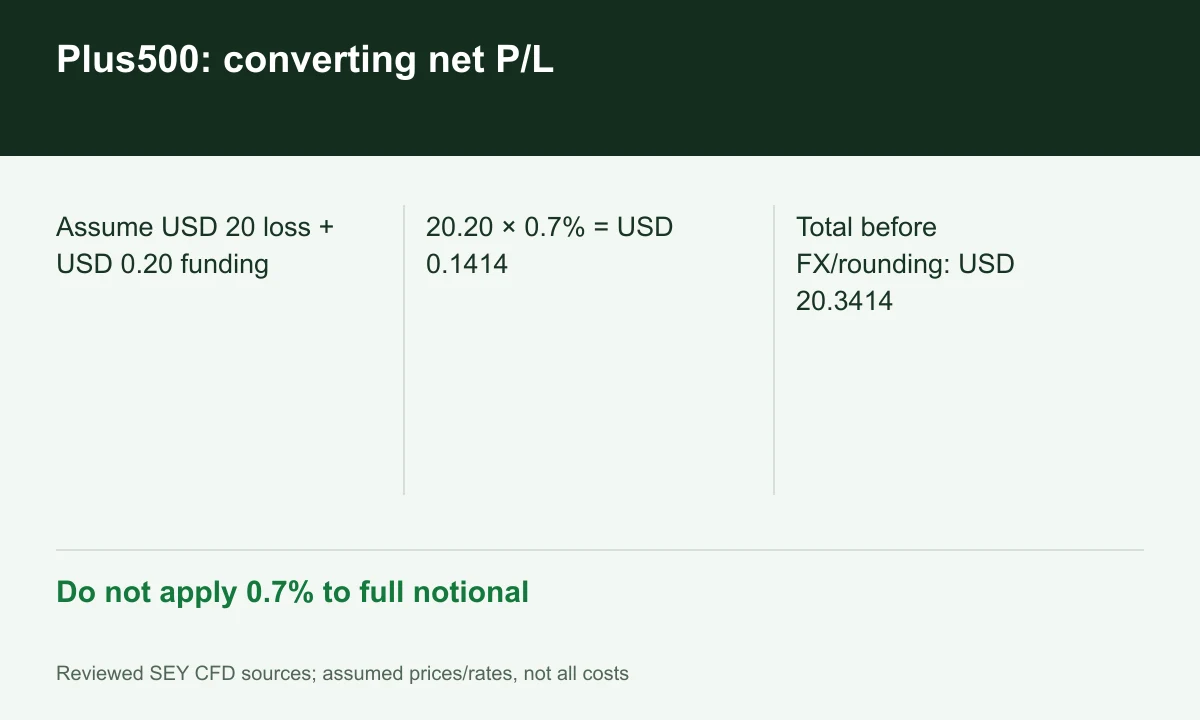
Provider guide
Illustrate the up-to-0.7% charge on relevant net P/L while separating financing.
Read guide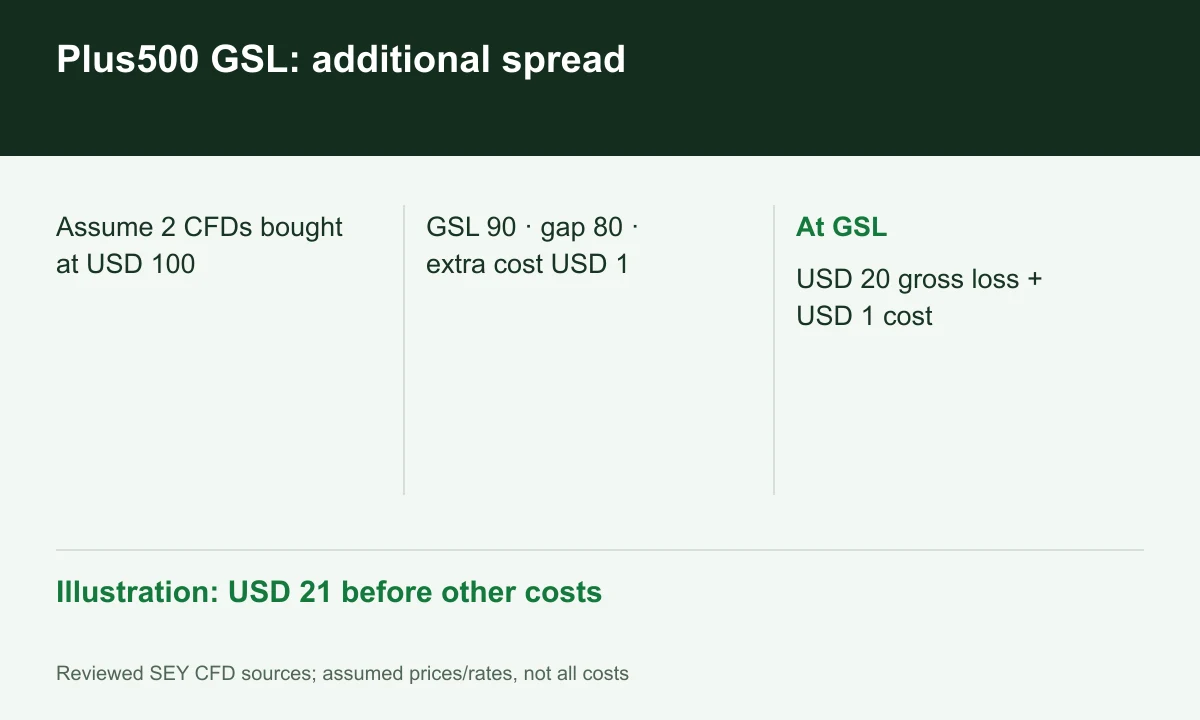
Provider guide
Read the non-refundable charge and amendment restrictions through an assumed gap scenario.
Read guide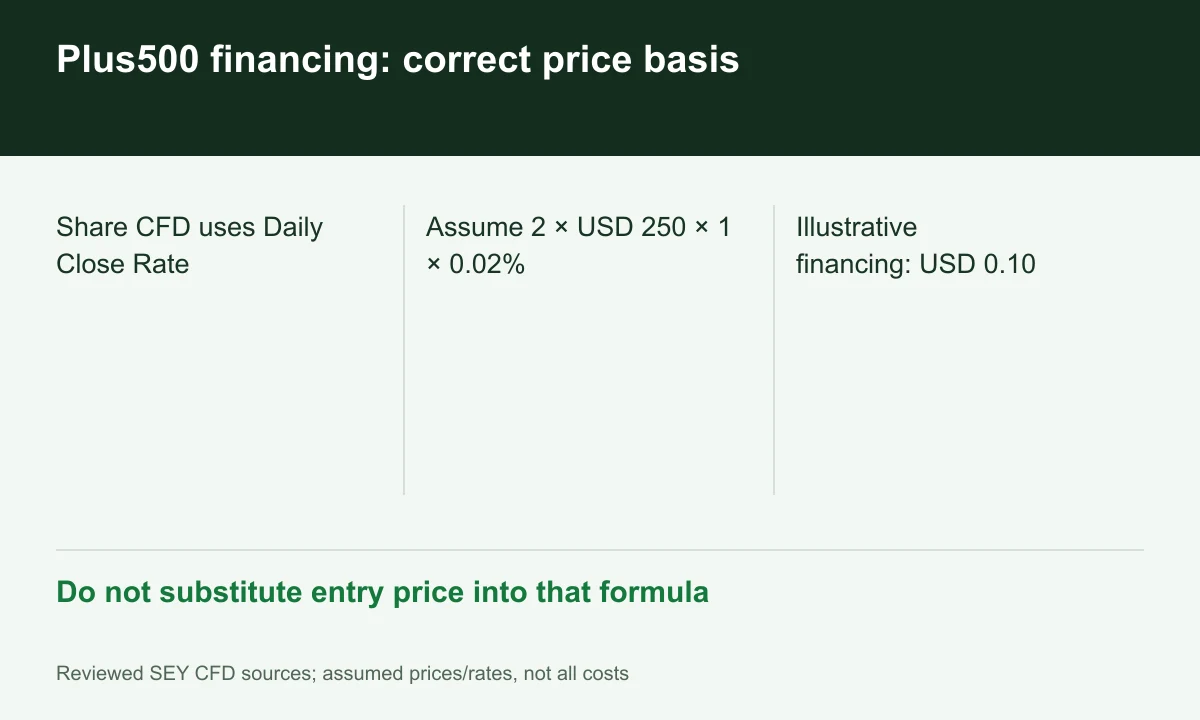
Provider guide
Use the asset-specific formula rather than a fixed notional assumption for every funding charge.
Read guide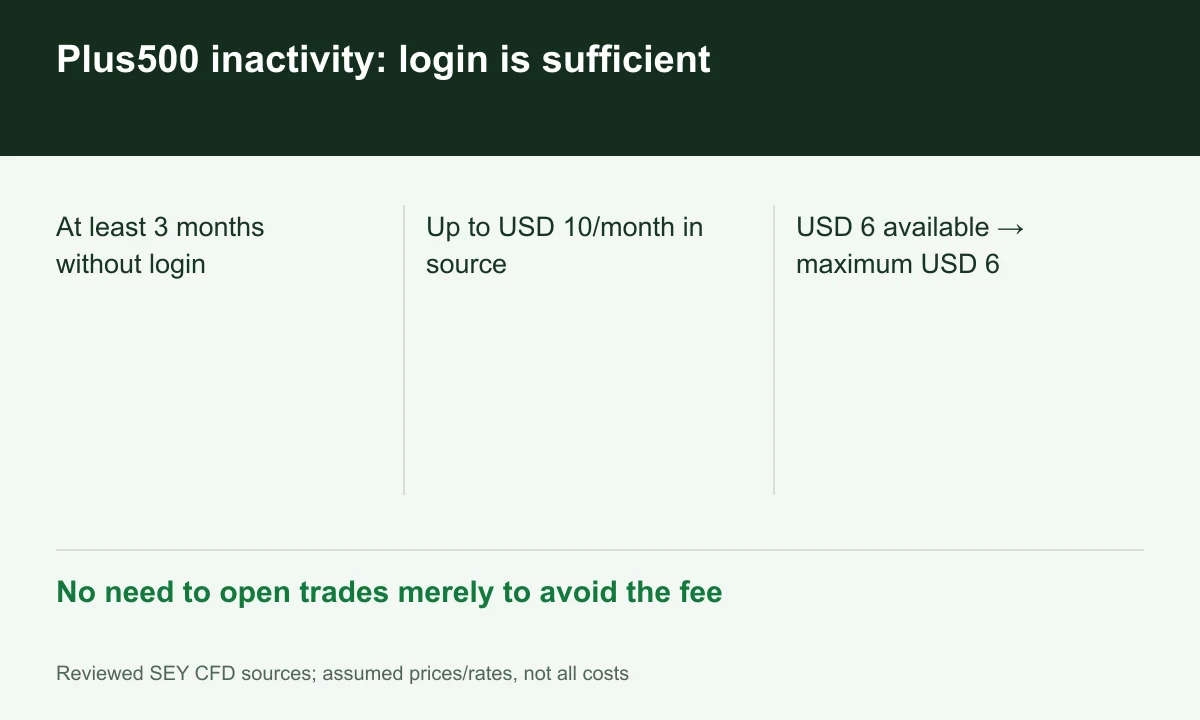
Provider guide
The source’s login criterion does not require an order; separate account fees from open-position costs.
Read guide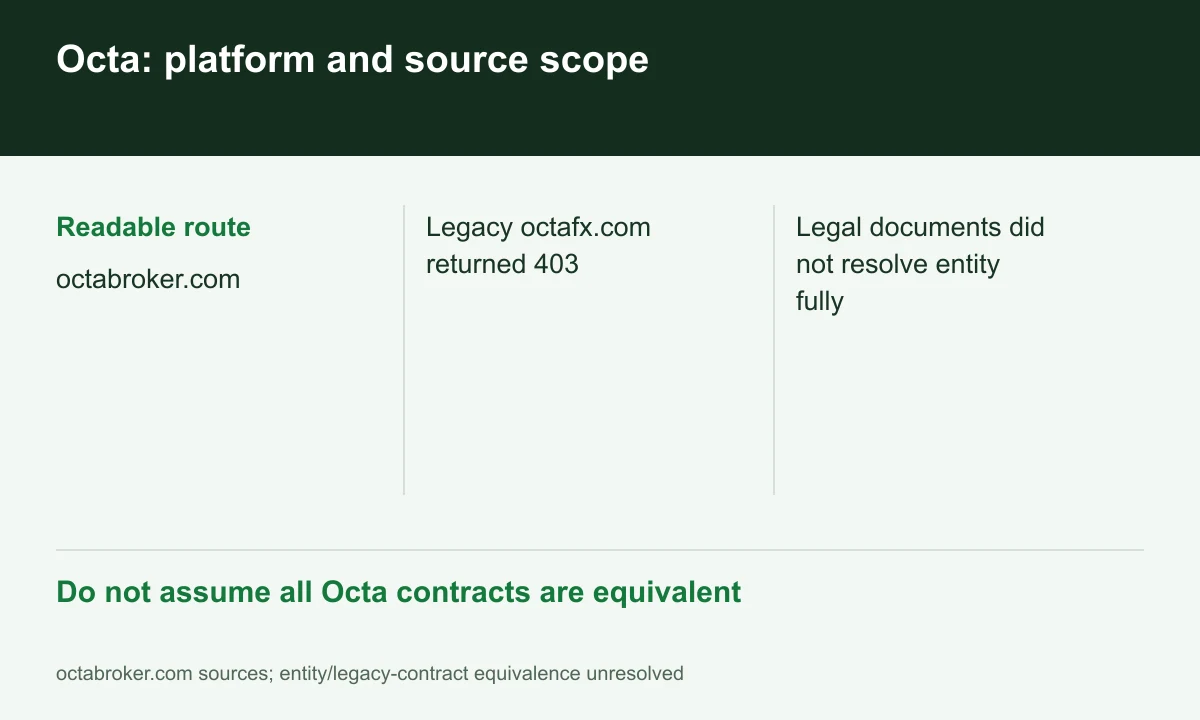
Provider guide
Use the readable octabroker.com pages while keeping unresolved legal-entity scope explicit.
Read guide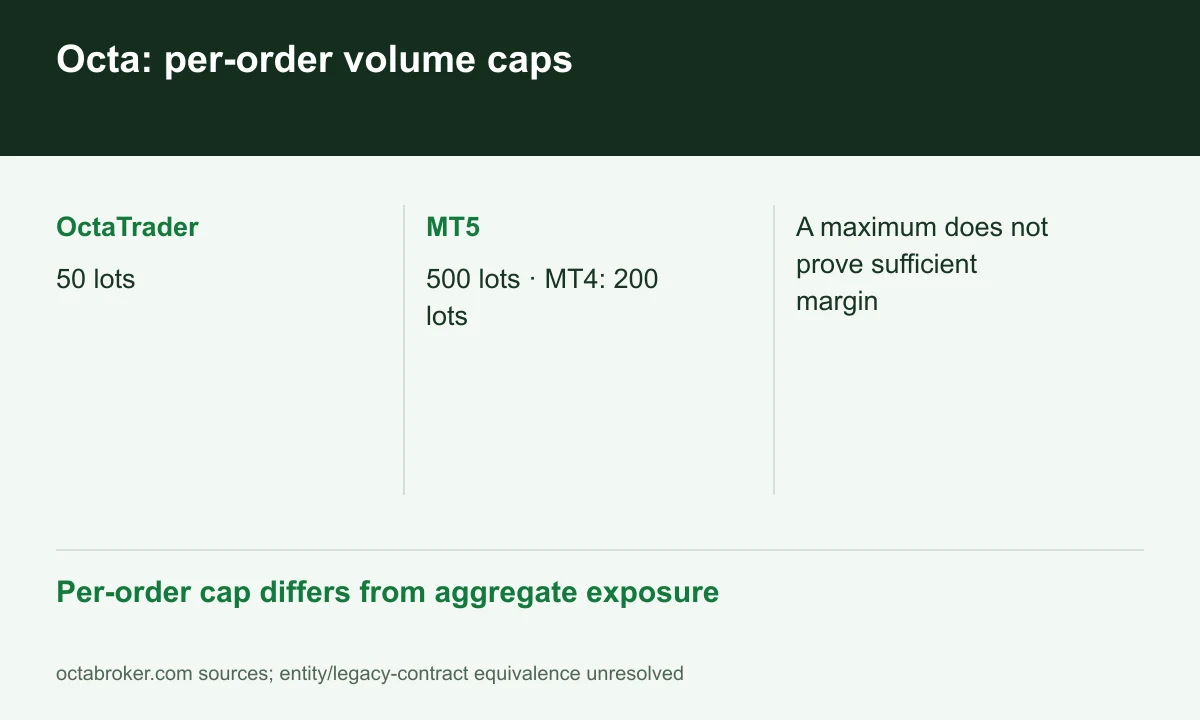
Provider guide
Separate per-order volume from ticket count, margin and batch acceptance.
Read guide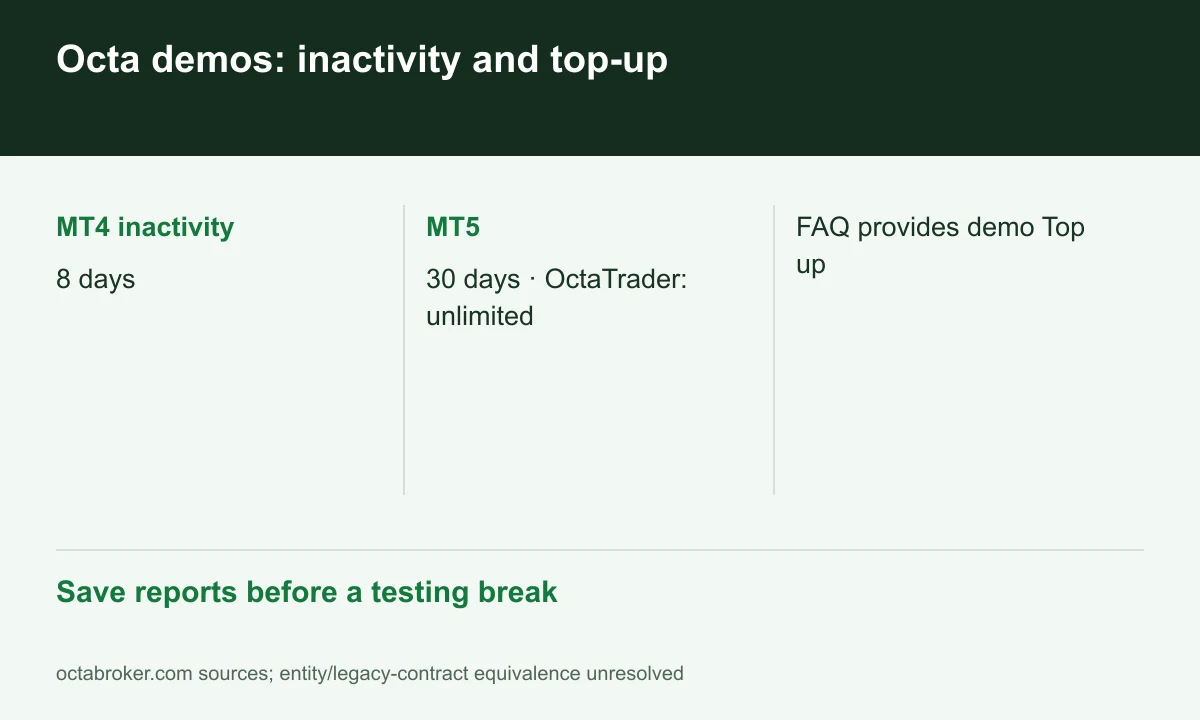
Provider guide
Save test history before a break; MT4, MT5 and OctaTrader have different stated inactivity periods.
Read guide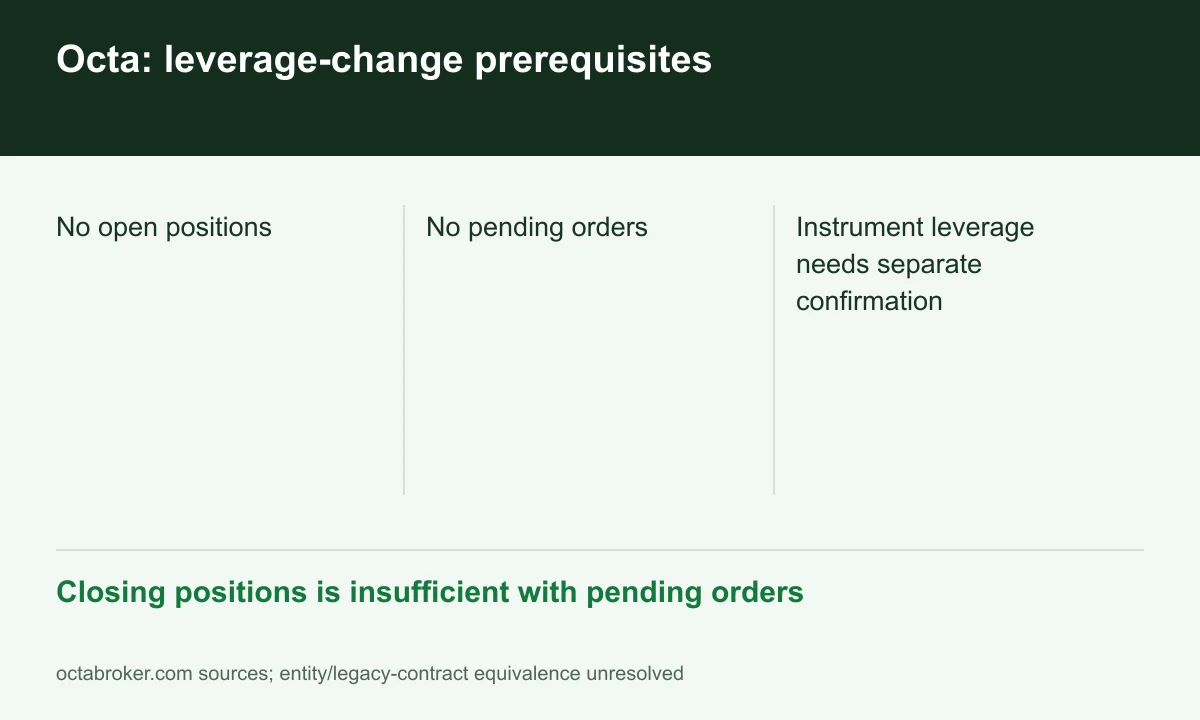
Provider guide
Check both order groups before changing settings, then recompute margin with equal assumed exposure.
Read guide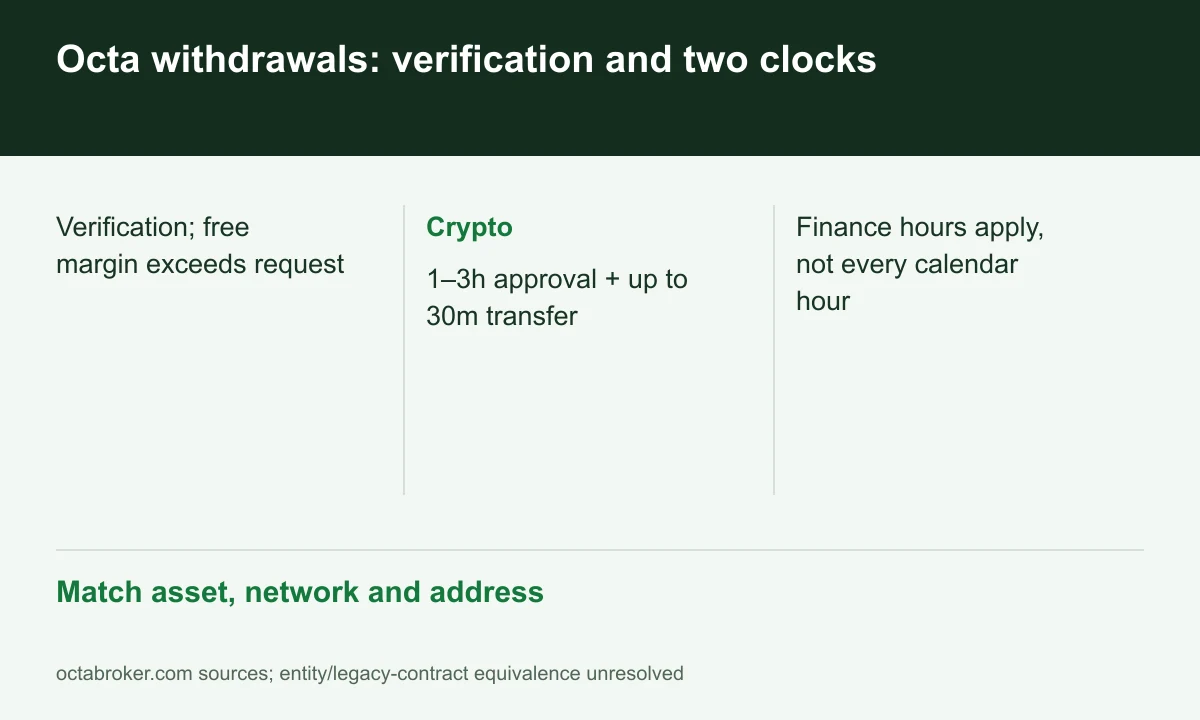
Provider guide
Select the correct network and Finance hours before interpreting pending status.
Read guide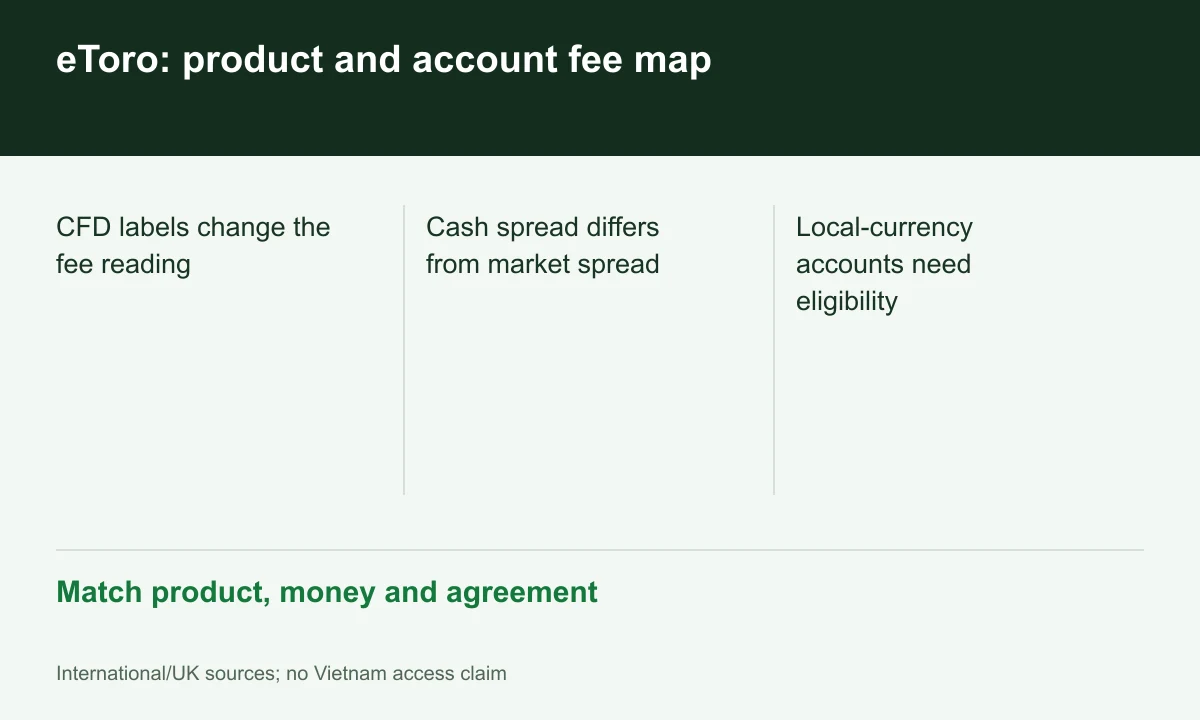
Provider guide
Separate CFD, real-stock and local-currency account costs before estimating a total.
Read guide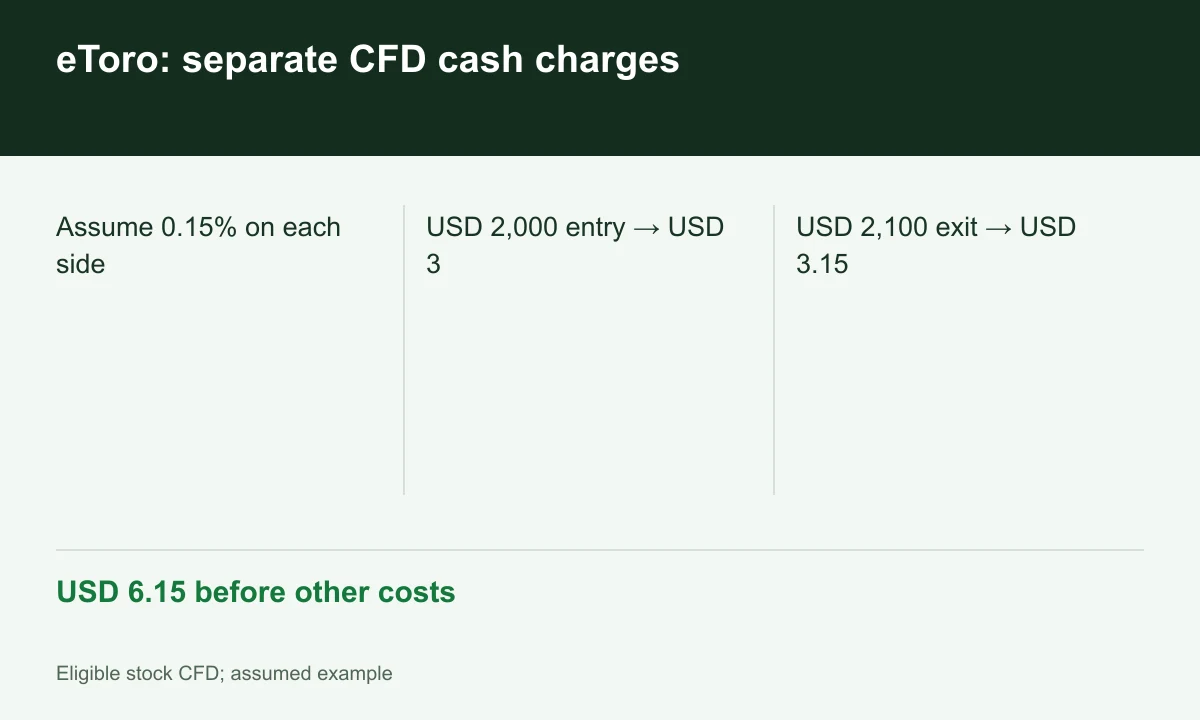
Provider guide
Use different entry and exit values to distinguish cash fees from execution slippage.
Read guide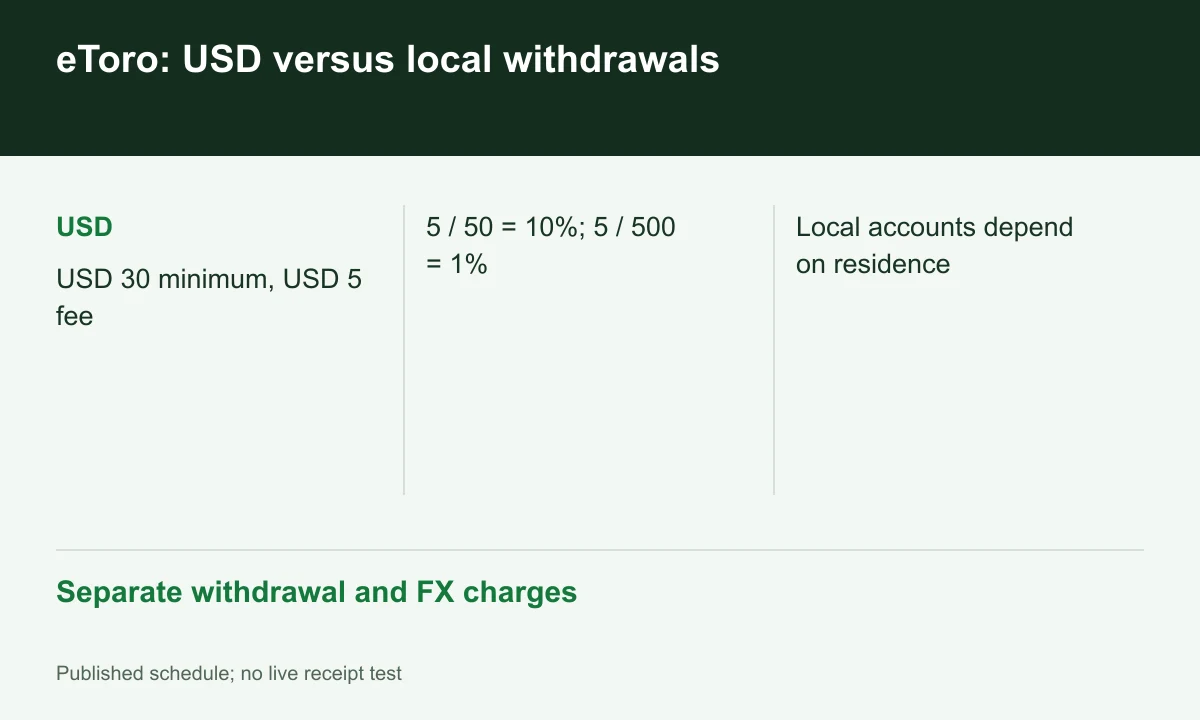
Provider guide
Treat the minimum, fixed withdrawal charge and FX conversion as separate checks.
Read guide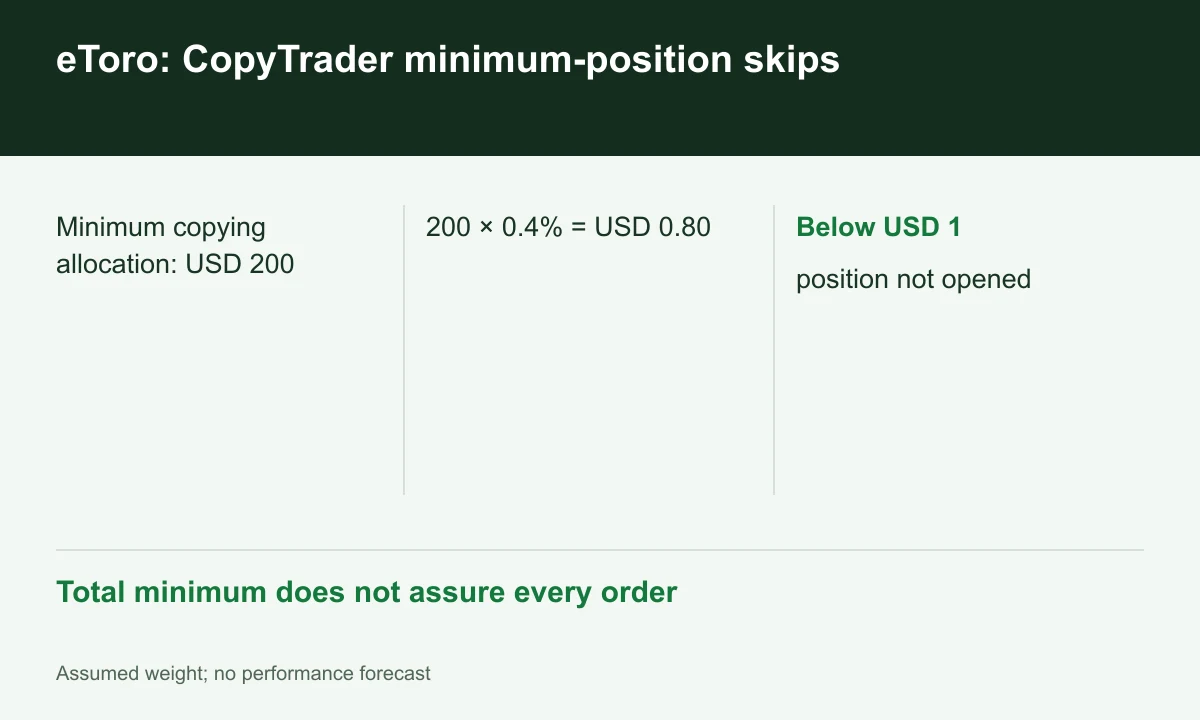
Provider guide
A USD 200 allocation can still skip sub-USD 1 positions; a proportional example explains why.
Read guide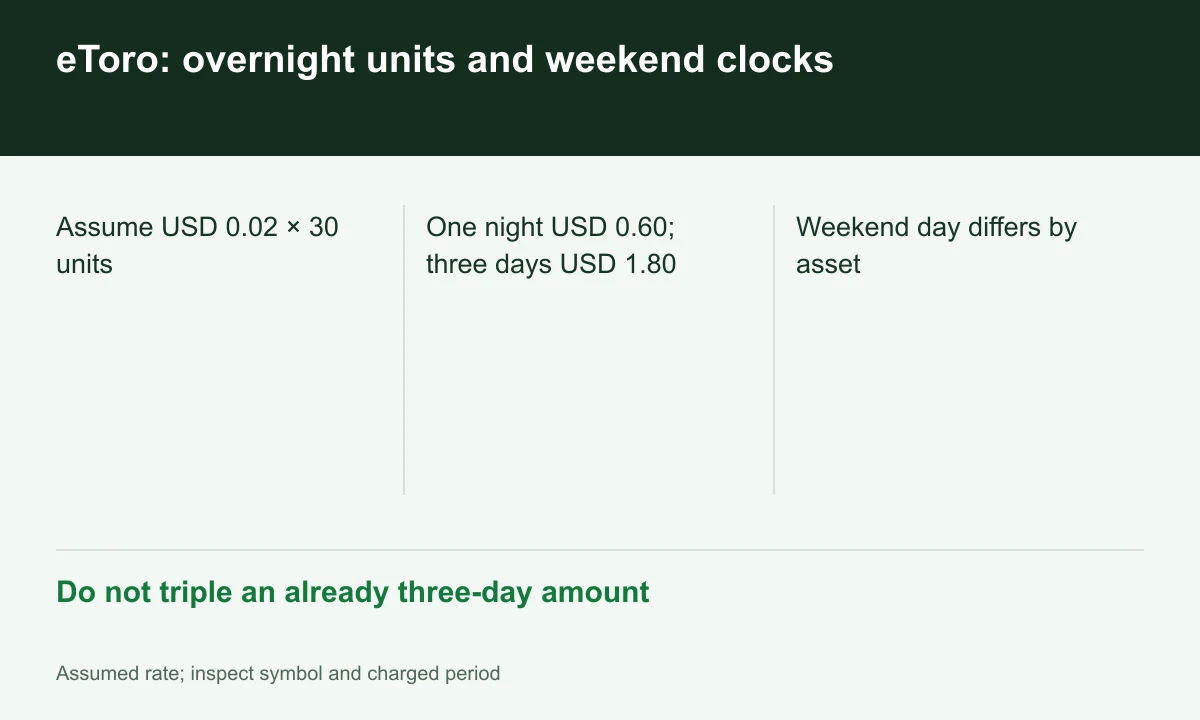
Provider guide
Scale unit-based fees and counted days without assigning one weekend schedule to every CFD.
Read guide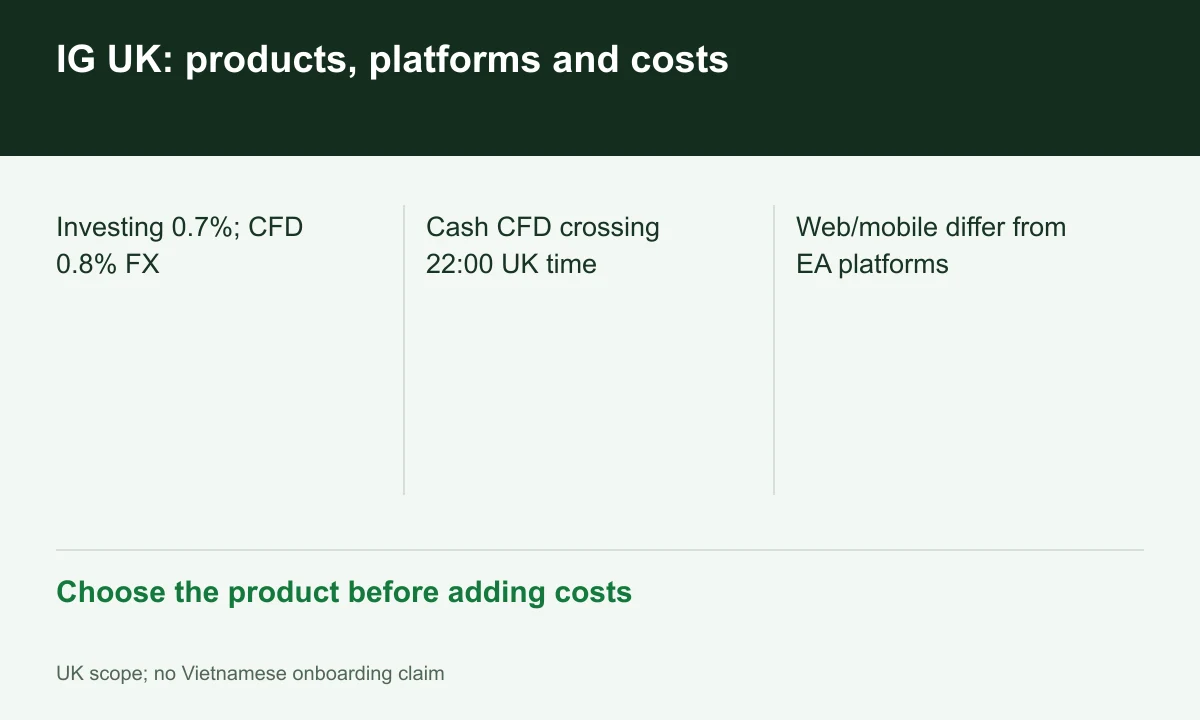
Provider guide
Use the correct investing, spread-bet or CFD schedule without merging entities or access rights.
Read guide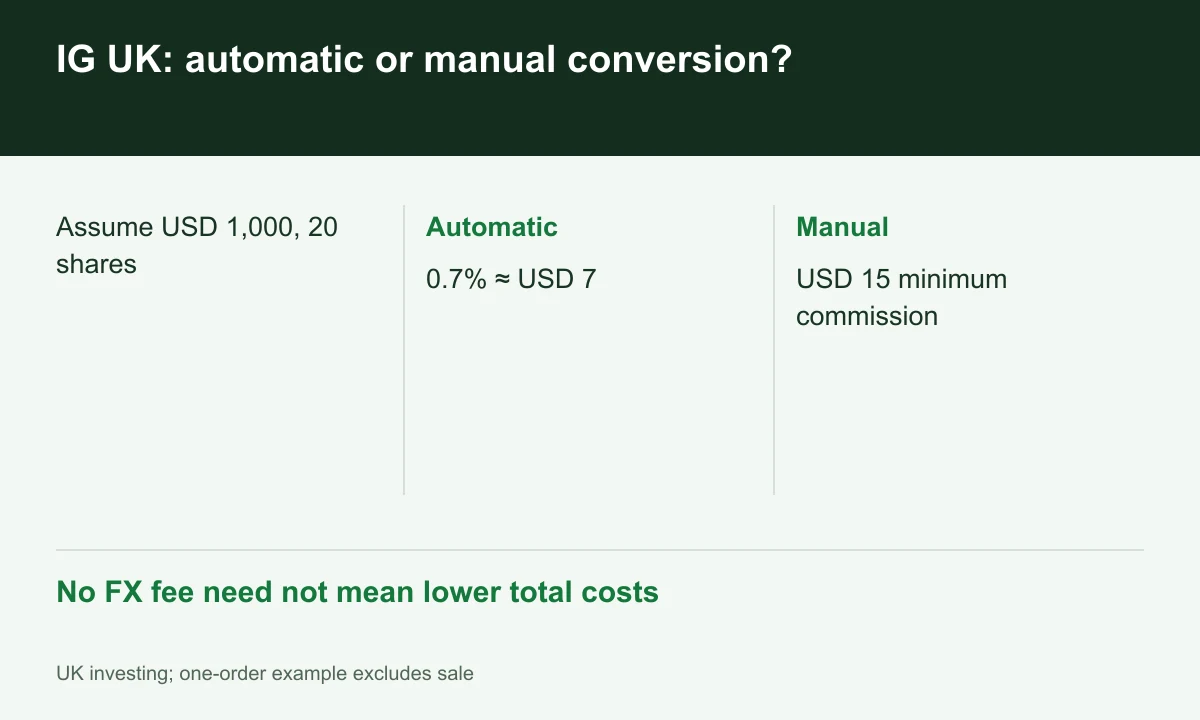
Provider guide
A 20-share US example shows how avoiding an FX fee can introduce minimum commission.
Read guide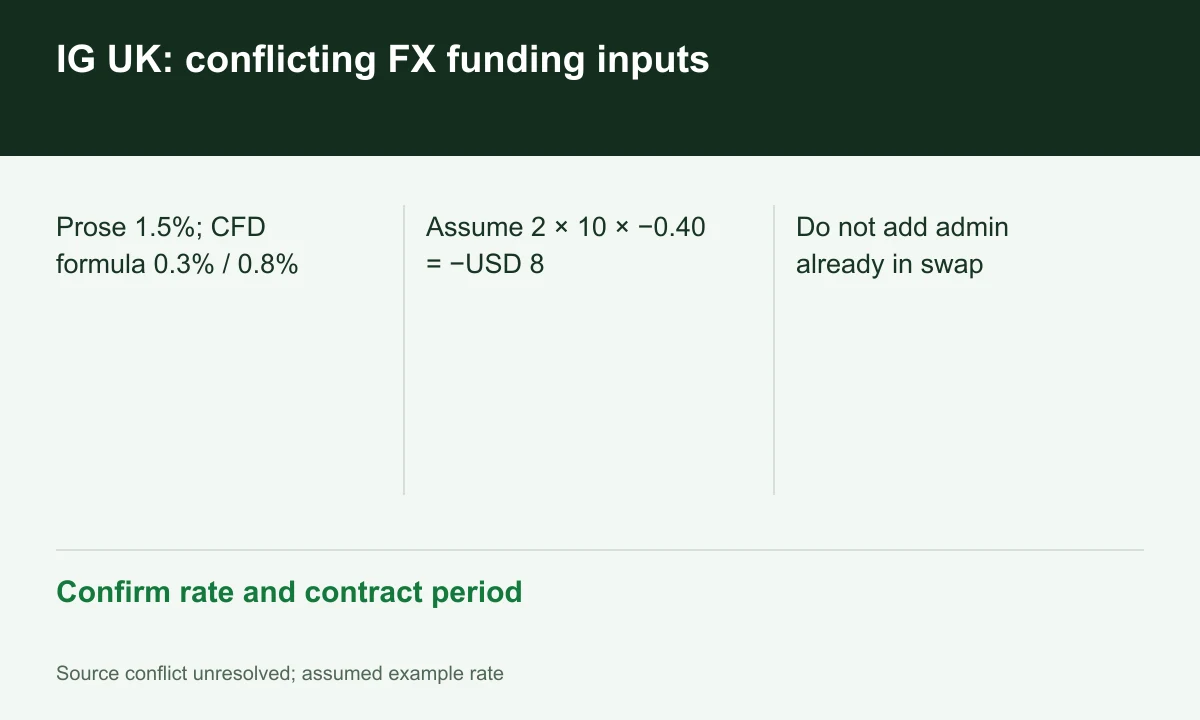
Provider guide
Calculate a confirmed swap charge without arbitrarily choosing inconsistent admin inputs.
Read guide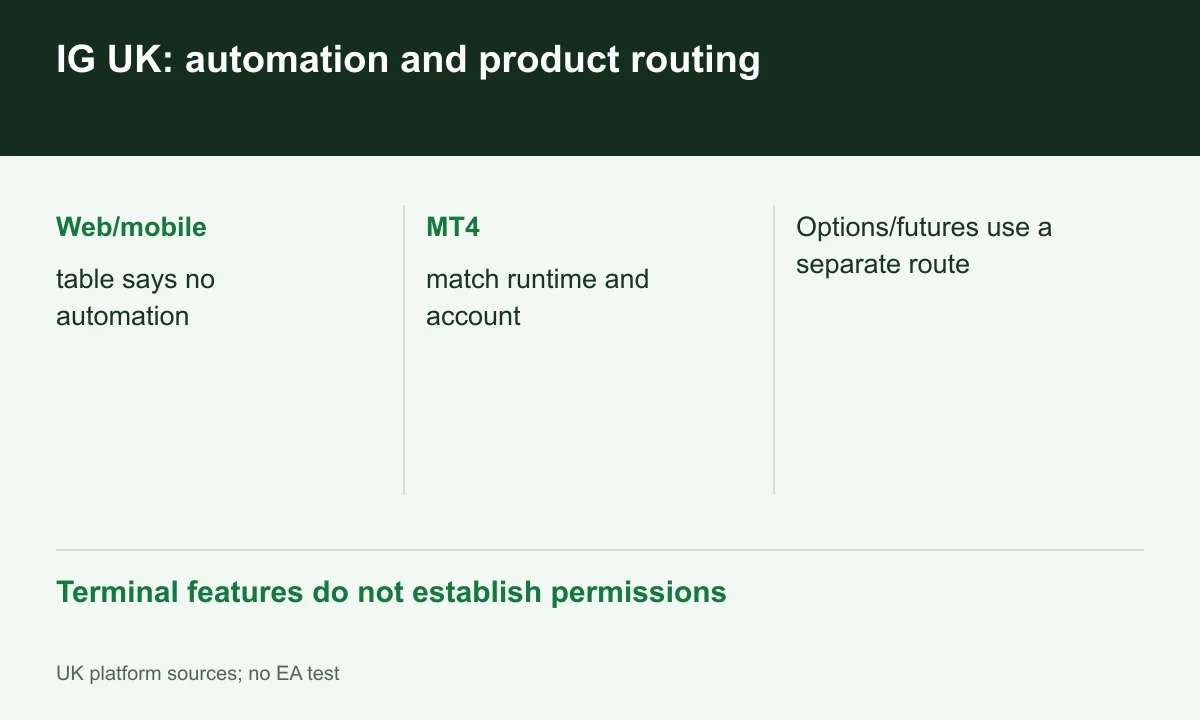
Provider guide
Distinguish EA runtime, charting and product access before moving platforms.
Read guide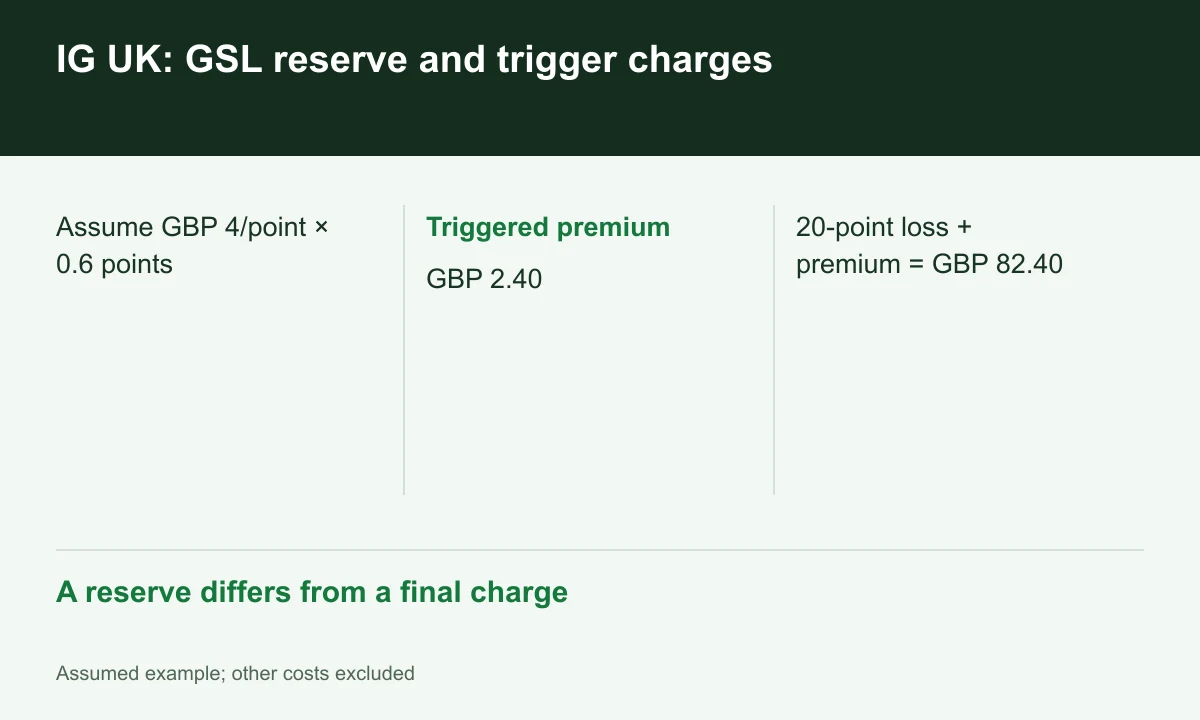
Provider guide
Separate the premium reserved alongside margin from its trigger-dependent charge.
Read guide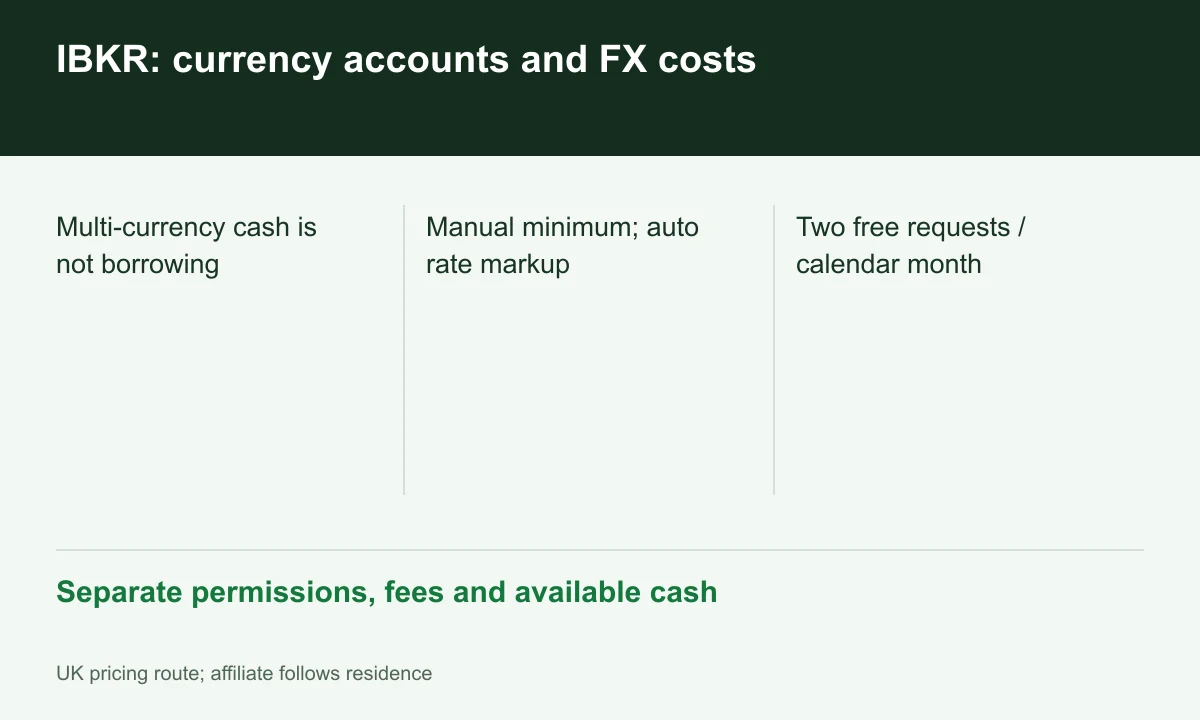
Provider guide
Read UK spot pricing alongside cash/margin mechanics without equating conversion with leveraged-FX permission.
Read guide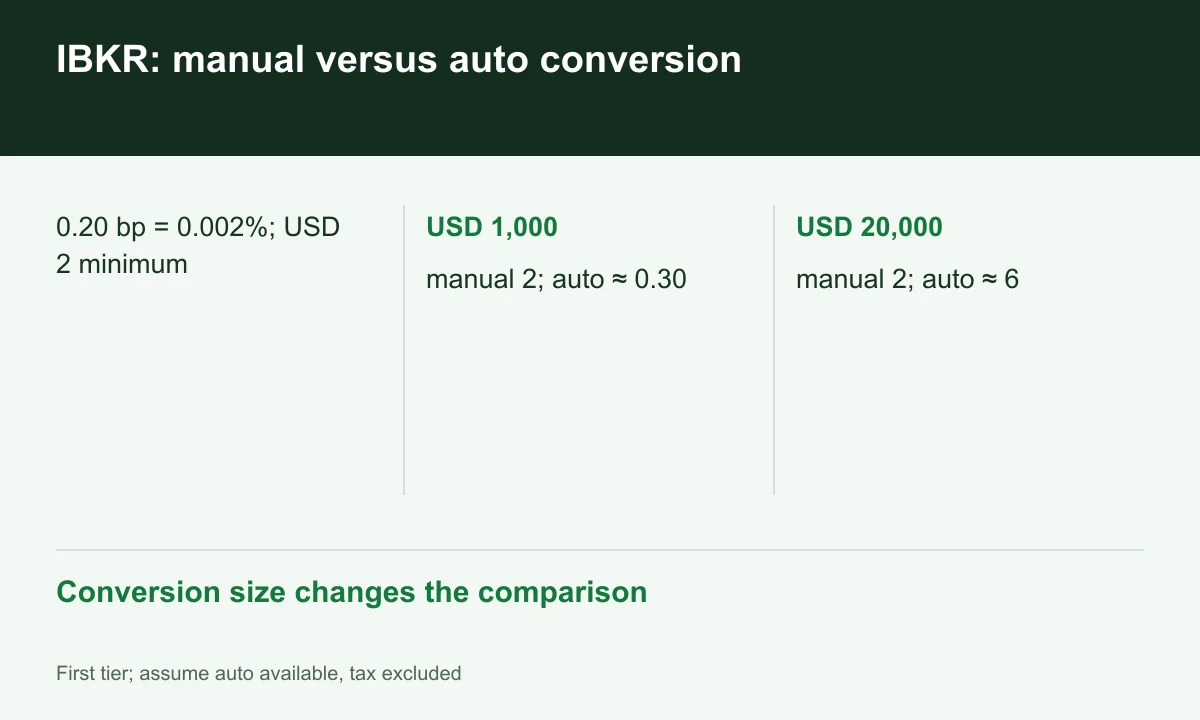
Provider guide
USD 1,000 and USD 20,000 examples isolate minimum effects without a universal recommendation.
Read guide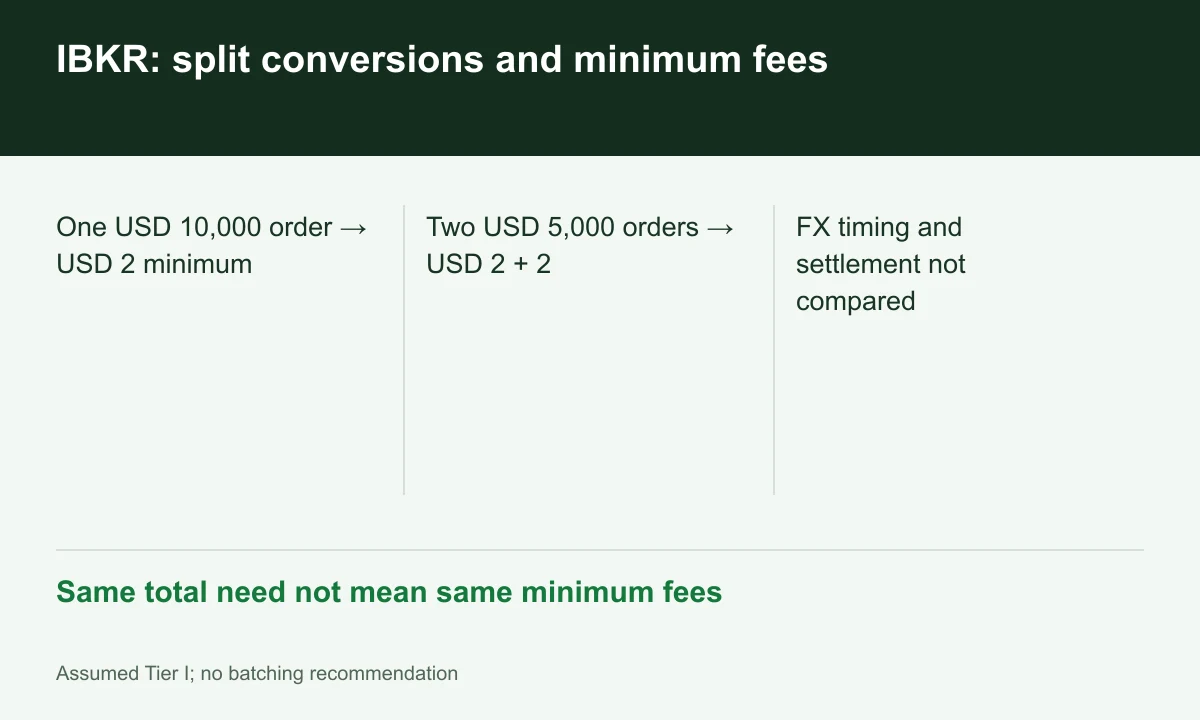
Provider guide
Two small orders can incur two minimums; separate fee arithmetic from market-timing advice.
Read guide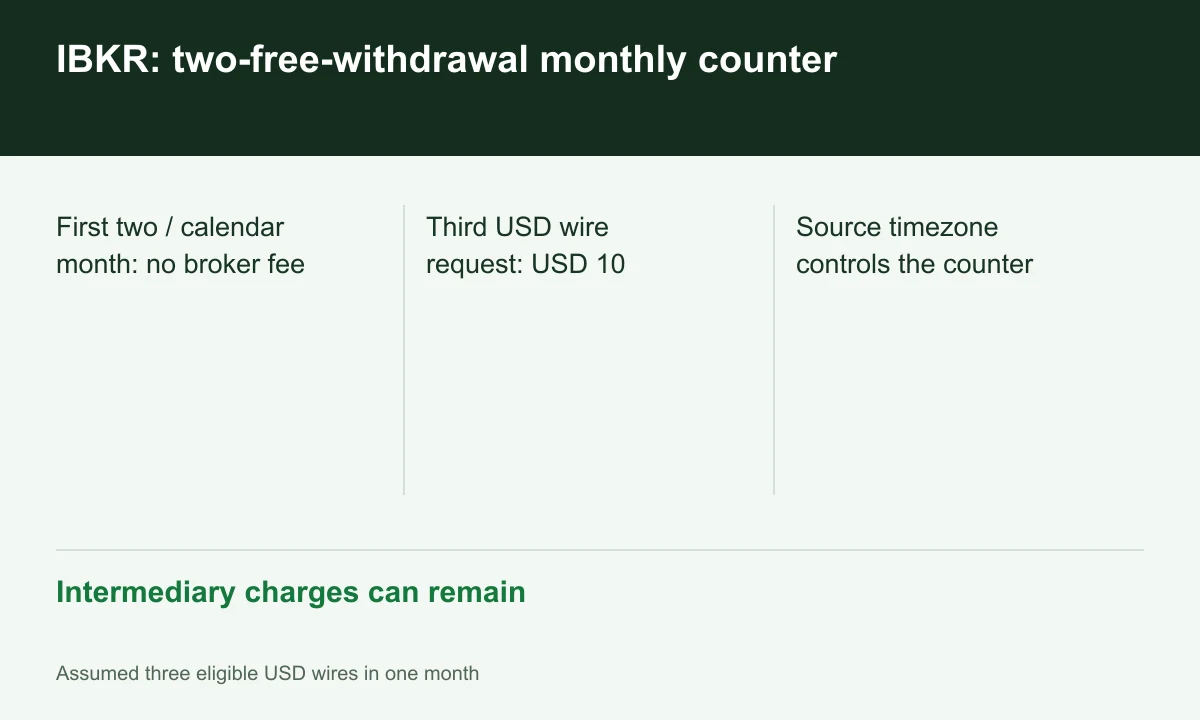
Provider guide
Count requests by calendar month and method rather than applying an old one-free-request rule.
Read guide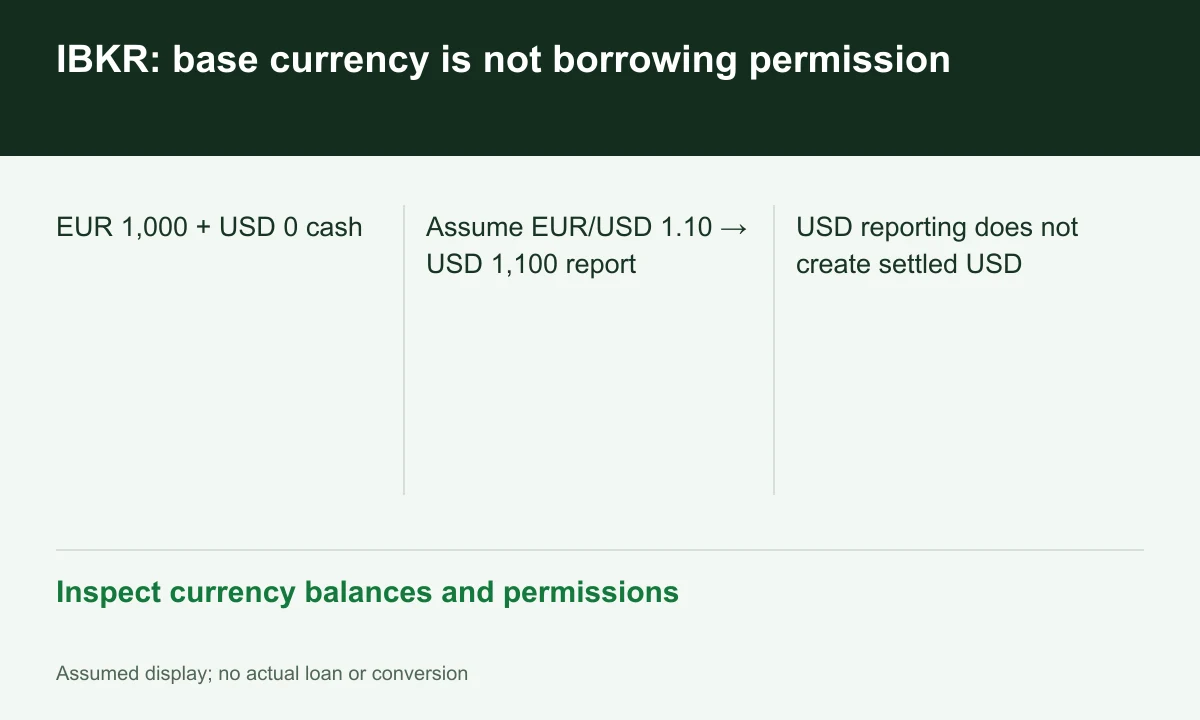
Provider guide
Separate reporting values, foreign cash and Forex permission instead of mistaking display translation for conversion.
Read guide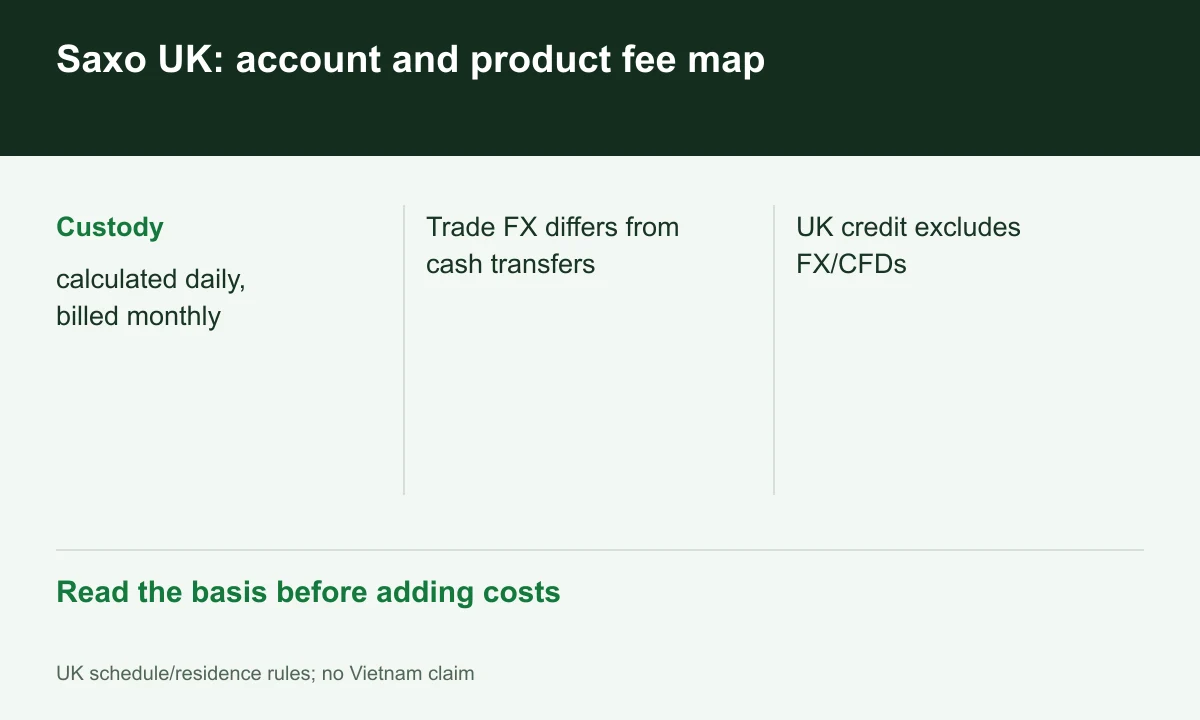
Provider guide
Custody, conversion, securities transfers and referral credit use different bases.
Read guide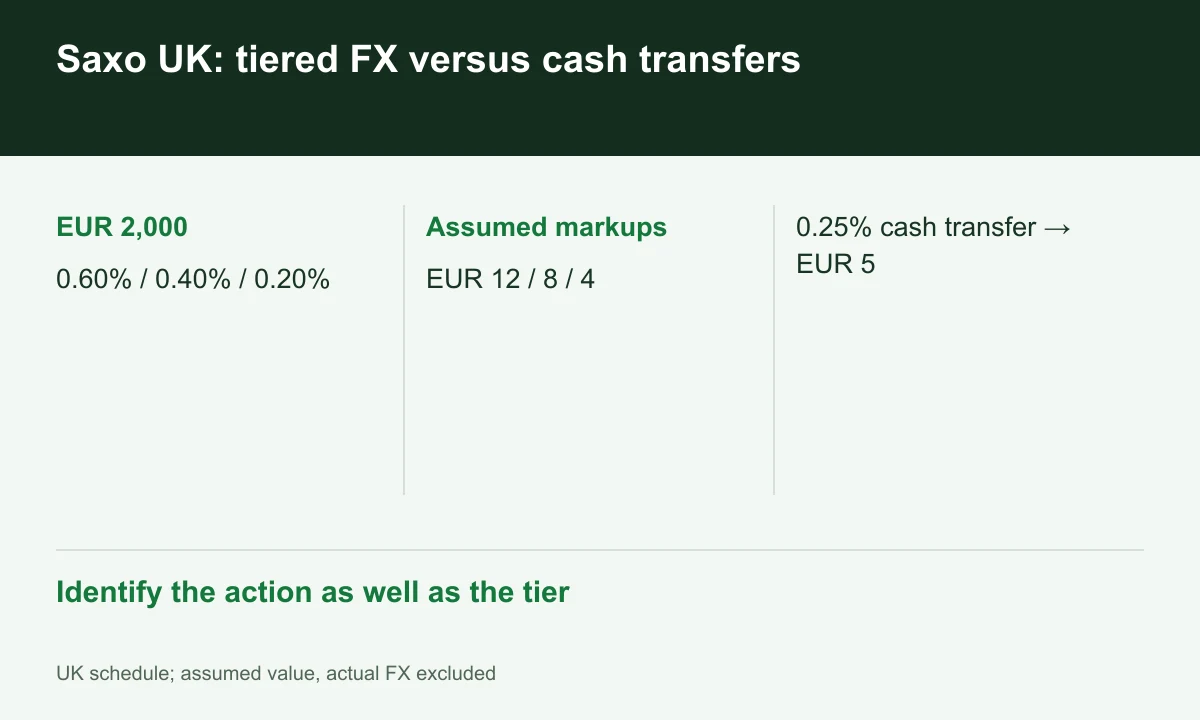
Provider guide
Compare tiered trade conversions with 0.25% cash-account transfers on an equal assumed amount.
Read guide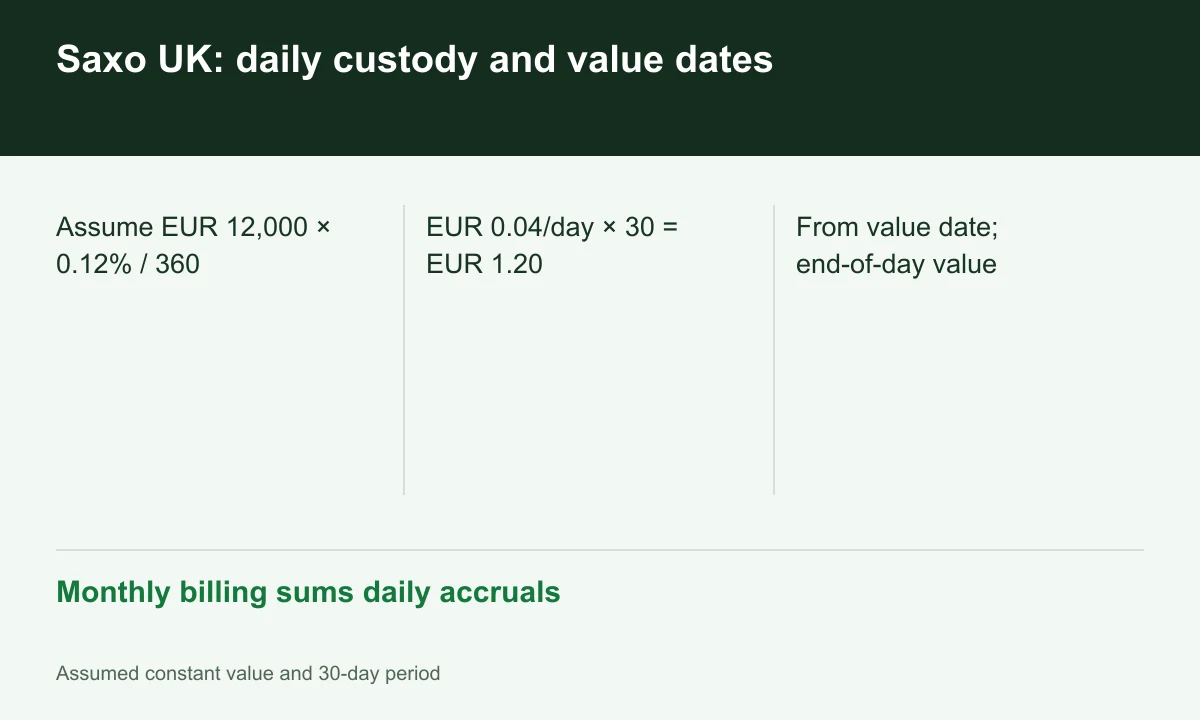
Provider guide
A EUR 12,000 example explains monthly billing of daily accruals rather than monthly charging of an annual rate.
Read guide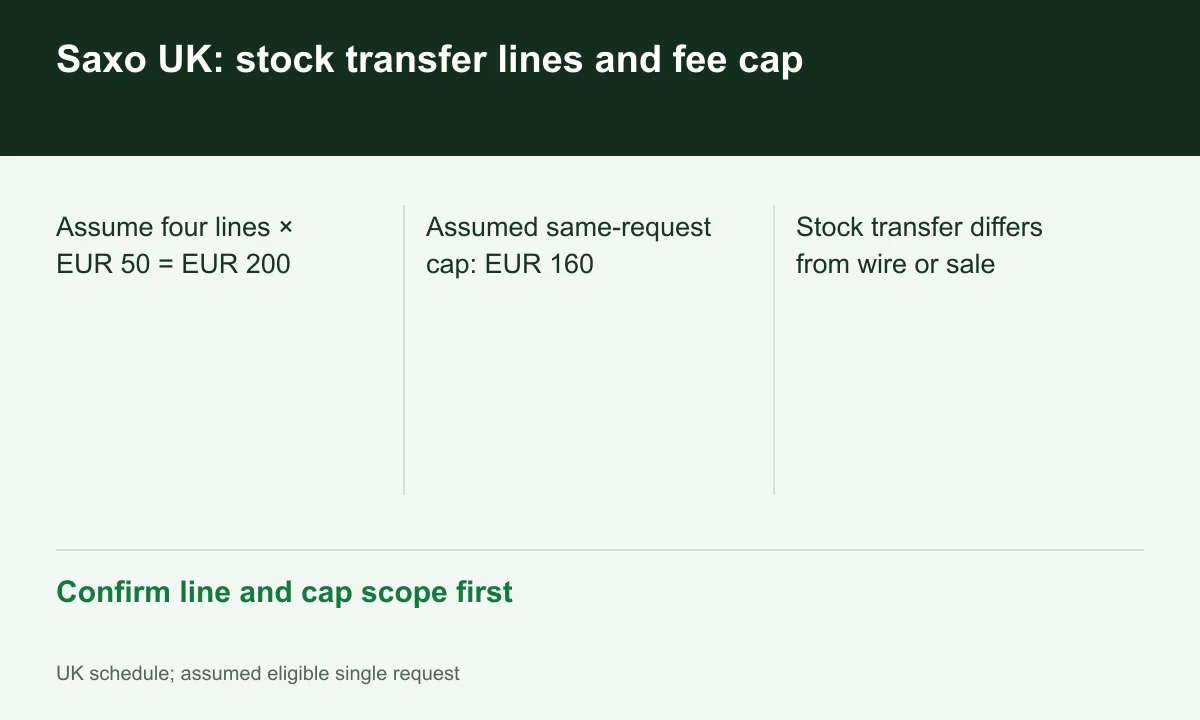
Provider guide
Four lines illustrate the EUR 160 cap separately from cash transfers or stock sales.
Read guide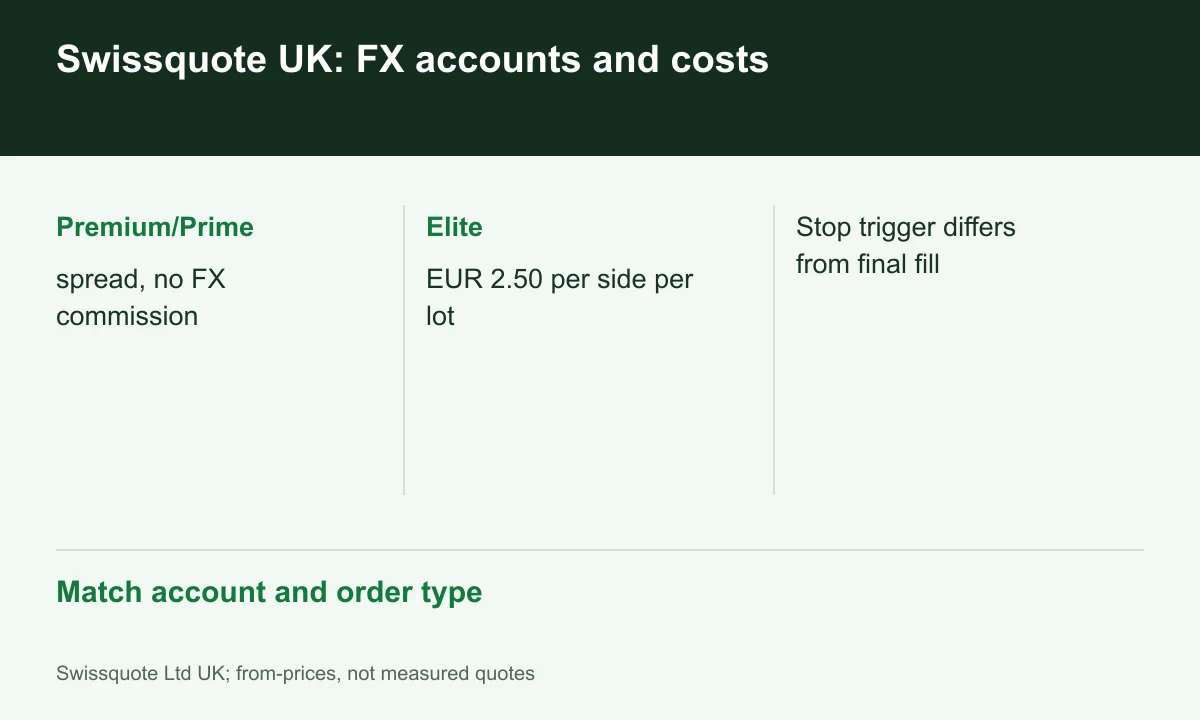
Provider guide
Distinguish Premium, Prime and Elite, funding conditions and stop execution at Swissquote Ltd.
Read guide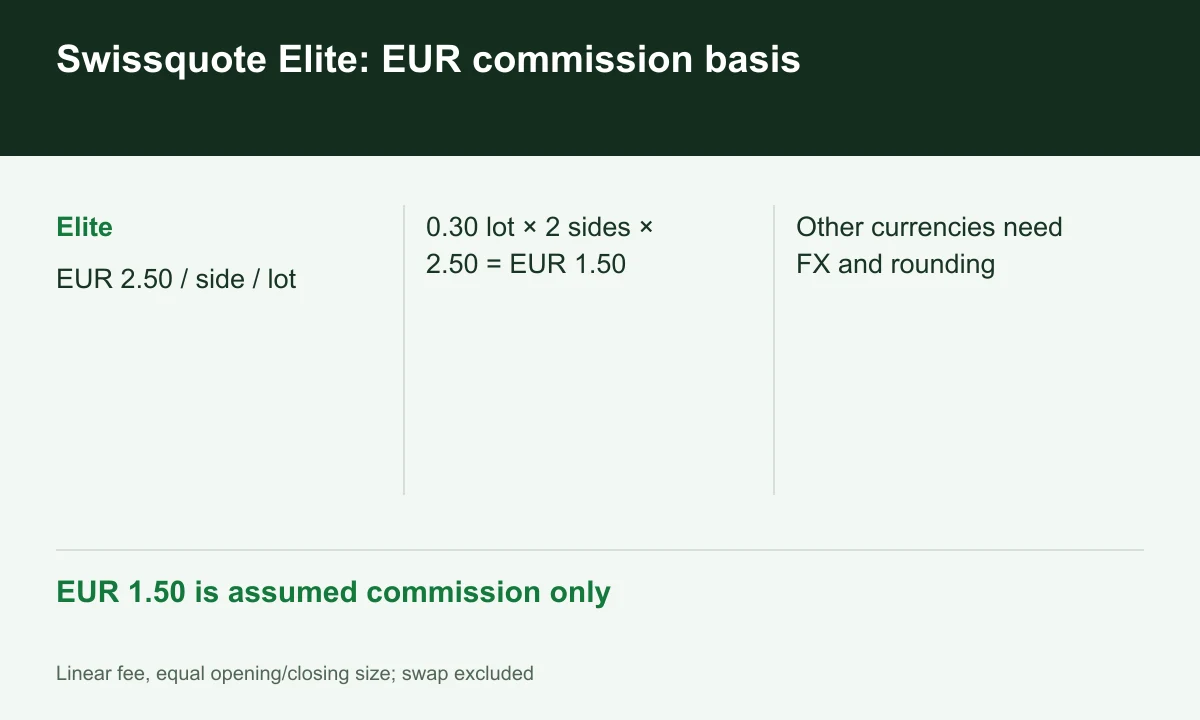
Provider guide
Calculate both sides on 0.30 lot, retaining EUR as the fee basis before account-currency conversion.
Read guide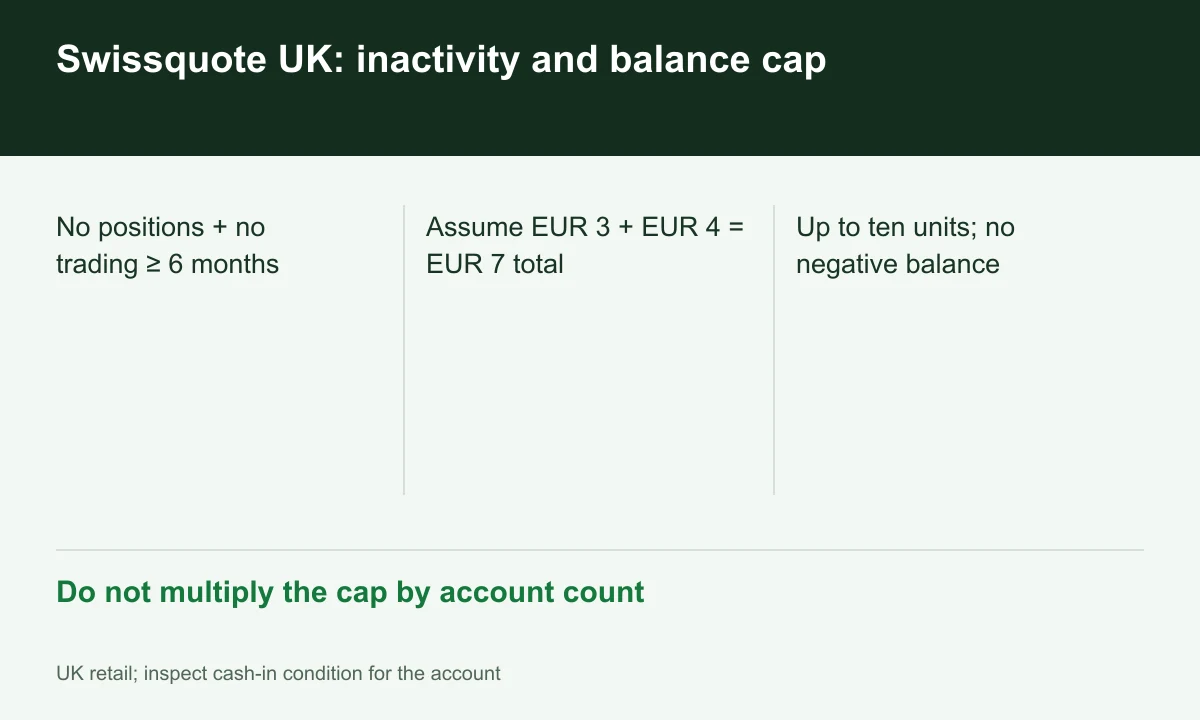
Provider guide
Read the six-month conditions, account aggregation and no-negative limit before budgeting fees.
Read guide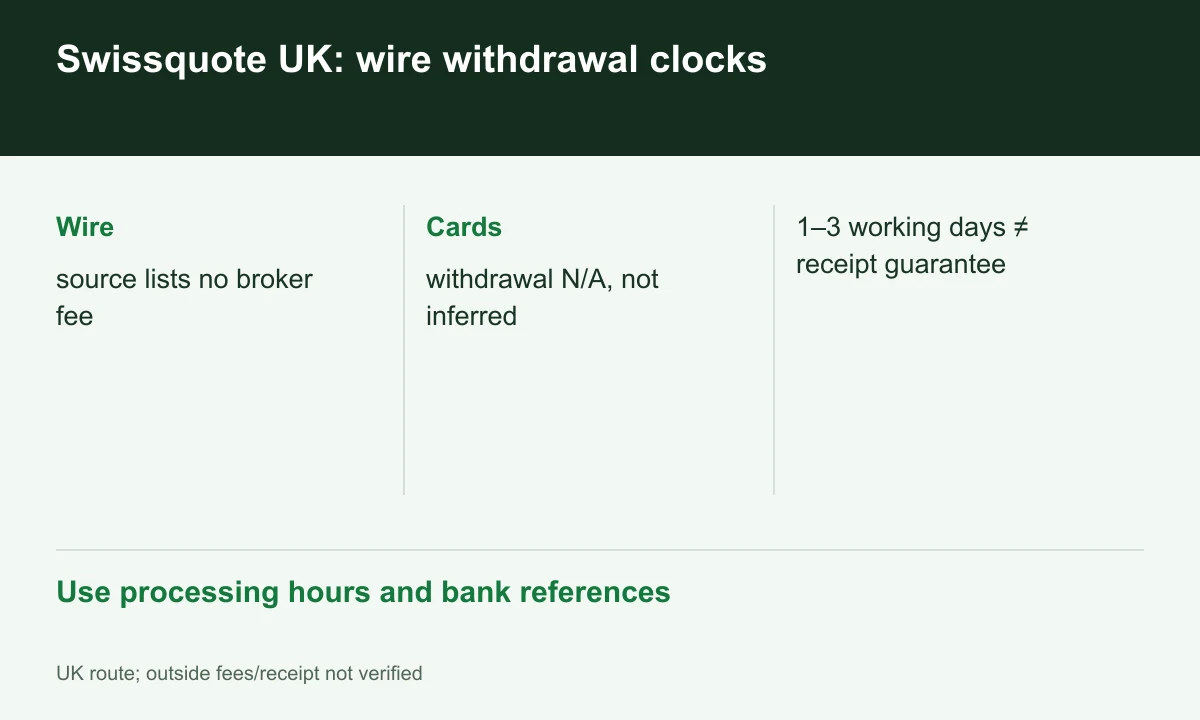
Provider guide
Separate card deposits, wire withdrawals and bank receipt to avoid false arrival promises.
Read guide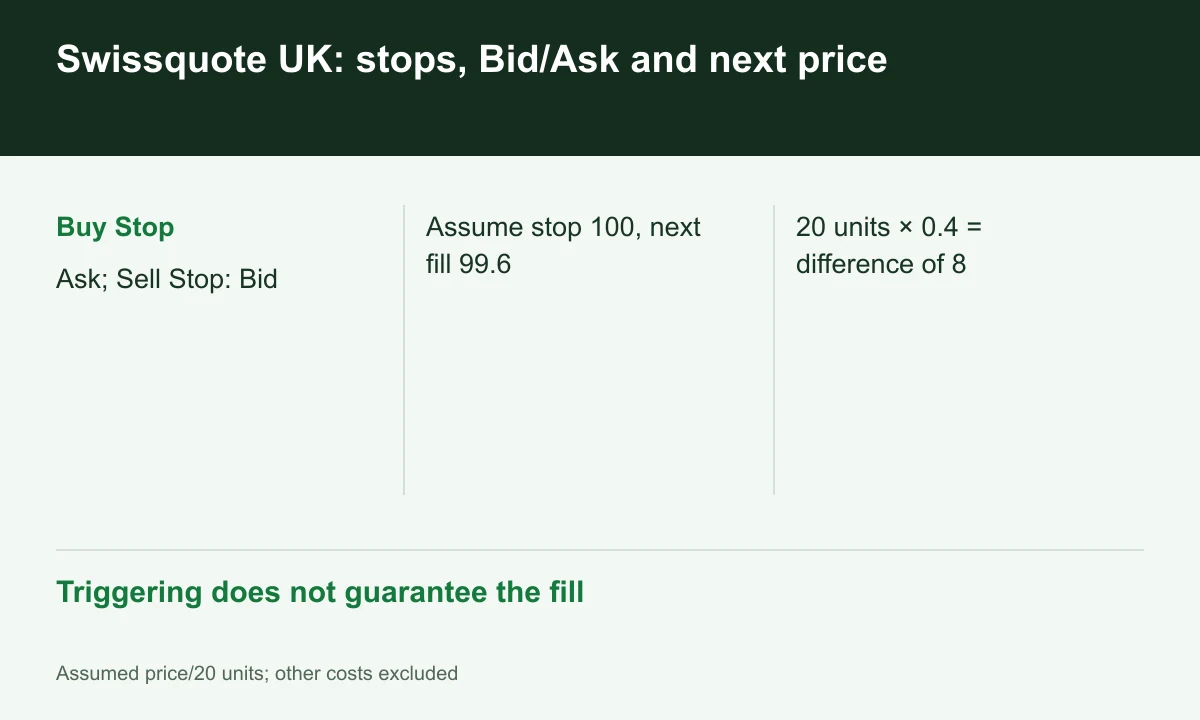
Provider guide
A sell-stop example at 100 with a 99.6 next fill separates triggering from execution.
Read guide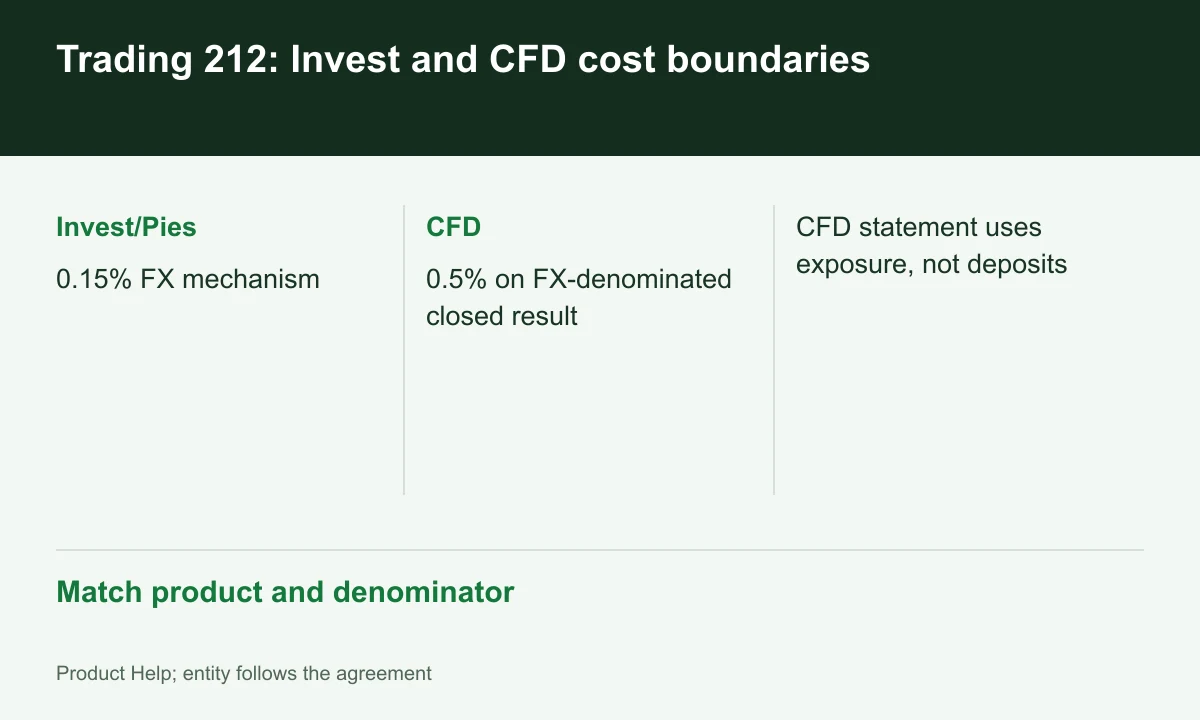
Provider guide
One app can still have different multi-currency access, FX fees and statement denominators.
Read guide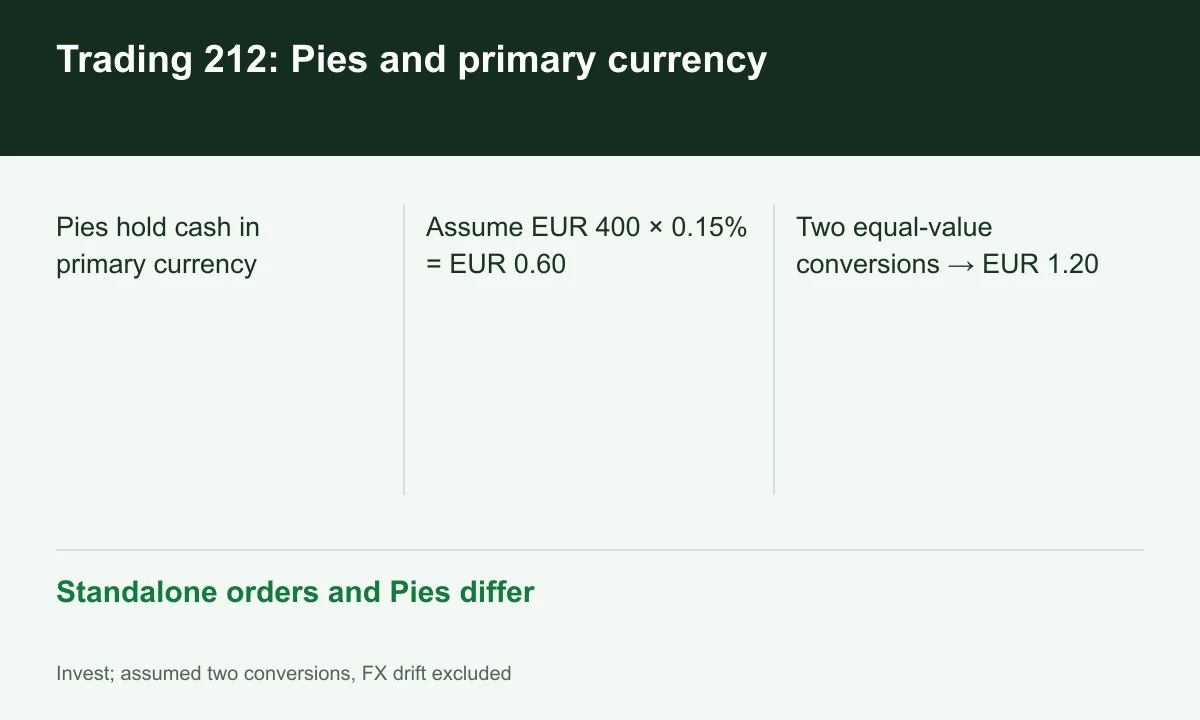
Provider guide
Selecting USD for a standalone order does not remove Pie conversion or an earlier currency exchange.
Read guide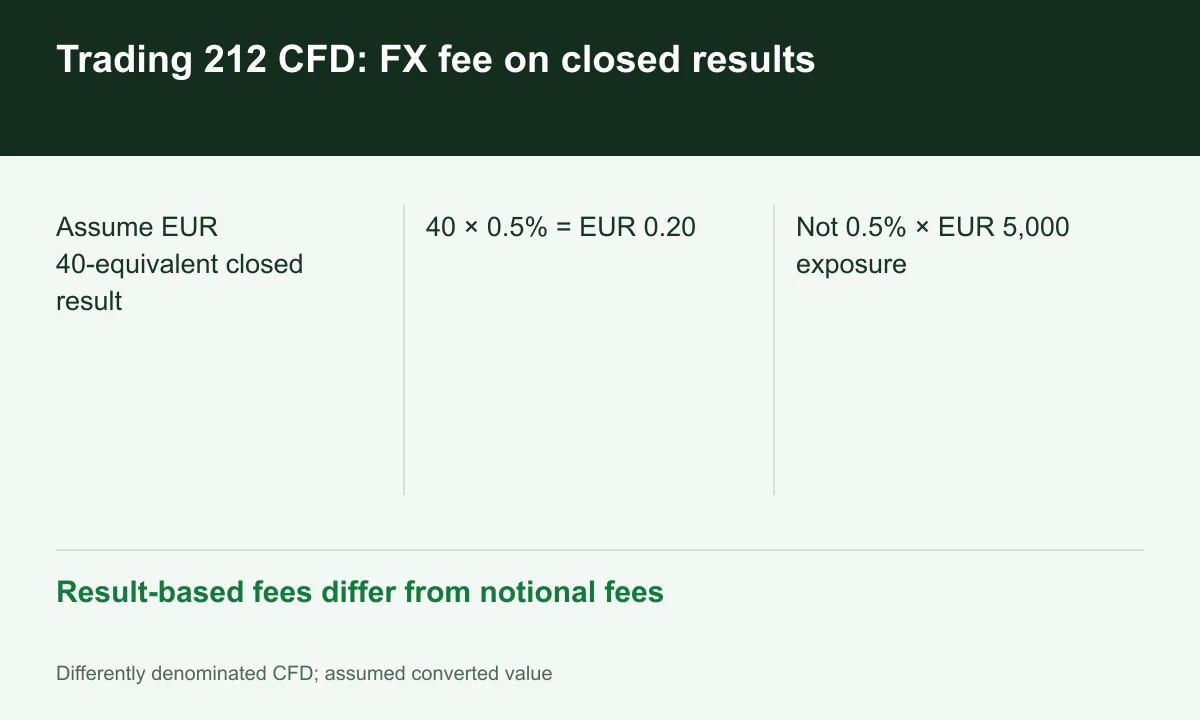
Provider guide
A 0.5% calculation separates closed results from full exposure and overnight charges.
Read guide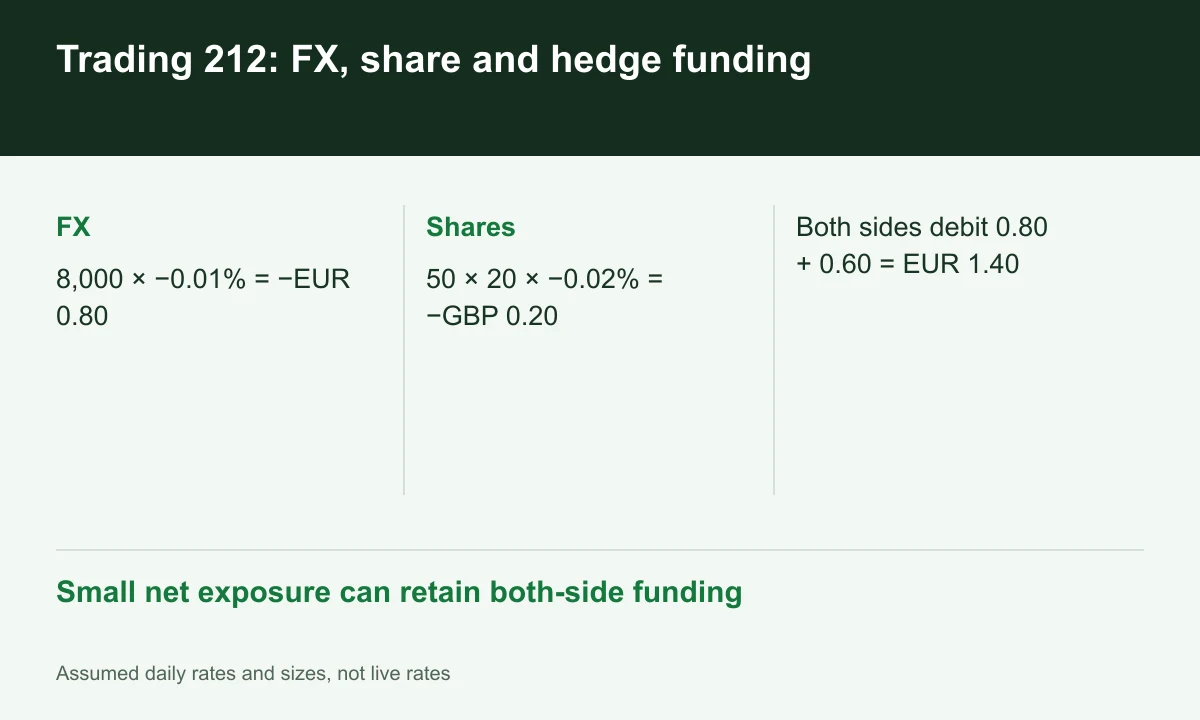
Provider guide
Use the two formulas and a both-sides-debit example without treating an annual rate as daily.
Read guide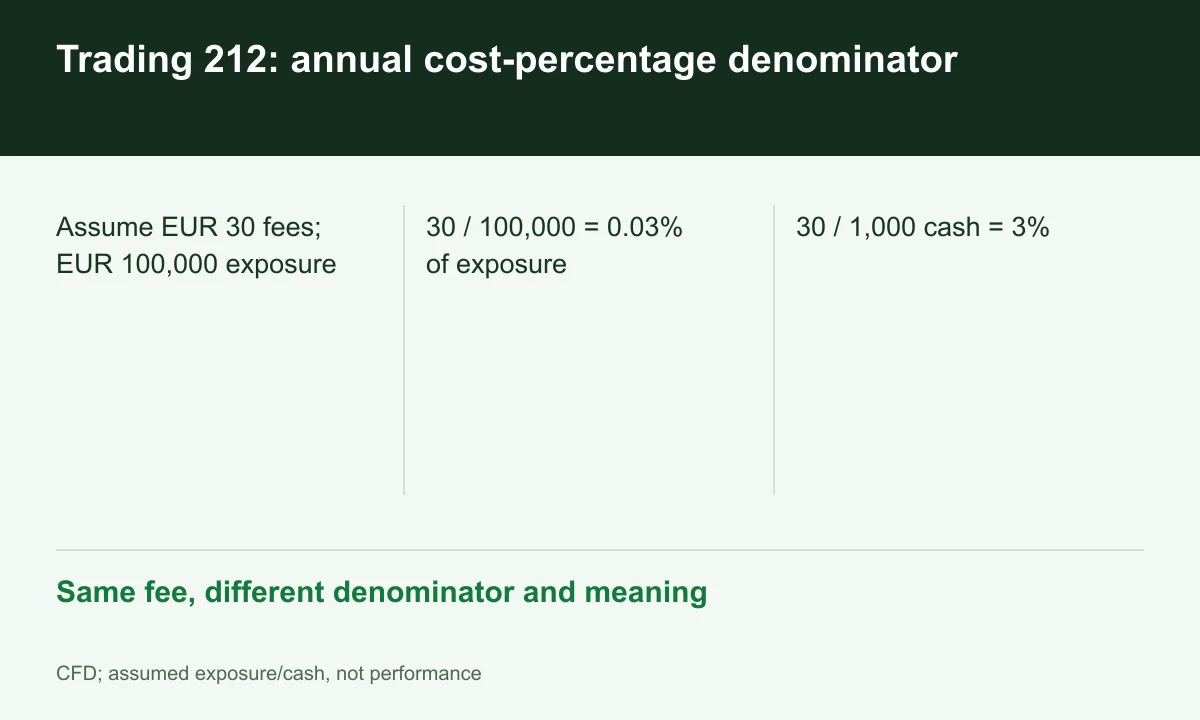
Provider guide
EUR 30 costs can appear as 0.03% of exposure while representing 3% of assumed cash.
Read guide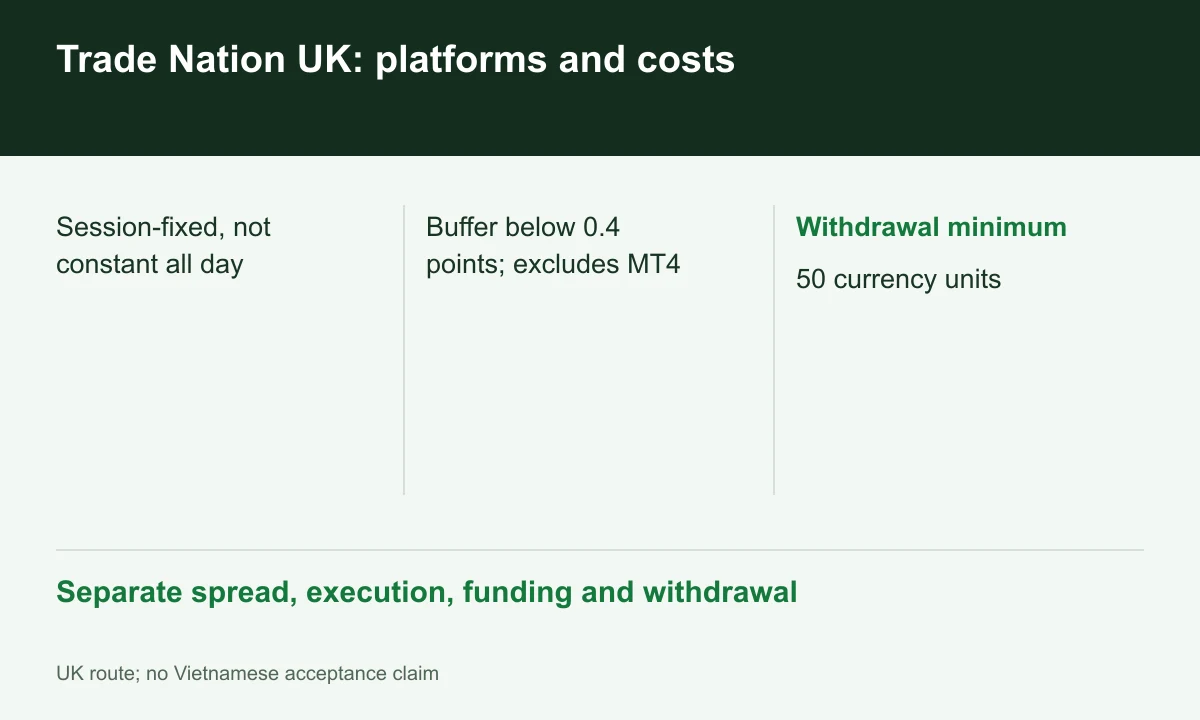
Provider guide
Session-fixed pricing, stop buffers and withdrawal minima are separate mechanisms.
Read guide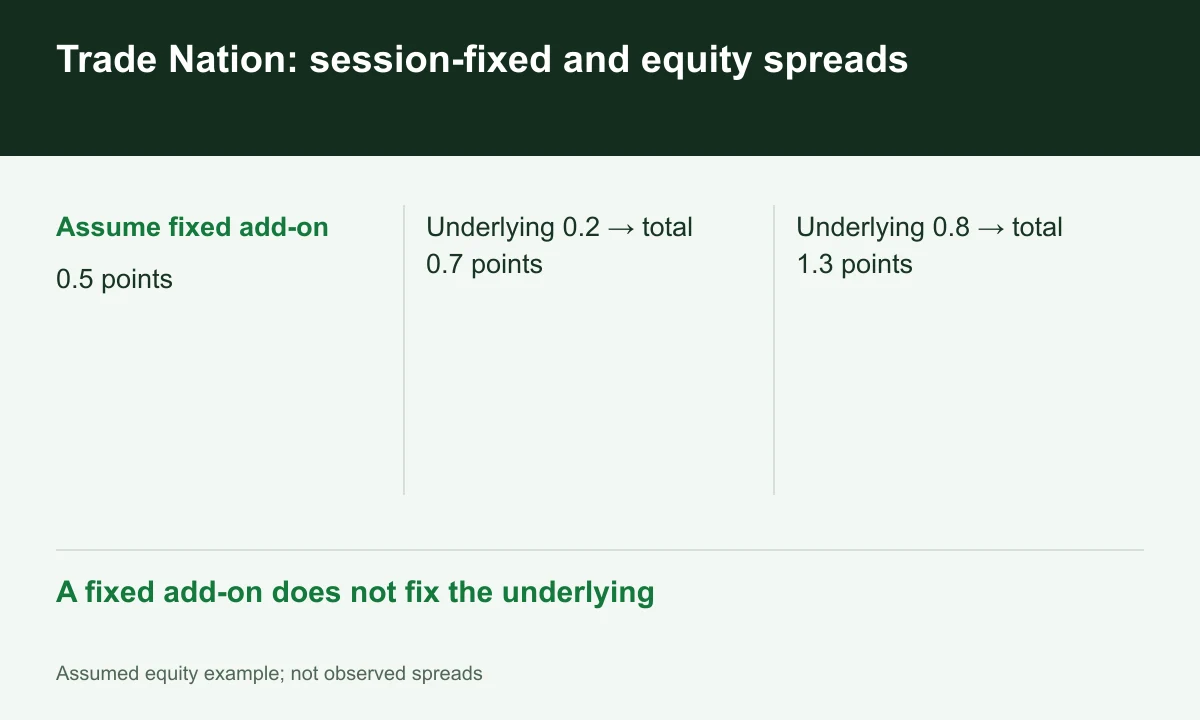
Provider guide
A fixed 0.5 add-on over a changing underlying spread explains the equity exception.
Read guide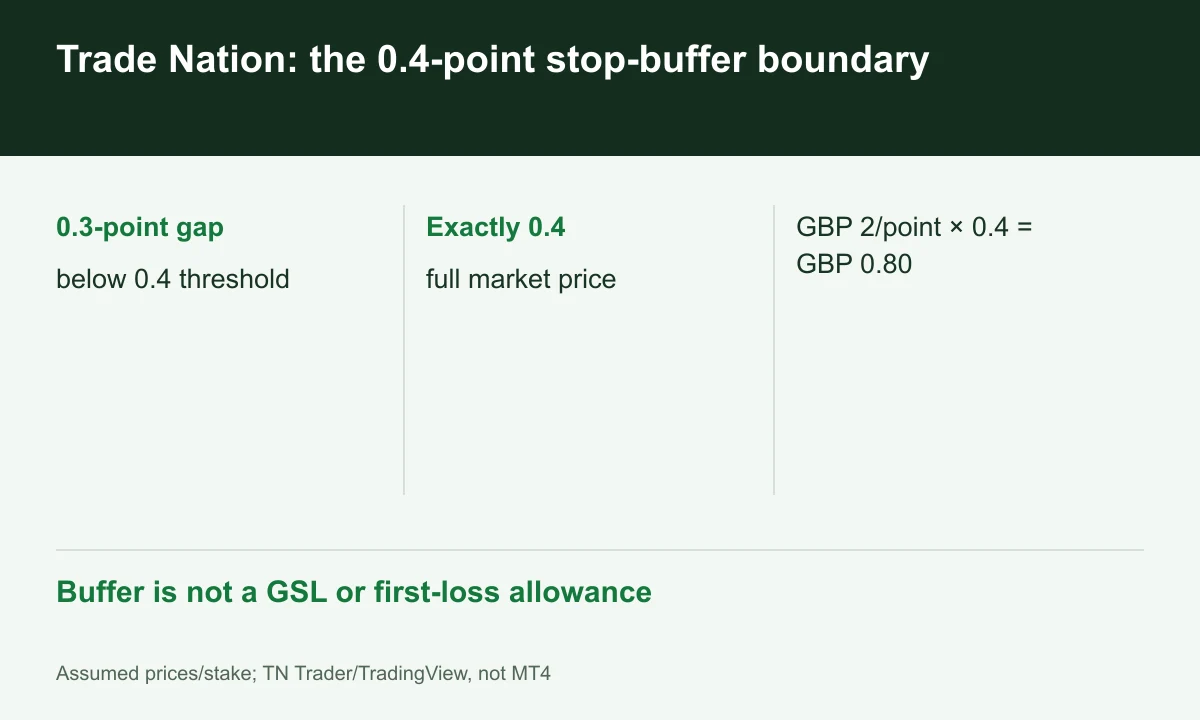
Provider guide
Compare below-threshold and exact-threshold fills; the buffer is not a universal 0.4-point allowance.
Read guide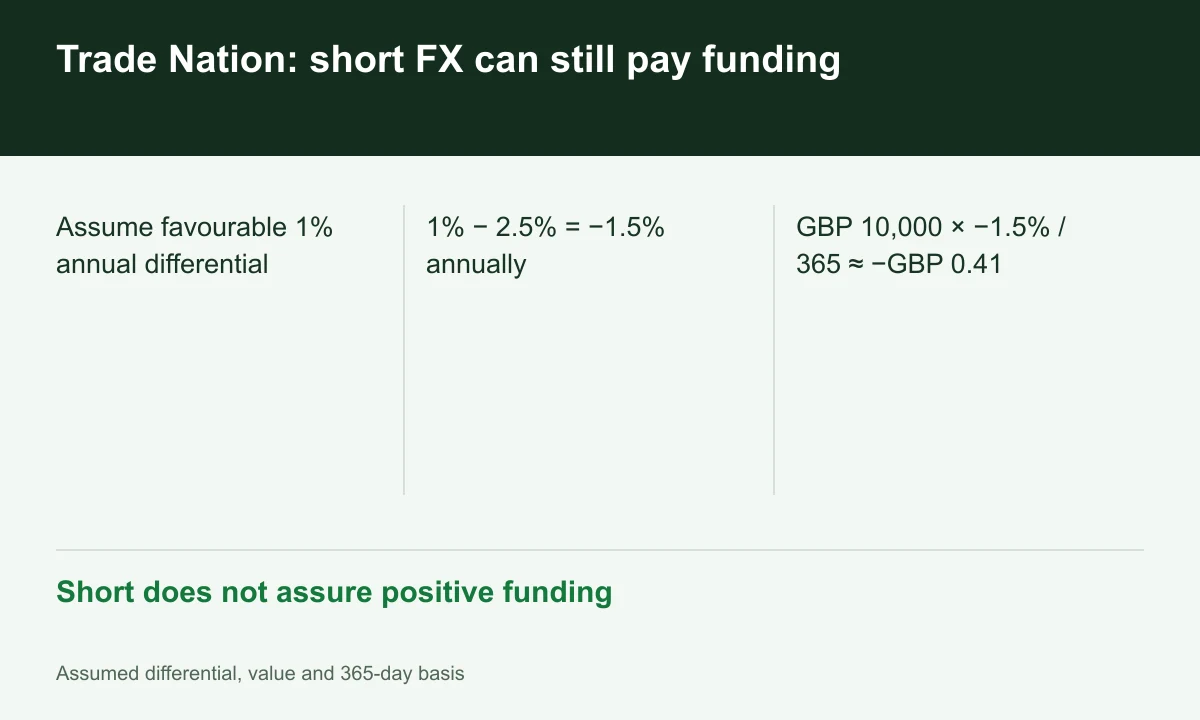
Provider guide
An interest differential smaller than the markup can debit both sides; do not reuse stale bank rates.
Read guide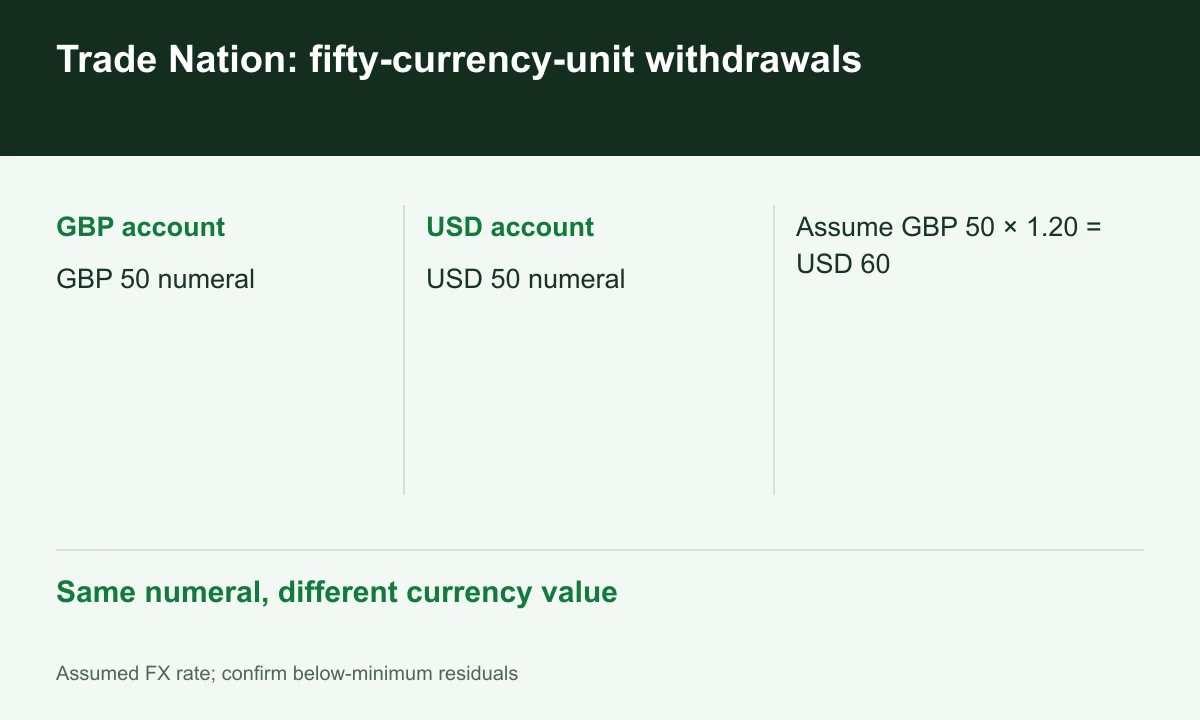
Provider guide
GBP 50 and USD 50 share a numeral but not value; small deposit minima do not carry over to withdrawals.
Read guide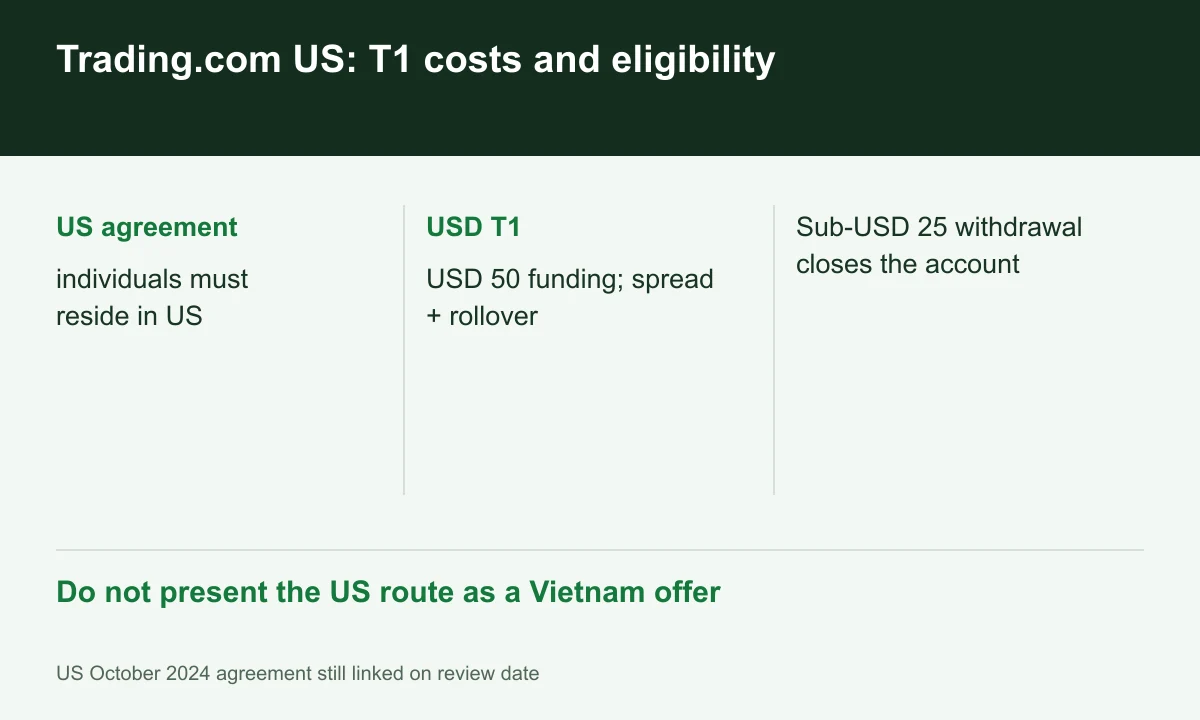
Provider guide
USD T1 pricing, rollover and dynamic margin sit within a US-resident individual agreement.
Read guide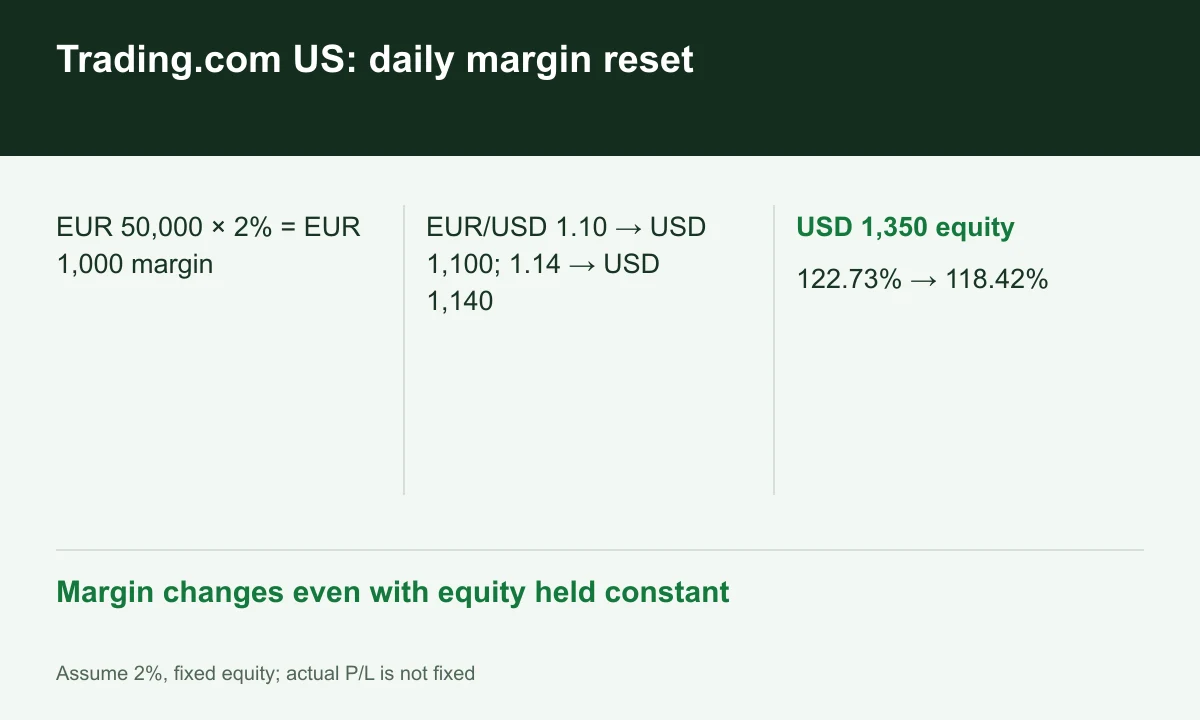
Provider guide
Hold equity constant to isolate FX effects on required margin and the 120% alert level.
Read guide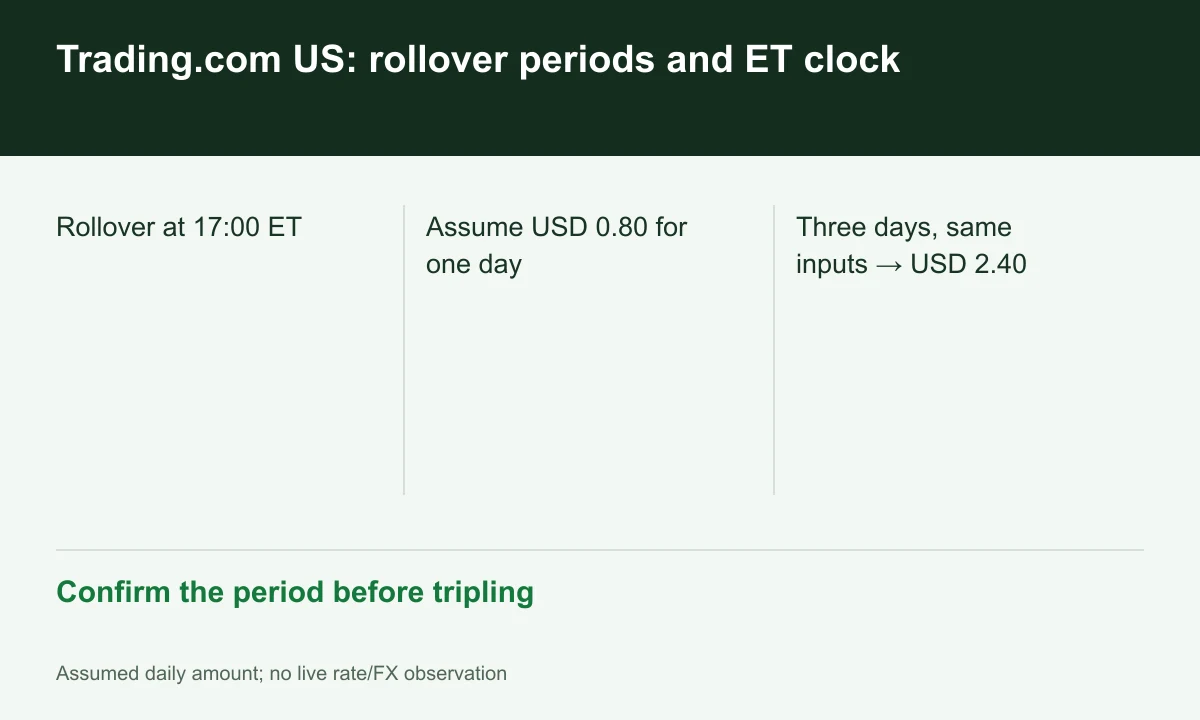
Provider guide
Separate one-day periods, three-day periods and points/pips before scaling costs.
Read guide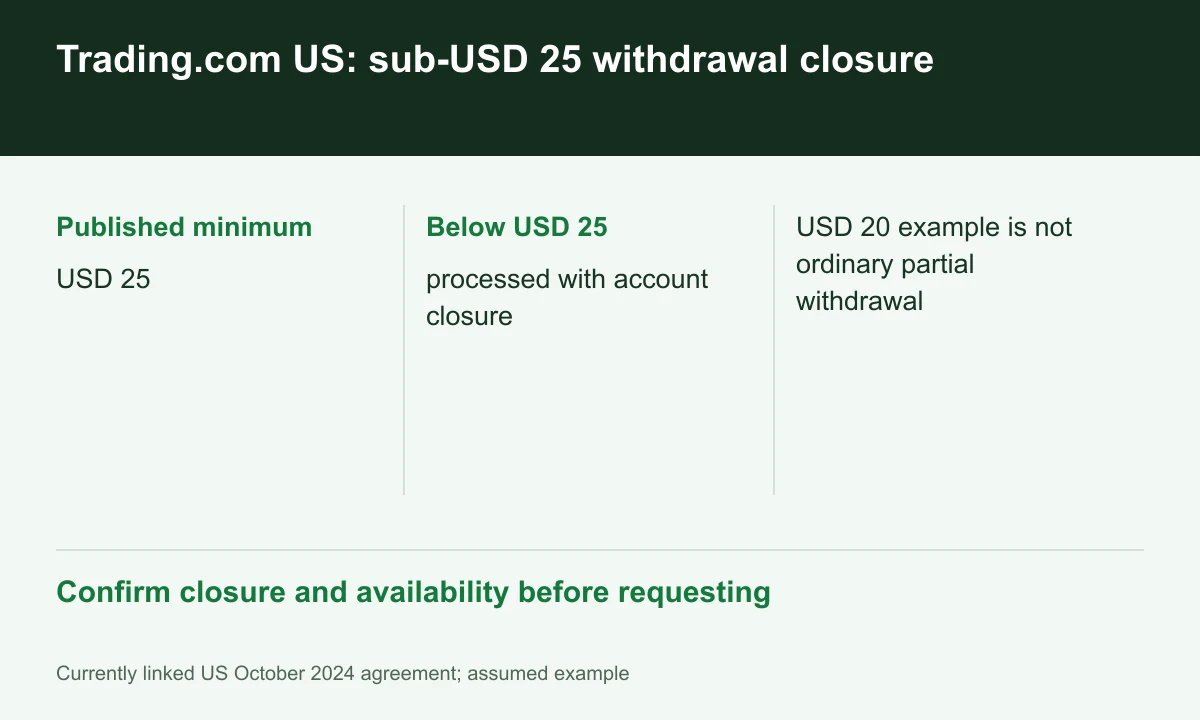
Provider guide
The agreement’s small-withdrawal exception is linked to account closure rather than ordinary partial withdrawal.
Read guide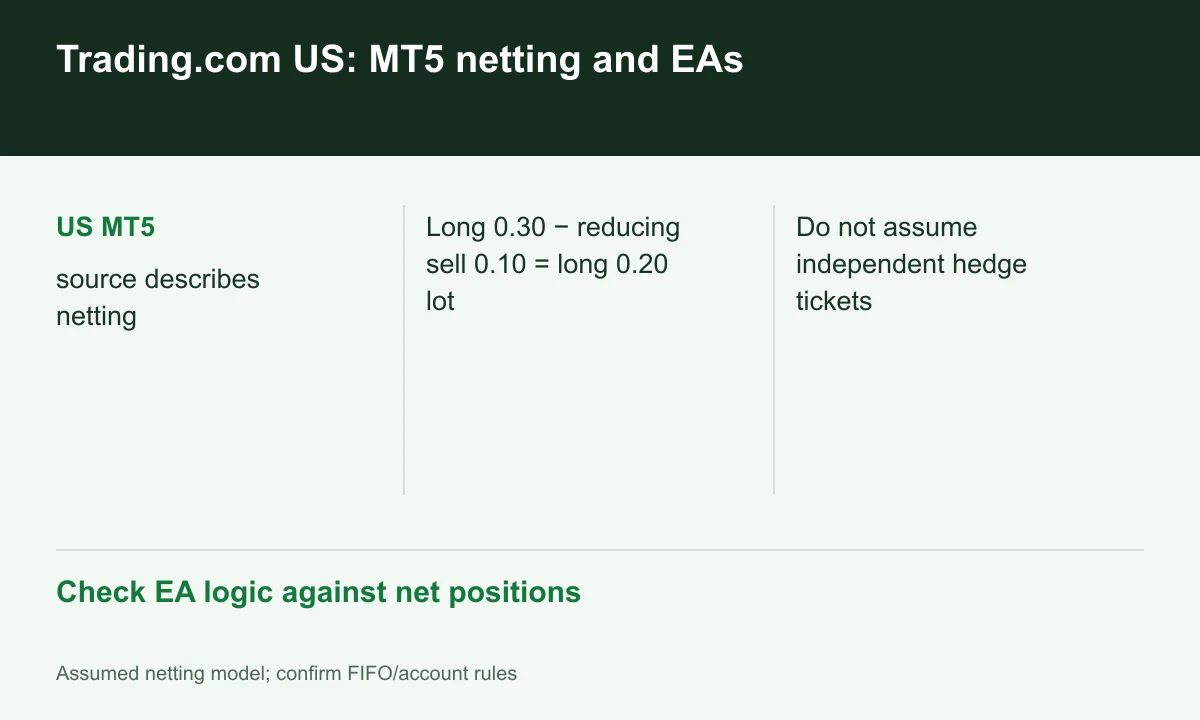
Provider guide
An EA needs net-position, account/server and permission checks rather than presumed independent hedges.
Read guide
Guide
Read the stock contract separately from legacy CFD pages: the contracting company, execution broker and regional availability determine the service.
Read guide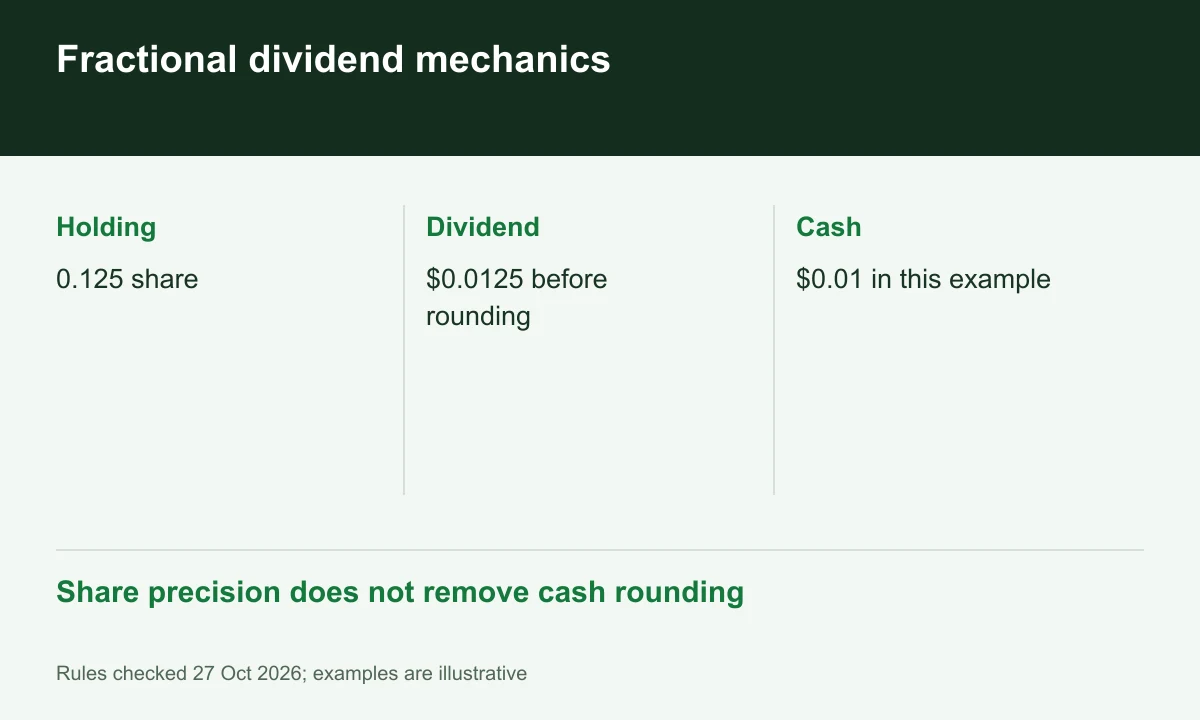
Guide
Small fractional holdings can receive rounded dividends below a simple pro rata estimate; distinguish share precision from cash payment precision.
Read guide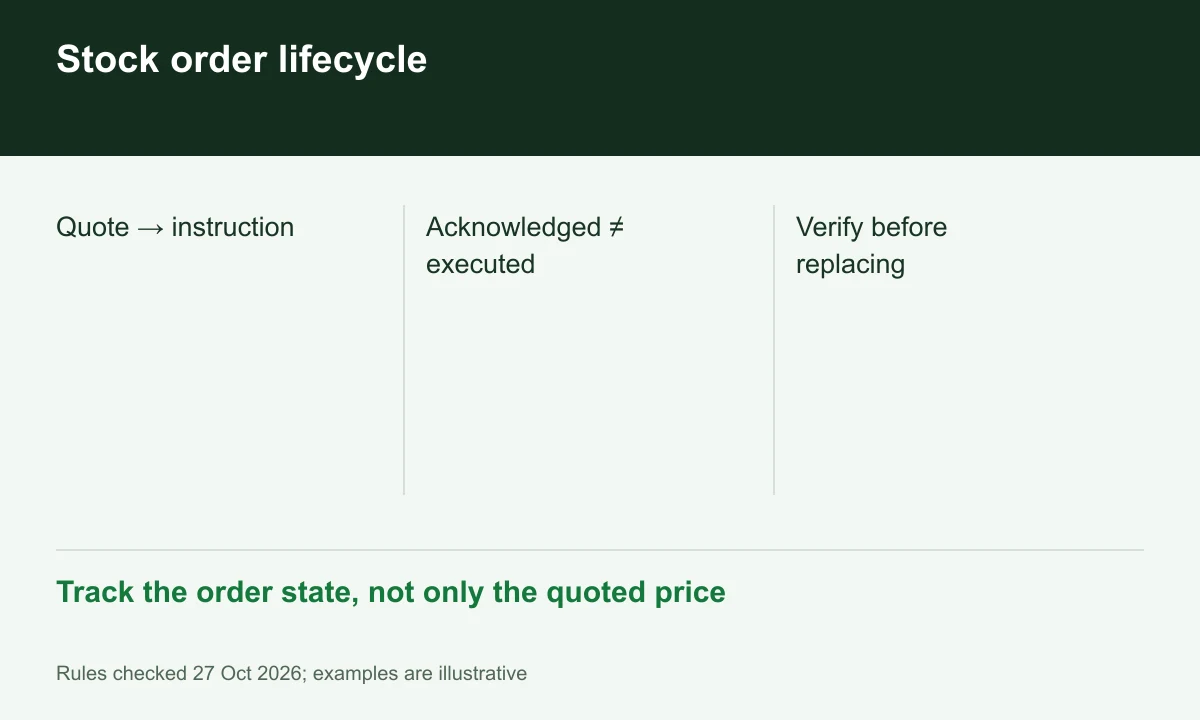
Guide
A submitted stock order is not an executed trade: market prices, session handling and cancellation requests need separate checks.
Read guide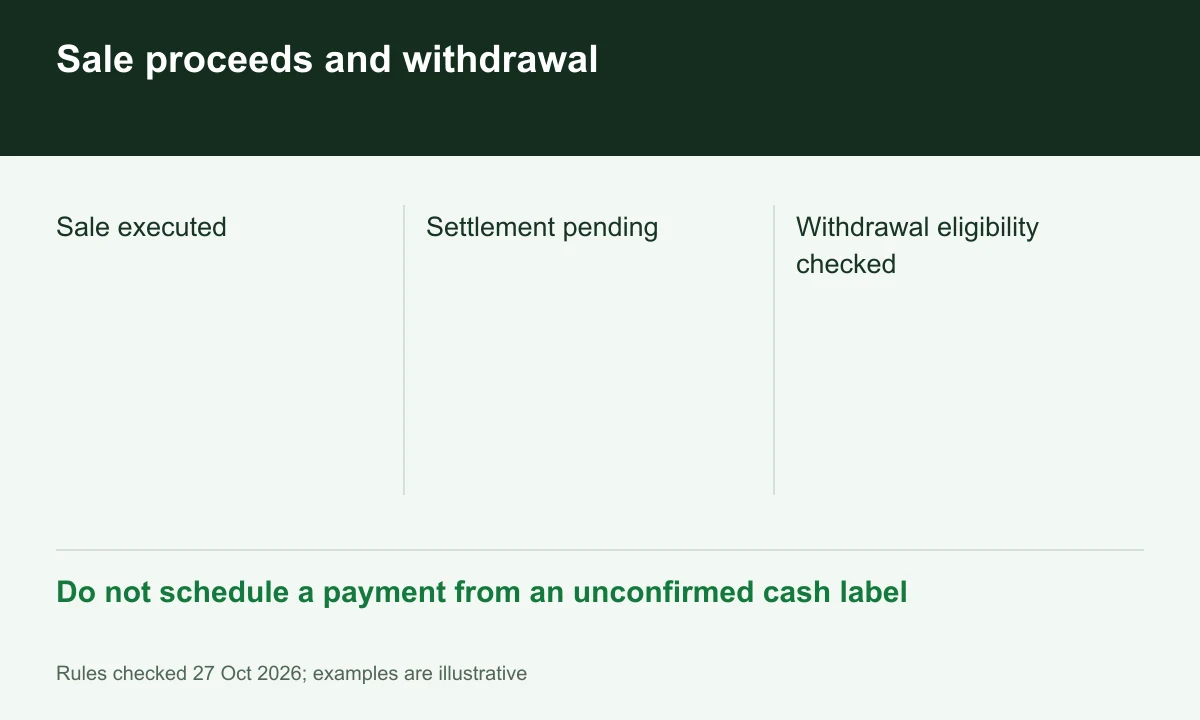
Guide
A stock sale may appear in the account before its proceeds become withdrawable; settlement and broker discretion are separate from execution.
Read guide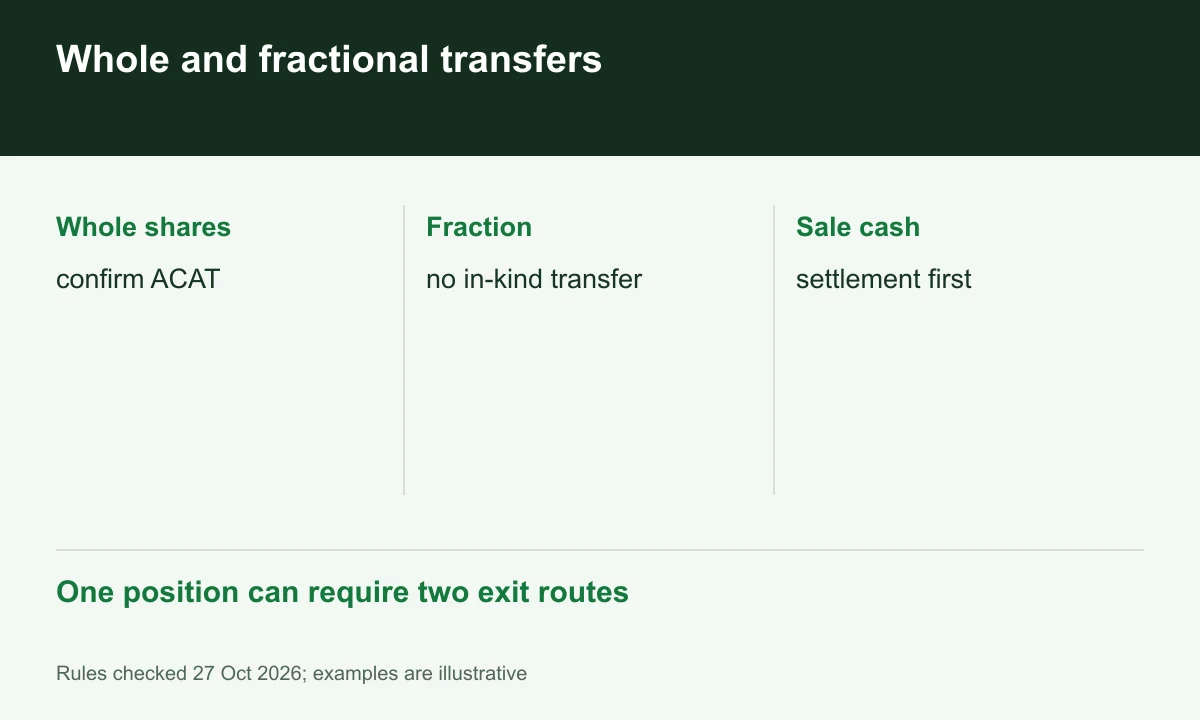
Guide
Plan a stock transfer by security and quantity: a whole-share transfer route does not mean fractional positions can move in kind.
Read guide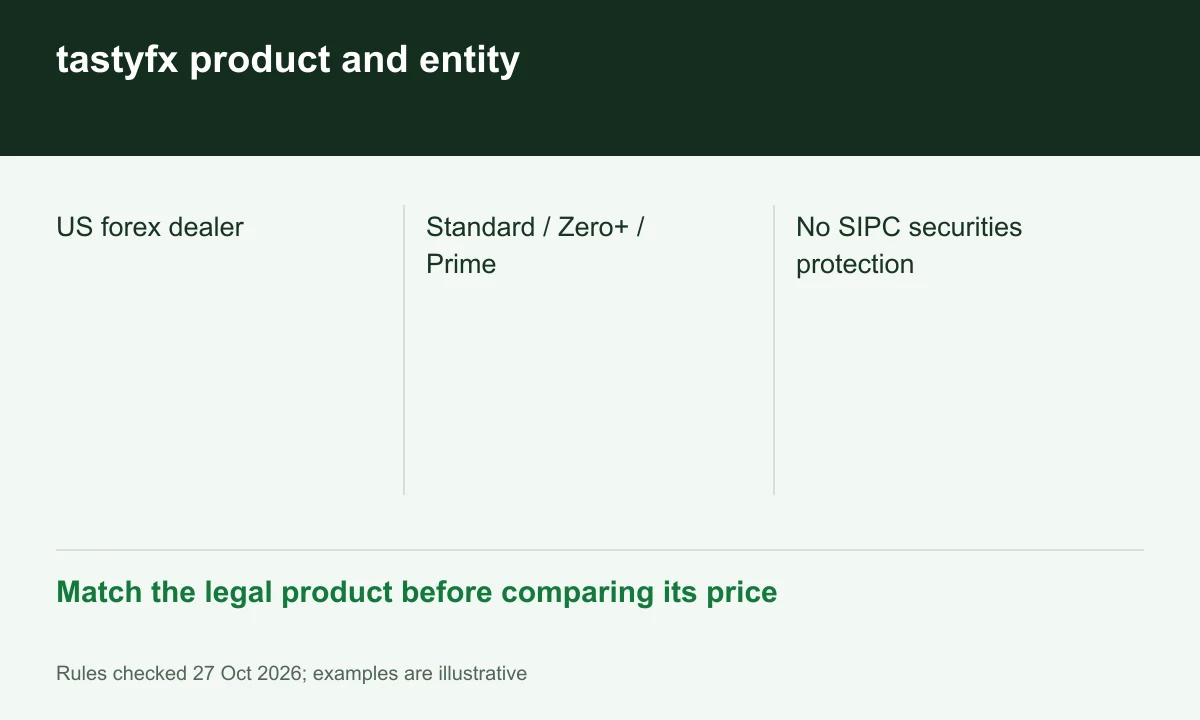
Guide
tastyfx is a US retail forex dealer; its account models and protections should not be confused with an IG overseas CFD or securities account.
Read guide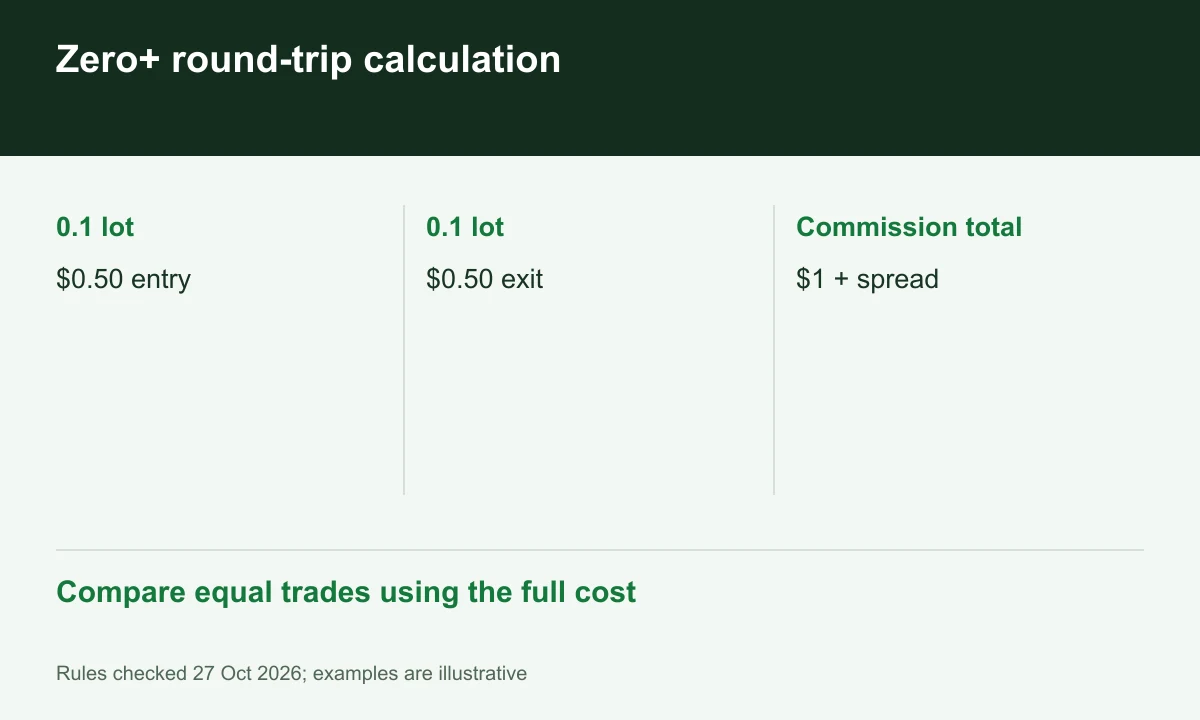
Guide
Zero+ charges commission when opening and closing: compare its complete round-trip cost with Standard spreads rather than comparing headline minimums.
Read guide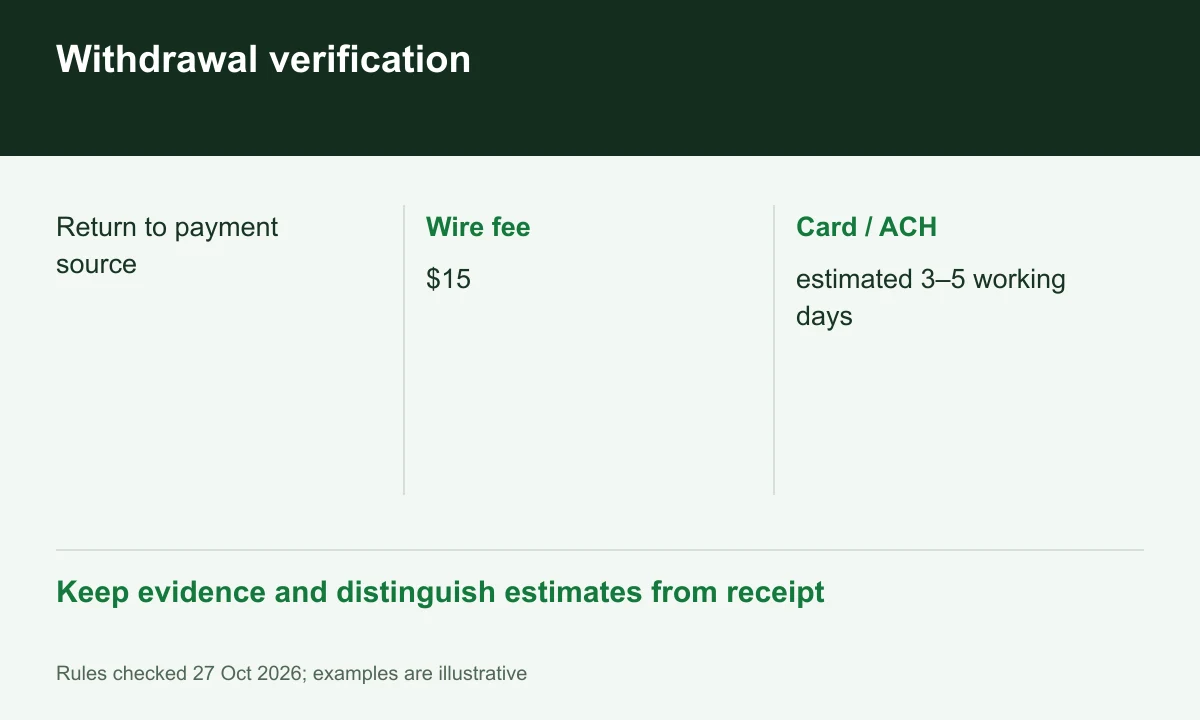
Withdrawals
A withdrawal request can require source-of-funds verification; payment routes, card limits and bank processing are separate from account approval.
Read guide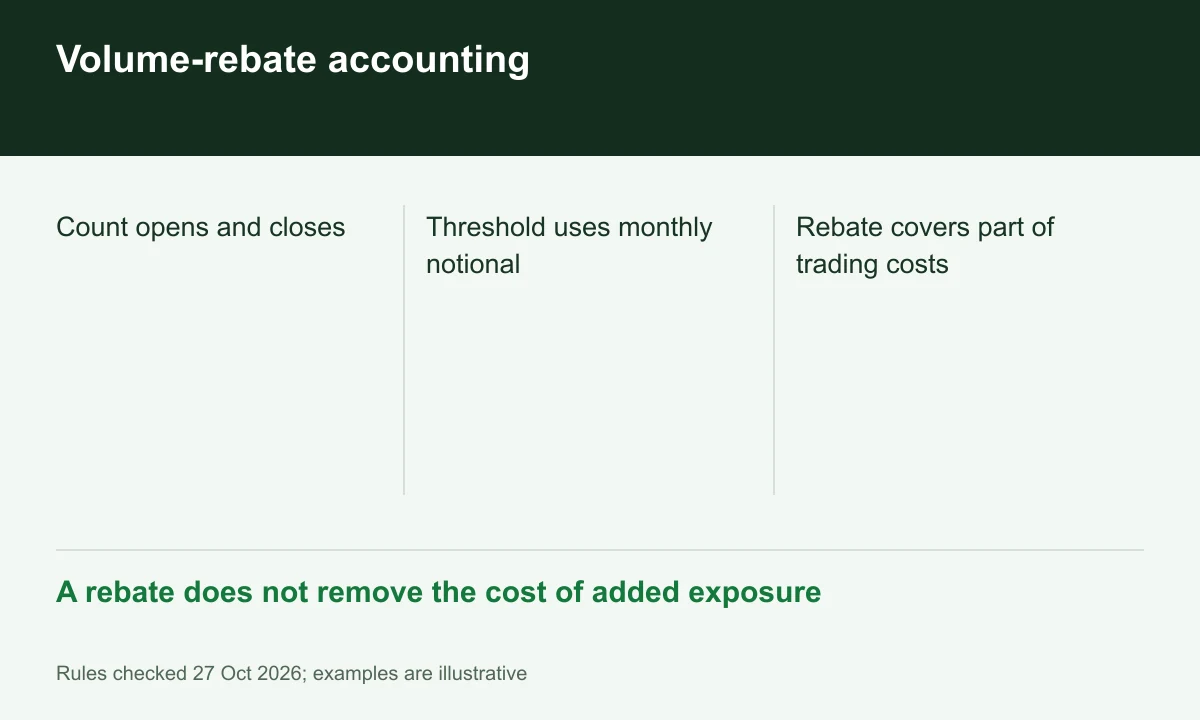
Guide
Volume-based rebates count opening and closing notional in a calendar month; the threshold is trading exposure, not a required million-dollar deposit.
Read guide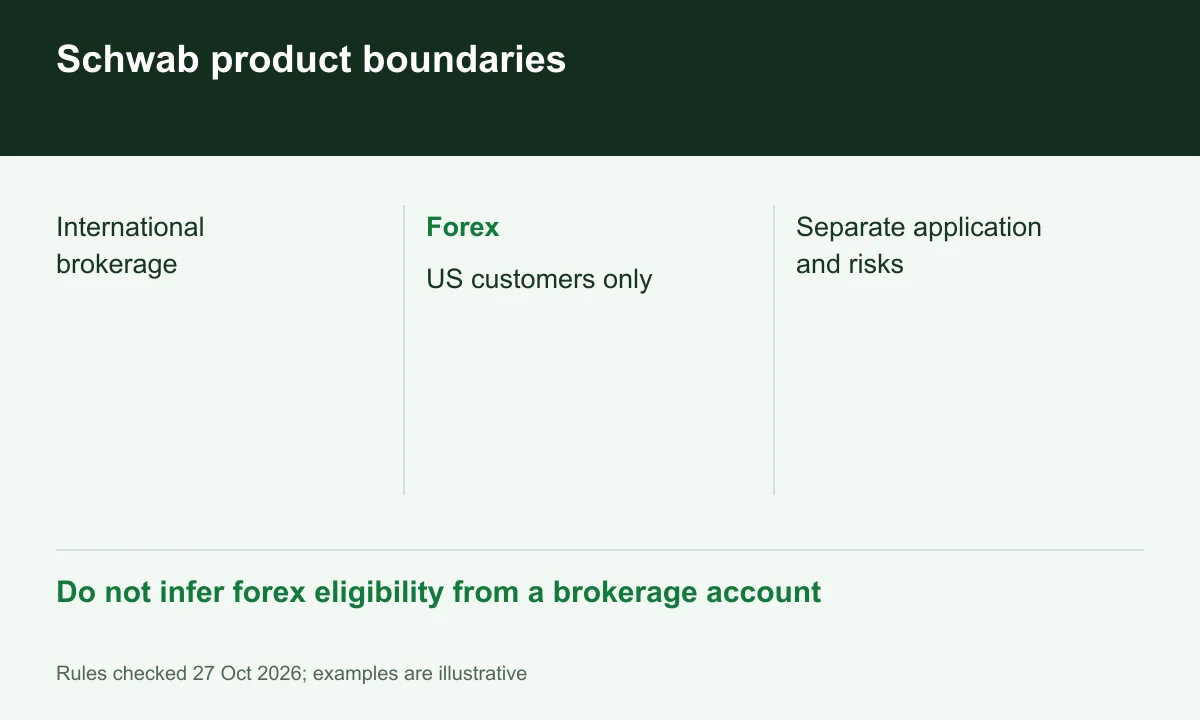
Guide
Schwab International and Schwab forex have different eligibility: the current dealer disclosure limits forex to US customers, not all international investors.
Read guide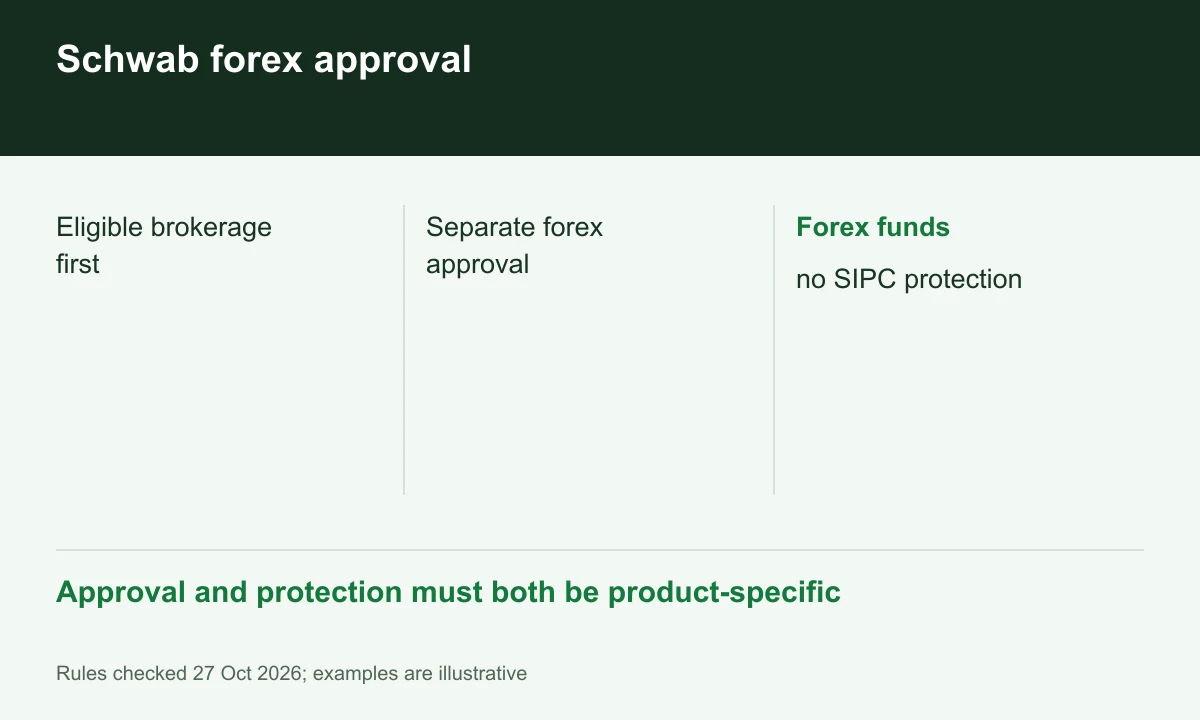
Guide
US-only forex requires separate approval and carries dealer-counterparty risk; securities-account protection must not be applied to its forex balance.
Read guide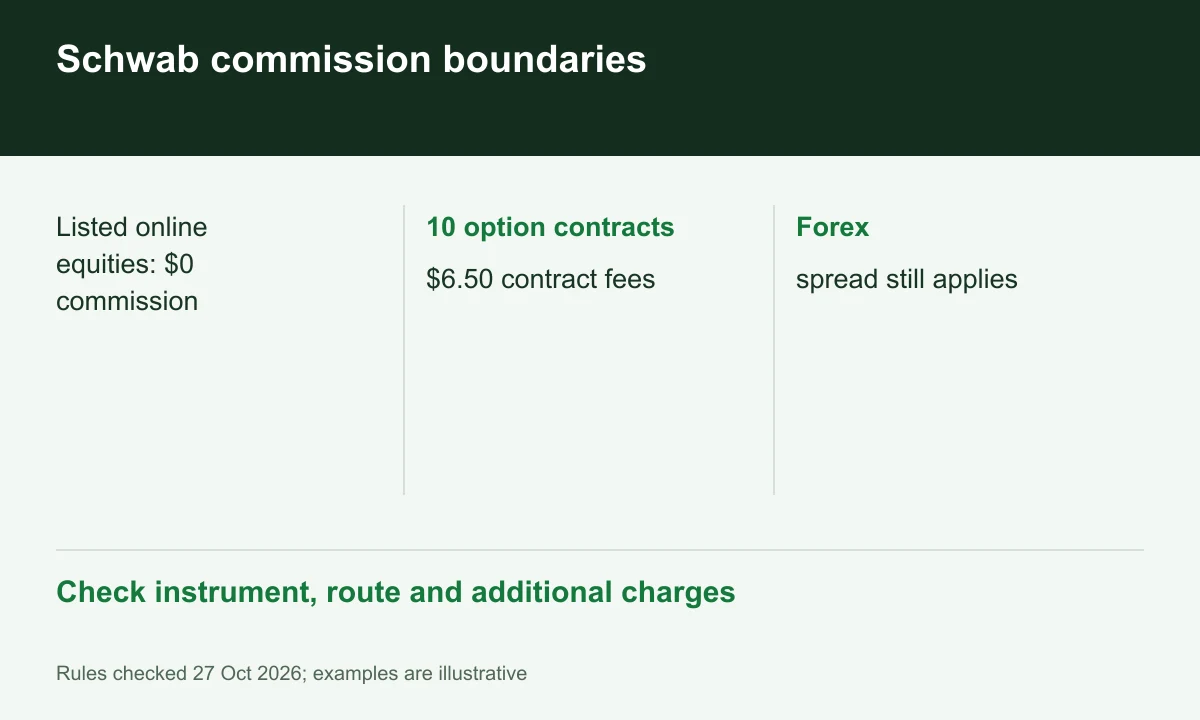
Guide
The $0 headline applies to specified online transactions; options contract fees, OTC commissions and forex spreads require separate calculations.
Read guide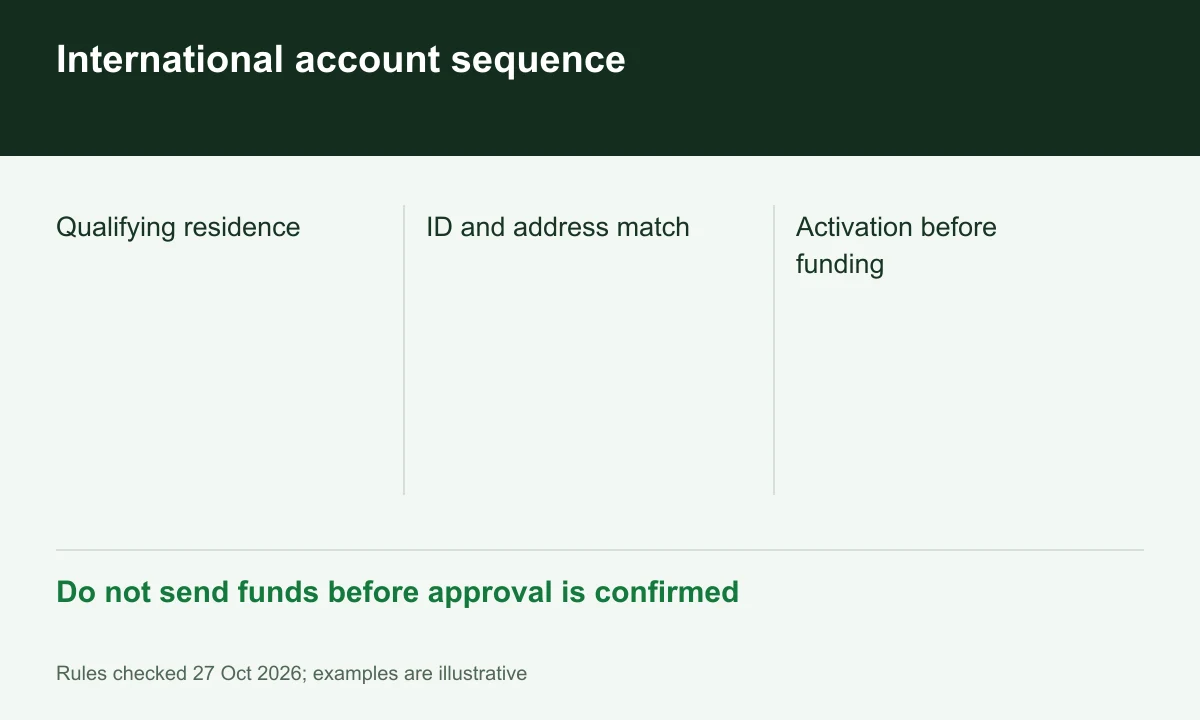
Guide
A qualifying country and matching identity documents come before funding; the international guide says to wait for account activation confirmation.
Read guide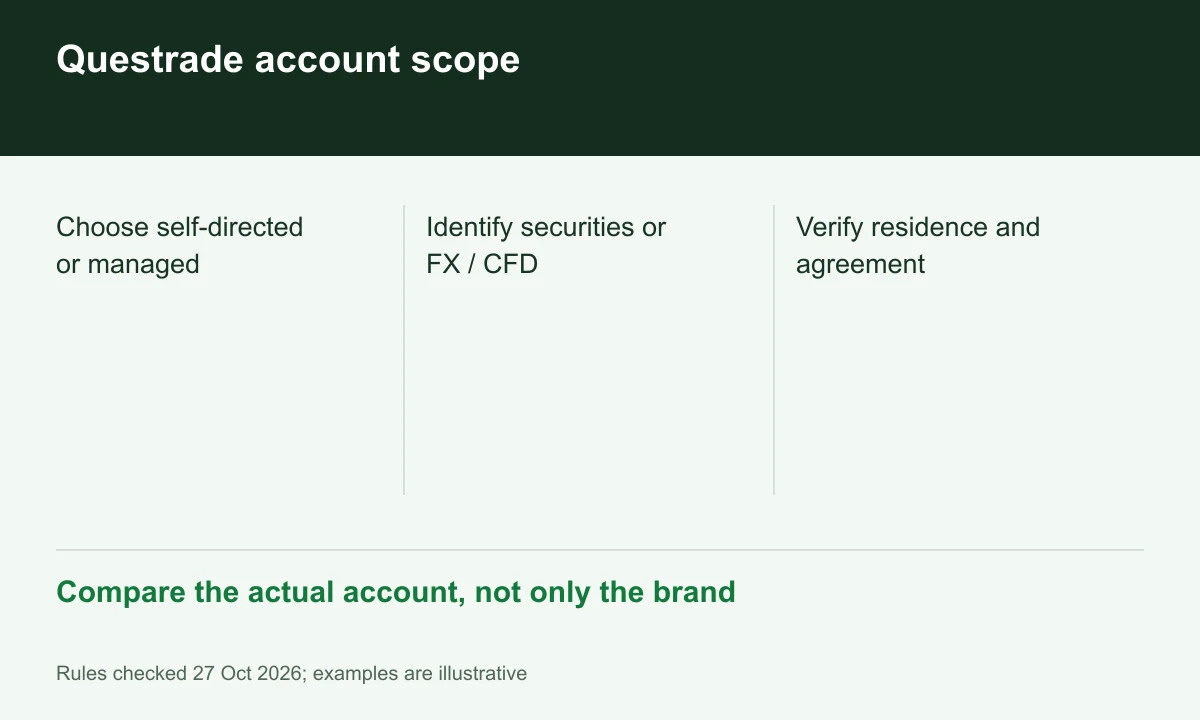
Guide
Questrade is a Canadian investing service with separate FX/CFD arrangements; its stock pricing and promotion eligibility cannot be applied to every account.
Read guide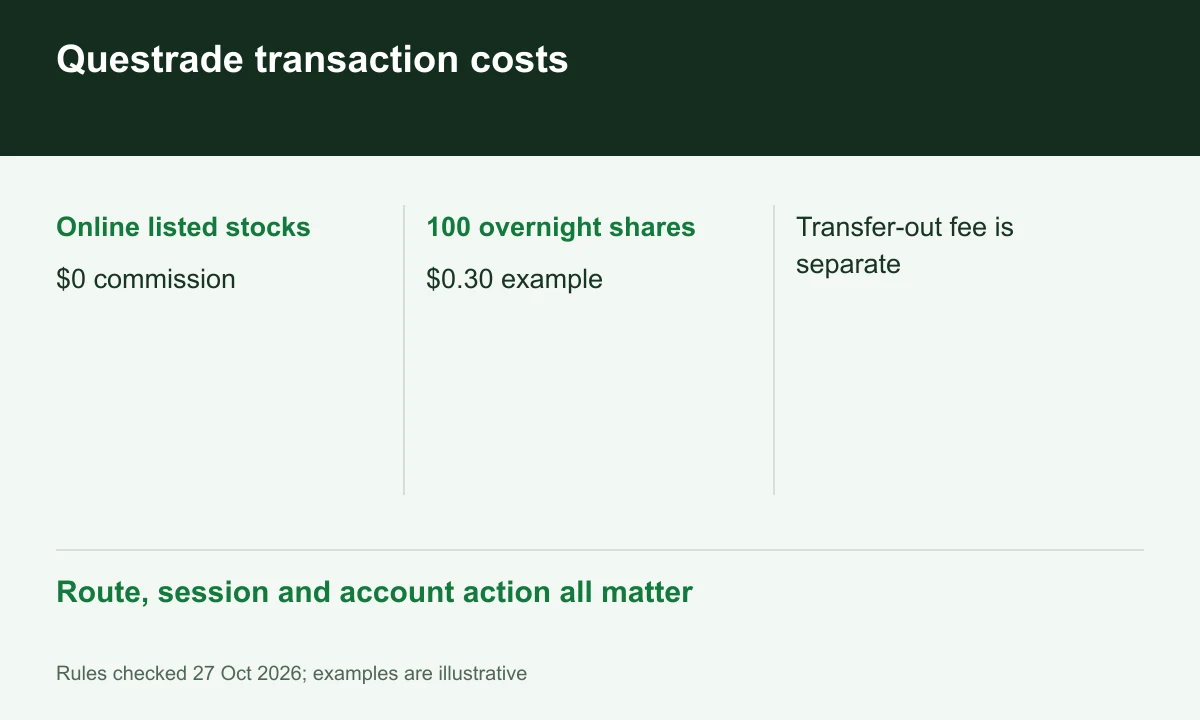
Guide
Most stock trades have no commission, but selected US routes, overnight fills and account transfers can create separate costs worth checking before an order.
Read guide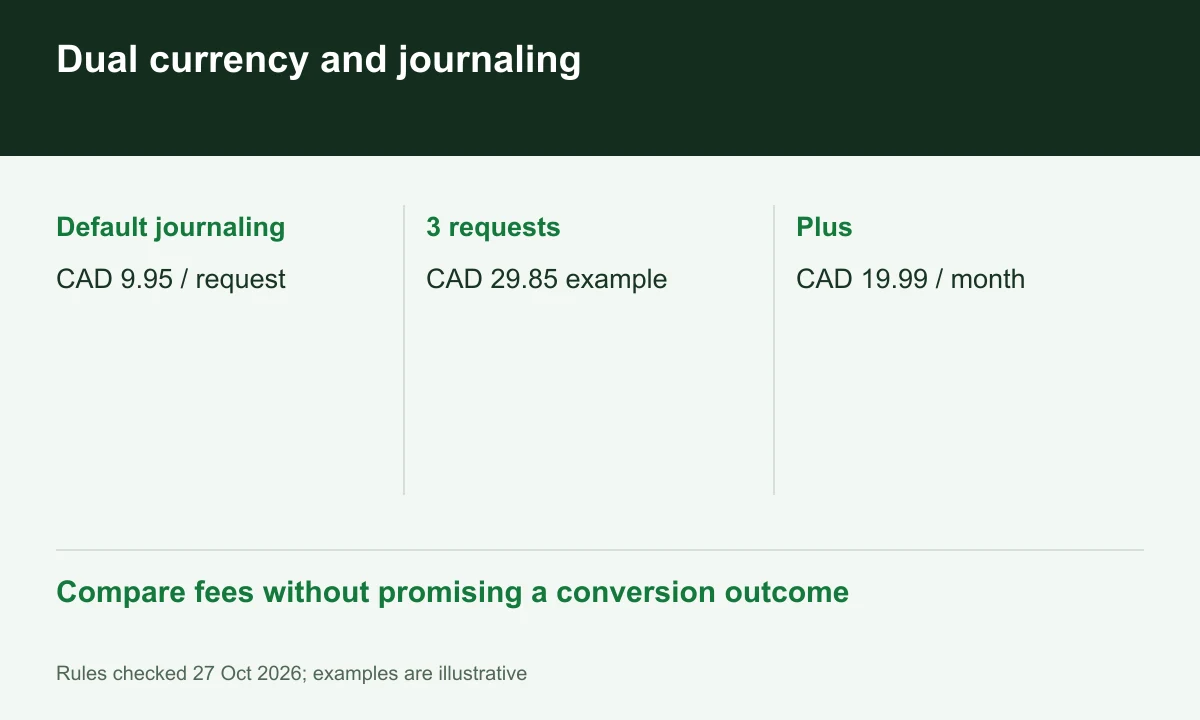
Guide
Holding USD and journaling a security are different operations; compare the current per-request fee with a monthly Plus subscription without assuming free conversion.
Read guide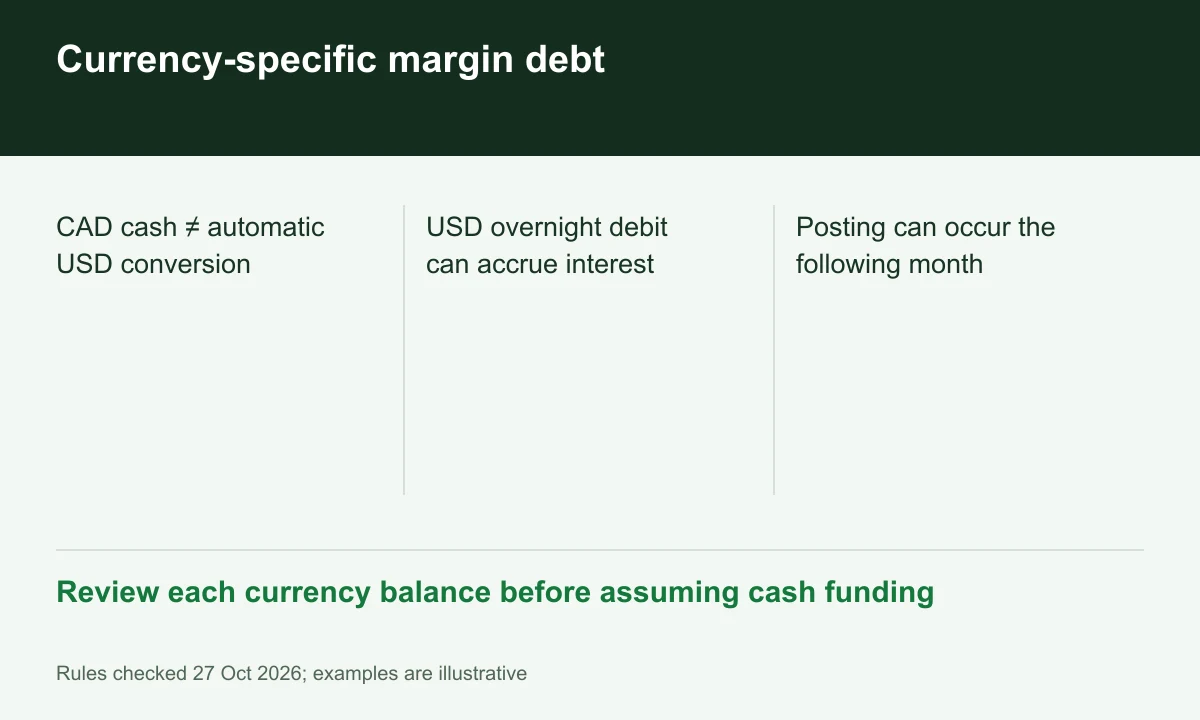
Guide
A positive CAD balance does not automatically fund a USD purchase in a margin account; inspect currency-specific debits and the current interest schedule.
Read guide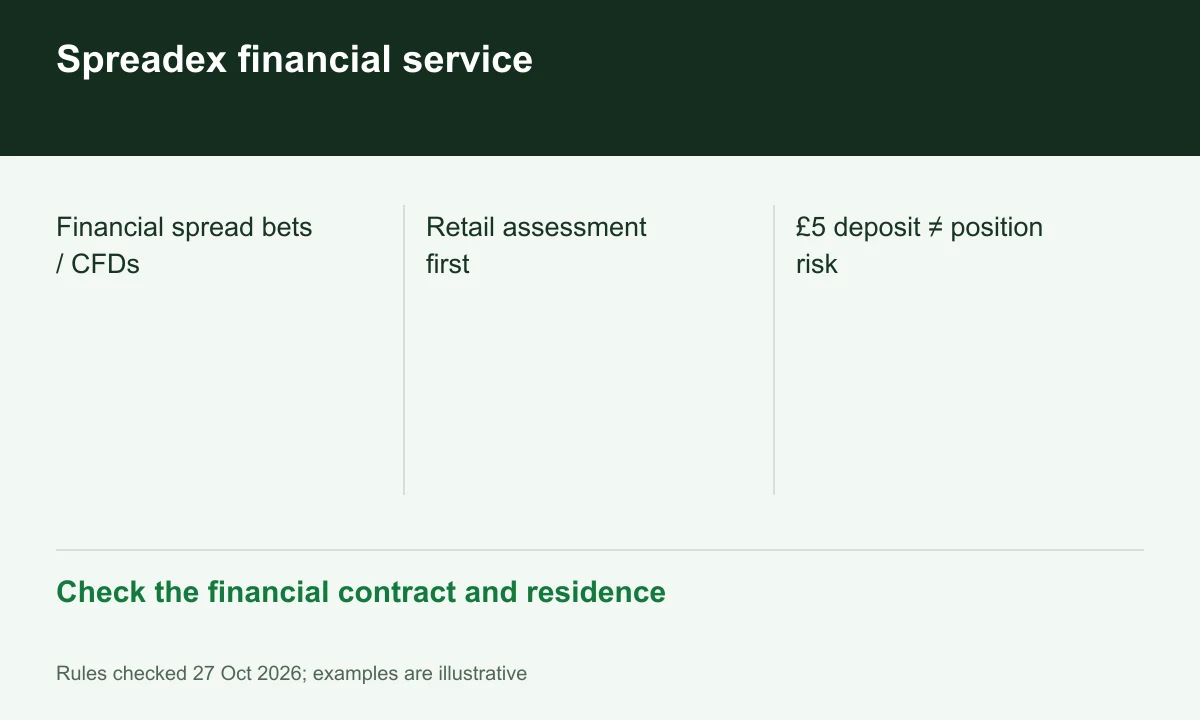
Guide
This review covers Spreadex financial spread betting and CFDs, not sports betting; retail classification, costs and residence need separate checks.
Read guide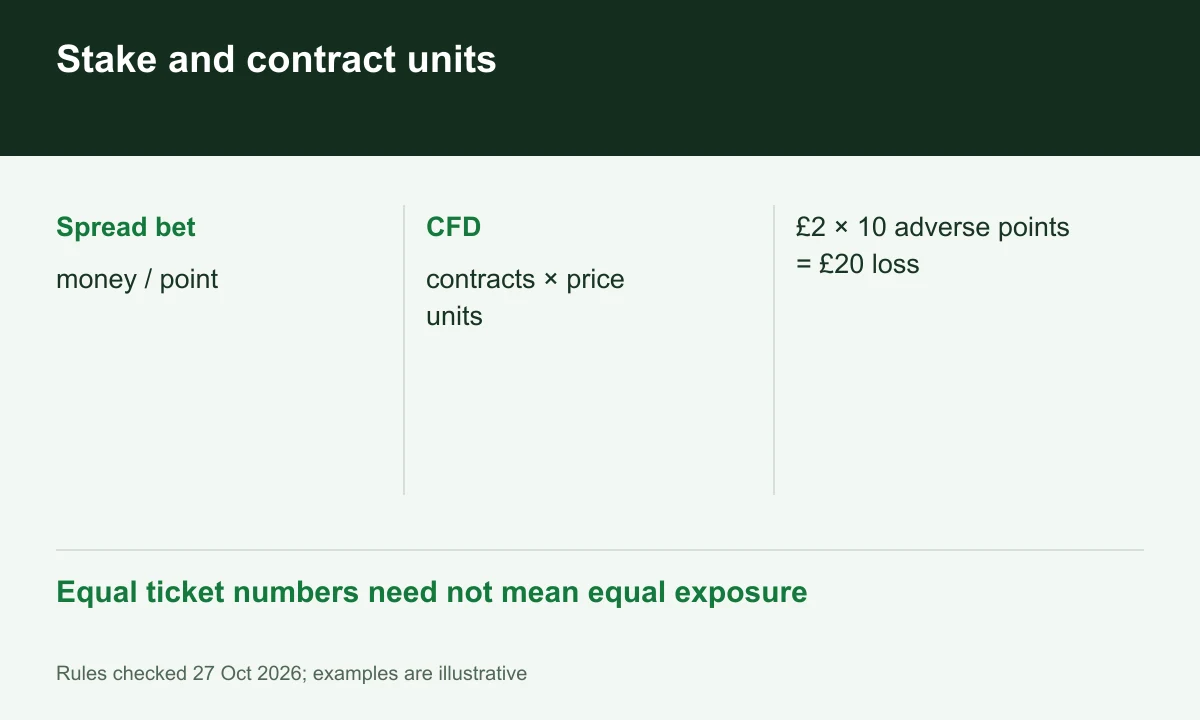
Guide
A spread-bet stake and a CFD quantity are different units; equal numbers on two order tickets can create very different market exposure.
Read guide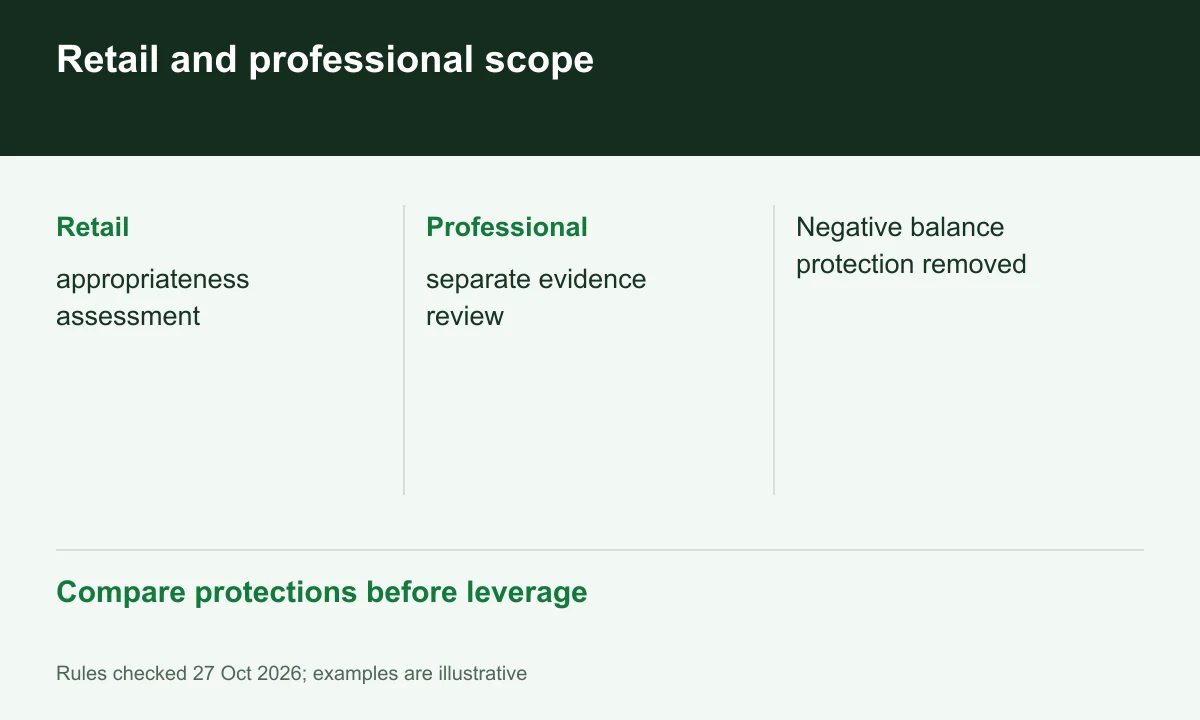
Guide
Professional status is a separate application after retail onboarding and removes negative balance protection; higher leverage changes the risk agreement.
Read guide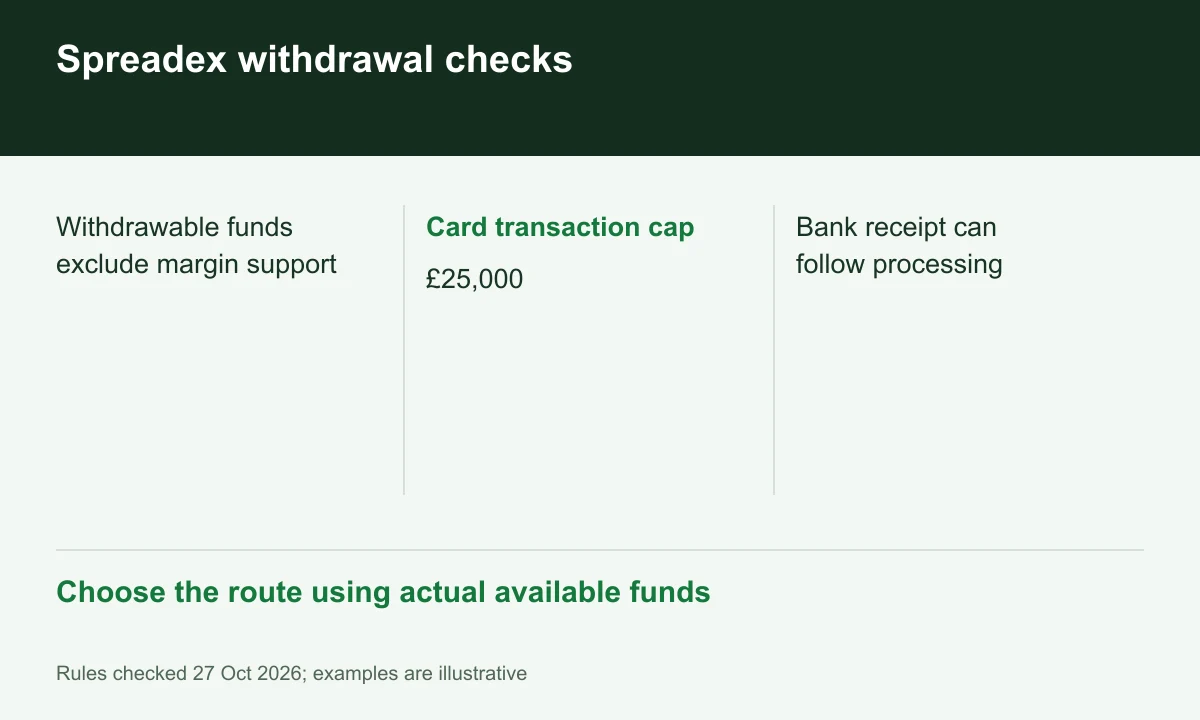
Withdrawals
Withdrawals use funds not supporting positions; card caps, original payment source and receiving-bank estimates affect the route and timing.
Read guide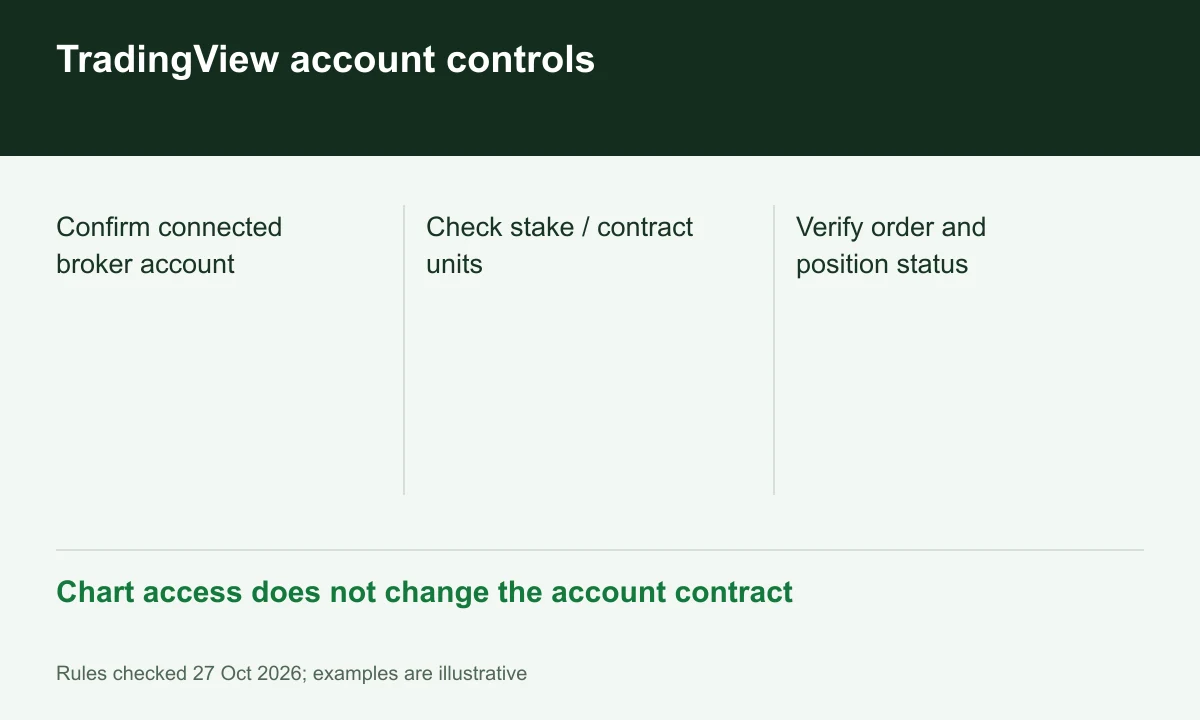
Guide
Connecting TradingView changes the trading interface, not the underlying Spreadex account, product risks or withdrawal requirements.
Read guide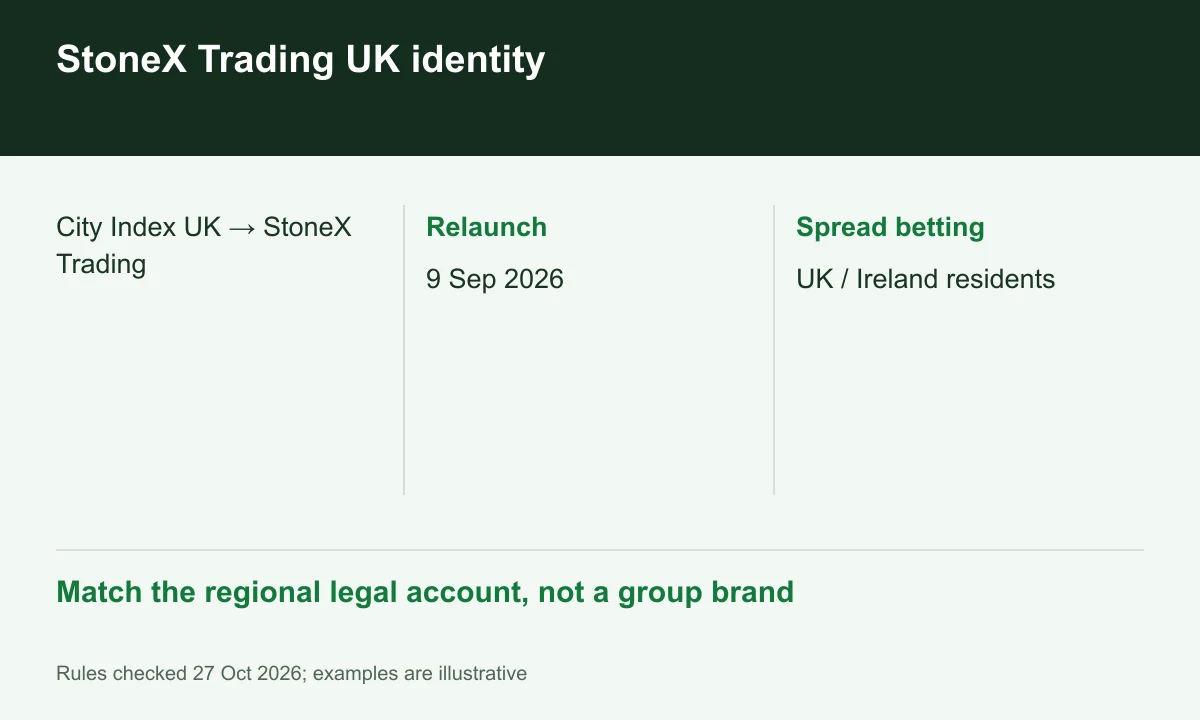
Guide
StoneX Trading is the September 2026 City Index UK relaunch; the UK spread-betting and CFD service must be distinguished from FOREX.com and other group products.
Read guide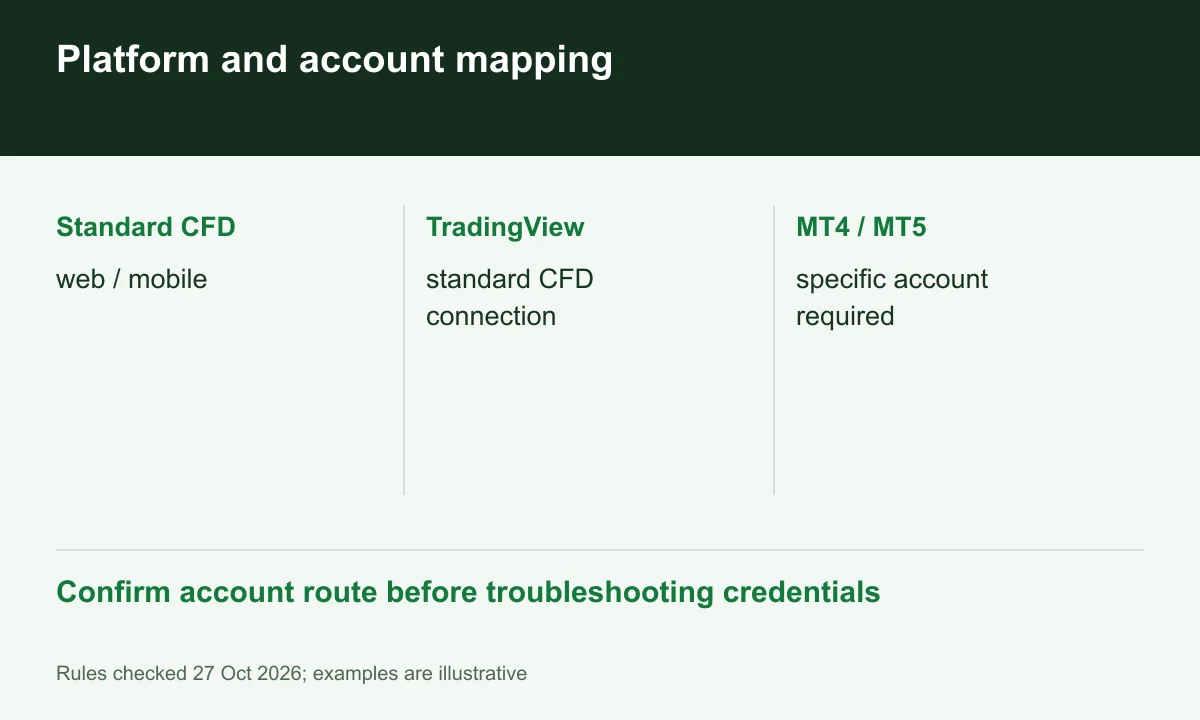
Guide
Choose the account before the app: standard CFD credentials and dedicated MetaTrader accounts have different access paths under the UK service.
Read guide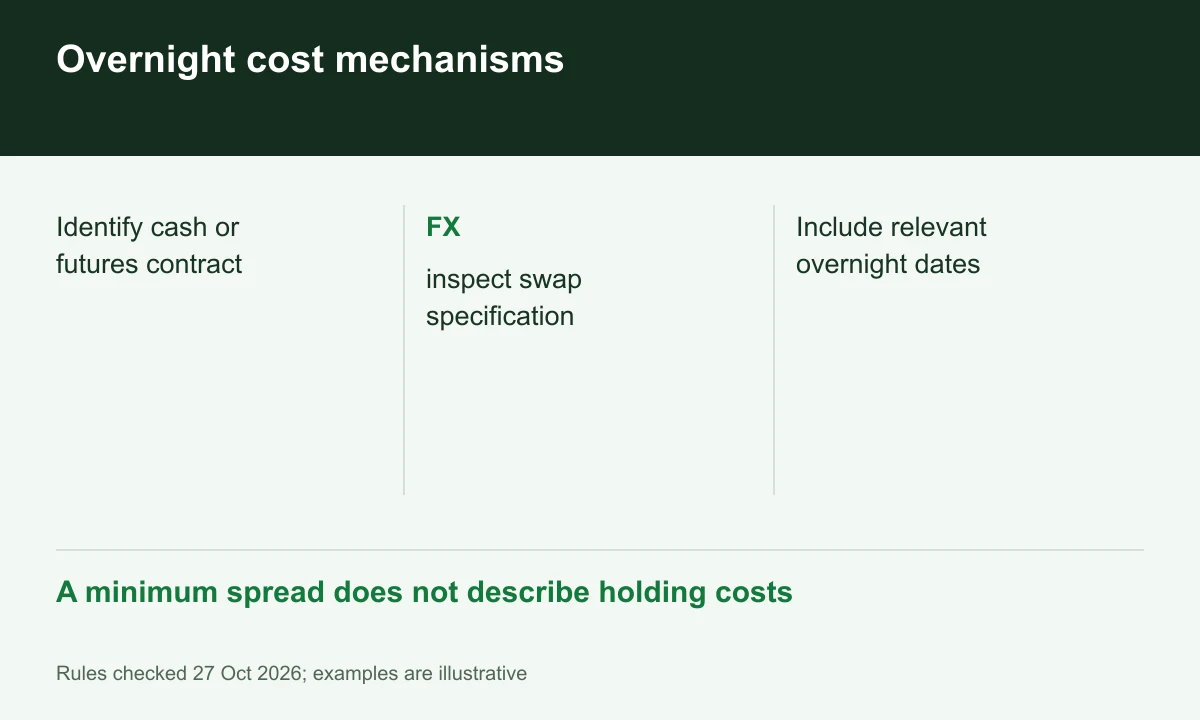
Guide
The UK cost schedule separates daily financing, FX swaps and futures contracts; the same market name does not imply the same holding-cost mechanism.
Read guide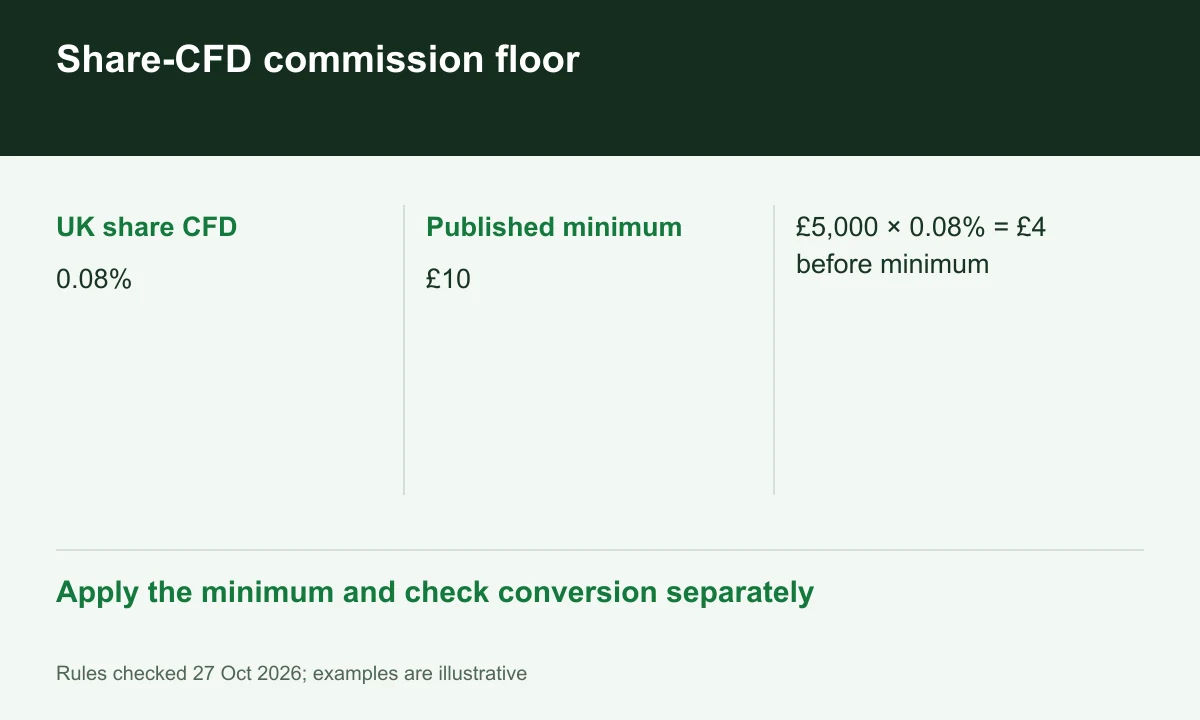
Guide
Share CFDs are the commission exception in the UK schedule; minimums and account-currency conversion can matter more than a headline percentage.
Read guide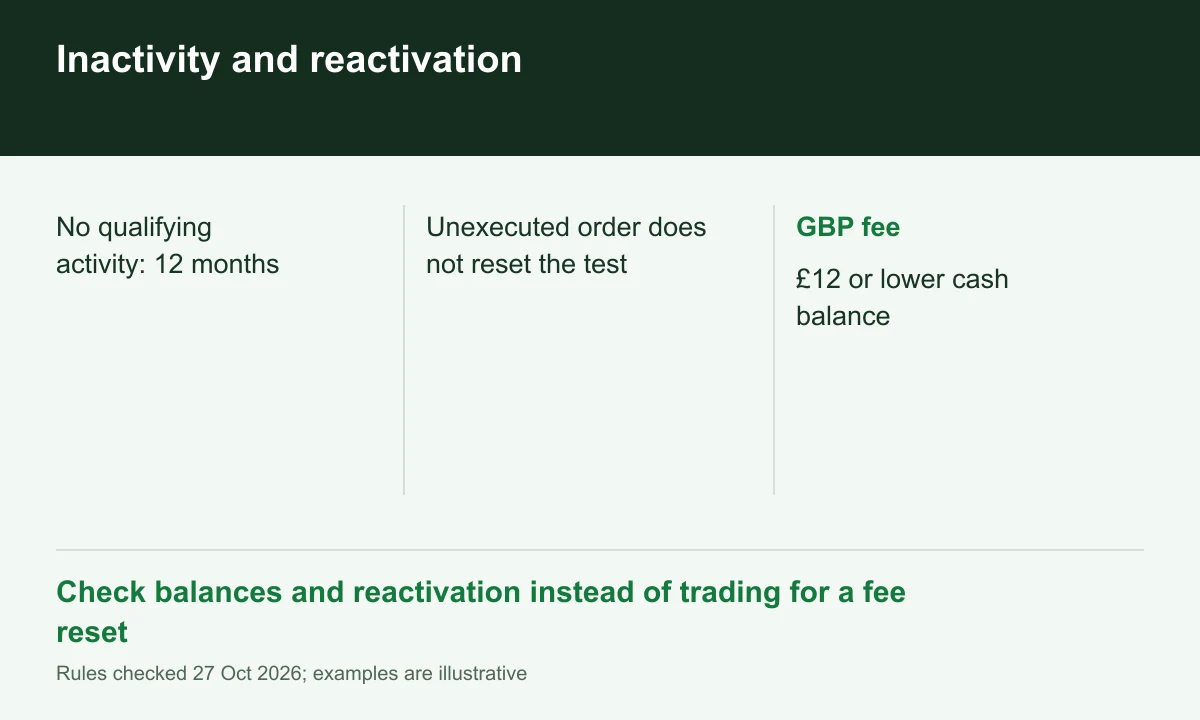
Guide
An unexecuted order does not count as activity under the UK inactivity rule; check the twelve-month period, base currency and reactivation conditions.
Read guide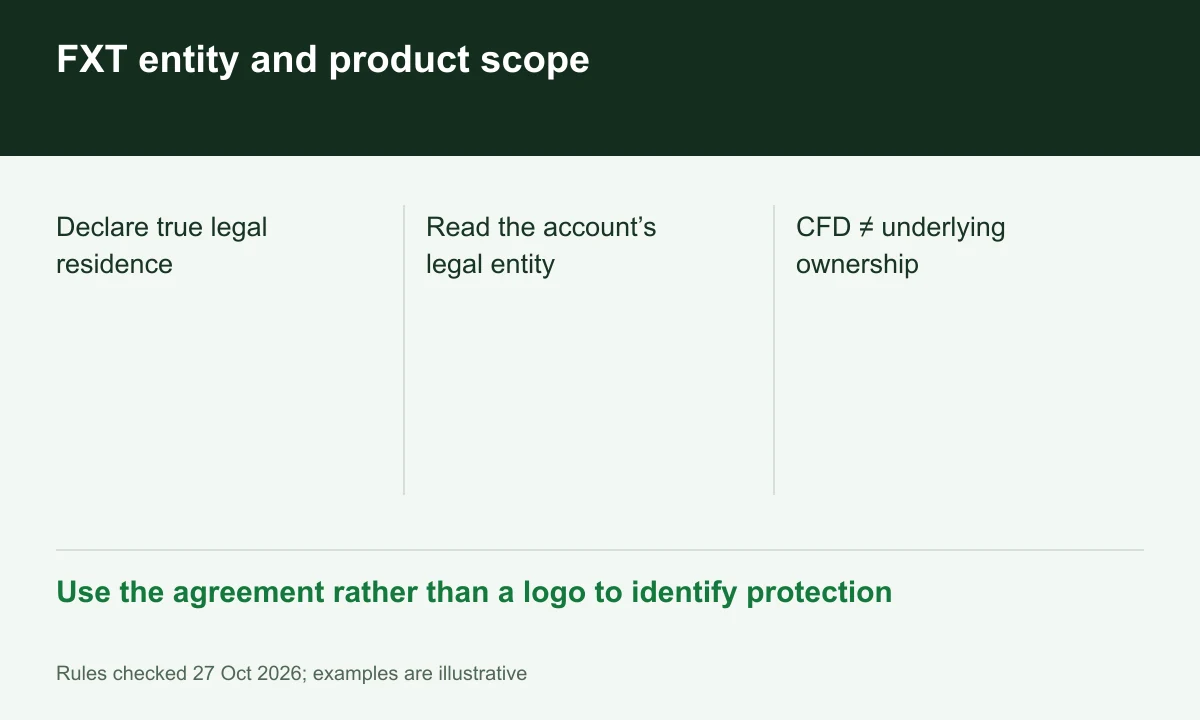
Guide
FXT means FXTRADING.com here: legal residence, account documents and product availability determine the entity, not a shared brand or website language.
Read guide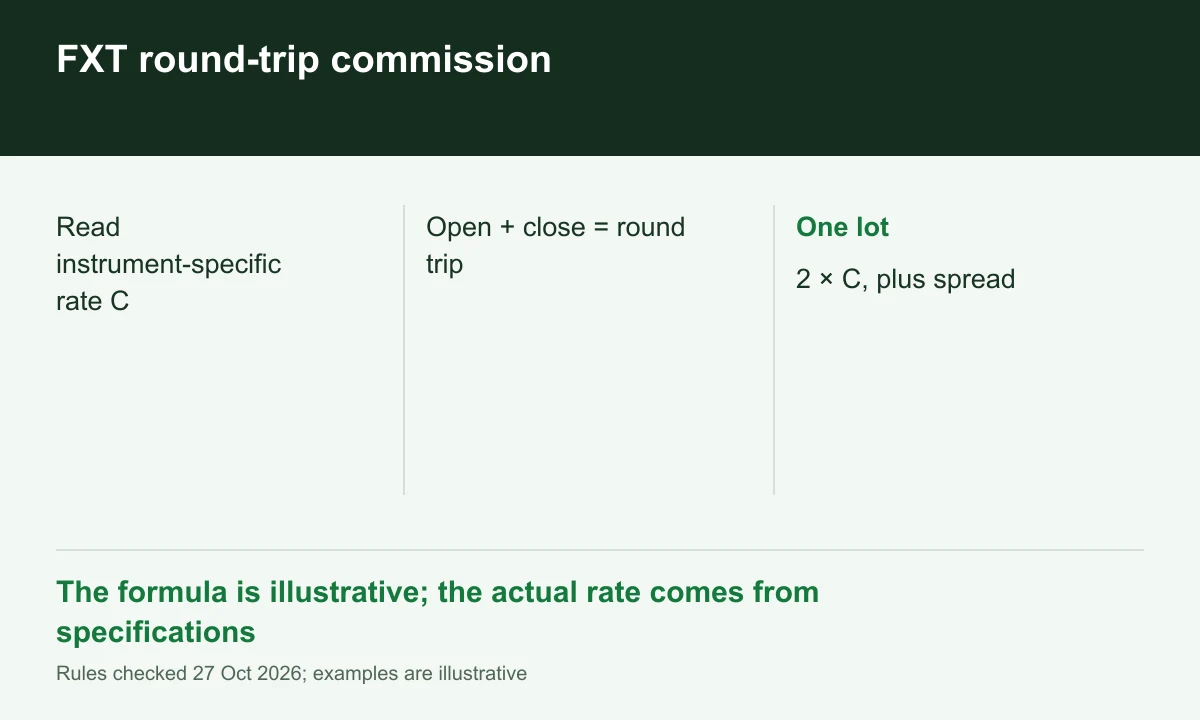
Guide
Raw Spread adds commission to spread, with rates varying by instrument and account currency; calculate both sides instead of assuming one universal dollar rate.
Read guide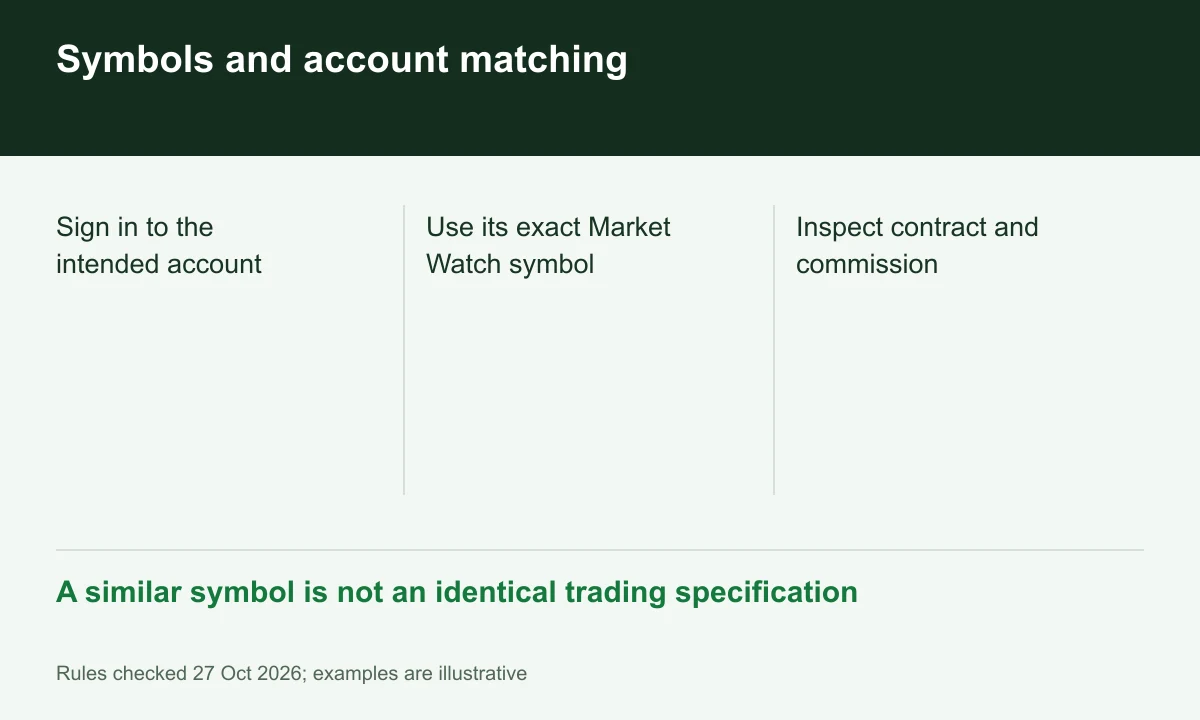
Guide
The same market can use different FXT symbols by account and region; the exact symbol shown in the signed-in account takes priority over an old table.
Read guide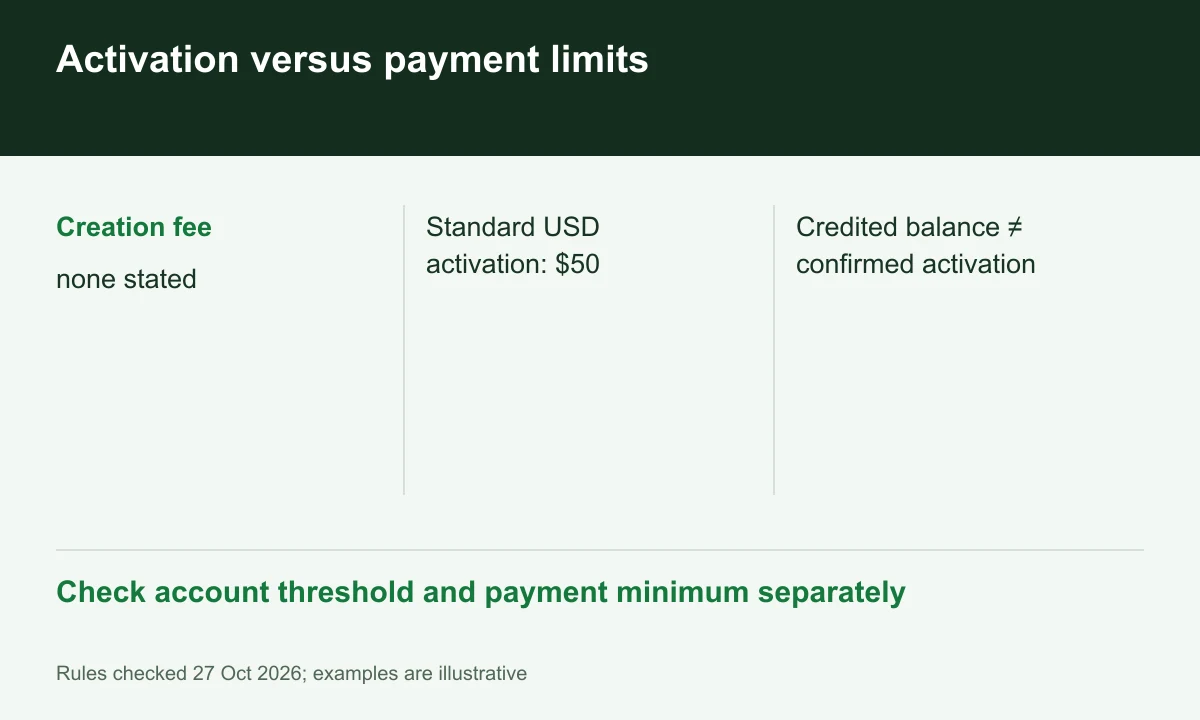
Guide
Free account creation is separate from activation funding; account thresholds, payment-method limits and credited funds must be checked independently.
Read guide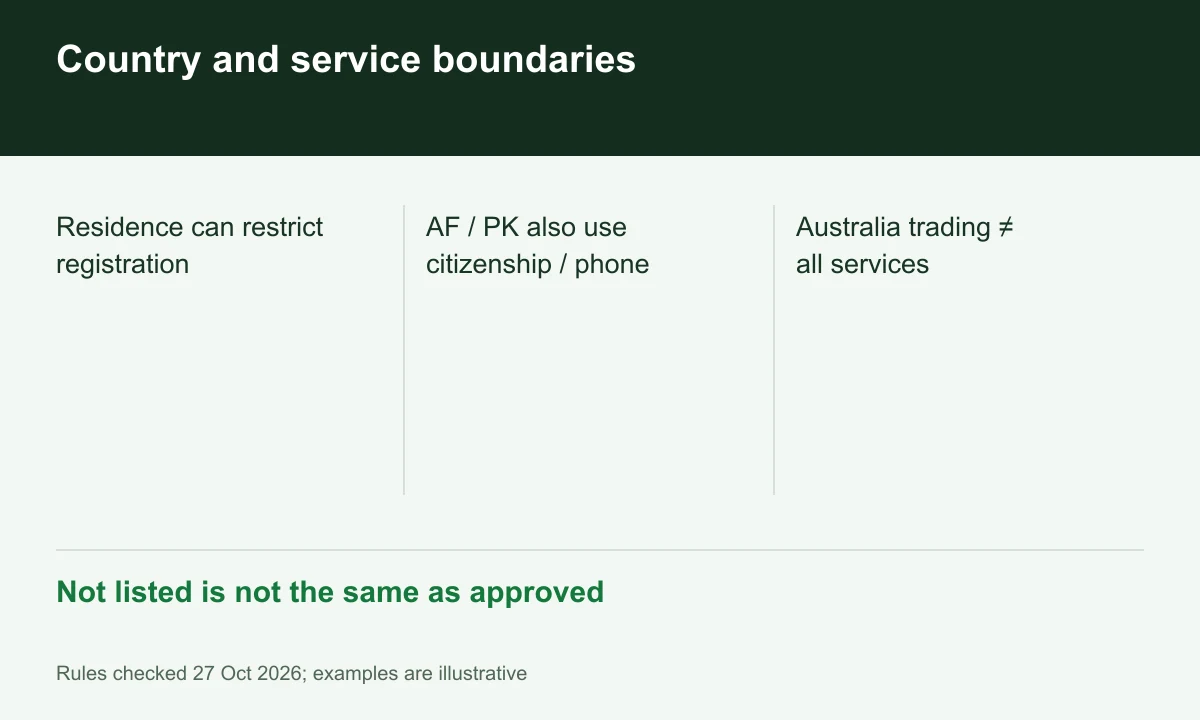
Guide
FXT applies country and service-specific restrictions; a country absent from the exclusion list is not automatically approved for every account or programme.
Read guideProvider guide
A concise IC Markets review: FINEX's 9.5/10 editorial score, Raw Spread fees, MT4, MT5, cTrader and TradingView. Explore the benefits before choosing an account.
Read guide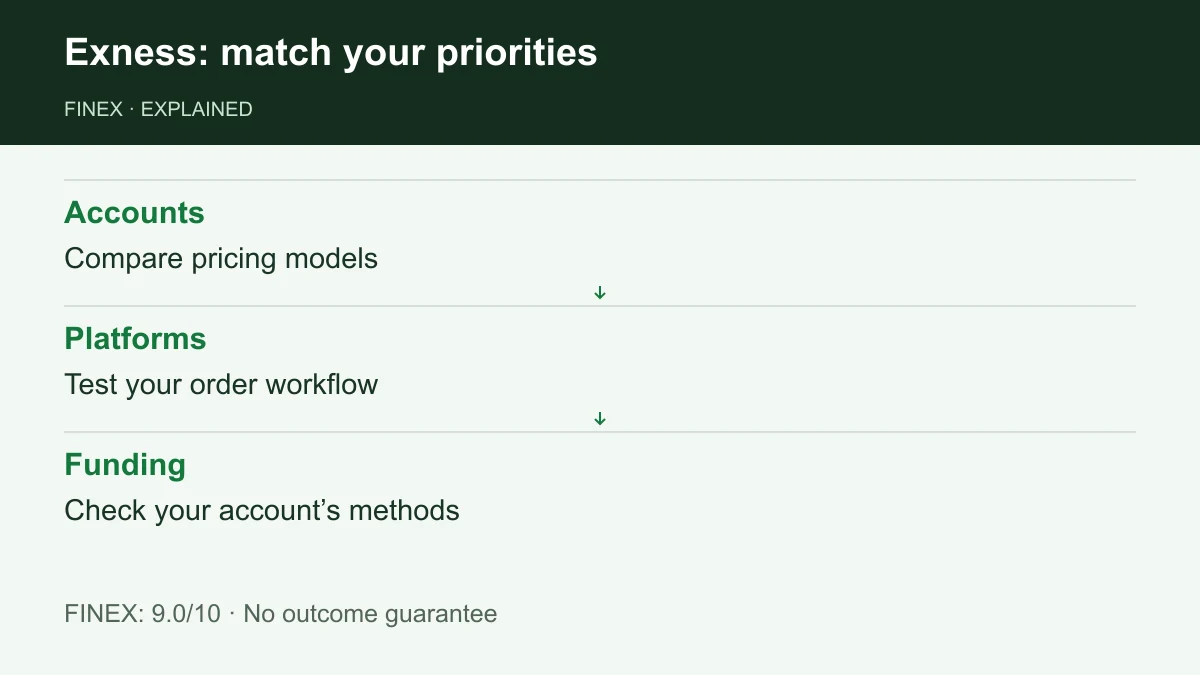
Provider guide
A concise Exness review: FINEX score 9.0/10, Standard and Raw Spread pricing, MT4/MT5, Exness Trade and key withdrawal conditions.
Read guide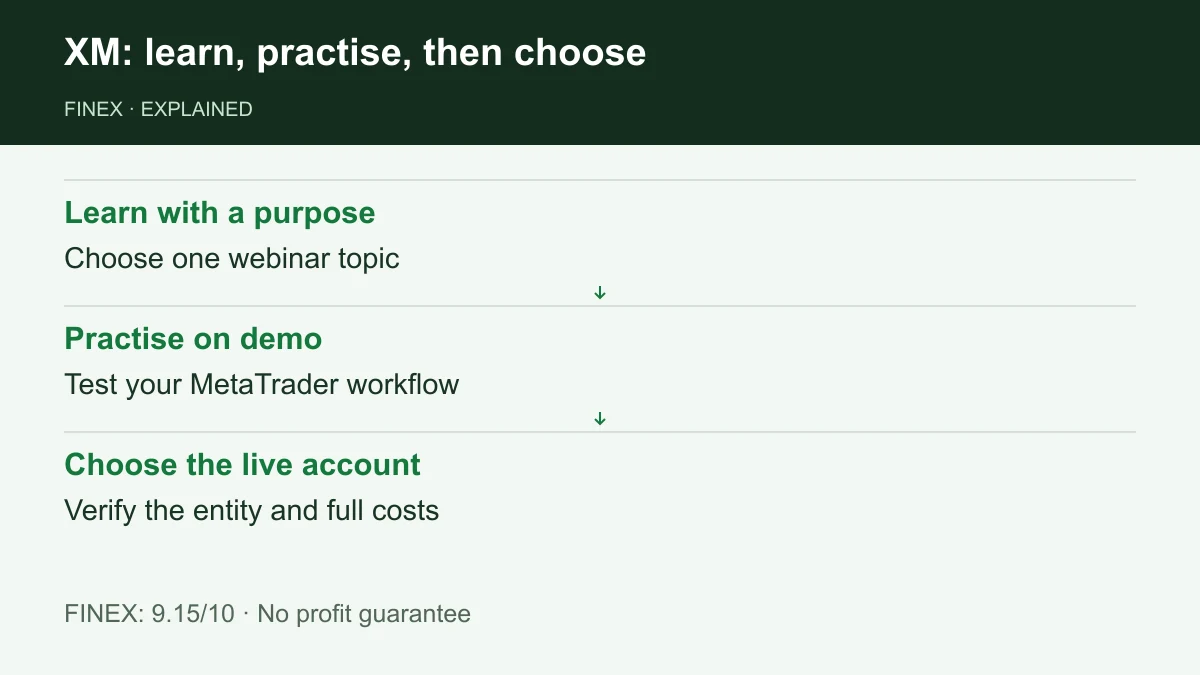
Provider guide
XM review: FINEX score 9.15/10, MetaTrader, learning resources and checks for the right account and entity before registering.
Read guide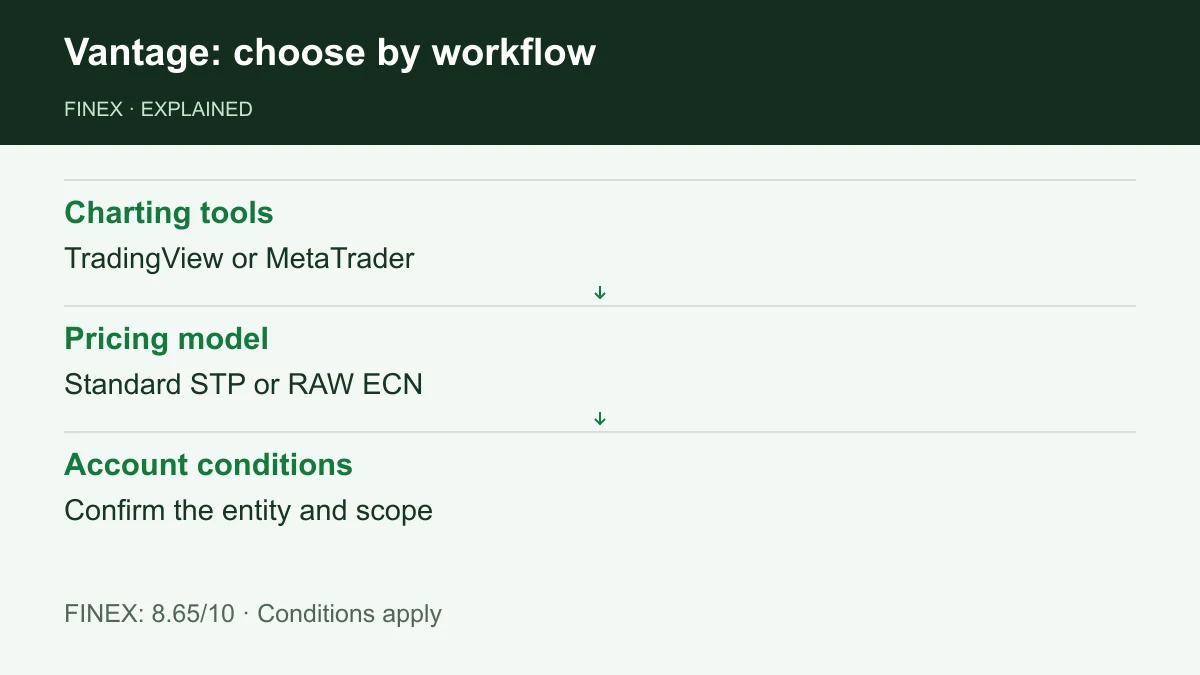
Provider guide
Vantage review: FINEX score 8.65/10, MT4/MT5 and TradingView, Standard STP versus Raw ECN pricing, withdrawals and international entity scope.
Read guide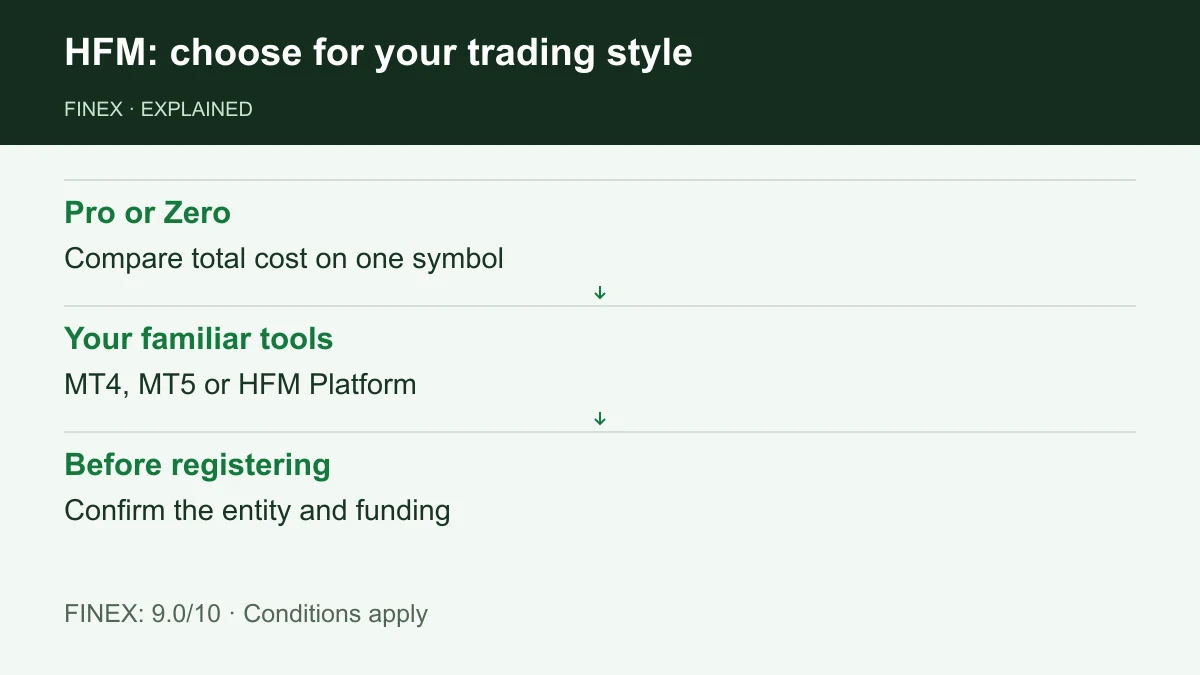
Provider guide
HFM review: FINEX score 9.0/10, Pro and Zero accounts, MT4/MT5, HFM Platform, pricing and withdrawal terms to check before registering.
Read guide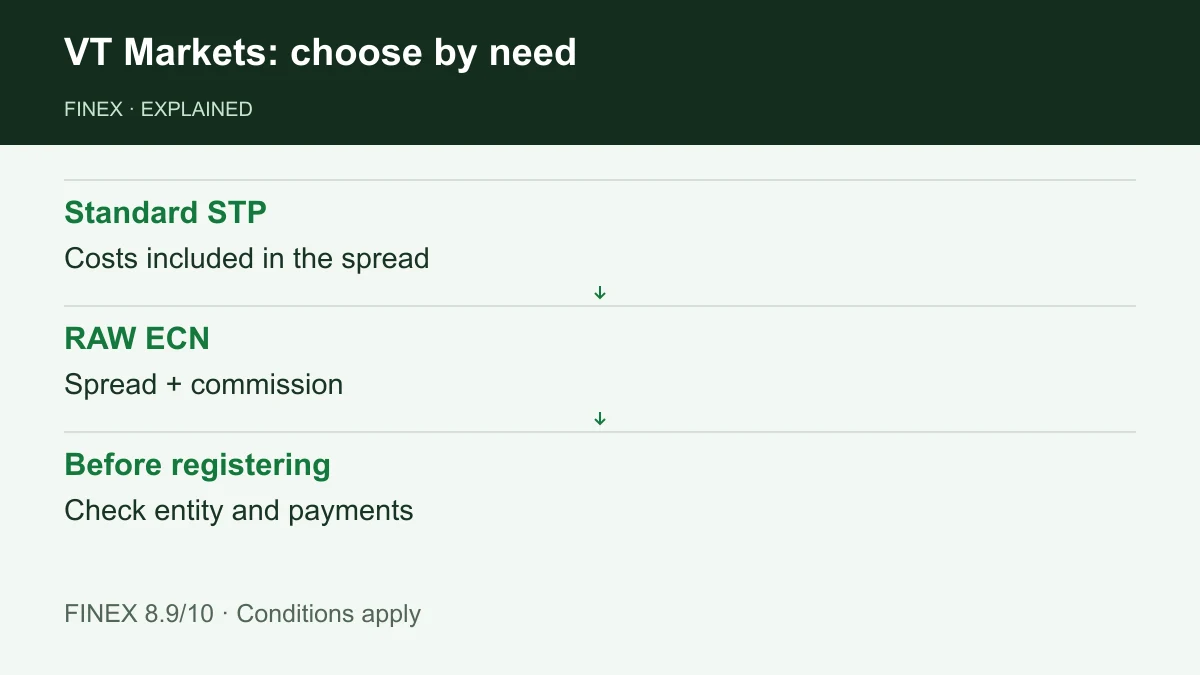
Provider guide
A concise VT Markets review: Standard STP versus RAW ECN, MT4/MT5, strengths, drawbacks and the costs and withdrawal terms to check.
Read guide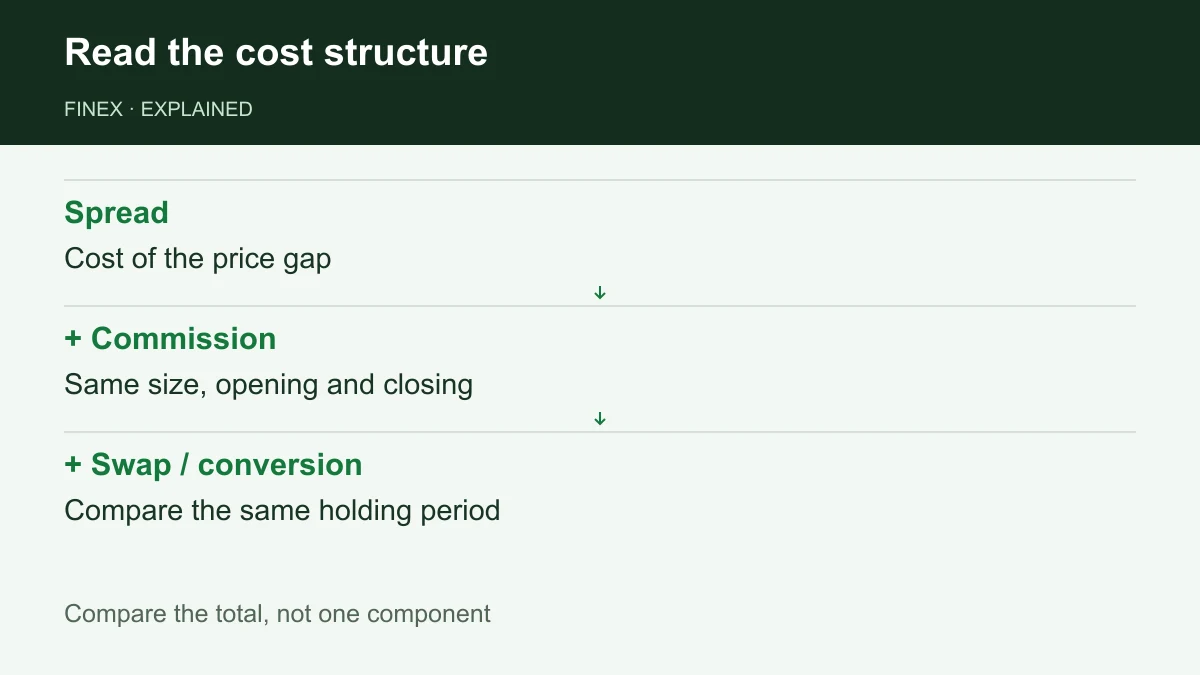
Provider guide
A source-led Exness guide to account pricing, contracting entity, regional eligibility and withdrawal terms. Check the account and company shown in your own application.
Read guideProvider guide
A source-led IC Markets guide to account pricing, contracting entity, regional eligibility and withdrawal terms. Check the account and company shown in your own application.
Read guide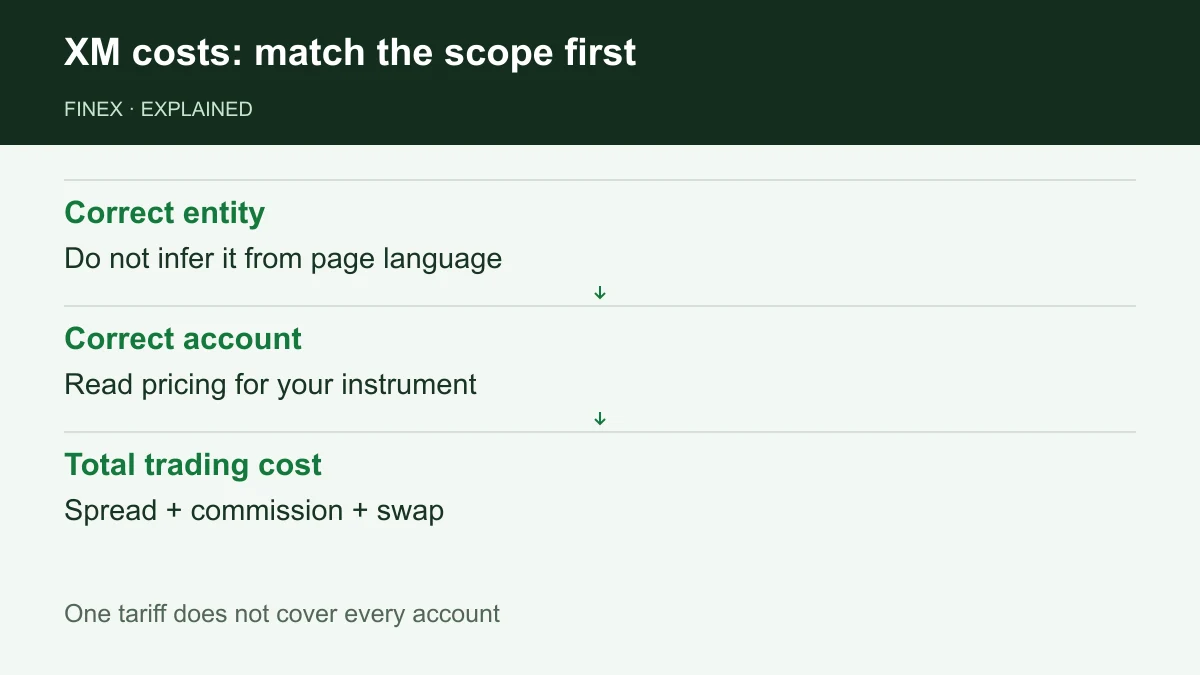
Provider guide
A source-led XM guide to account pricing, contracting entity, regional eligibility and withdrawal terms. Check the account and company shown in your own application.
Read guide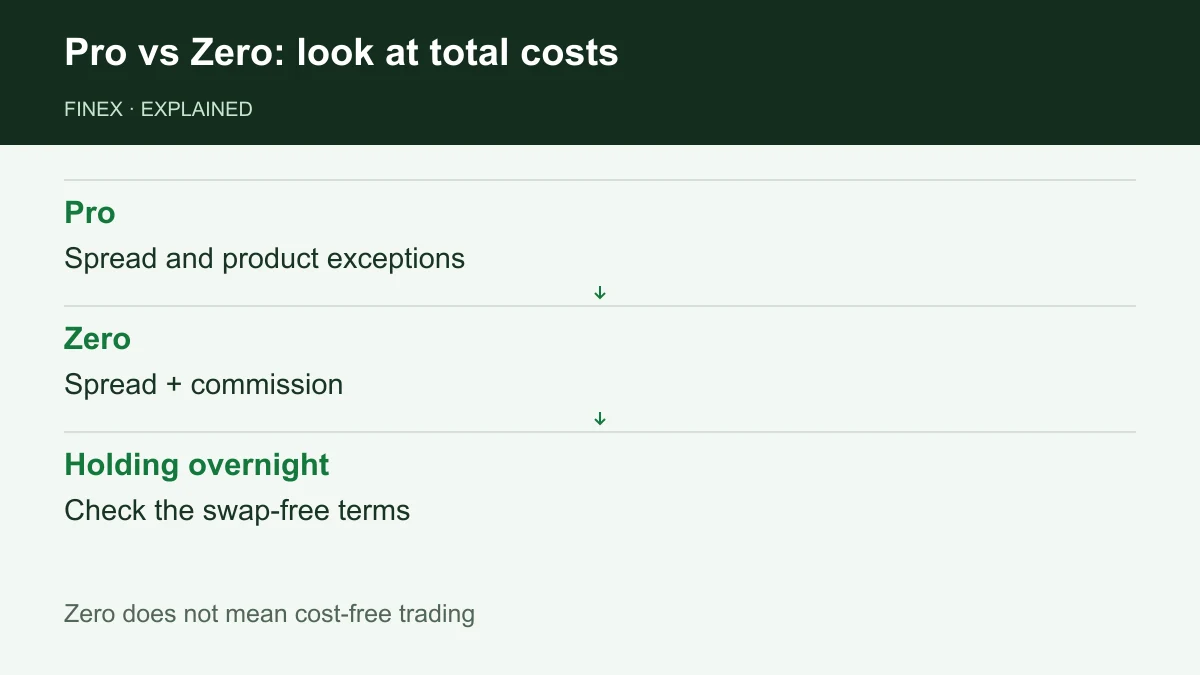
Provider guide
A source-led HFM guide to account pricing, contracting entity, regional eligibility and withdrawal terms. Check the account and company shown in your own application.
Read guide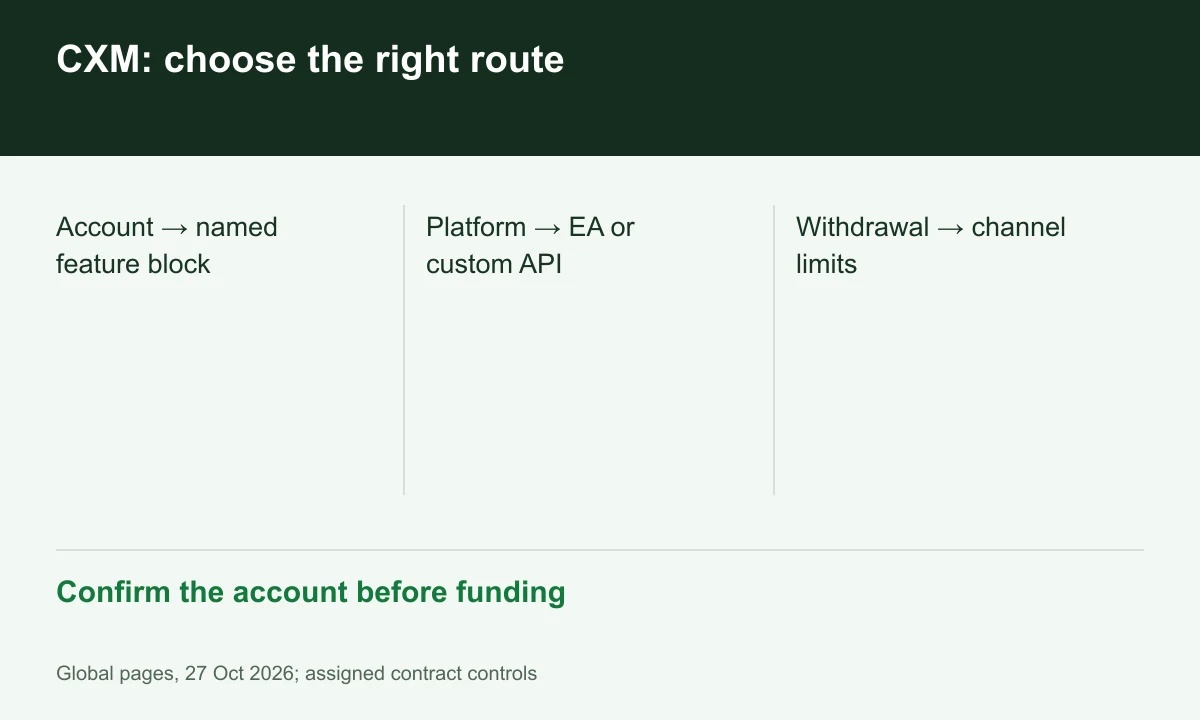
Provider guide
A source-led CXM guide to account pricing, contracting entity, regional eligibility and withdrawal terms. Check the account and company shown in your own application.
Read guide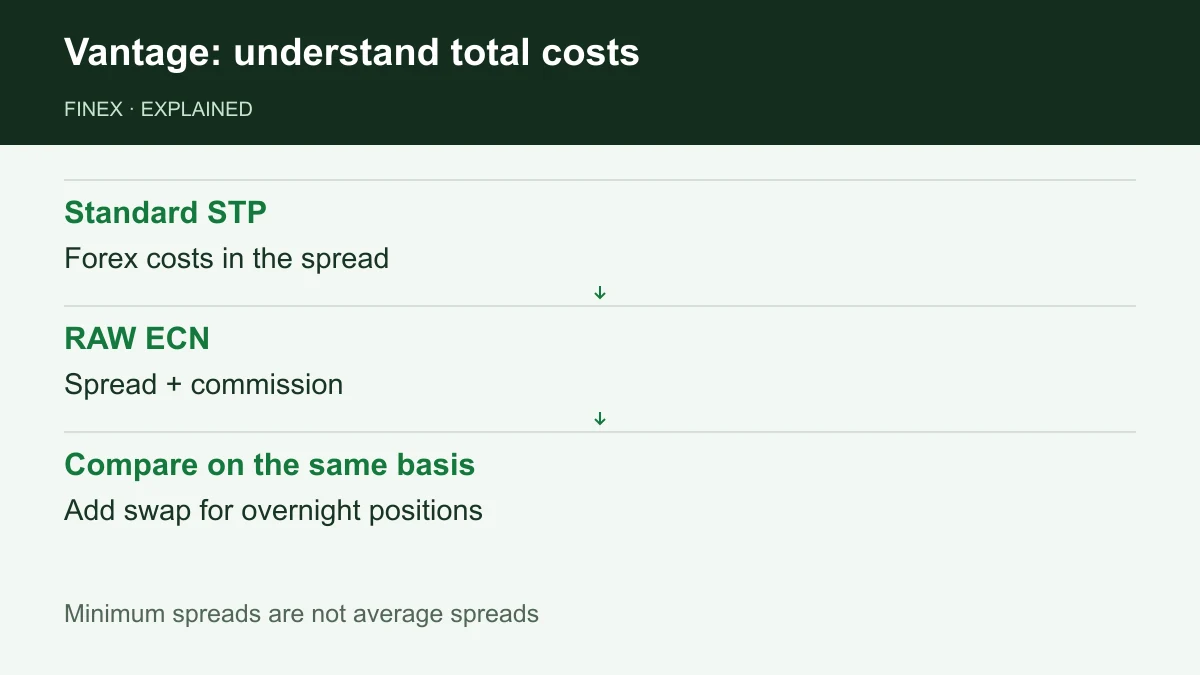
Provider guide
A source-led Vantage guide to account pricing, contracting entity, regional eligibility and withdrawal terms. Check the account and company shown in your own application.
Read guide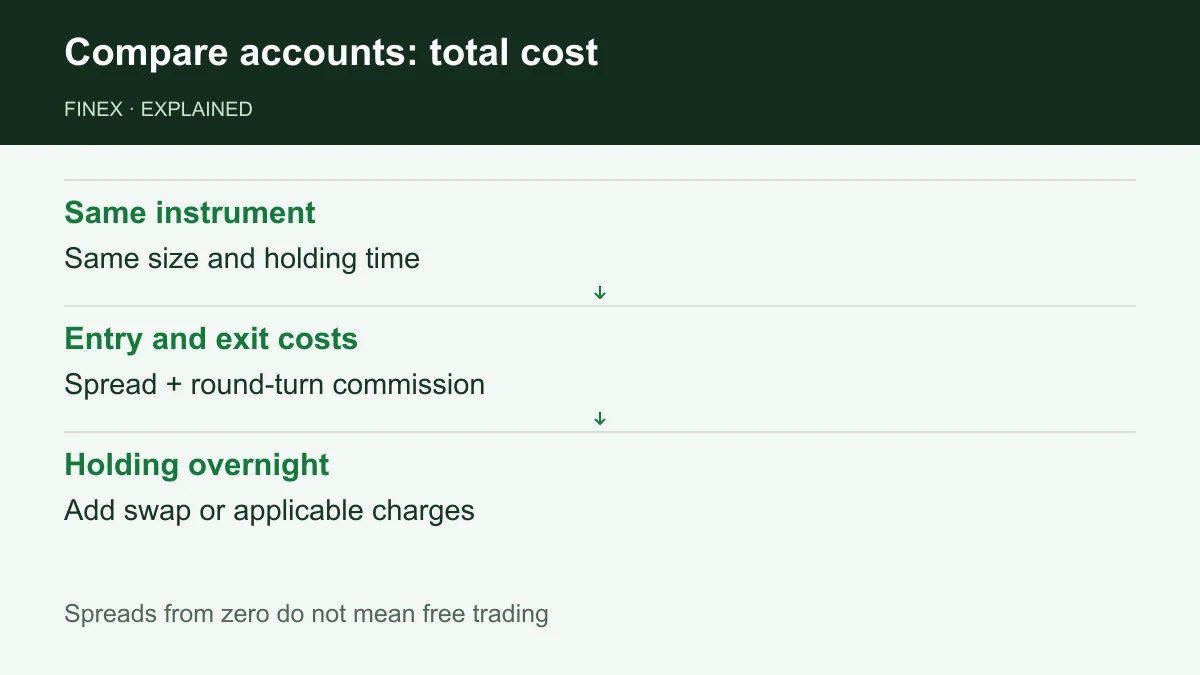
Provider guide
A source-led VT Markets guide to account pricing, contracting entity, regional eligibility and withdrawal terms. Check the account and company shown in your own application.
Read guide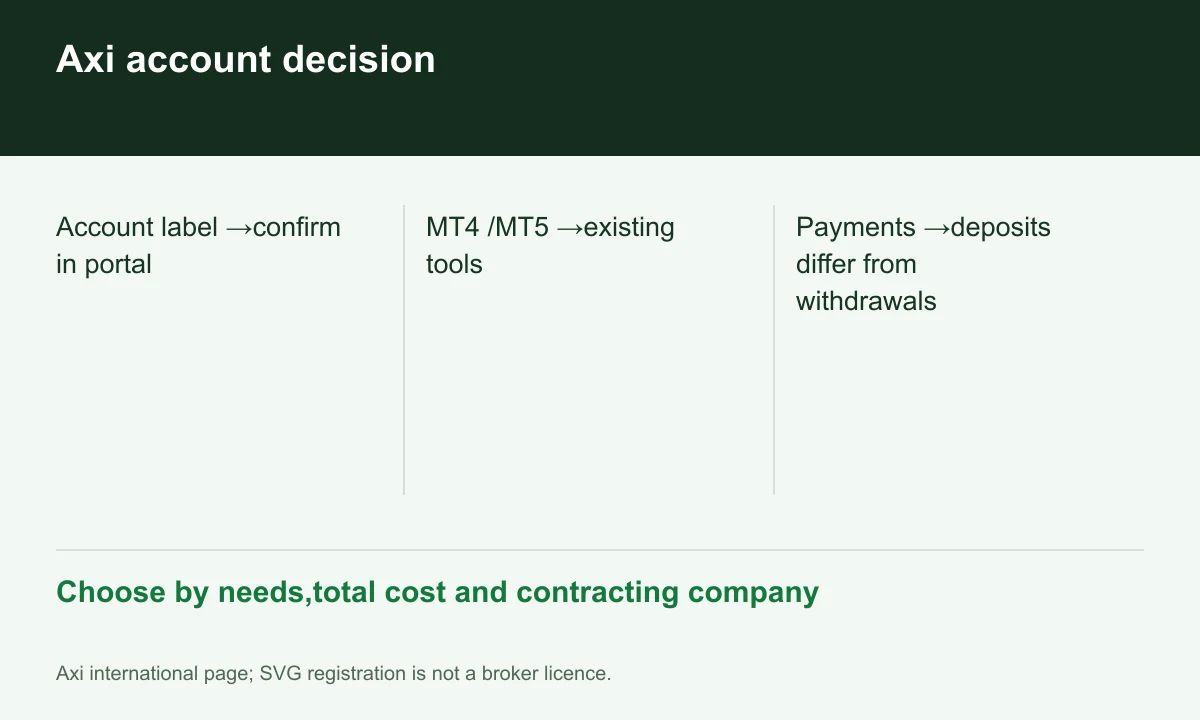
Provider guide
A source-led Axi guide to account pricing, contracting entity, regional eligibility and withdrawal terms. Check the account and company shown in your own application.
Read guide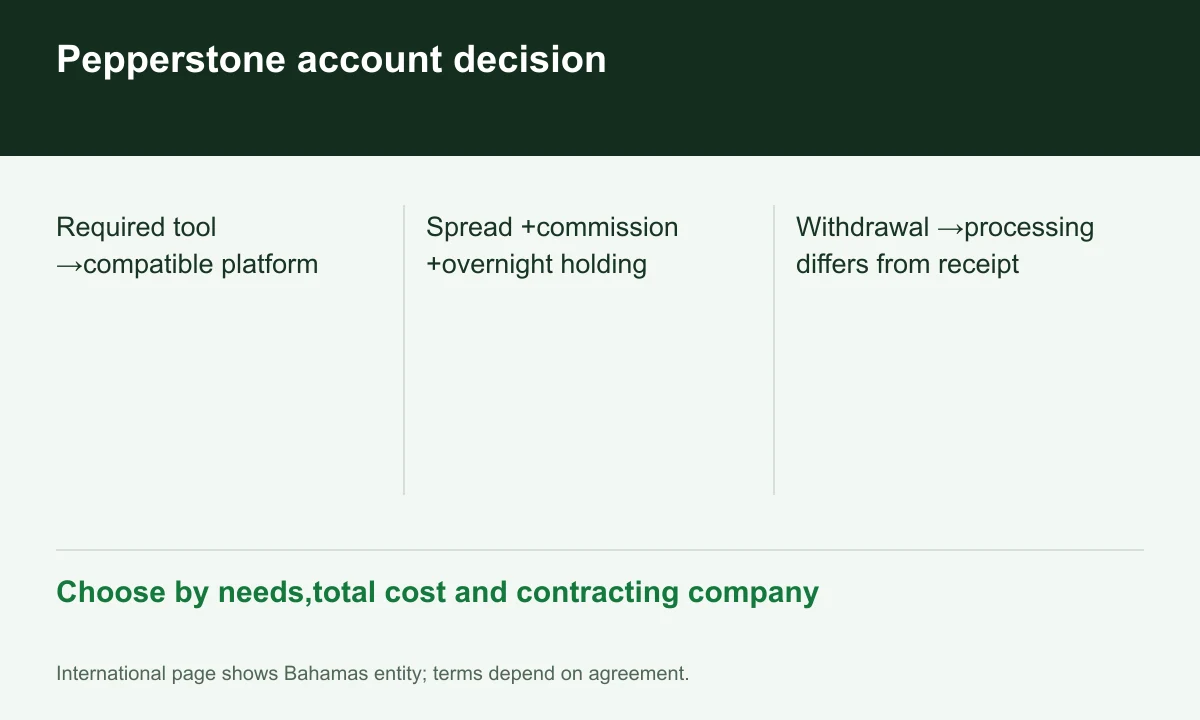
Provider guide
A source-led Pepperstone guide to account pricing, contracting entity, regional eligibility and withdrawal terms. Check the account and company shown in your own application.
Read guide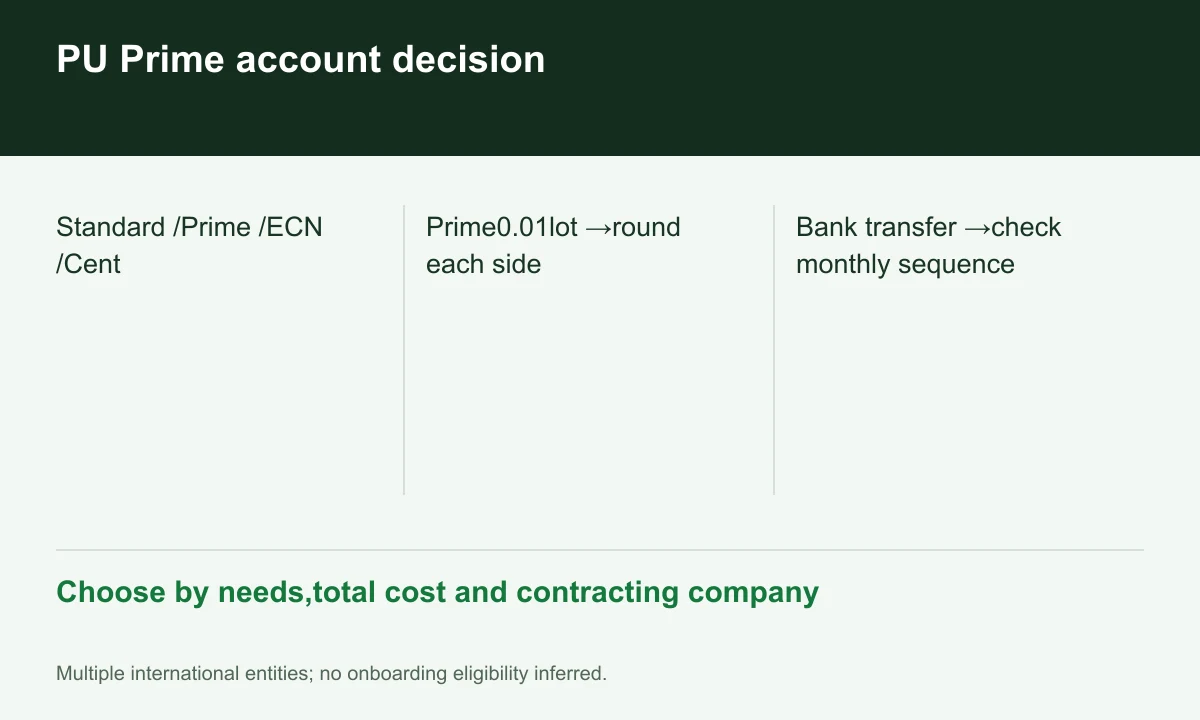
Provider guide
A source-led PU Prime guide to account pricing, contracting entity, regional eligibility and withdrawal terms. Check the account and company shown in your own application.
Read guide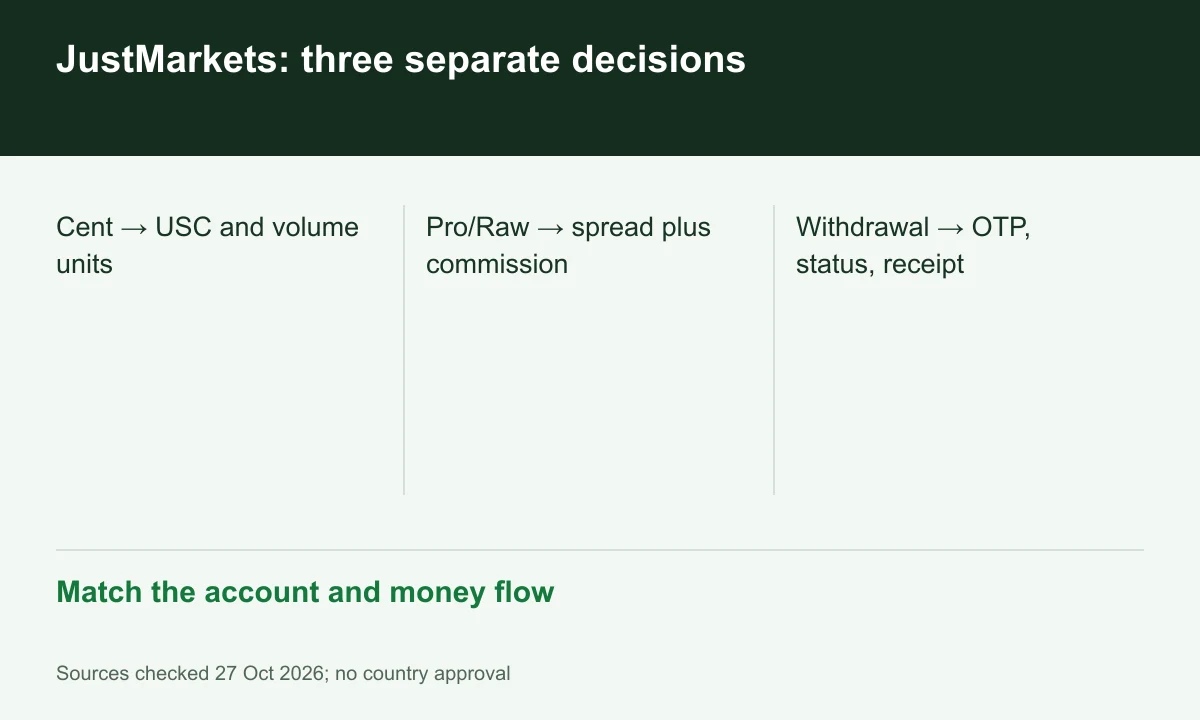
Provider guide
A source-led JustMarkets guide to account pricing, contracting entity, regional eligibility and withdrawal terms. Check the account and company shown in your own application.
Read guide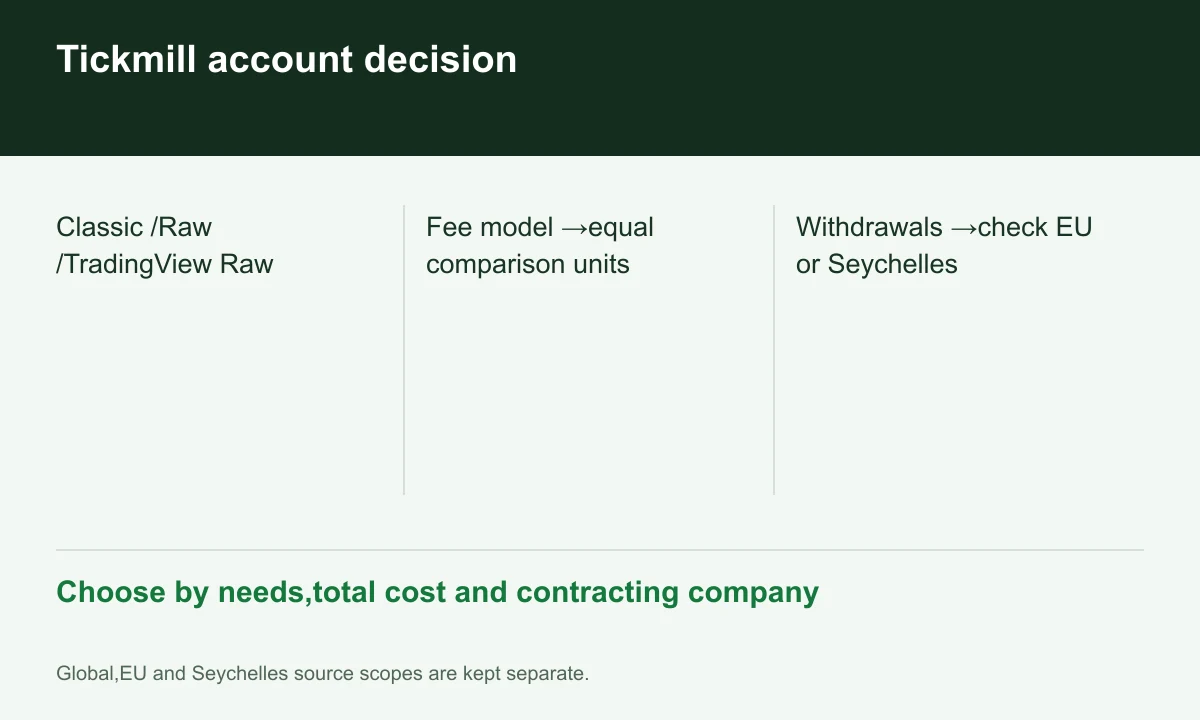
Provider guide
A source-led Tickmill guide to account pricing, contracting entity, regional eligibility and withdrawal terms. Check the account and company shown in your own application.
Read guide
Provider guide
A source-led Valetax guide to account pricing, contracting entity, regional eligibility and withdrawal terms. Check the account and company shown in your own application.
Read guide
Provider guide
A source-led ETO Markets guide to account pricing, contracting entity, regional eligibility and withdrawal terms. Check the account and company shown in your own application.
Read guide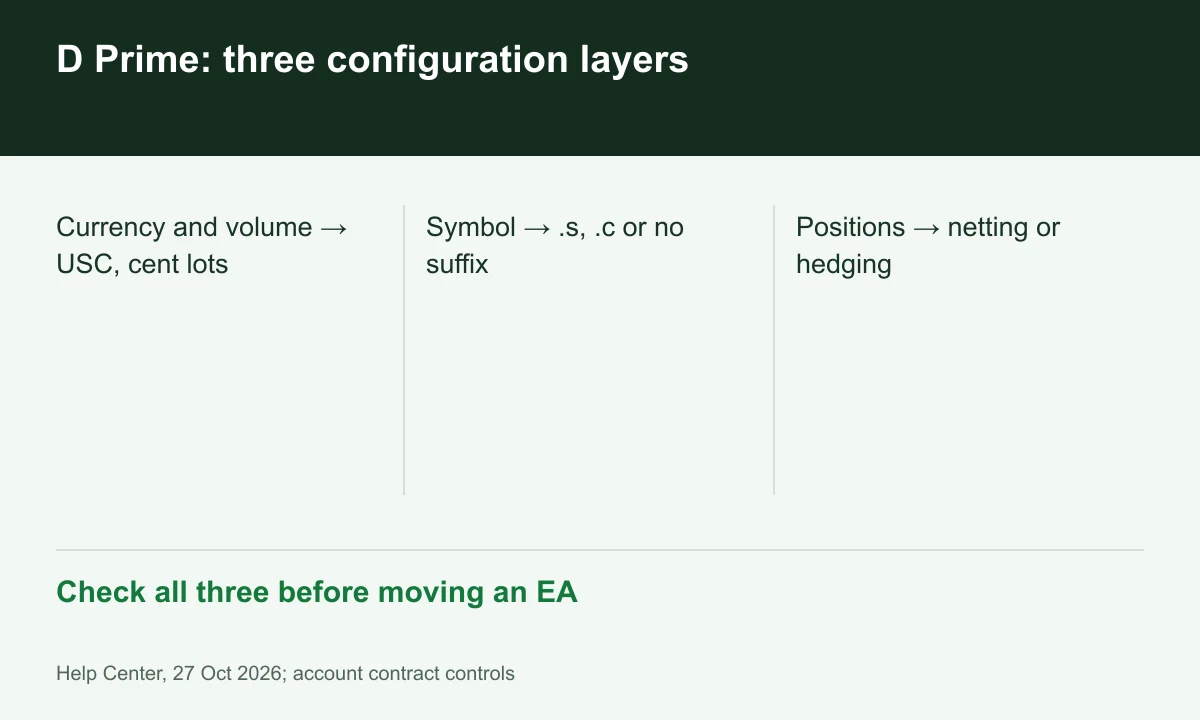
Provider guide
A source-led D Prime guide to account pricing, contracting entity, regional eligibility and withdrawal terms. Check the account and company shown in your own application.
Read guide
Provider guide
A source-led TMGM guide to account pricing, contracting entity, regional eligibility and withdrawal terms. Check the account and company shown in your own application.
Read guide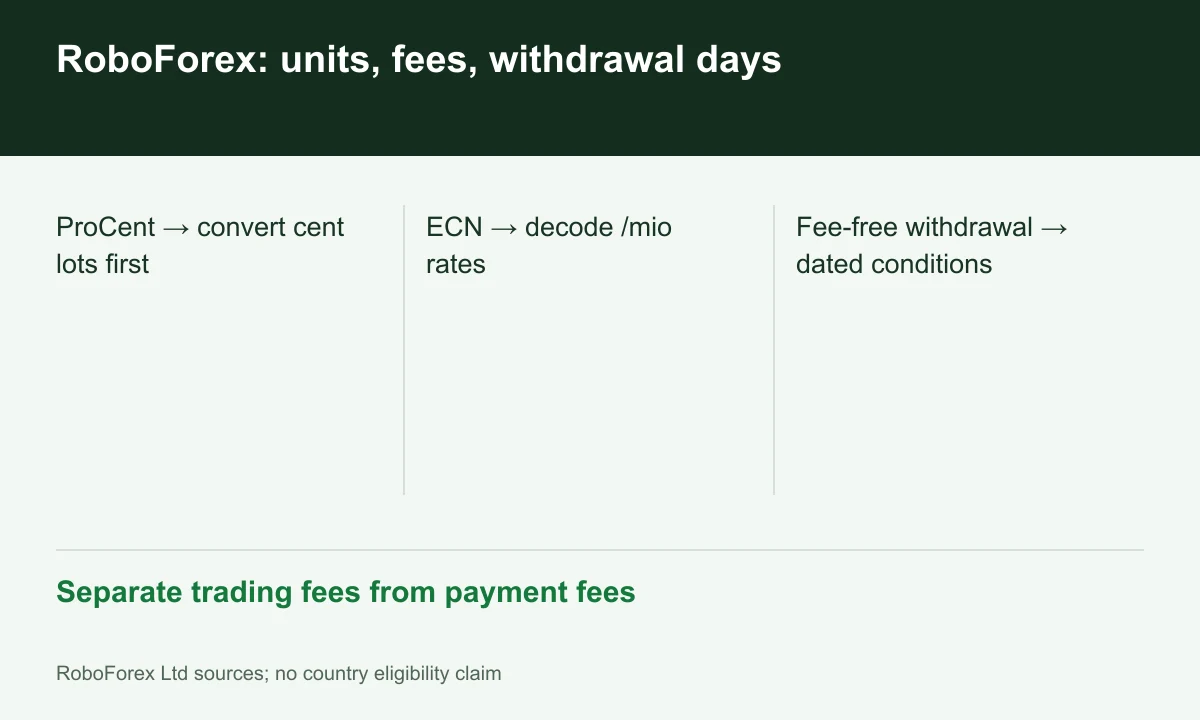
Provider guide
A source-led RoboForex guide to account pricing, contracting entity, regional eligibility and withdrawal terms. Check the account and company shown in your own application.
Read guide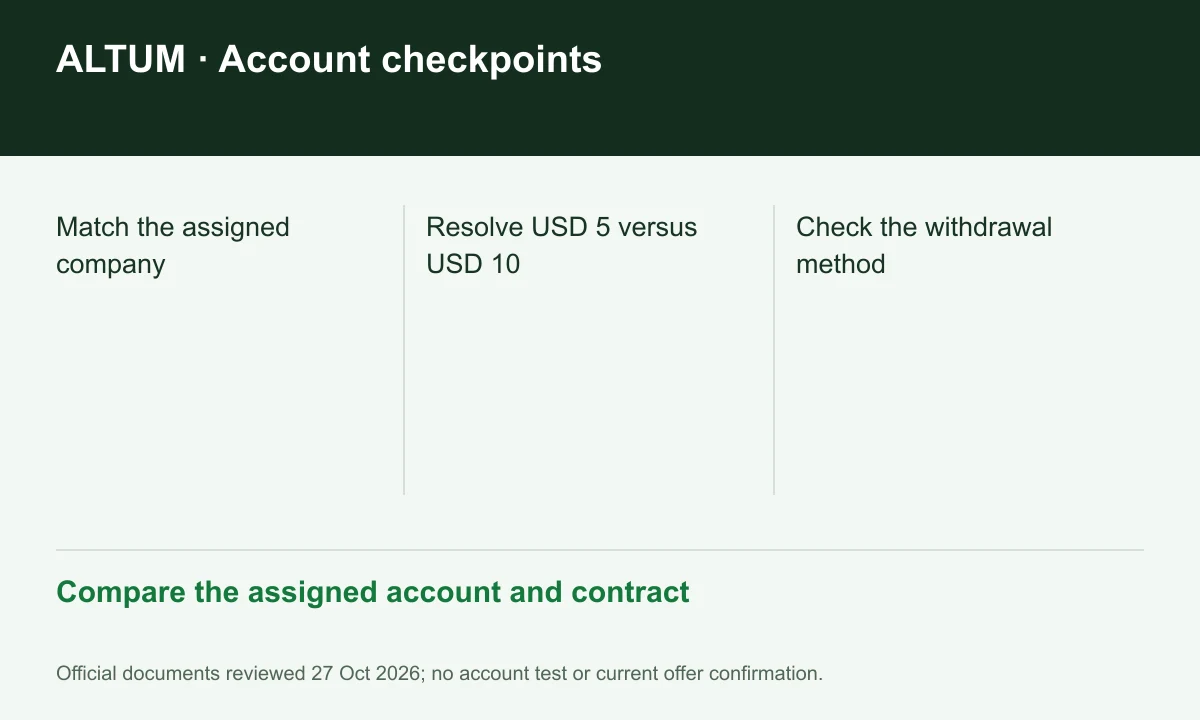
Provider guide
A source-led Altum guide to account pricing, contracting entity, regional eligibility and withdrawal terms. Check the account and company shown in your own application.
Read guide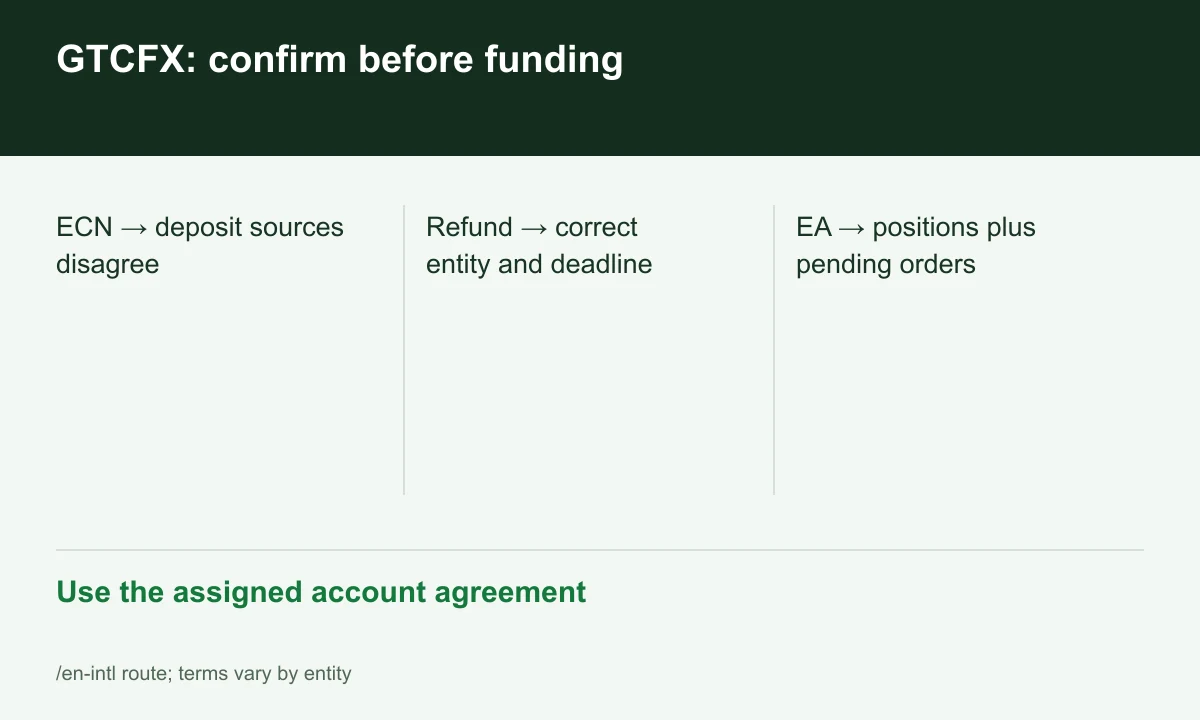
Provider guide
A source-led GTCFX guide to account pricing, contracting entity, regional eligibility and withdrawal terms. Check the account and company shown in your own application.
Read guide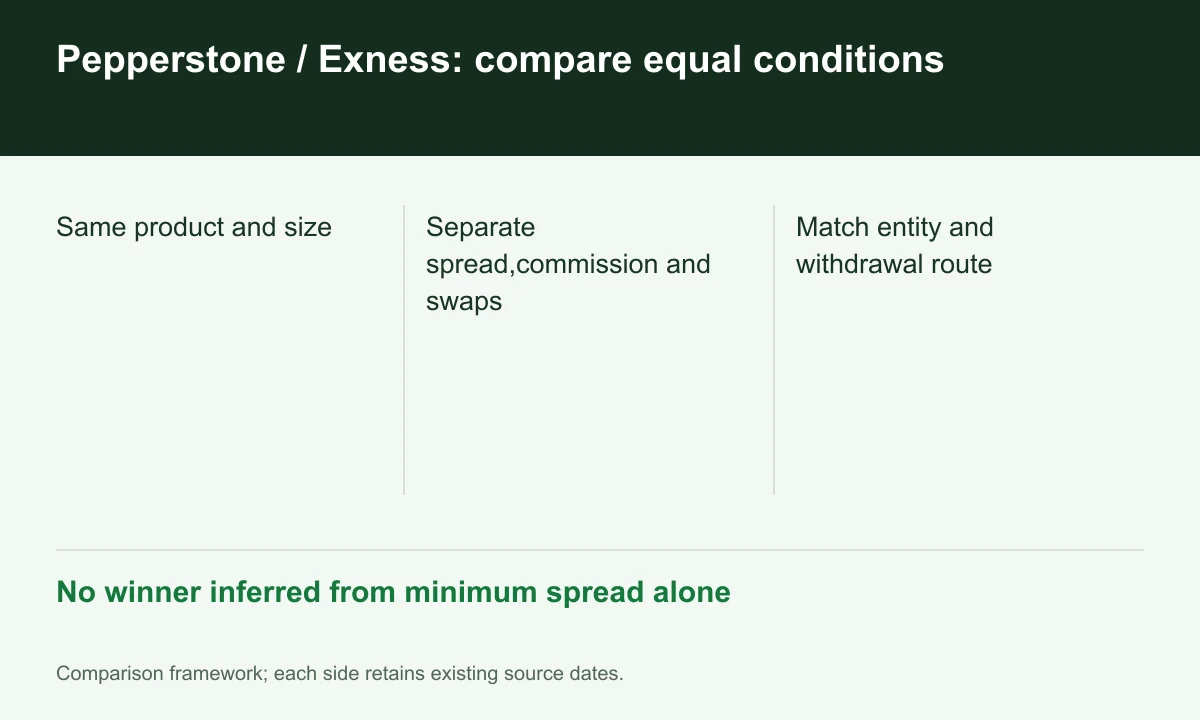
Comparison
A side-by-side, official-source comparison of Pepperstone and Exness. Match the exact product, account or program and country before drawing a conclusion.
Read guide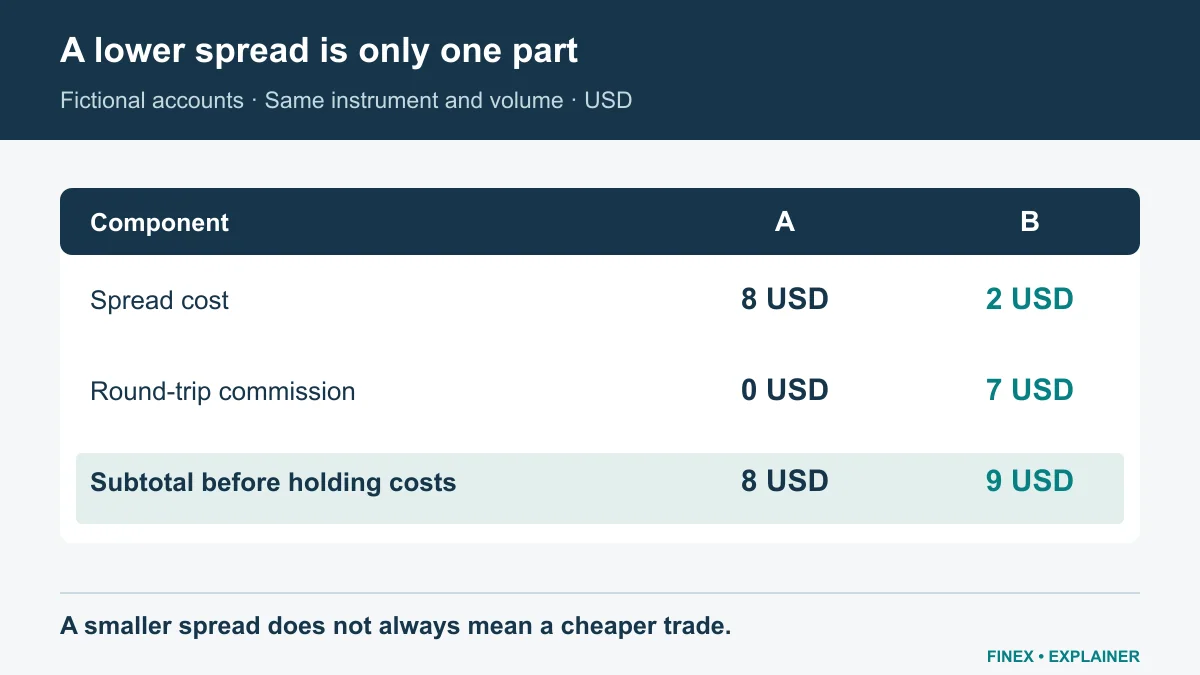
Comparison
A side-by-side, official-source comparison of IC Markets and XM. Match the exact product, account or program and country before drawing a conclusion.
Read guide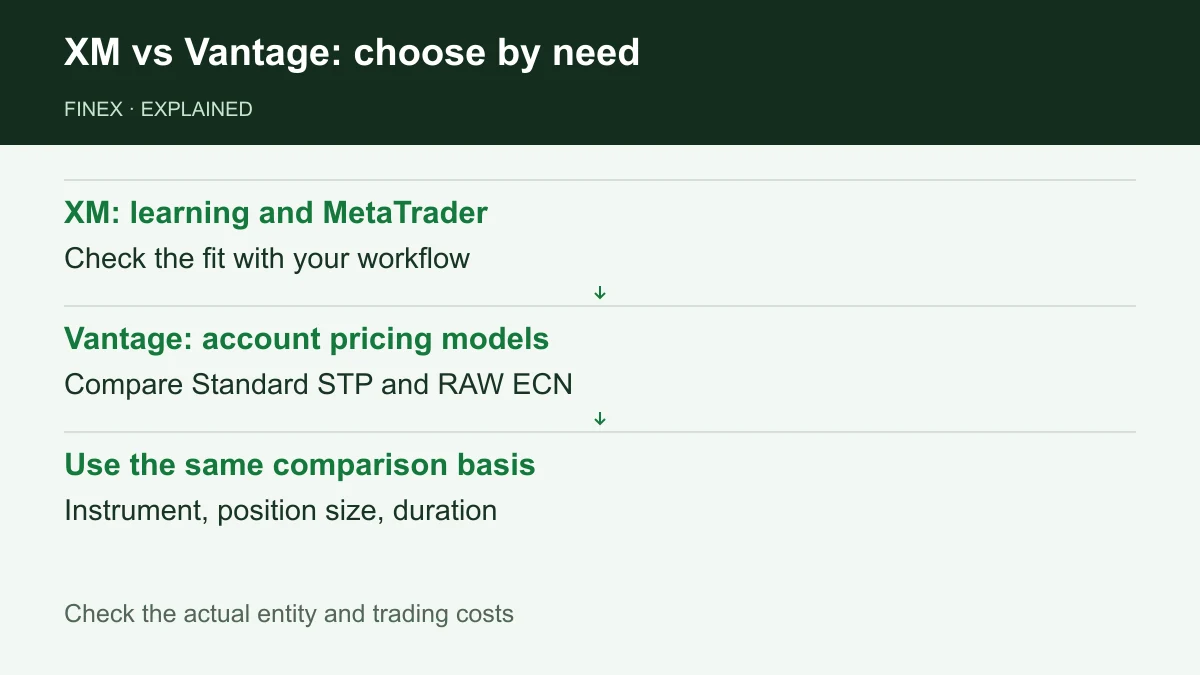
Comparison
A side-by-side, official-source comparison of XM and Vantage. Match the exact product, account or program and country before drawing a conclusion.
Read guide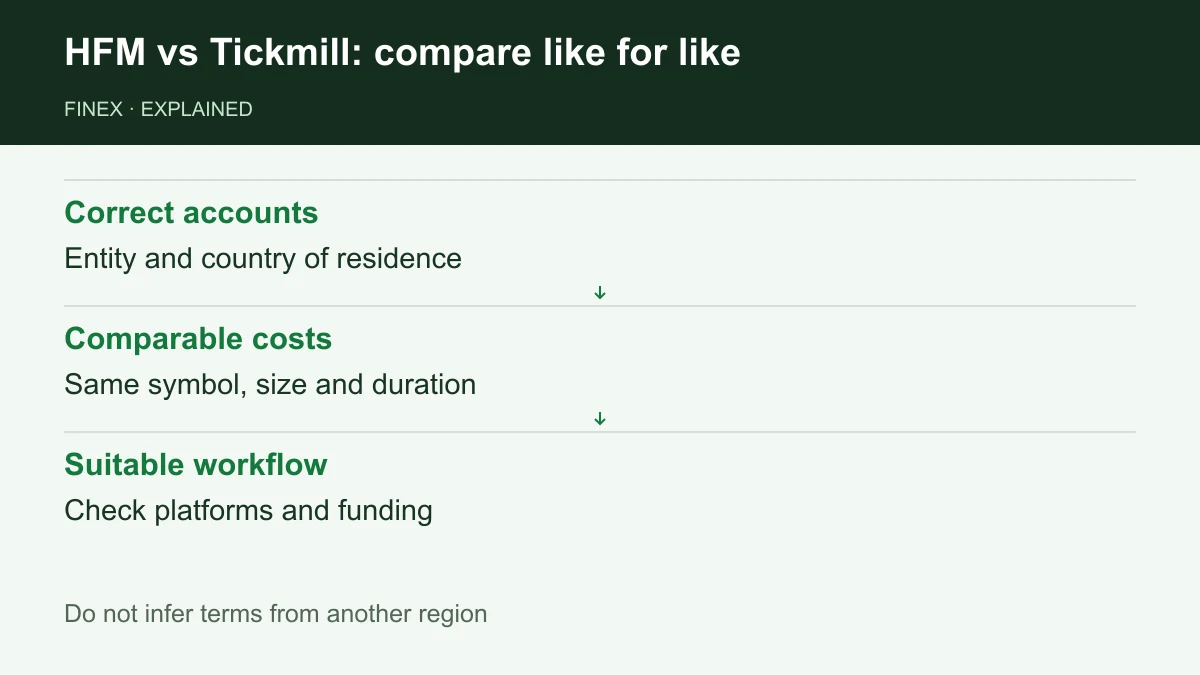
Comparison
A side-by-side, official-source comparison of HFM and Tickmill. Match the exact product, account or program and country before drawing a conclusion.
Read guide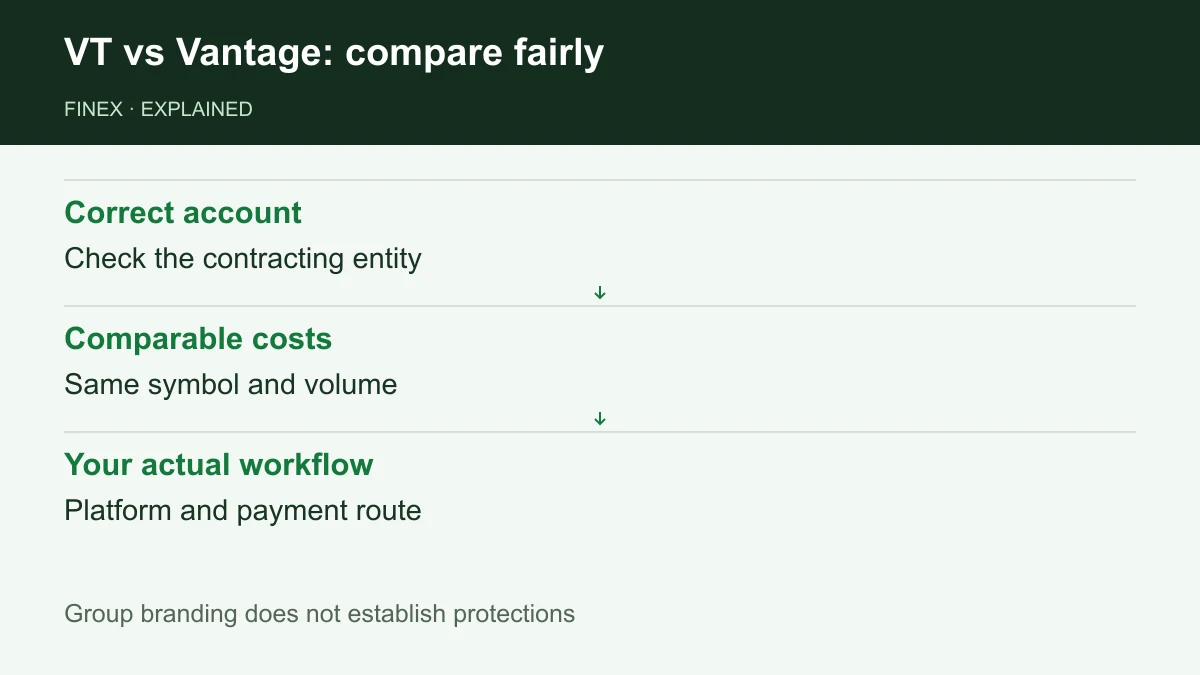
Comparison
A side-by-side, official-source comparison of Vantage and VT Markets. Match the exact product, account or program and country before drawing a conclusion.
Read guide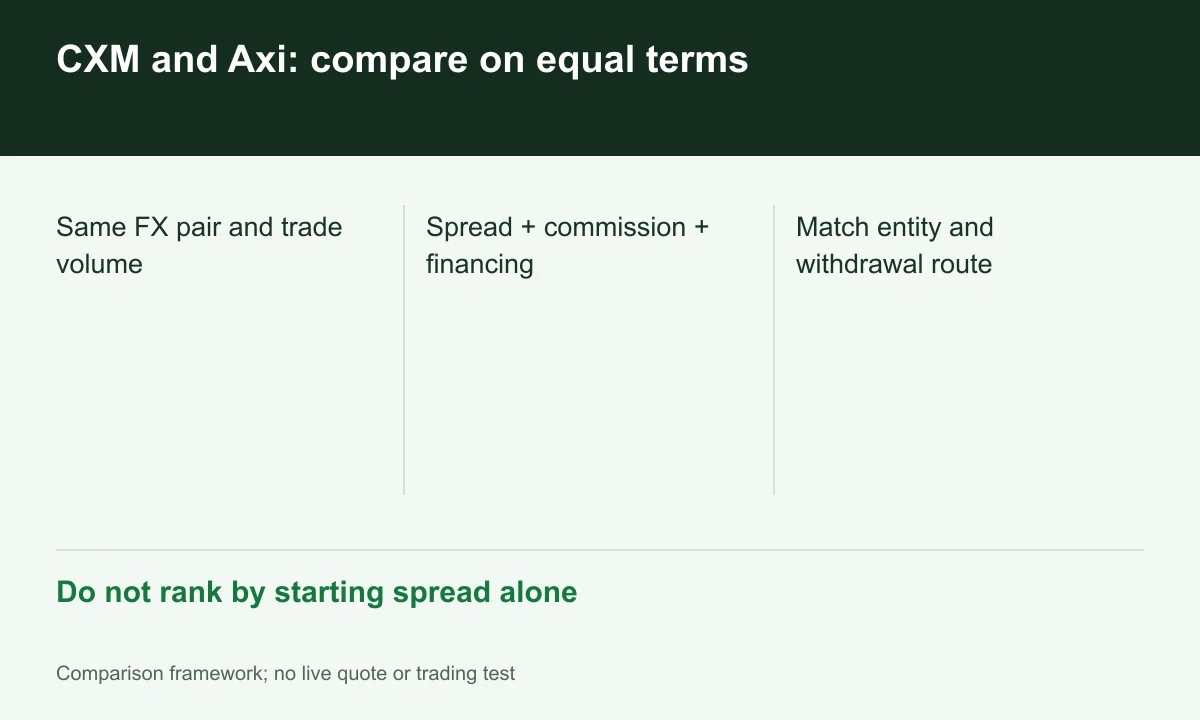
Comparison
A side-by-side, official-source comparison of CXM and Axi. Match the exact product, account or program and country before drawing a conclusion.
Read guide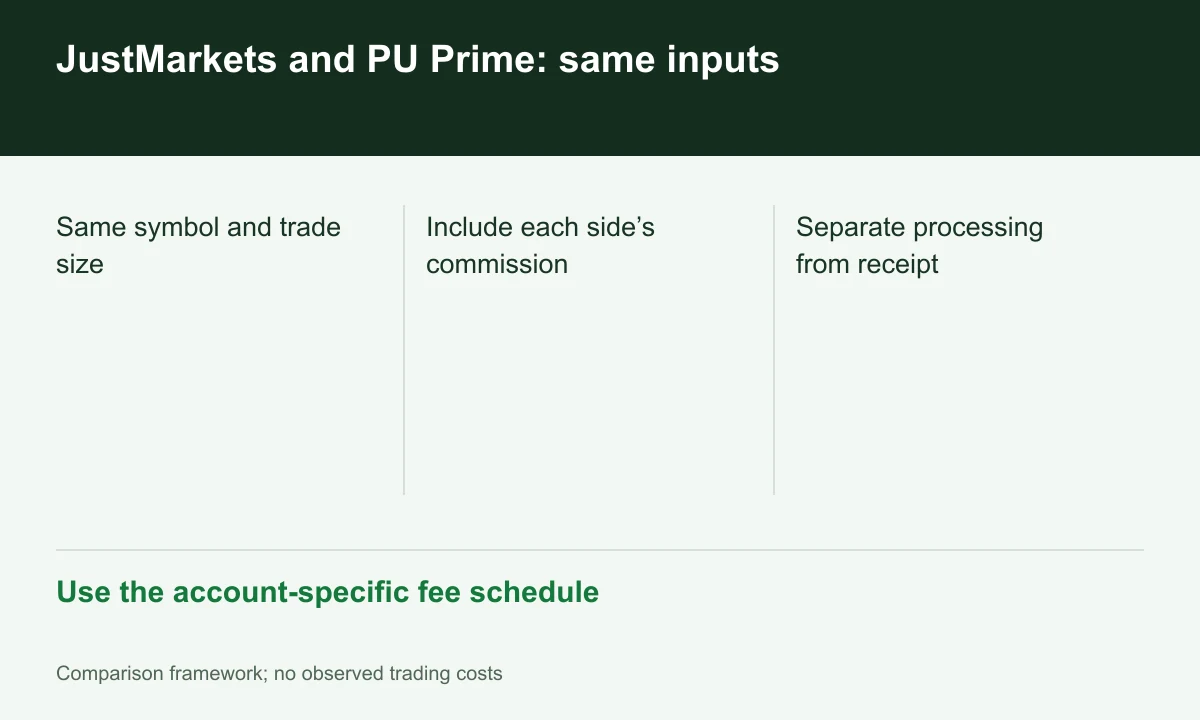
Comparison
A side-by-side, official-source comparison of JustMarkets and PU Prime. Match the exact product, account or program and country before drawing a conclusion.
Read guide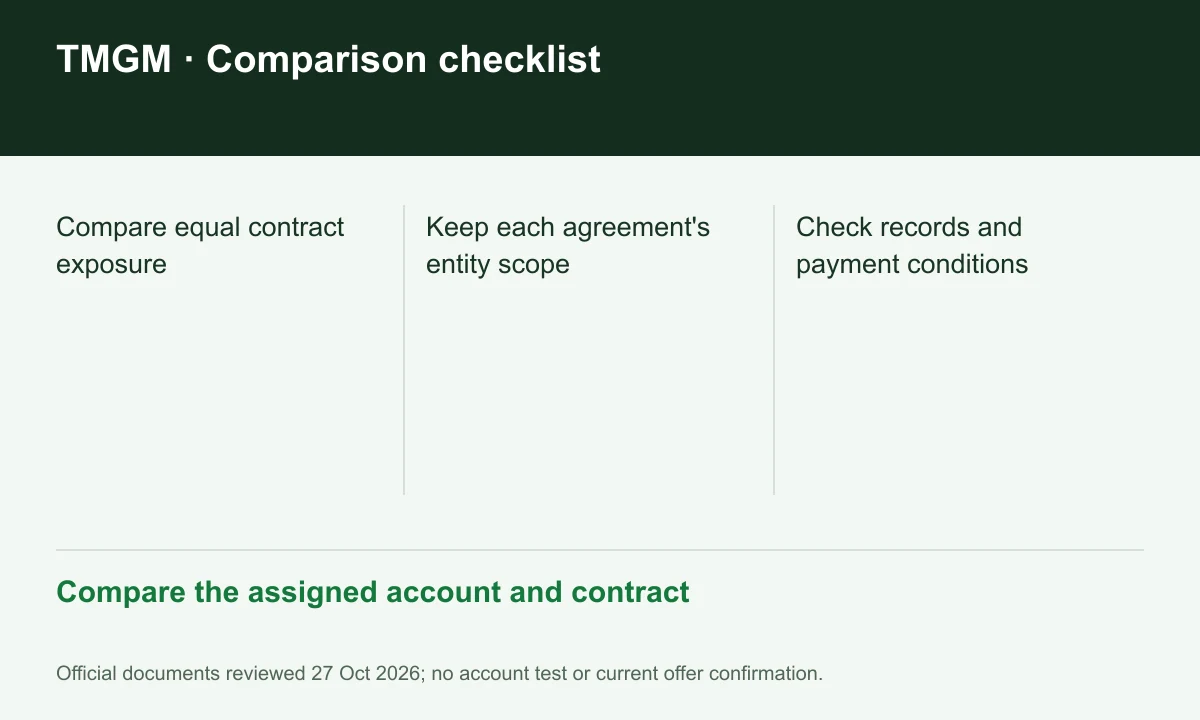
Comparison
A side-by-side, official-source comparison of TMGM and Pepperstone. Match the exact product, account or program and country before drawing a conclusion.
Read guide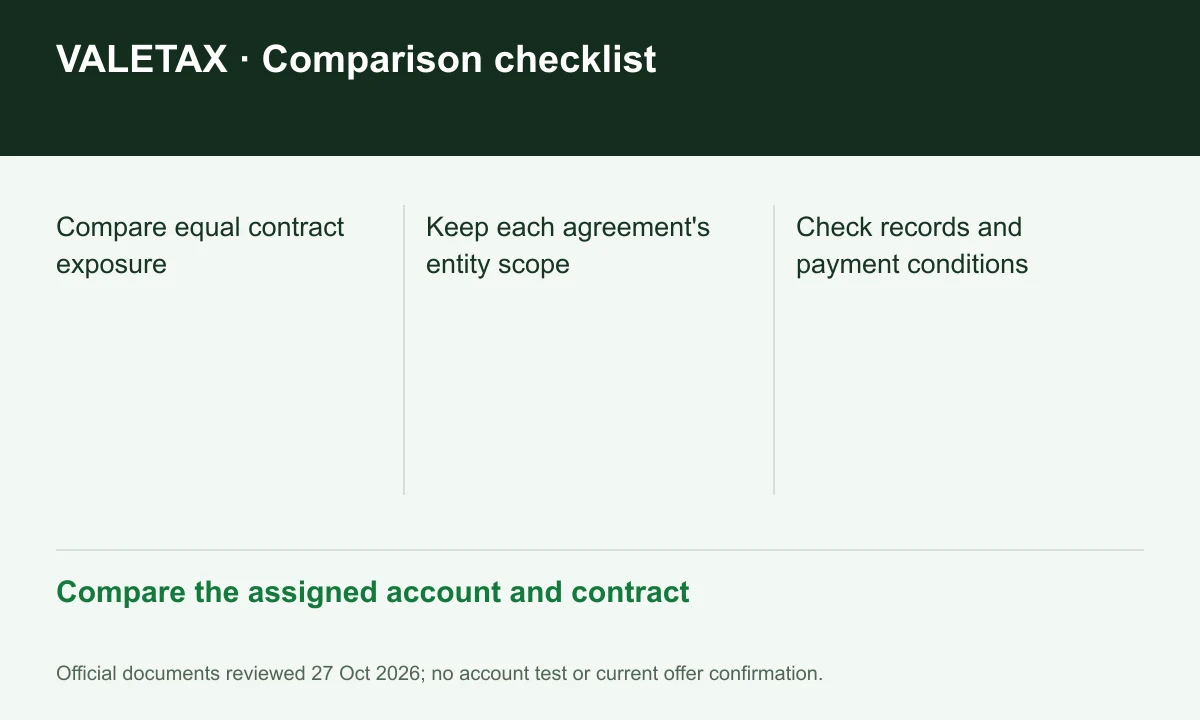
Comparison
A side-by-side, official-source comparison of RoboForex and Valetax. Match the exact product, account or program and country before drawing a conclusion.
Read guide
Comparison
A side-by-side, official-source comparison of GTCFX and Altum. Match the exact product, account or program and country before drawing a conclusion.
Read guide
Comparison
A side-by-side, official-source comparison of ETO Markets and D Prime. Match the exact product, account or program and country before drawing a conclusion.
Read guide
Comparison
A side-by-side, official-source comparison of Tickmill and Exness. Match the exact product, account or program and country before drawing a conclusion.
Read guide
Comparison
A side-by-side, official-source comparison of Axi and IC Markets. Match the exact product, account or program and country before drawing a conclusion.
Read guideComparison
A side-by-side, official-source comparison of XM and JustMarkets. Match the exact product, account or program and country before drawing a conclusion.
Read guideComparison
A side-by-side, official-source comparison of Vantage and GTCFX. Match the exact product, account or program and country before drawing a conclusion.
Read guideWithdrawals
A practical route-by-route check of the IC Markets withdrawal disclosure, including eligibility, processing, payment details and evidence to keep.
Read guide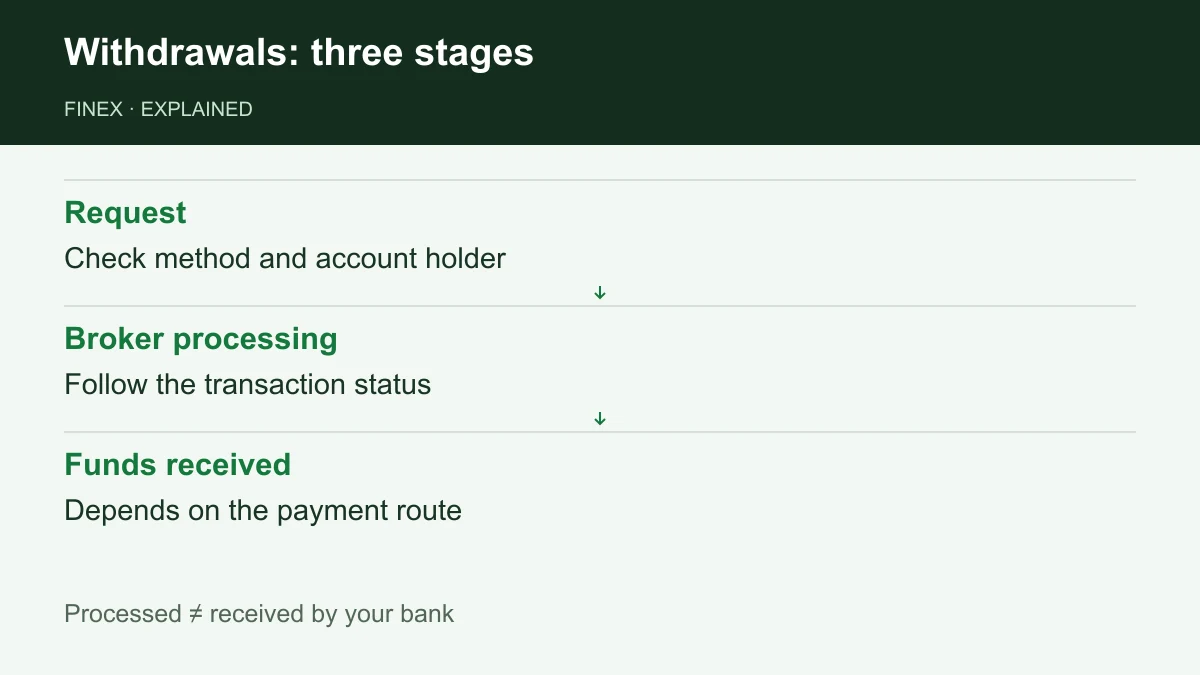
Withdrawals
A practical route-by-route check of the Exness withdrawal disclosure, including eligibility, processing, payment details and evidence to keep.
Read guide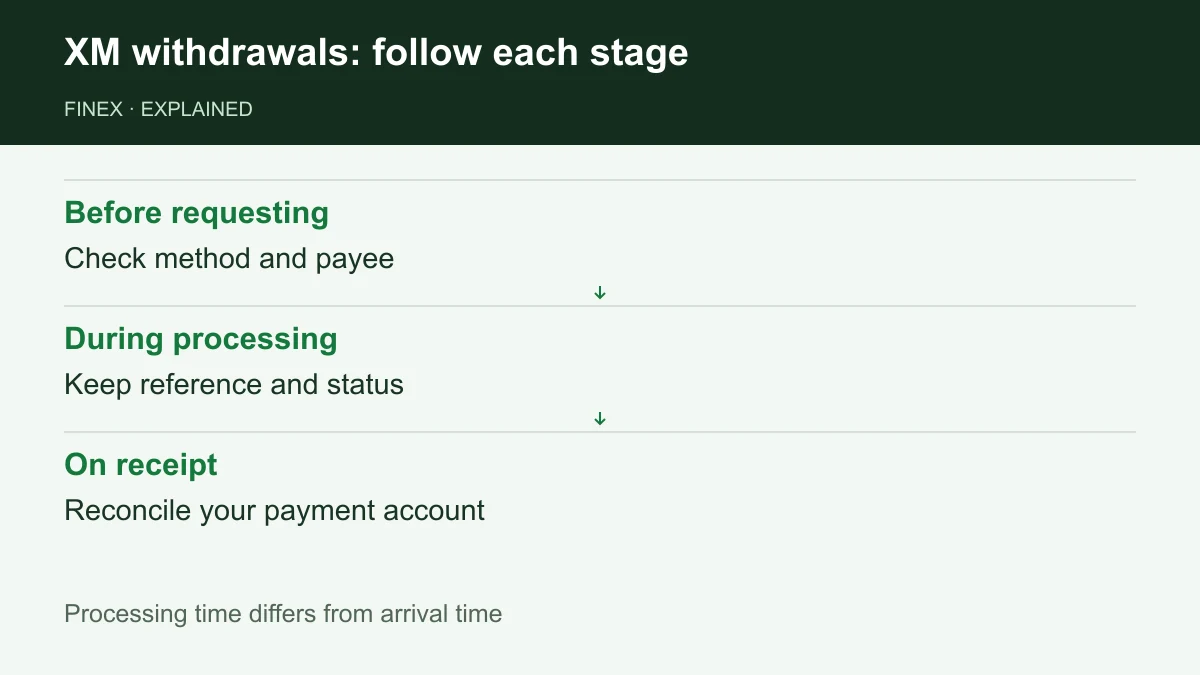
Withdrawals
A practical route-by-route check of the XM withdrawal disclosure, including eligibility, processing, payment details and evidence to keep.
Read guide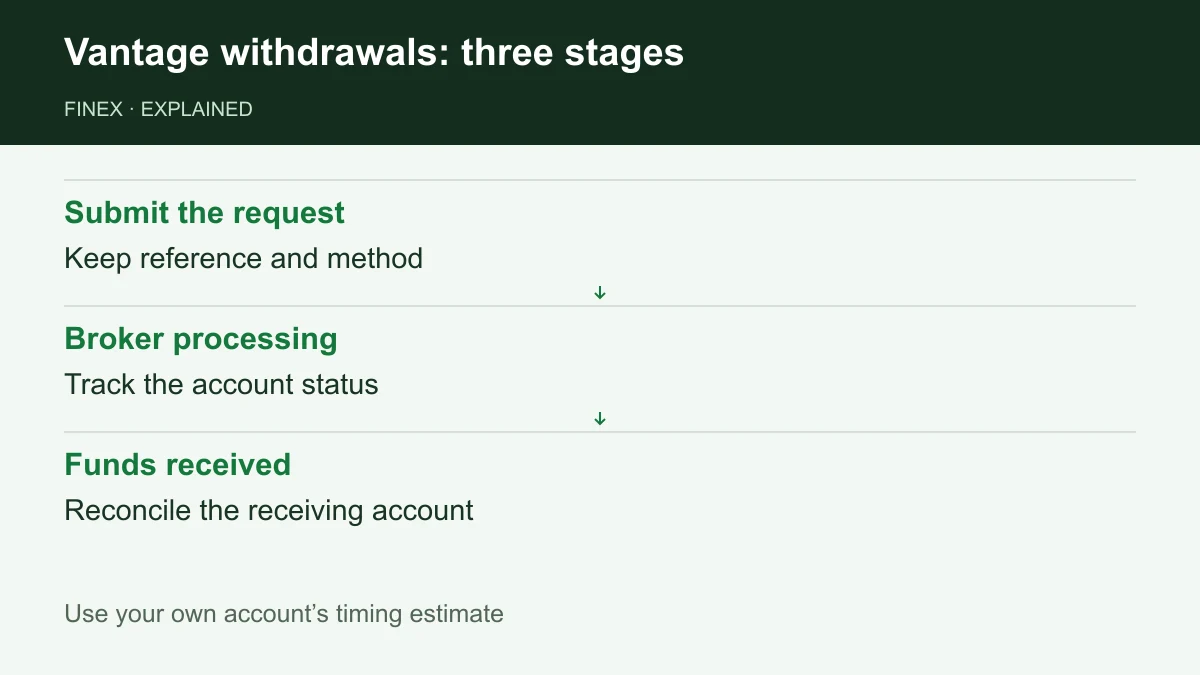
Withdrawals
A practical route-by-route check of the Vantage withdrawal disclosure, including eligibility, processing, payment details and evidence to keep.
Read guide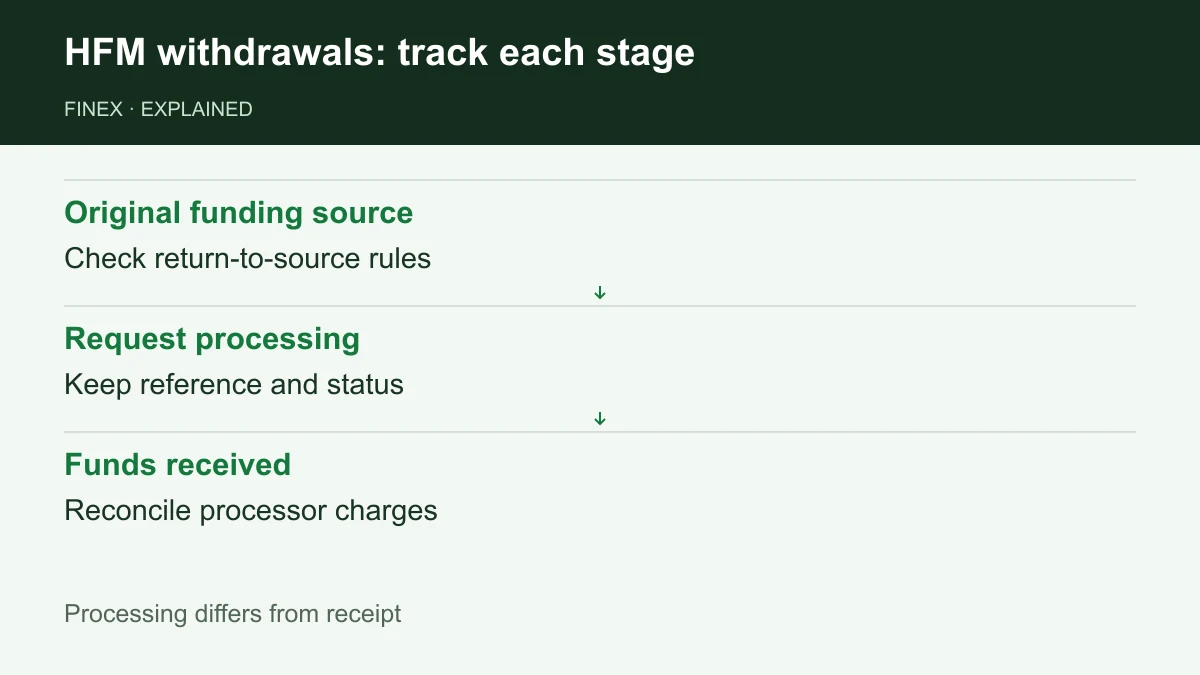
Withdrawals
A practical route-by-route check of the HFM withdrawal disclosure, including eligibility, processing, payment details and evidence to keep.
Read guide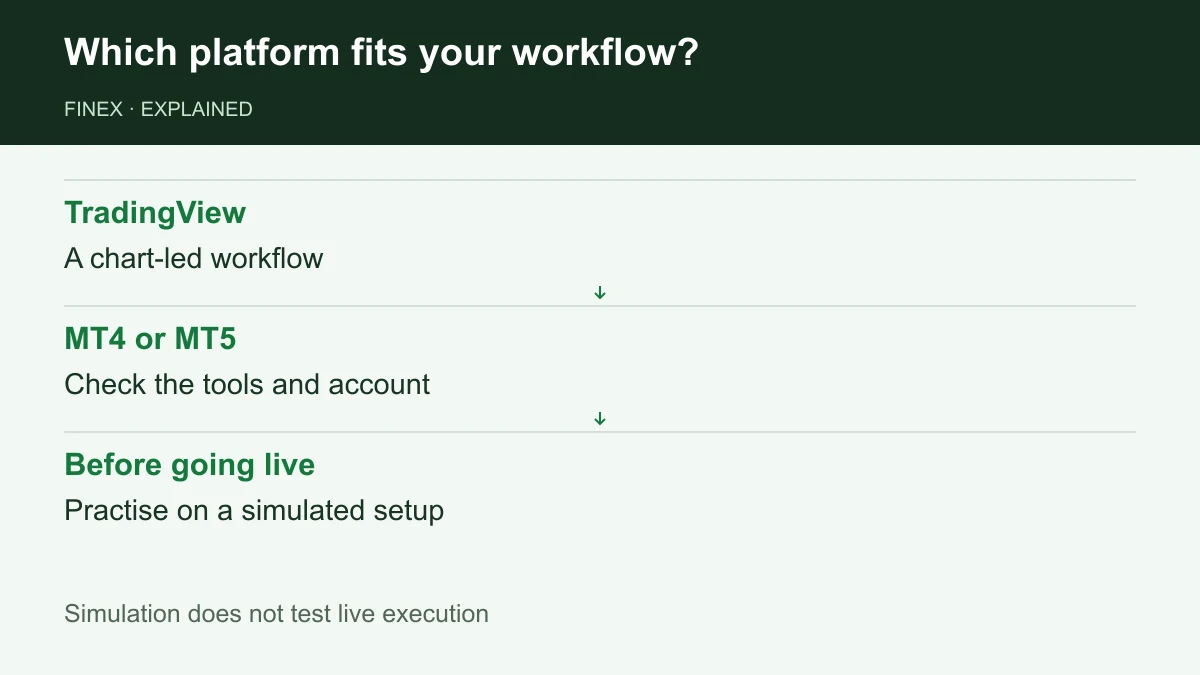
Provider guide
Choose a Vantage platform, connect TradingView and check account compatibility. Separate Paper Trading practice from live execution before registering.
Read guide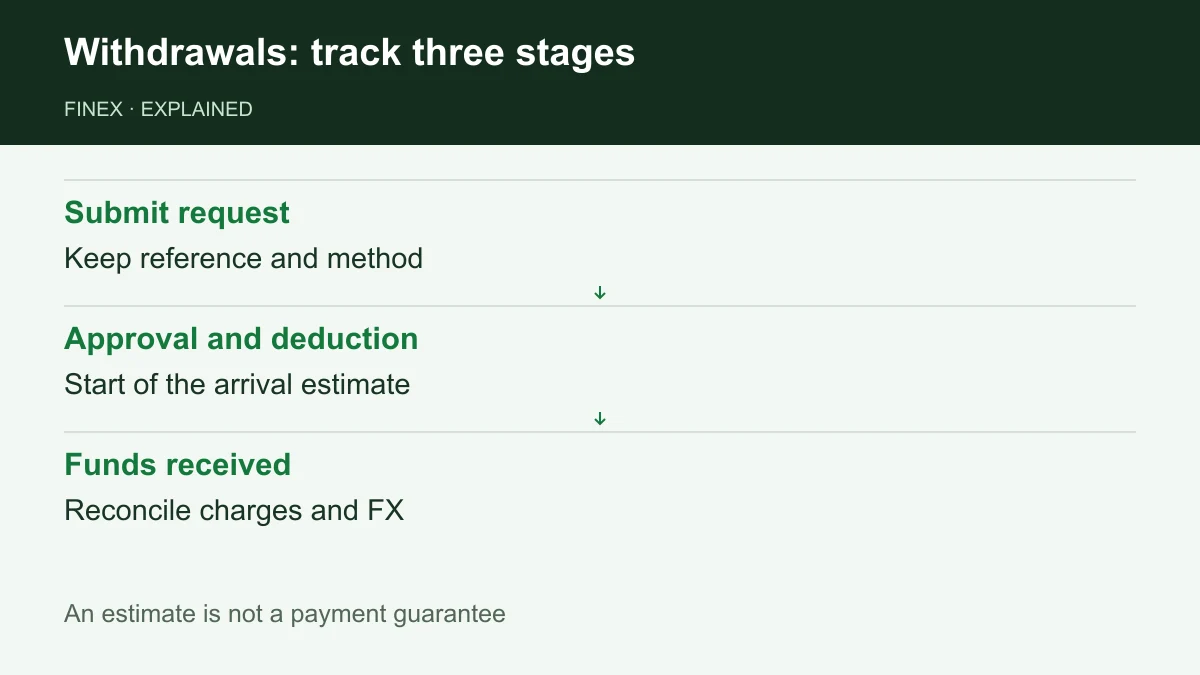
Withdrawals
VT Markets withdrawals: distinguish approval from arrival, check method-specific fees, understand return-to-source rules and handle a delayed request.
Read guide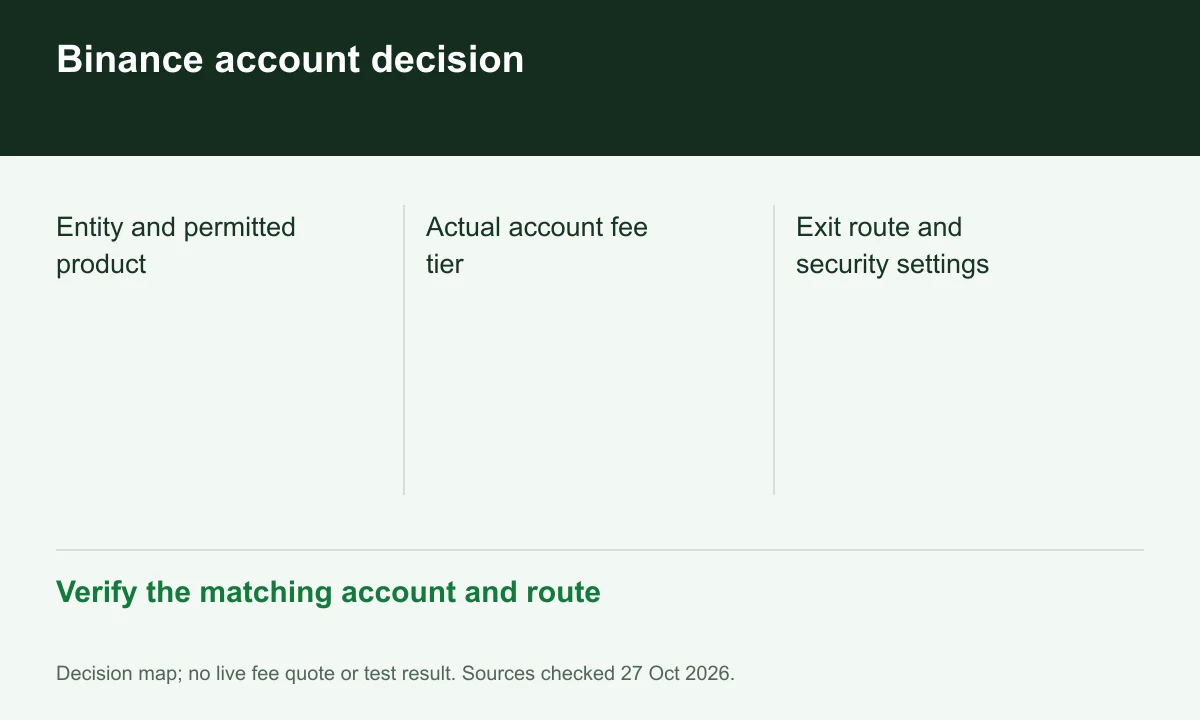
Provider guide
Check Binance's published trading fees, contracting entity, country restrictions, supported withdrawal routes and security disclosures against official sources.
Read guide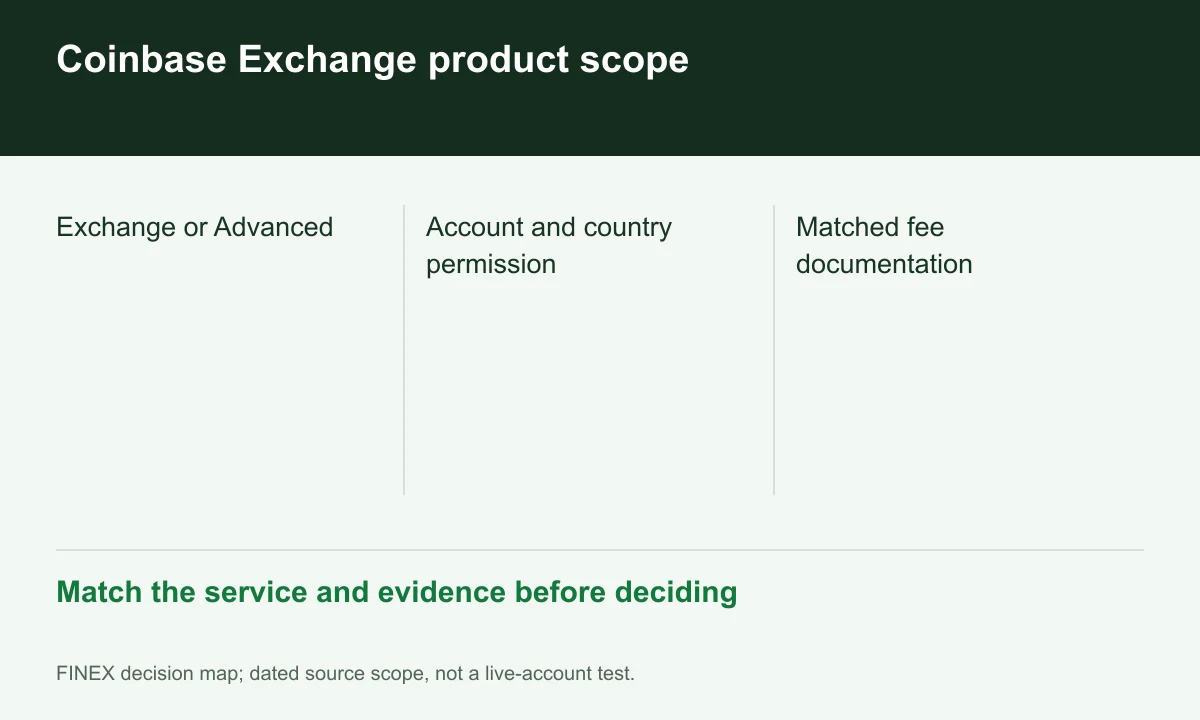
Provider guide
Check Coinbase Exchange's published trading fees, contracting entity, country restrictions, supported withdrawal routes and security disclosures against official sources.
Read guide
Provider guide
Check Upbit's published trading fees, contracting entity, country restrictions, supported withdrawal routes and security disclosures against official sources.
Read guide
Provider guide
Check OKX's published trading fees, contracting entity, country restrictions, supported withdrawal routes and security disclosures against official sources.
Read guide
Provider guide
Check Bybit's published trading fees, contracting entity, country restrictions, supported withdrawal routes and security disclosures against official sources.
Read guide
Provider guide
Check Bitget's published trading fees, contracting entity, country restrictions, supported withdrawal routes and security disclosures against official sources.
Read guide
Provider guide
Check Gate's published trading fees, contracting entity, country restrictions, supported withdrawal routes and security disclosures against official sources.
Read guide
Provider guide
Check KuCoin's published trading fees, contracting entity, country restrictions, supported withdrawal routes and security disclosures against official sources.
Read guide
Provider guide
Check MEXC's published trading fees, contracting entity, country restrictions, supported withdrawal routes and security disclosures against official sources.
Read guide
Provider guide
Check HTX's published trading fees, contracting entity, country restrictions, supported withdrawal routes and security disclosures against official sources.
Read guide
Provider guide
Check Bitfinex's published trading fees, contracting entity, country restrictions, supported withdrawal routes and security disclosures against official sources.
Read guide
Provider guide
Check BingX's published trading fees, contracting entity, country restrictions, supported withdrawal routes and security disclosures against official sources.
Read guide
Provider guide
Check Kraken's published trading fees, contracting entity, country restrictions, supported withdrawal routes and security disclosures against official sources.
Read guide
Provider guide
Check Binance TR's published trading fees, contracting entity, country restrictions, supported withdrawal routes and security disclosures against official sources.
Read guide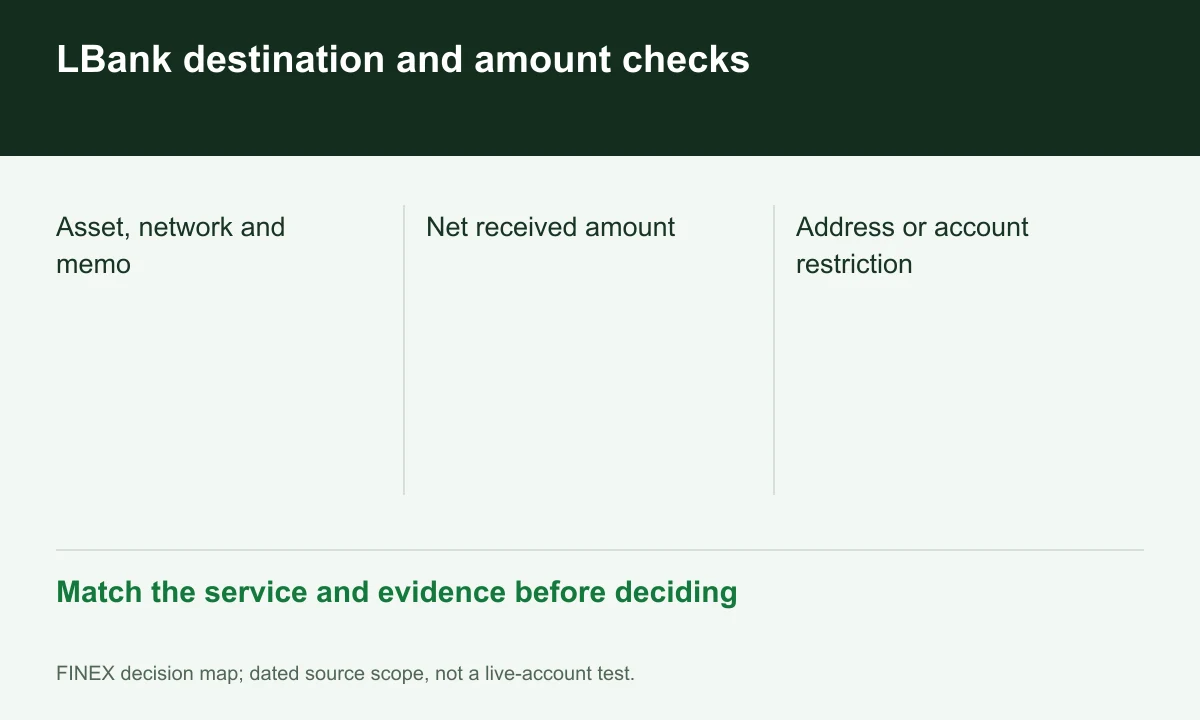
Provider guide
Check LBank's published trading fees, contracting entity, country restrictions, supported withdrawal routes and security disclosures against official sources.
Read guide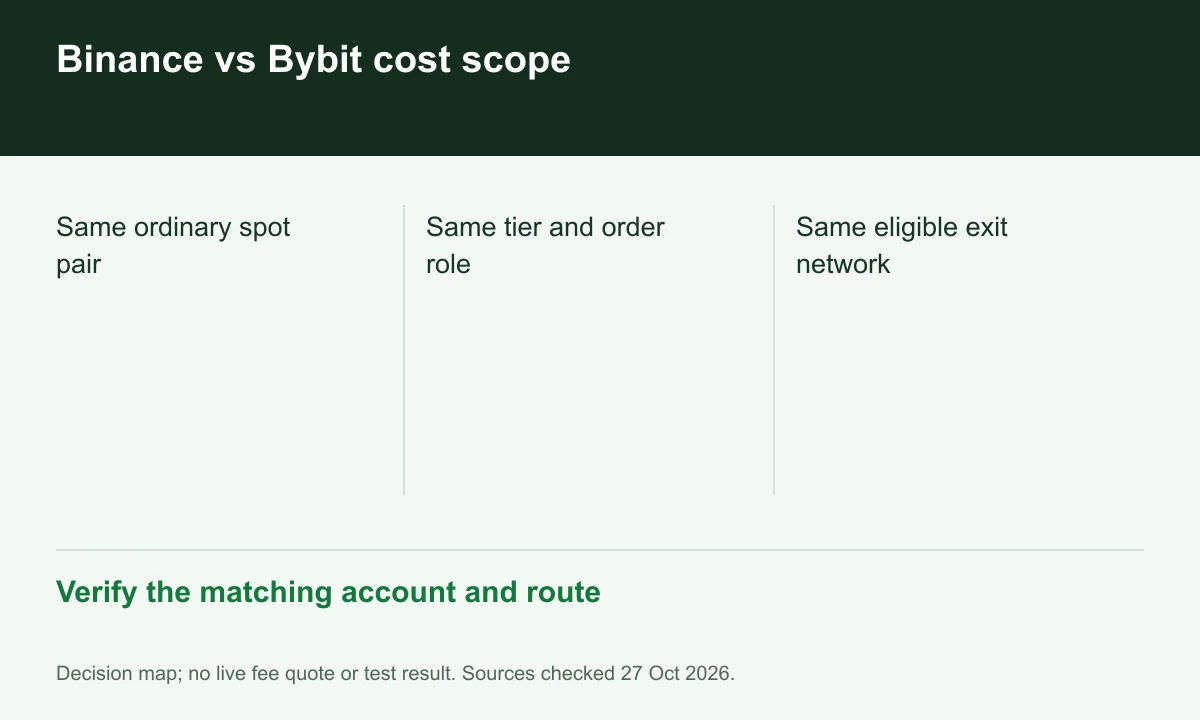
Comparison
A side-by-side, official-source comparison of Binance and Bybit. Match the exact product, account or program and country before drawing a conclusion.
Read guide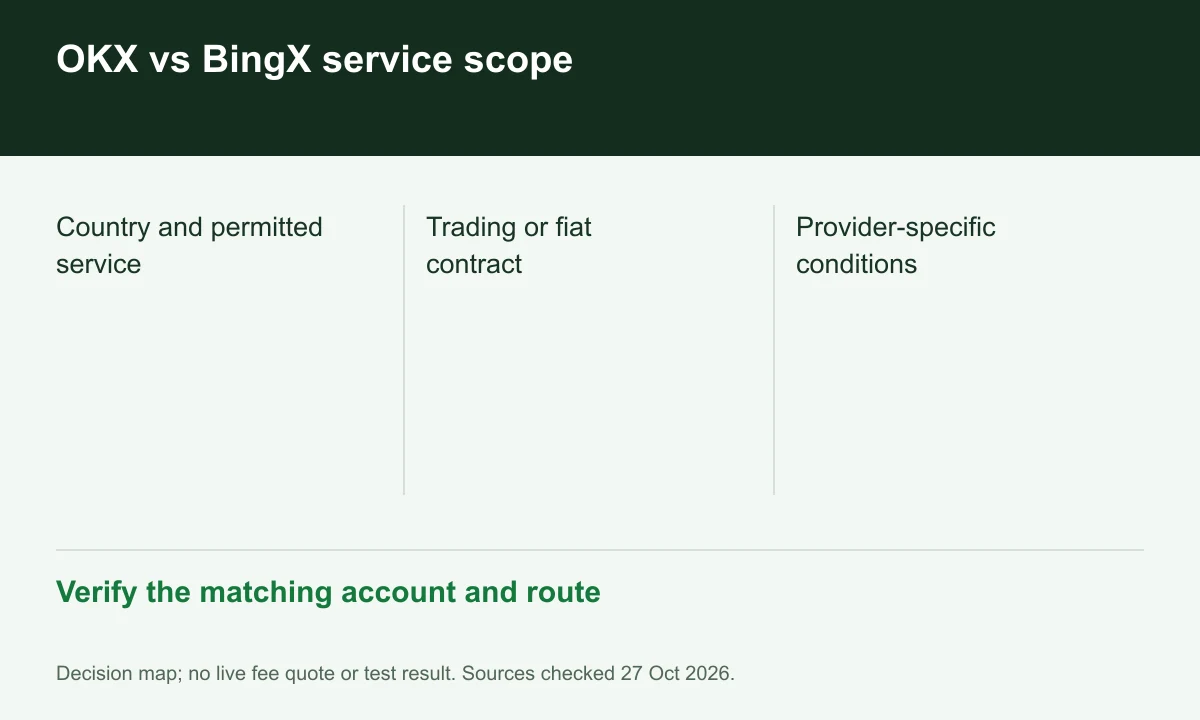
Comparison
A side-by-side, official-source comparison of OKX and BingX. Match the exact product, account or program and country before drawing a conclusion.
Read guide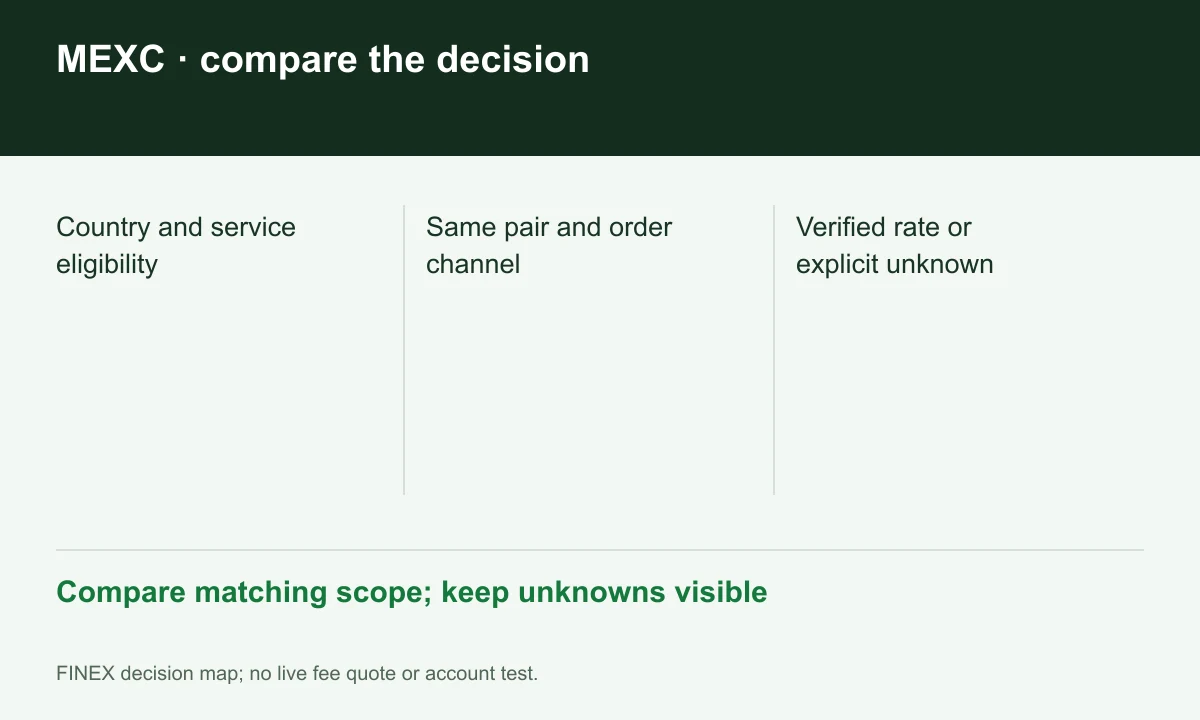
Comparison
A side-by-side, official-source comparison of MEXC and Gate. Match the exact product, account or program and country before drawing a conclusion.
Read guide
Comparison
A side-by-side, official-source comparison of Coinbase Exchange and Kraken. Match the exact product, account or program and country before drawing a conclusion.
Read guide
Comparison
A side-by-side, official-source comparison of Upbit and Binance TR. Match the exact product, account or program and country before drawing a conclusion.
Read guide
Comparison
A side-by-side, official-source comparison of Bitget and KuCoin. Match the exact product, account or program and country before drawing a conclusion.
Read guide
Comparison
A side-by-side, official-source comparison of HTX and LBank. Match the exact product, account or program and country before drawing a conclusion.
Read guide
Comparison
A side-by-side, official-source comparison of Bitfinex and Kraken. Match the exact product, account or program and country before drawing a conclusion.
Read guide
Comparison
A side-by-side, official-source comparison of Binance and OKX. Match the exact product, account or program and country before drawing a conclusion.
Read guide
Comparison
A side-by-side, official-source comparison of Bybit and BingX. Match the exact product, account or program and country before drawing a conclusion.
Read guide
Comparison
A side-by-side, official-source comparison of MEXC and Bitget. Match the exact product, account or program and country before drawing a conclusion.
Read guide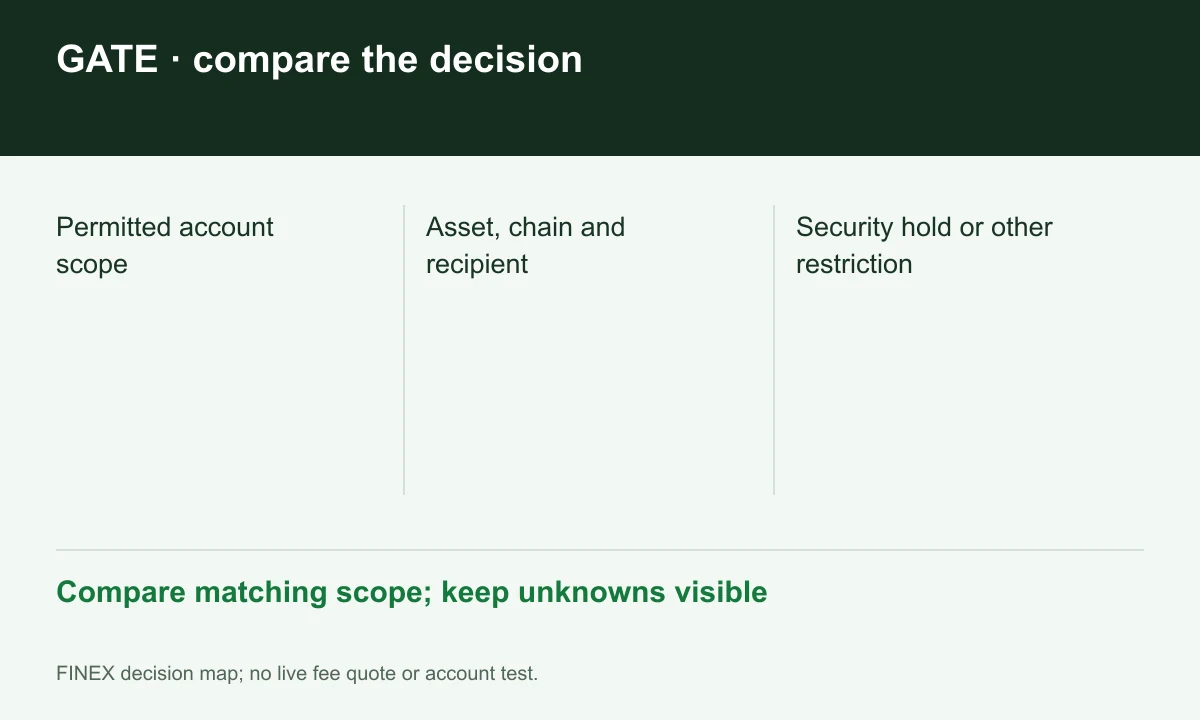
Comparison
A side-by-side, official-source comparison of Gate and KuCoin. Match the exact product, account or program and country before drawing a conclusion.
Read guide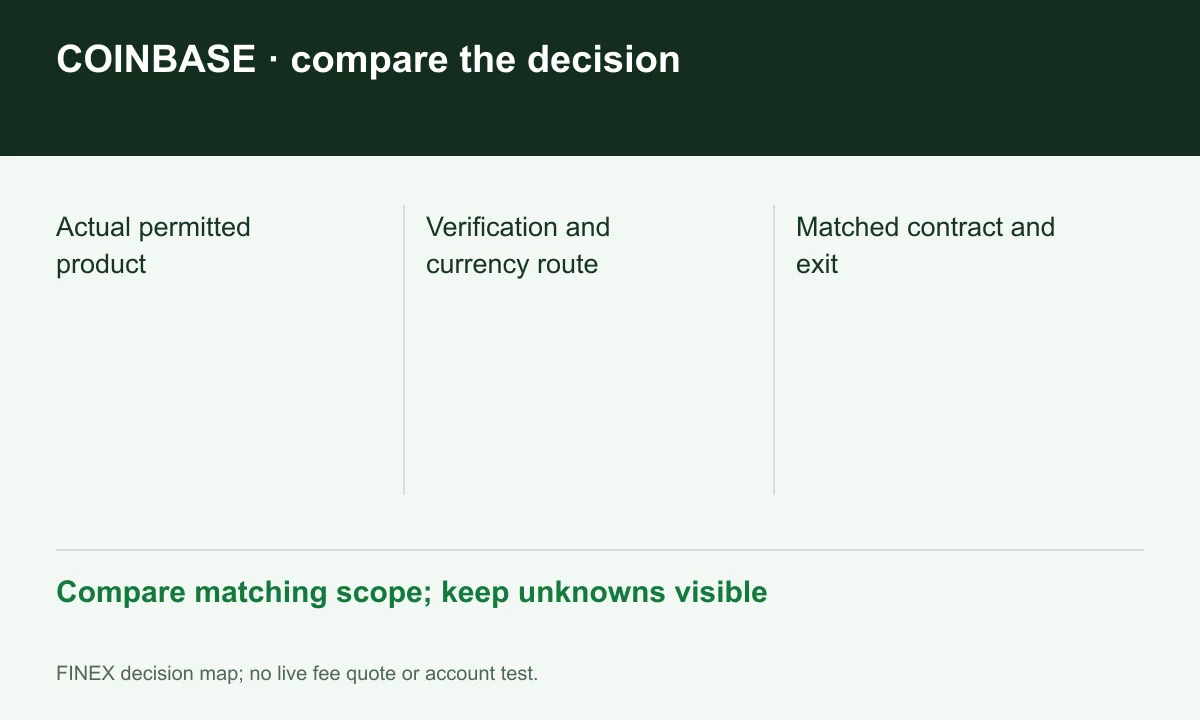
Comparison
A side-by-side, official-source comparison of Coinbase Exchange and Bitfinex. Match the exact product, account or program and country before drawing a conclusion.
Read guide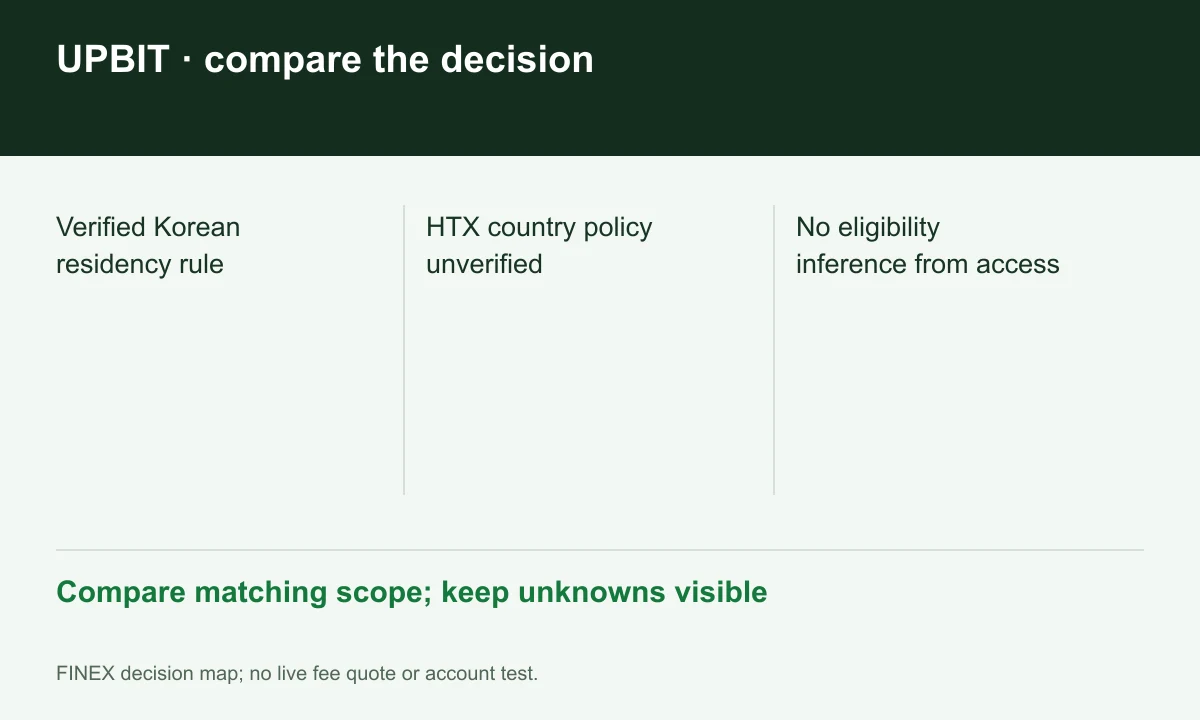
Comparison
A side-by-side, official-source comparison of Upbit and HTX. Match the exact product, account or program and country before drawing a conclusion.
Read guide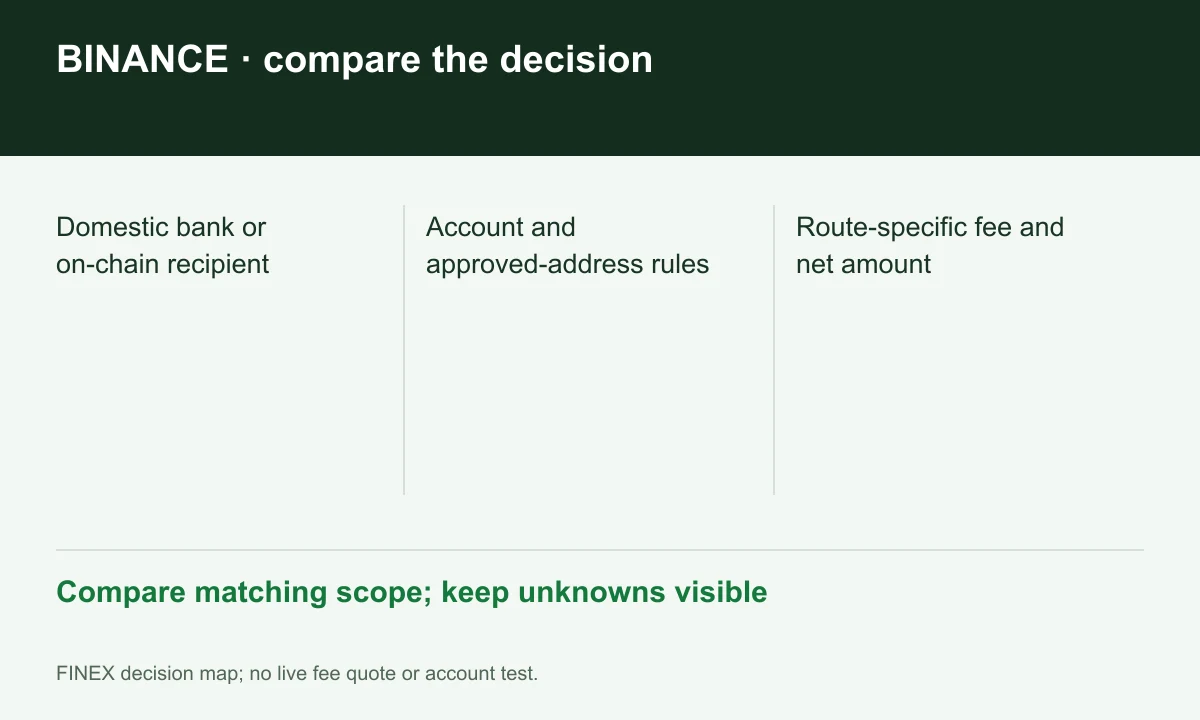
Comparison
A side-by-side, official-source comparison of Binance TR and LBank. Match the exact product, account or program and country before drawing a conclusion.
Read guide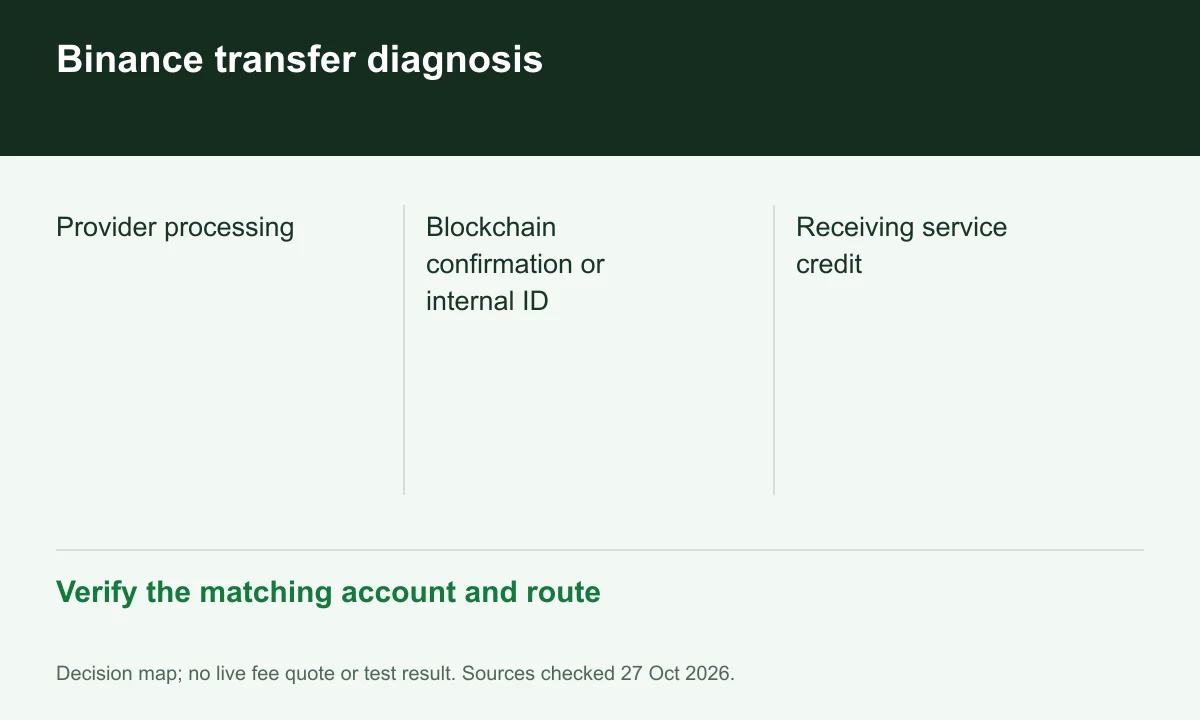
Withdrawals
A practical route-by-route check of the Binance withdrawal disclosure, including eligibility, processing, payment details and evidence to keep.
Read guide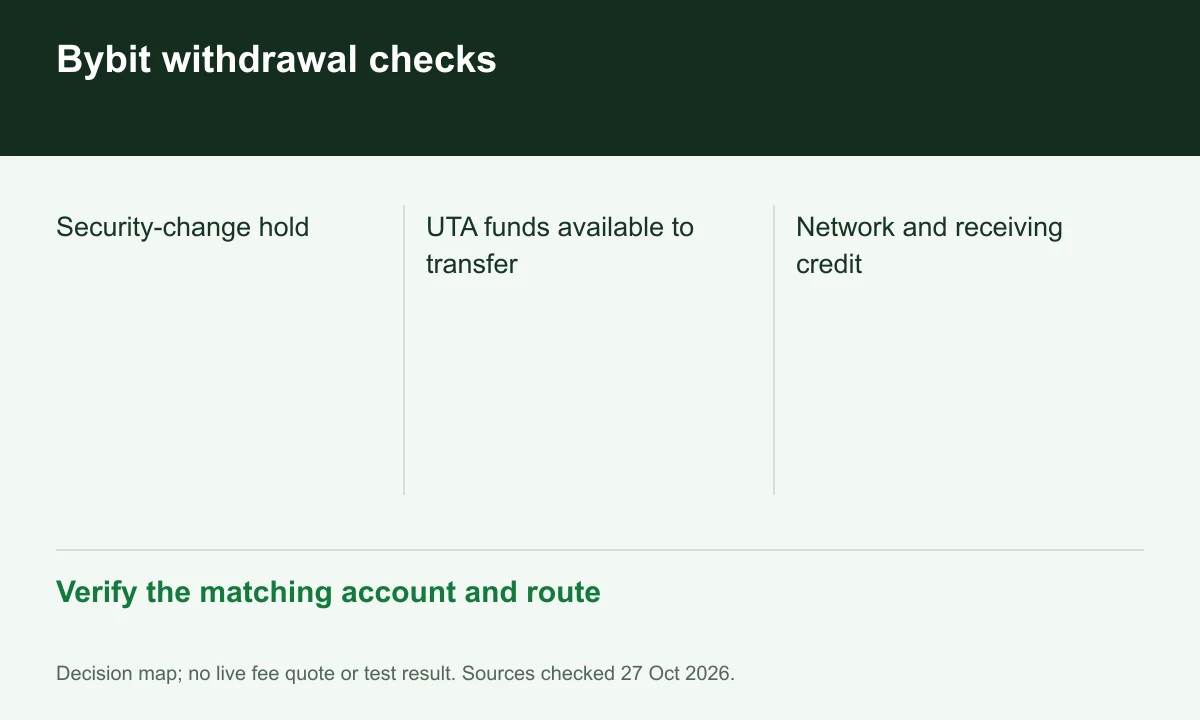
Withdrawals
A practical route-by-route check of the Bybit withdrawal disclosure, including eligibility, processing, payment details and evidence to keep.
Read guide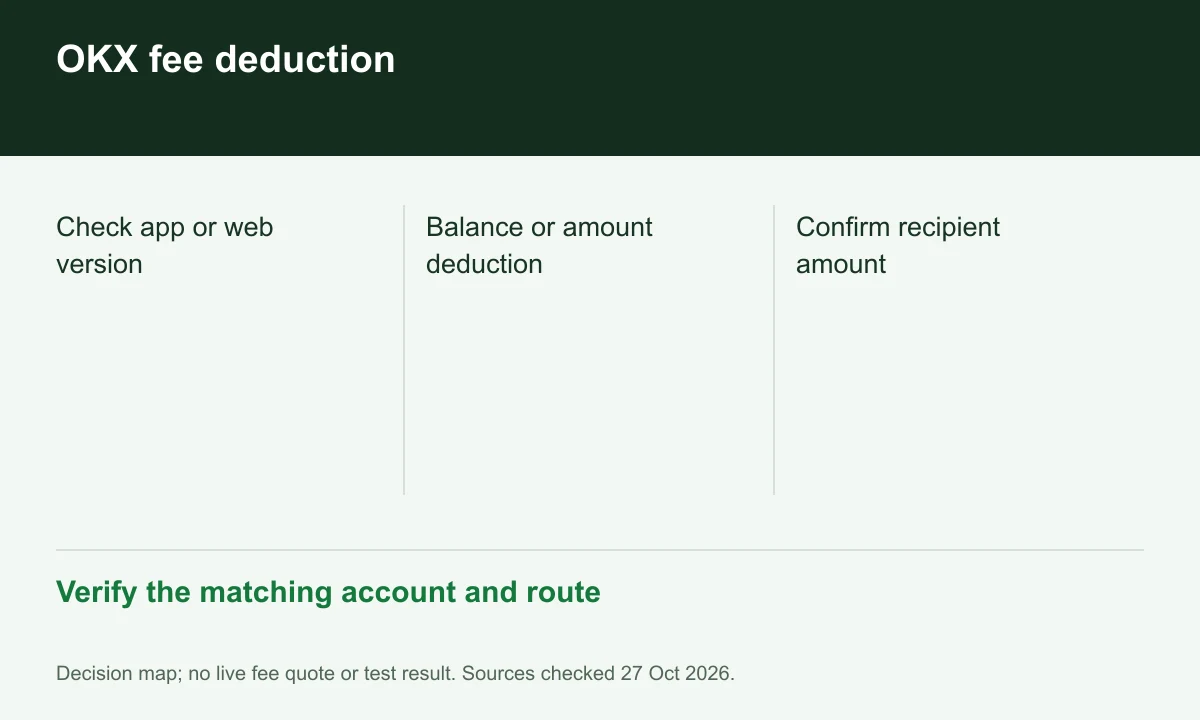
Withdrawals
A practical route-by-route check of the OKX withdrawal disclosure, including eligibility, processing, payment details and evidence to keep.
Read guide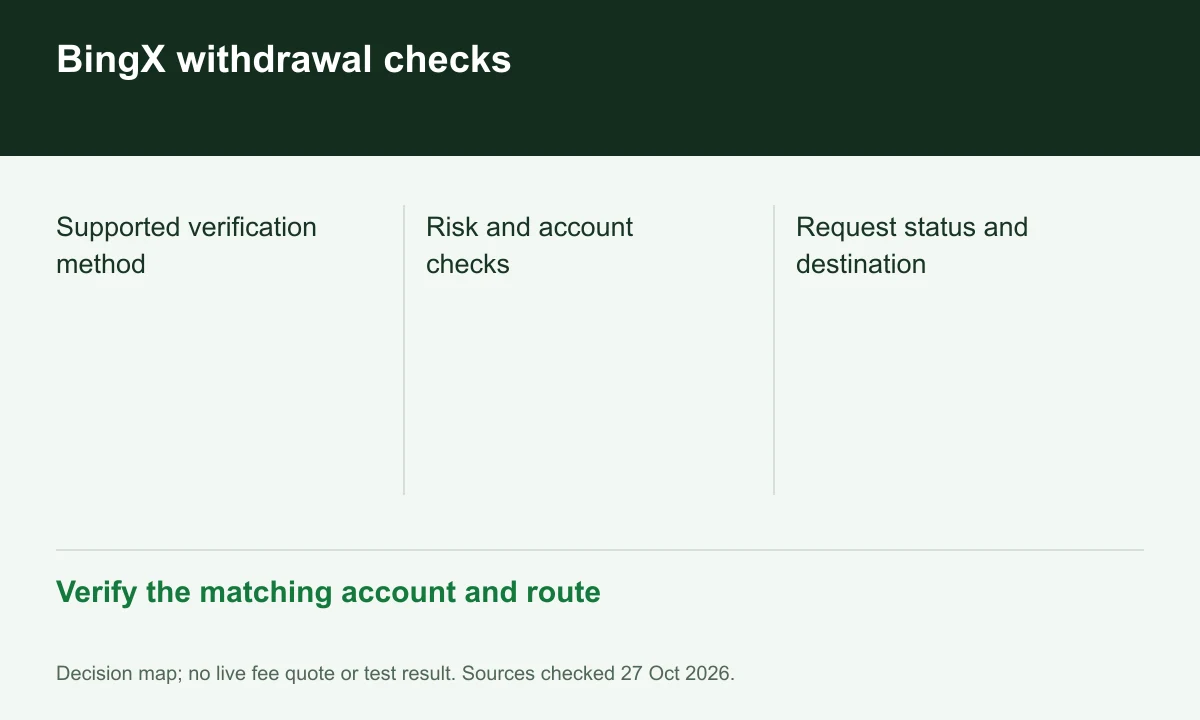
Withdrawals
A practical route-by-route check of the BingX withdrawal disclosure, including eligibility, processing, payment details and evidence to keep.
Read guide
Withdrawals
A practical route-by-route check of the MEXC withdrawal disclosure, including eligibility, processing, payment details and evidence to keep.
Read guide
Provider guide
Plan a Binance on-chain withdrawal lock around upcoming transfers, early-unlock choices and authentication requirements before enabling the protection.
Read guide
Provider guide
Map Binance verification methods to login, assets and security actions, check feature access and understand the consequences of requiring a passkey.
Read guide
Provider guide
Choose a Bybit UTA margin mode by product support, shared collateral and risk boundaries; keep margin, available and transferable balances distinct.
Read guide
Provider guide
Compare Bybit UTA collateral selection with separate subaccounts to decide which spot holdings can support derivatives and how usable balances change.
Read guide
Provider guide
Plan an OKX Offline Mode window, check covered outflow channels and the saved timezone, and understand why facial verification cannot bypass it.
Read guide
Provider guide
Understand OKX's personal cumulative withdrawal threshold, covered channels and different API versus web/app verification routes when protection triggers.
Read guide
Provider guide
Separate BingX login, fund-password and passkey controls, read device exceptions and verify recovery through the official account-security route.
Read guide
Provider guide
Identify the payment provider behind a BingX fiat route, check residence and KYC requirements and separate fiat support from digital-asset custody.
Read guide
Provider guide
Read MEXC's verification requirements for trading and funding, distinguish access levels and keep fee eligibility separate from identity approval.
Read guide
Provider guide
Check MEXC's exact pair, product and order channel before using a zero-fee claim; resolve event scope and current account charges without guessing.
Read guide
Provider guide
Separate Coinbase Exchange from Advanced before comparing maker/taker rates, tier qualification, stable pairs and withdrawal charges.
Read guide
Provider guide
Check a Coinbase identity request through the signed-in account, recognise official document flows and distinguish verification from lost-2FA recovery.
Read guide
Provider guide
Read Bitfinex's zero execution-fee schedule alongside funding interest, lender charges and funding-wallet terms before estimating a leveraged trade.
Read guide
Provider guide
Compare Bitfinex bank-wire verification, recipient-bank details and crypto network requirements without treating processing estimates as arrival promises.
Read guide
Provider guide
Separate Kraken Instant Buy and Pro fees, understand the Kraken+ waiver's scope and retain spread, payment and funding costs in your comparison.
Read guide
Provider guide
Check whether a Kraken balance was included in a dated reserve review and distinguish covered assets, futures adjustments and transactions after that snapshot.
Read guide
Provider guide
Gate's global agreement lists Vietnam as restricted. Check access implications, existing-account questions and why security or reserve claims do not override it.
Read guide
Provider guide
Read Gate's Merkle and zk-SNARK explanation by batch and asset scope, without turning an implementation audit into a current customer guarantee.
Read guide
Provider guide
Understand Bitget's main-account KYC, inherited subaccount permissions and temporary service loss during a verification reset before moving funds.
Read guide
Provider guide
Choose Bitget withdrawal controls by the failure you want to prevent: an untrusted destination, address tampering or an incorrect withdrawal request.
Read guide
Provider guide
Read KuCoin's geographic and IP restrictions before travel, including their impact on positions, account access and withdrawal troubleshooting.
Read guide
Provider guide
Read KuCoin reserve data by snapshot date and covered assets, then separate account restrictions and authentication controls from reserve ratios.
Read guide
Provider guide
Understand Upbit Korea's residency, identity and real-name banking checks before comparing KRW access with BTC or USDT markets and transfer routes.
Read guide
Provider guide
Check Upbit Korea's recipient category, ownership match and permitted destination before treating a smaller transfer as exempt from all checks.
Read guide
Provider guide
Read Binance TR's Turkish bank-account conditions, distinguish TRY funding from crypto withdrawals and verify the regional account before sending money.
Read guide
Provider guide
Separate Binance TR's contract, verification and linked-transfer conditions from Binance global; account linking does not make every service interchangeable.
Read guide
Provider guide
Match the LBank asset, network and memo, review the fee and estimated recipient amount, then distinguish platform review from blockchain confirmation.
Read guide
Provider guide
Separate LBank's address whitelist from its new-address lock, then plan destination changes around account-security holds and actual on-chain details.
Read guide
Provider guide
Read HTX's dated reserve announcements without mixing snapshot dates or changing USDs groupings, and separate provider claims from current live evidence.
Read guide
Provider guide
Use historical Huobi/HTX whitelist and authentication guidance as a checklist, distinguish later product claims and verify controls in the actual account.
Read guide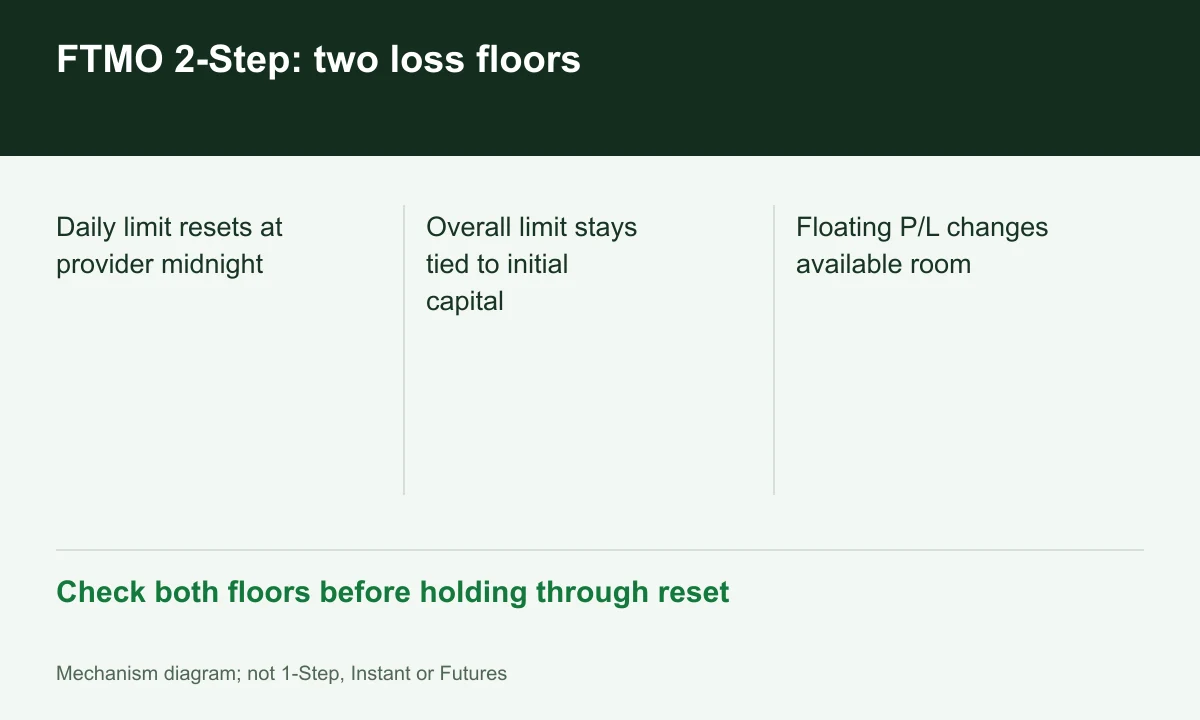
Guide
A practical explanation of daily and total loss limits, with a hypothetical $25,000 account and a rollover checklist.
Read guide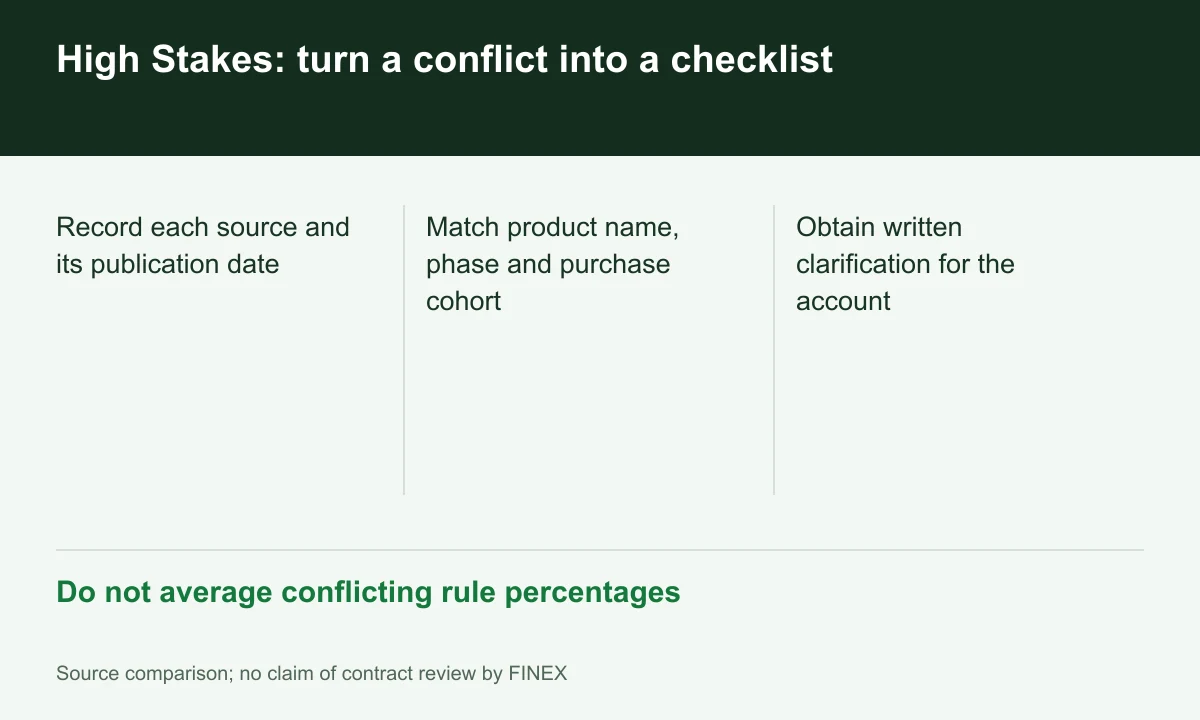
Guide
Understand the differences between named High Stakes pages and general 2-Step FAQs before relying on a drawdown or payout figure.
Read guide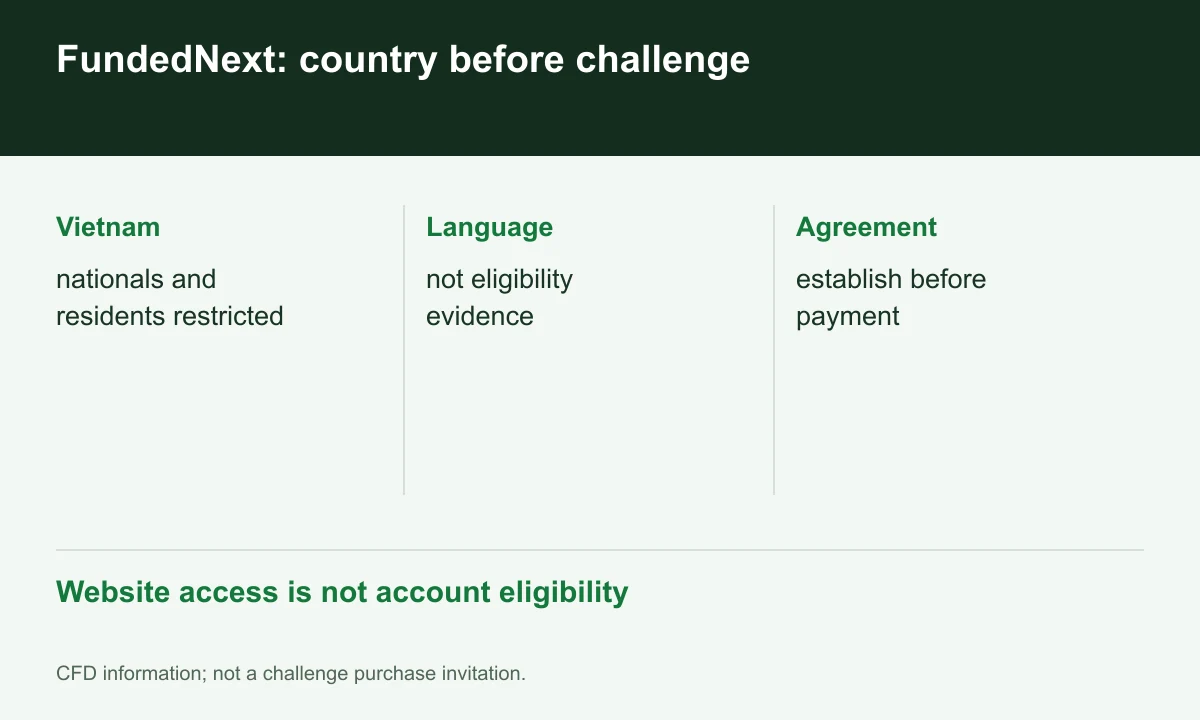
Guide
The Vietnam restriction, simulated account model and programme-specific checks readers should understand before evaluating Stellar 2-Step.
Read guide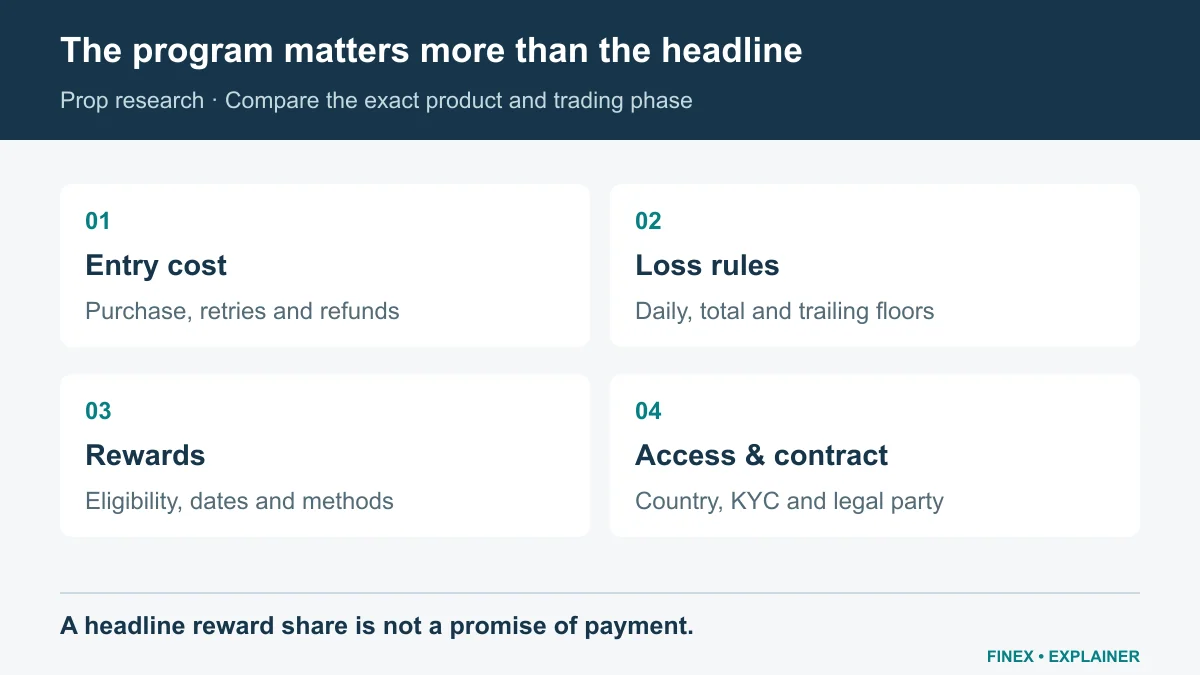
Guide
A needs-based checklist for comparing three prop programmes without mixing rules, account sizes or promotional payout figures.
Read guideGuide
Separate purchase fees, optional costs, simulated profit and approved rewards using an illustrative cash calculation.
Read guideComparison
Separate an evaluation service, simulated account size and a brokerage relationship before comparing providers.
Read guide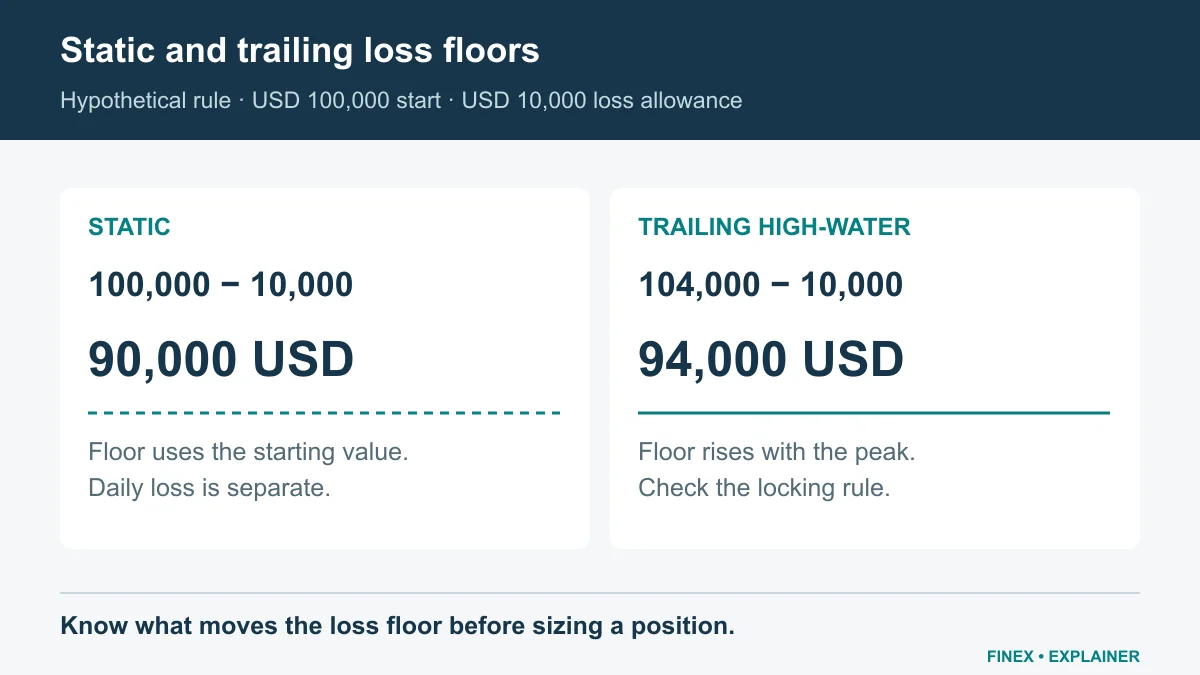
Guide
Use original hypothetical examples to distinguish loss allowances, equity floors and moving checkpoints.
Read guideGuide
A practical compatibility review that separates holding, execution, account stages and permitted automation.
Read guideGuide
Build a short evidence record before paying, with clear questions about the counterparty, rules and identity requirements.
Read guideGuide
Evaluate the conditions behind a reward percentage and the evidence behind payout claims without relying on invented reviews.
Read guide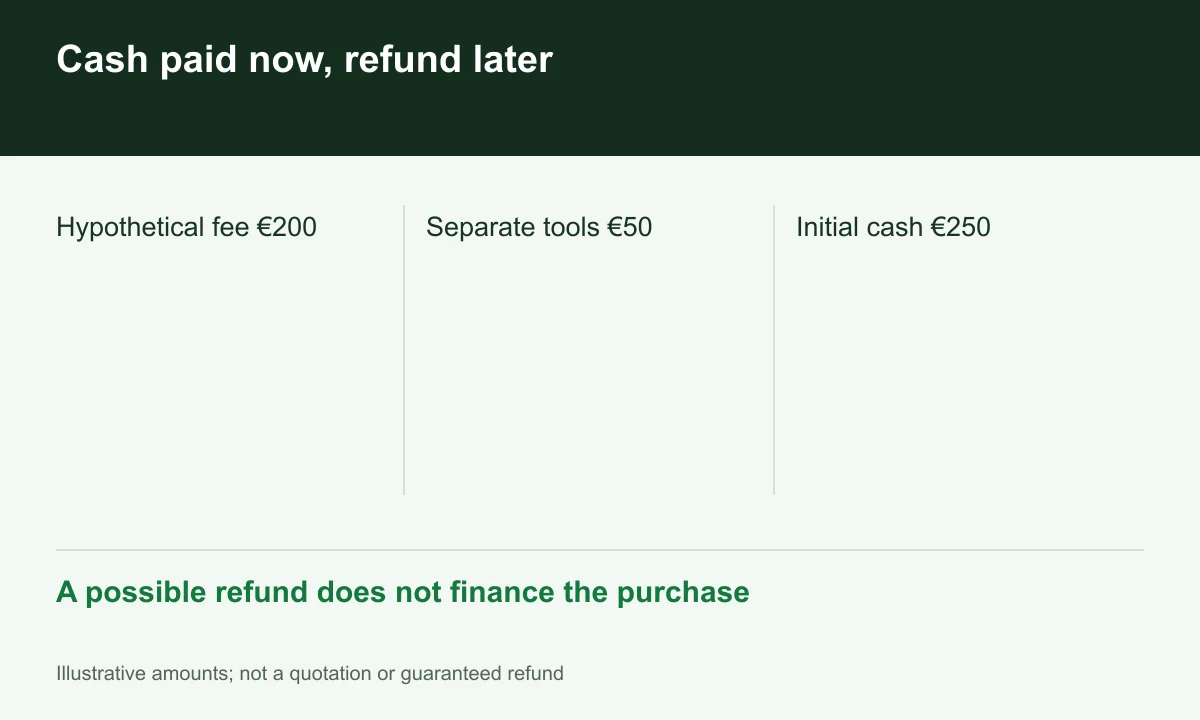
Guide
Separate the upfront fee from a conditional refund and build a cash budget without assuming that passing means payment.
Read guide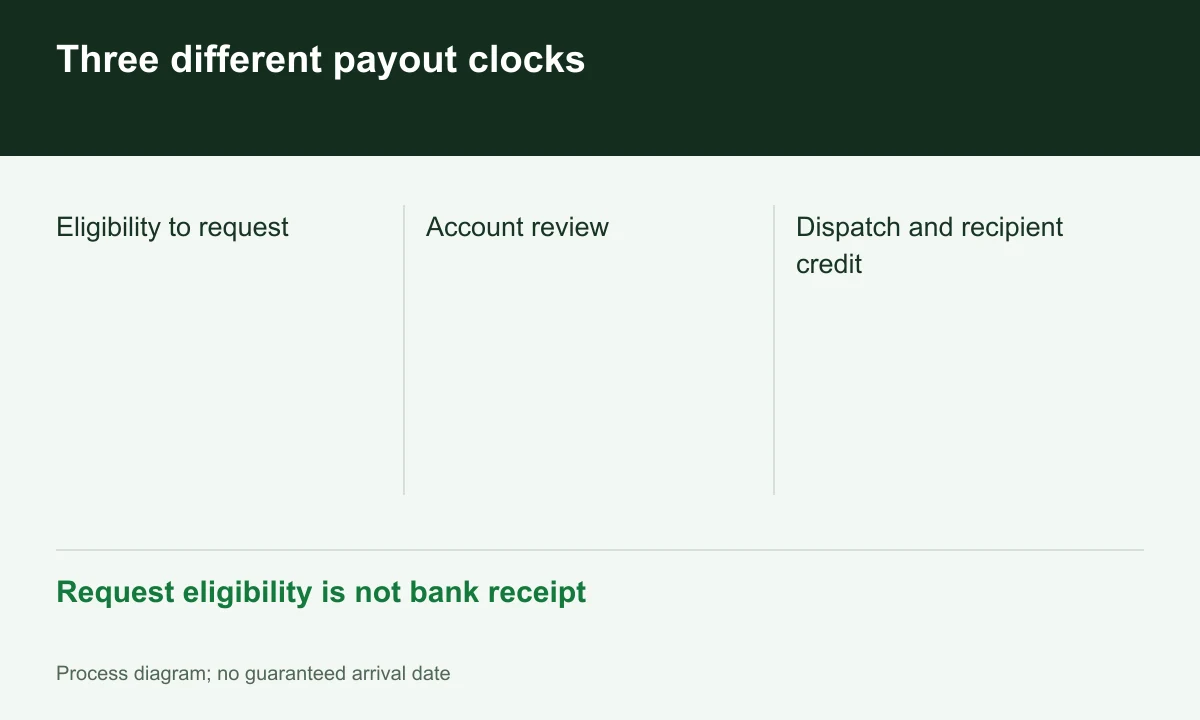
Guide
Use separate clocks for the first request, account review and payment dispatch; none establishes a guaranteed arrival date.
Read guide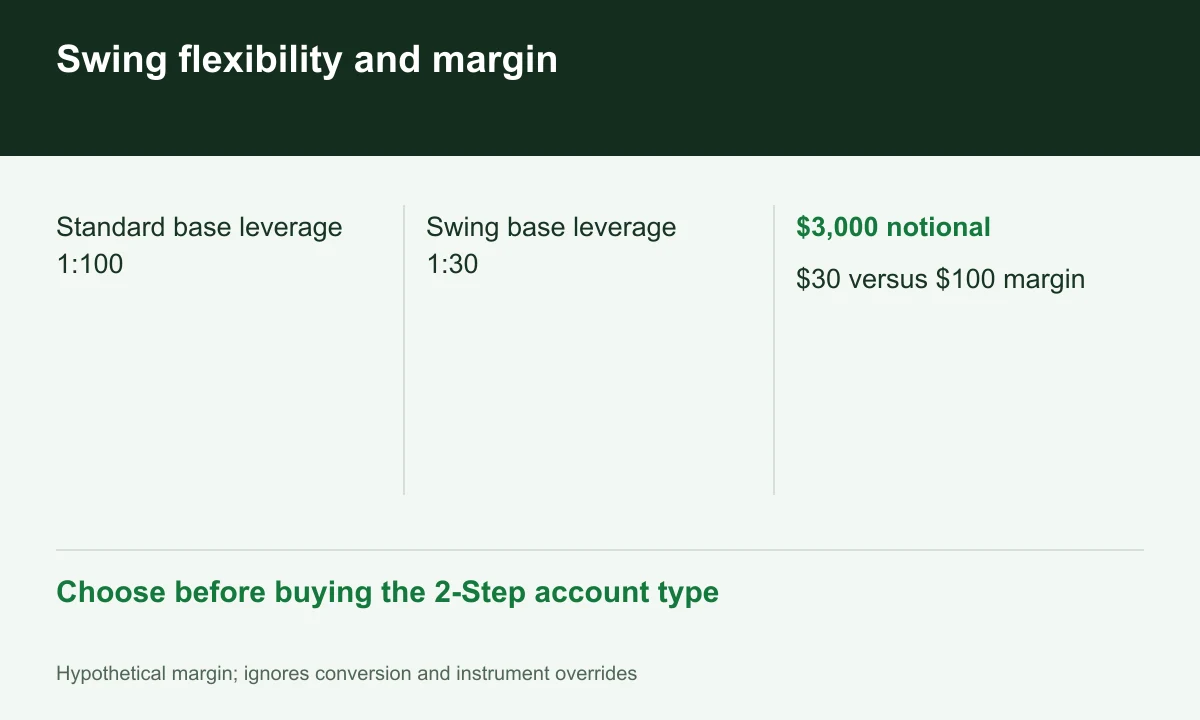
Guide
Match the 2-Step account type to how positions survive news and market closures, then check the margin trade-off.
Read guide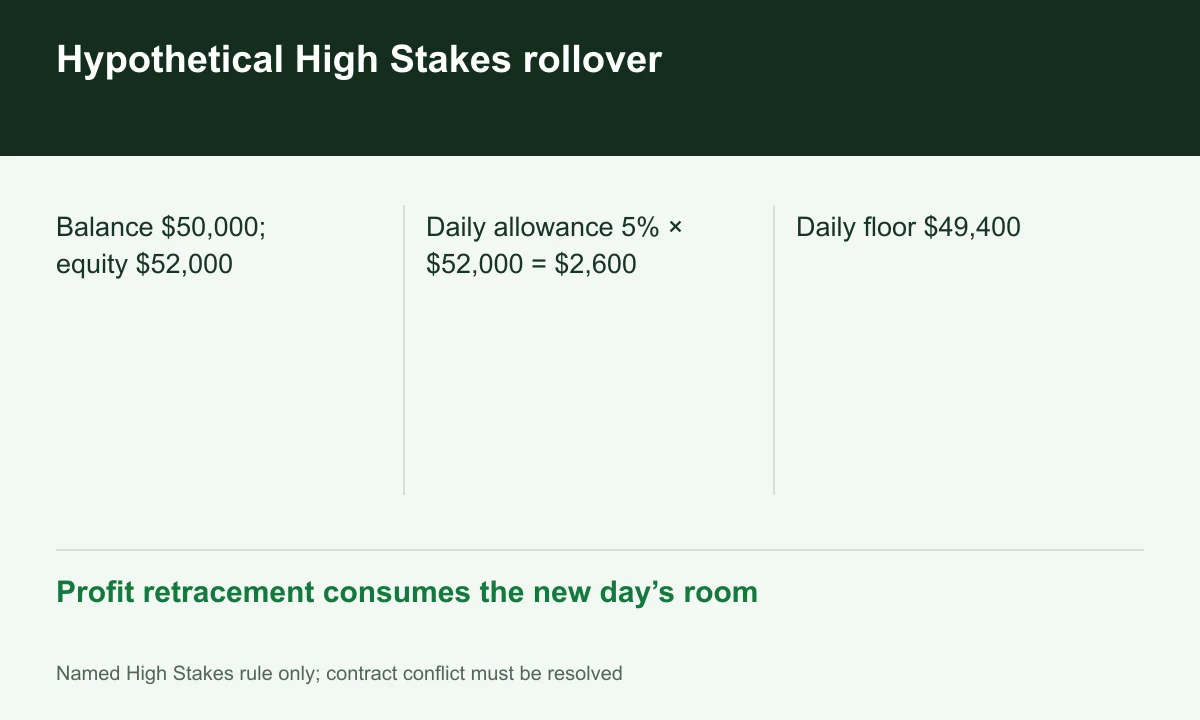
Guide
Work through the named High Stakes drawdown rule while keeping the conflicting generic 2-Step rule visible.
Read guide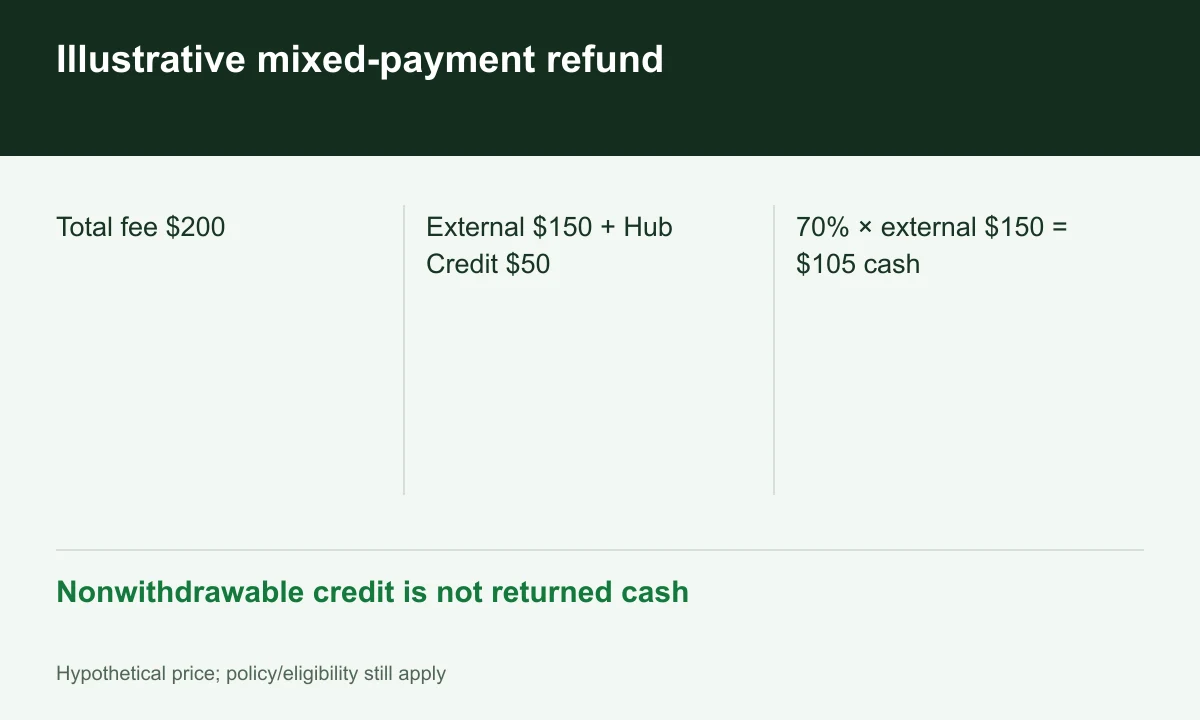
Guide
Calculate the withdrawable portion separately from purchase credit, and check the conditions tied to the first payout.
Read guide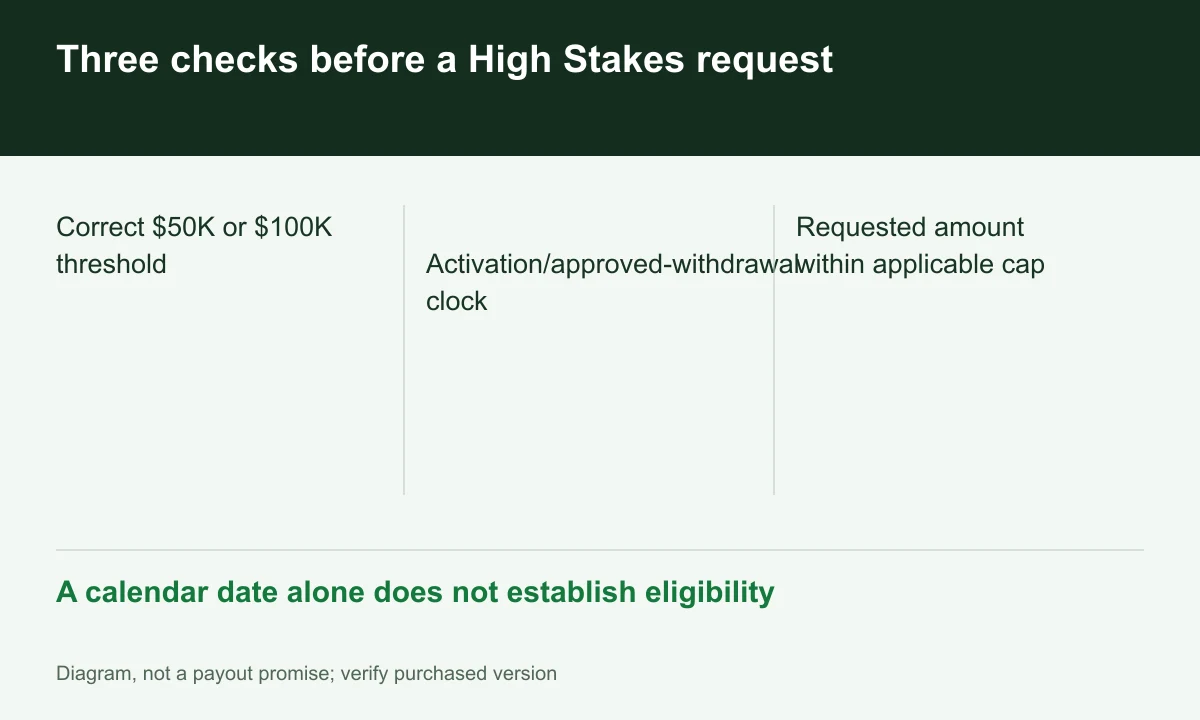
Guide
A fourteen-day cycle alone does not tell you how much you can request. Read the named account-size thresholds first.
Read guide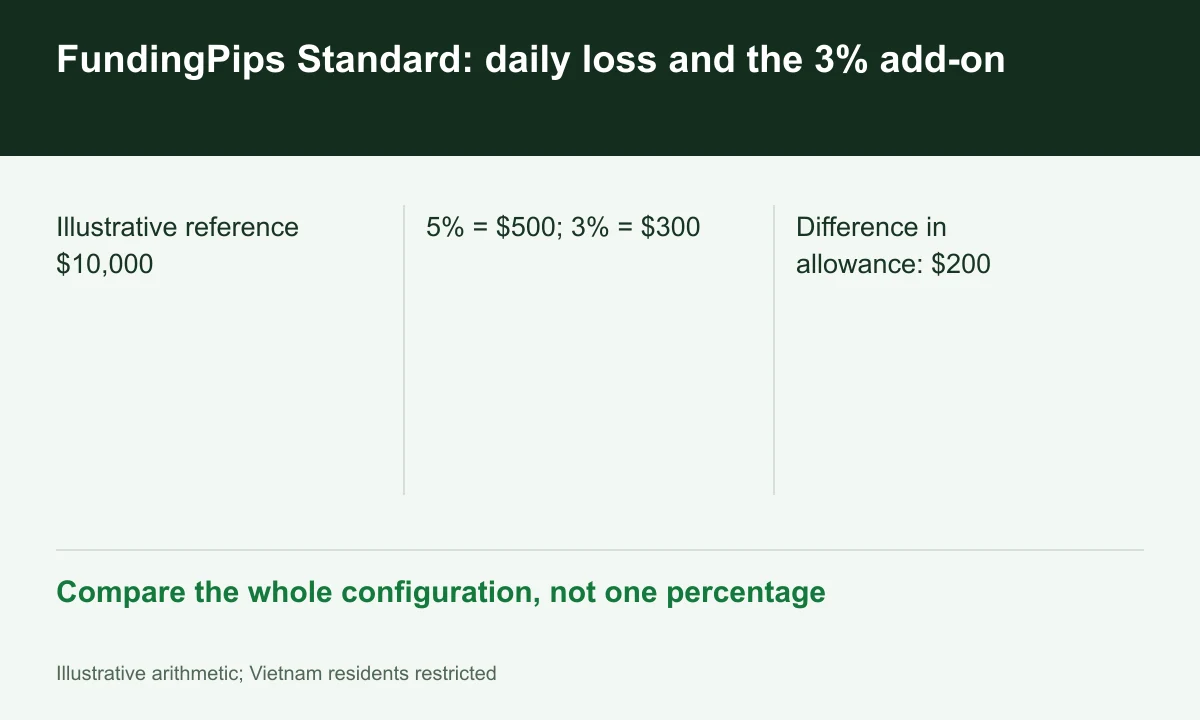
Guide
Understand the Standard configuration before calculating its loss floor. Vietnam residents are excluded by the official eligibility page.
Read guide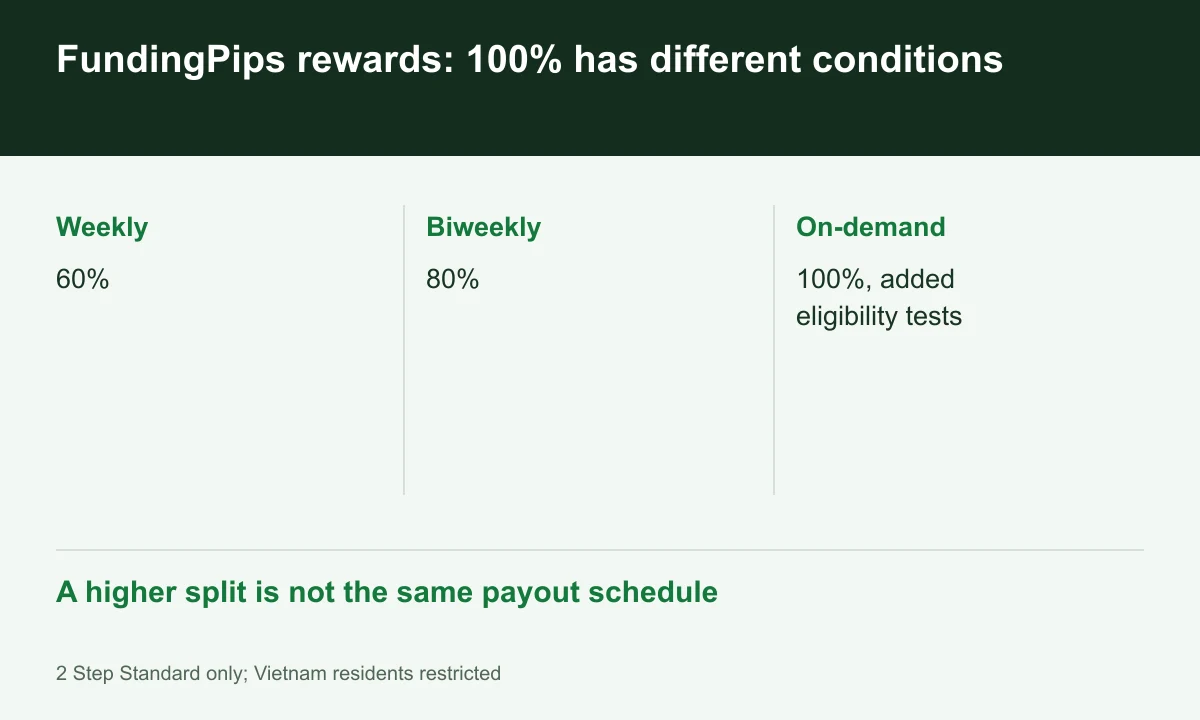
Guide
Compare Standard reward cycles using the eligible profit base and permanent cycle choice. Vietnam residents remain excluded.
Read guide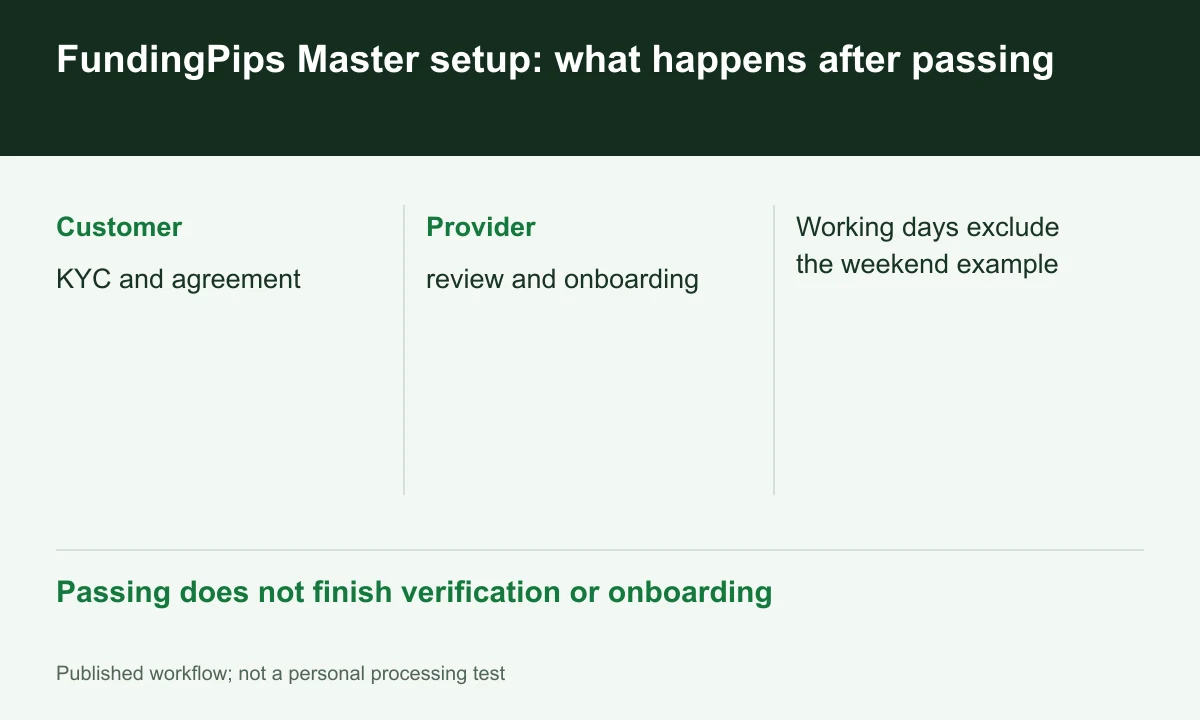
Guide
Separate identity verification, trading review and onboarding from evaluation success; Vietnam residents are not eligible.
Read guide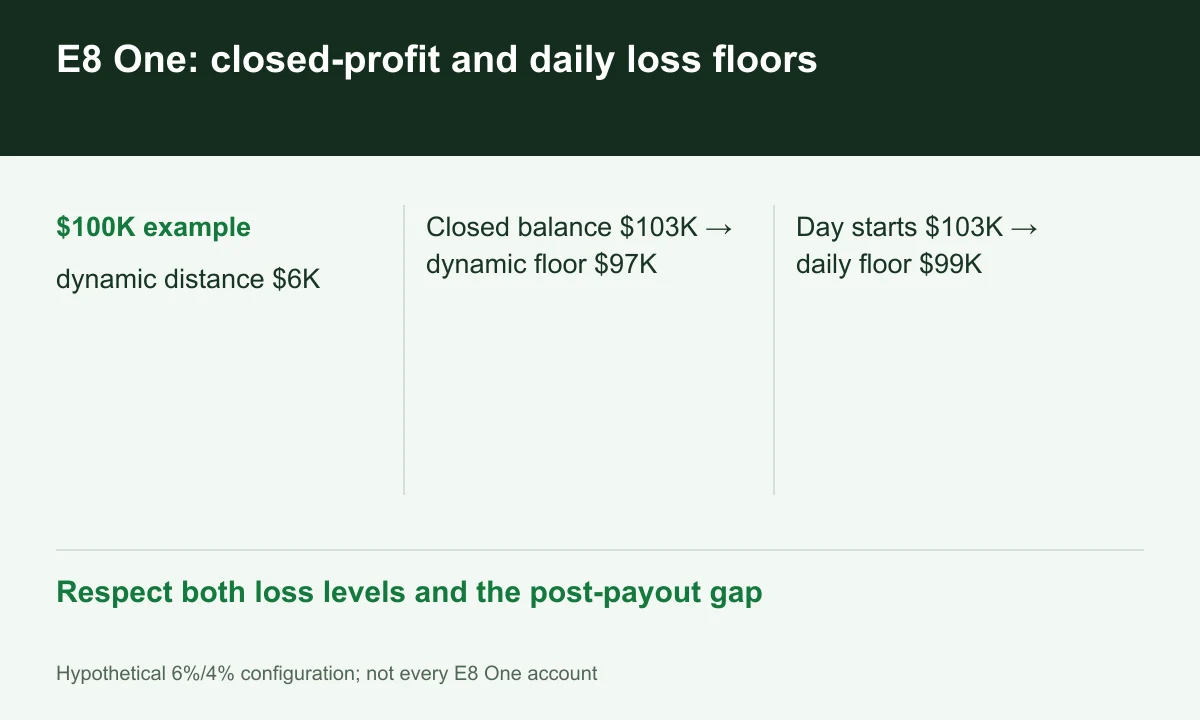
Guide
Calculate the two floors independently and avoid importing a configurable preset into every E8 One account.
Read guide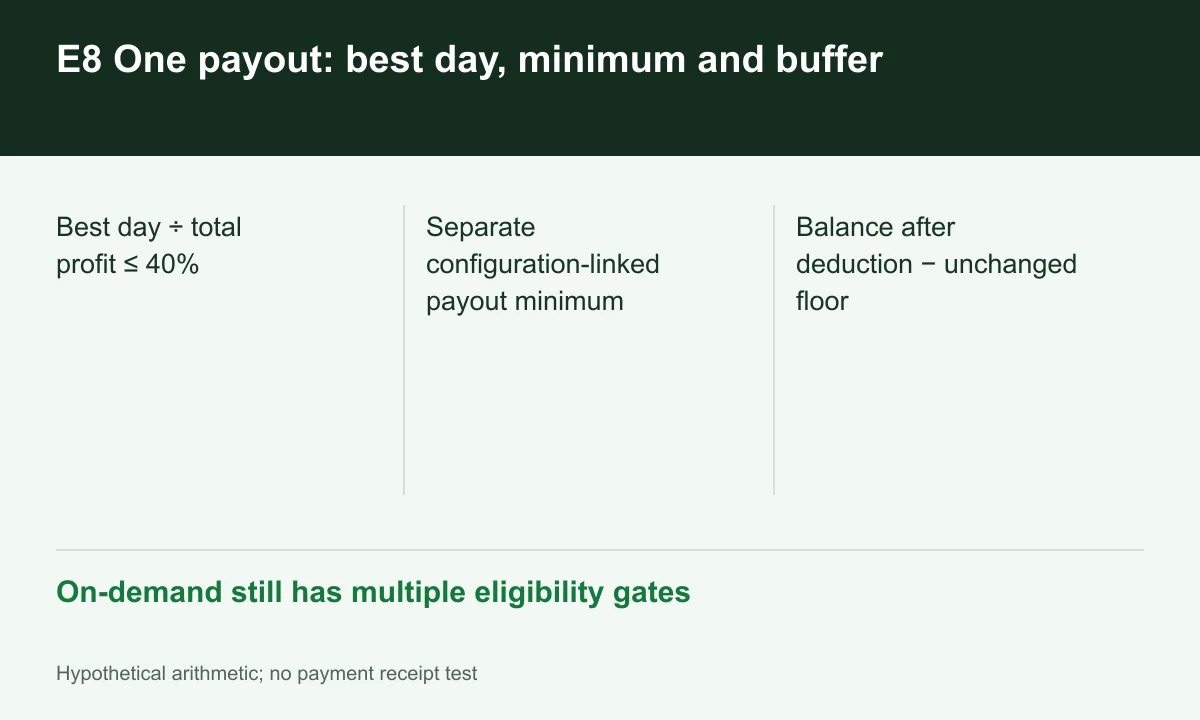
Guide
Test consistency, minimum reward and remaining drawdown room separately before interpreting an on-demand payout headline.
Read guide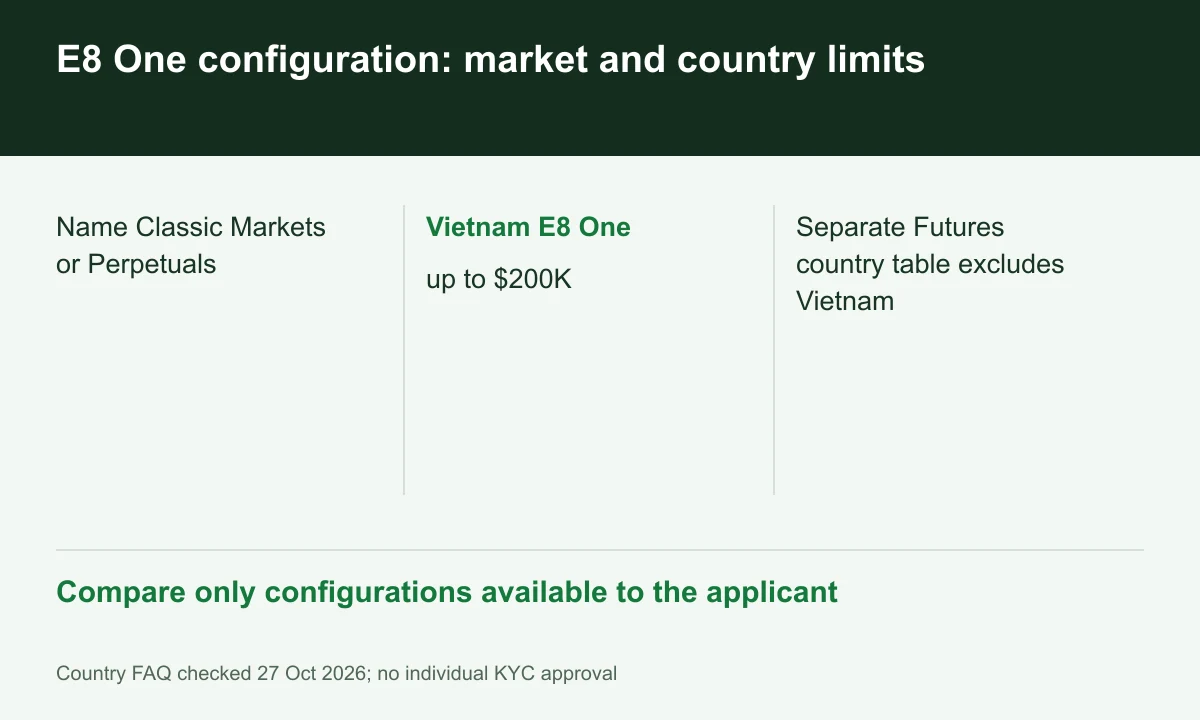
Guide
Separate Classic Markets, Perpetuals and Futures before comparing account size, platform access or payout options.
Read guide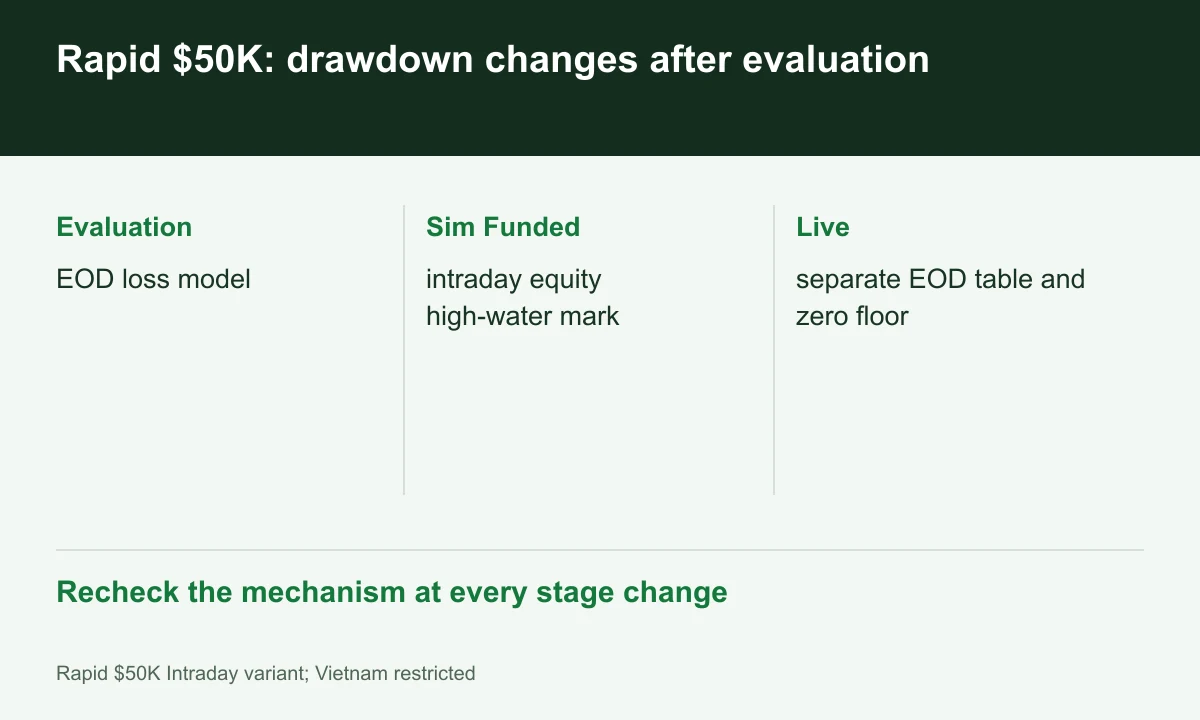
Guide
Follow the move from evaluation EOD drawdown to Sim Funded intraday equity trailing. Vietnam residents are restricted.
Read guide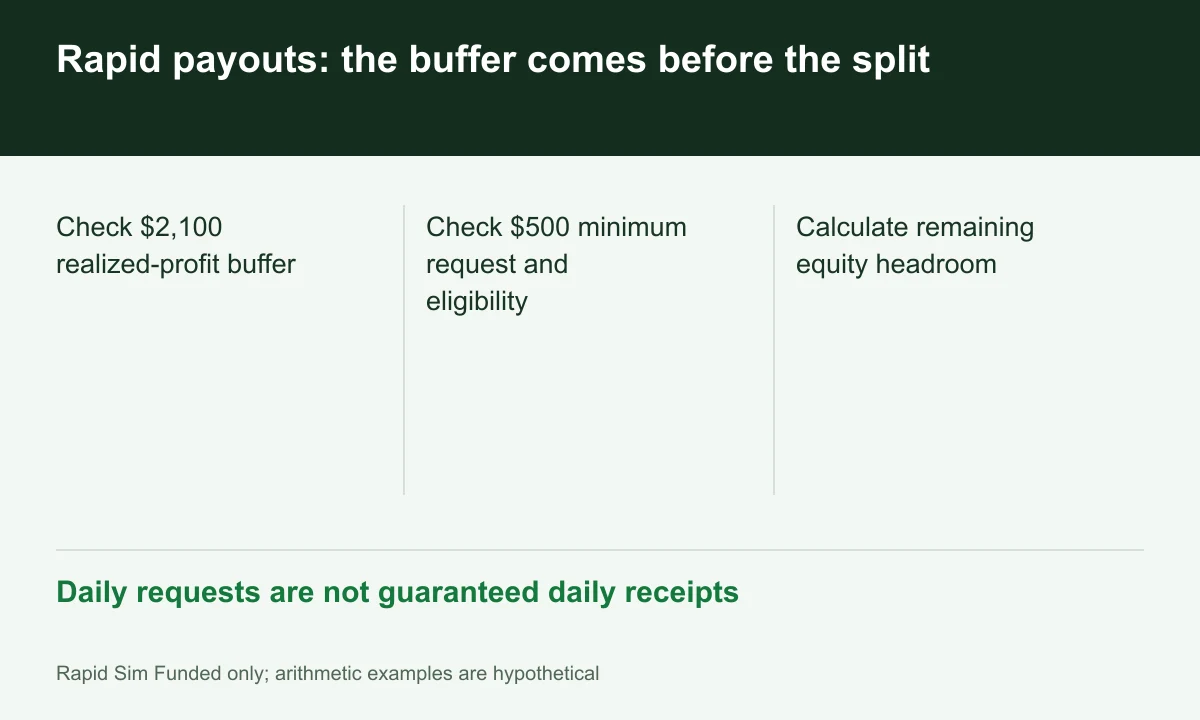
Guide
Read the Rapid Sim Funded buffer, request minimum and timing together; daily availability does not guarantee payment.
Read guide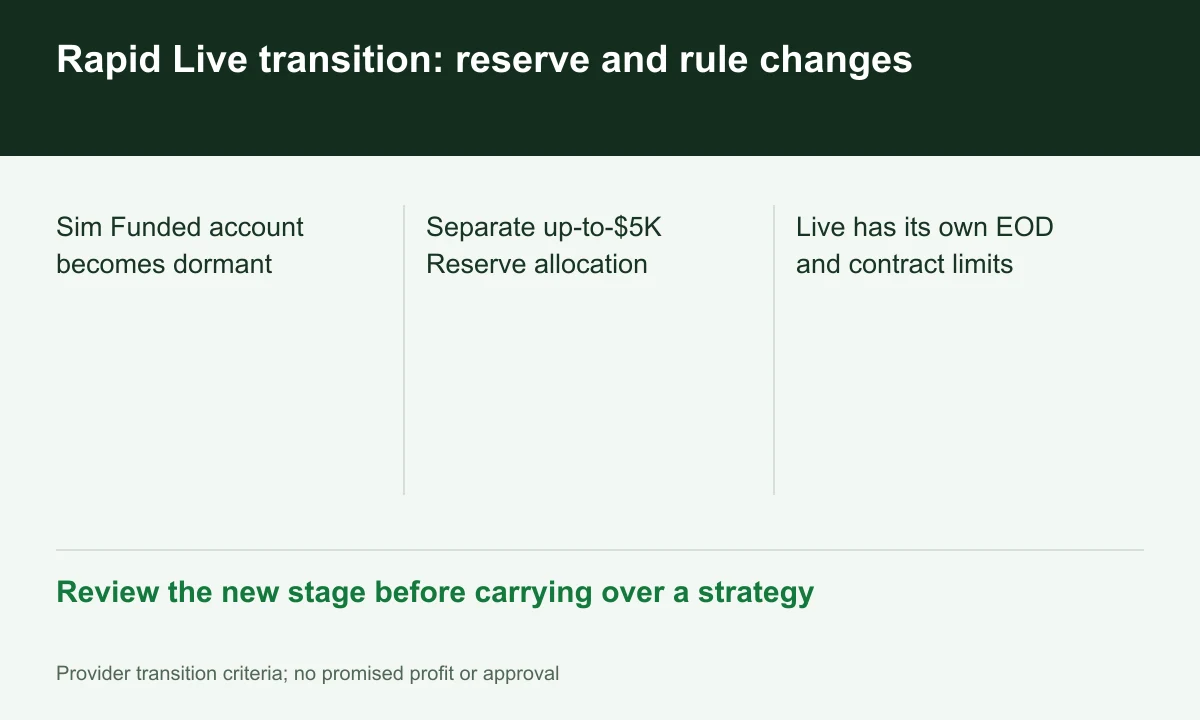
Guide
Treat live transition as a new operating stage with different contracts, loss mechanics and access to remaining profits.
Read guide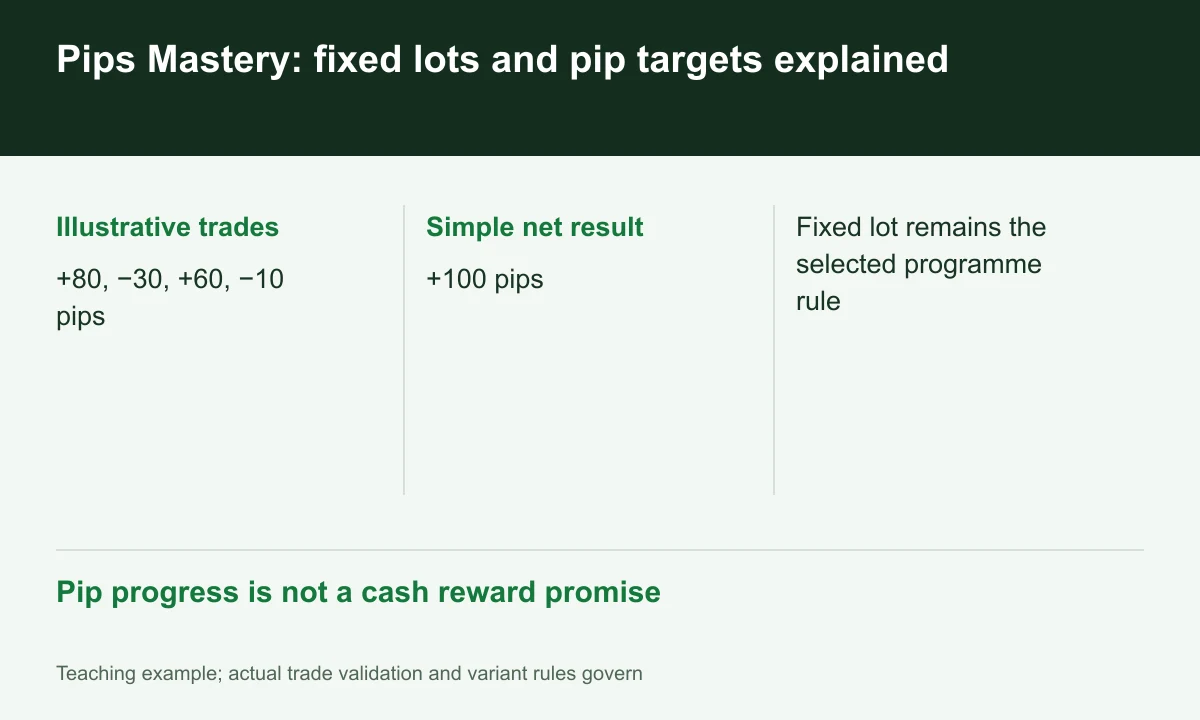
Guide
Use the Mastery pip metric without treating it as cash profit, account ownership or a prediction of reward.
Read guide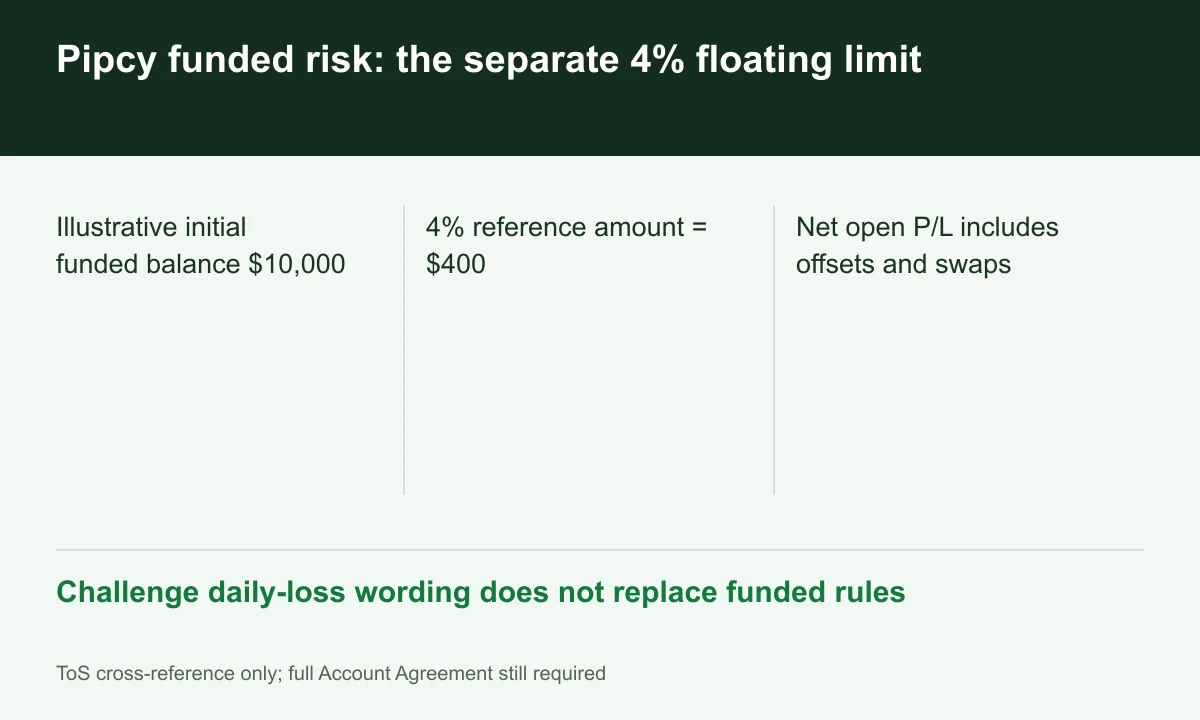
Guide
No daily drawdown on a challenge page does not remove the funded account’s separate aggregate floating-loss rule.
Read guide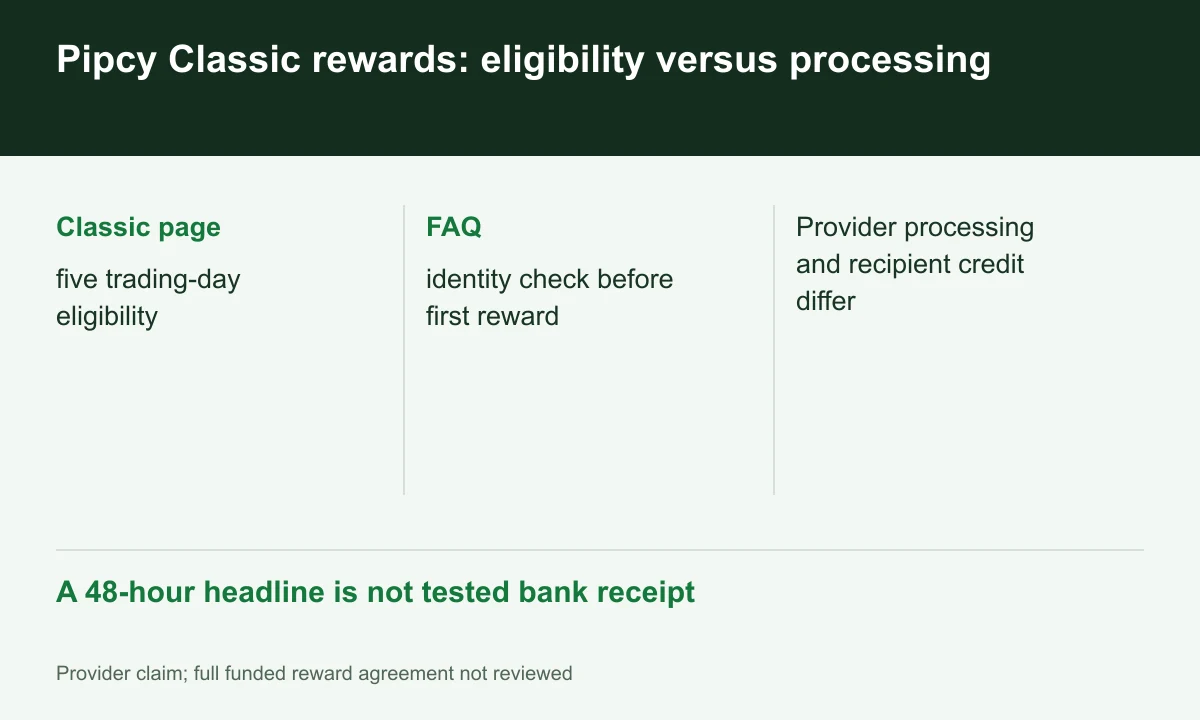
Guide
Separate the first eligible request, identity check, provider processing and recipient credit before relying on the 48-hour headline.
Read guide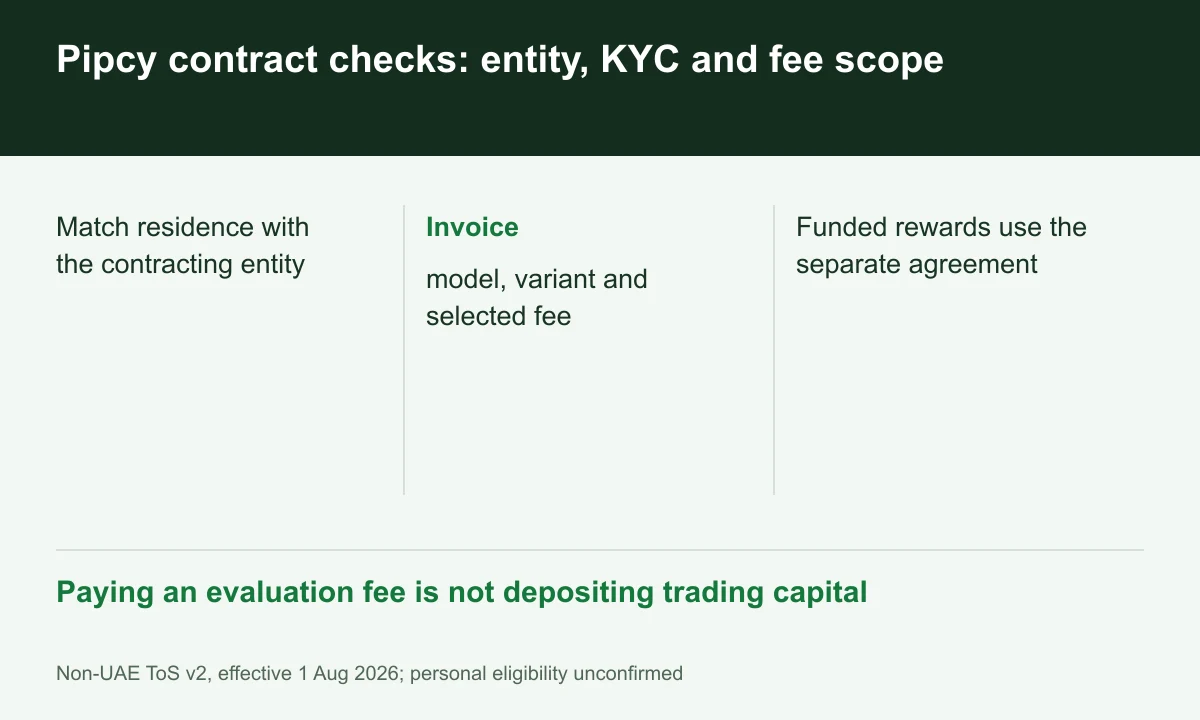
Guide
Identify who contracts with you, what the evaluation fee buys and which later agreement controls funded rewards.
Read guide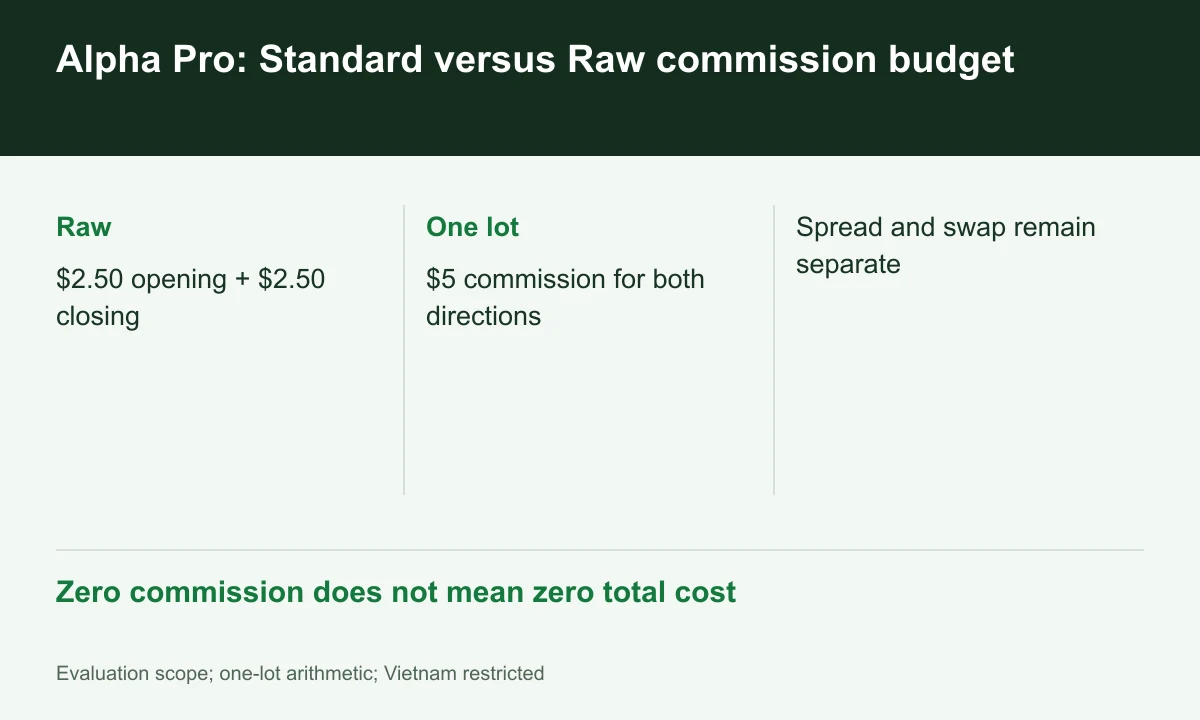
Guide
Compare execution-cost components without mistaking a commission-free evaluation for zero-cost trading. Vietnam nationals and residents are restricted.
Read guide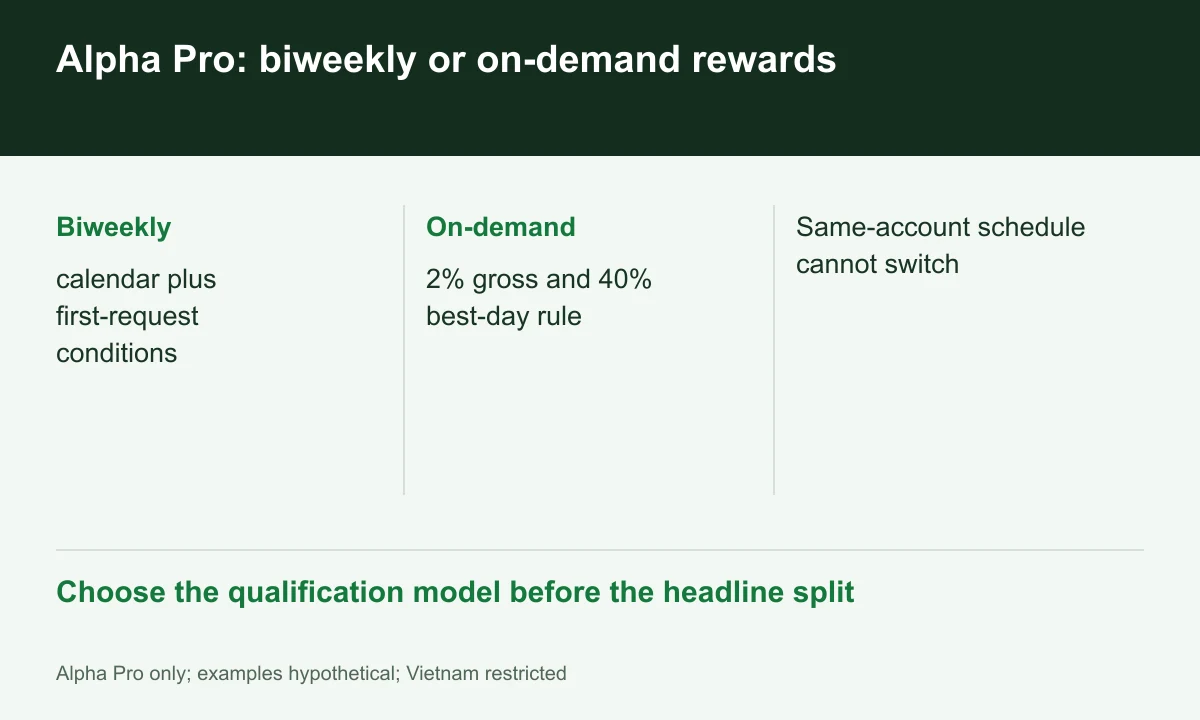
Guide
Compare eligibility clocks and consistency before the percentage. Neither schedule is available to a restricted Vietnamese applicant.
Read guide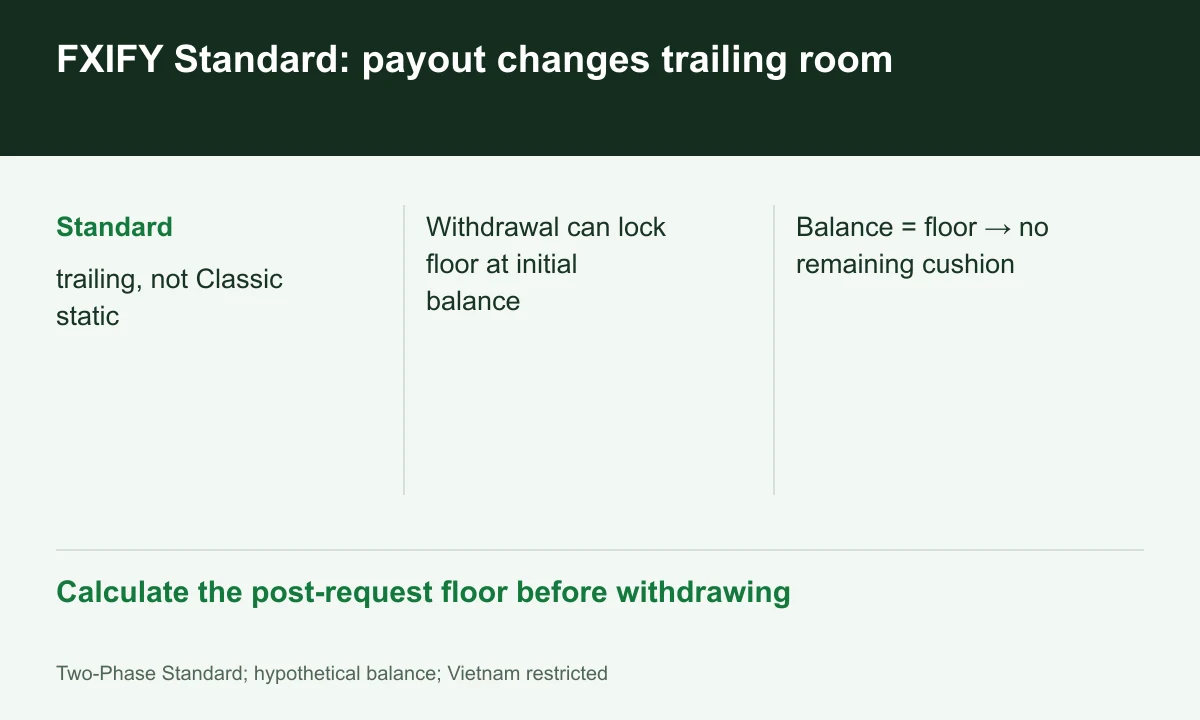
Guide
The Standard two-phase account uses a different loss model from Classic and PRO. Vietnam is explicitly restricted.
Read guide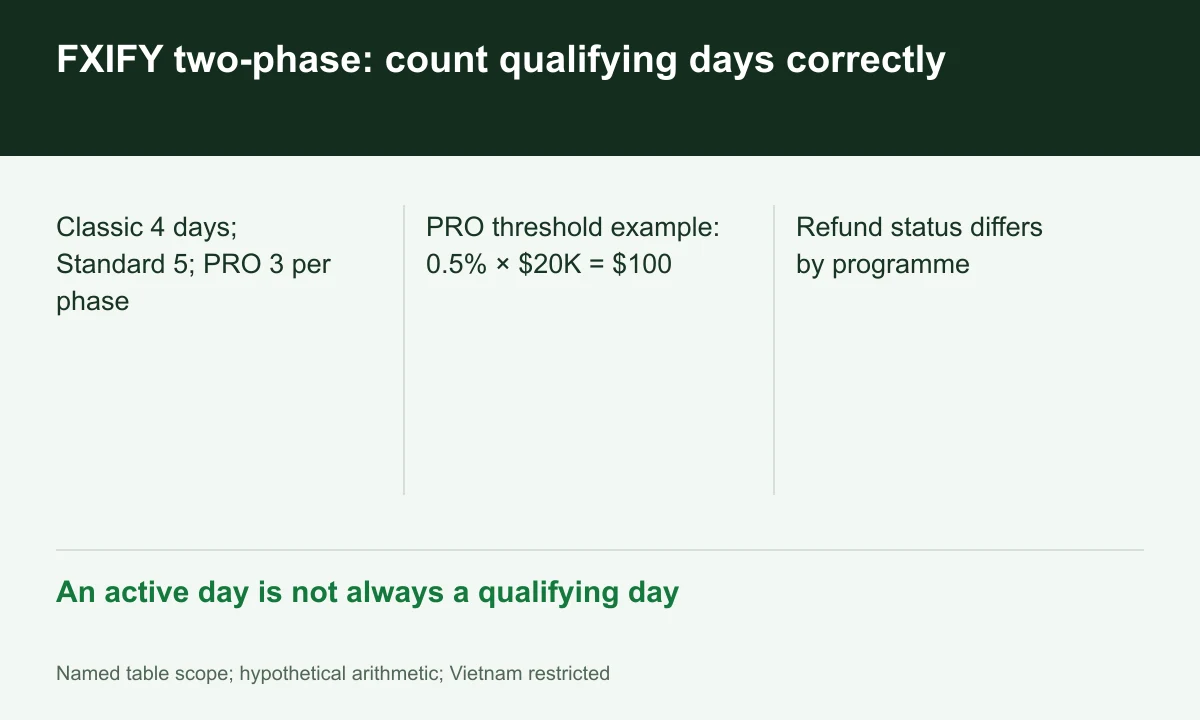
Guide
Minimum days, profit thresholds and refund rules differ between Classic, Standard and PRO; an active day is not automatically a qualifying day.
Read guide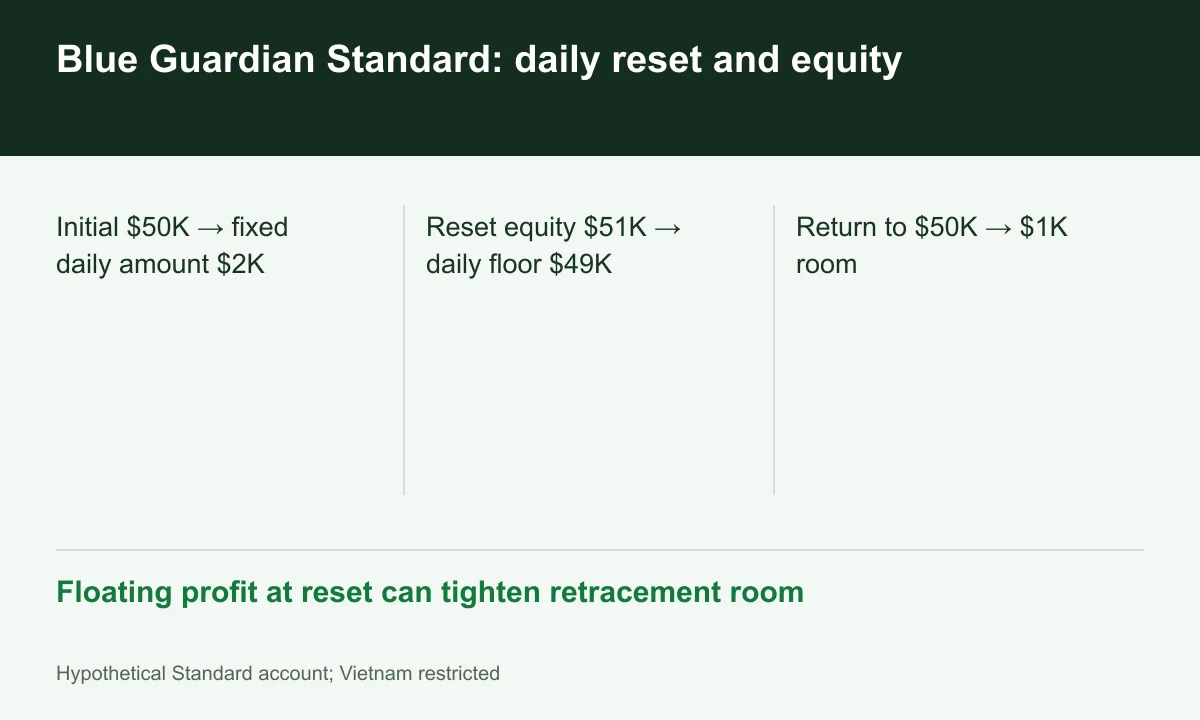
Guide
Use the fixed daily-loss amount and the reset reference separately. Vietnam residents are excluded, and all reviewed accounts are simulated.
Read guide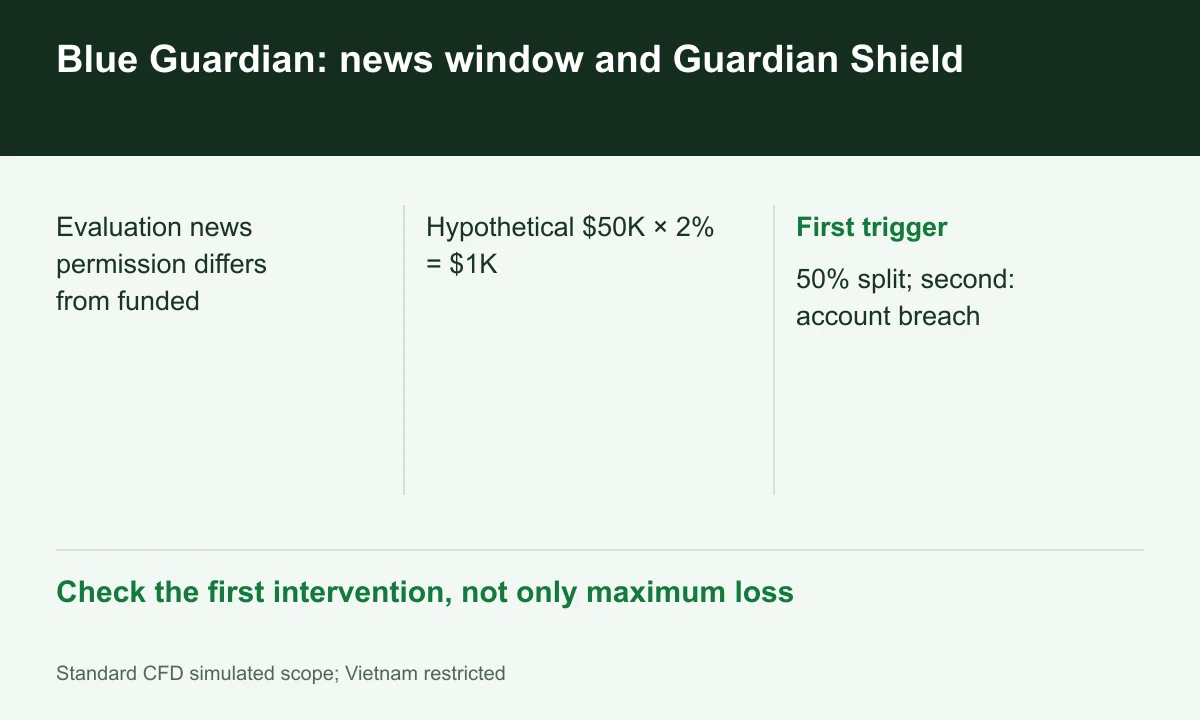
Guide
Funded Guardian Shield can permanently reduce the split to 50% on its first trigger; a second breaches the account. News and holding-time rules also matter. Vietnam remains restricted.
Read guide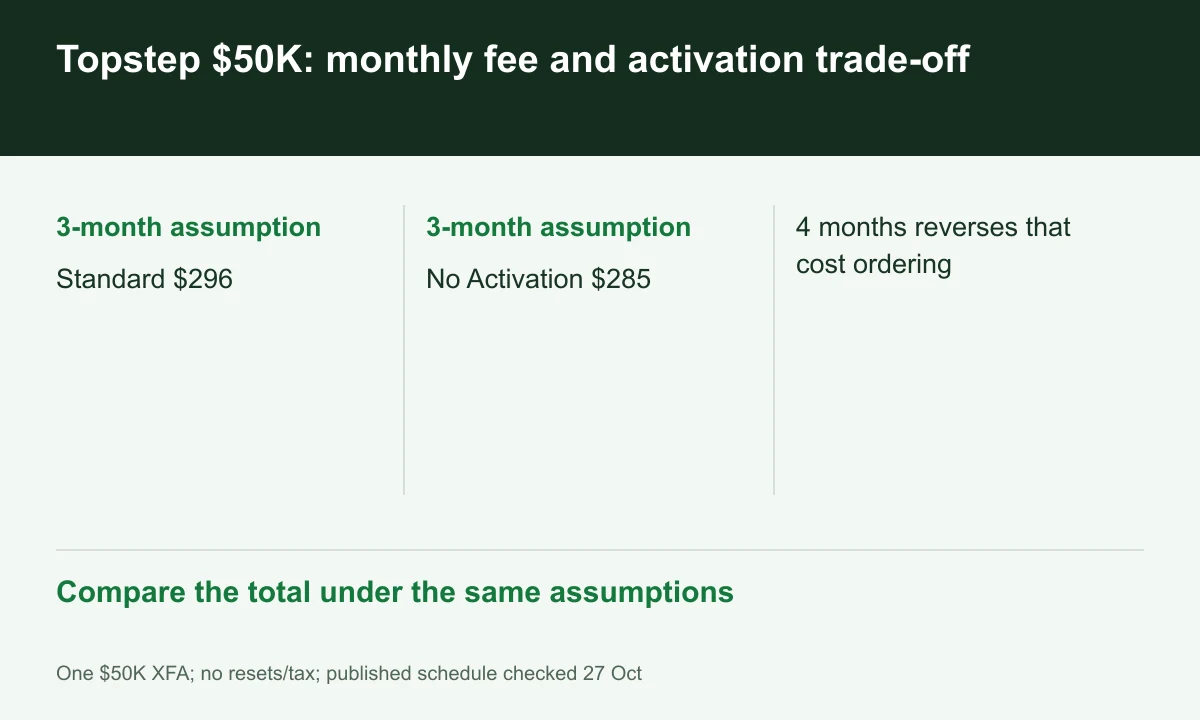
Guide
Compare two published billing paths over an explicitly assumed number of months; a lower starting fee need not produce a lower total.
Read guide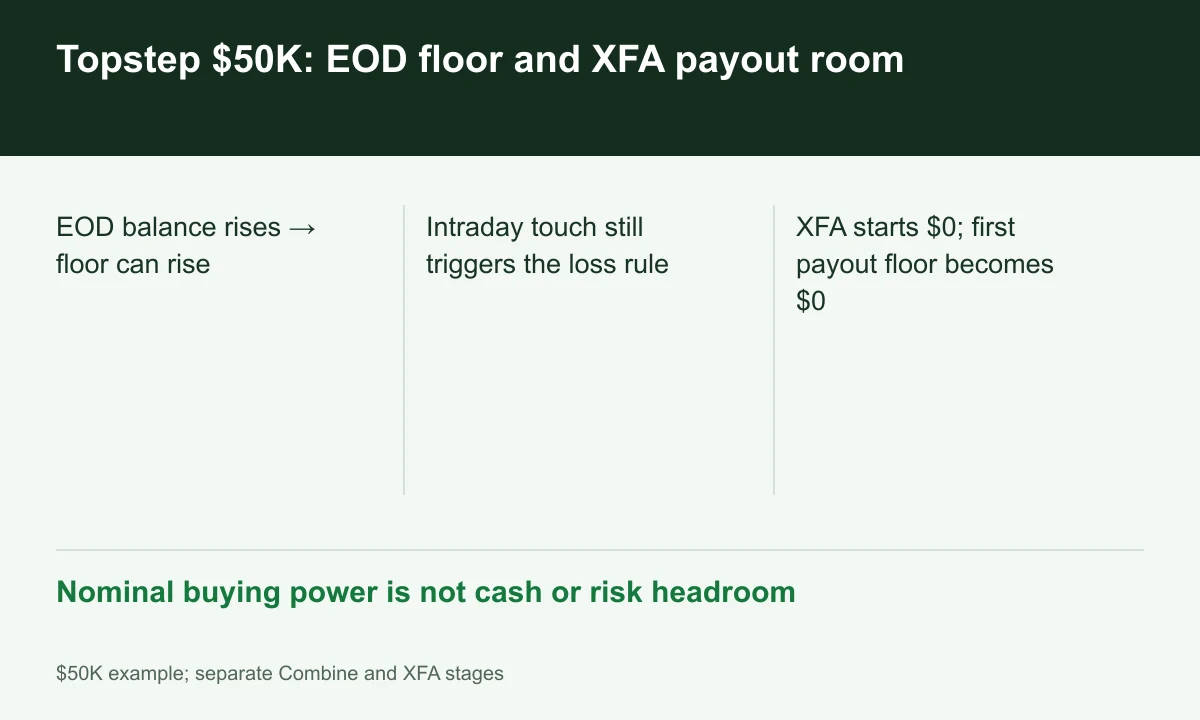
Guide
The limit moves at end of day but is enforced during the session. XFA starts from zero, not a withdrawable $50,000 balance.
Read guide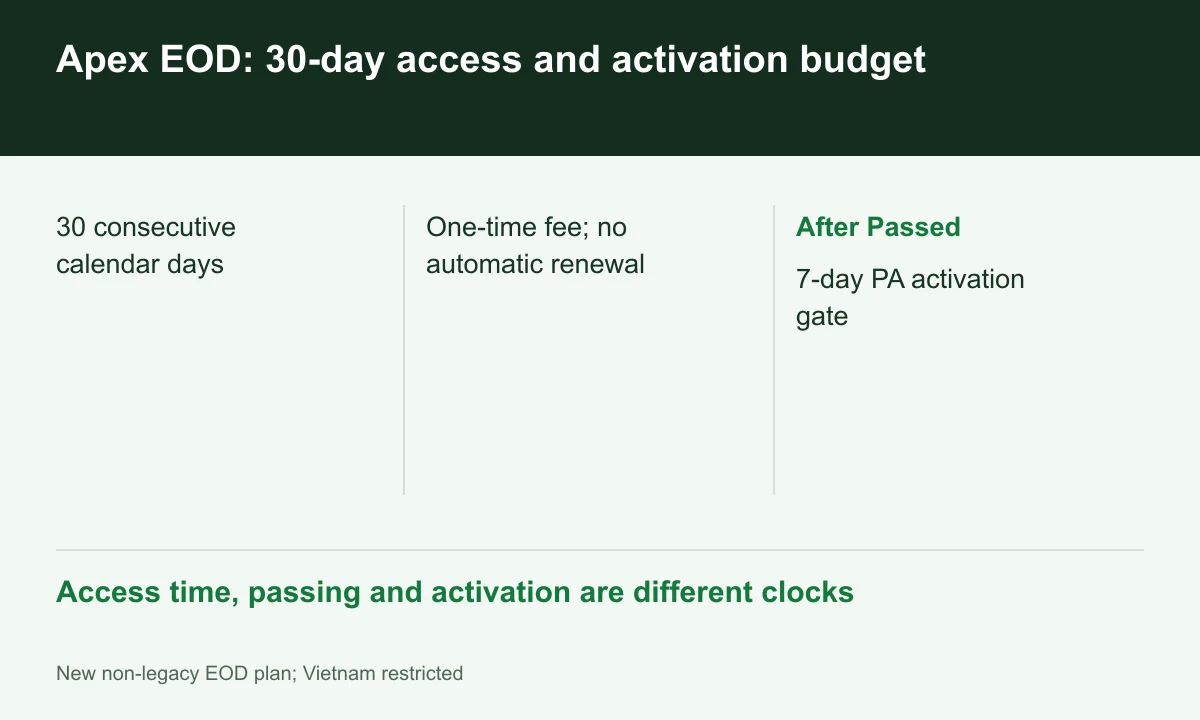
Guide
New evaluation plans are one-time purchases with an expiry, not the legacy recurring model. Vietnam is restricted.
Read guide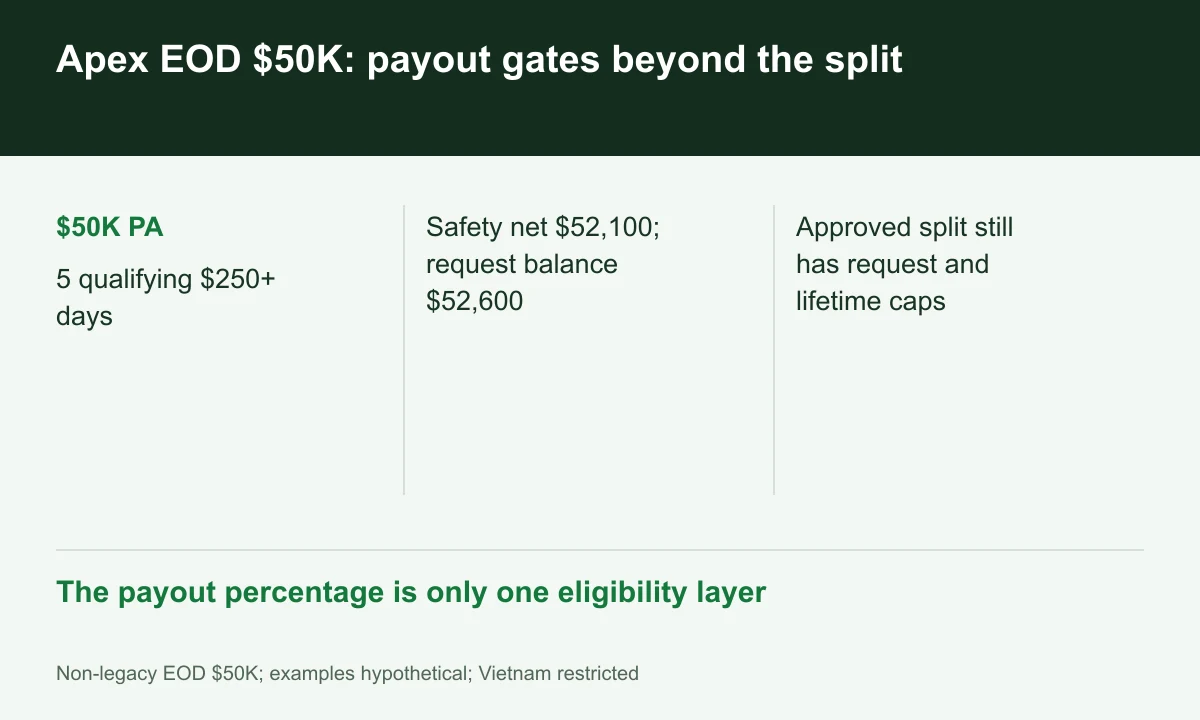
Guide
The 100% split applies only to an approved request; qualifying days, safety net, consistency and request caps still apply. Vietnam is restricted.
Read guide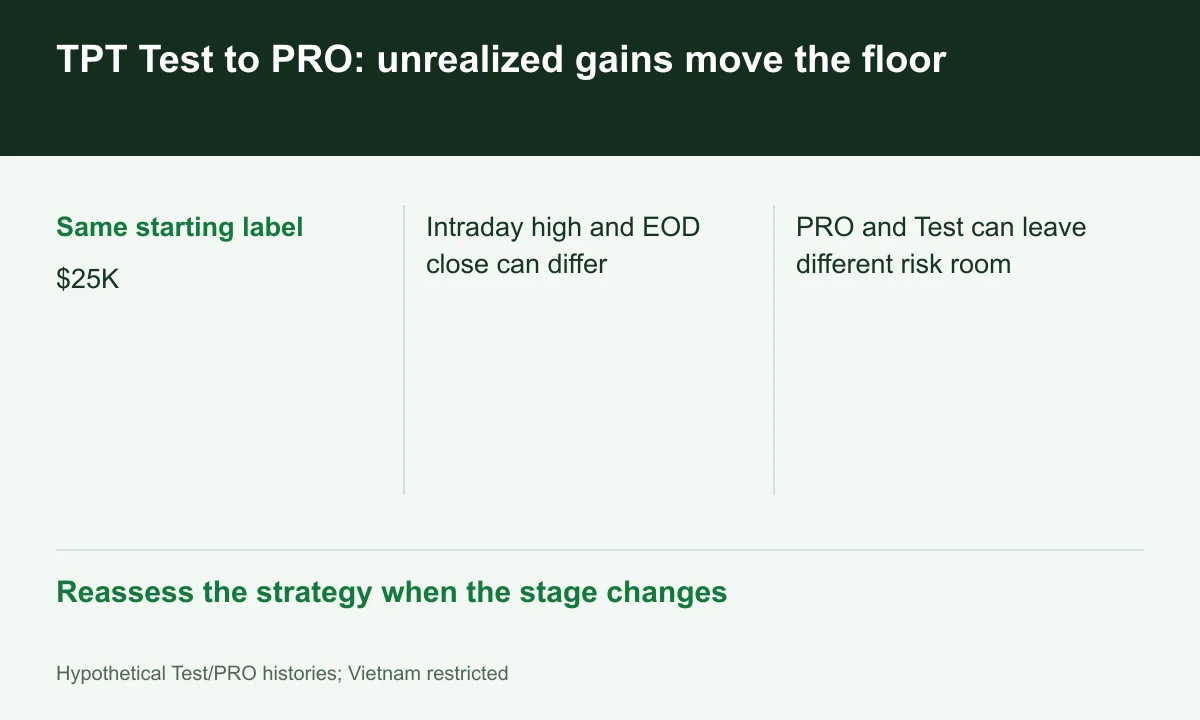
Guide
Test uses EOD updating while PRO trails intraday equity. The same nominal account size therefore does not preserve the same risk mechanism.
Read guide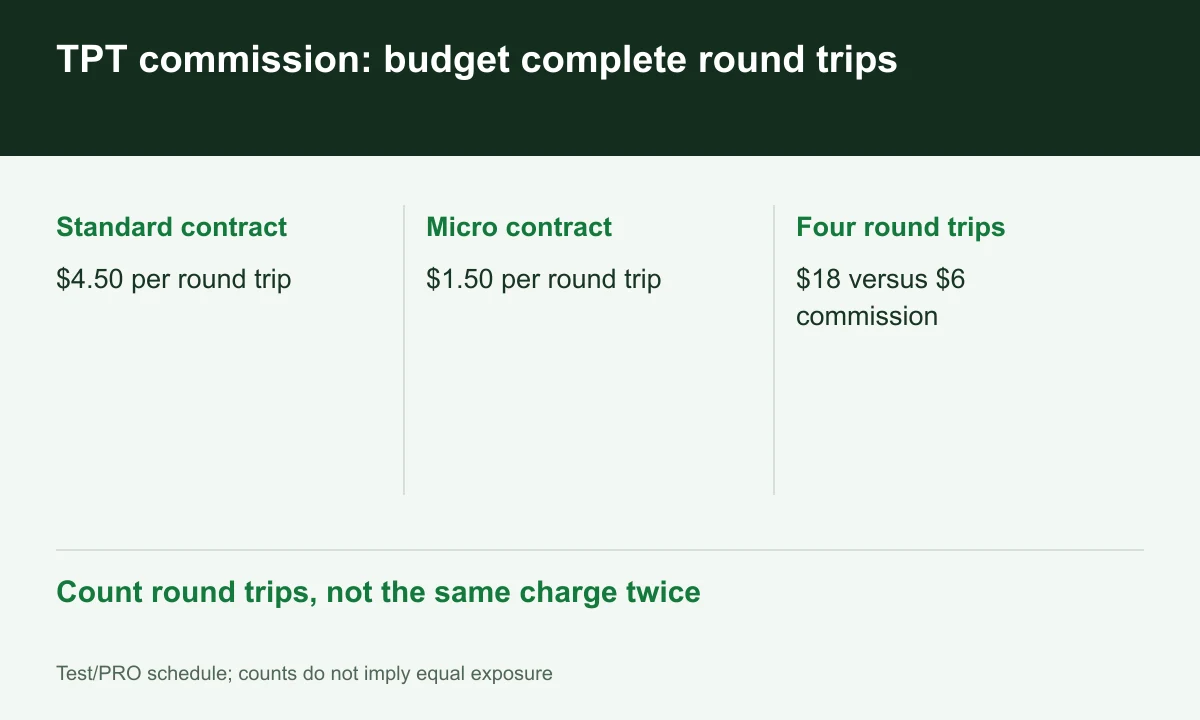
Guide
The published commission applies to Test and PRO simulations, and its round-trip unit already includes opening and closing. Vietnam is restricted.
Read guide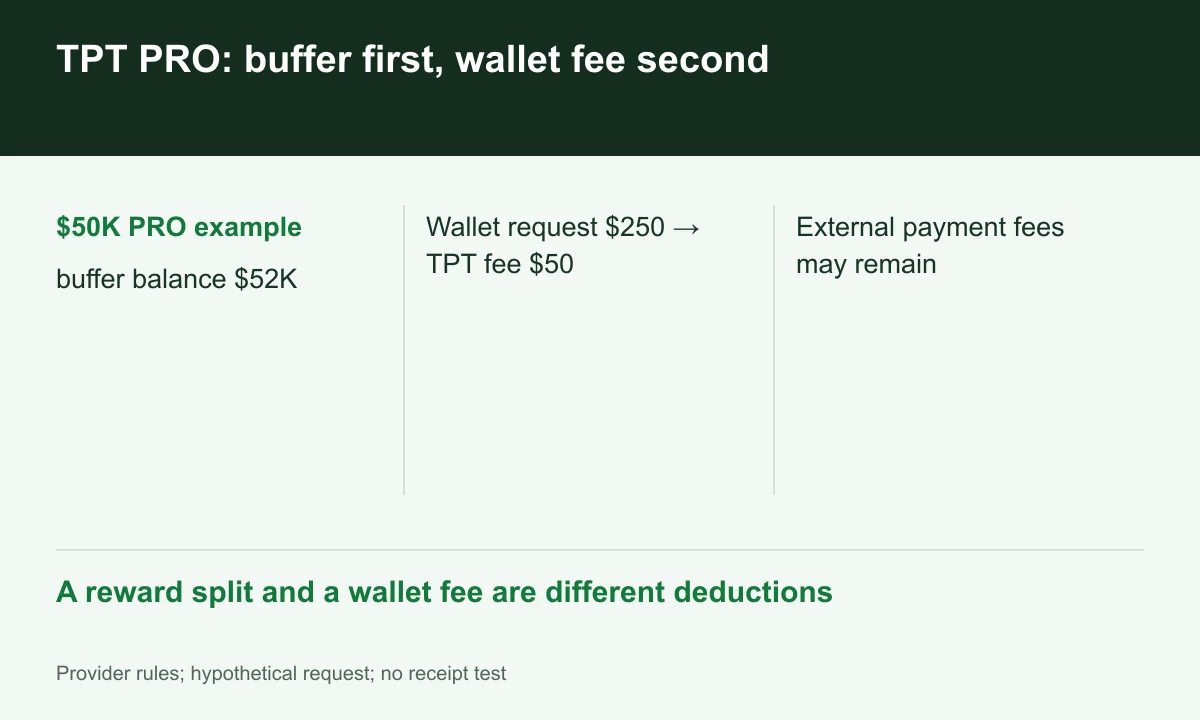
Guide
Day-one eligibility is conditional on the PRO buffer; a later wallet withdrawal can have another fee. Vietnam is restricted.
Read guide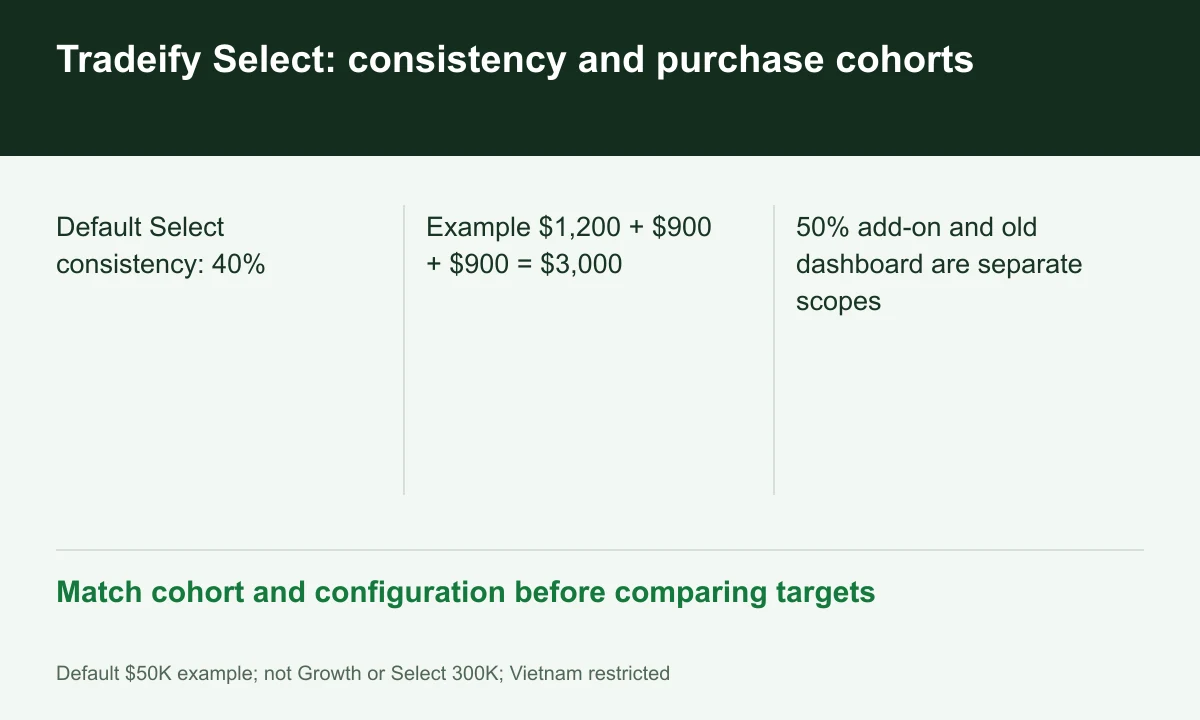
Guide
A default Select evaluation has a 40% consistency rule, while the paid add-on and legacy dashboard cohort change what should be compared. Vietnam is restricted.
Read guide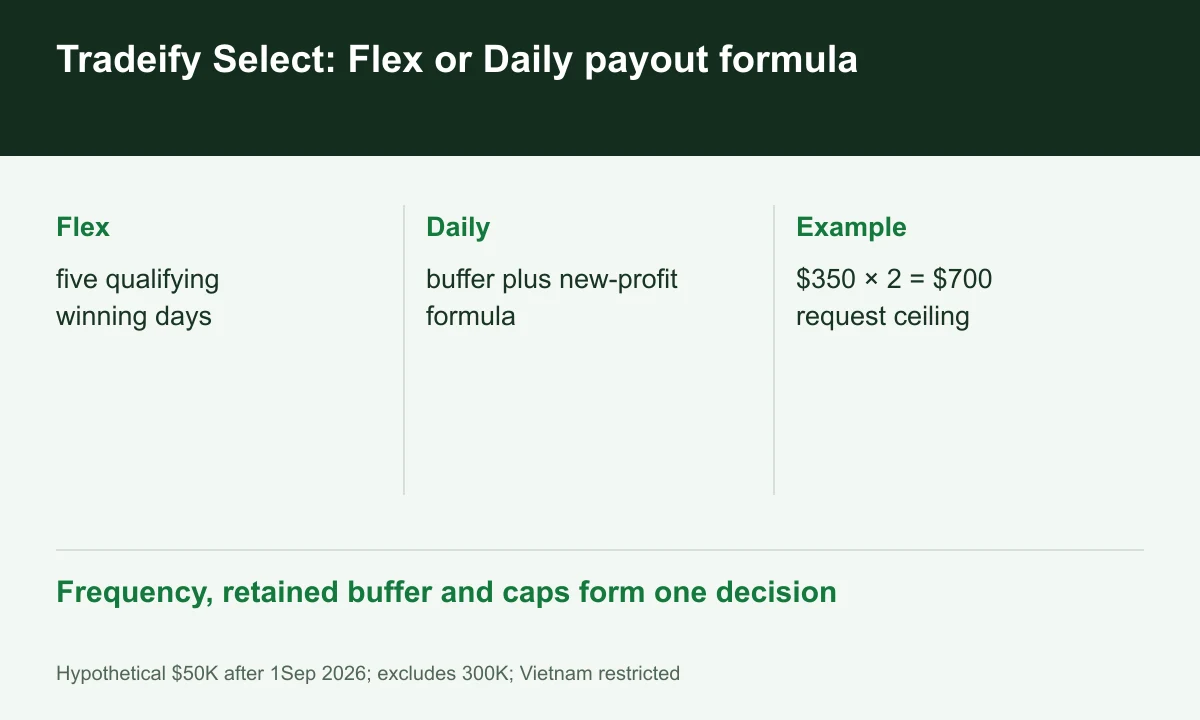
Guide
The funded payout choice is permanent; Daily adds a buffer and daily loss limit, while Flex counts winning days. Vietnam remains restricted.
Read guide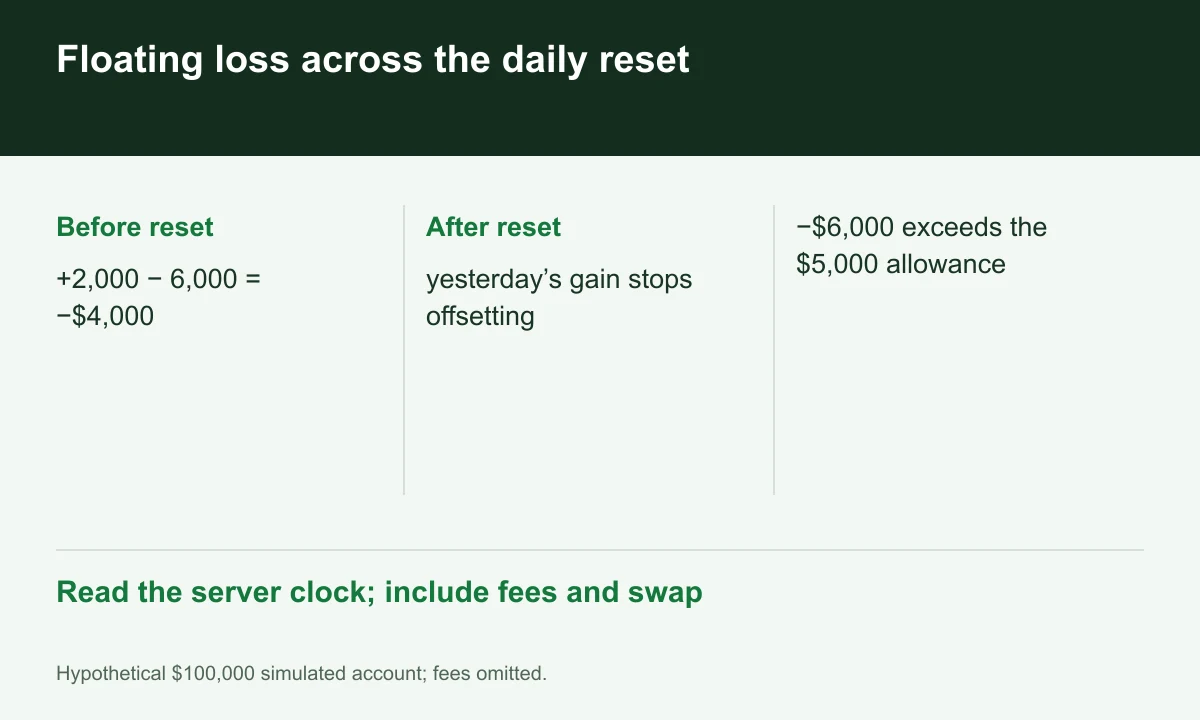
Guide
A worked simulated-account example across server midnight, including commission and swap.
Read guide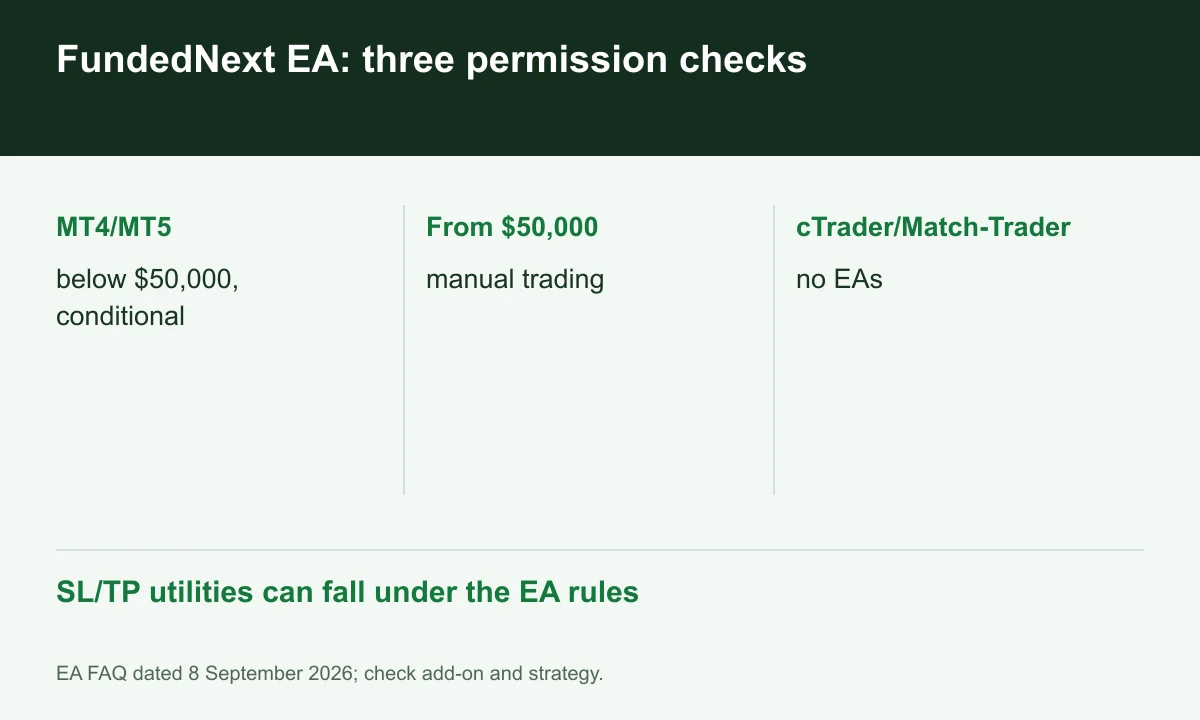
Guide
Bots and SL/TP utilities do not have the same permission on every account.
Read guide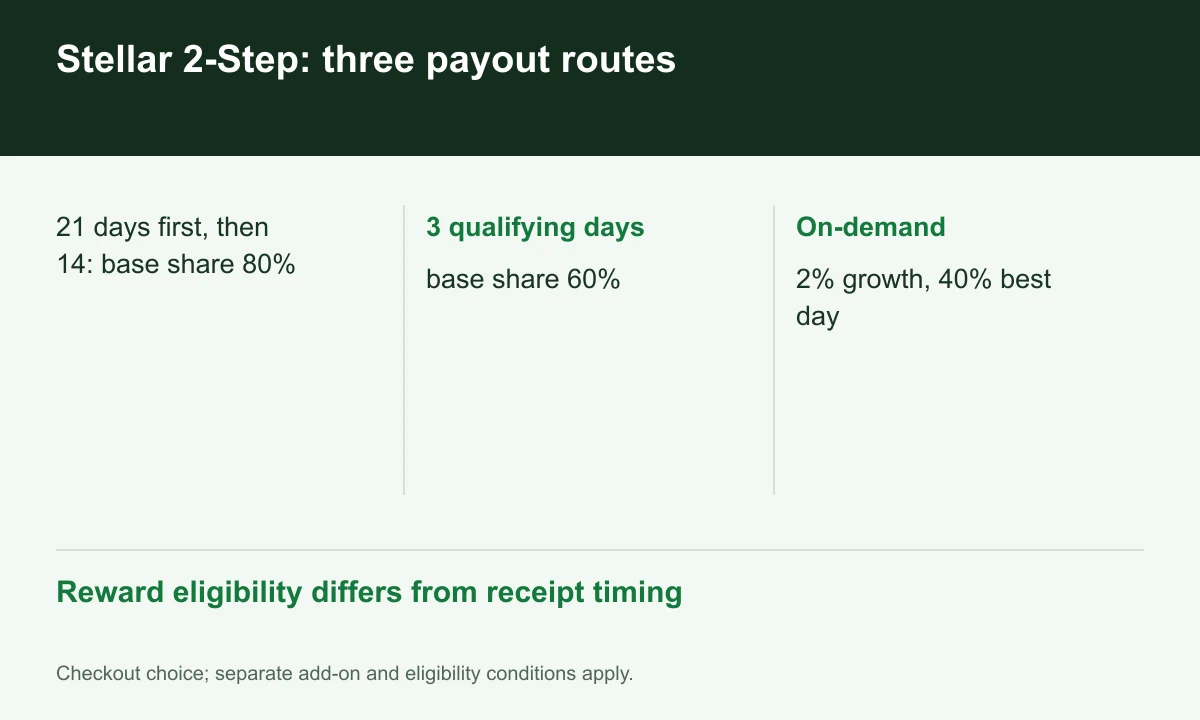
Guide
Separate timing, reward share and the wallet step before comparing “on-demand”.
Read guide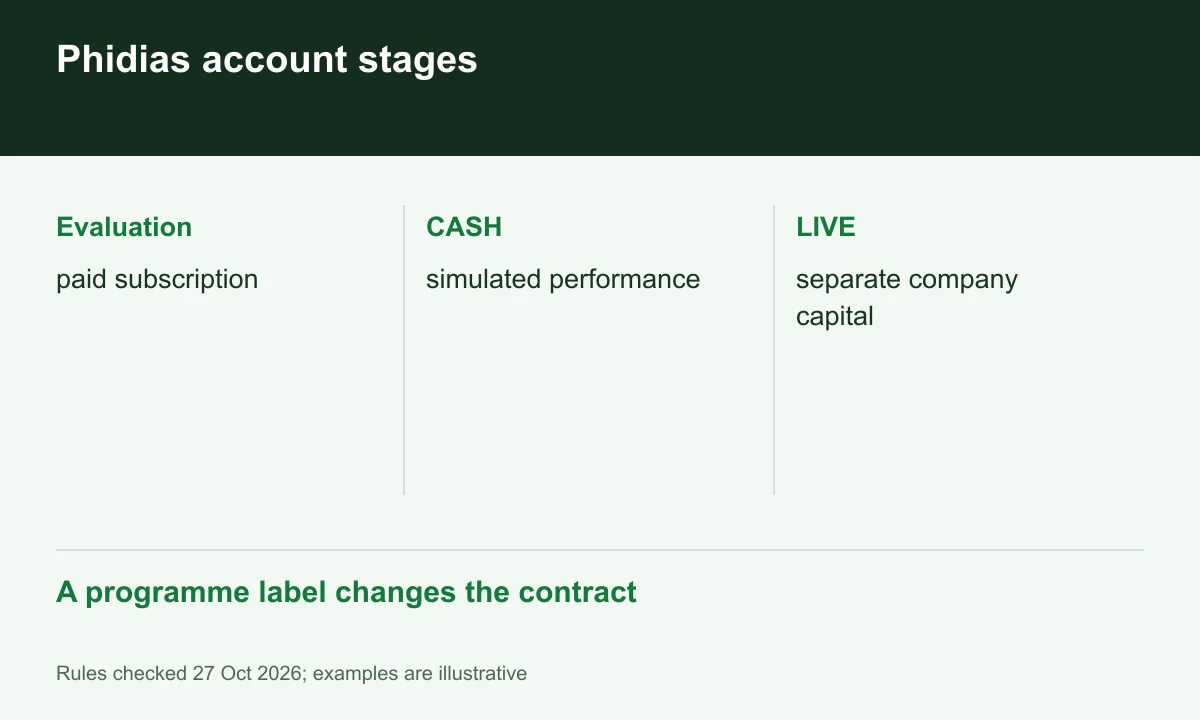
Guide
Phidias CASH is simulated; a LIVE account is a separate stage. Vietnam is absent from the reviewed exclusion list, which does not approve an individual applicant. Choose the named programme before comparing targets or payouts.
Read guide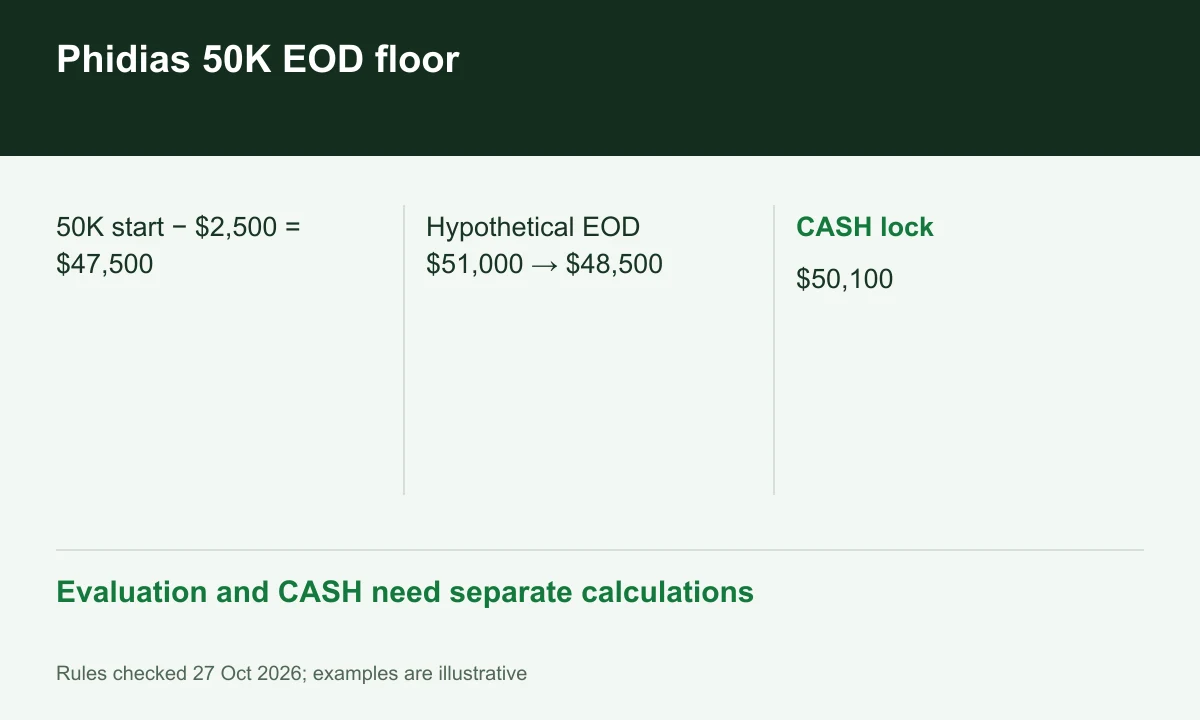
Guide
Understand Phidias Fundamental and Premium EOD drawdown, the published floor and trailing rules, with a clearly labelled simulated example.
Read guide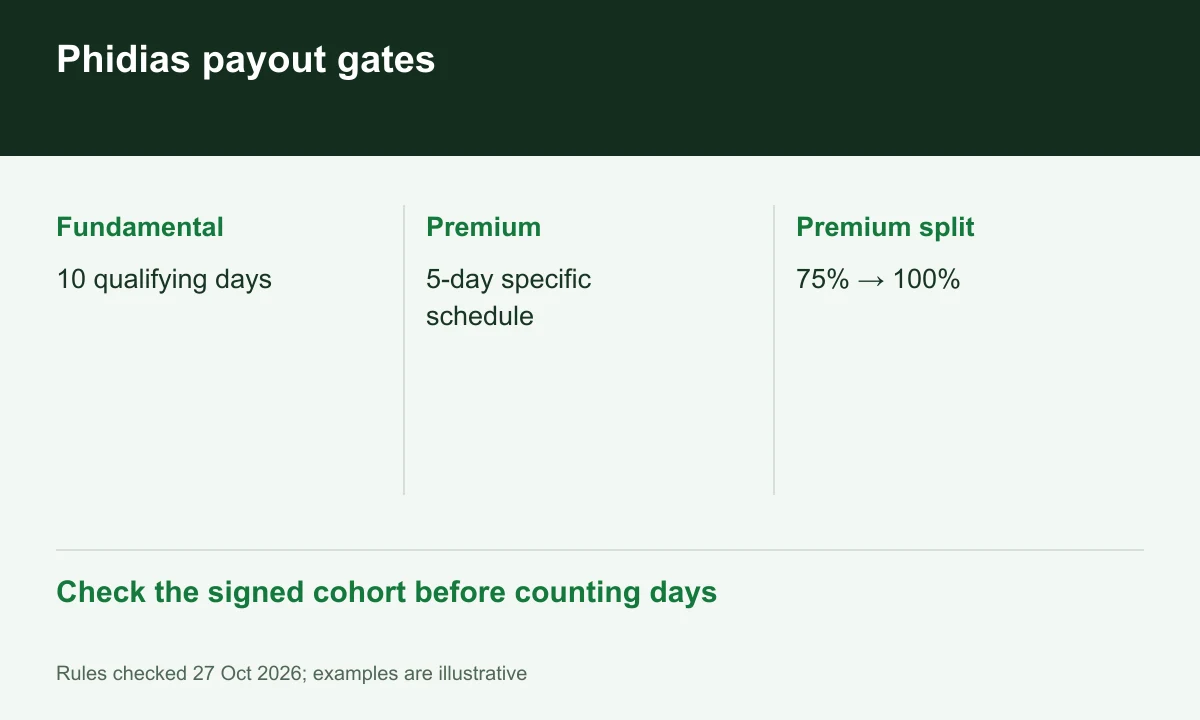
Guide
Premium advertises five days between payouts and a progressive split; Fundamental uses a different schedule and 80/20 split. General terms contain a ten-day withdrawal requirement, so the account-specific agreement needs to resolve the scope.
Read guide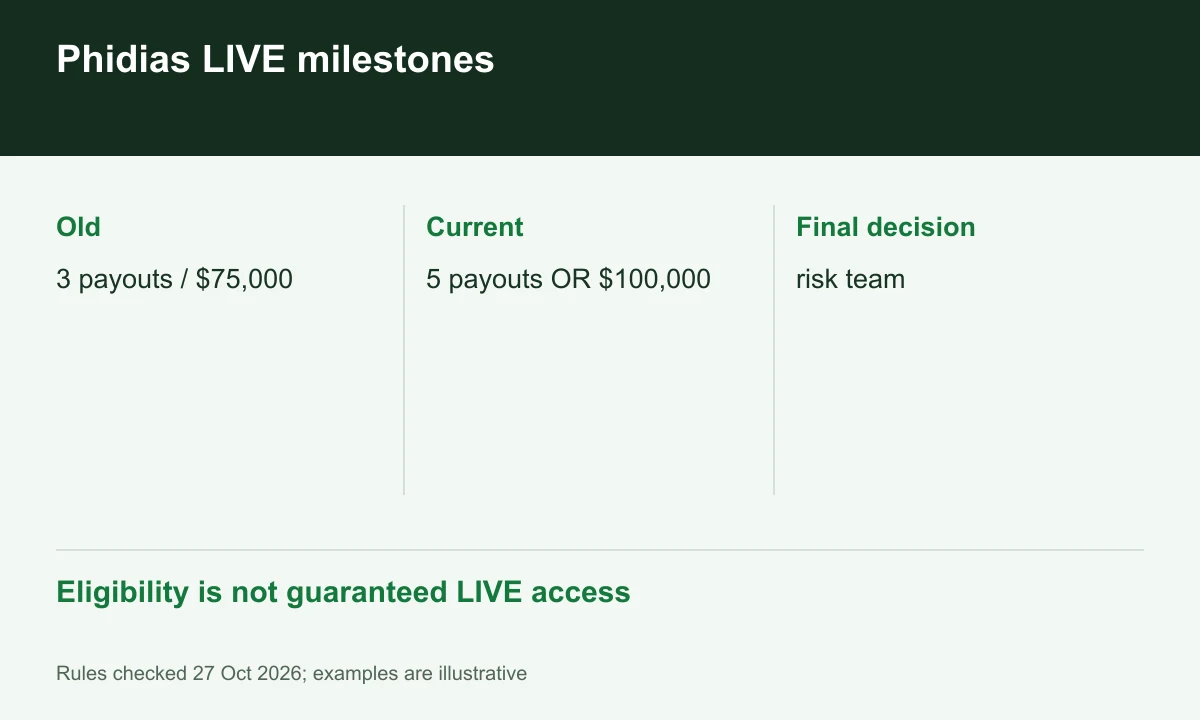
Guide
Current Fundamental/Premium rules use five successful payouts or $100,000 cumulative profit for LIVE consideration. They expressly replace the older three-payout/$75,000 wording. Neither current milestone guarantees a LIVE account.
Read guide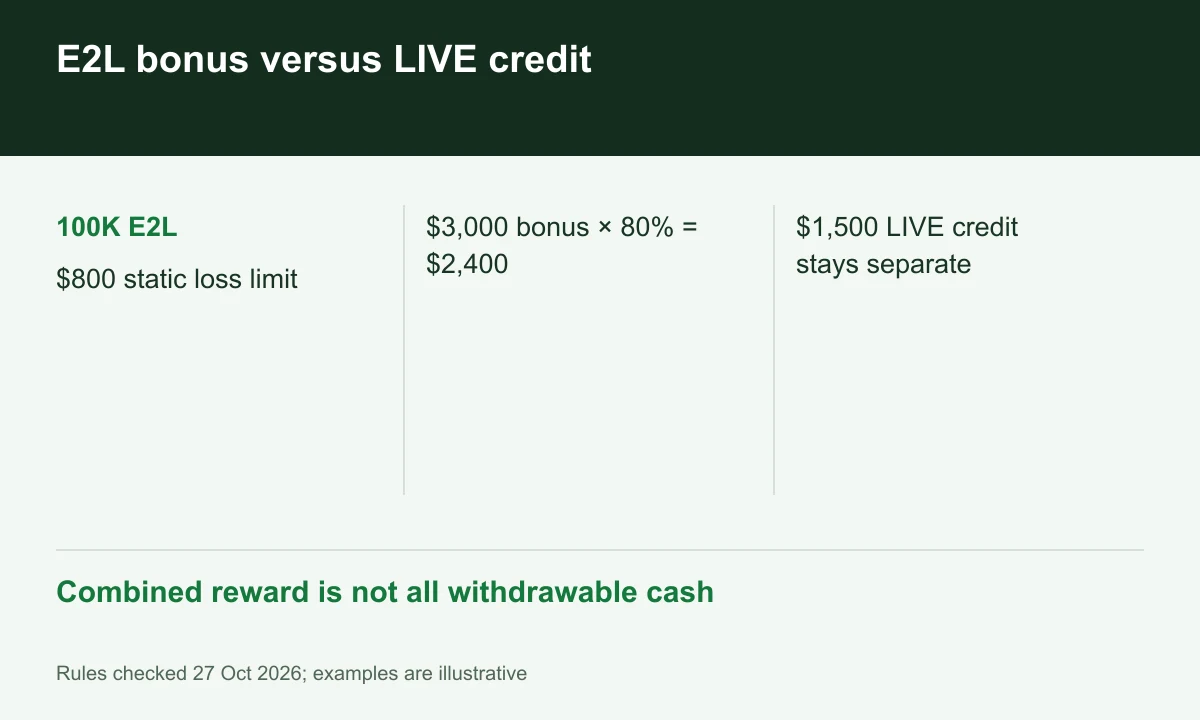
Guide
Express to Live is a separate static-drawdown route. Its advertised total reward combines a payout component and LIVE credit; the combined number should not be read as cash received in a bank account.
Read guide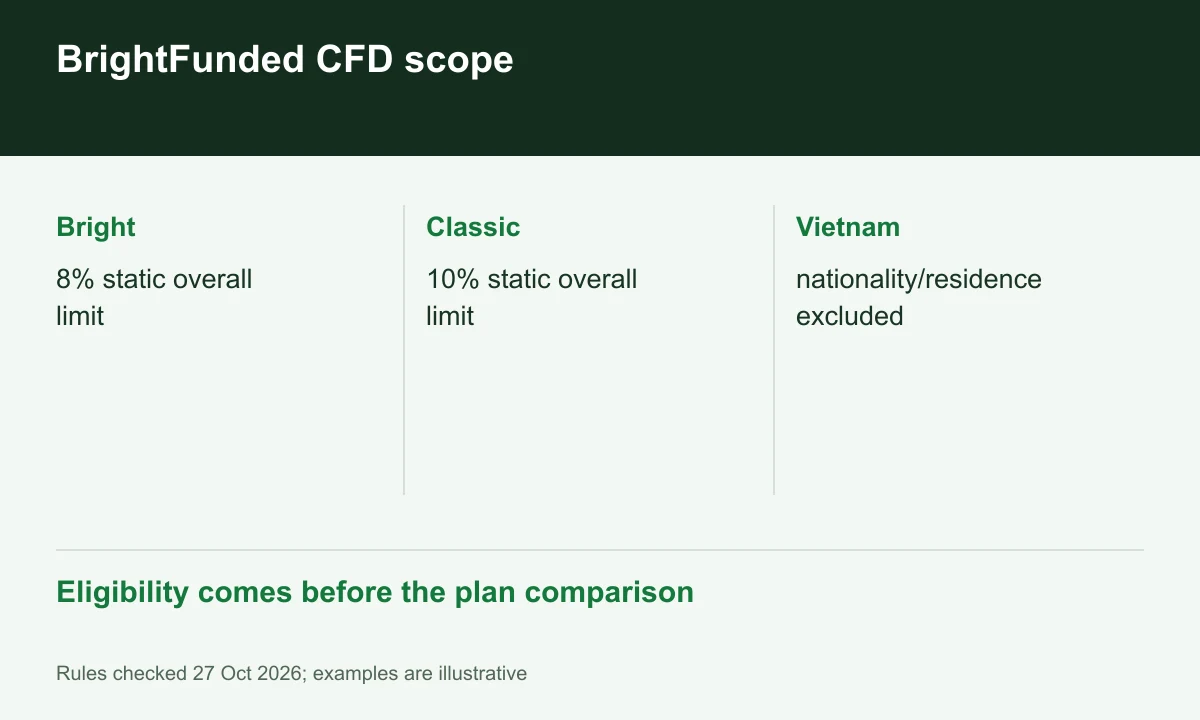
Guide
BrightFunded’s reviewed CFD country policy excludes Vietnamese nationality or residence. This is an informational review, not an invitation to buy. CFD Bright, Classic and 1-Step have different loss models; futures marketing does not define their rules.
Read guide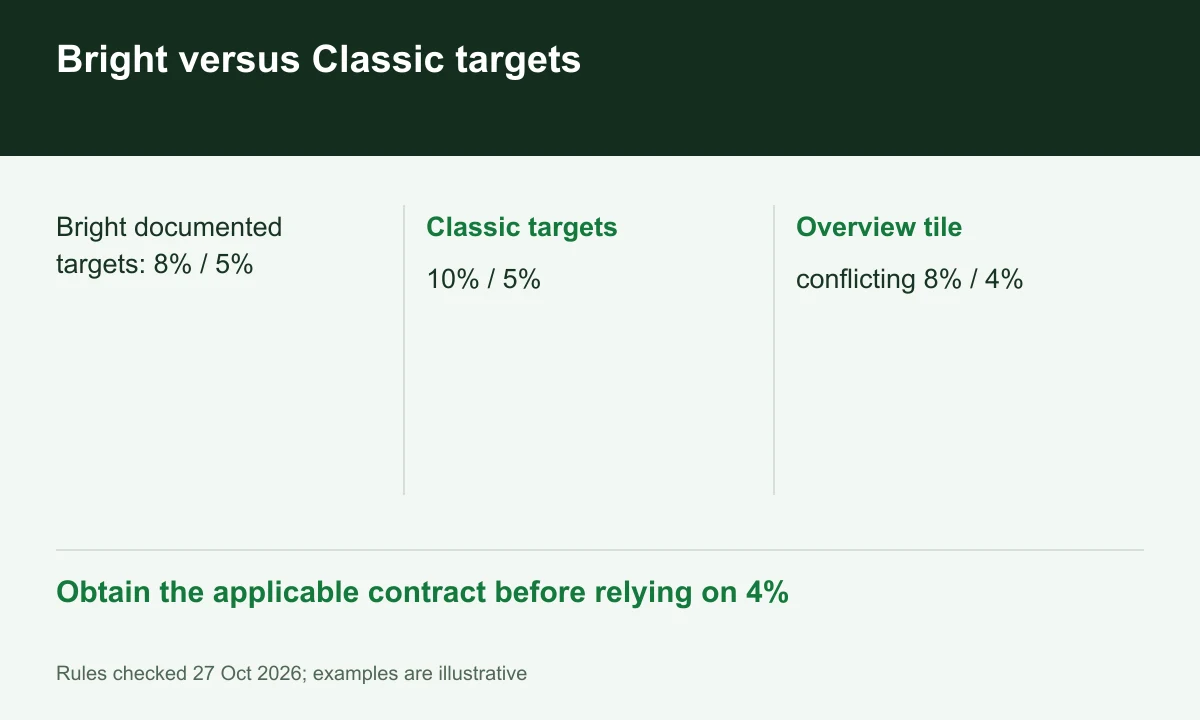
Guide
The named Bright product and two current help articles show 8% then 5%; the broad CFD overview displays 8% then 4% in a tile. Use the named-product evidence provisionally and obtain the applicable terms; Vietnam remains restricted.
Read guide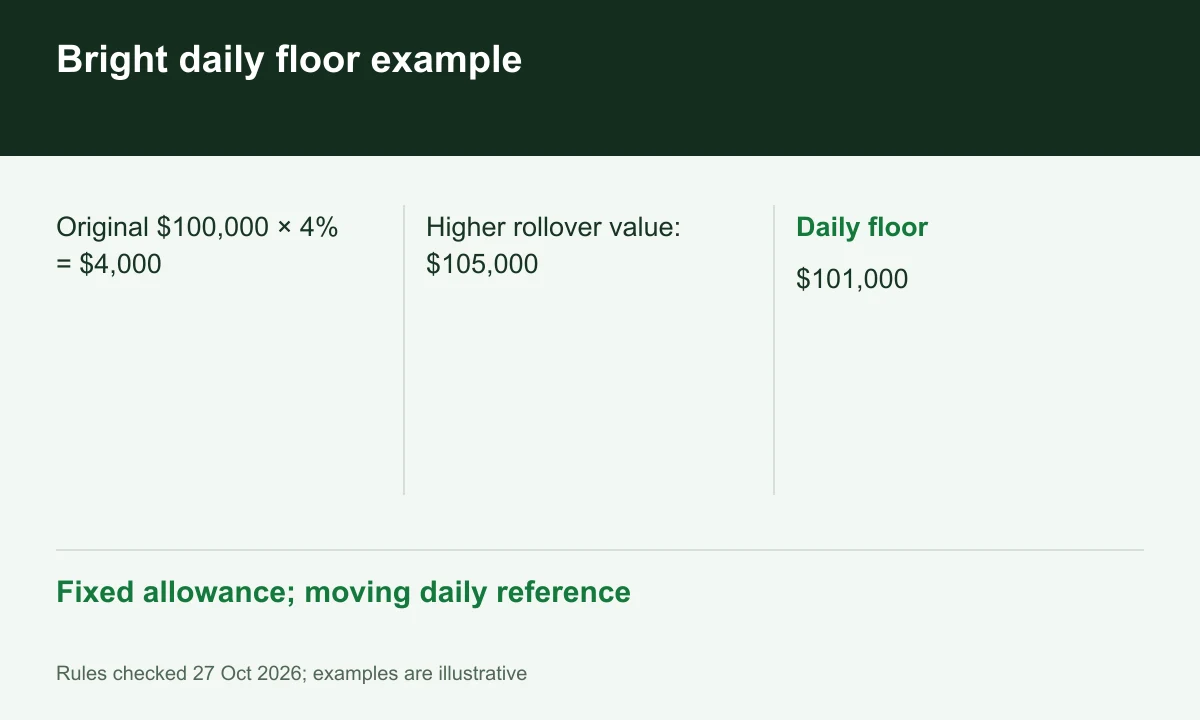
Guide
For the newer CFD cohort, the daily allowance is a fixed percentage of original size, deducted from the higher rollover balance or equity. This article uses 2-Step Bright’s 4%; older purchases have a separate method. Vietnam is restricted.
Read guide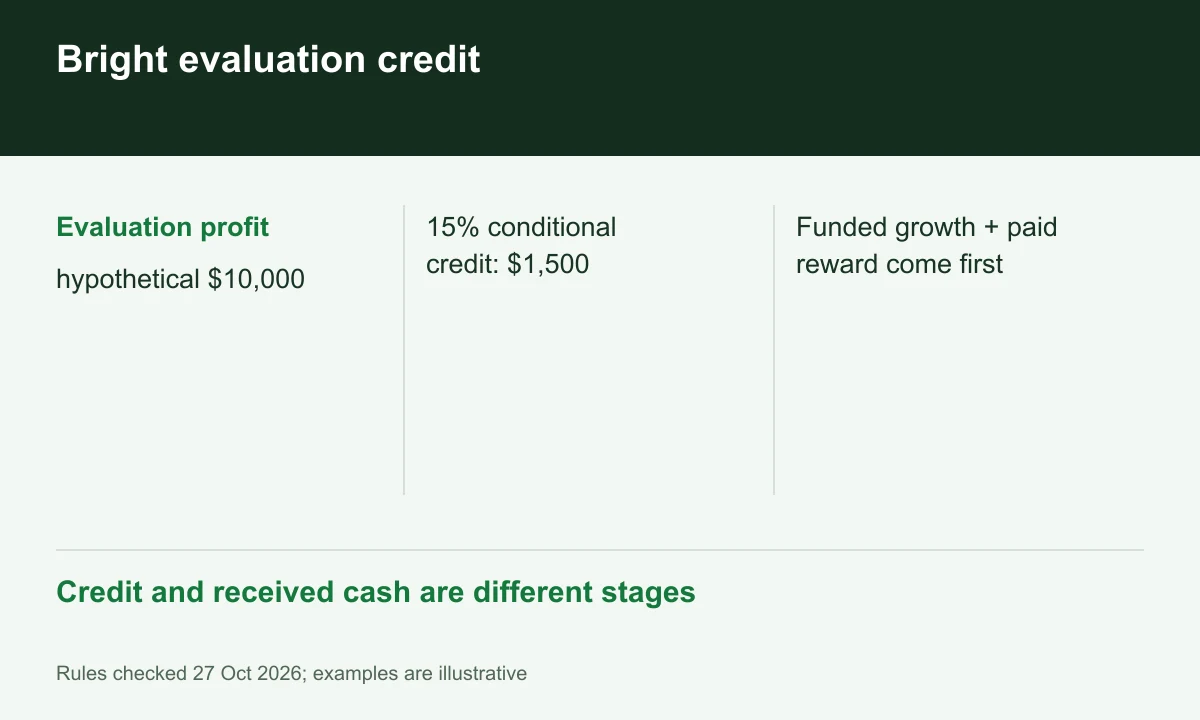
Guide
The 15% evaluation benefit is conditional account credit, not an immediate cash payment after passing. A reward-specific FAQ describes the new funded account step in more detail than the general onboarding page. Vietnam remains excluded.
Read guide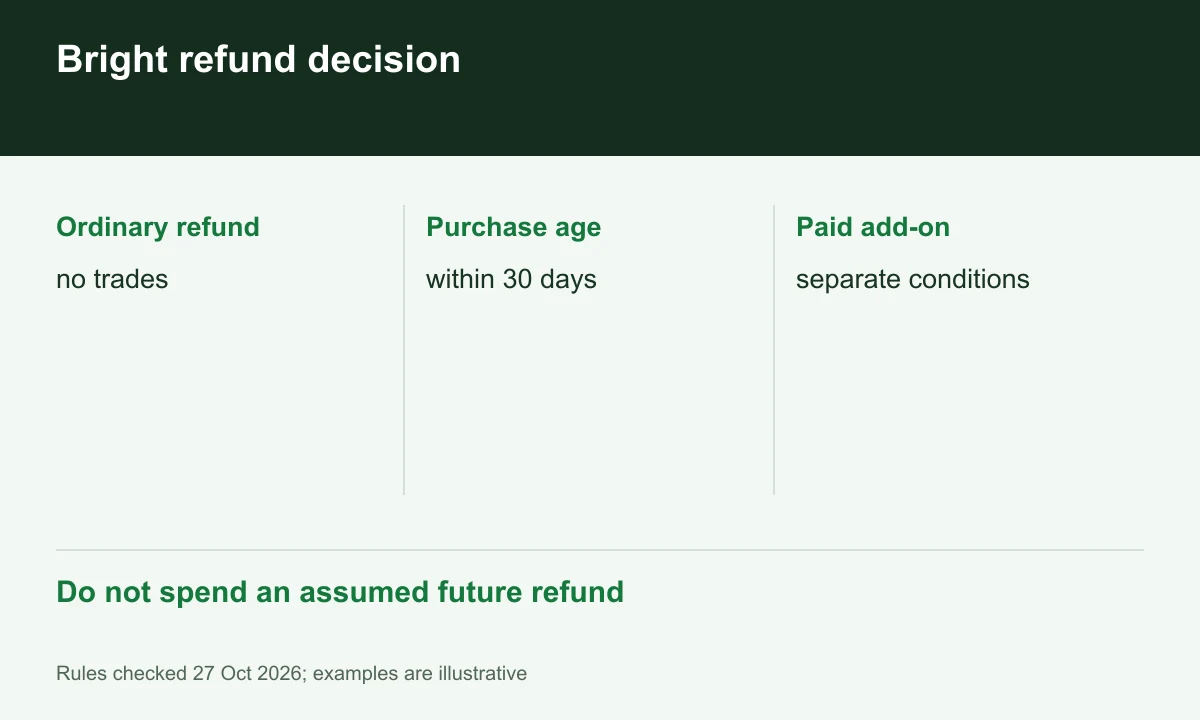
Guide
The cancellation FAQ requires an untraded account bought within thirty days. A paid “100% fee refund” add-on is a different checkout feature; do not treat its name as unconditional cancellation protection. Vietnam is restricted.
Read guide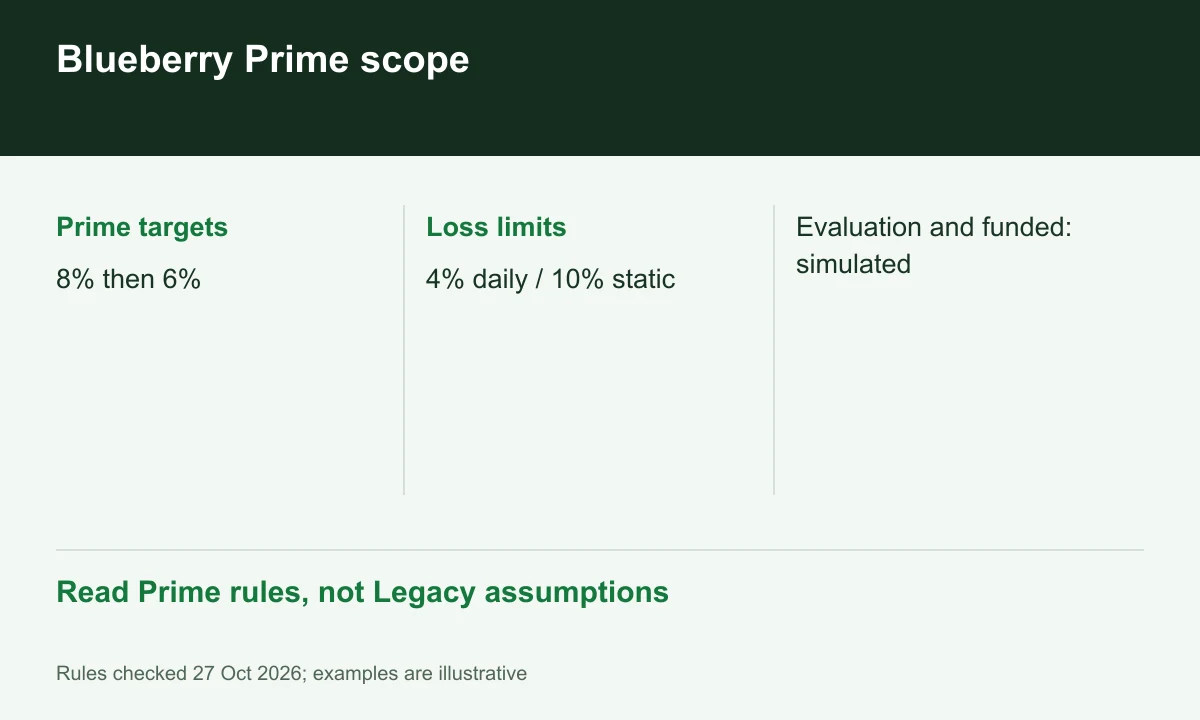
Guide
Prime is a separate two-phase simulated programme, not the discontinued Legacy 2-Step. Its 8%/6% targets and 4%/10% loss limits need product-specific reading. Vietnam is absent from the reviewed purchase restriction list, which is not individual approval.
Read guide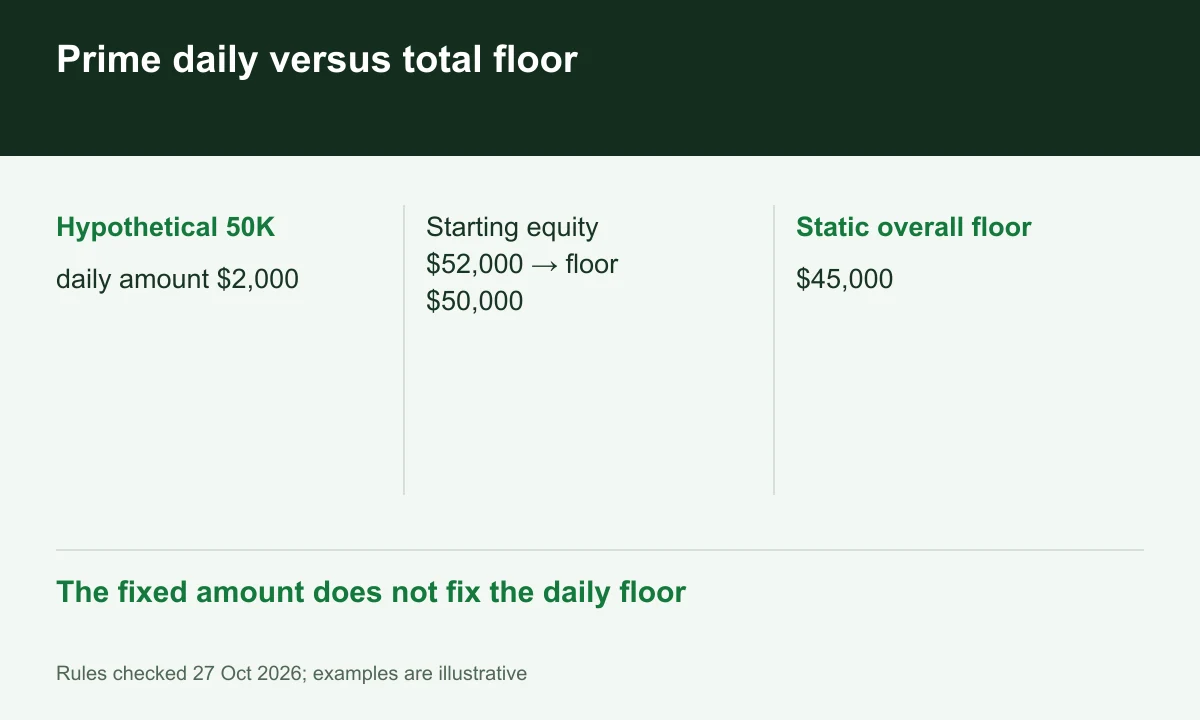
Guide
Prime’s daily amount is 4% of original size; its daily reference uses the higher starting balance or equity. The overall floor stays 10% below original size. The same word “fixed” therefore describes two different things.
Read guide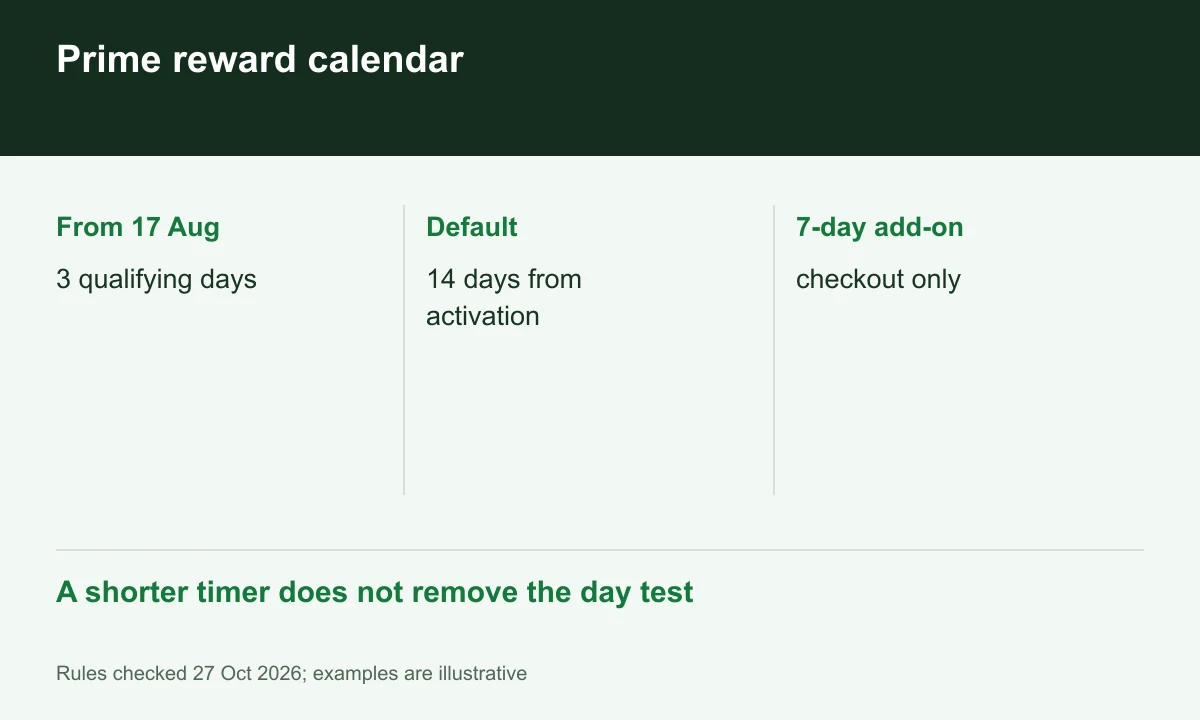
Guide
Prime rewards combine a time interval, qualifying closed-profit days and a minimum amount. A 7-day add-on changes timing, not all eligibility conditions. The payout request button is not evidence of cash received.
Read guide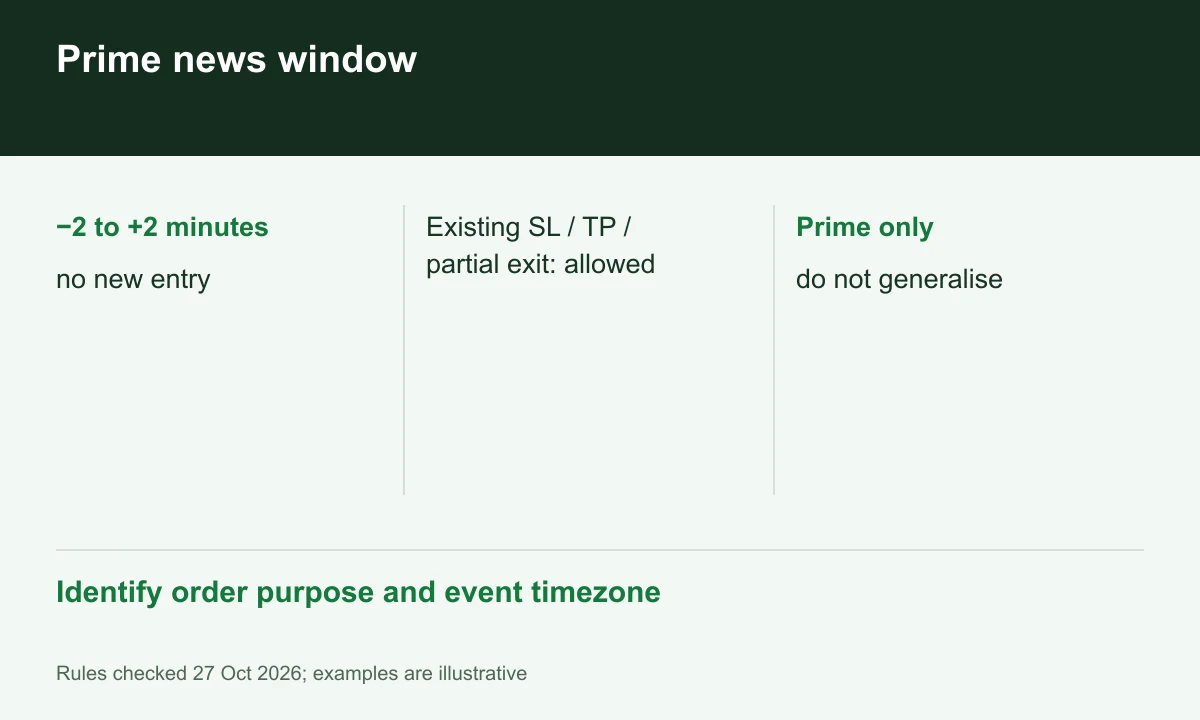
Guide
Prime prohibits new entries within two minutes either side of scheduled high-impact news, but allows management and closure of existing positions. Do not import a different provider’s blanket exit ban or interpret “no risk cap” as no rules.
Read guide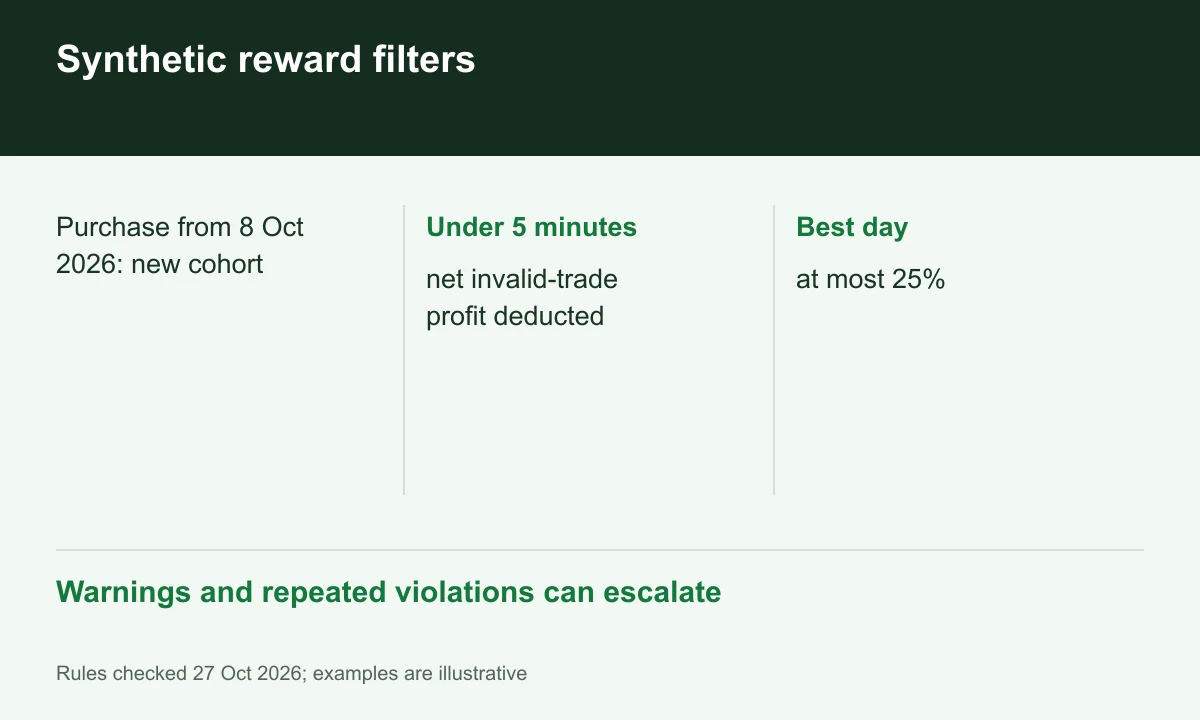
Guide
From 8 October 2026, funded Synthetic purchases have a five-minute profit filter and 25% consistency test. Legacy accounts retain 30% until their next payout, then migrate. Repeated excessive scalping after rejection/warning can breach the account; this is not merely a harmless deduction.
Read guide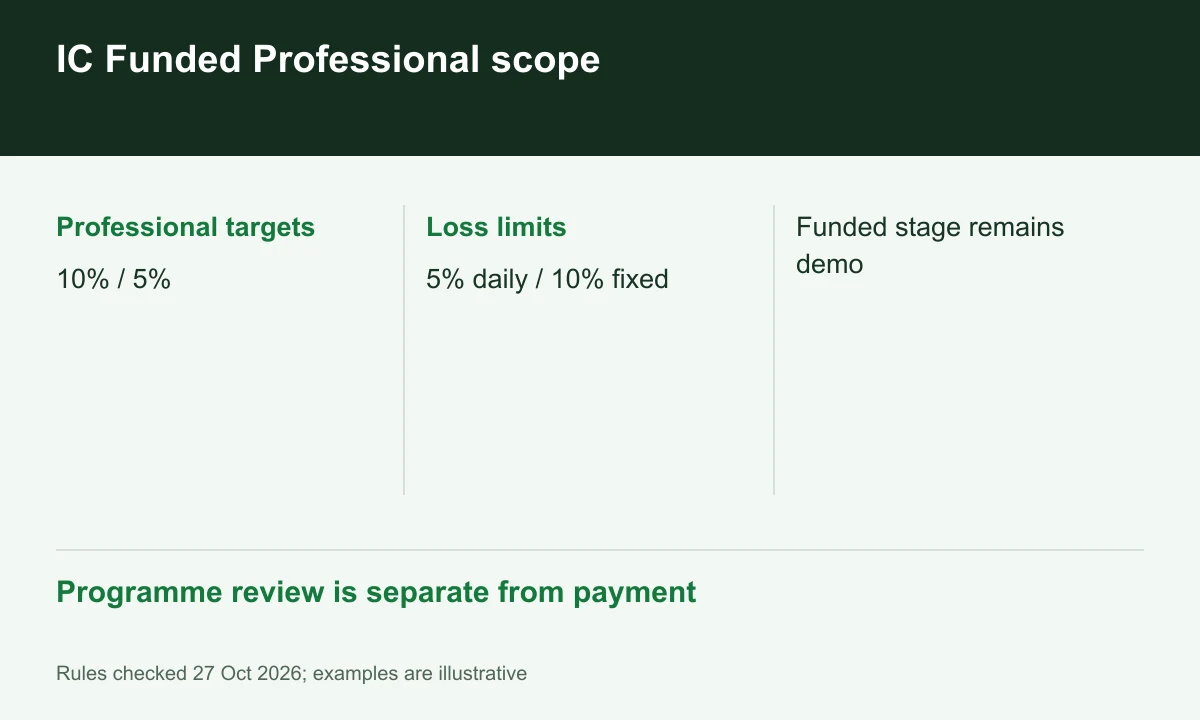
Guide
IC Funded’s Professional route uses demo accounts throughout, including funded. It is not an IC Markets brokerage account. The readable current eligibility pages do not establish Vietnam-specific approval, so confirm eligibility before paying.
Read guide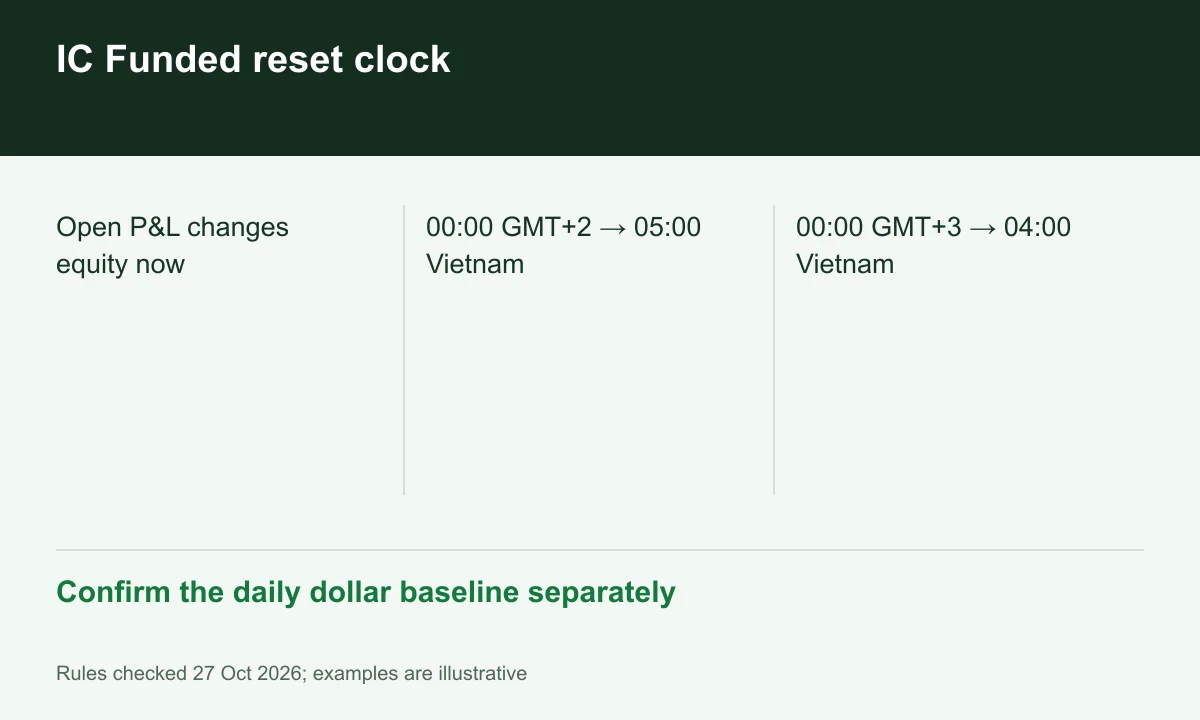
Guide
IC Funded monitors equity, including floating positions, and resets daily loss at 00:00 server time on GMT+2/GMT+3. A closed balance above the limit does not protect an account whose equity breaches it. The exact daily baseline needs account-level confirmation.
Read guide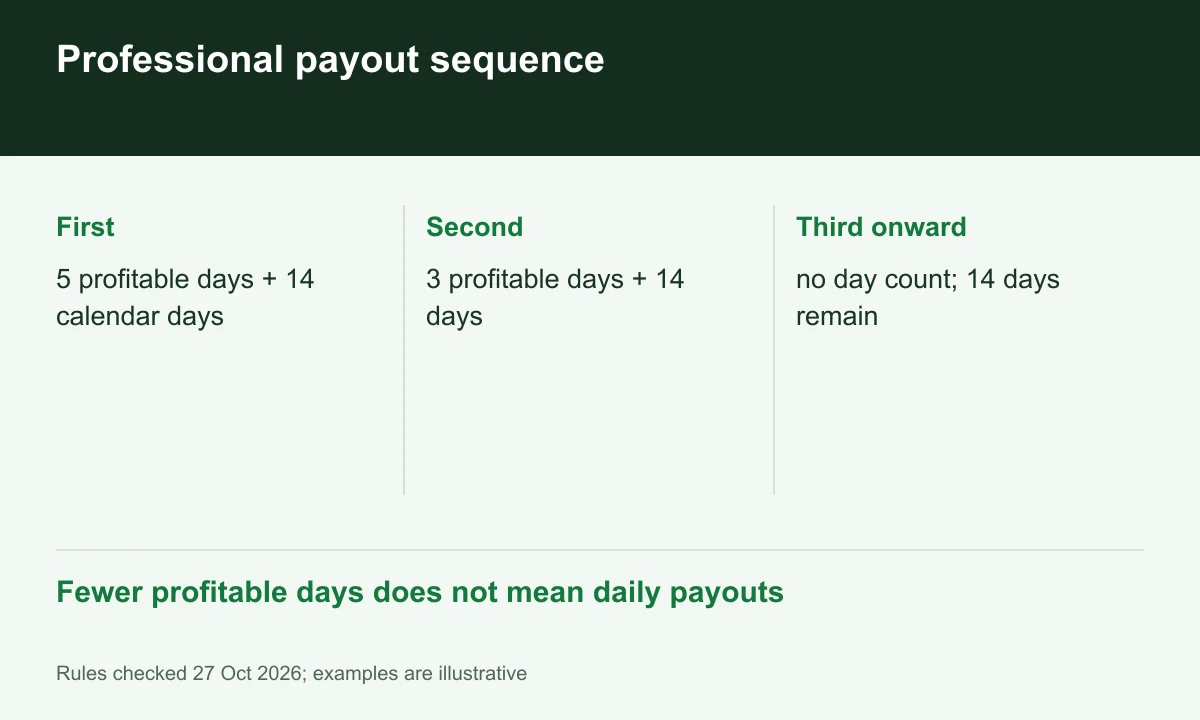
Guide
Professional’s first request requires five profitable days and at least fourteen calendar days; the second needs three profitable days, and the third onward removes the profitable-day count. The fourteen-day minimum remains in the published table.
Read guide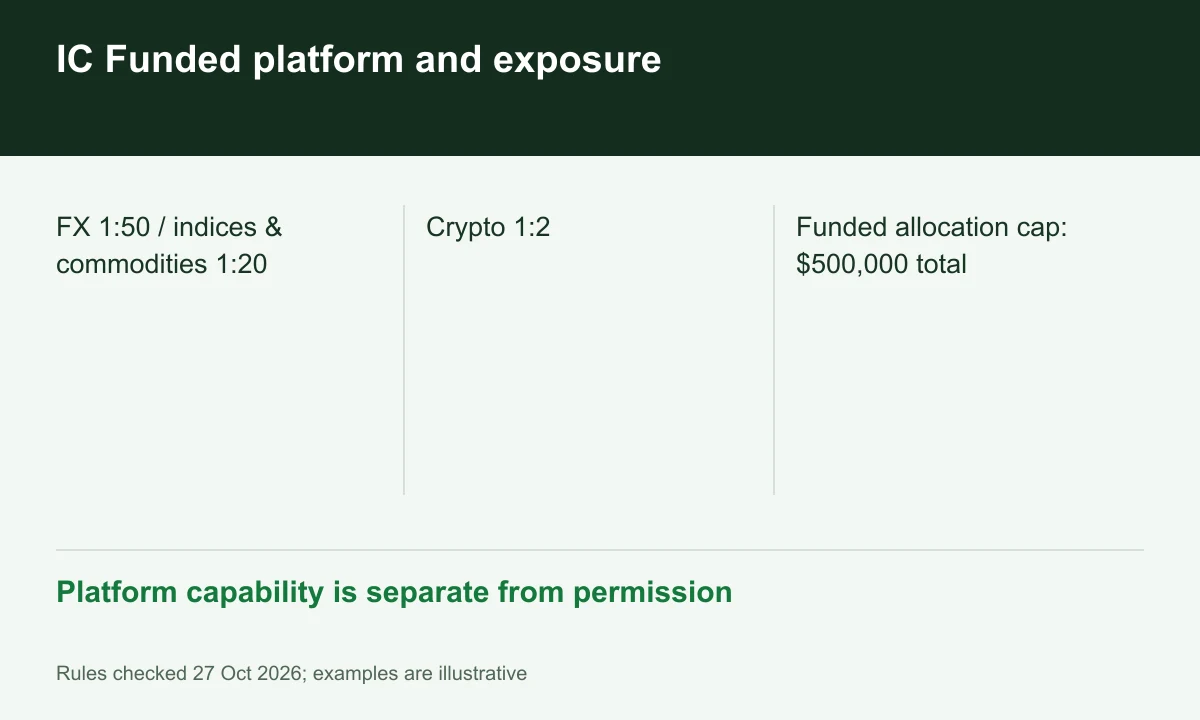
Guide
IC Funded offers MT5 and cTrader without an additional platform charge, but access to software is not approval of every strategy. Professional leverage varies by instrument, and multiple accounts share a $500,000 funded allocation cap per trader.
Read guide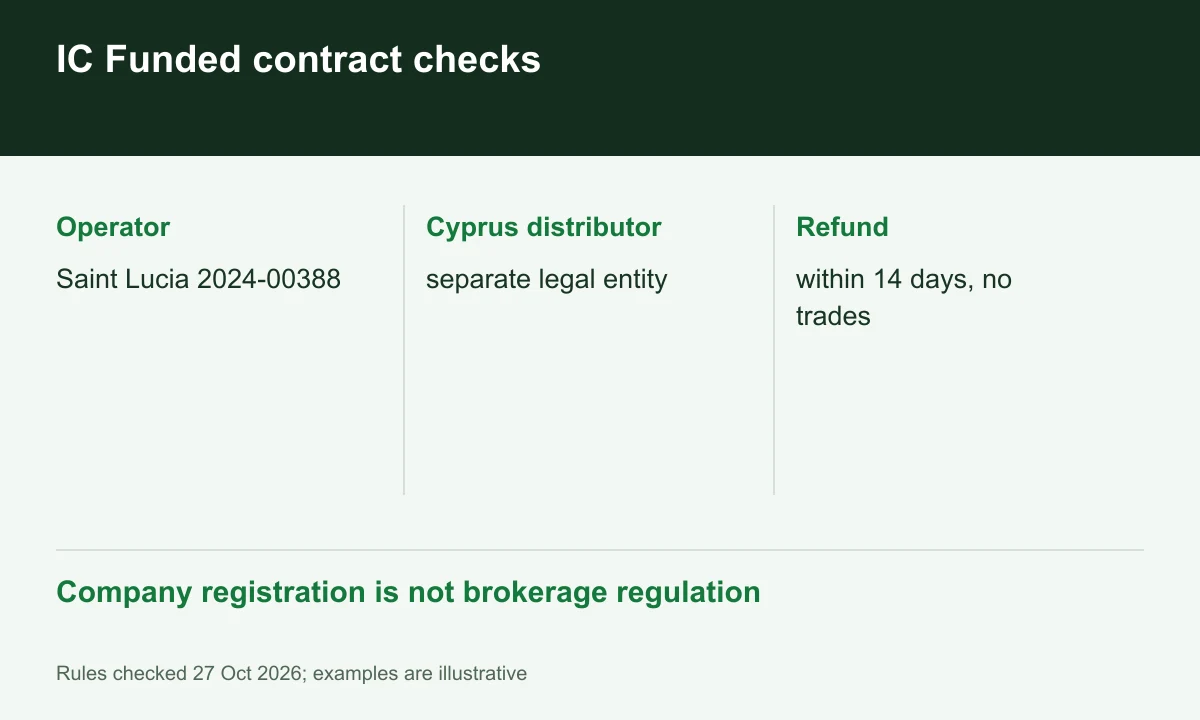
Guide
The current site names IC Funded Evaluations Ltd in Saint Lucia, registration 2024-00388, and a separate Cyprus distributor. It explicitly says it is not a broker. Check this contract and eligibility independently of the IC Markets name.
Read guide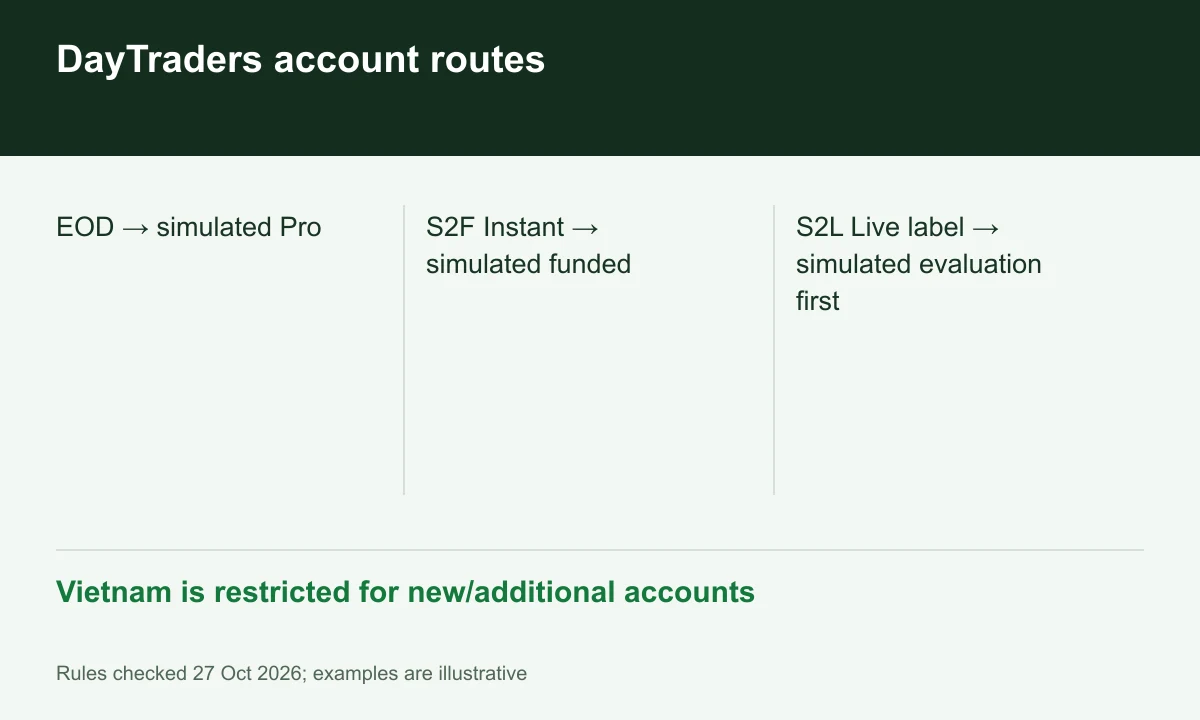
Guide
DayTraders at daytraders.com is distinct from TradeDay. Its current country policy excludes Vietnam from new or additional accounts. This informational review separates simulated Pro/S2F accounts from the S2L evaluation and eventual LIVE contract.
Read guide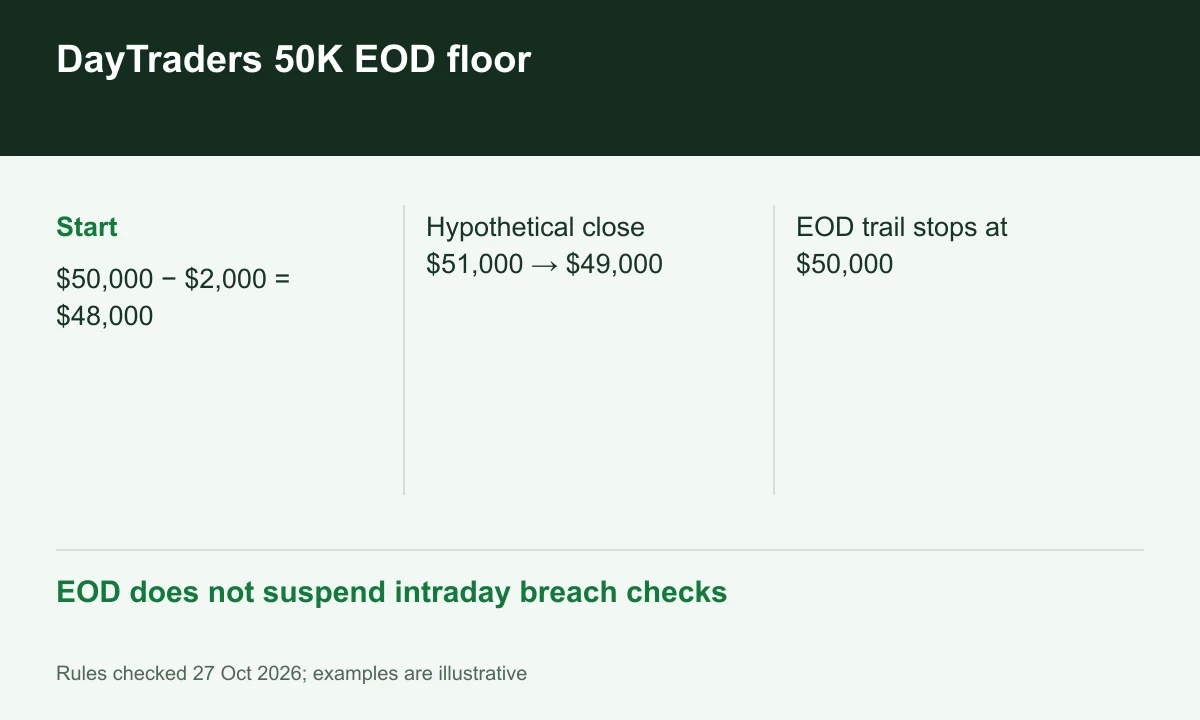
Guide
DayTraders EOD updates the trailing reference at the close but enforces the resulting floor during the session. For 50K, the $2,000 trail starts at $48,000 and stops at the $50,000 starting balance. Vietnam is restricted for new accounts.
Read guide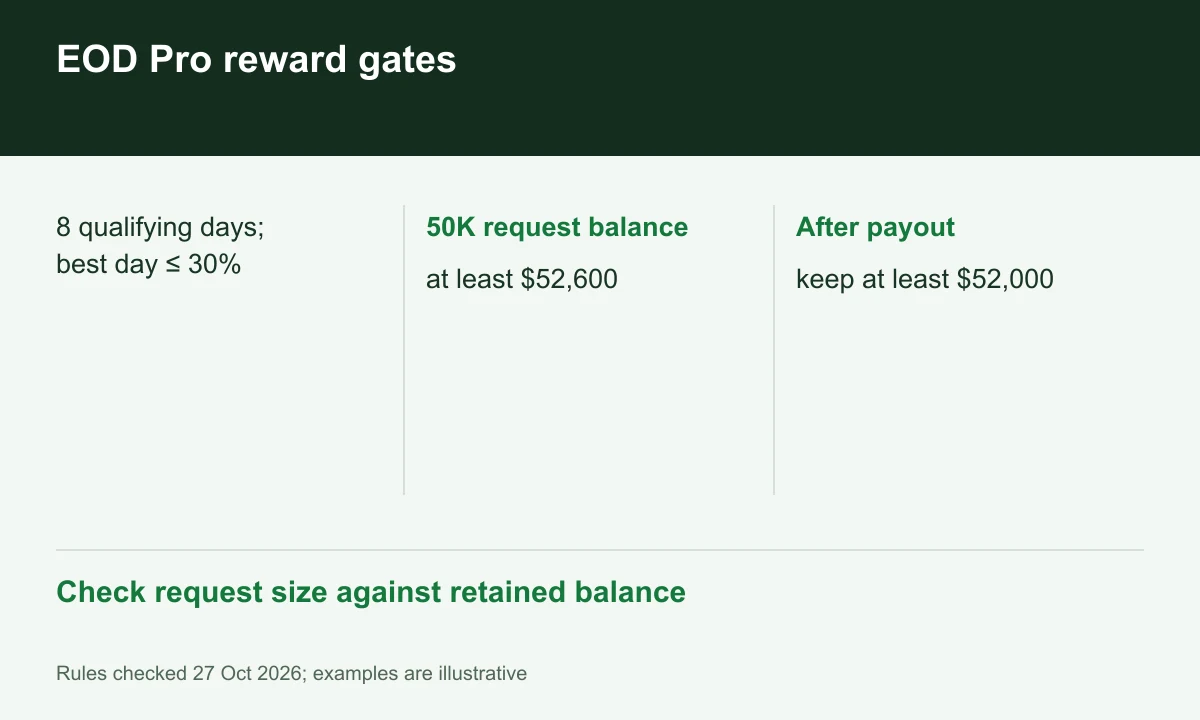
Guide
EOD Pro rewards require eight qualifying days, a best day no greater than 30% of cycle profit, and size-specific balance thresholds. The 50K minimum request balance is $52,600; at least $52,000 must remain after payout. Vietnam is restricted.
Read guide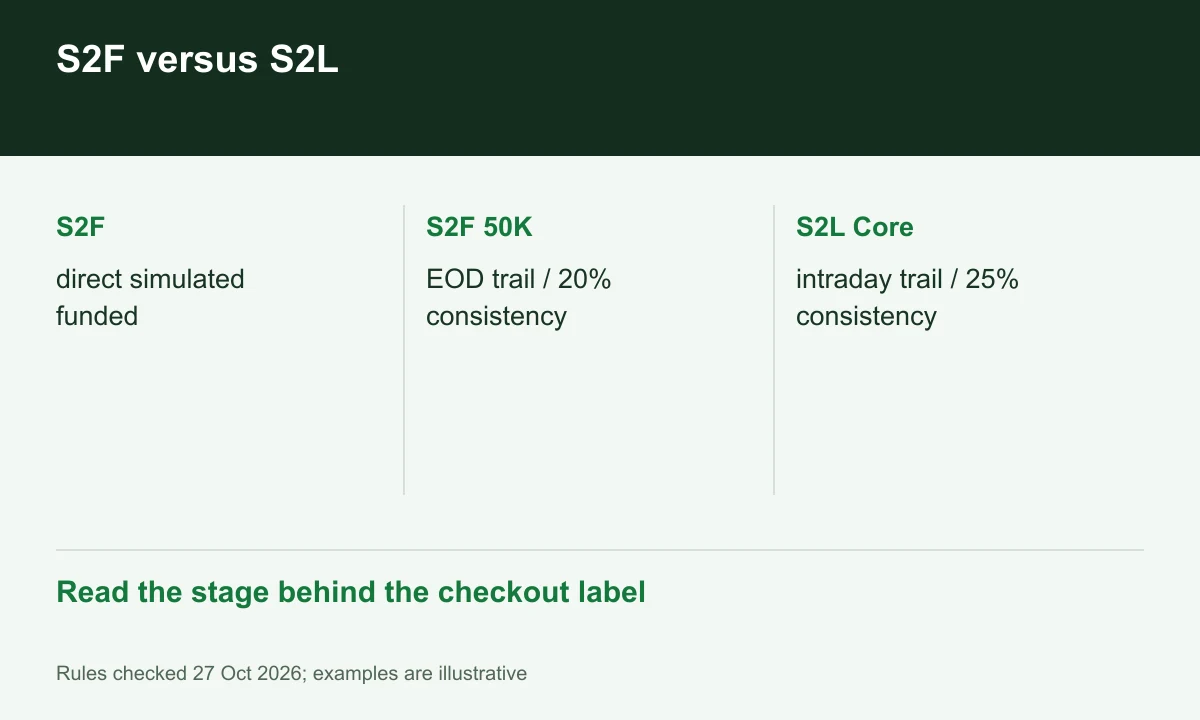
Guide
S2F gives direct simulated-funded access; S2L starts with a simulated evaluation leading to a reviewed LIVE setup. The checkout labels Instant and Live do not erase those stages. Vietnam is restricted from new or additional services.
Read guide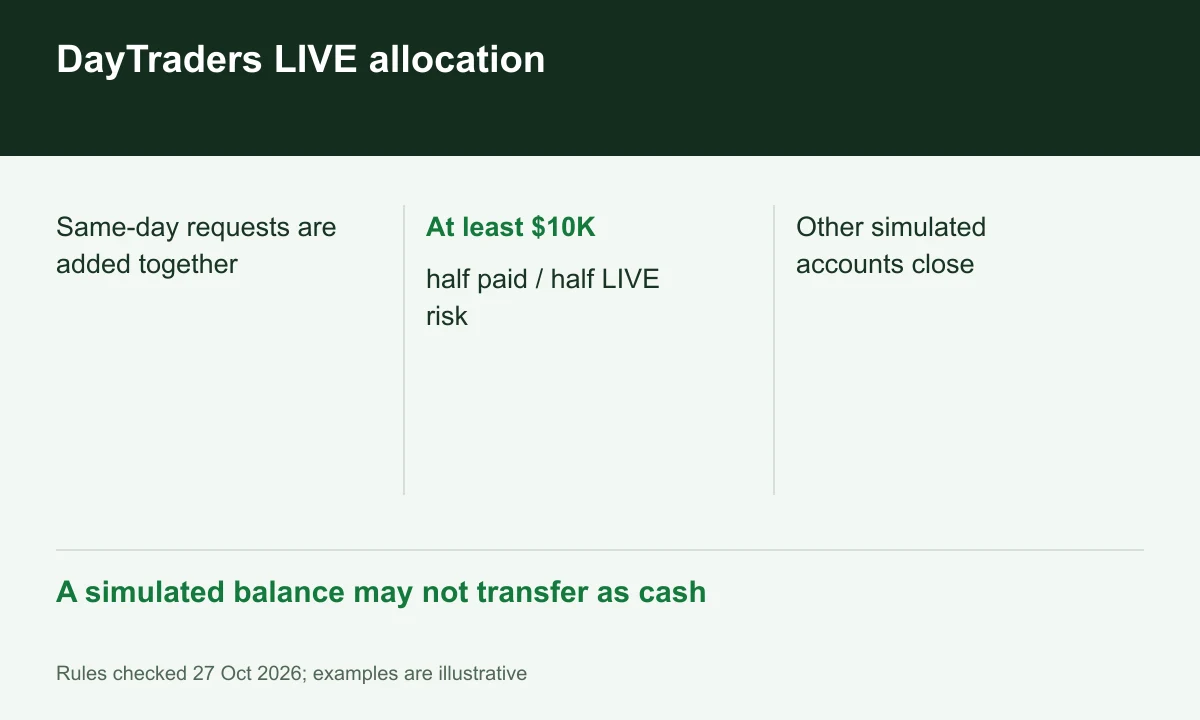
Guide
Pro/S2F LIVE invitations are discretionary, with no fixed milestone. If an invitation coincides with payout requests totalling at least $10,000 that day, the current policy splits half to payment and half to LIVE max drawdown. Vietnam remains restricted.
Read guide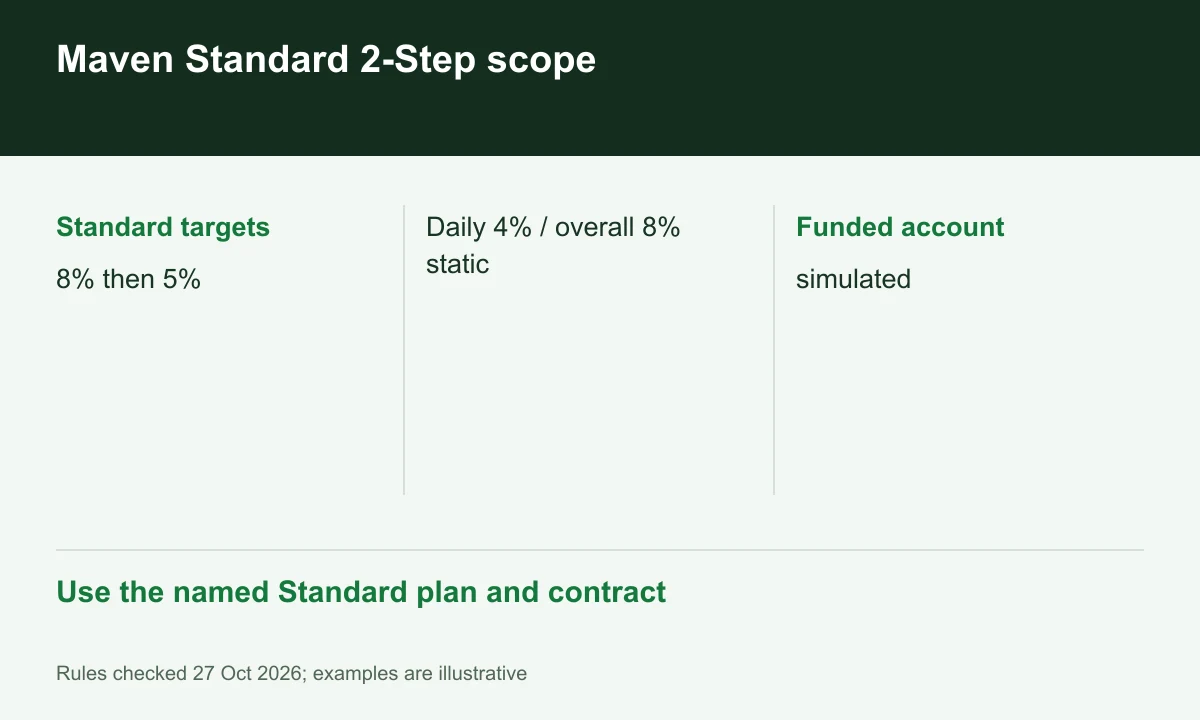
Guide
Maven Trading at maventrading.com is the retail prop programme reviewed here, not an institutional firm with a similar name. Standard 2-Step uses simulated accounts, 8%/5% targets and an 8% static overall limit. Vietnam is not listed in the reviewed exclusions, without individual pre-approval.
Read guide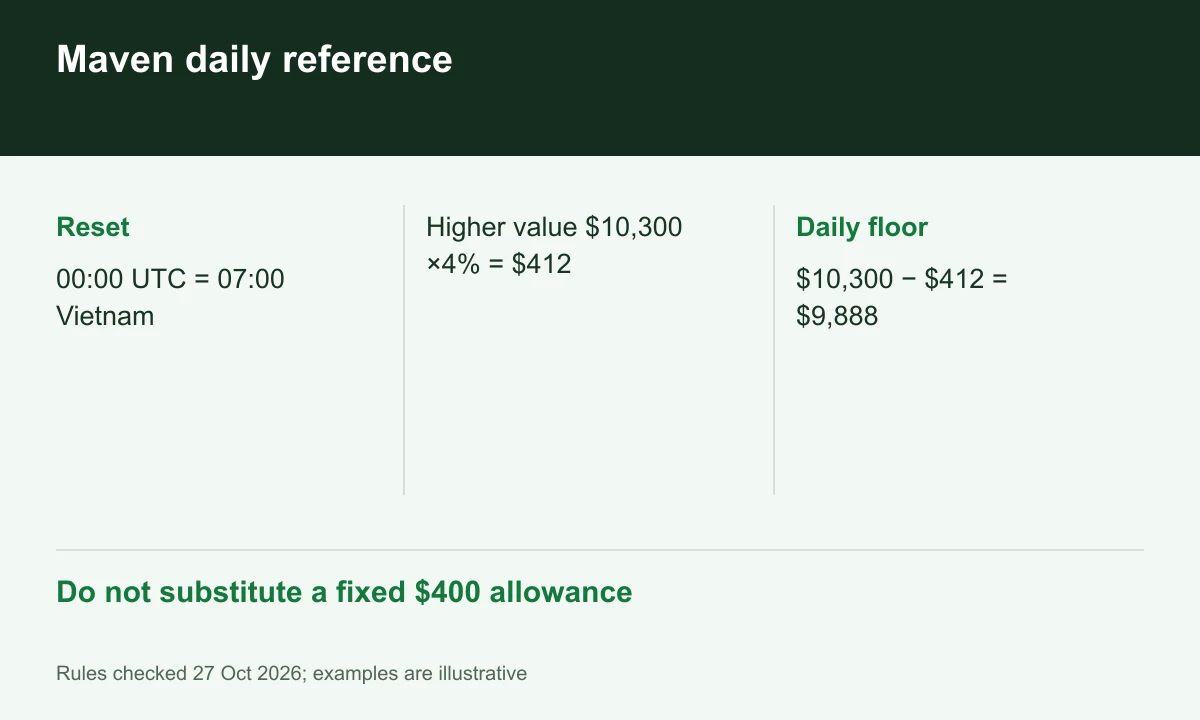
Guide
Maven’s Standard daily calculation uses the higher balance or equity at 00:00 UTC. The 4% allowance in its current FAQ is calculated from that reference, unlike a fixed-original-size method. The overall 8% floor stays static.
Read guide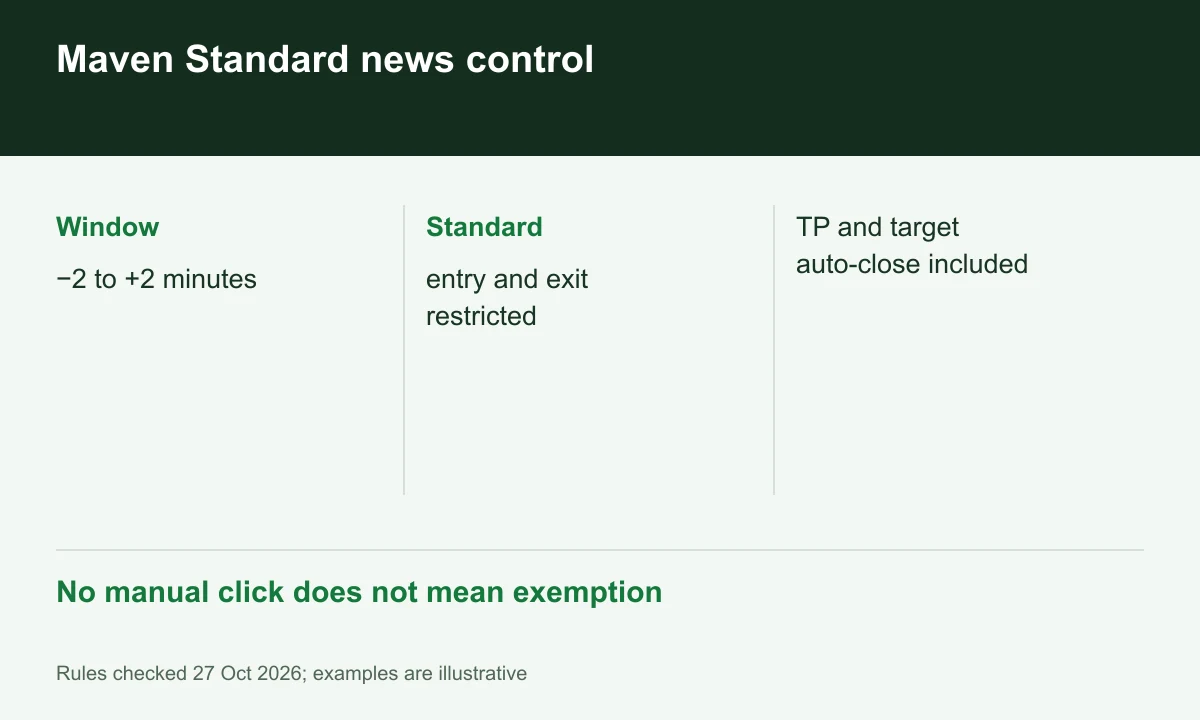
Guide
Standard plans restrict opening and closing affected trades within two minutes either side of relevant Red Folder news. The FAQ includes automatic take-profit and target-triggered closure. A hands-off exit is therefore not automatically exempt.
Read guide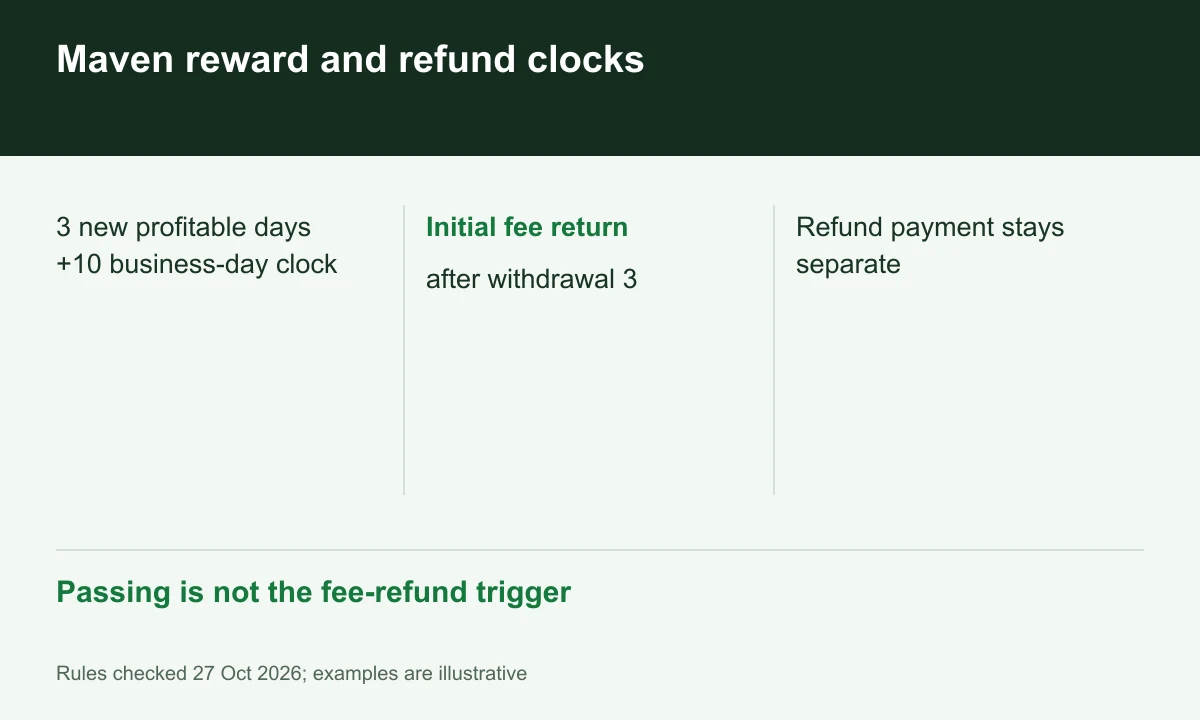
Withdrawals
Standard 2-Step needs three new profitable days per payout cycle and ten business days from its first qualifying cycle trade. A $10,000 pre-split cap applies across two payouts or a rolling 30 days. Initial fee return follows the third withdrawal separately, not passing.
Read guide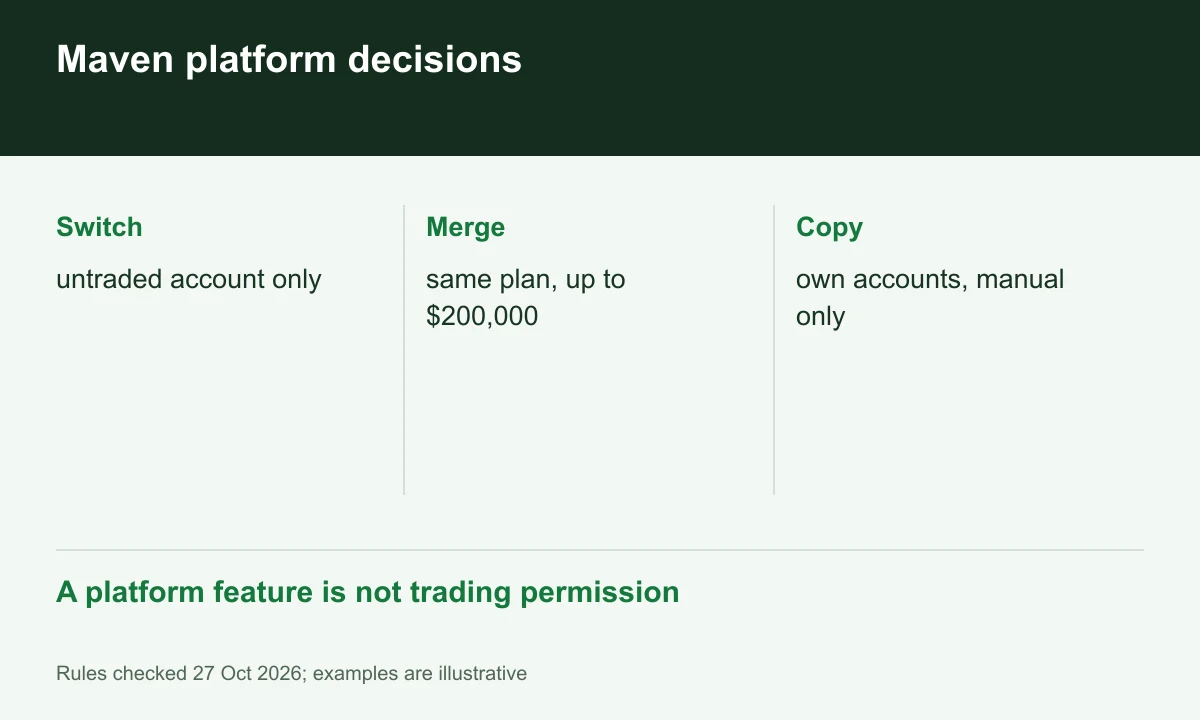
Guide
Maven names MT5 and Match Trader, but platform switching requires an untraded account and ends before Phase 2 or funded. Same-plan merge and own-account manual-copy rules have their own limits; software capability is not permission.
Read guide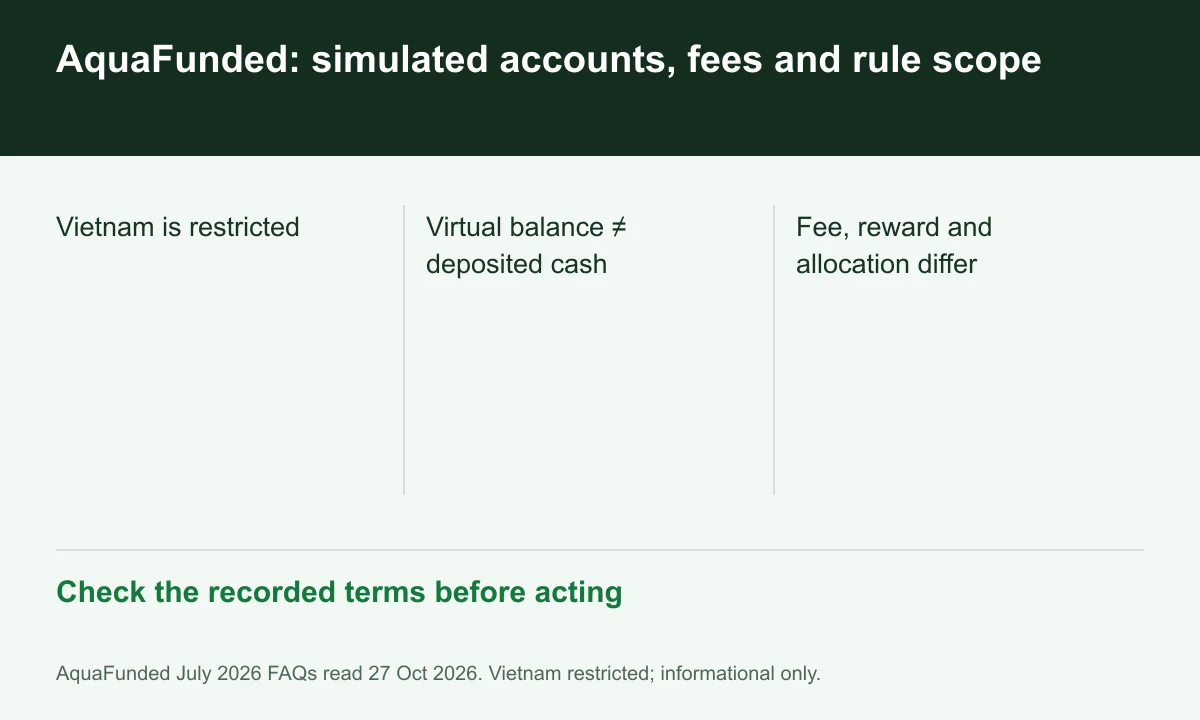
Guide
Read AquaFunded's simulated-account framework, Vietnam restriction, fee-refund milestone and account allocation separately from marketing claims about trading capital.
Read guide
Guide
Distinguish AquaFunded's restricted-country list from its conditional Instant-only group, and avoid turning a limited model allowance into worldwide access.
Read guide
Guide
Track AquaFunded's evaluation-fee refund milestone and hard-breach exclusion, keeping a conditional refund separate from challenge completion and simulated profit.
Read guide
Guide
Understand AquaFunded's inactivity trigger from the first trade, distinguish an inactivity breach from a fee, and keep dated records without assuming a holiday pause.
Read guide
Guide
Separate AquaFunded evaluation count from active funded allocation, check breakeven merging conditions, and keep Instant Funding exclusions and country caps visible.
Read guide
Guide
Read Crypto Fund Trader's simulated programme structure and conflicting minimum-day pages before matching drawdown, platform eligibility and performance rewards.
Read guide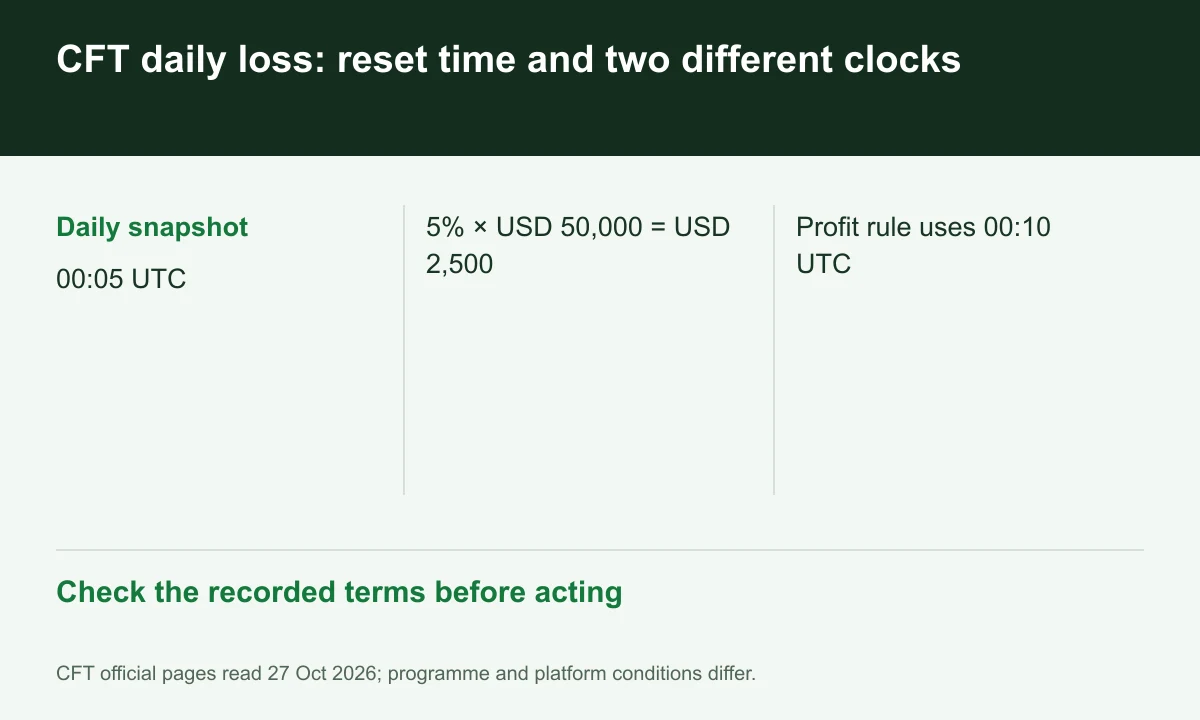
Guide
Calculate a hypothetical CFT 2-Phase daily allowance using its 00:05 UTC snapshot, while separating the 00:10 profit-cap clock and equity-based breach check.
Read guide
Guide
Work through Crypto Fund Trader's 1-Phase balance-based trailing floor with an original hypothetical example, retaining equity monitoring and the separate daily limit.
Read guide
Guide
Compare CFT's platform-specific country statements without mistaking its Bybit policy for permission from the exchange or treating a simulated sub-account as personal deposits.
Read guide
Guide
Understand CFT's daily/per-trade simulated profit ceiling and grouped executions, while retaining the detailed reverse-trading restrictions and source wording differences.
Read guide
Guide
Read Moneta Funded's September contract, Vietnam restriction and account-specific rule hierarchy before interpreting simulation balances, payout options or scaling claims.
Read guide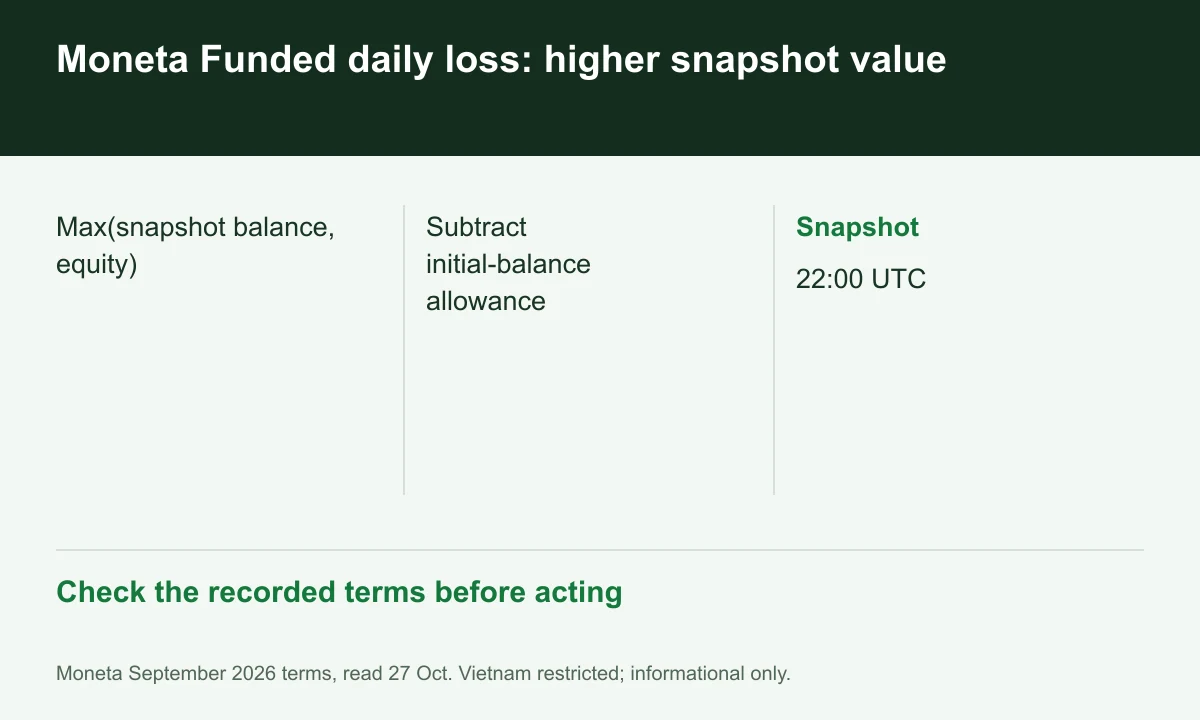
Guide
Apply Moneta Funded's higher-of-balance-or-equity snapshot formula with a hypothetical allowance, and distinguish the 22:00 UTC reset from a generic midnight rule.
Read guide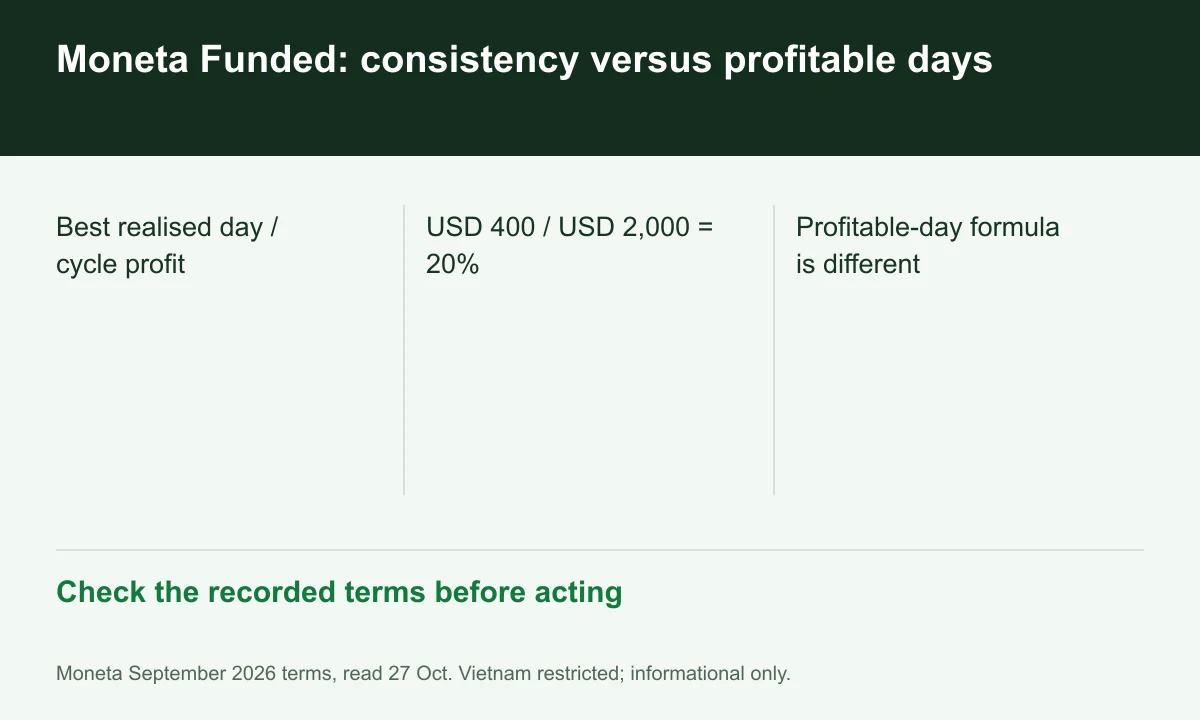
Guide
Separate Moneta Funded's realised-profit consistency ratio from its minimum-of-balance-and-equity day test, using labelled examples rather than assuming one programme limit.
Read guide
Guide
Read Moneta Funded's optional broker-transfer agreement, bonus withdrawal restrictions and deduction triggers without treating a larger credit number as cash available now.
Read guide
Guide
Compare Moneta Funded's aggregate and per-challenge account limits, while recognizing that related positions may be one trade idea rather than independent risks.
Read guide
Guide
Read Atmos's current company disclosure beside its older Cyprus agreement, then separate simulated capital, challenge fees and account-specific trading rules.
Read guide
Guide
Distinguish Atmos's static floor from its trailing equity model, using a hypothetical calculation while leaving programme percentages and locking conditions account-specific.
Read guide
Guide
Read Atmos's funded-stage two-minute news restriction as an entry-and-exit rule, then check affected instruments and pending-order risks without inventing event eligibility.
Read guide
Guide
Read Atmos's dated refund PDF for pre-trade cancellation conditions, keeping the contracting-company question and service termination separate from a payout request.
Read guide
Guide
Compare Atmos's current payout summary with its dated refund PDF, separating cycle eligibility, approval, payment processing and any optional broker transfer.
Read guide
Guide
Read Goat Funded Trader's current access rules separately from its retired 2-Step PRO model, keeping simulated accounts and restricted-country checks explicit.
Read guide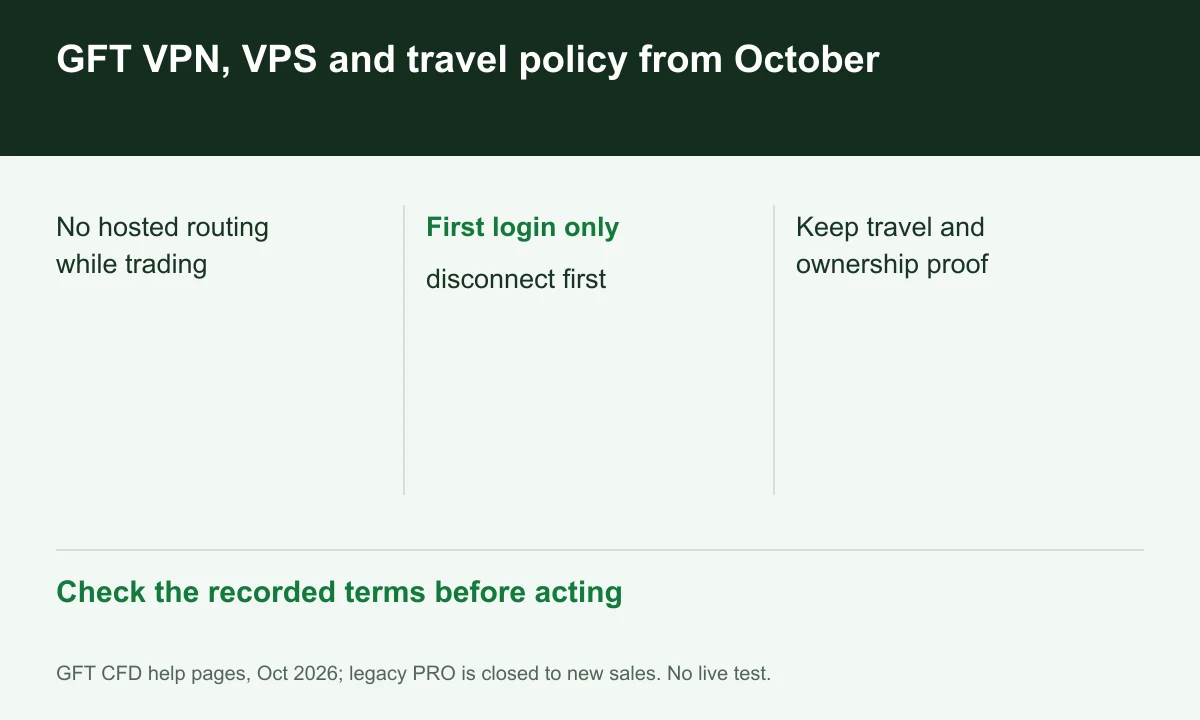
Guide
Read Goat Funded Trader's October hosting prohibition, first-login exception and travel evidence requirements without assuming a dedicated VPS remains permitted.
Read guide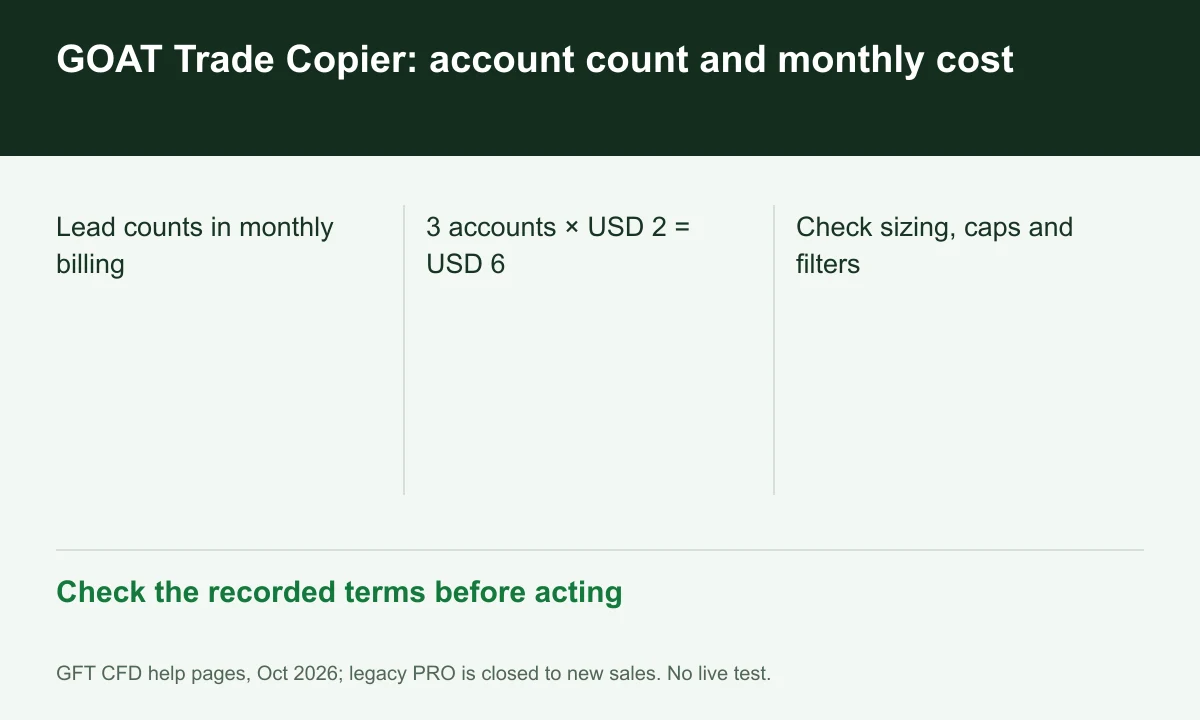
Guide
Calculate GOAT Trade Copier's subscription by counting the lead and followers, then check sizing controls and the narrow exception to the hosted-trading prohibition.
Read guide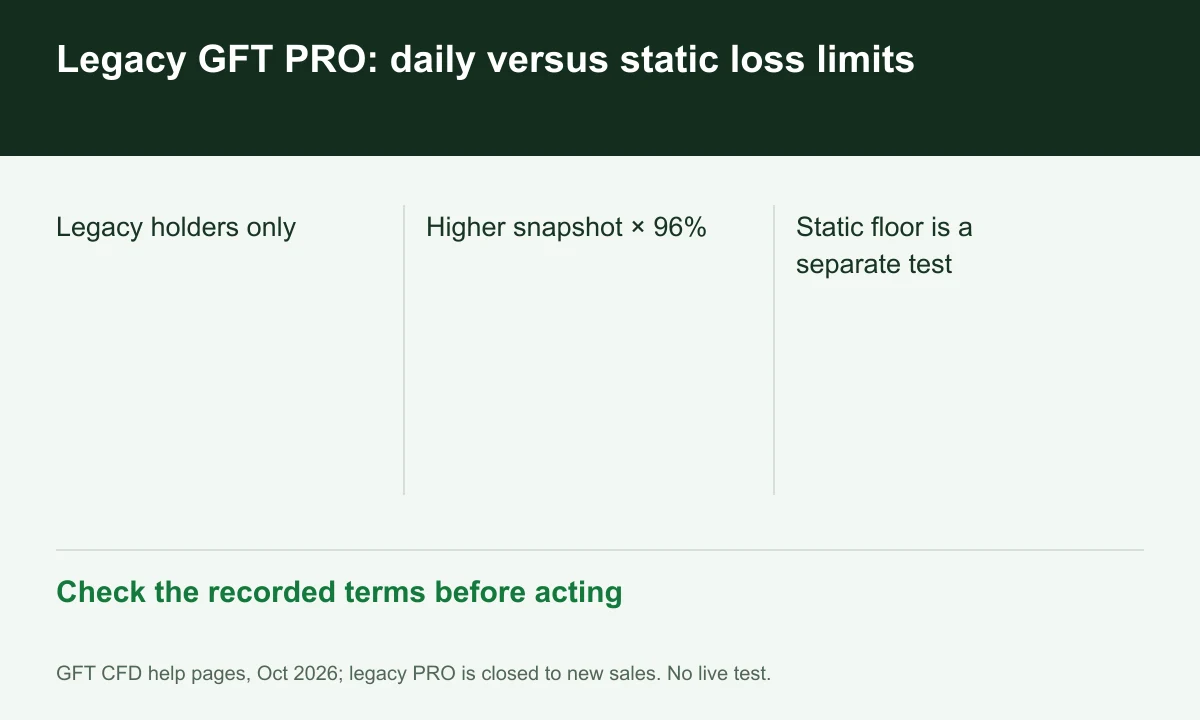
Guide
Read the retired GFT 2-Step PRO model's higher-snapshot daily test alongside its initial-balance static floor, using a clearly hypothetical existing-account example.
Read guide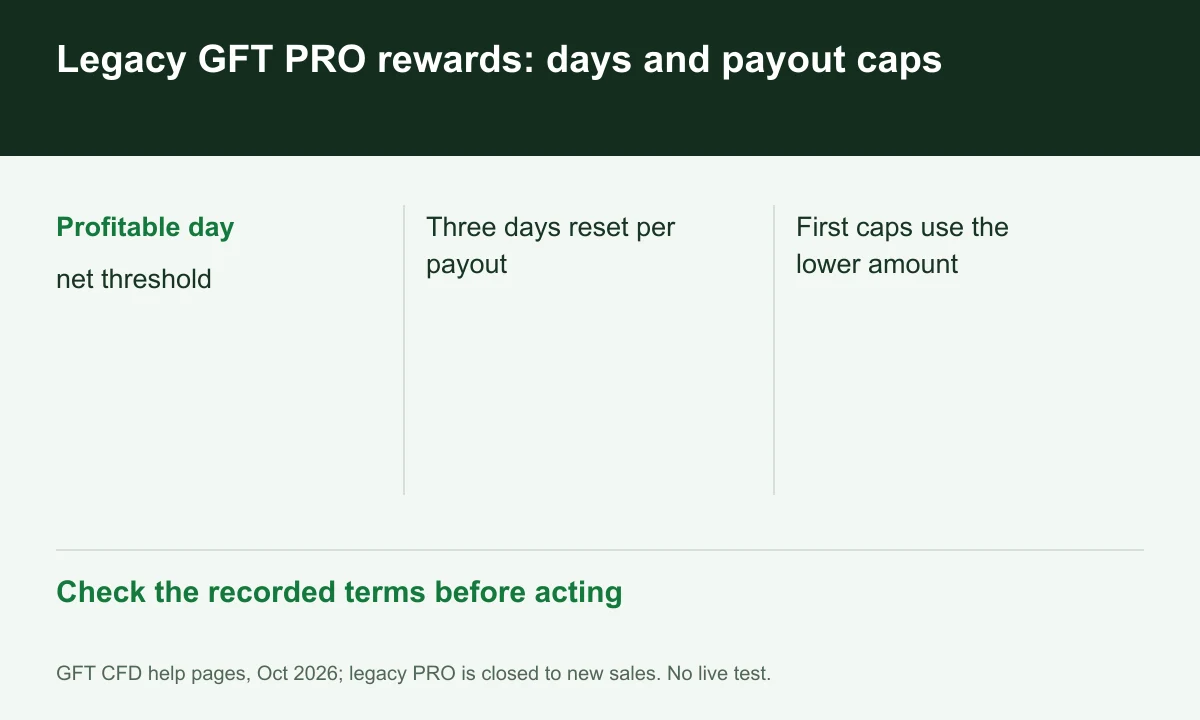
Guide
Distinguish legacy GFT PRO profitable-day requirements, daily profit deductions and first-payout caps, rather than treating any positive trading day as sufficient.
Read guide
Guide
Match For Traders' selected asset class and account rules with the contract, separating virtual allocation, evaluation completion and discretionary reward approval.
Read guide
Guide
Read For Traders' account-specific activation-fee clauses beside one-time-fee marketing, and identify the unresolved '[X] days' deadline before relying on it.
Read guide
Guide
Follow For Traders' completed-trade definition for inactivity, distinguish opening from closing, and retain the selected service's timer rather than a universal assumption.
Read guide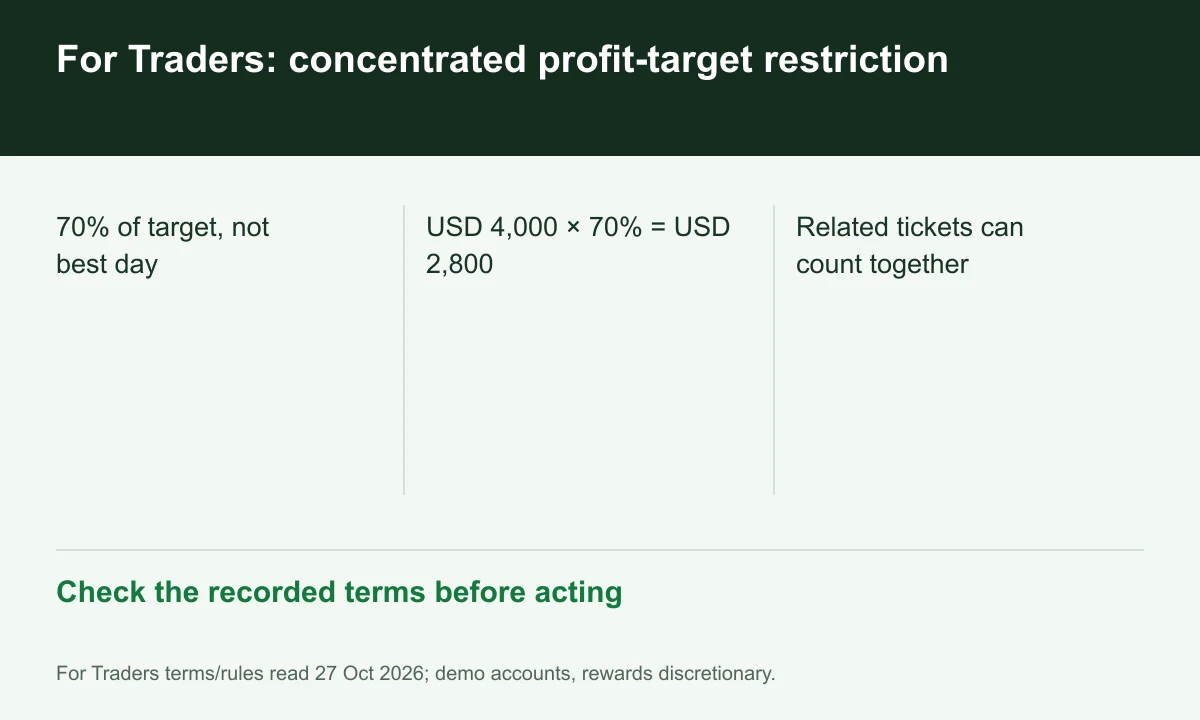
Guide
Read For Traders' more-than-70%-of-target restriction across a single trade or same-symbol direction, with a hypothetical calculation that does not imply a safe boundary.
Read guide
Guide
Distinguish For Traders' 48-hour verification-call booking requirement from the scheduled call date and reward marketing timelines, keeping approval discretion clear.
Read guide
Guide
Read FundedElite's Quantum SRL contract alongside Lite and Catalyst marketing, separating simulated accounts, programme configuration and conditional rewards.
Read guide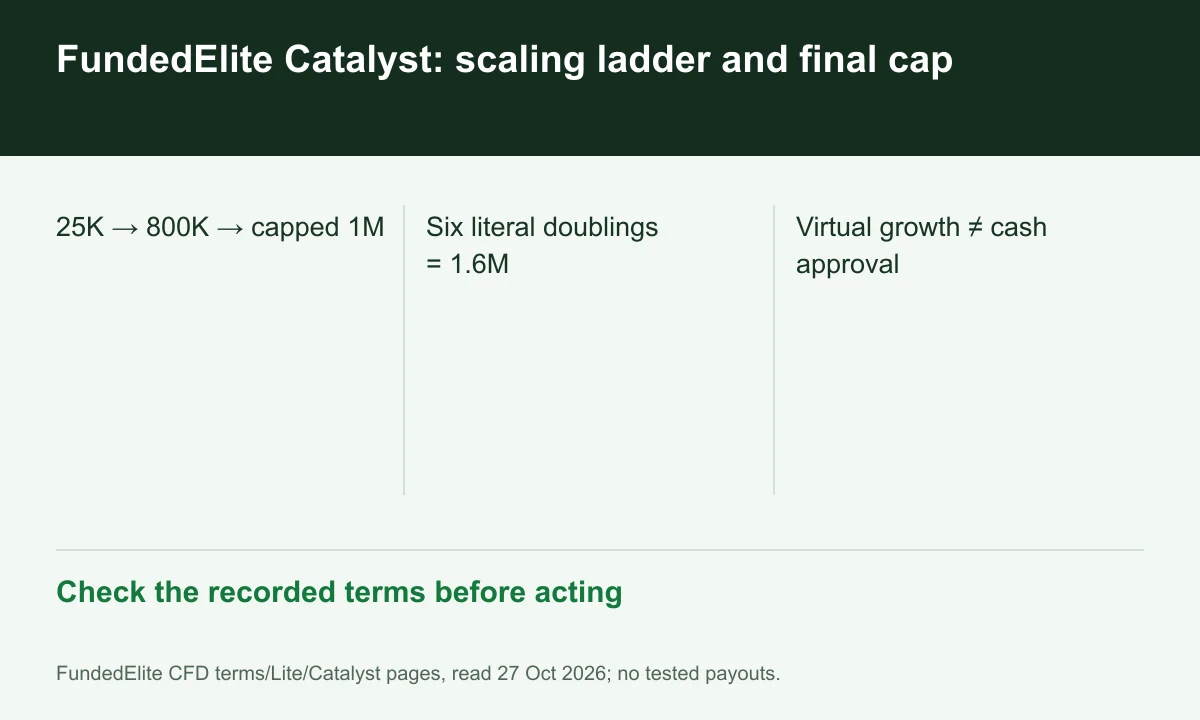
Guide
Read Catalyst's displayed 25K-to-1M ladder without repeating literal six-doubling arithmetic, and separate virtual account growth from an approved cash reward.
Read guide
Guide
Check FundedElite's pre-trading fourteen-day refund conditions and programme-specific completion refund, without treating either route as an unconditional money-back promise.
Read guide
Guide
Track FundedElite's identity and risk interviews, five-business-day attendance requirement and same-name payout checks separately from marketing processing timelines.
Read guide
Guide
Read FundedElite's one-user-account definition, personal-use requirement and conditional copying/tool rules without assuming technical platform support means permission.
Read guide
Guide
Read Lark Funding's simulated-account framework and payment-provider eligibility alongside programme-specific loss rules, drawdown locks and add-on timing.
Read guide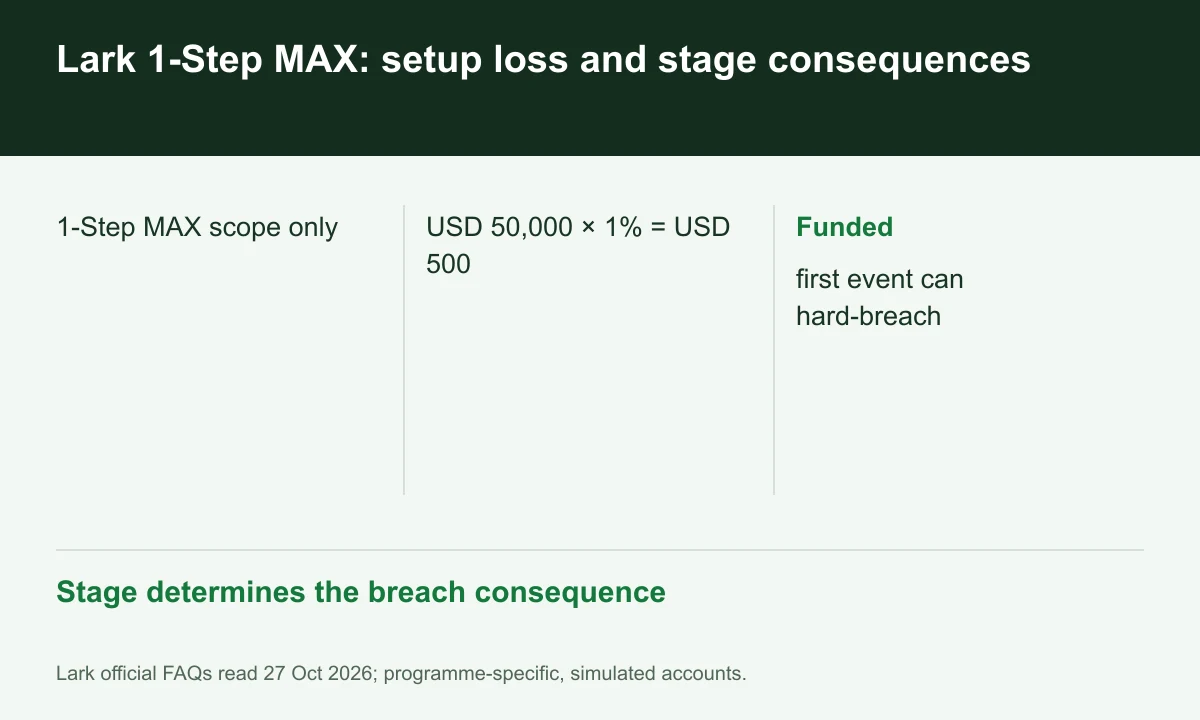
Guide
Work through Lark's fixed one-percent setup-loss example and the difference between evaluation soft breaches and the funded stage's immediate hard breach.
Read guide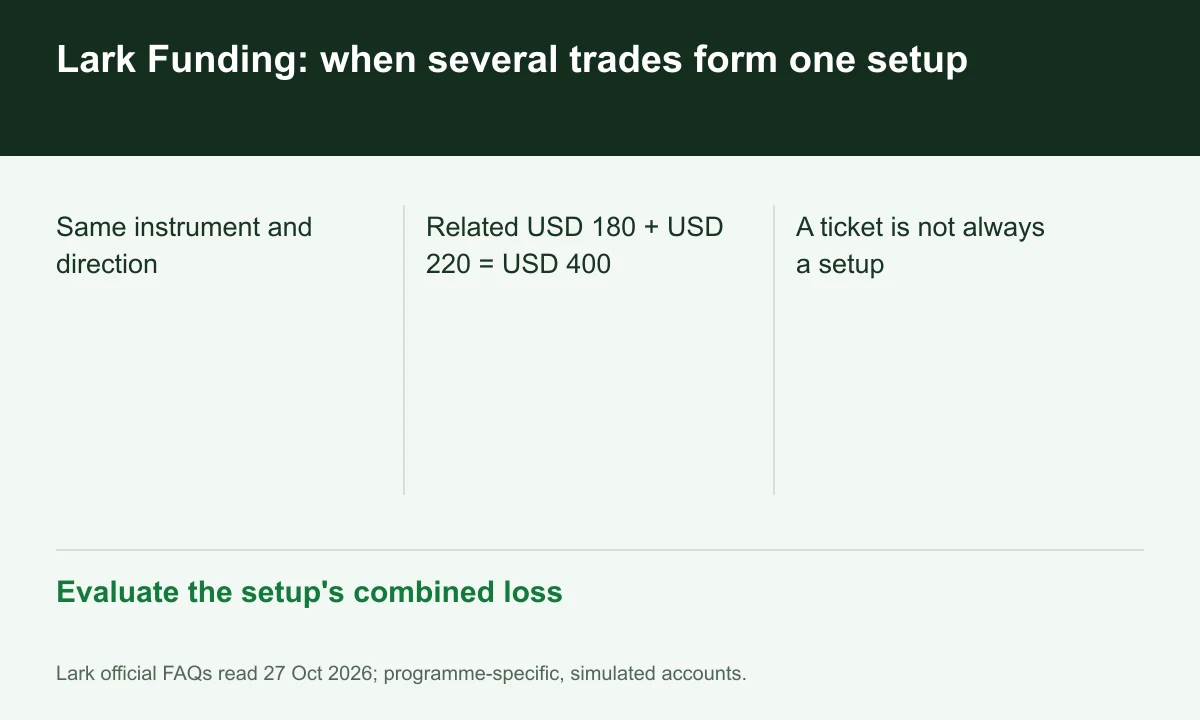
Guide
Read Lark's same-instrument, same-direction setup grouping and combine related losses in a hypothetical example instead of assuming each ticket gets a fresh limit.
Read guide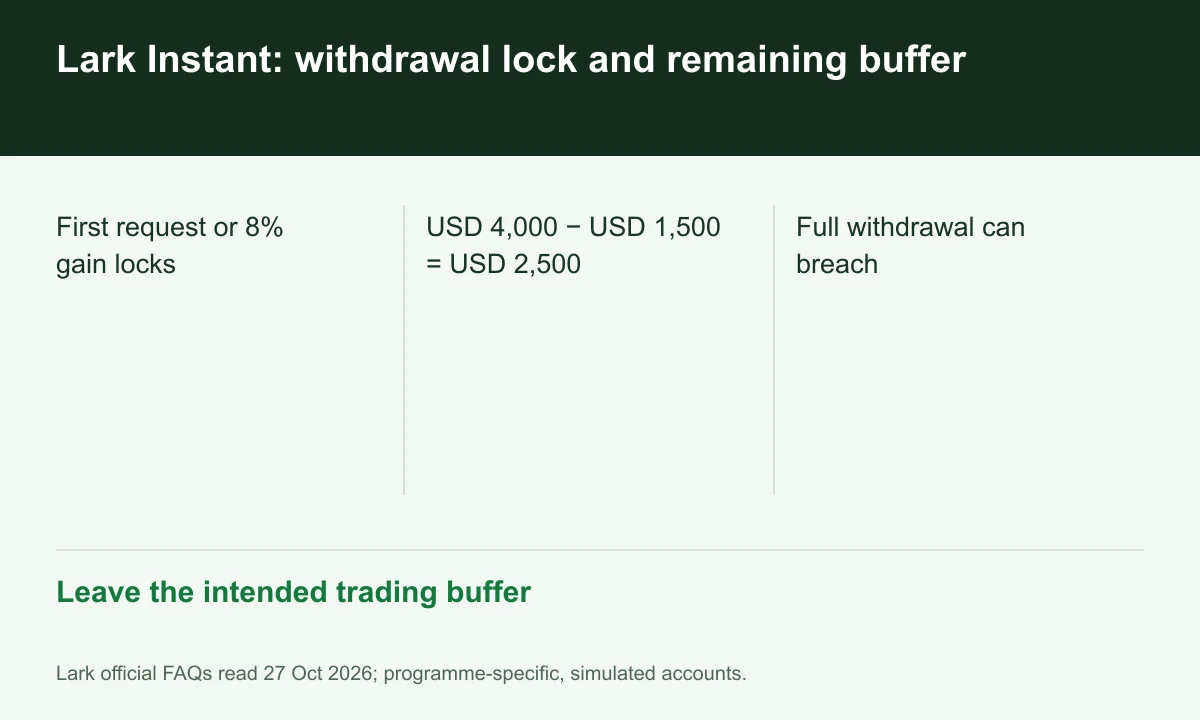
Withdrawals
Calculate a hypothetical remaining buffer after a Lark Instant withdrawal, keeping the first-request lock and eight-percent milestone separate from payout approval.
Read guide
Guide
Read Lark's pre-pass add-on cutoff as a configuration decision, while distinguishing it from instant-account rules, payment eligibility and unverified promotion claims.
Read guide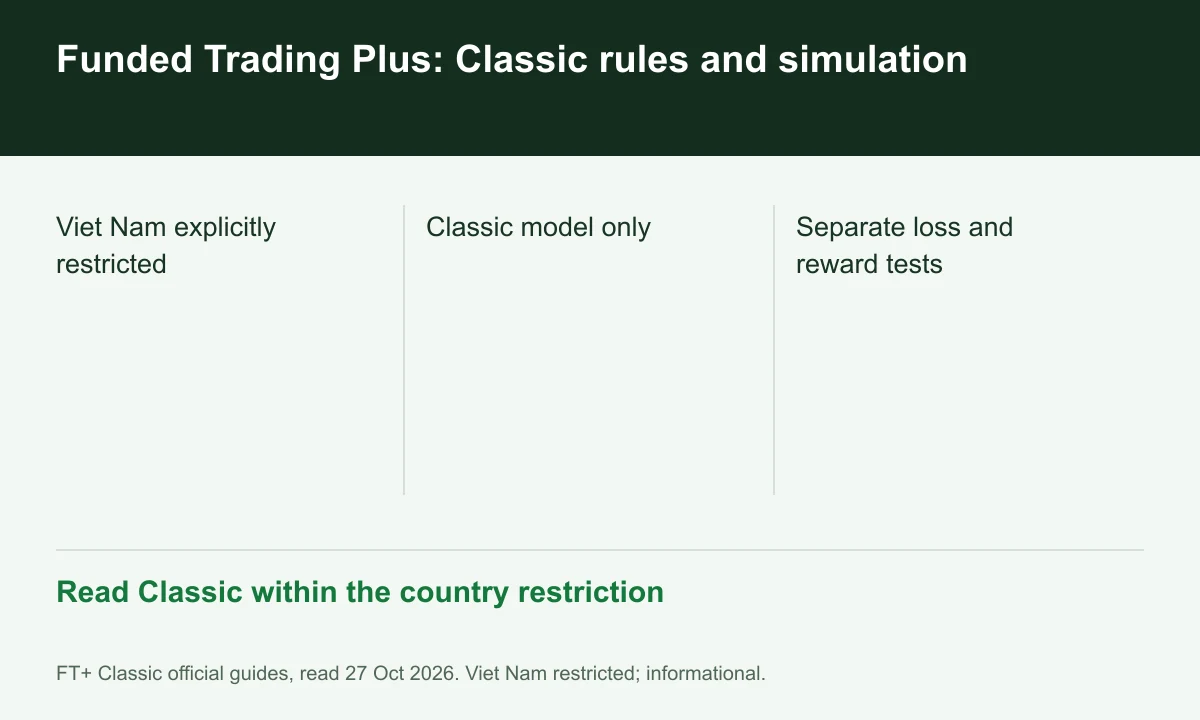
Guide
Read Funded Trading Plus Classic's phase-specific risk and reward rules with its explicit Vietnam restriction, without treating simulated balances as cash deposits.
Read guide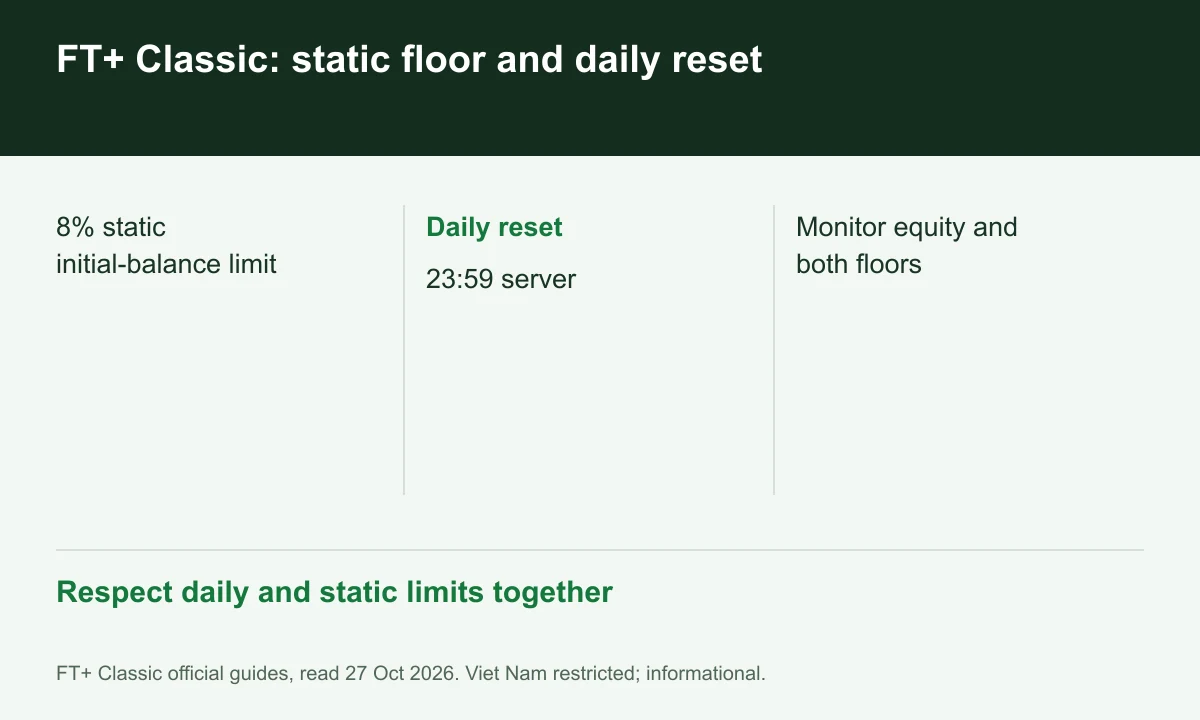
Guide
Compare FT+ Classic's initial-balance static drawdown with its prior-closed-balance daily reset, using a hypothetical starting size and preserving server-time scope.
Read guide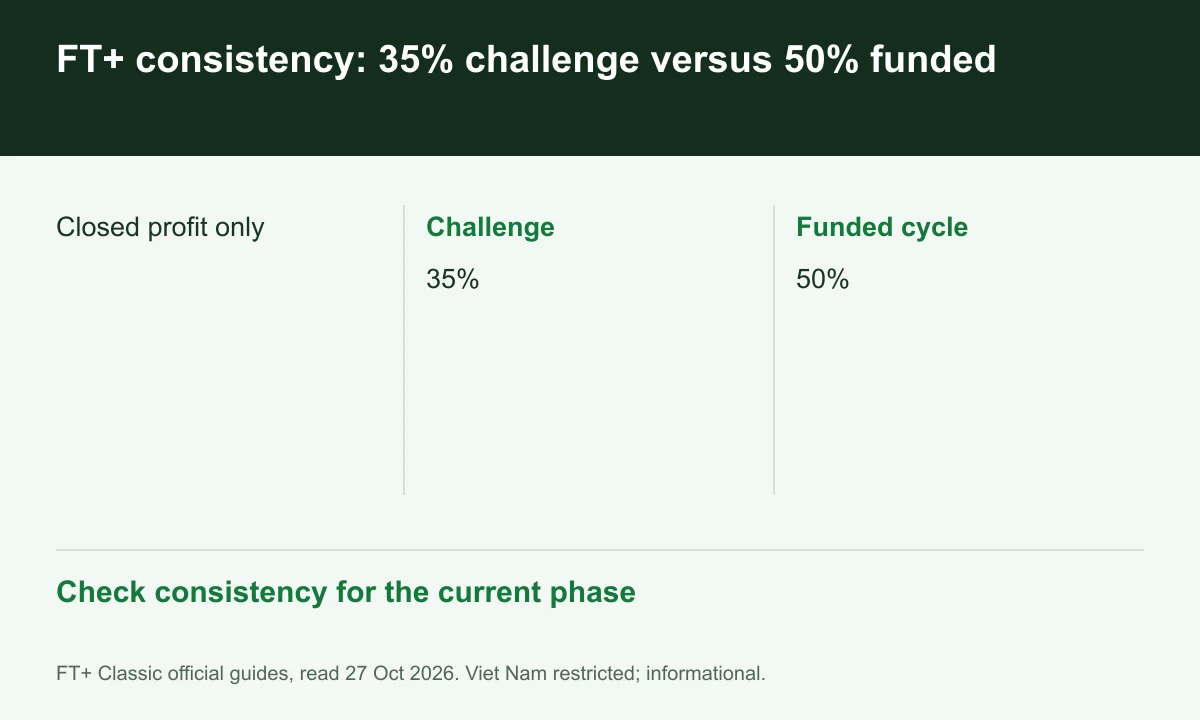
Guide
Calculate FT+ Classic's closed-profit consistency ratio, retaining separate challenge and payout periods instead of assuming target achievement is sufficient.
Read guide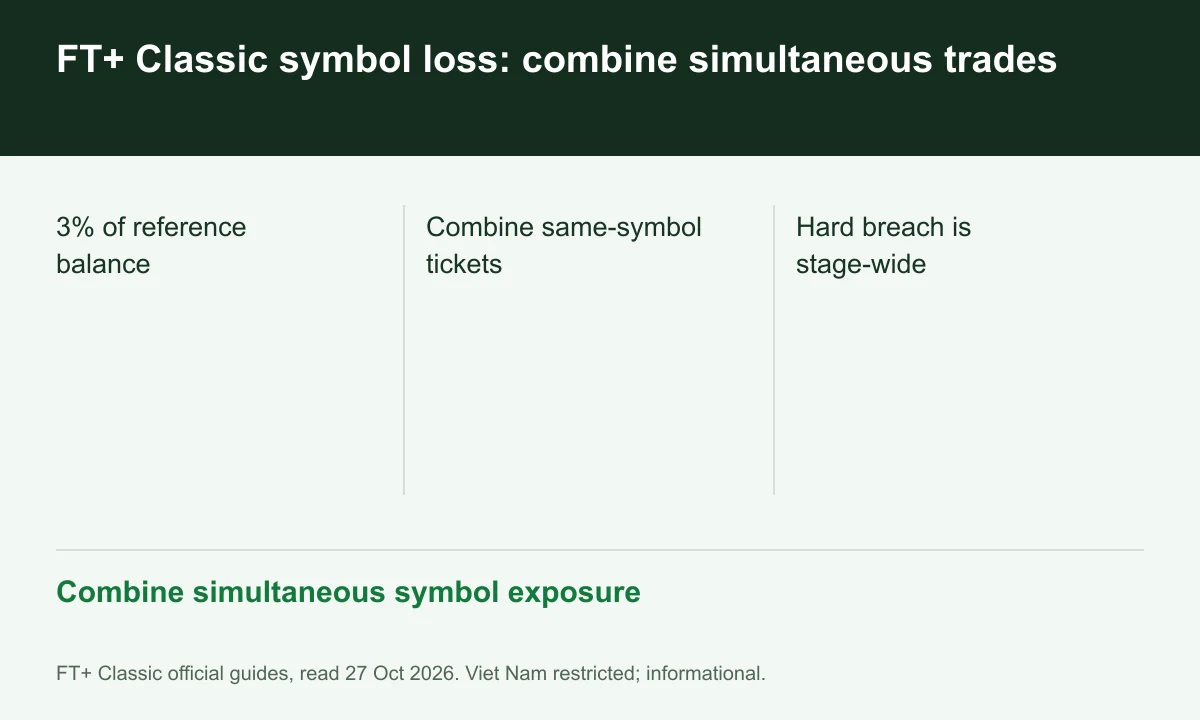
Guide
Read FT+ Classic's three-percent symbol-loss hard breach and combine simultaneous positions on one instrument before comparing them with an account-level daily limit.
Read guide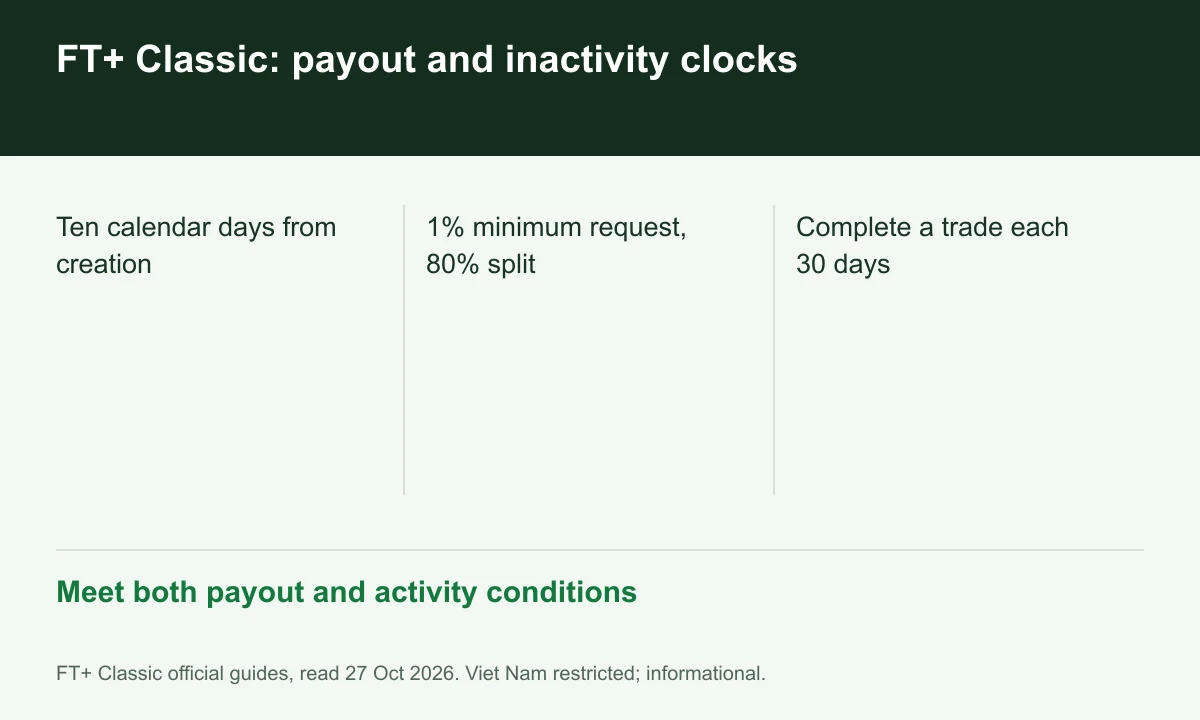
Guide
Separate FT+ Classic's ten-day payout eligibility, minimum request and completed-trade inactivity requirement, retaining unresolved examples rather than promising receipt.
Read guide
Guide
Read Finotive Funding's current contract hierarchy, simulated-service definition and separate group-company roles before applying marketing, dashboard or FAQ statements.
Read guide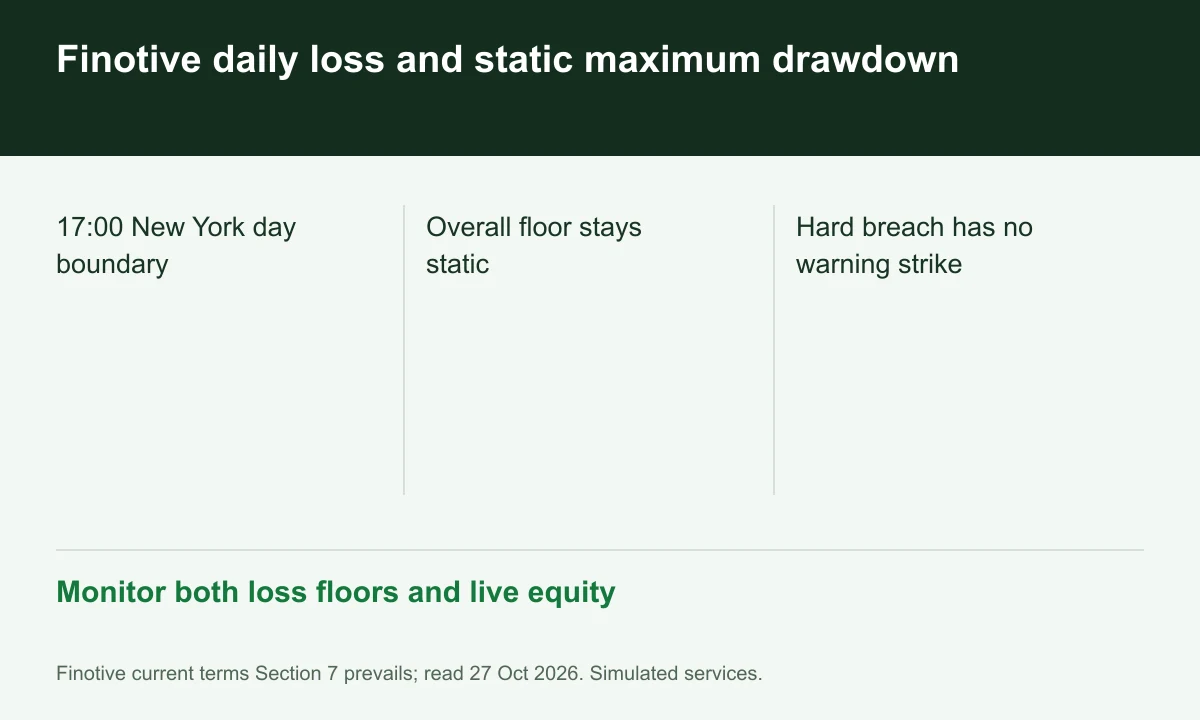
Guide
Compare Finotive's New York daily-loss reset with its static overall floor, keeping product-specific percentages and immediate hard-breach consequences explicit.
Read guide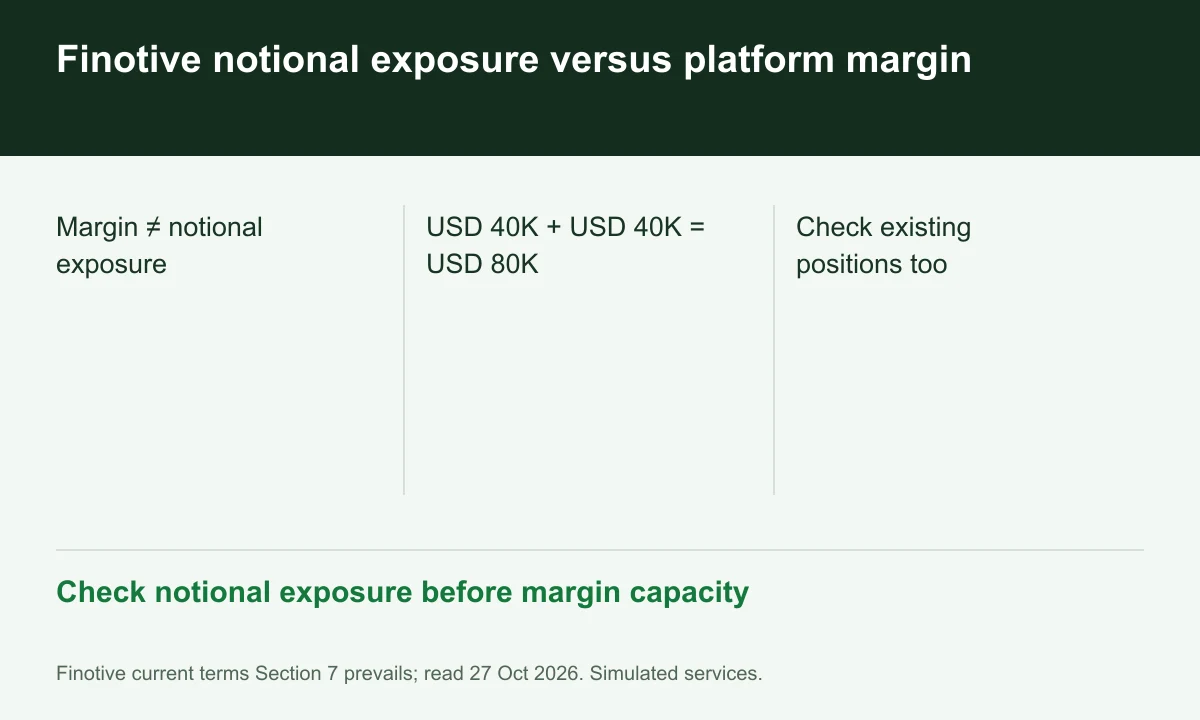
Guide
Distinguish Finotive's Notional Volume Limit from leverage and margin availability, using a clearly hypothetical exposure comparison and its dashboard calculator workflow.
Read guide
Guide
Read Finotive's account-specific Rapid Reset offer, retained breach history and current-rule treatment instead of assuming the same login restores the original contract.
Read guide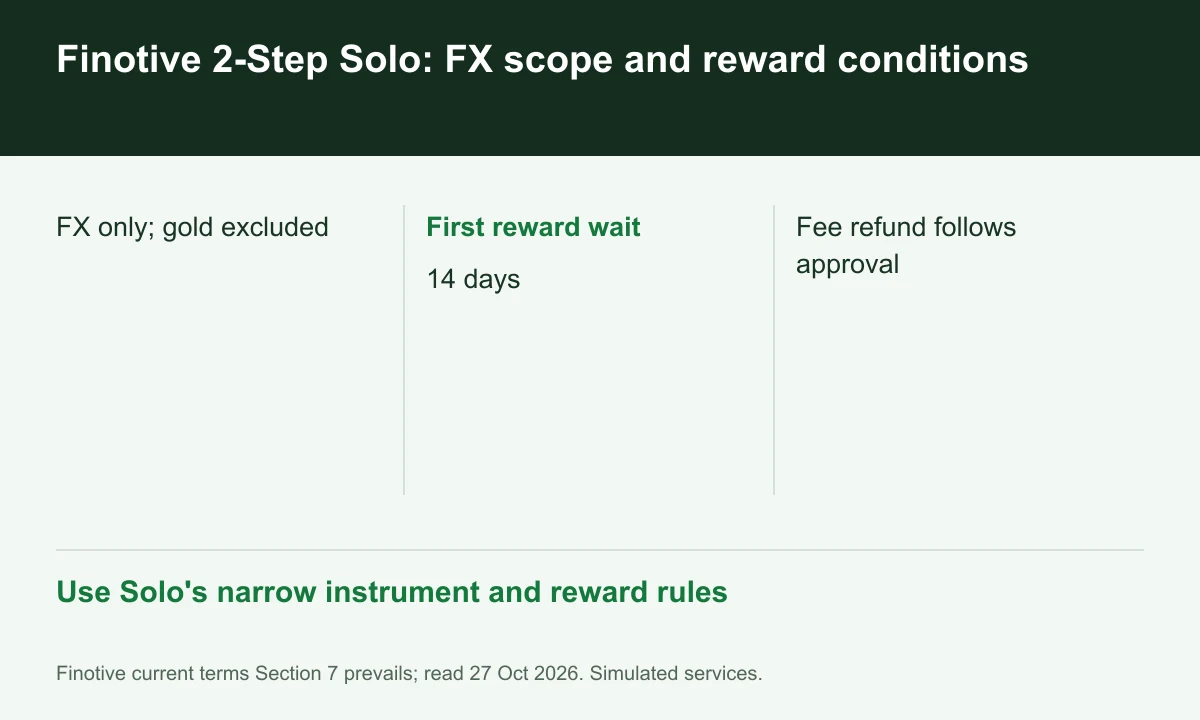
Guide
Read Finotive Solo's FX-only universe and specific rule exceptions, then separate first reward timing and fee refund from unsupported commission-volume assumptions.
Read guide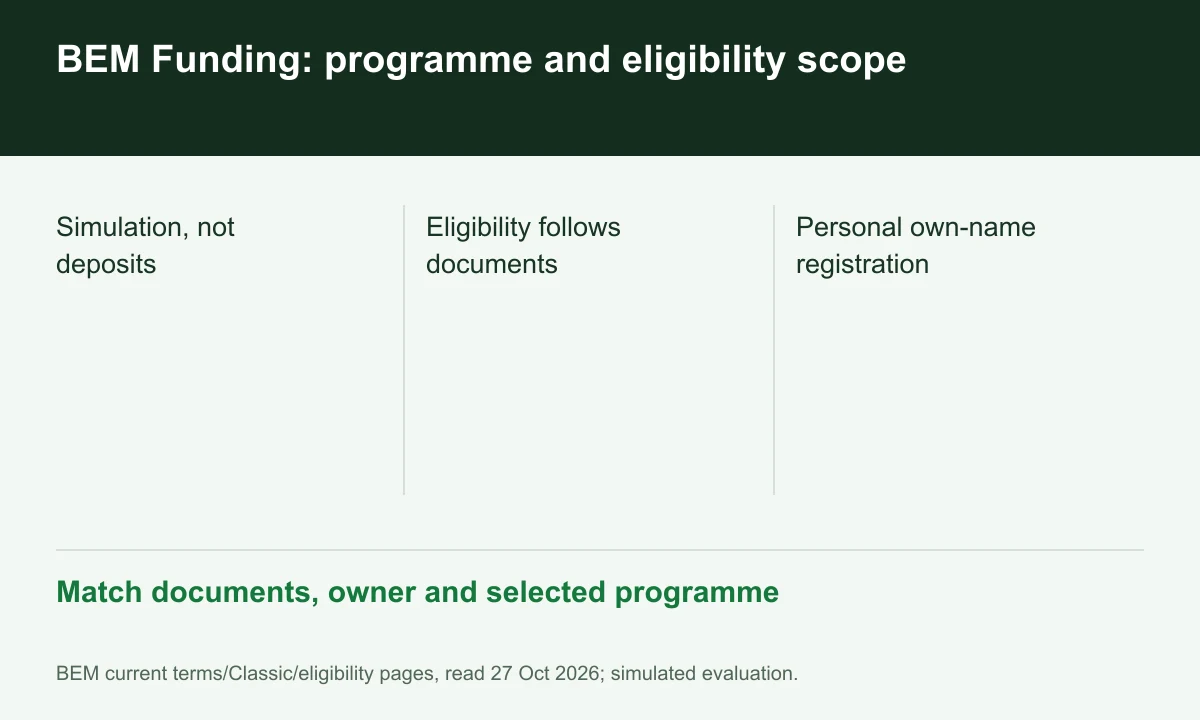
Guide
Read BEM Funding's current simulation contract and document-based eligibility alongside Classic's account rules, preserving personal registration and payment ownership.
Read guide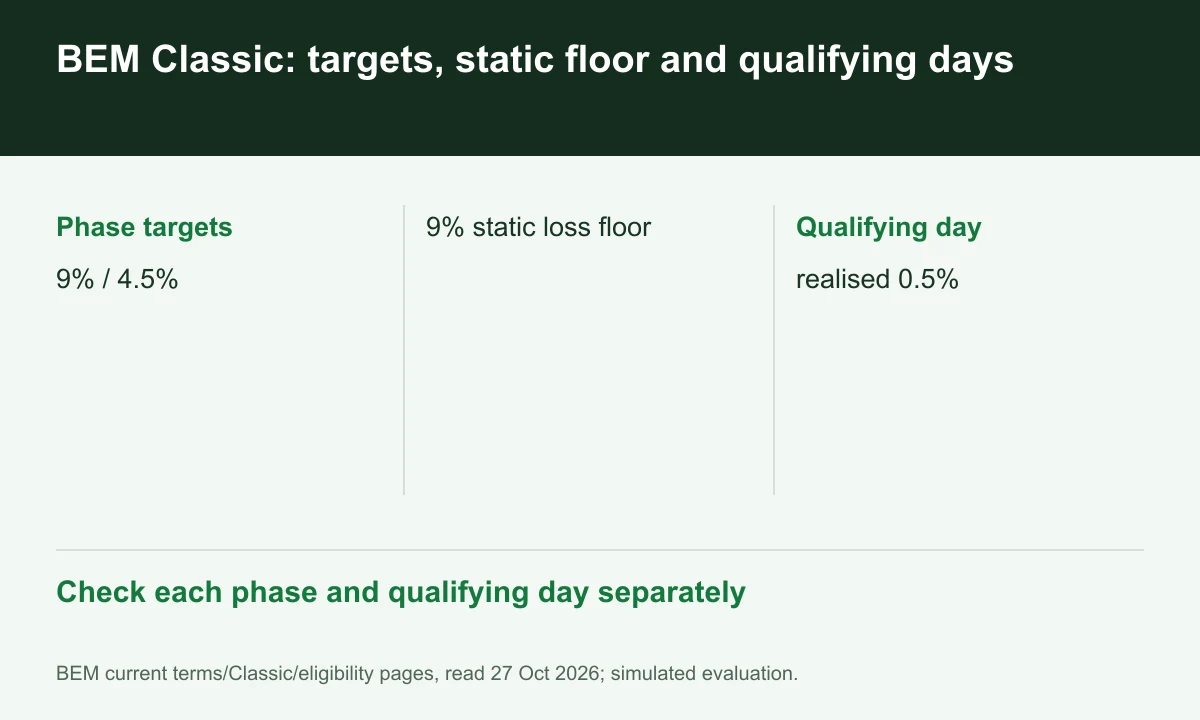
Guide
Calculate BEM Classic's phase targets and minimum qualifying-day profit on a hypothetical size, keeping its static floor distinct from the daily drawdown.
Read guide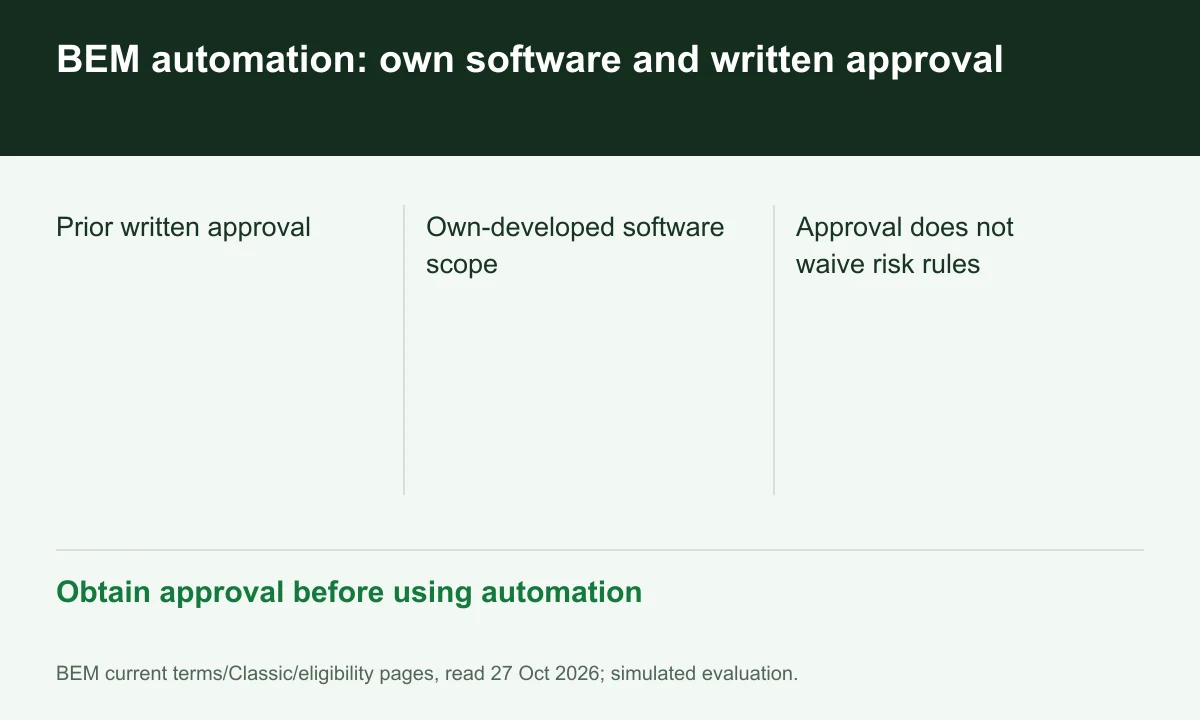
Guide
Read BEM's prior written approval requirement for user-developed automation, distinguishing software ownership, possible testing and prohibited third-party tools.
Read guide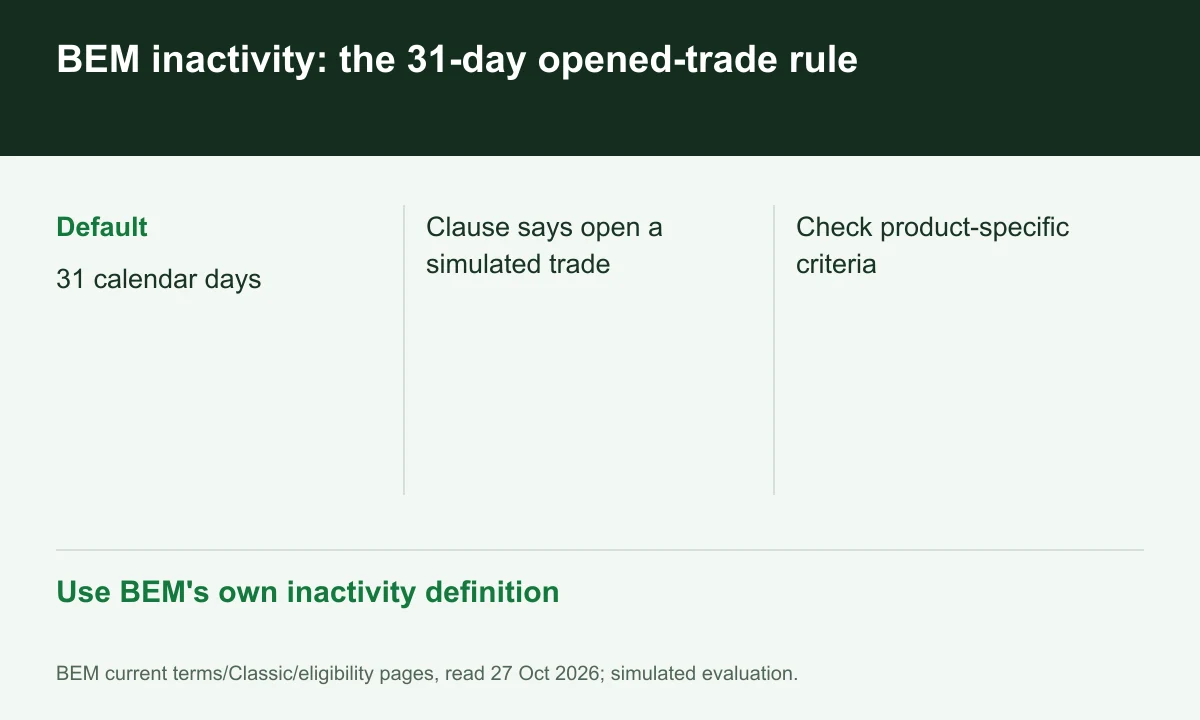
Guide
Read BEM's default thirty-one-calendar-day inactivity wording and product exceptions without importing another firm's completed-trade definition or unlimited-time assumption.
Read guide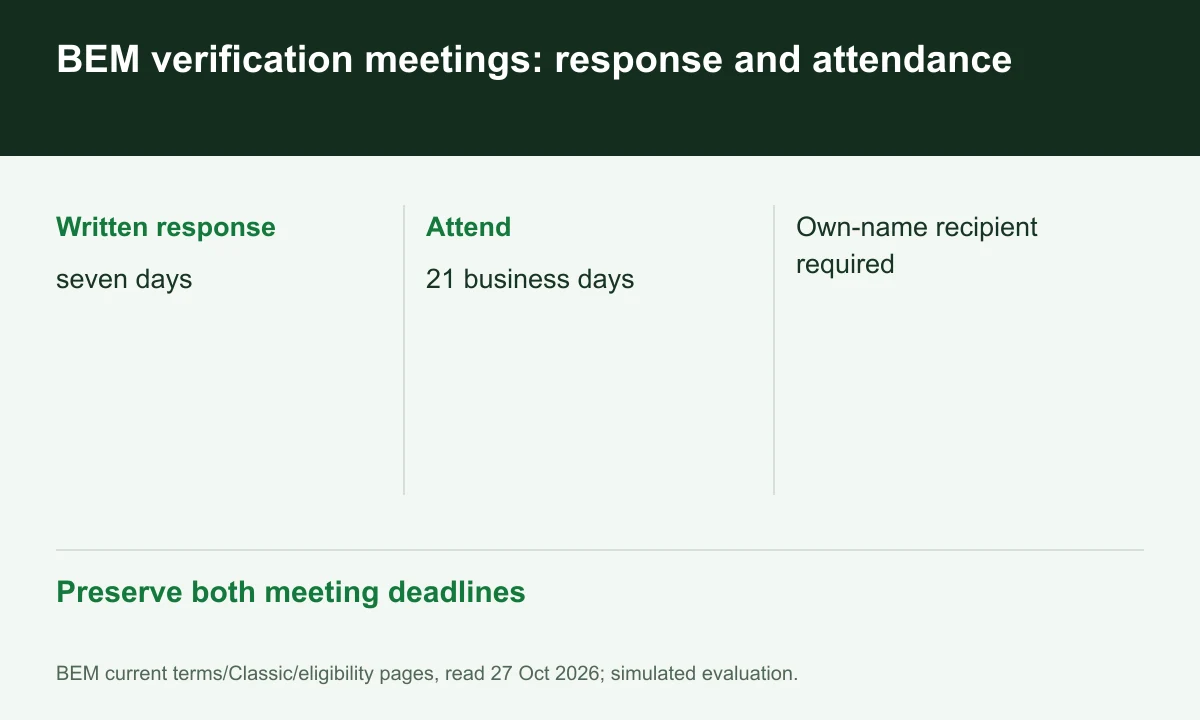
Guide
Separate BEM's written response and meeting attendance deadlines from payout approval, with personal identity and the terms' limited remedy provisions kept explicit.
Read guide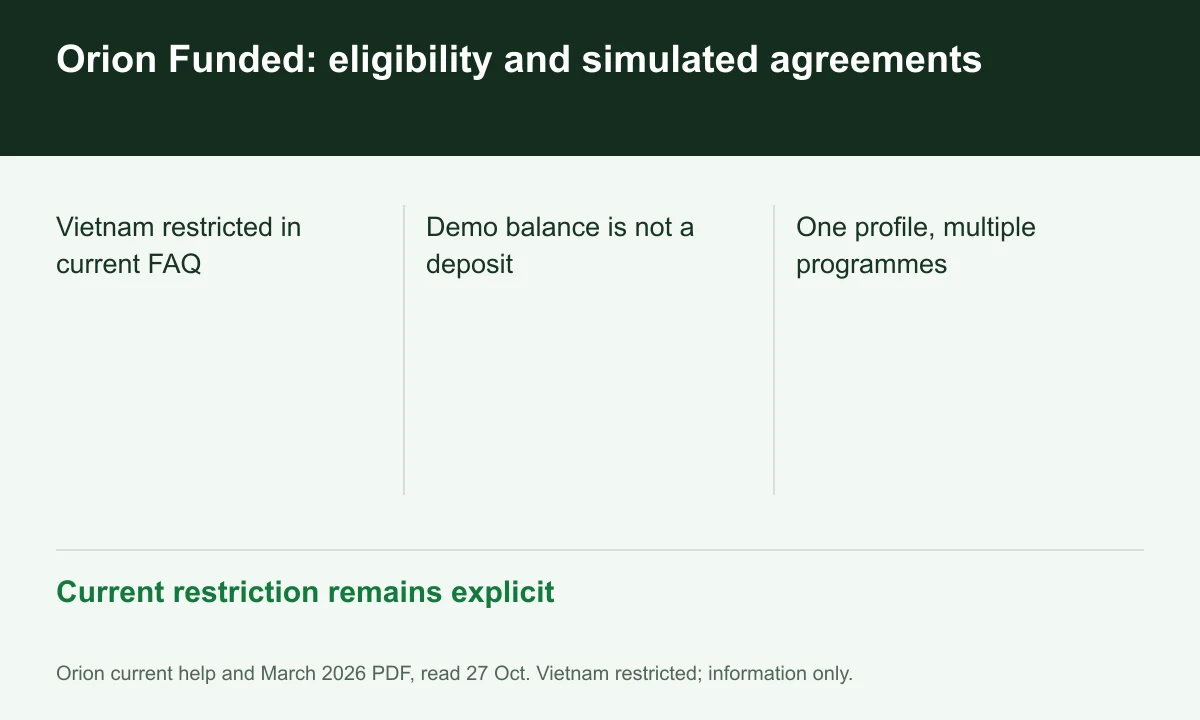
Guide
Read Orion's current Vietnam restriction beside the March contract, then separate demo balances, user profiles, programme access and the later Trader agreement.
Read guide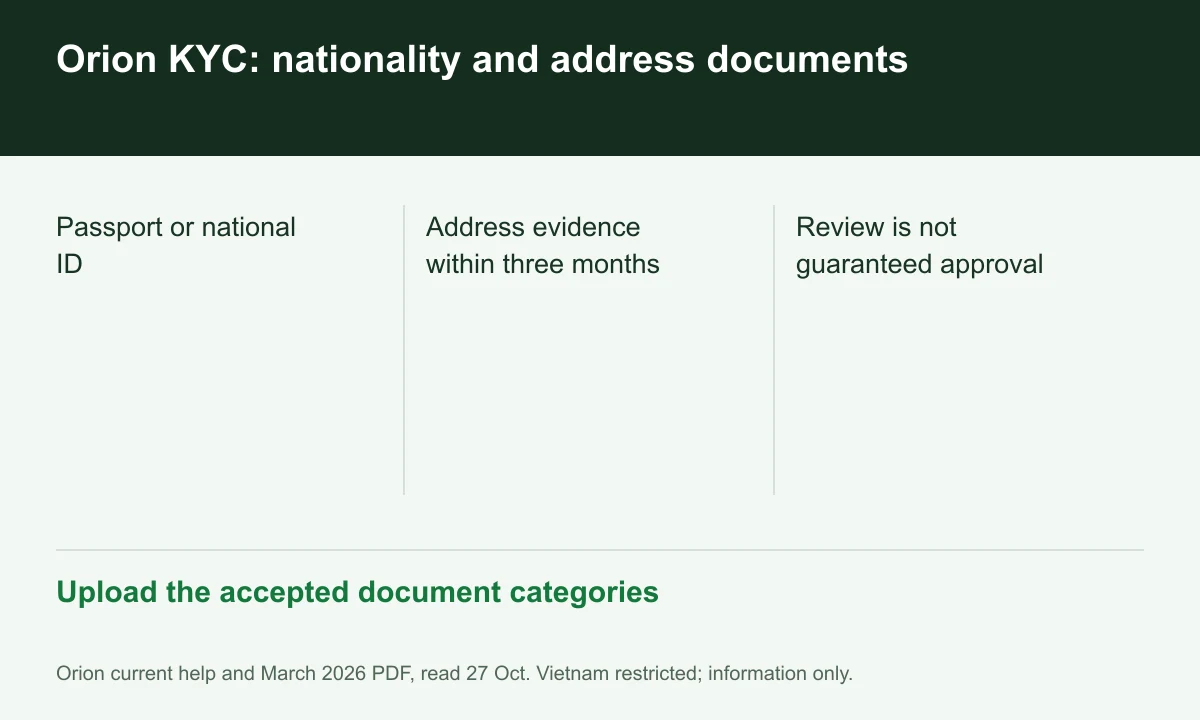
Guide
Read Orion's natural-person document checklist, including rejected ID types and address recency, without treating a typical review time as guaranteed approval.
Read guide
Guide
Compare Orion's natural-person, entrepreneur and company agreement routes, including the limited registration-type change and beneficial-owner document requirements.
Read guide
Guide
Read the March Orion contract's four-reward fee-refund milestone separately from passing evaluation, programme payments and account-closure exclusions.
Read guide
Guide
Understand Orion's Client Section-wide suspension effects, complaint record and thirty-calendar-day review statement without promising reinstatement or a fee refund.
Read guide
Guide
Match City Traders Imperium's programme choice with its current simulated-service company, drawdown type and trading permissions instead of mixing group or model claims.
Read guide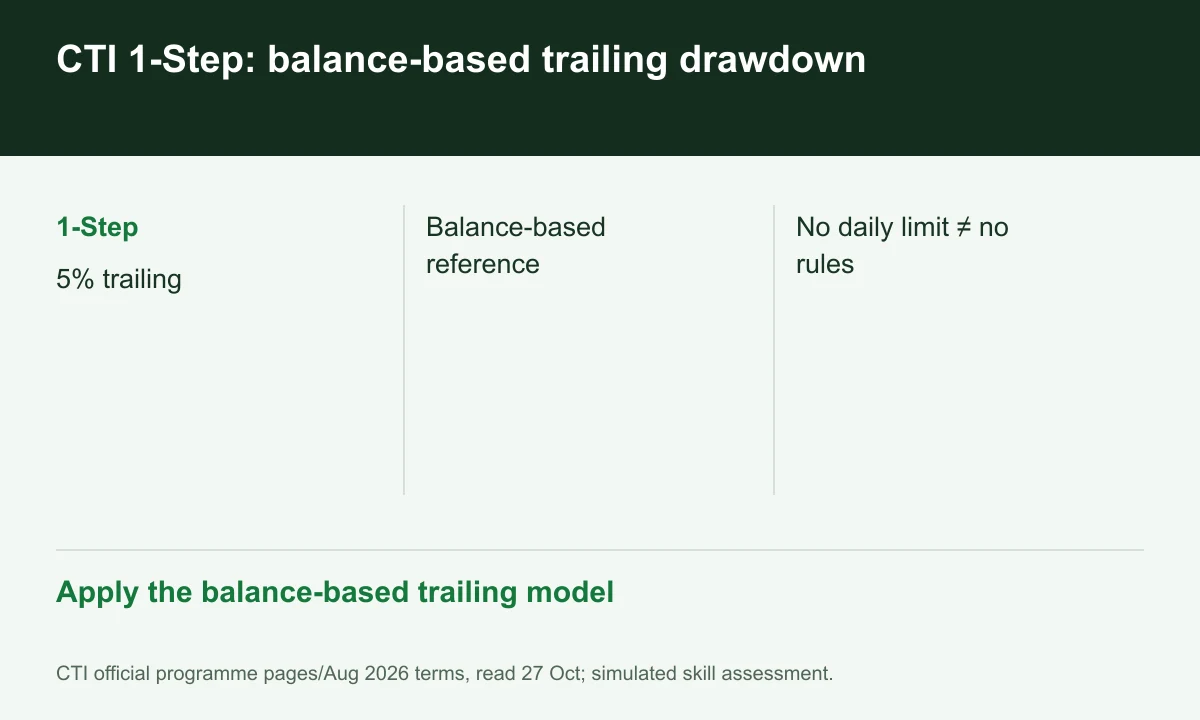
Guide
Read CTI's current one-step trailing-loss design and no-daily-limit statement, using a hypothetical size without inventing an undocumented locking mechanism.
Read guide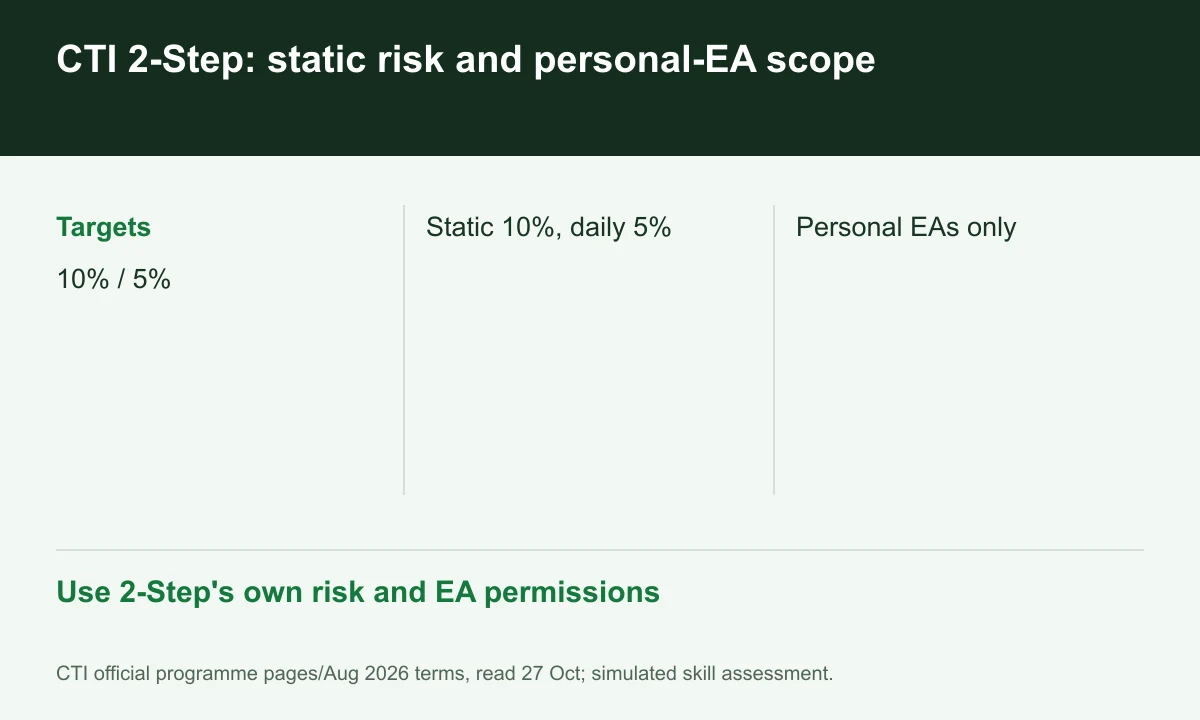
Guide
Work through CTI's two-step static and daily limits, then retain its personal-EA restriction instead of importing the one-step page's broader tool permissions.
Read guide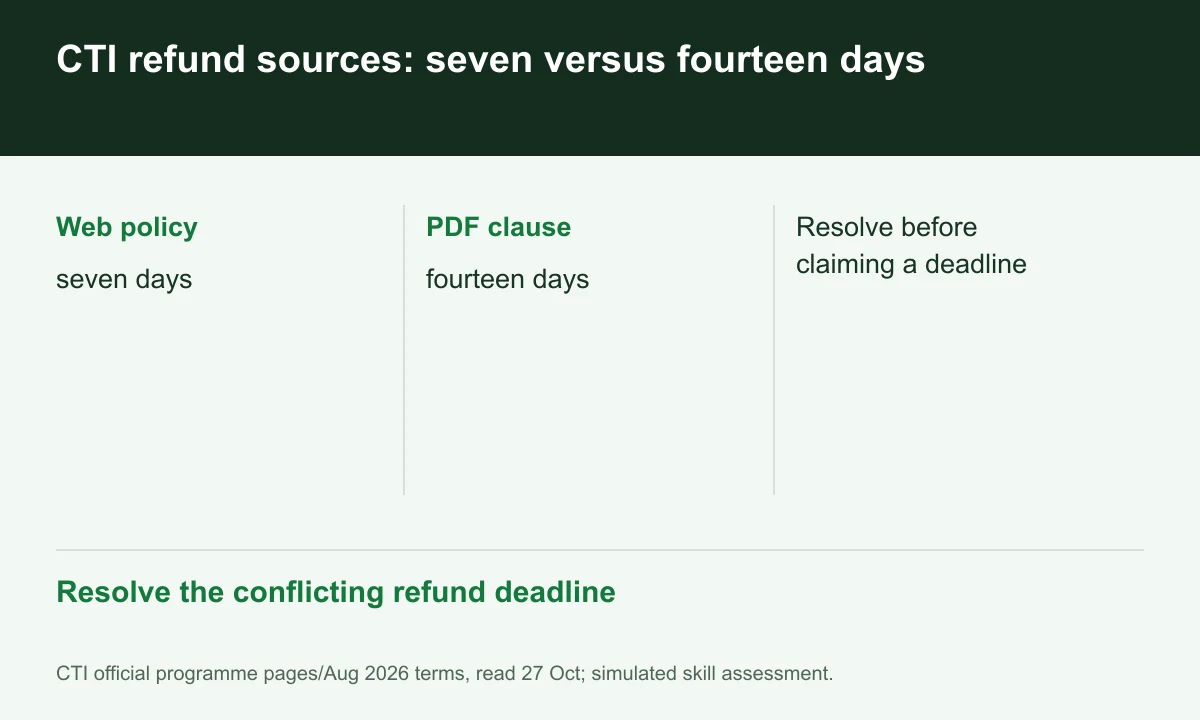
Guide
Compare CTI's live seven-day refund policy with the authoritative PDF's fourteen-day pre-trade clause, keeping activity conditions and bank processing separate.
Read guide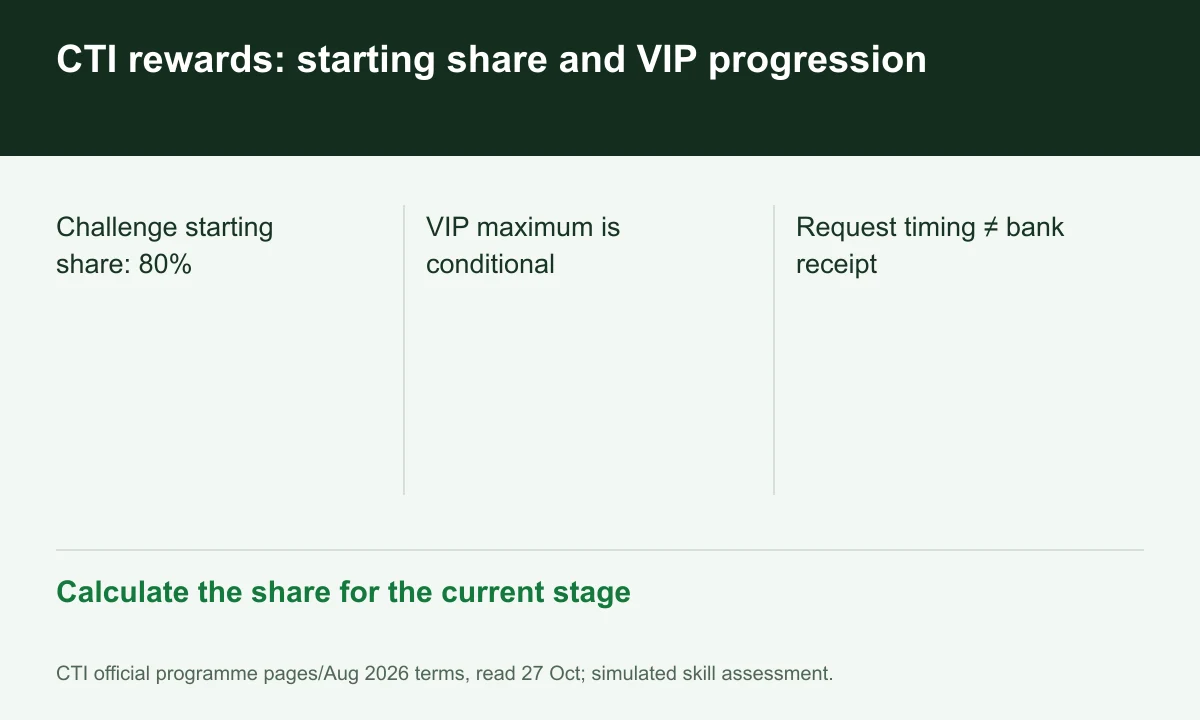
Guide
Distinguish CTI's starting eighty-percent challenge reward share from the up-to-one-hundred-percent VIP headline, and separate first-request timing from receipt.
Read guide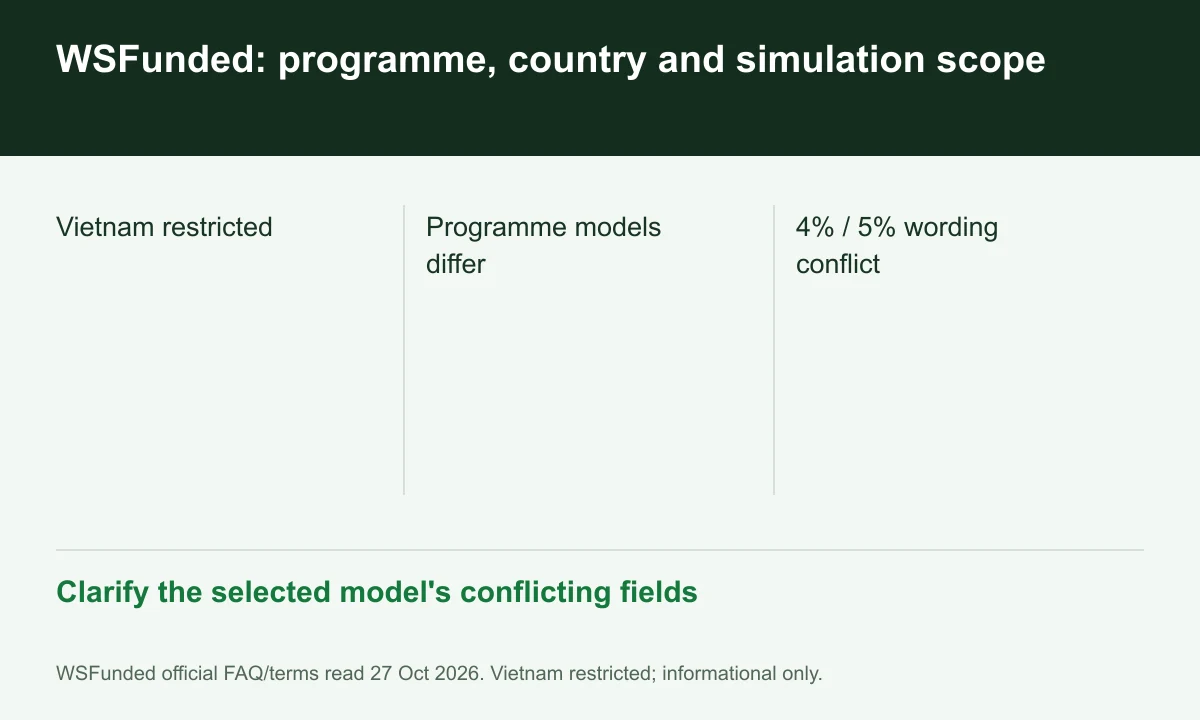
Guide
Read WSFunded's explicit Vietnam restriction and simulated-account terms before comparing programme limits, calendar changes and promotional FAQ statements.
Read guide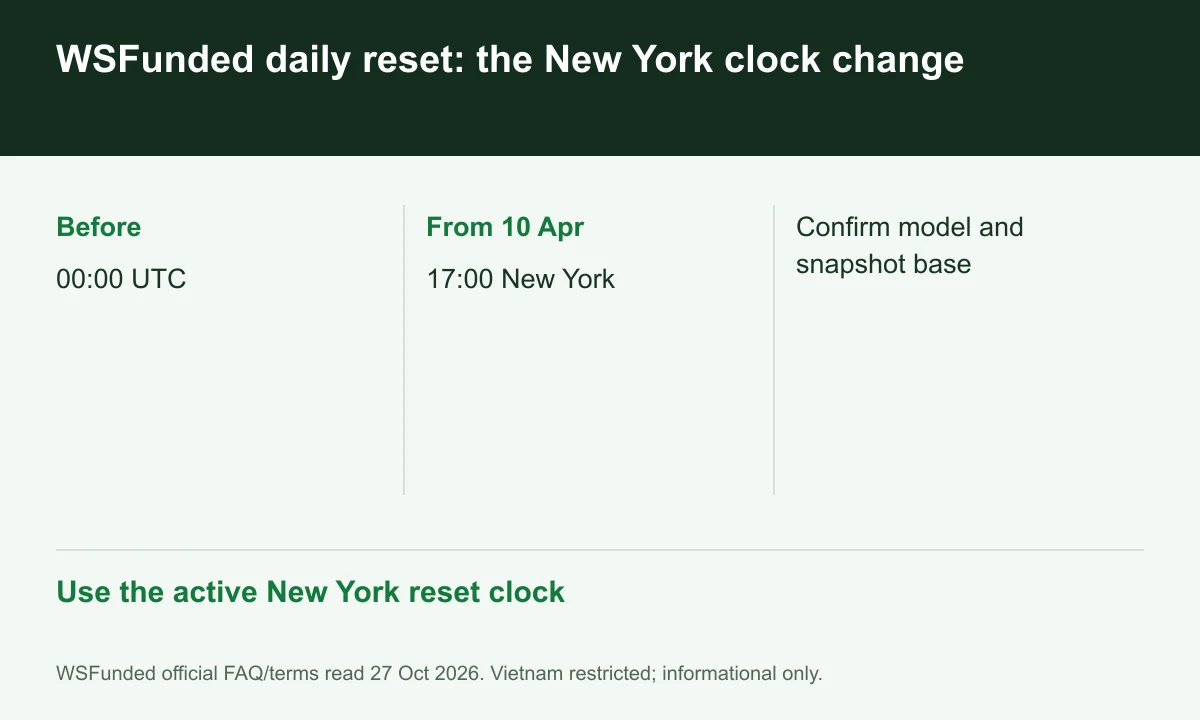
Guide
Read WSFunded's April 2026 reset change from UTC midnight to New York market close, preserving seasonal local-time conversion and programme-specific loss bases.
Read guide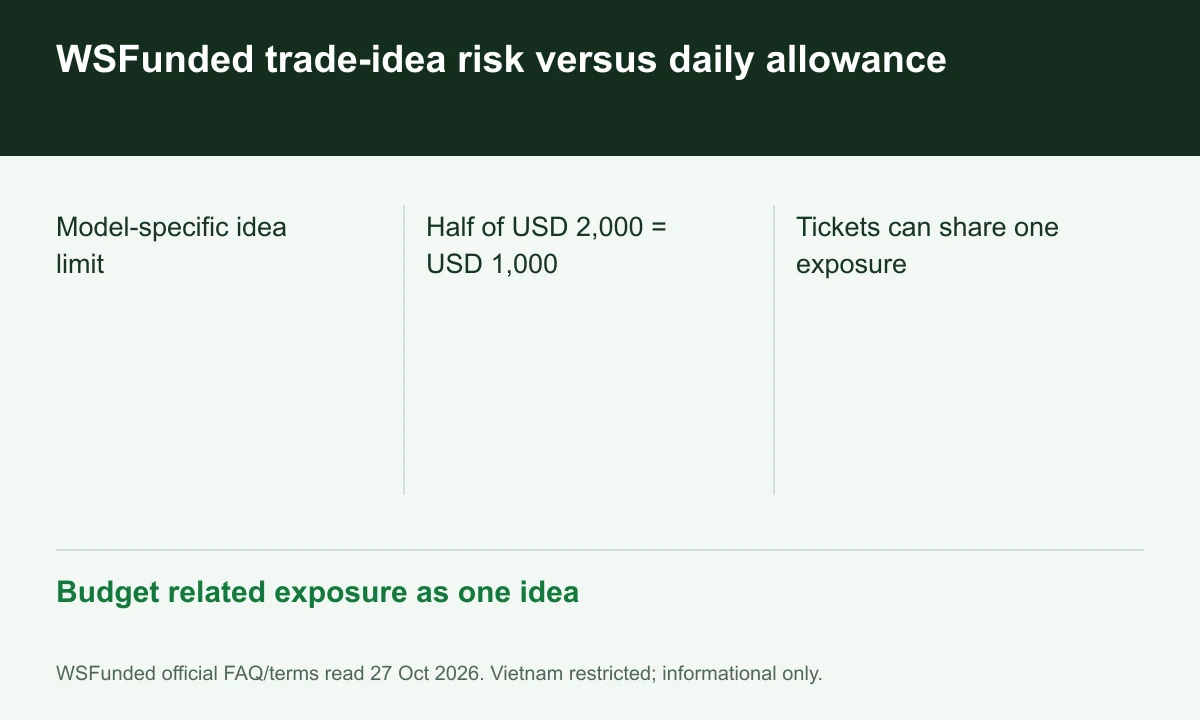
Guide
Separate WSFunded's related-trade idea limit from total daily drawdown, using hypothetical arithmetic while preserving model exceptions and unresolved source percentages.
Read guide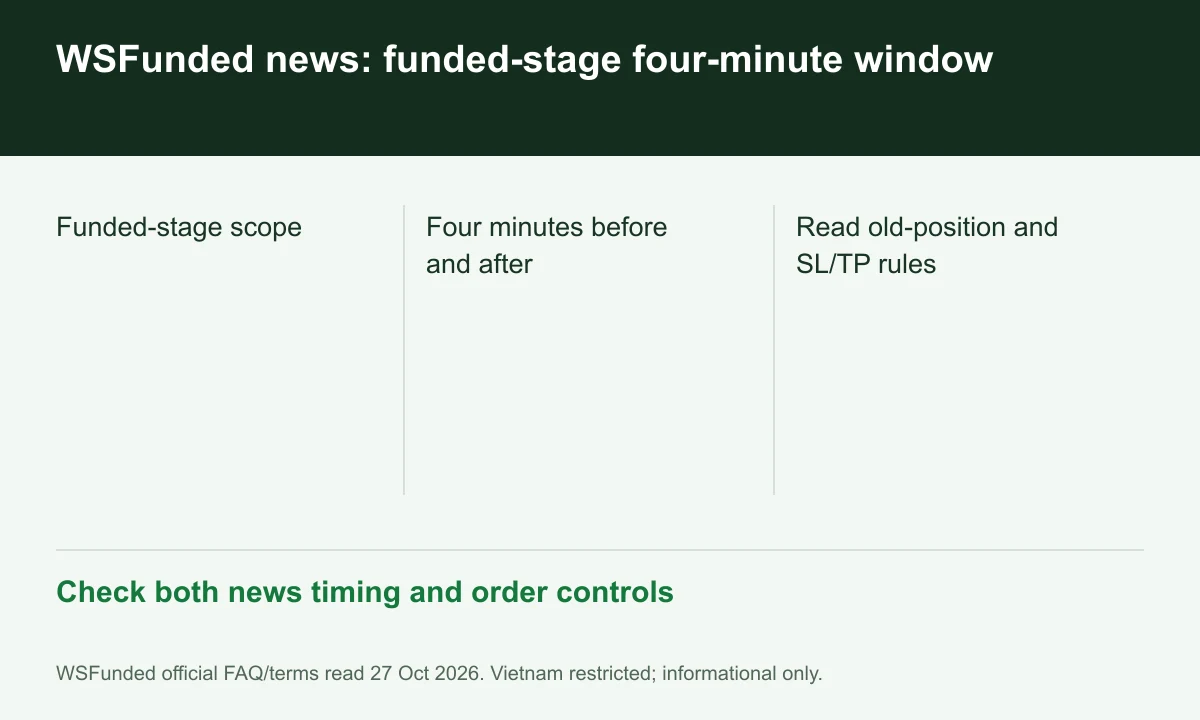
Guide
Read WSFunded's funded-account news window and stop requirements together, preserving the older-position exception without inventing permission for automatic exits.
Read guide
Guide
Distinguish WSFunded's EA-allowed programme labels from its same-strategy, signal-copying and funded-account restrictions, while retaining the one-profile rule.
Read guide
Guide
Read the Instant Funding brand's Acello contract, simulated-service definition and product-specific exceptions, without confusing it with other firms' generic instant programmes.
Read guide
Guide
Read Instant Funding's same-instrument, same-direction grouping and model-specific risk caps, using a hypothetical allowance without treating reopened tickets as fresh budgets.
Read guide
Guide
Read Instant Funding's news restriction with its explicit product and phase exemptions, distinguishing held positions from new entries and exits inside the event window.
Read guide
Guide
Separate Instant Funding's payout-stage KYC from enhanced due diligence, including strategy evidence and the effect a pending review can have on simulated results and rewards.
Read guide
Guide
Read Instant Funding's first-trade and fourteen-day cancellation clauses together, retaining contradictory tax wording rather than publishing an unsupported all-in fee claim.
Read guide
Guide
Hantec Trader official links now redirect to RZR Funded, whose site describes simulated accounts and unchanged existing contracts. The last verified country policy excluded Vietnam; the migrated country page could not be read, so no new eligibility is inferred.
Read guide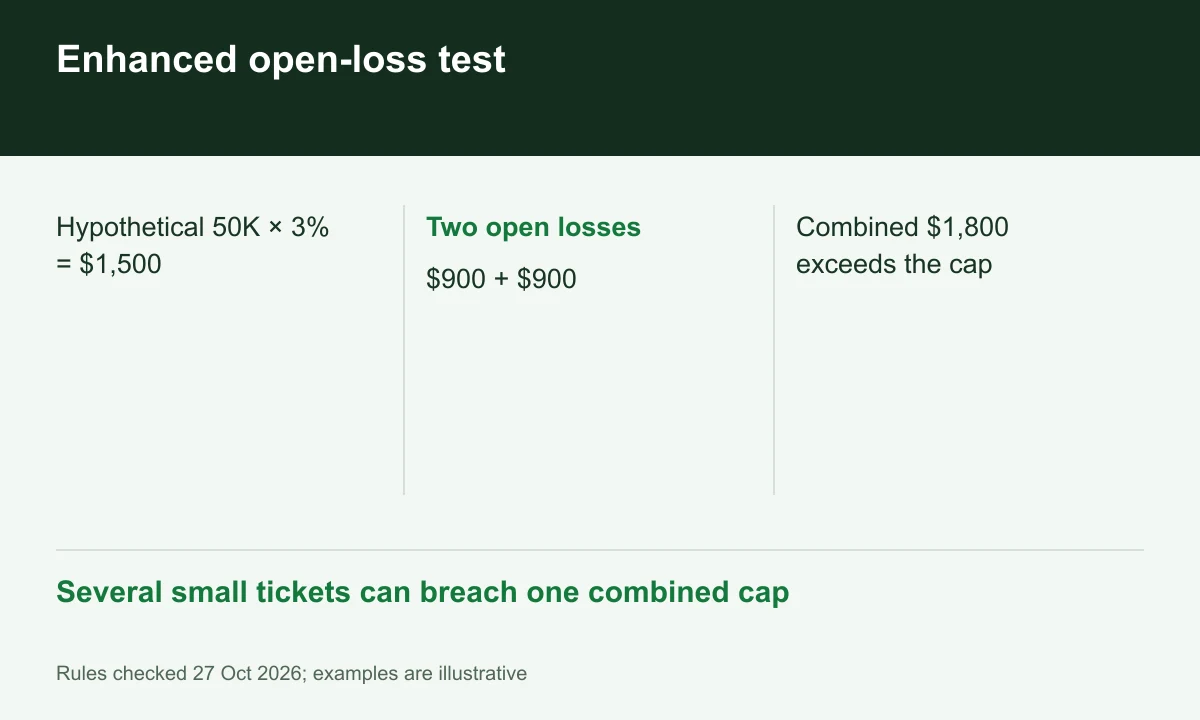
Guide
Enhanced’s funded stage limits aggregate floating losses to 3% of starting balance, separate from daily and overall drawdown. The RZR rebrand says existing rules continue. Vietnam’s last verified exclusion remains pending readable migrated-country evidence.
Read guide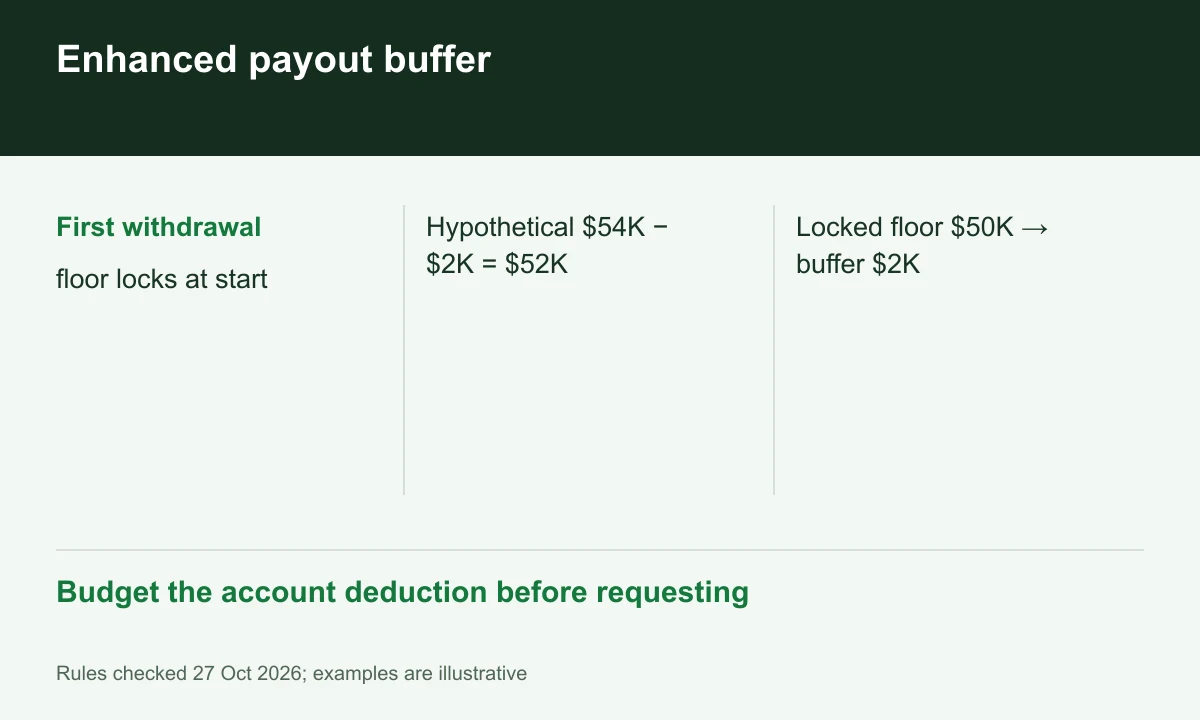
Withdrawals
Enhanced’s first withdrawal locks maximum total loss at starting balance. A payout can therefore leave much less room than the original 10% static allowance. This applies to the named programme, not every RZR product; Vietnam eligibility is not newly confirmed.
Read guide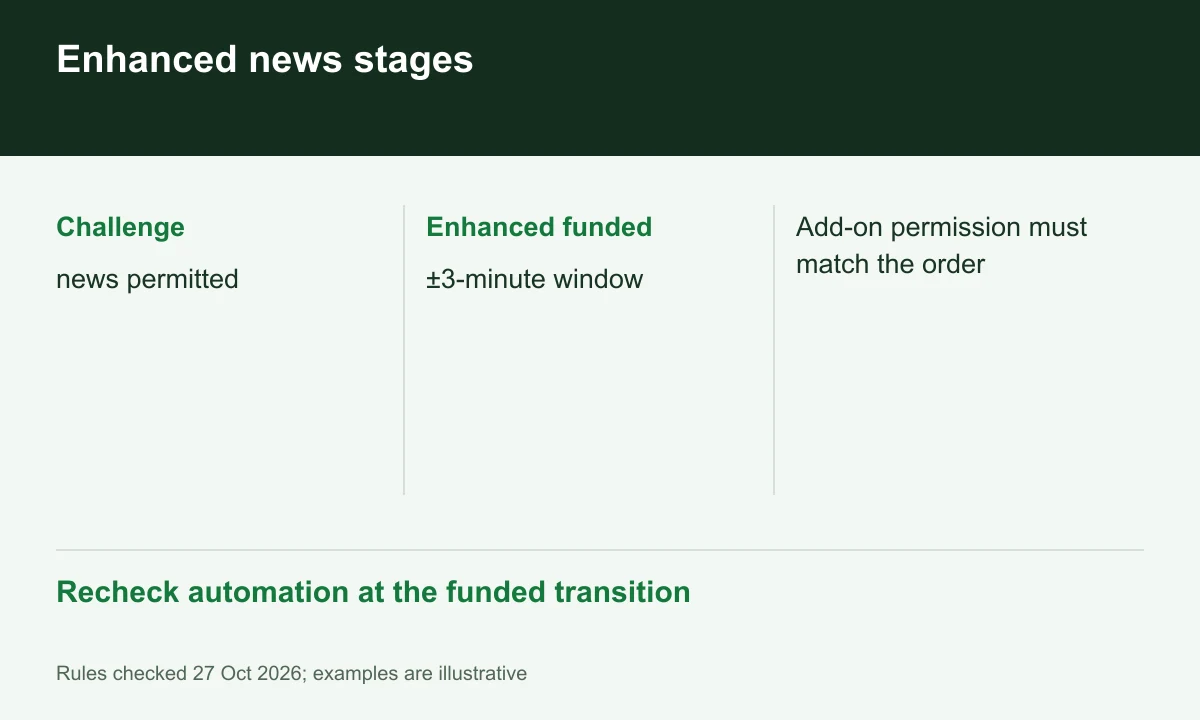
Guide
Enhanced permits news trading during evaluation but restricts funded opening and closing within three minutes of Red Folder releases unless the relevant add-on applies. The rebrand does not make an evaluation strategy automatically compliant in funded.
Read guide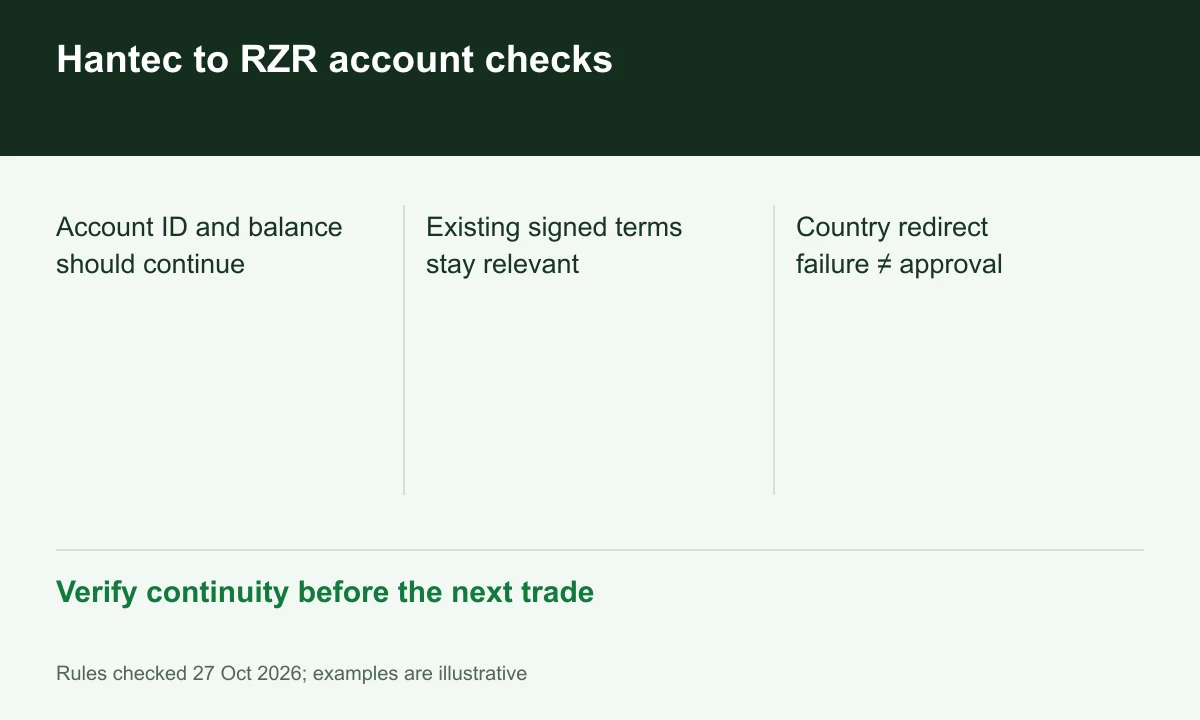
Guide
Official Hantec links redirect to RZR Funded, whose notice says existing profiles, terms, balances and payout conditions continue. Verify domain and account continuity from those official links. The migrated country page was inaccessible, so prior Vietnam restrictions are not treated as lifted.
Read guide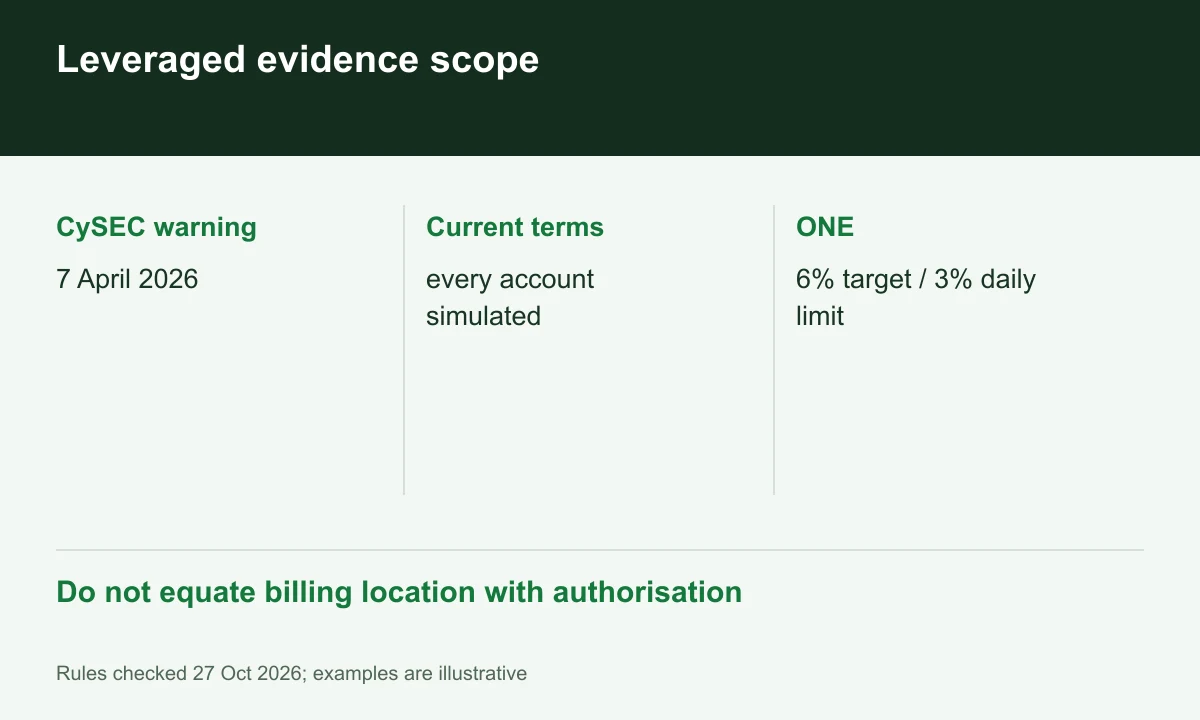
Guide
CySEC’s 7 April 2026 warning names getleveraged.com as not belonging to an authorised investment-services entity. Leveraged’s 27 October terms describe all accounts as simulated services. This informational review does not infer regulatory approval or recommend registration.
Read guide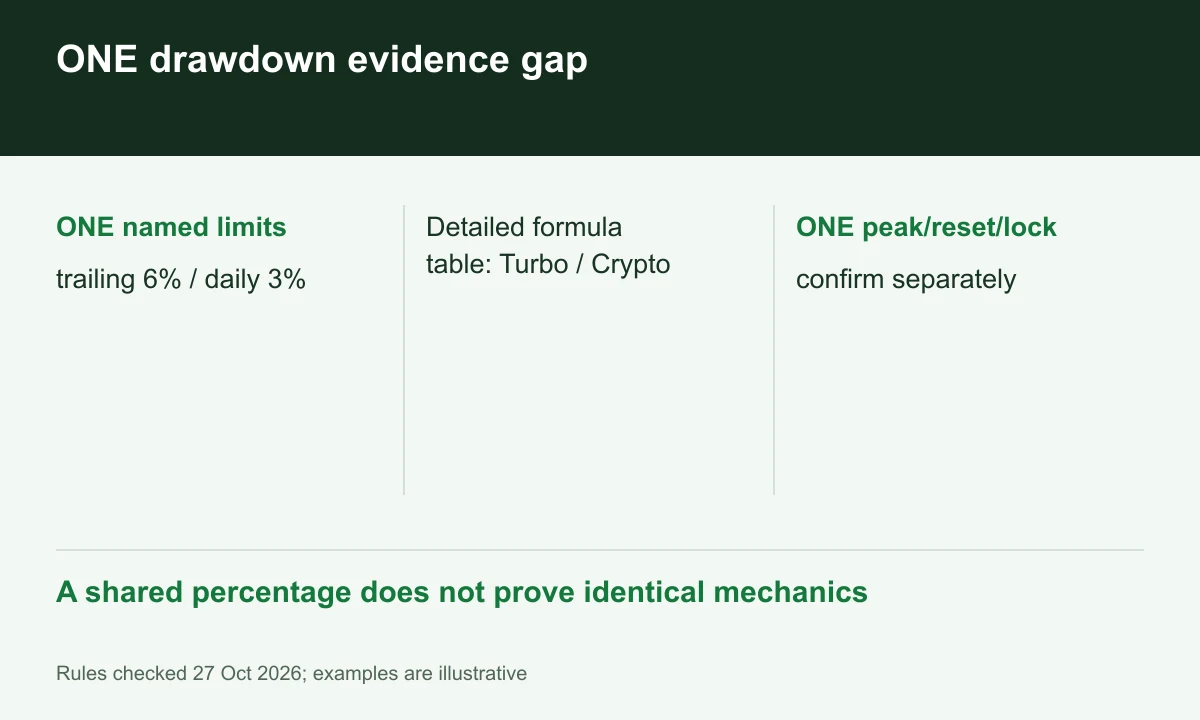
Guide
ONE lists 6% trailing and 3% daily limits, but the detailed trailing FAQ labels its formula for Turbo/Crypto, not ONE. Do not silently transfer it. CySEC’s 7 April 2026 domain warning and the current all-simulated service terms remain material.
Read guide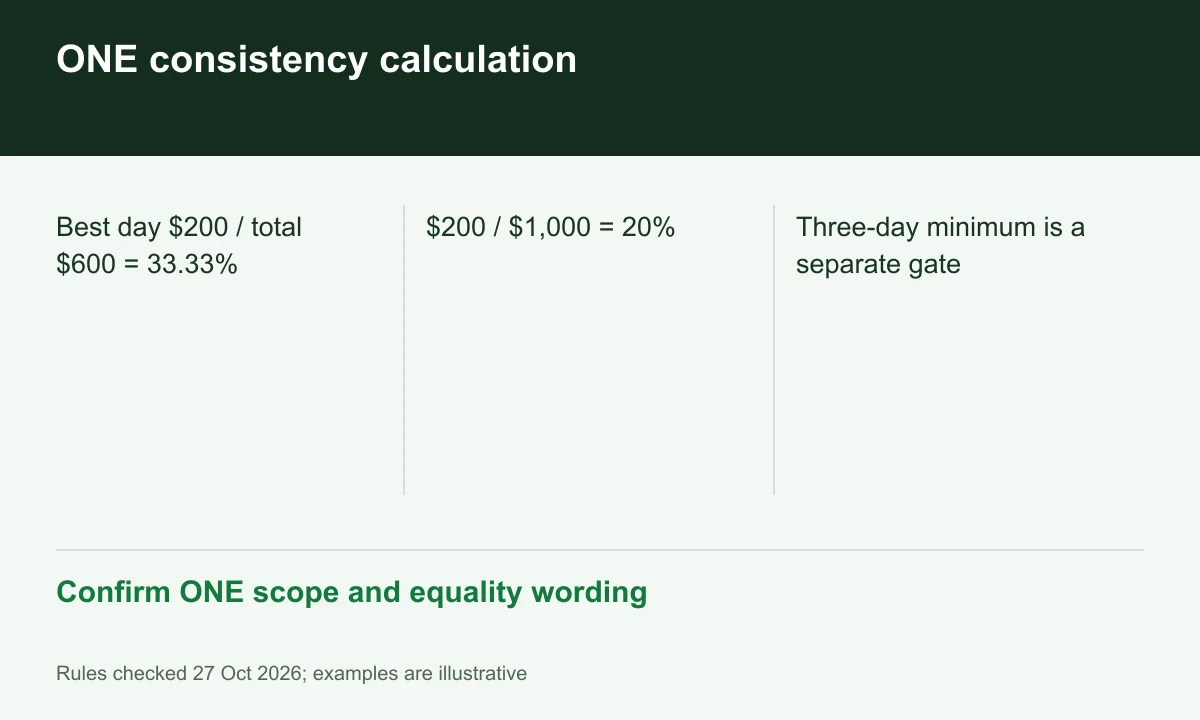
Guide
The ONE-specific page requires 20% consistency and three 0.5% profitable days, while a generic consistency FAQ names only Turbo/Crypto. This conflict needs product-specific confirmation. CySEC’s 7 April 2026 warning also remains relevant to the simulated service.
Read guide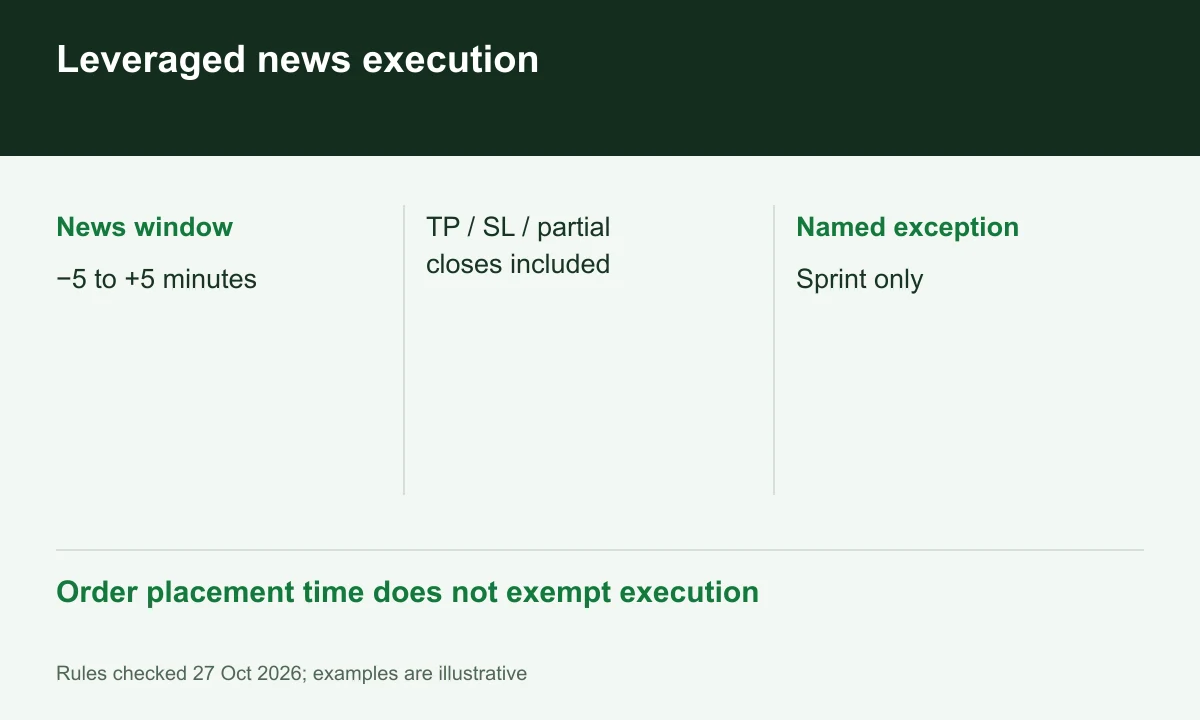
Guide
Leveraged’s news FAQ restricts execution around high-impact releases on all programmes except Sprint, including TP, SL and partial closes. Current terms describe simulations only. CySEC’s 7 April 2026 warning names the domain; this is rule analysis, not registration advice.
Read guide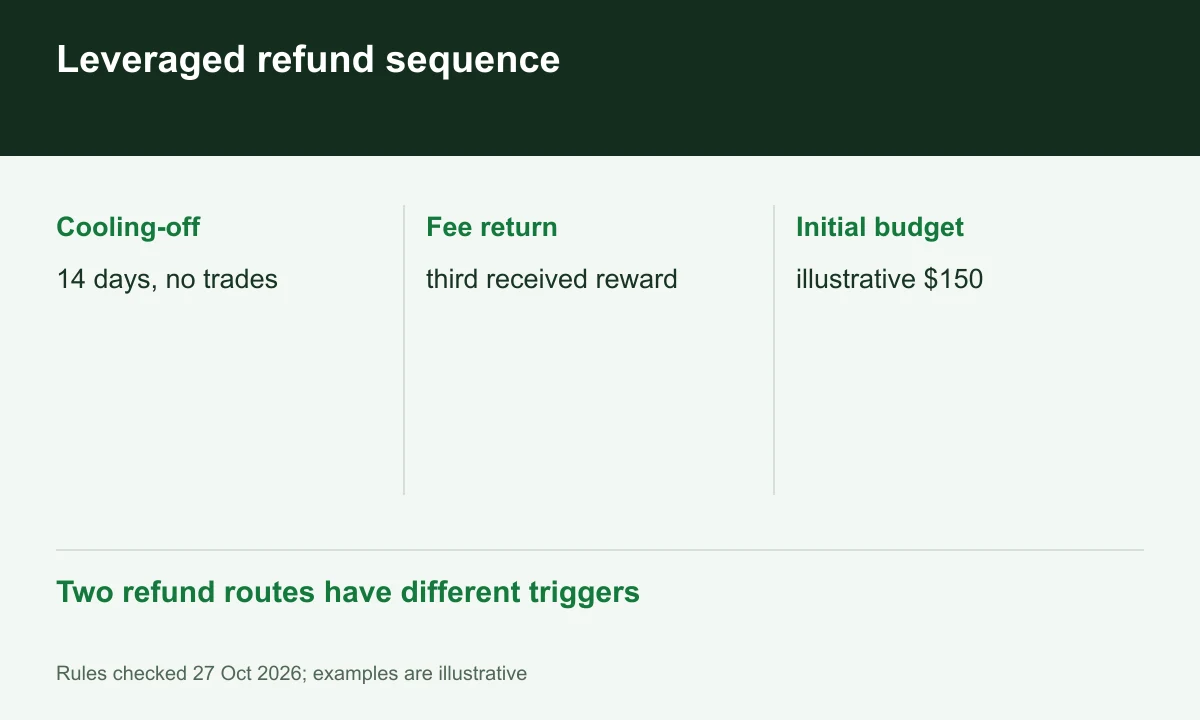
Guide
The 27 October 2026 terms allow fourteen-day cancellation before any trade and separately return an eligible evaluation fee with the third reward. Neither route is guaranteed cost recovery after trading. CySEC’s 7 April warning and the all-simulated service scope remain material.
Read guide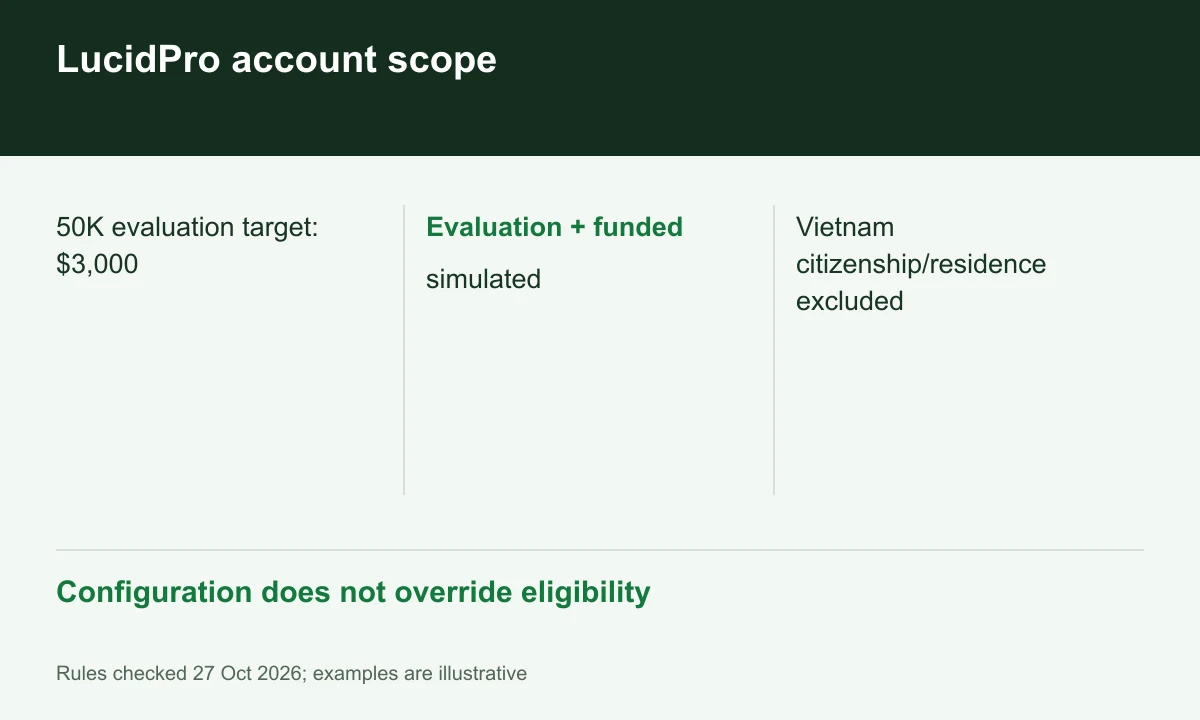
Guide
Lucid excludes Vietnamese citizens or residents. LucidPro evaluation and funded accounts are simulated; LIVE is a separate possibility. Current customization and payout FAQs add important conditions beyond the broad “no payout caps” benefit text.
Read guide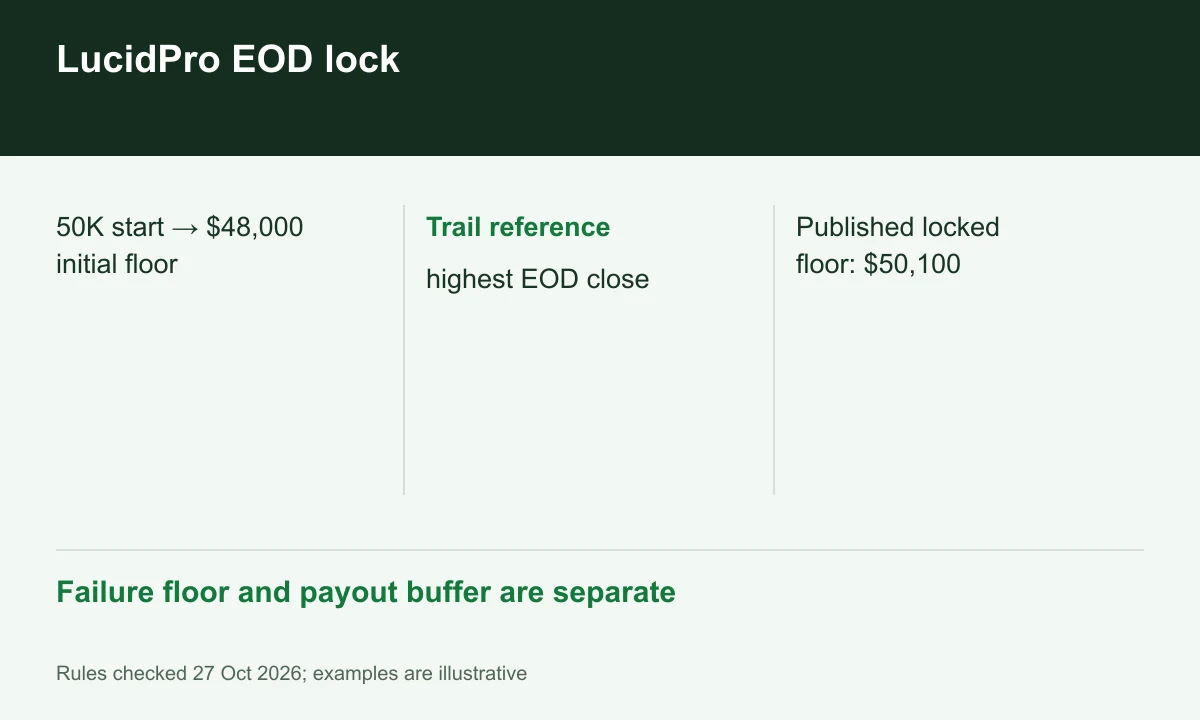
Guide
LucidPro’s 50K maximum-loss distance is $2,000 and its published locked floor is $50,100, not $50,000. Closing balance drives the EOD trail; the threshold still matters before any reward. Vietnamese citizens and residents are excluded.
Read guide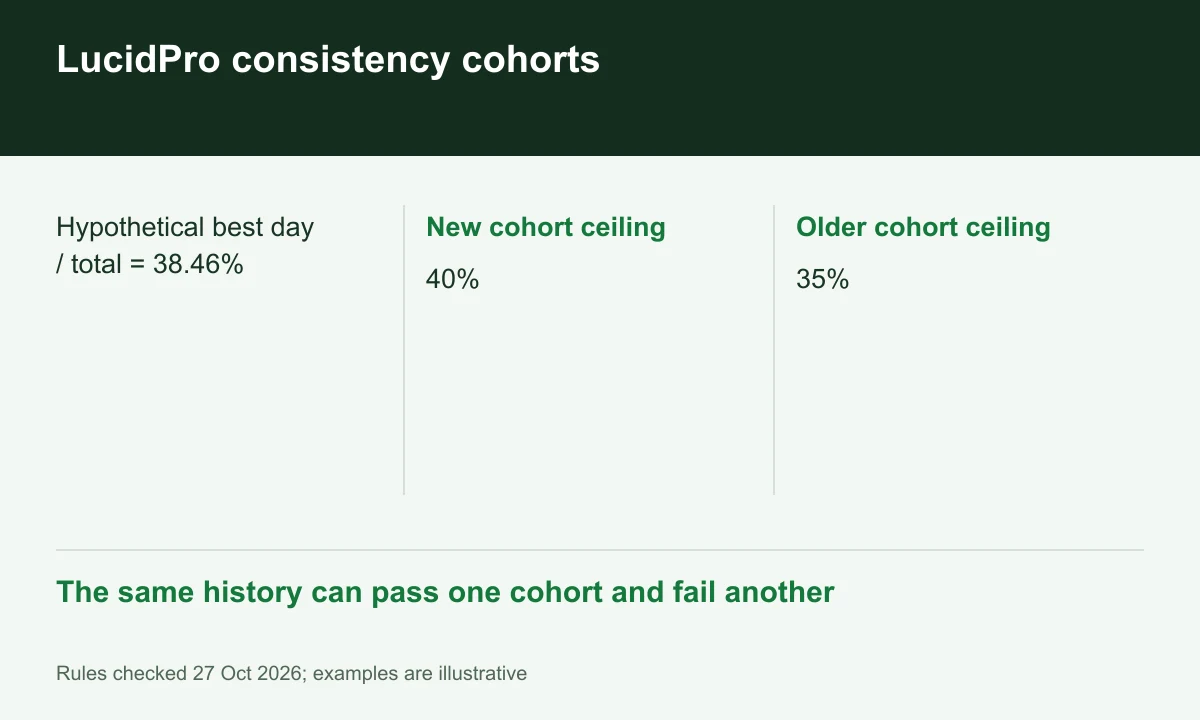
Guide
LucidPro’s current payout page uses 40%, but its dedicated consistency article retains 35% for an older purchase/reset cohort. The date is 28 November 2025 at 3 PM EST. Vietnam remains restricted by citizenship or residence.
Read guide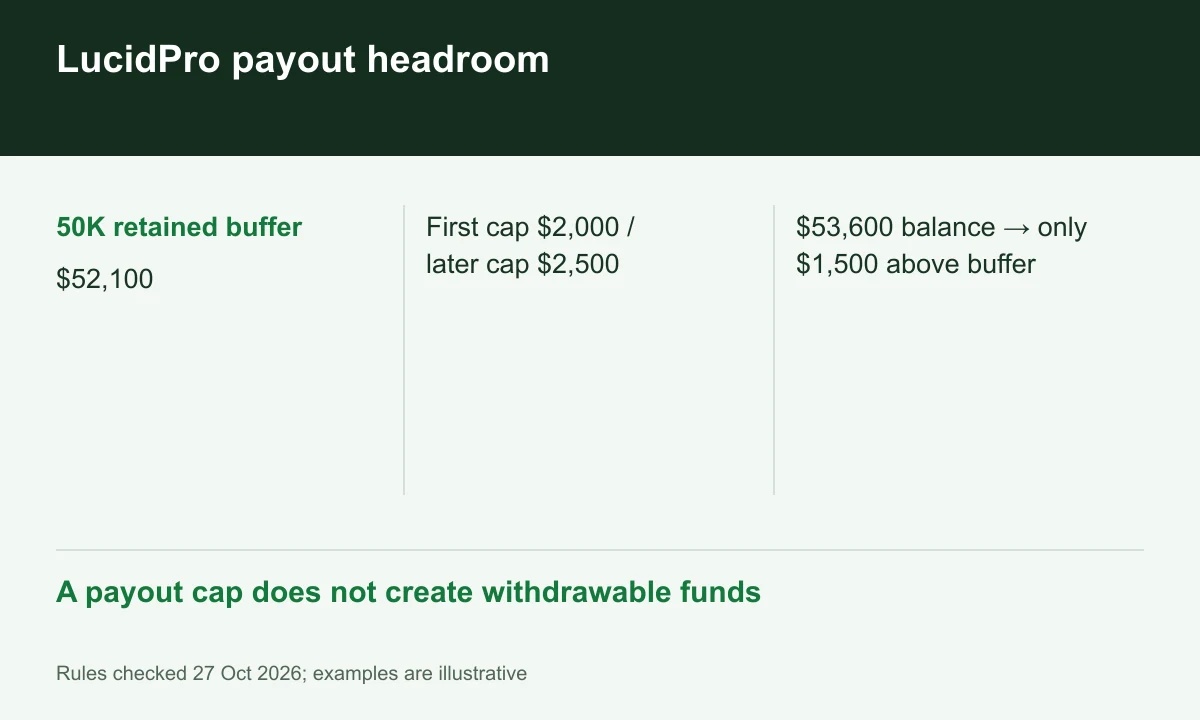
Guide
The dedicated payout table requires retaining $52,100 on 50K, with a $500 minimum request, $2,000 first cap and $2,500 later cap. It conflicts with the broad funded-page “no caps” line. Vietnam remains excluded.
Read guide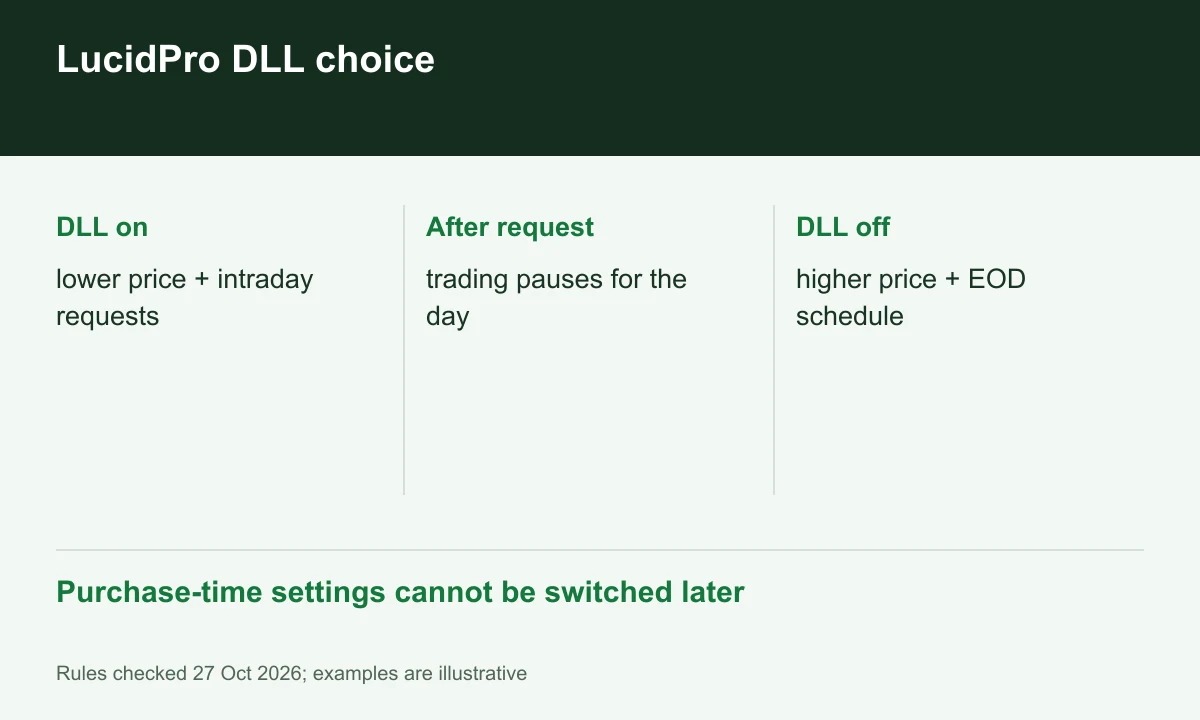
Guide
Current LucidPro customization locks DLL on/off at purchase. DLL on lowers the quoted package price and enables intraday on-demand requests, followed by a trading pause; DLL off uses end-of-day payouts. Vietnam eligibility remains restricted.
Read guide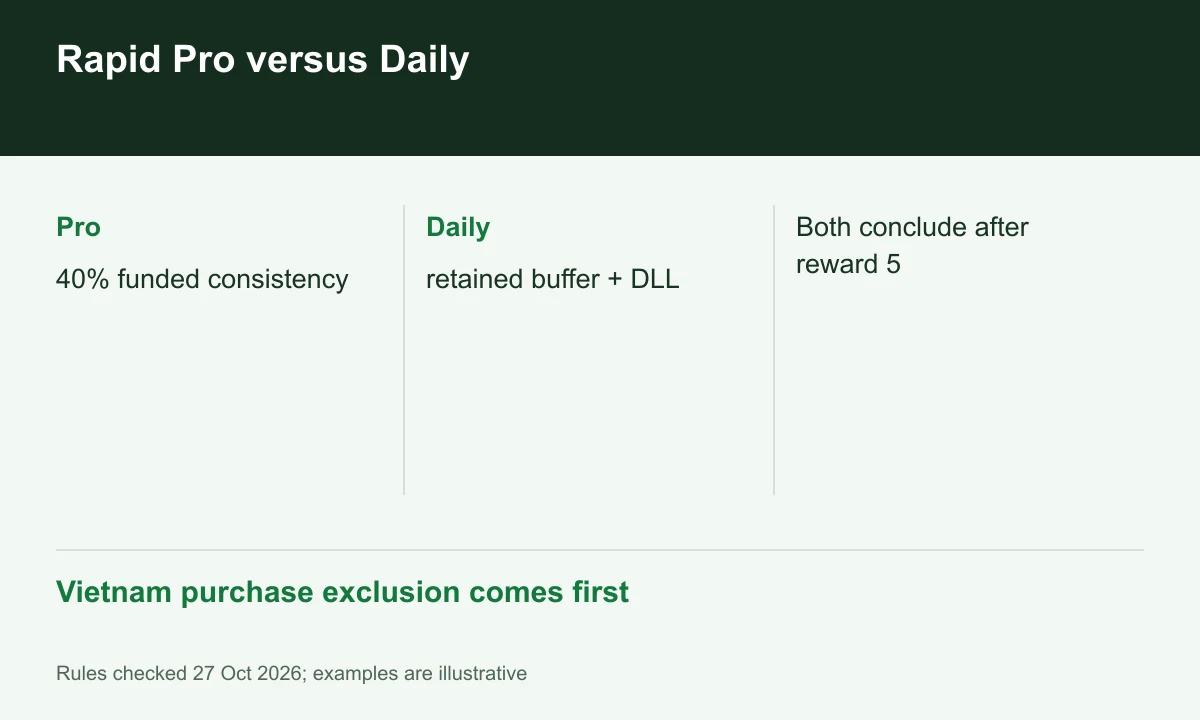
Guide
FundedNext Futures excludes Vietnam from account purchases. Rapid Pro/Daily are separate purchase-time paths with different reward gates; the account concludes after five Performance Rewards. A one-day challenge pass is not a promise of same-day cash or LIVE access.
Read guide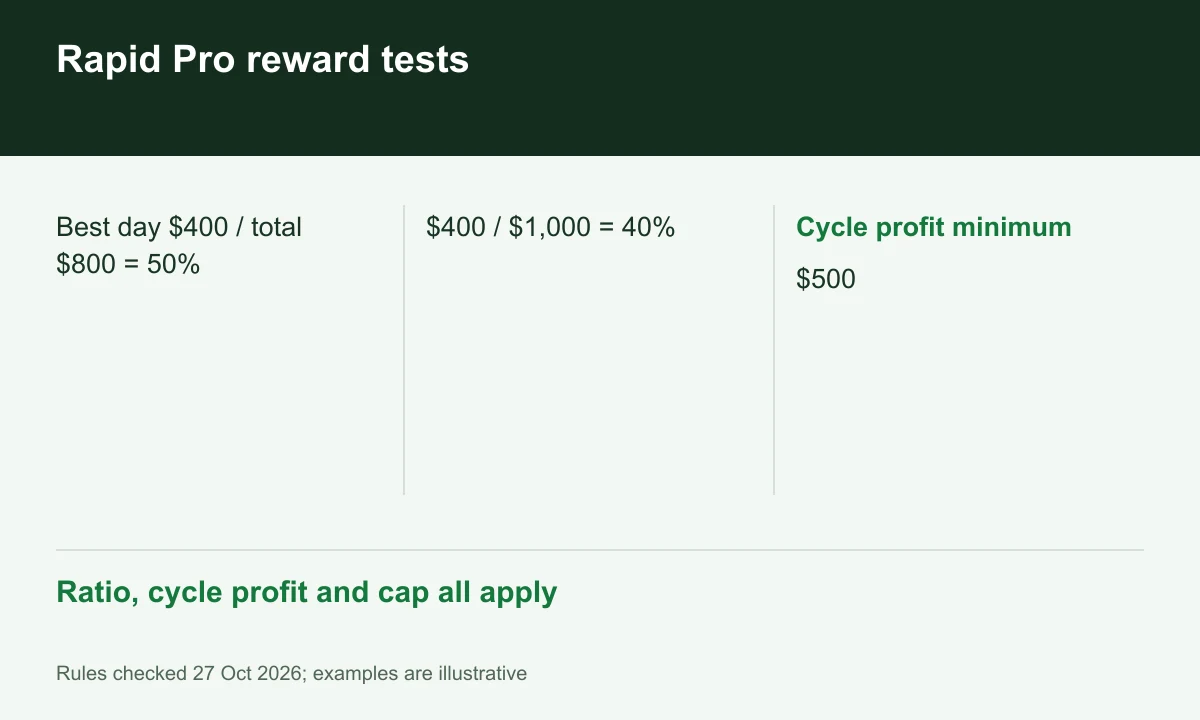
Guide
Rapid Pro funded applies 40% best-day consistency, at least $500 cycle profit and size-based withdrawal caps. Rewards are available every three days when eligible, and the account ends after five rewards. Vietnam is excluded from purchases.
Read guide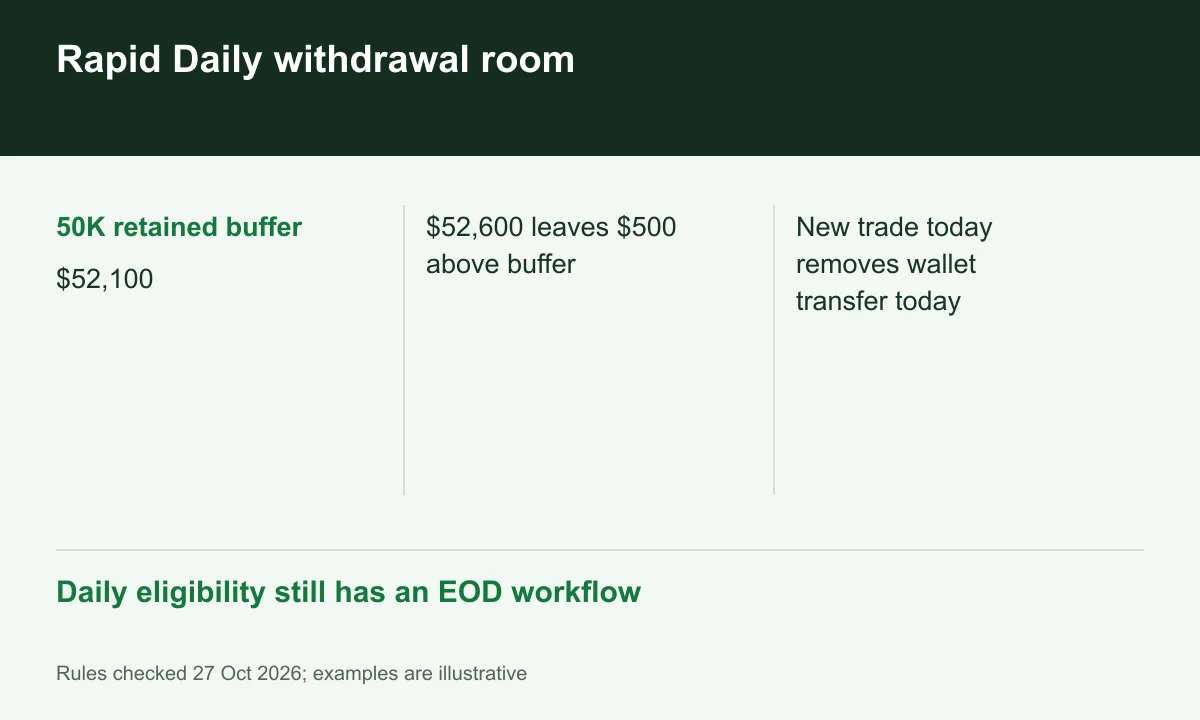
Guide
Rapid Daily 50K needs EOD balance above its $52,100 retained buffer for a withdrawal, plus $500 cycle profit. Its detailed request instructions say opening a new trade that day removes that day’s wallet-transfer option. Vietnam is excluded from purchases.
Read guide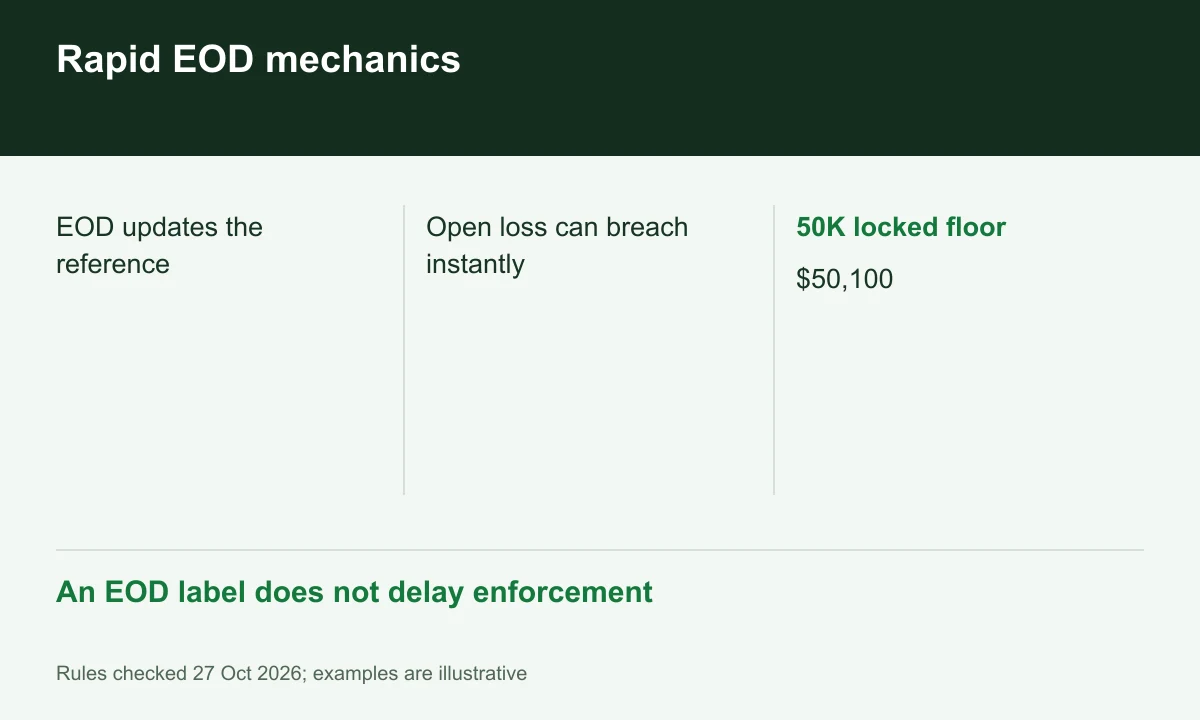
Guide
Rapid Pro/Daily move the maximum-loss reference at end of day, but floating loss can breach the existing threshold instantly. EOD does not postpone enforcement. The 50K published loss distance is $2,000 and locked floor $50,100; Vietnam is purchase-restricted.
Read guide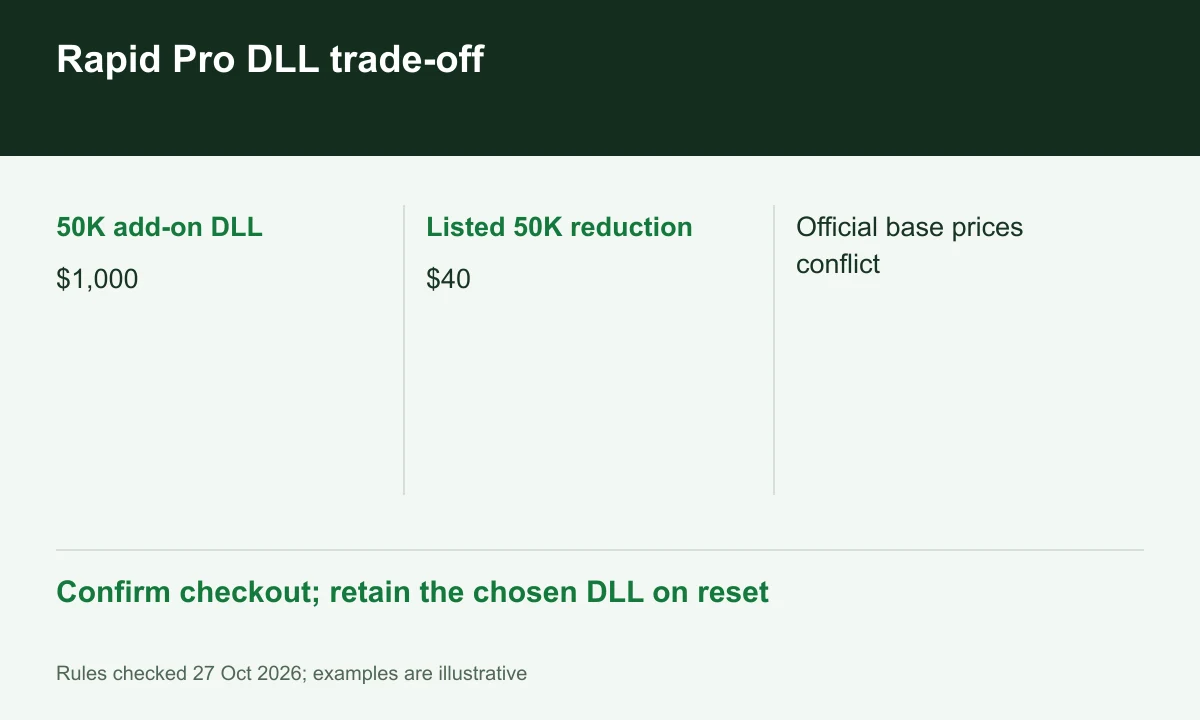
Guide
The Pro DLL add-on trades a lower purchase fee for a fixed daily loss limit through challenge and funded. Official price tables conflict with their own example and overview, so no single all-in price is certified here. Vietnam remains purchase-restricted.
Read guide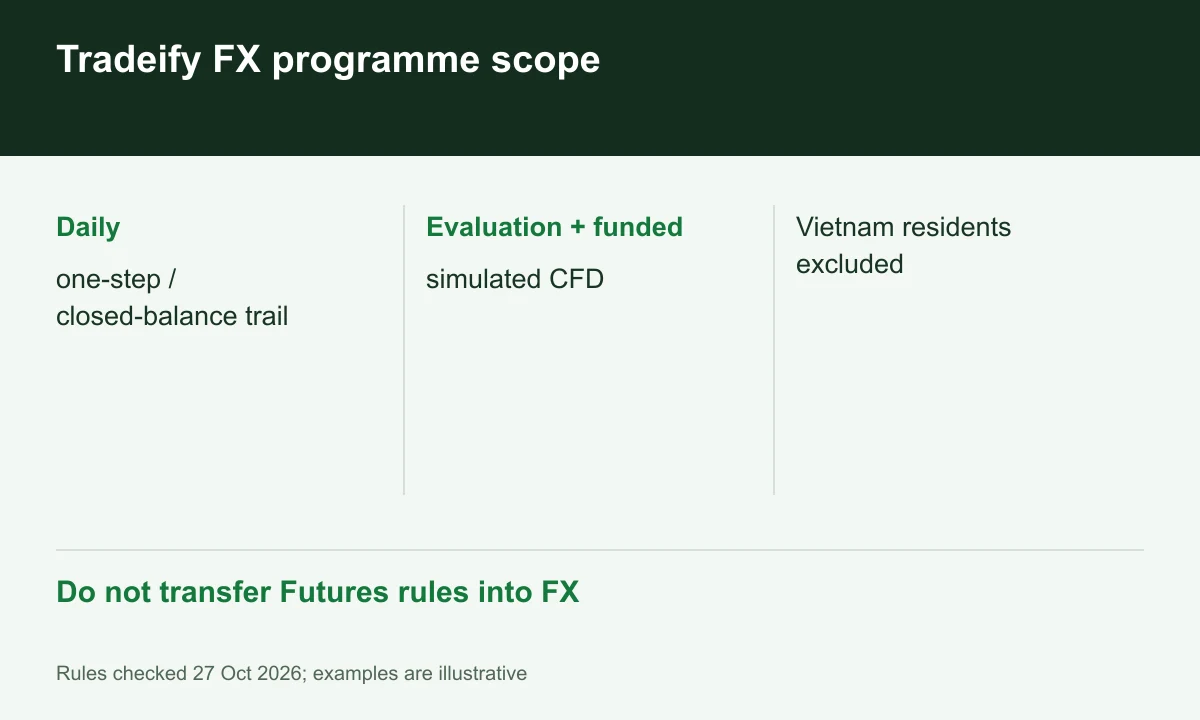
Guide
Tradeify FX excludes residents of Vietnam. Its evaluation and funded accounts are simulated CFD accounts on MT5; Futures and Perps are separate programmes. Daily, Classic and Direct have different rules, and LIVE invitations carry their own consequences.
Read guide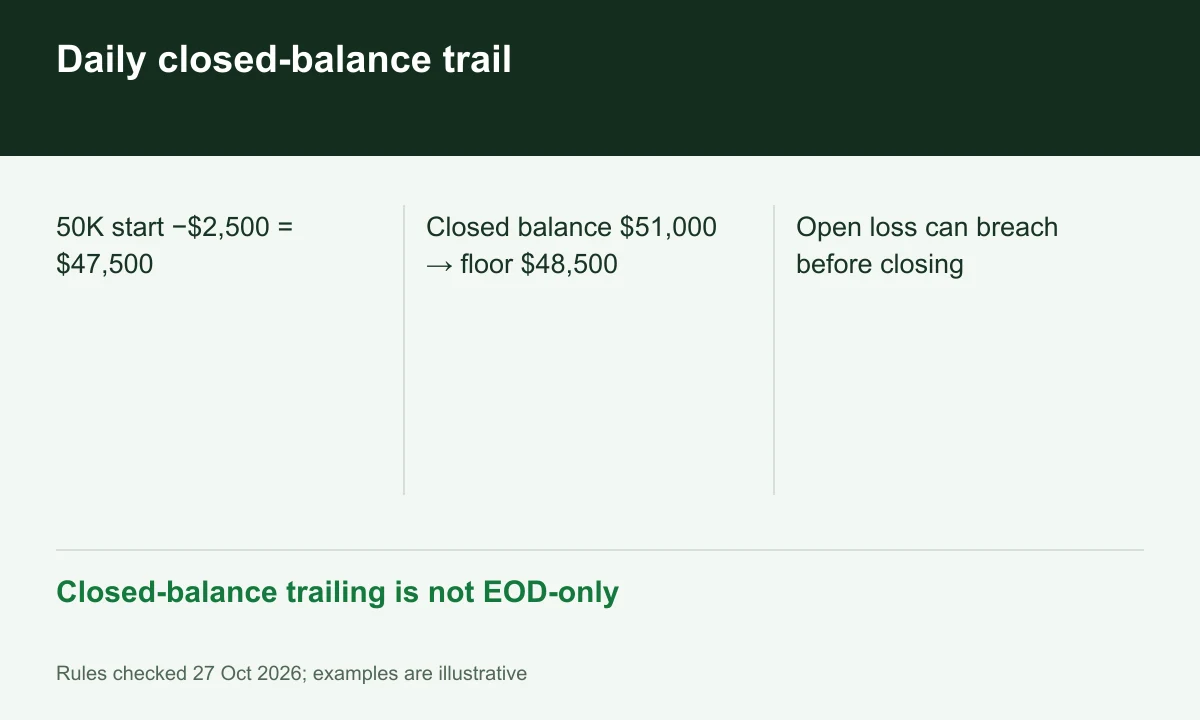
Guide
Daily’s 5% trailing floor moves immediately when a closed trade creates a new balance high, not only at EOD. Open profit does not move it, but open losses can breach it. Vietnam residents are excluded; this is a scoped rule example.
Read guide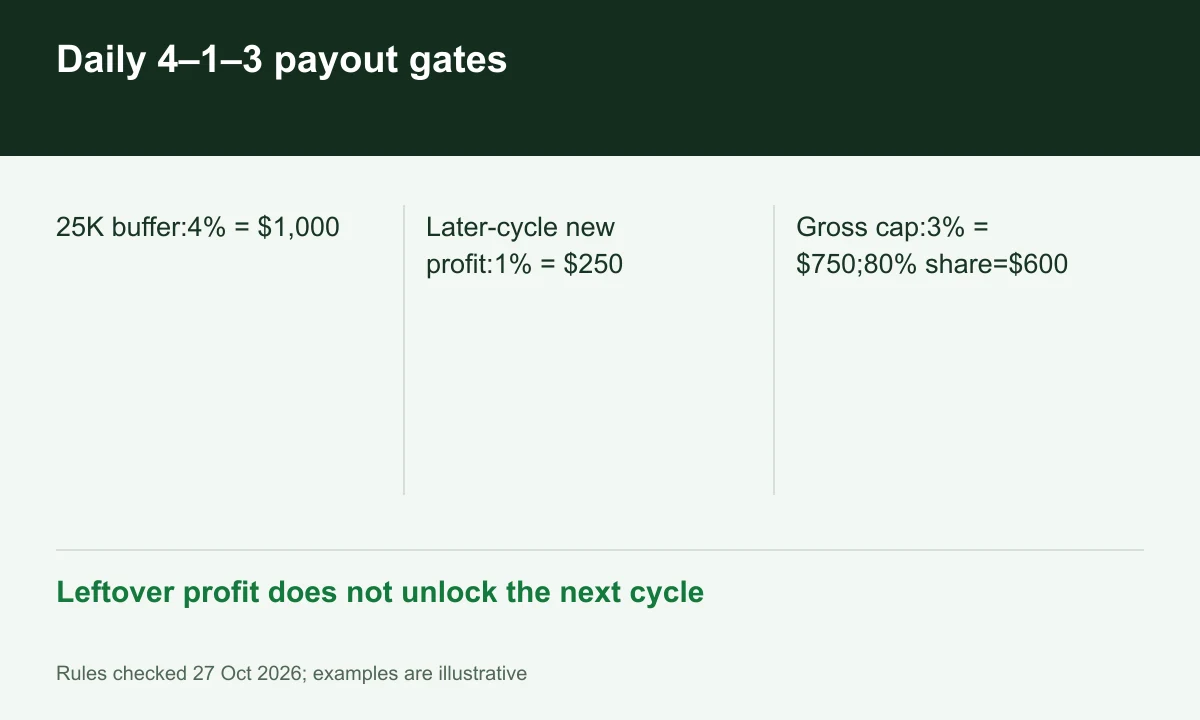
Guide
Daily payouts require profit above a 4% retained buffer, and each later cycle requires 1% new profit before another request. A 3% gross request cap applies before the reward share. The name Daily does not waive these gates; Vietnam residents are excluded.
Read guide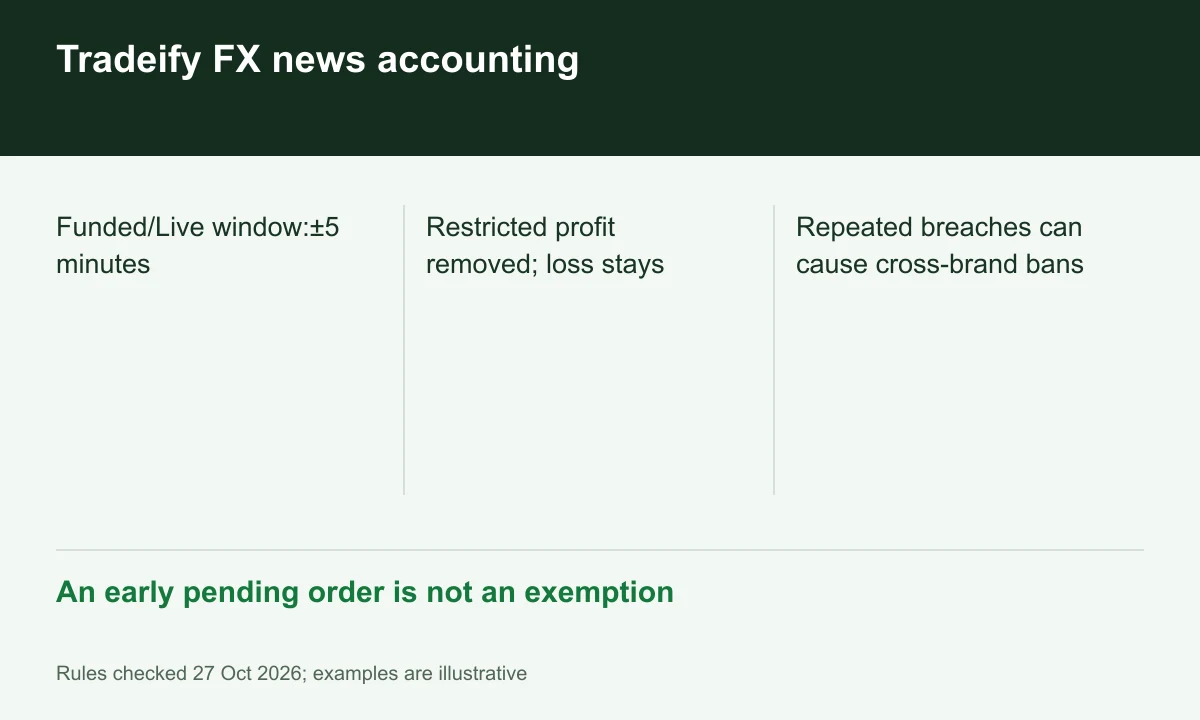
Guide
Funded and Live accounts restrict opening, closing and changing affected orders within five minutes either side of high-impact news. Profit may be deducted while loss remains; repeated violations can end accounts across linked brands. Vietnam residents are excluded.
Read guide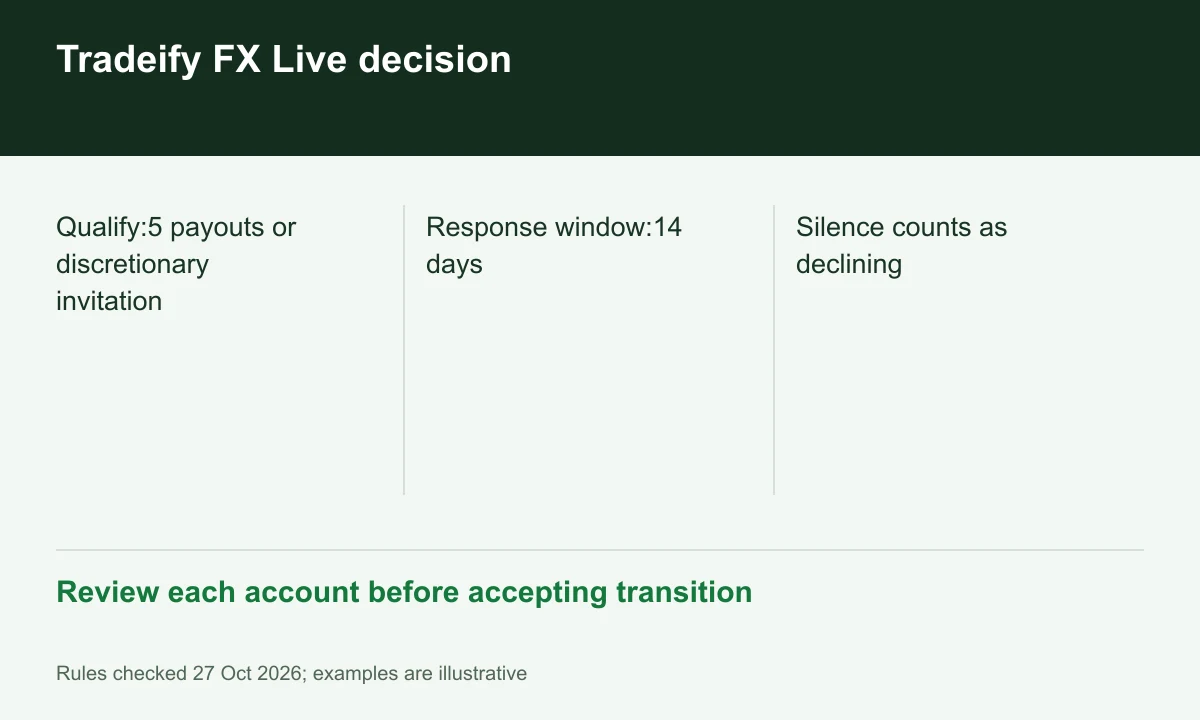
Guide
The Live Program can follow five payouts or a discretionary invitation. Not responding within fourteen days counts as declining, with account-closure and future-purchase consequences. Vietnam residents remain excluded; the programme label alone does not resolve execution or contract scope.
Read guide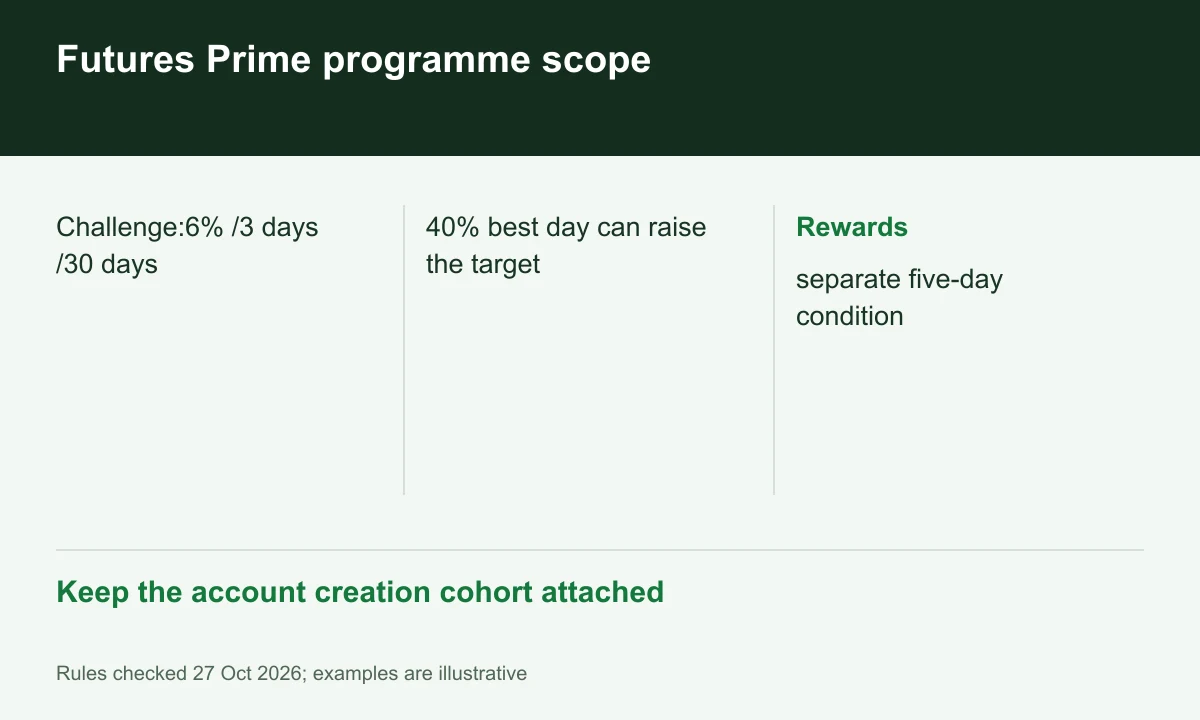
Guide
Futures Prime has a 30-day challenge,6% target and three unique trading days, with a 40% best-day target adjustment. Earning rewards use a separate five-day test. Vietnam is absent from the reviewed Futures exclusions, but product/data-provider availability still needs confirmation.
Read guide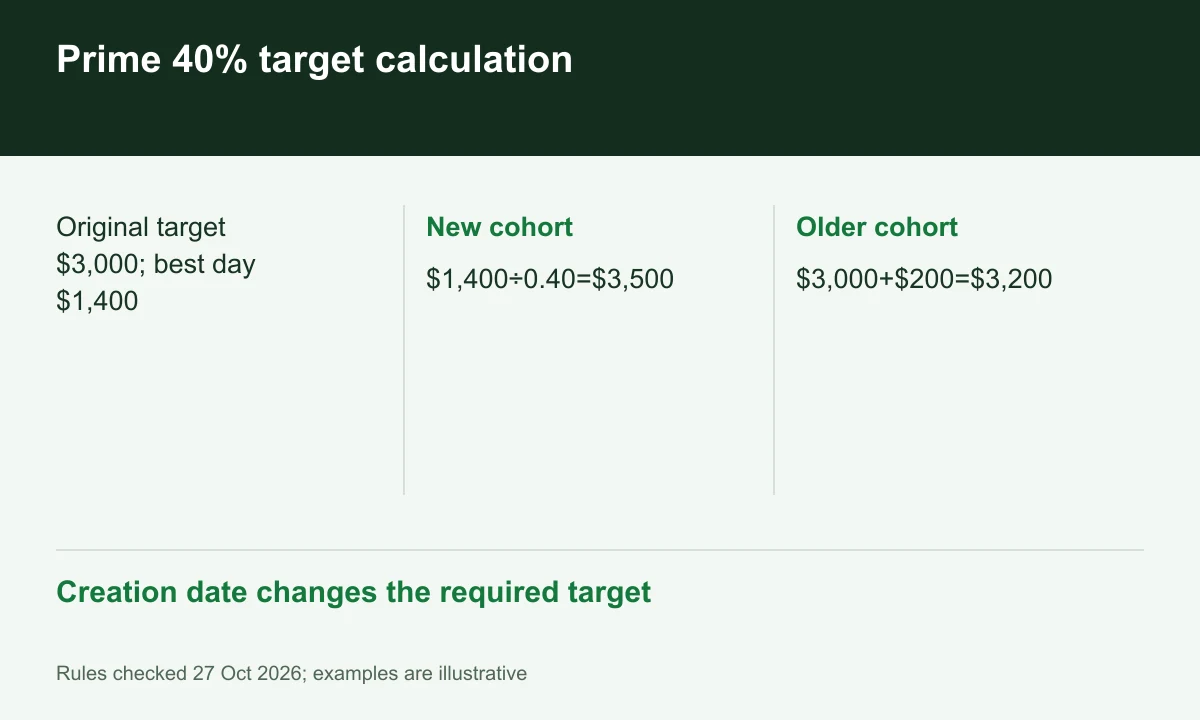
Guide
Futures Prime challenges created from 14 July 2026 recalculate the target as highest day÷0.40; older ones add only the excess over the original cap. It is a soft target adjustment, not a payout consistency test. Confirm residence and data eligibility separately.
Read guide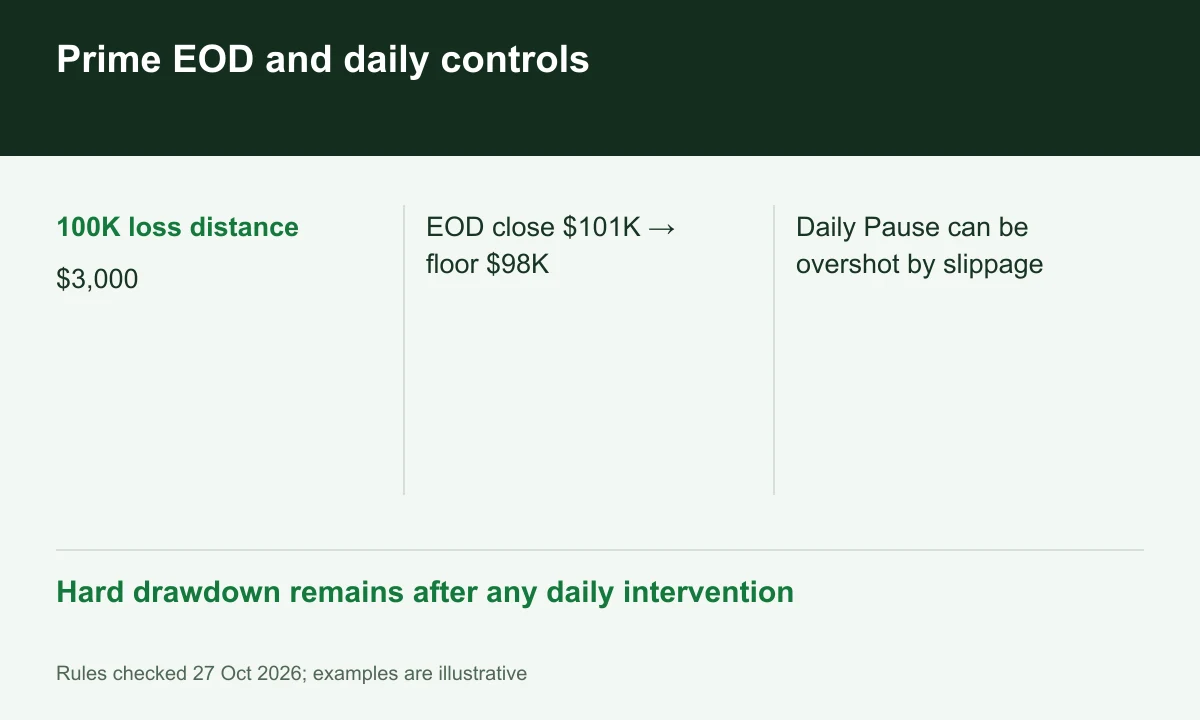
Guide
Maximum drawdown is a hard breach; Daily Pause is a separate session stop and not guaranteed protection against slippage. The current rule summary and detailed stage wording differ, so confirm the post 14 July 2026 Earning scope. Country/data eligibility remains separate.
Read guide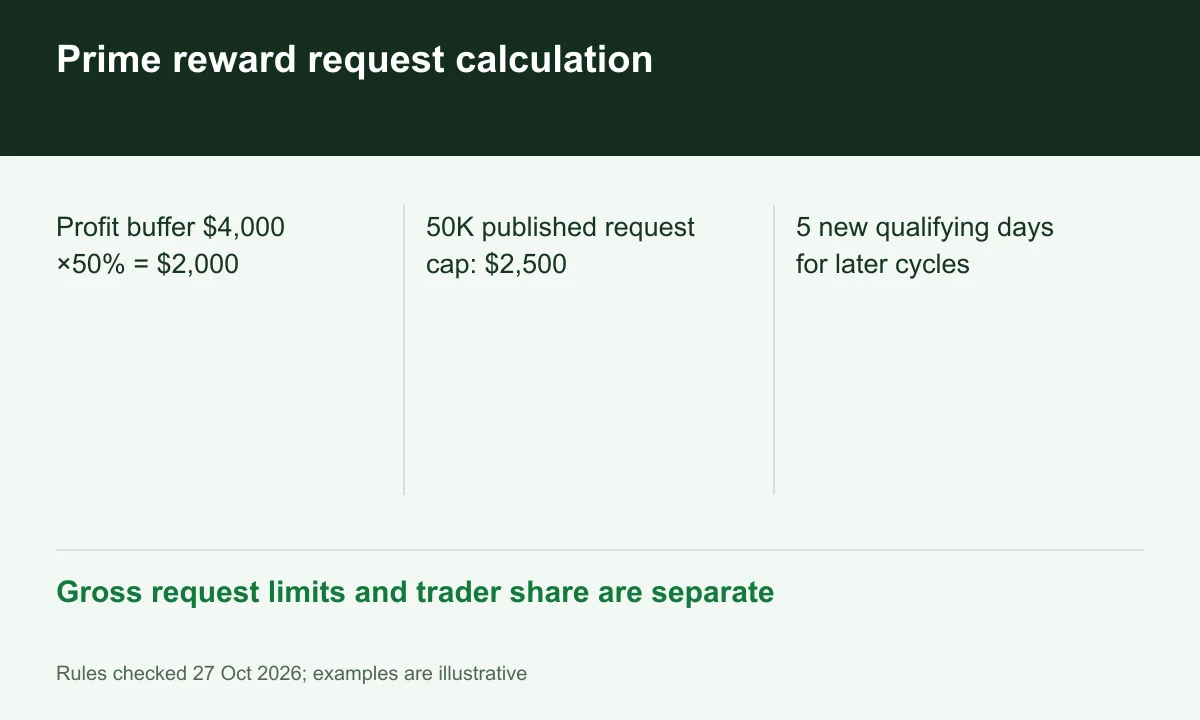
Guide
The current Futures Prime reward page permits a request up to 50% of profit buffer, subject to size caps and five $150 profitable days. Later cycles also need new positive net profit. The displayed cap does not by itself establish net cash after the reward share.
Read guide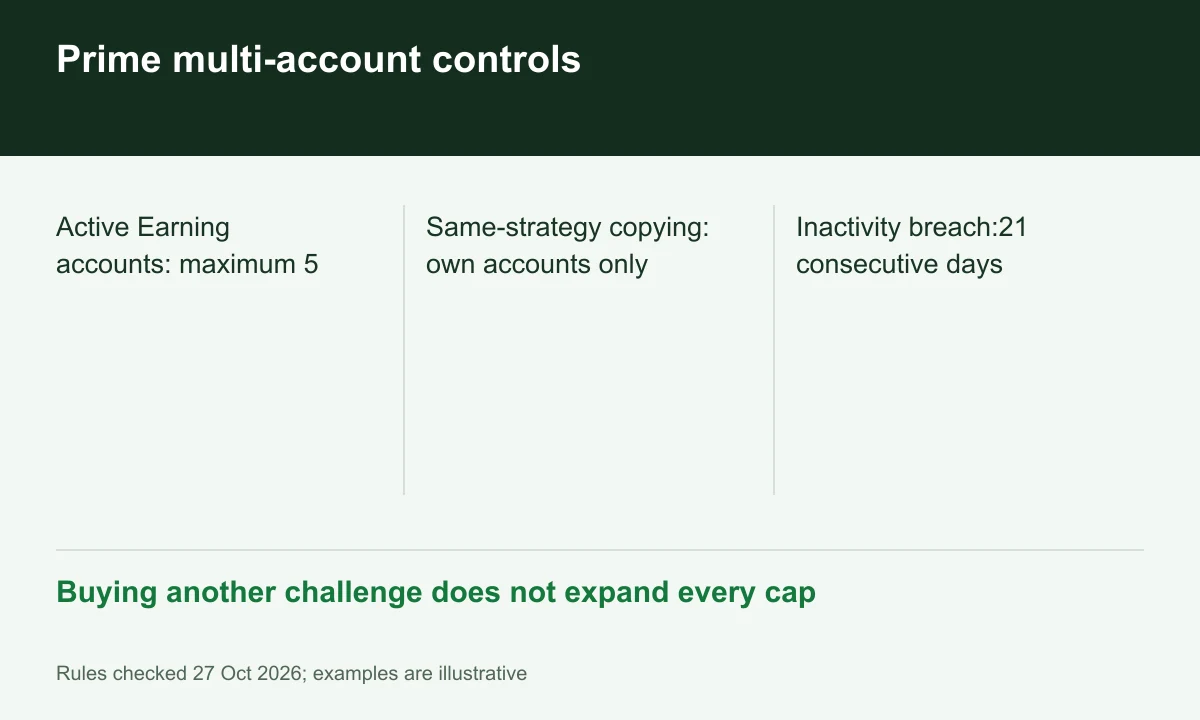
Guide
Futures Prime limits active Earning accounts and same-strategy copying to five, while 21 consecutive inactive days can breach an account. Buying more challenges does not remove these limits. Product/data eligibility and individual KYC remain separate.
Read guide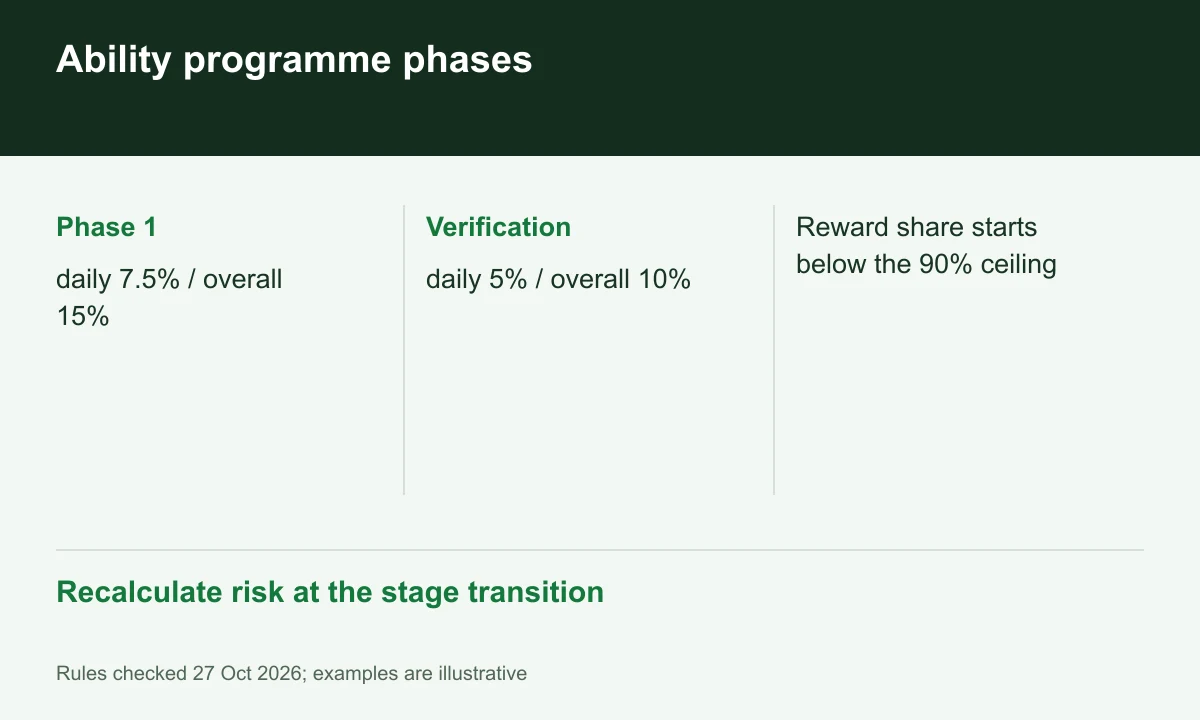
Guide
Ability Challenge’s first phase permits 7.5% daily/15% overall loss, but Verification and the named Live phase tighten to 5%/10%. Vietnam is absent from the reviewed residency exclusions, which does not approve an individual. “Up to 90%” is not the entry reward split.
Read guide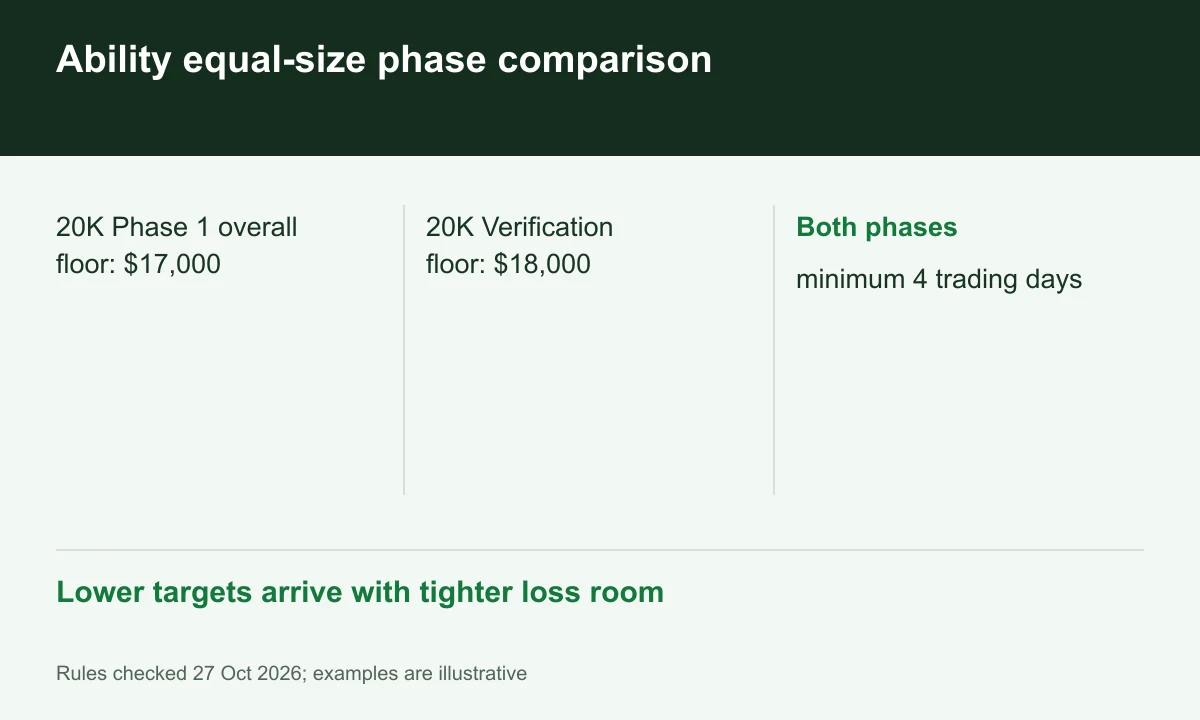
Guide
Ability’s Phase 1 and Verification use different loss percentages. On an equal nominal account, Verification leaves a smaller dollar allowance even though its target is lower. Country eligibility and actual funded-stage terms remain separate from this arithmetic.
Read guide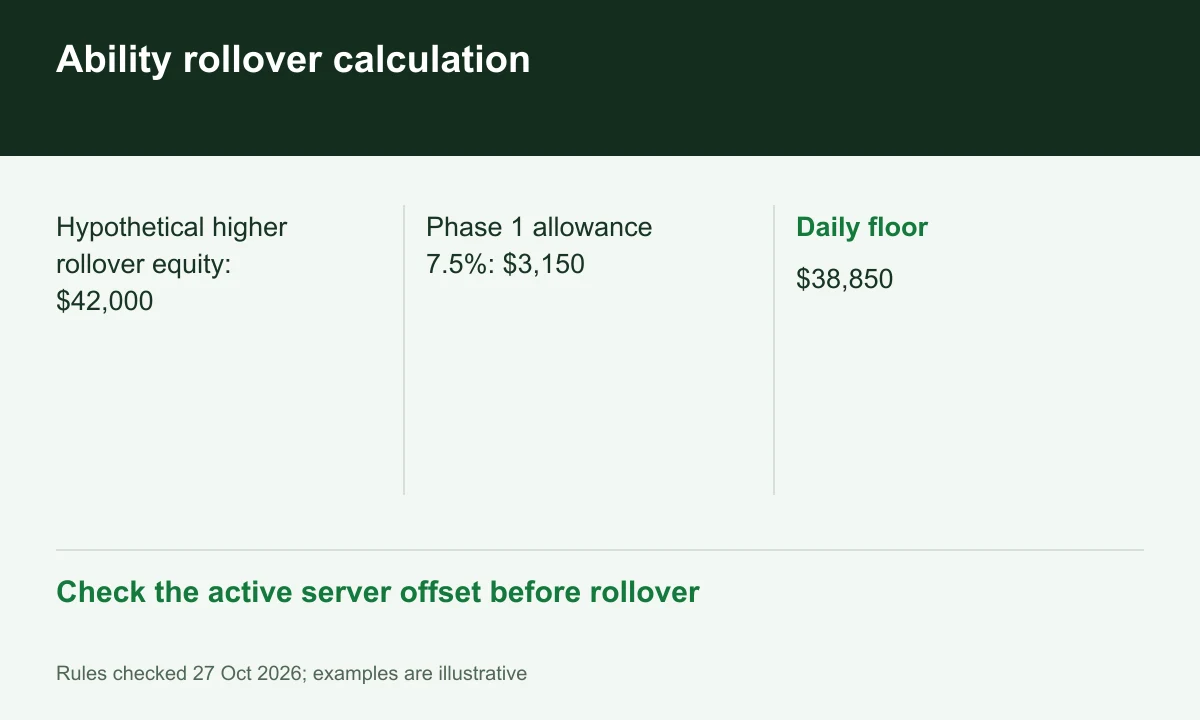
Guide
Ability uses the higher rollover balance/equity as the daily reference. A floating gain can therefore tighten next-day room before it is realised. The source mixes fixed GMT+2 wording with seasonal GMT+2/+3 schedules; verify the active server time.
Read guide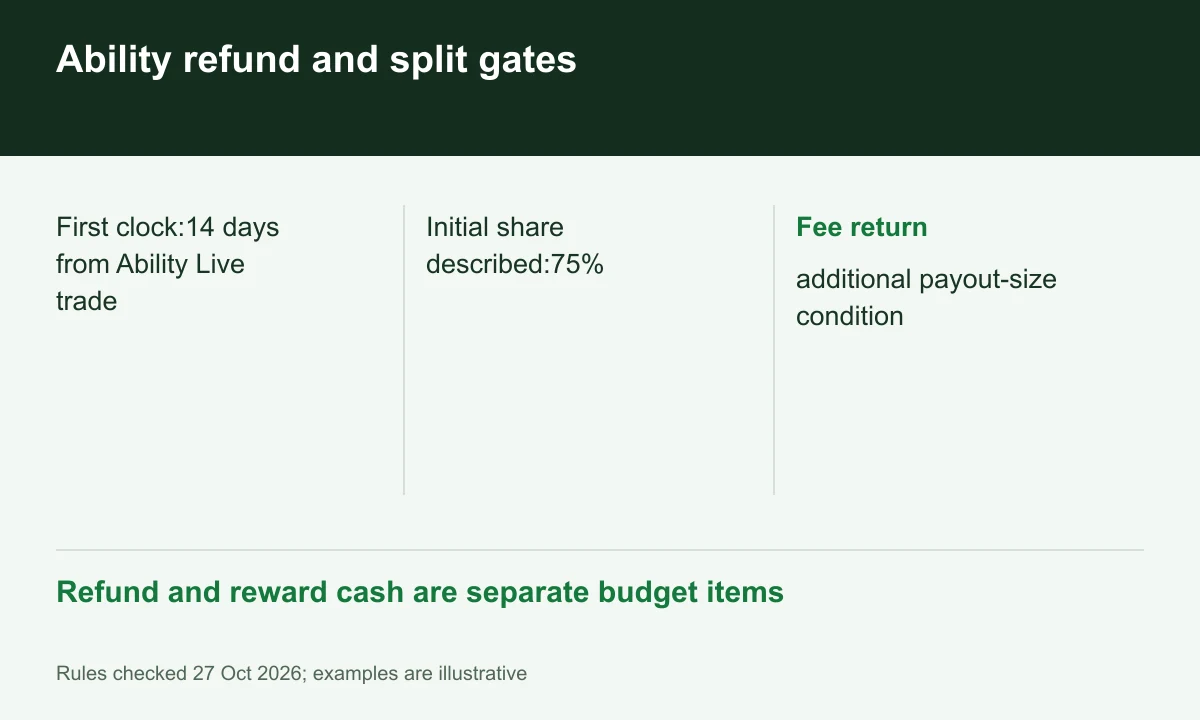
Guide
Ability’s fee return accompanies a qualifying first payout only when its payout-amount condition exceeds the fee and the account remains compliant. The knowledge centre describes an initial 75% share, not universal 90%. Passing evaluation is not a cash refund event.
Read guide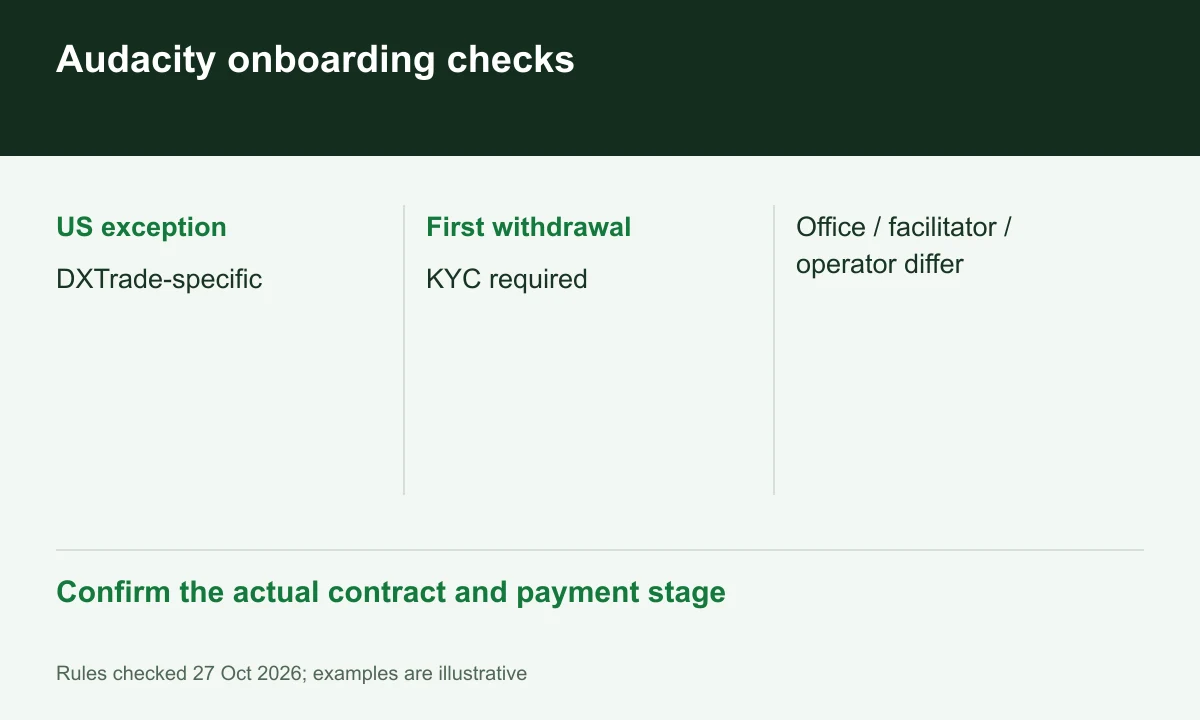
Guide
Audacity’s country help gives a US DXTrade exception rather than unrestricted US MT5 access. Vietnam is not on the reviewed exclusion list, but personal KYC and local eligibility still apply. A UK office does not itself identify a UK-regulated brokerage contract.
Read guide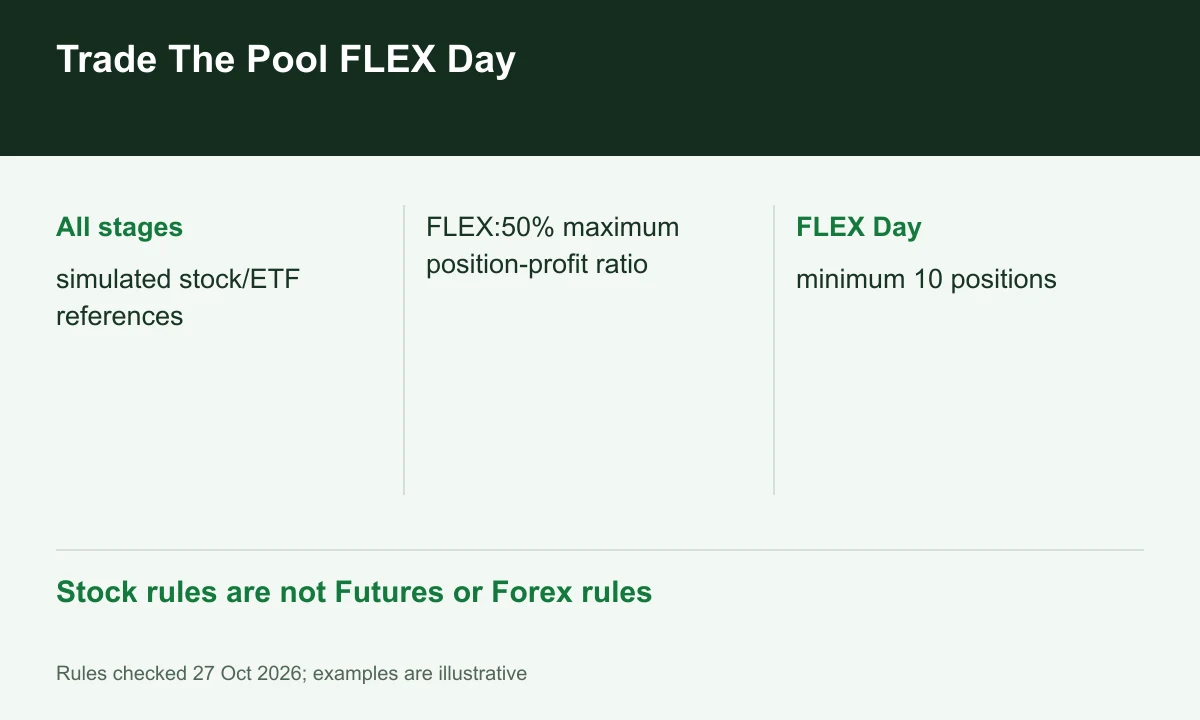
Guide
Trade The Pool is a stock/ETF-reference programme; its current Program Terms say every stage is simulated and no user order reaches an exchange. FLEX Day has its own position-consistency and activity rules. Vietnam is absent from the reviewed exclusions, without personal approval.
Read guide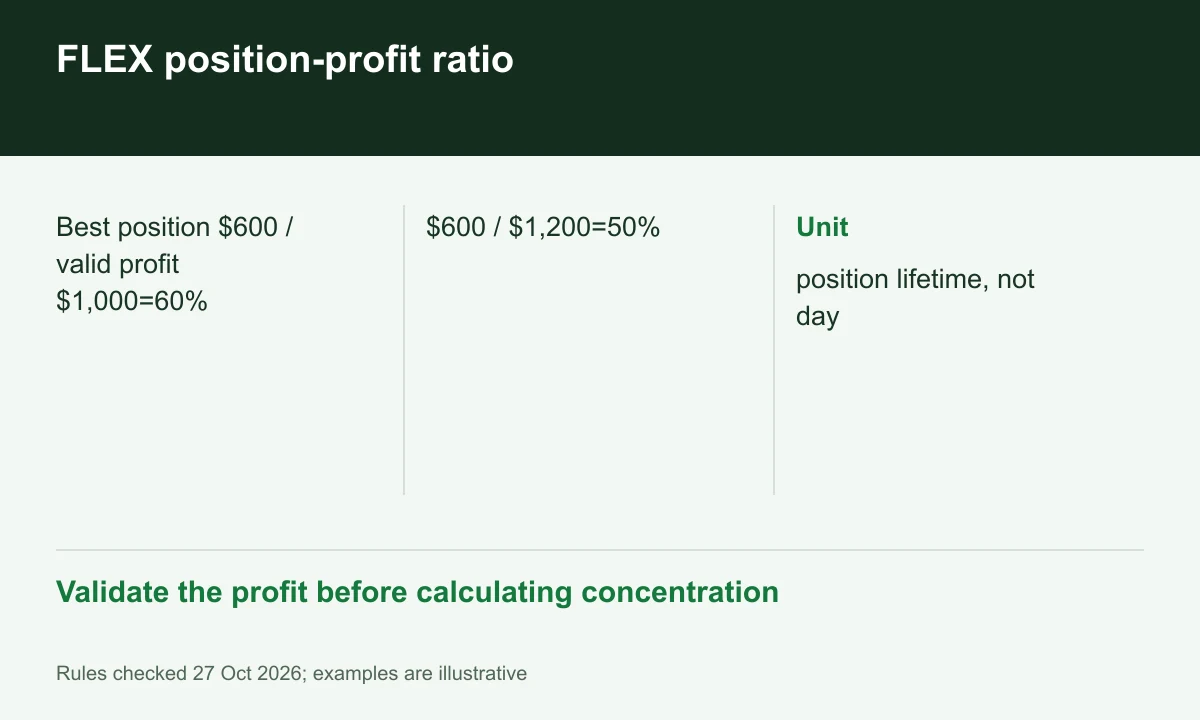
Guide
Trade The Pool’s FLEX 50% ratio measures the best position against total valid profit, not the best day. Program-specific terms override a generic 30% default. Position lifetime, holding time and price distance affect what counts; country/KYC approval remains separate.
Read guide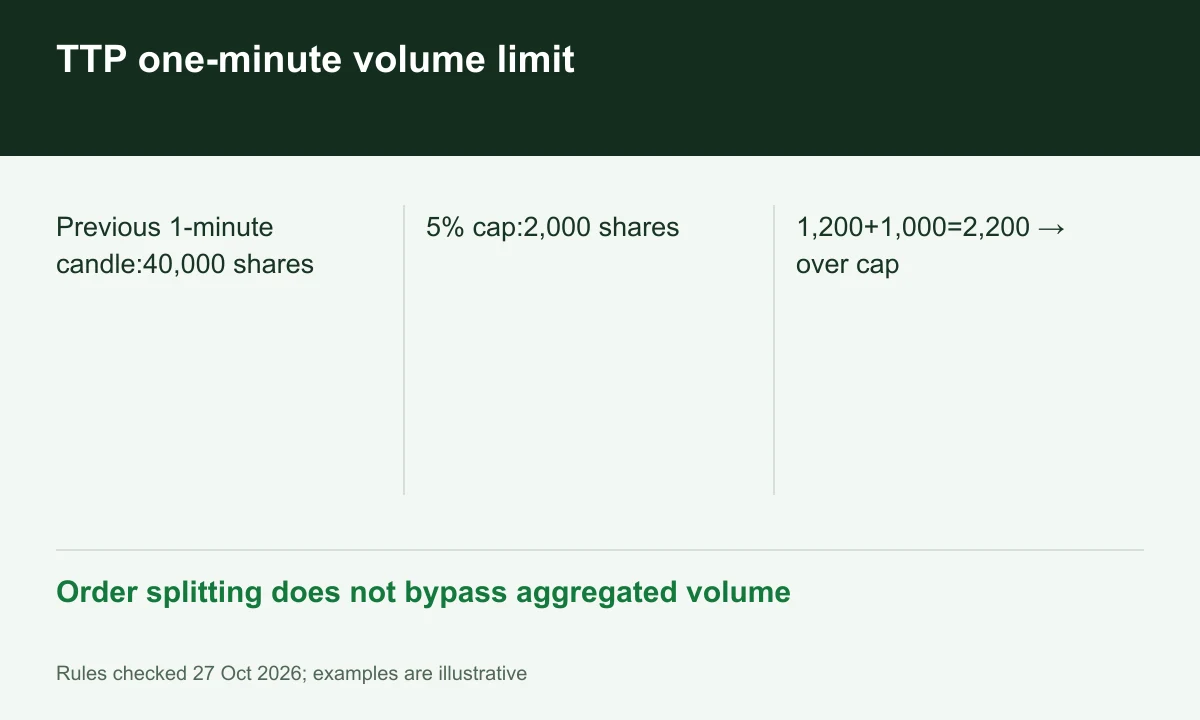
Guide
Trade The Pool caps opening/adding share volume at 5% of the previous one-minute candle, using its own data. Multiple entries in the same instrument/minute are aggregated. Small-looking tickets do not individually bypass the cap in this simulated stock programme.
Read guide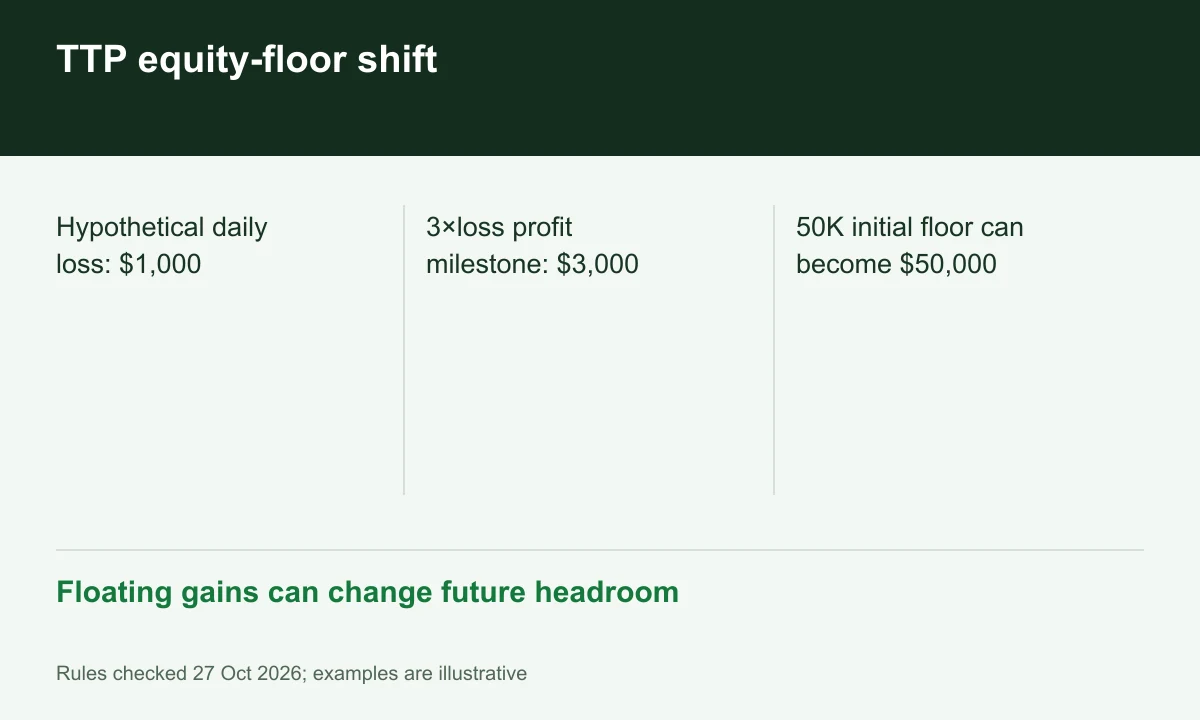
Guide
The Program Terms move the floor to initial balance once equity reaches 3×daily-loss profit, including unrealised gains. This can occur intraday before a withdrawal. A large profit does not guarantee the original drawdown cushion remains available.
Read guide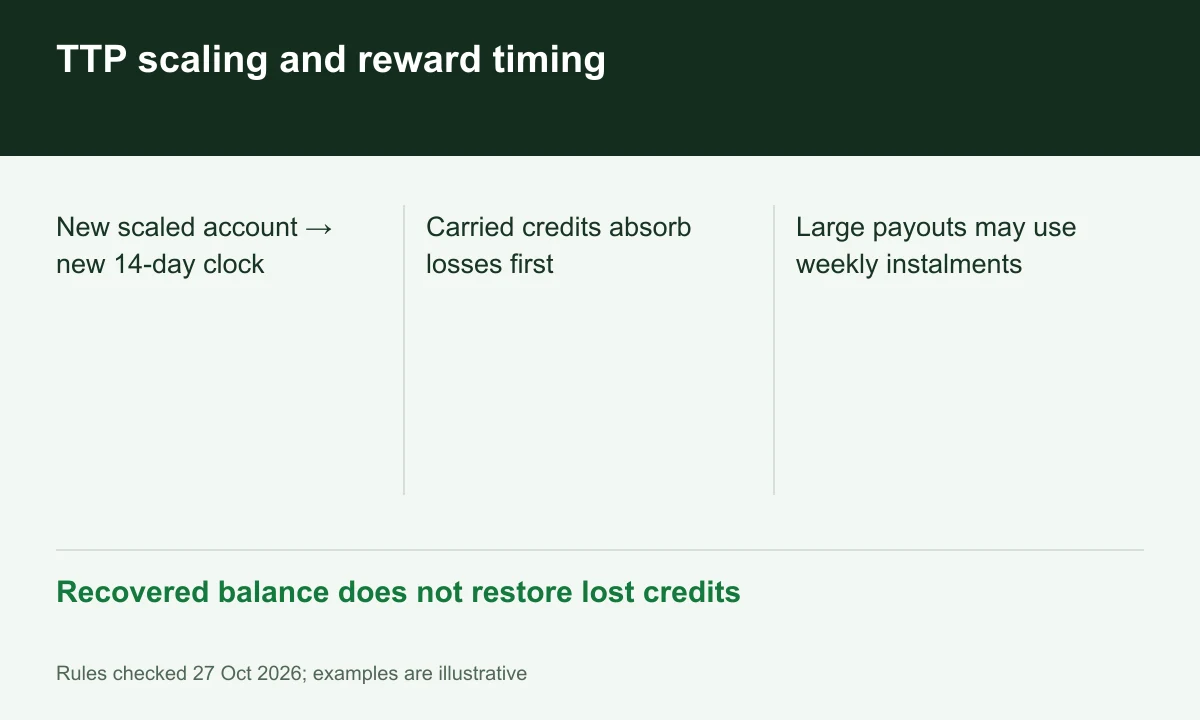
Guide
Trade The Pool’s fourteen-day payout timer restarts on a newly scaled Professional account. Rolled-over credits can absorb losses permanently rather than recover automatically with later gains. MAX/FLEX 70/30 split and programme-specific qualifying rules still apply.
Read guide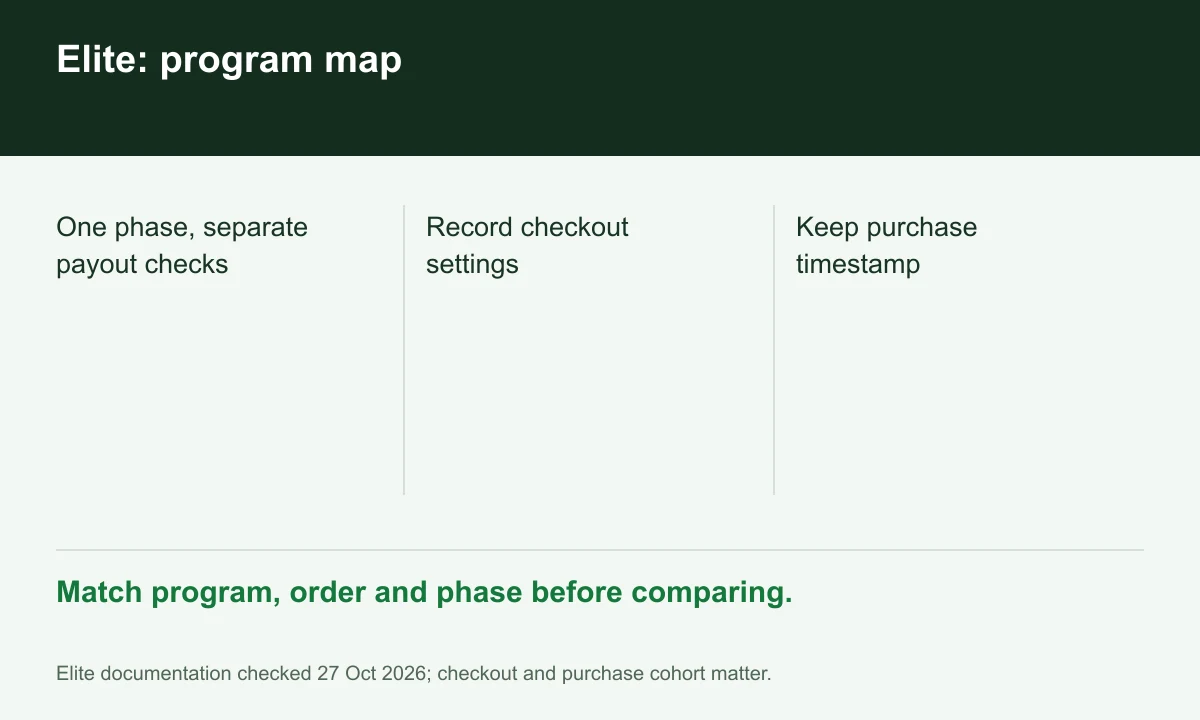
Guide
Map the Elite evaluation, checkout choices and payout checks before comparing account sizes; distinguish simulated access from a cash deposit.
Read guide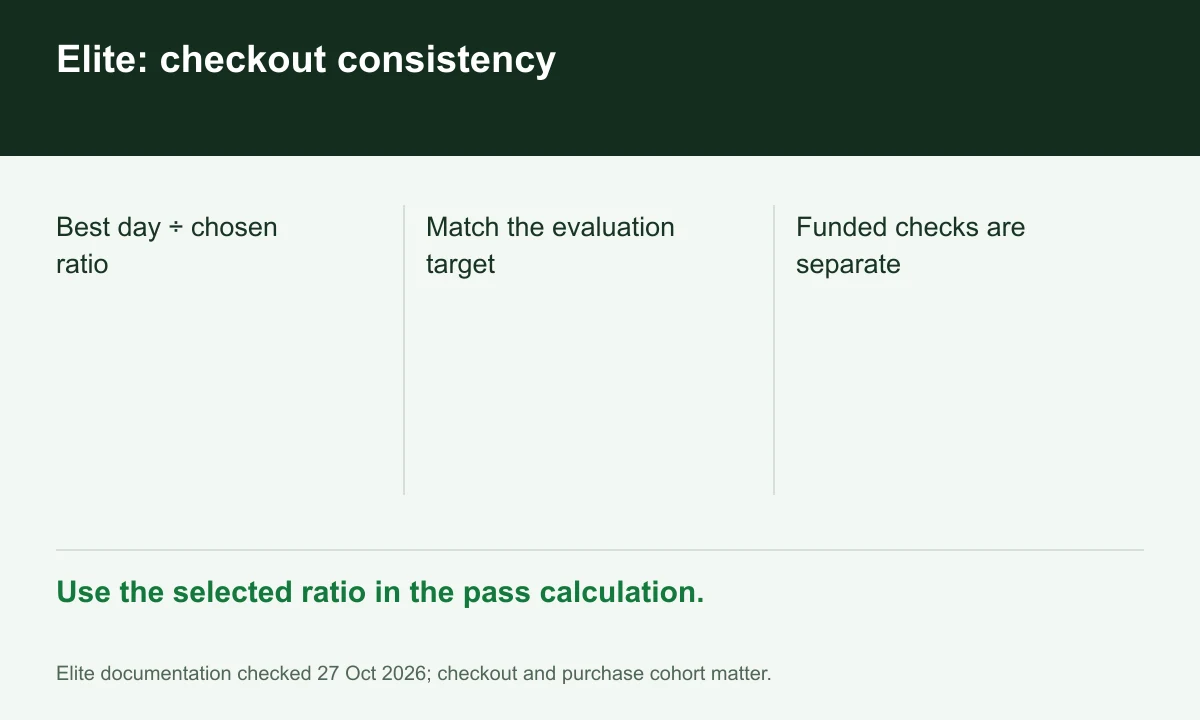
Guide
Understand how Elite's checkout consistency option changes the profit distribution needed to pass, with a hypothetical calculation and an order checklist.
Read guide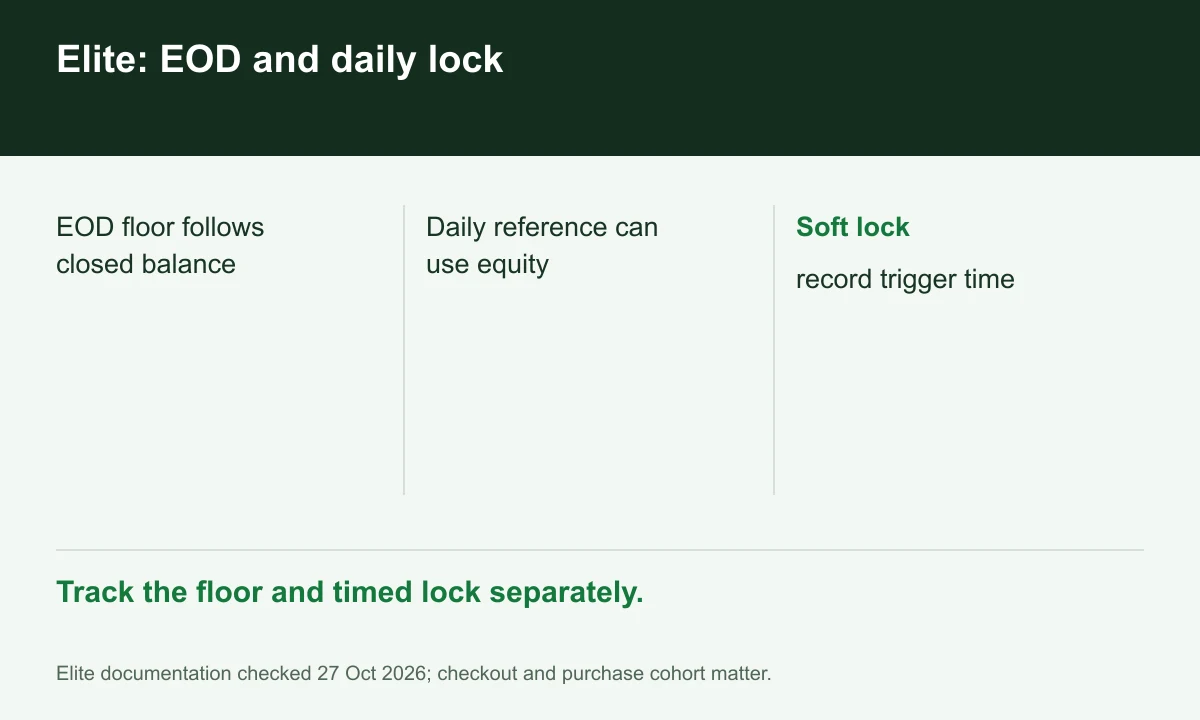
Guide
Distinguish Elite's end-of-day trailing floor from its optional daily soft lock; build a ledger that records both without treating them as one limit.
Read guide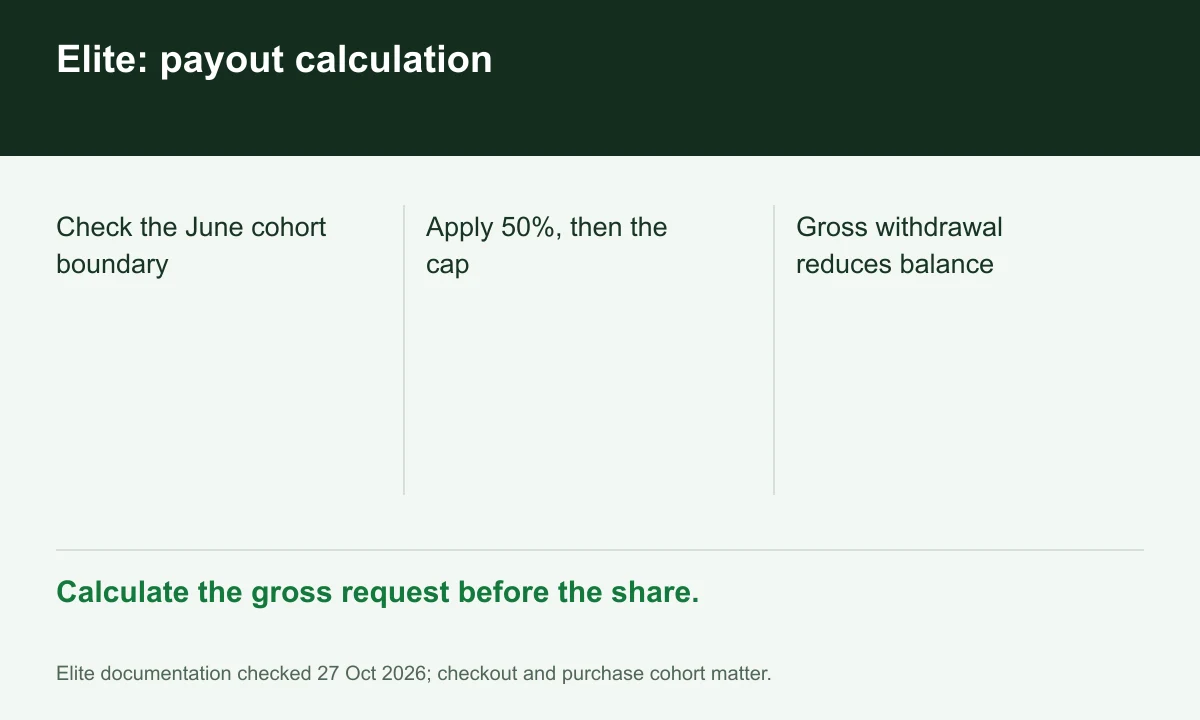
Guide
Check the June purchase-cohort boundary before calculating an Elite payout request; separate remaining profit, request caps and the trader's share.
Read guide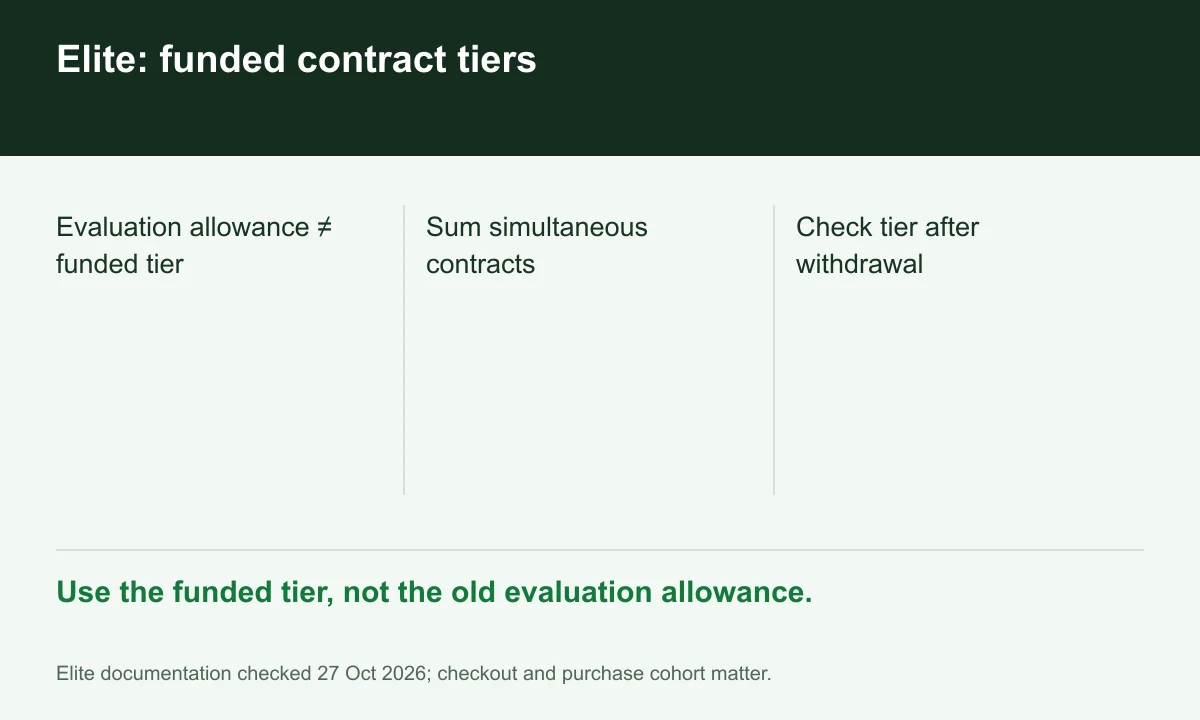
Guide
Plan the move from Elite evaluation to funded trading without carrying over the full evaluation position allowance; check simultaneous exposure by profit tier.
Read guide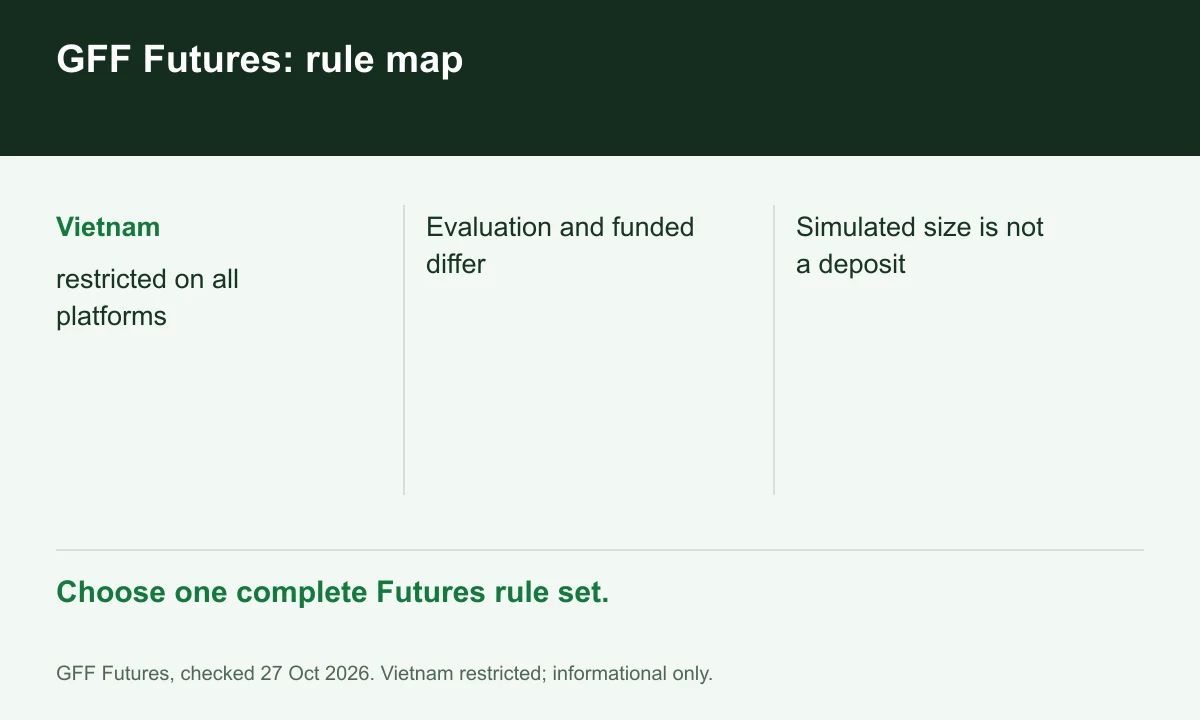
Guide
Compare the evaluation and funded mechanics of Goat Funded Futures before reading payout headlines; Vietnam is on its current restricted-country list.
Read guide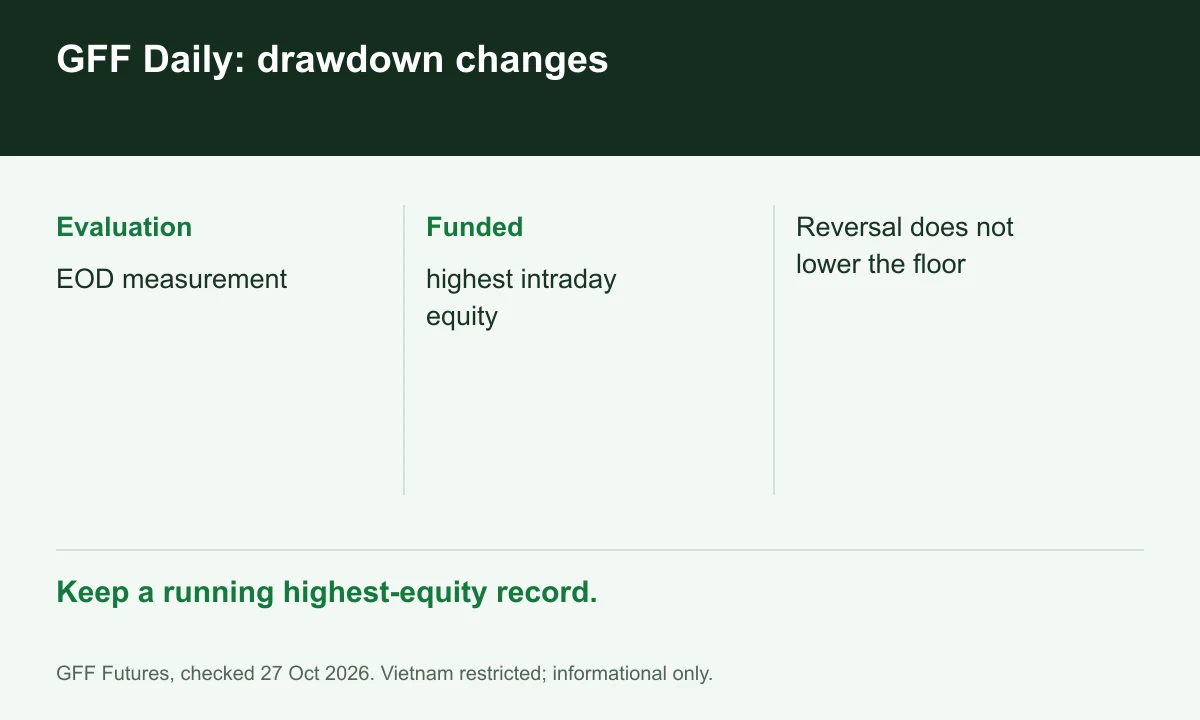
Guide
Follow the drawdown change when a Daily Payouts evaluation becomes funded; use a hypothetical equity reversal to understand why open profits matter.
Read guide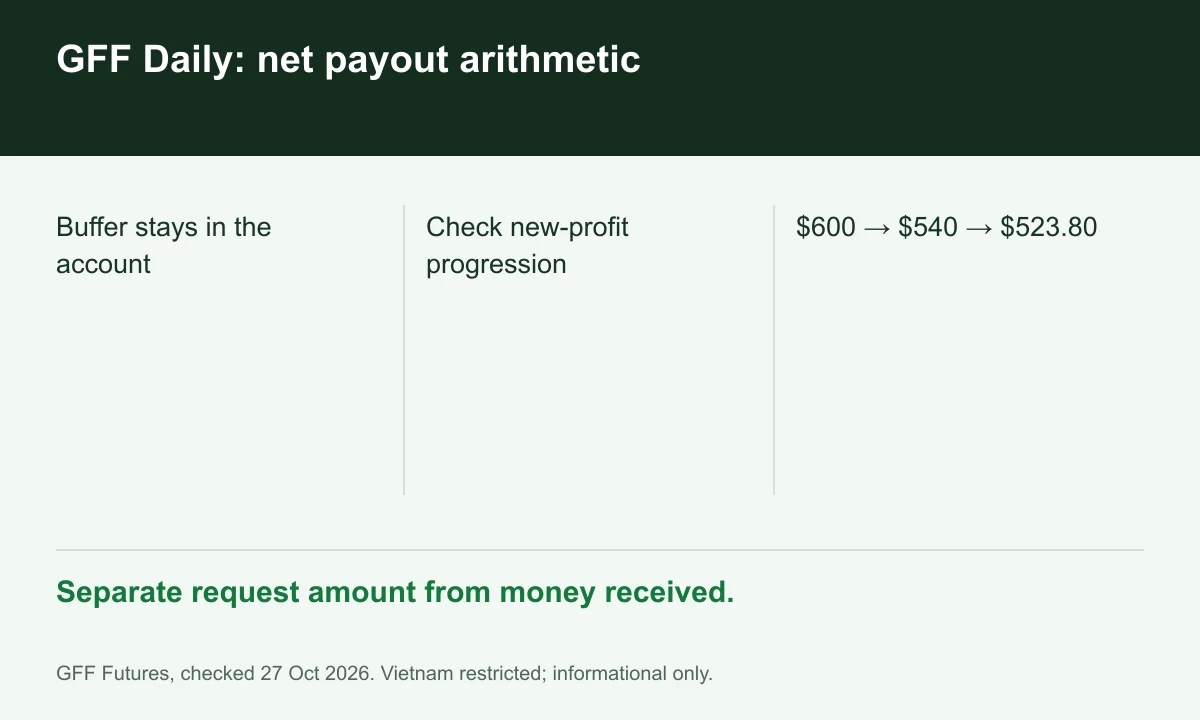
Guide
Calculate a hypothetical Daily Payouts receipt after its split and processing deduction; distinguish buffer, progression eligibility and the request cap.
Read guide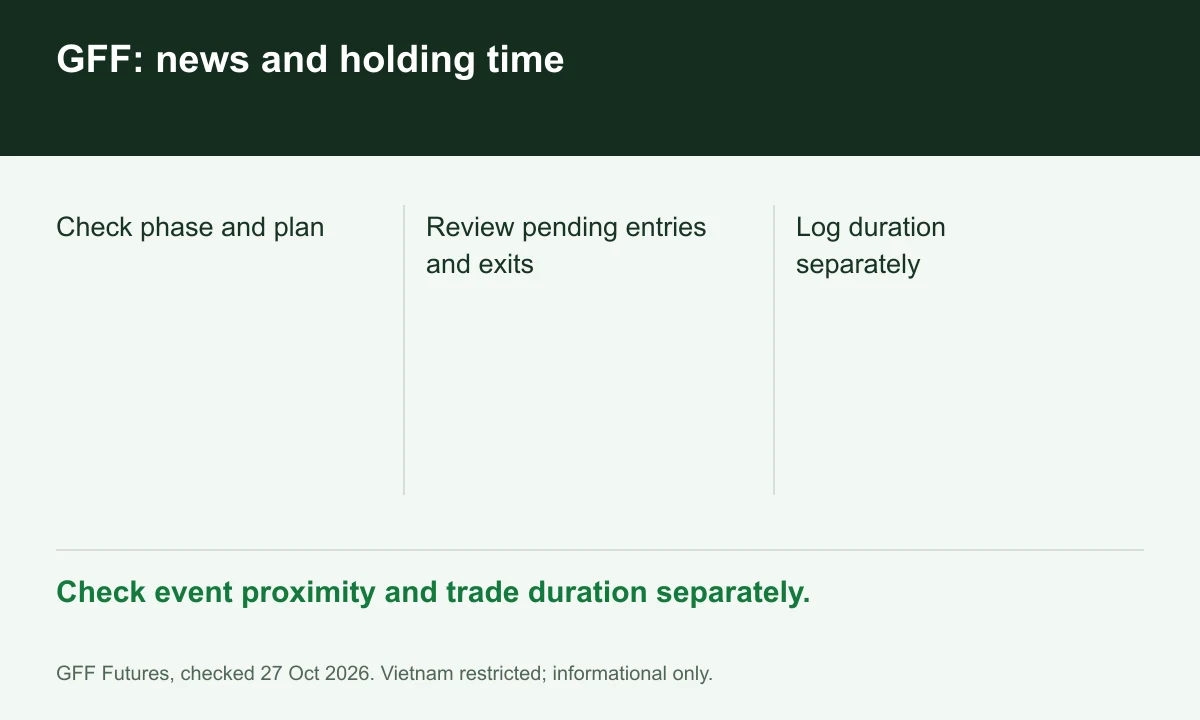
Guide
Separate GFF's news-event buffer from its plan-specific holding-time rules, using a pre-session checklist that includes pending orders and account phase.
Read guide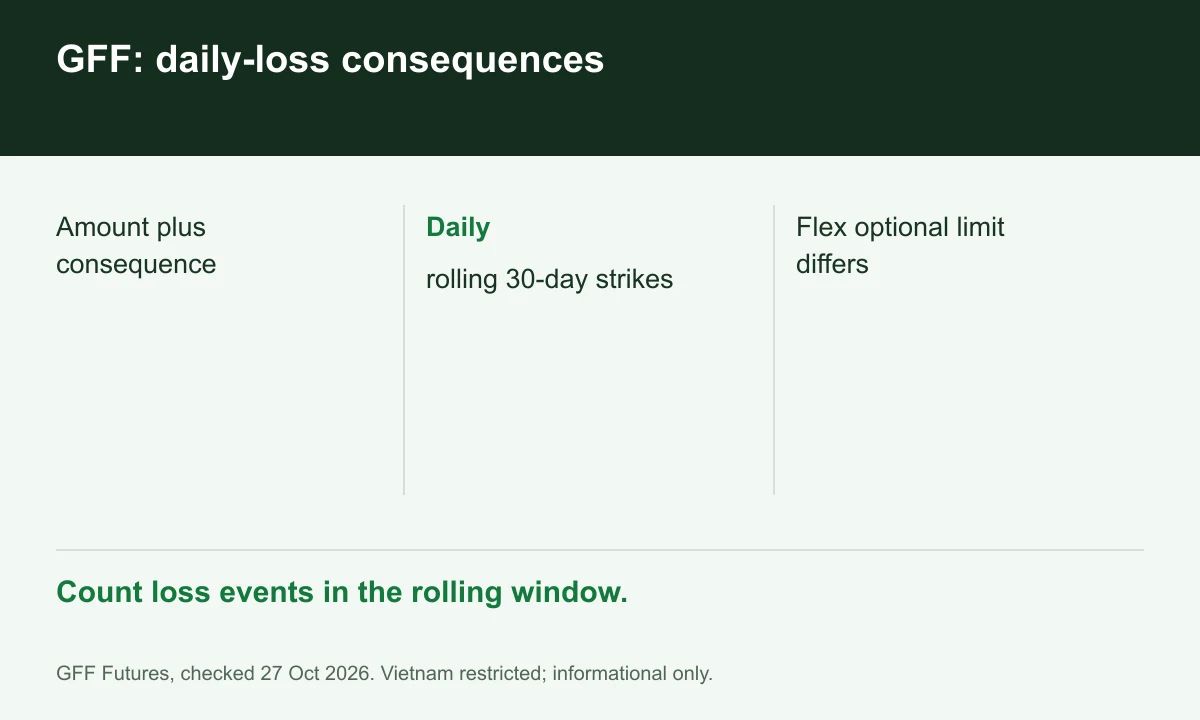
Guide
Understand why a daily loss event can mean different consequences across GFF plans; track the Daily Payouts rolling strike count rather than assuming a reset.
Read guide
Guide
Map TradeDay Fast Pass from evaluation through Funded Sim and live review, with purchase-cohort limits and the current Vietnam restriction made explicit.
Read guide
Guide
Check Fast Pass payout eligibility against the account-opening date, profitable-day ledger and request cap; avoid confusing a gross request with cash received.
Read guide
Guide
Use TradeDay's session clock to determine when Fast Pass trading and the next qualifying-day cycle can restart after a payout request and receipt.
Read guide
Withdrawals
Understand how a withdrawal reduces room above TradeDay's drawdown floor even when the trailing calculation is based on end-of-day realized results.
Read guide
Guide
Review TradeDay's citizenship, residency and funded-KYC requirements, including conflicting refund wording that should be resolved before any purchase.
Read guide
Guide
Map Blue Guardian Futures models and stages without borrowing CFD rules; compare model-specific drawdown and payout gates while retaining country restrictions.
Read guide
Guide
Compare Standard and Reserve loss controls by stage, especially Reserve's optional daily limit and its different evaluation and funded trailing behavior.
Read guide
Guide
Calculate Standard's potential withdrawal headroom separately from its buffer, cap and drawdown floor; keep the published consistency boundary conflict visible.
Read guide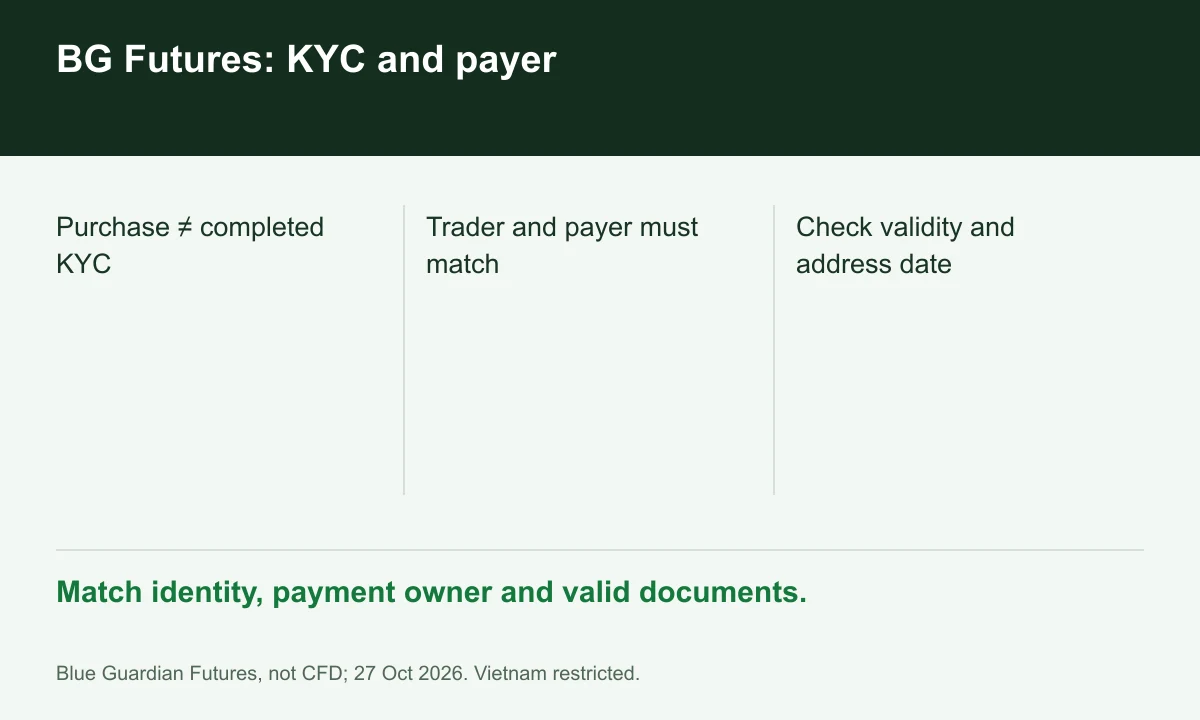
Guide
Prepare the identity and payment-ownership checks in Blue Guardian Futures' current onboarding guidance without confusing successful purchase with payout eligibility.
Read guide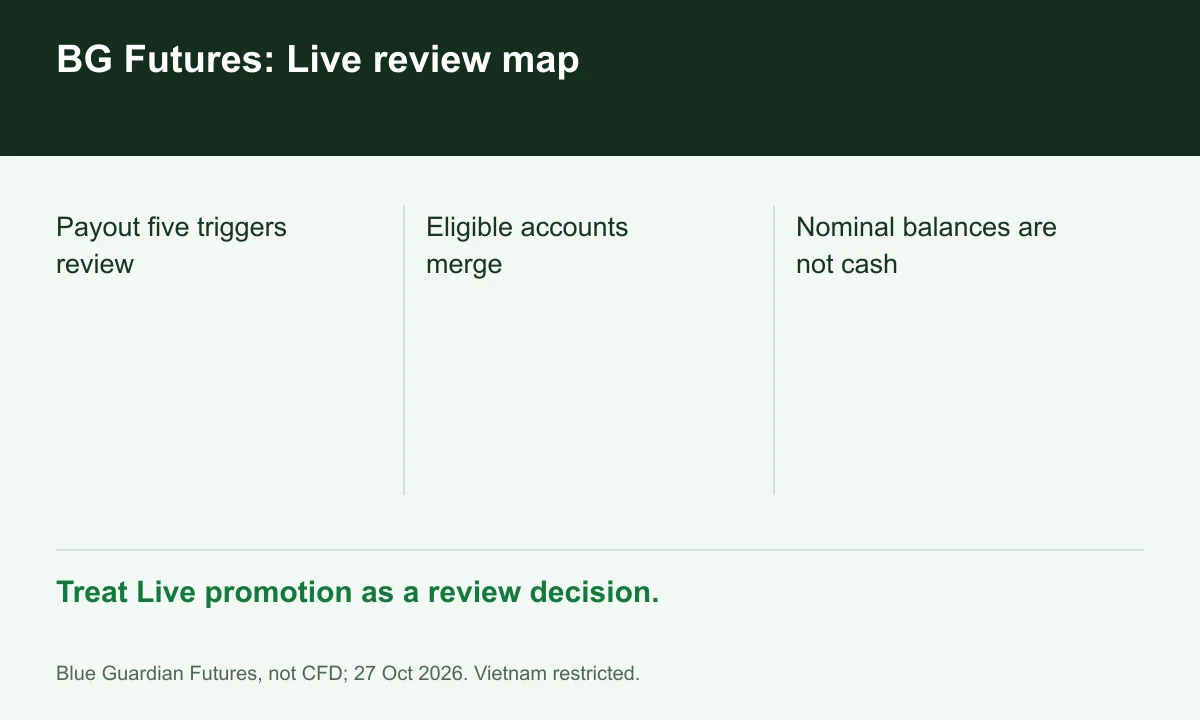
Guide
Understand why a fifth payout is a Live-review trigger rather than a guarantee, and inventory eligible simulated accounts before a possible merger.
Read guide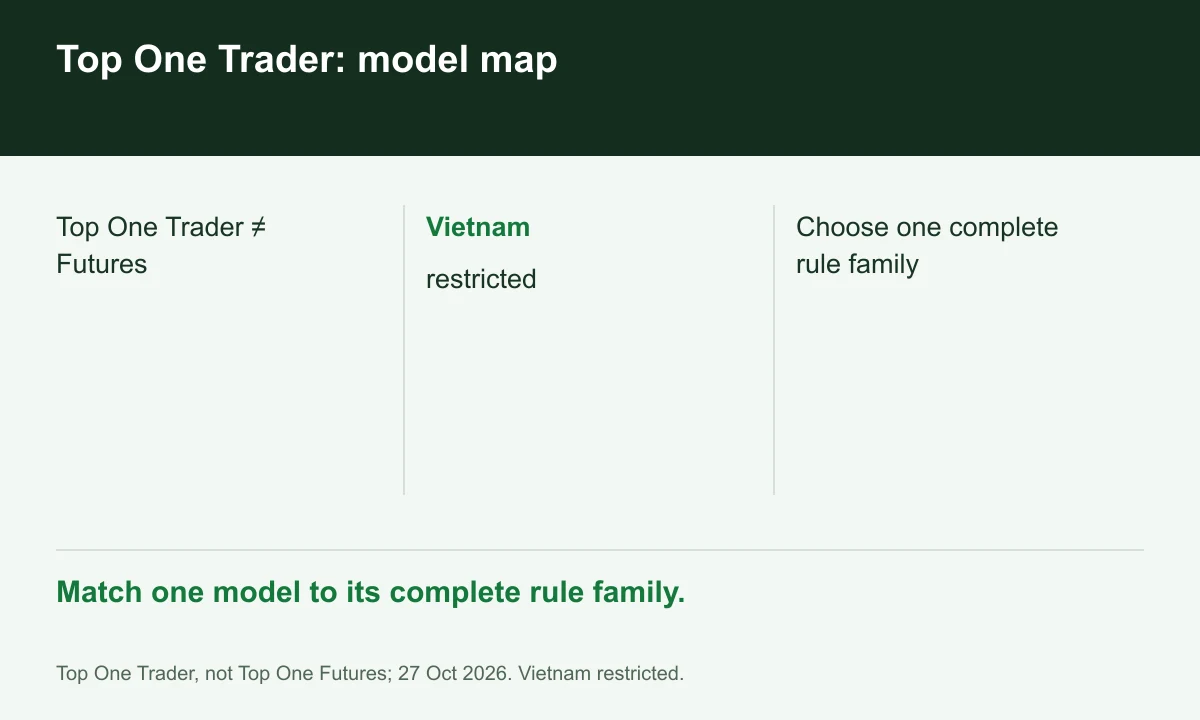
Guide
Compare Top One Trader's current challenge and instant models by loss method and payout tests, while keeping Vietnam's service restriction explicit.
Read guide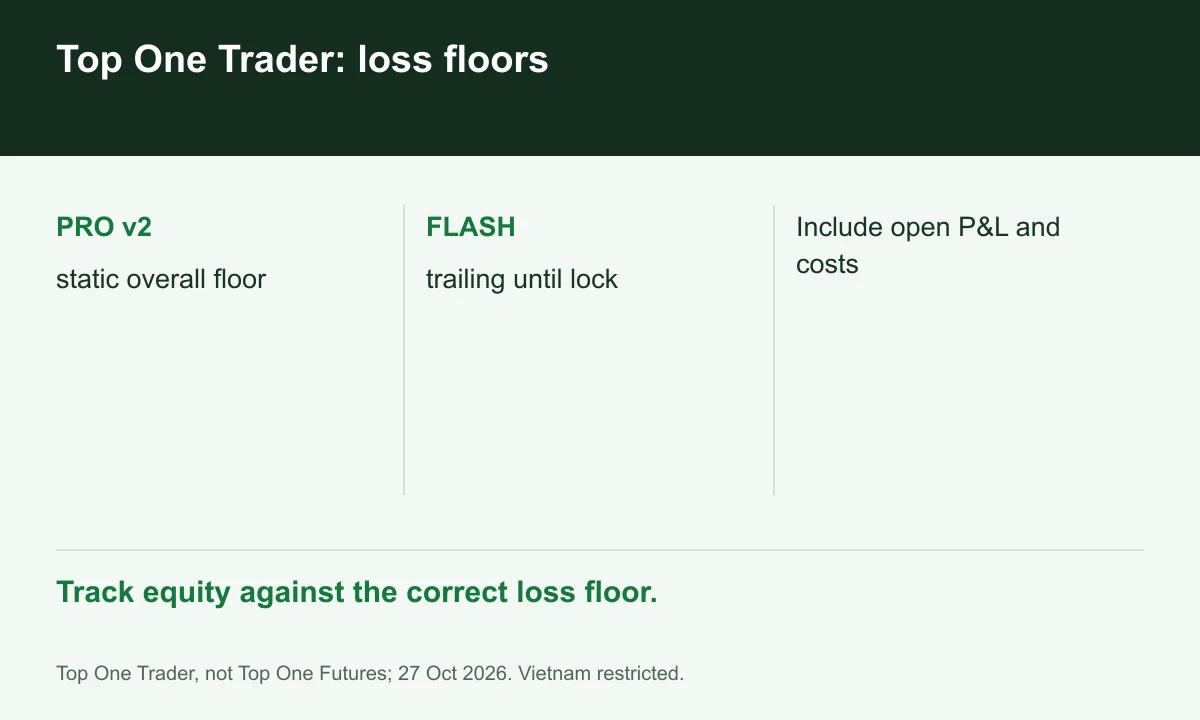
Guide
Distinguish the current PRO v2 static loss floor from FLASH trailing drawdown, using a hypothetical worksheet that separates equity from realized balance.
Read guide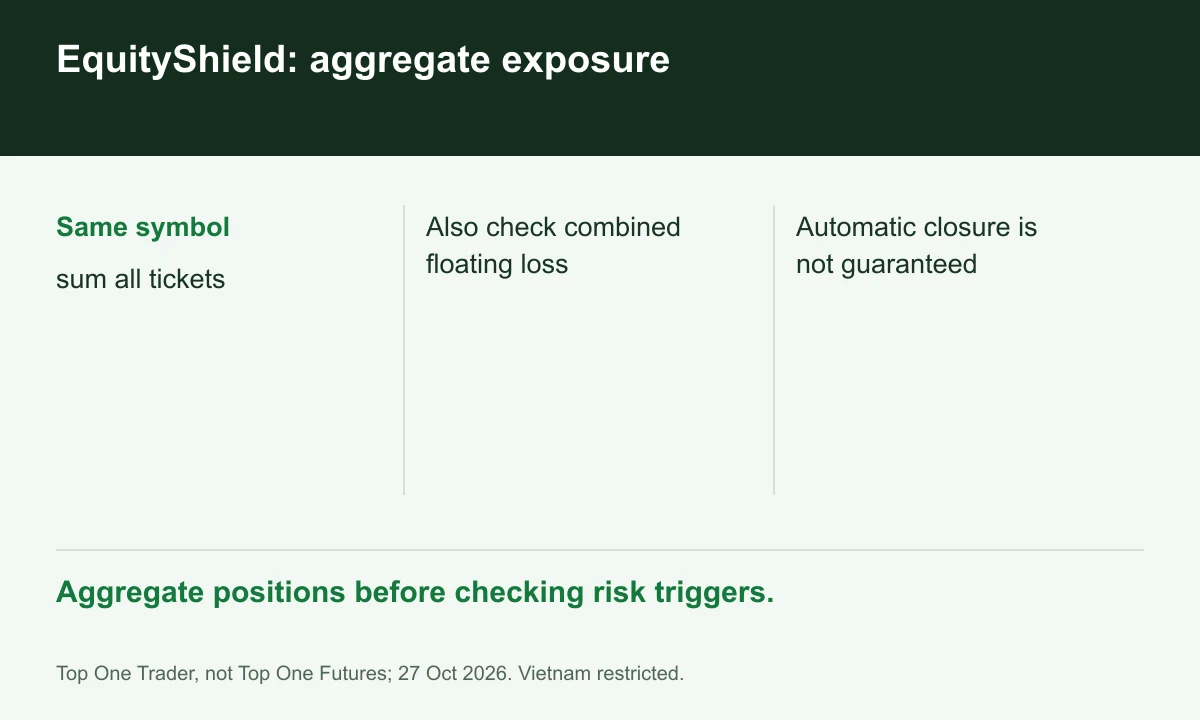
Guide
Understand EquityShield's symbol-level and account-level floating-loss tests without treating automatic closure as a guaranteed substitute for personal risk controls.
Read guide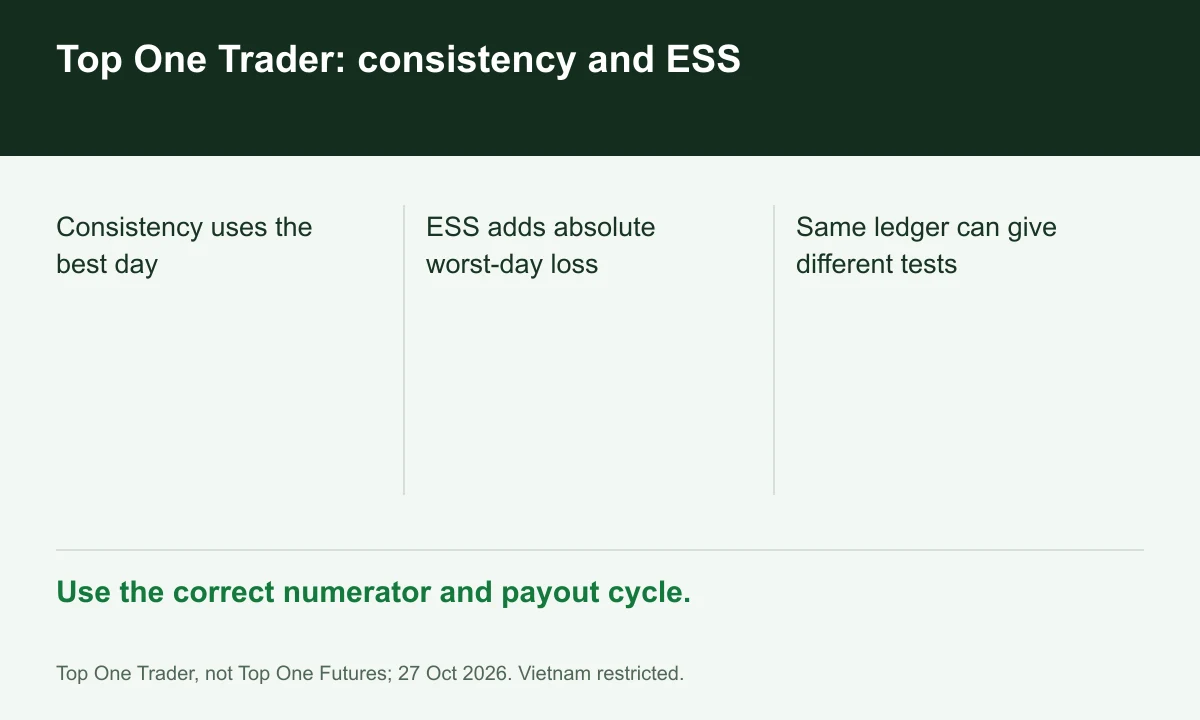
Guide
Calculate consistency and ESS with the same hypothetical profit ledger to see why a large losing day matters to one test but not the other's numerator.
Read guide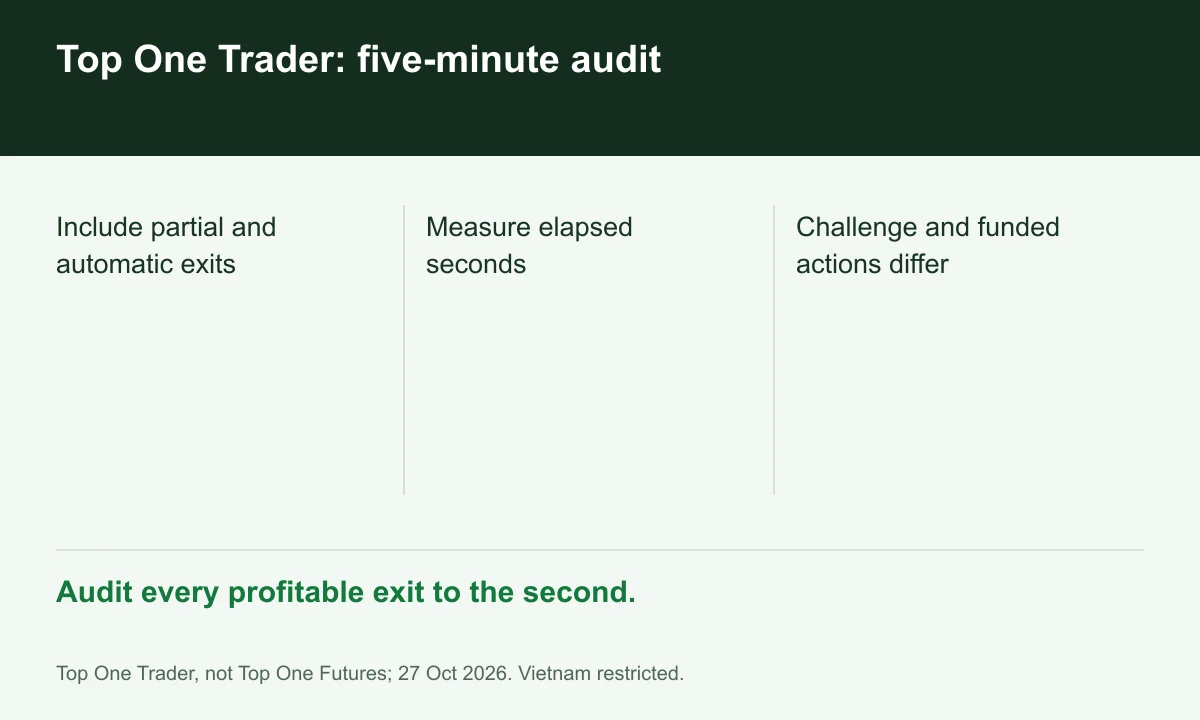
Guide
Audit profitable trade durations, partial closes and automated exits under Top One Trader's five-minute rule, keeping challenge and funded consequences separate.
Read guide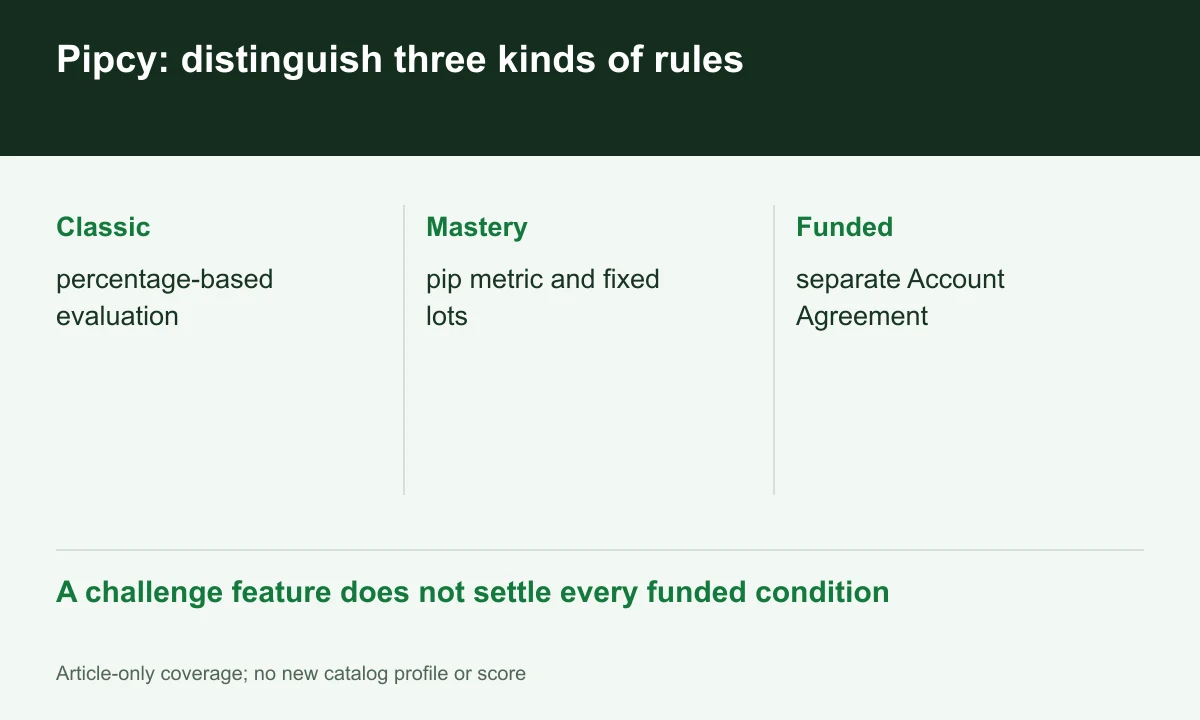
Provider guide
A concise Pipcy review: compare Classic with Pips Mastery, see its converted 8.2/10 Trustpilot customer score, strengths and checks before buying a challenge.
Read guide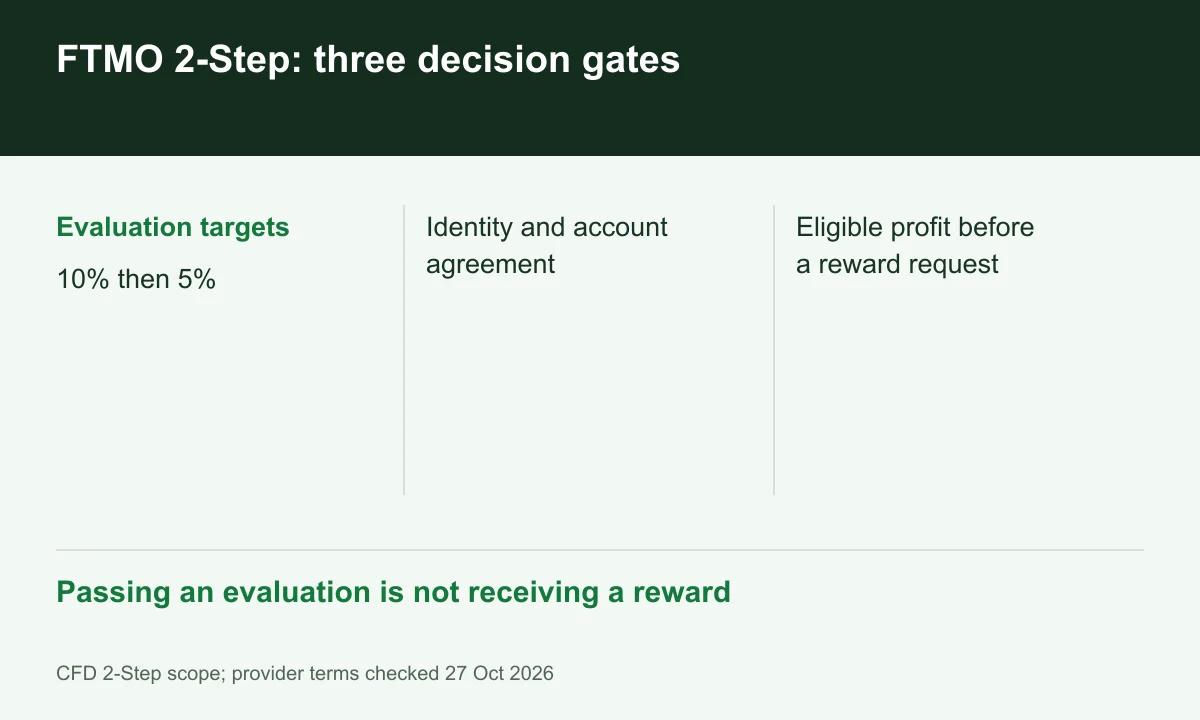
Provider guide
A program-specific FTMO guide to evaluation rules, loss limits, fees, reward conditions and the contracting party. Confirm the exact plan before buying.
Read guide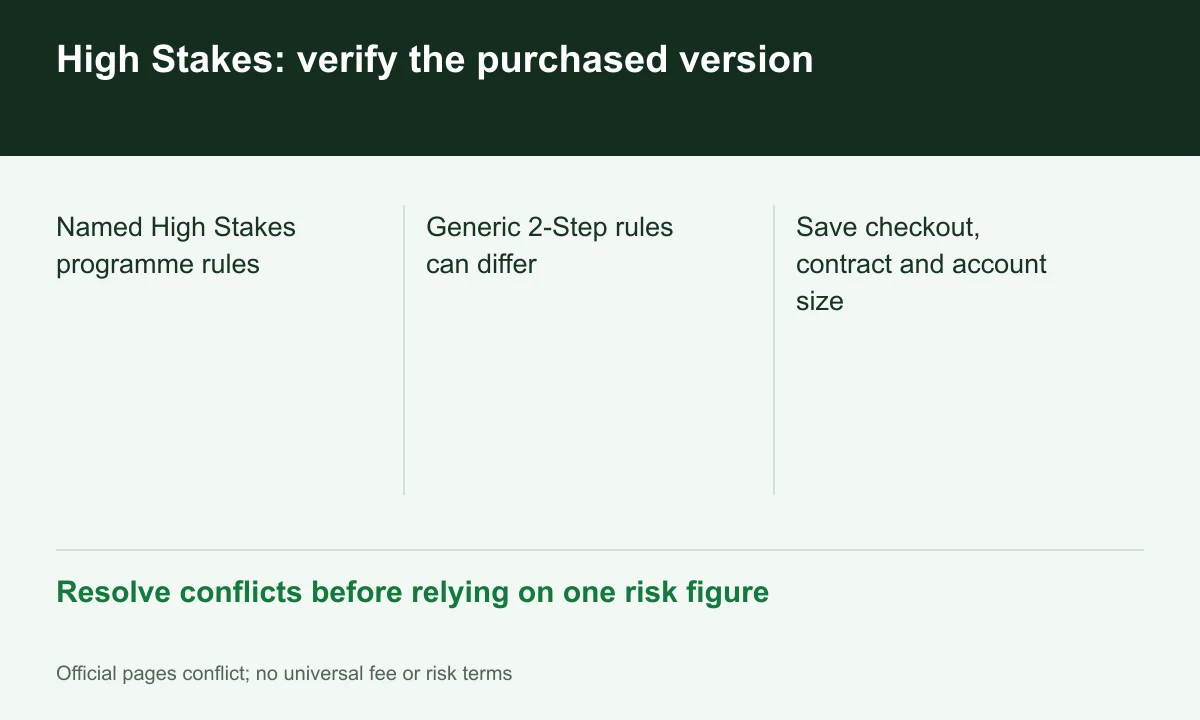
Provider guide
A program-specific The5ers guide to evaluation rules, loss limits, fees, reward conditions and the contracting party. Confirm the exact plan before buying.
Read guide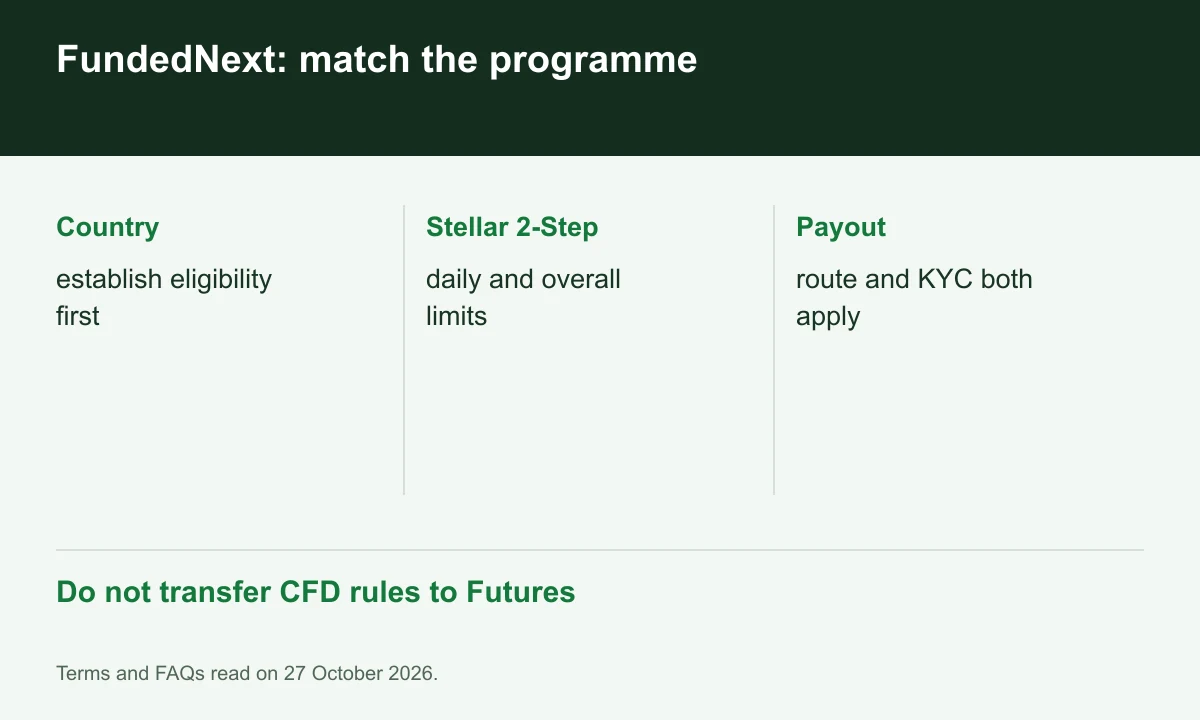
Provider guide
A program-specific FundedNext guide to evaluation rules, loss limits, fees, reward conditions and the contracting party. Confirm the exact plan before buying.
Read guide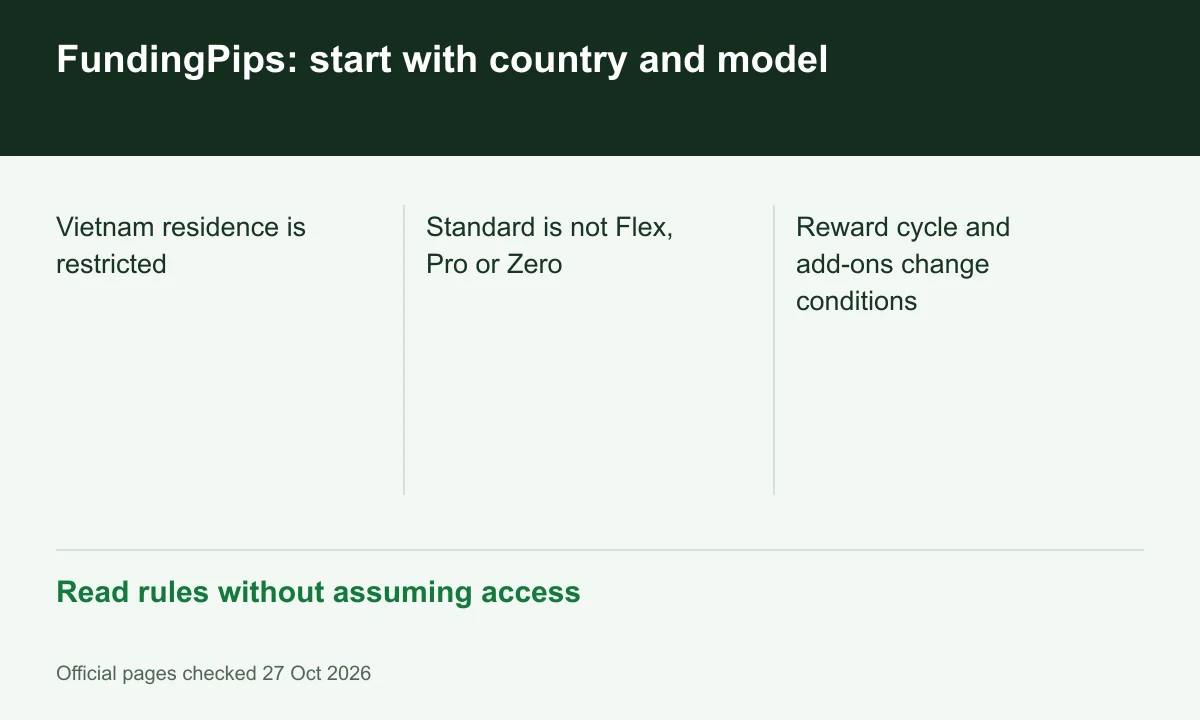
Provider guide
A program-specific FundingPips guide to evaluation rules, loss limits, fees, reward conditions and the contracting party. Confirm the exact plan before buying.
Read guide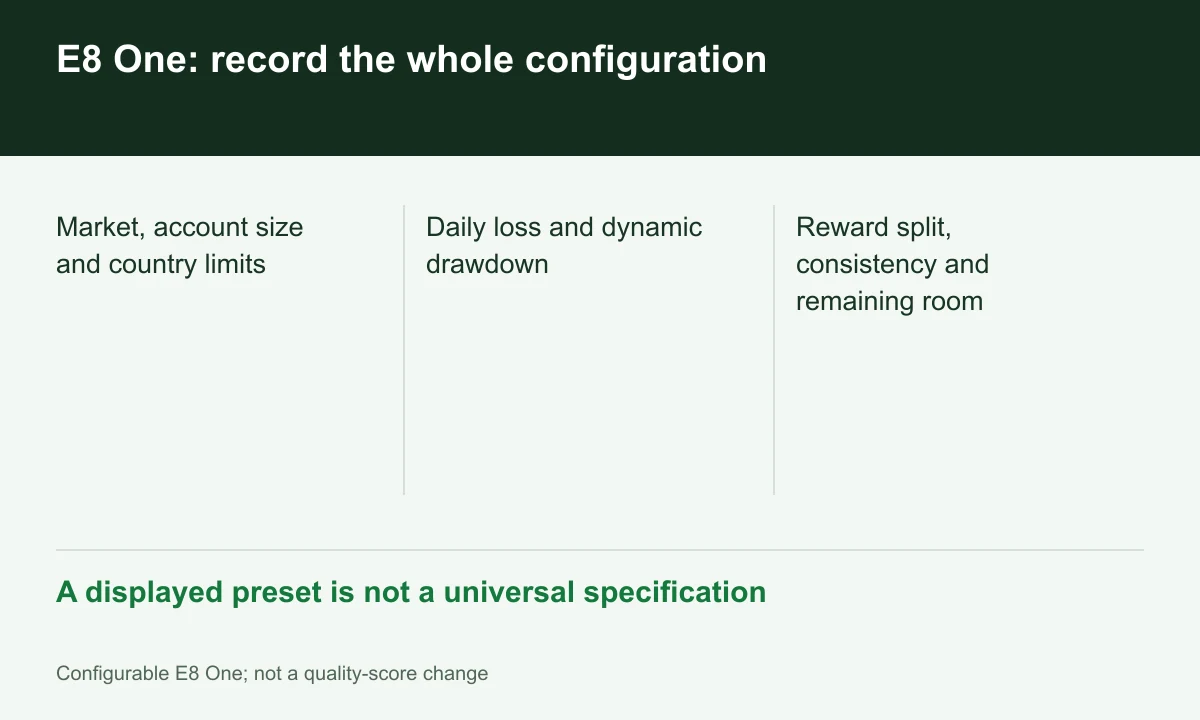
Provider guide
A program-specific E8 Markets guide to evaluation rules, loss limits, fees, reward conditions and the contracting party. Confirm the exact plan before buying.
Read guide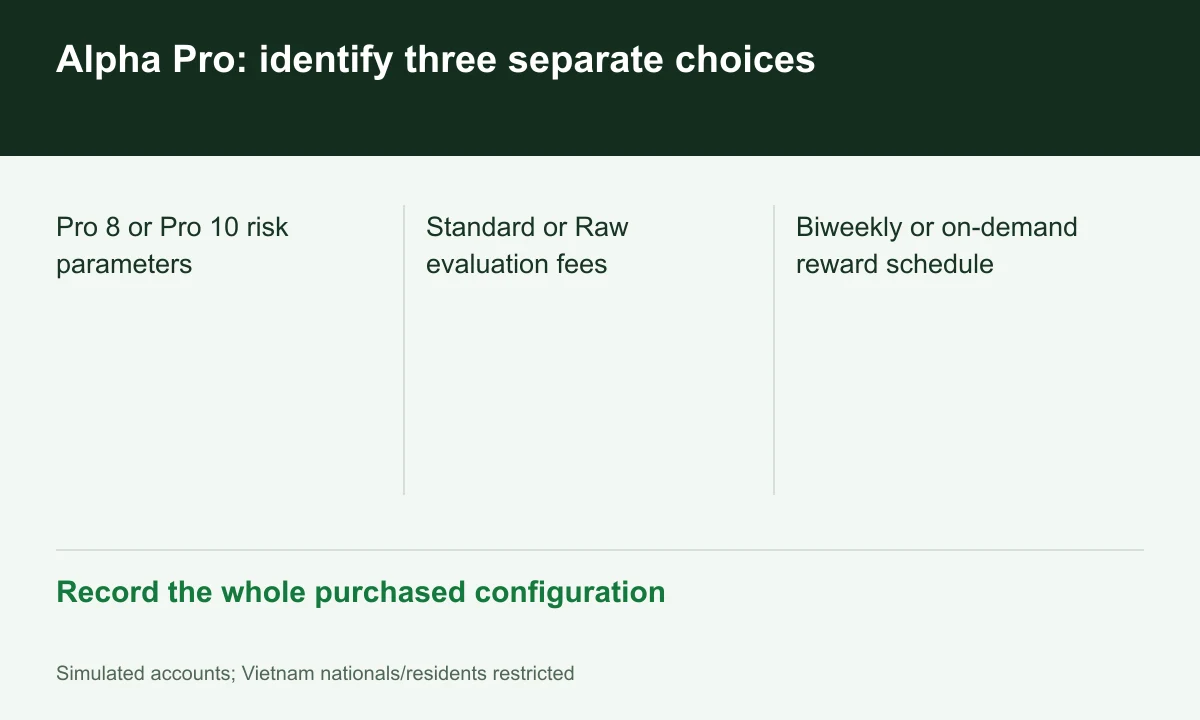
Provider guide
A program-specific Alpha Capital Group guide to evaluation rules, loss limits, fees, reward conditions and the contracting party. Confirm the exact plan before buying.
Read guide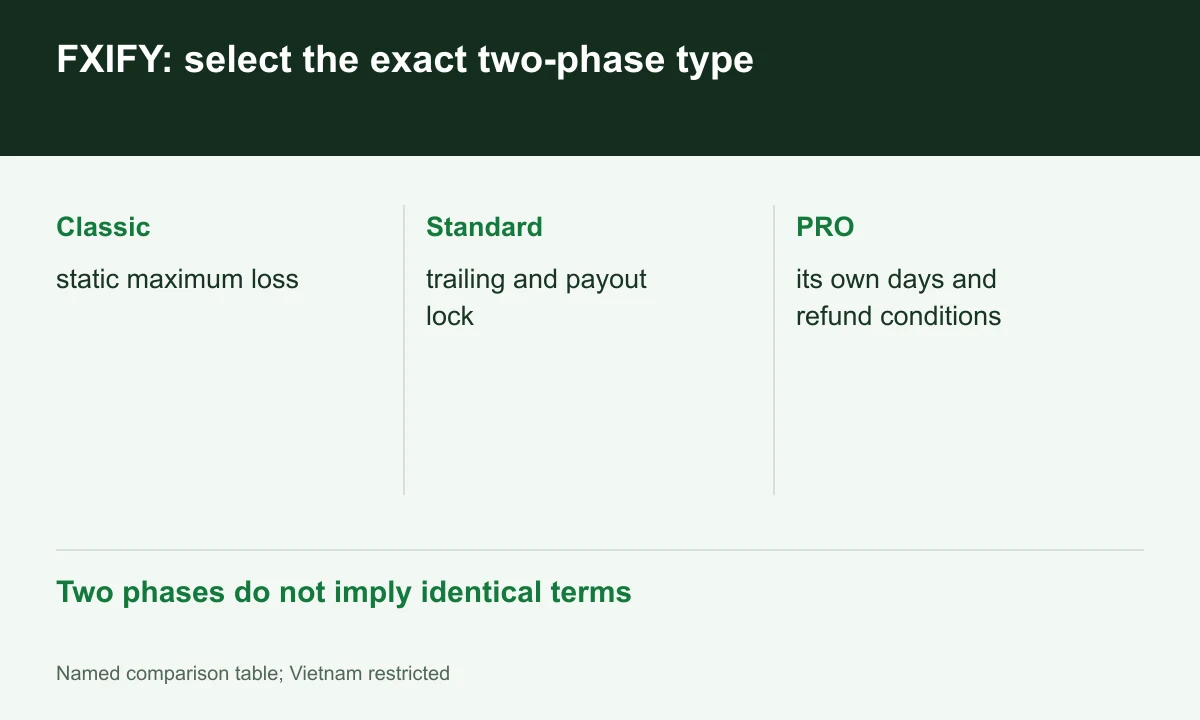
Provider guide
A program-specific FXIFY guide to evaluation rules, loss limits, fees, reward conditions and the contracting party. Confirm the exact plan before buying.
Read guide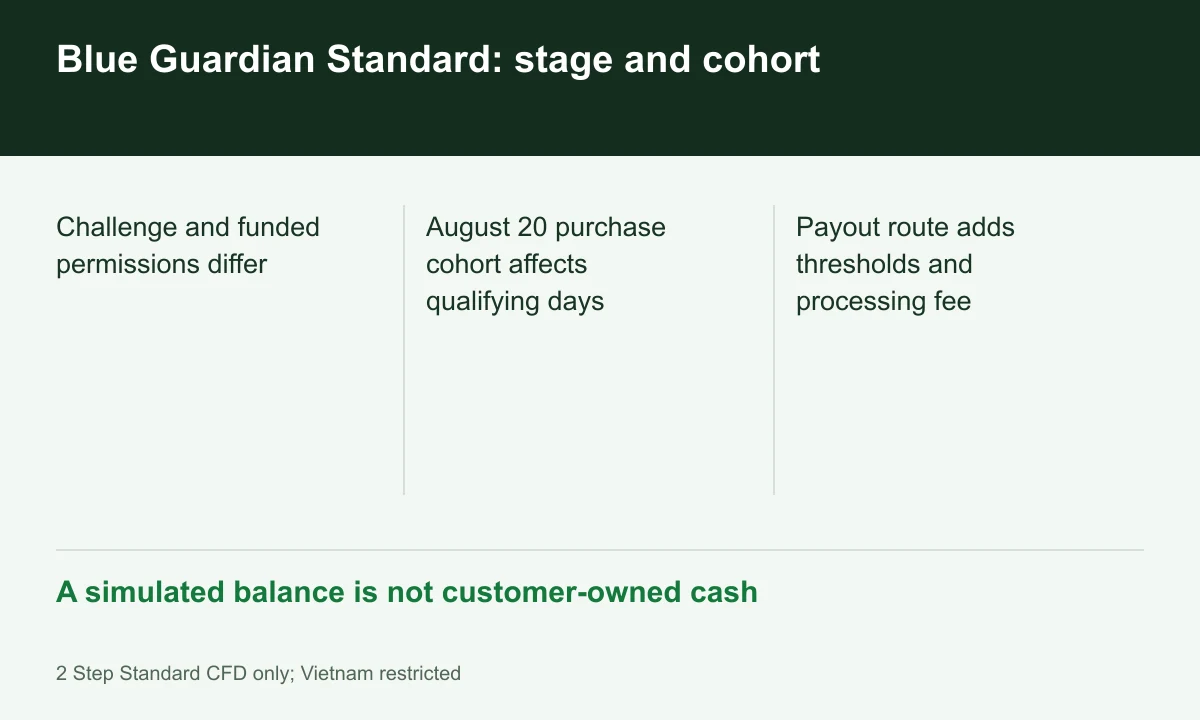
Provider guide
A program-specific Blue Guardian guide to evaluation rules, loss limits, fees, reward conditions and the contracting party. Confirm the exact plan before buying.
Read guide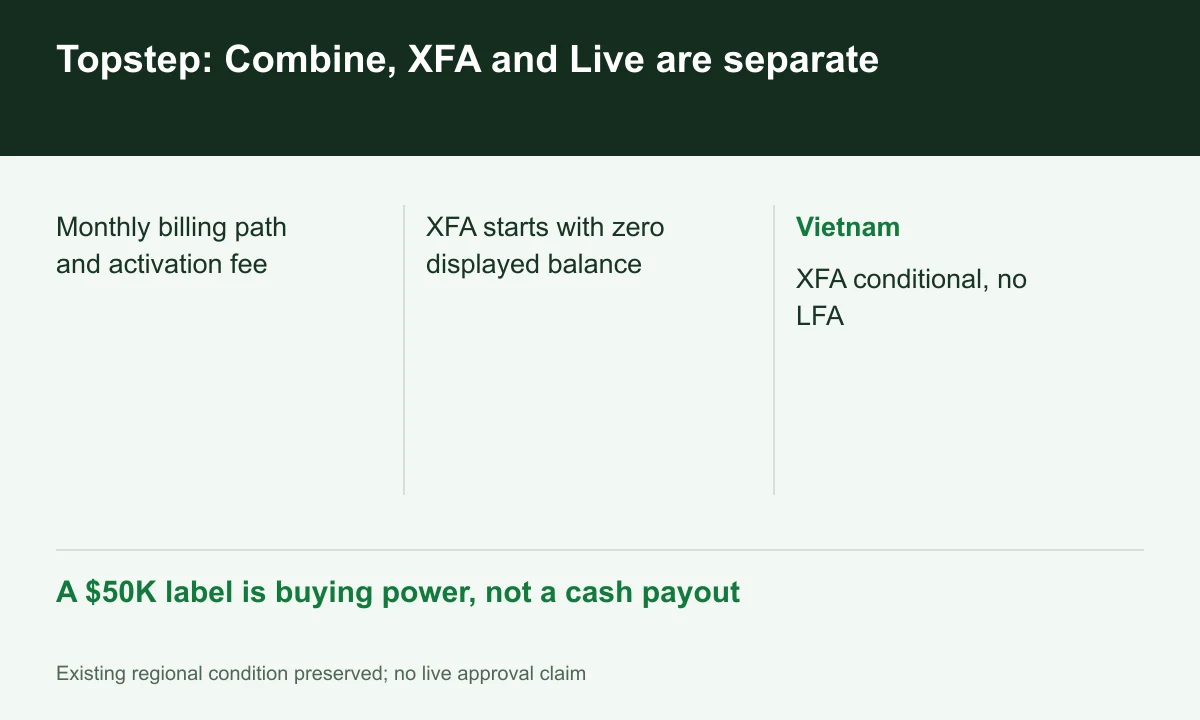
Provider guide
A program-specific Topstep guide to evaluation rules, loss limits, fees, reward conditions and the contracting party. Confirm the exact plan before buying.
Read guide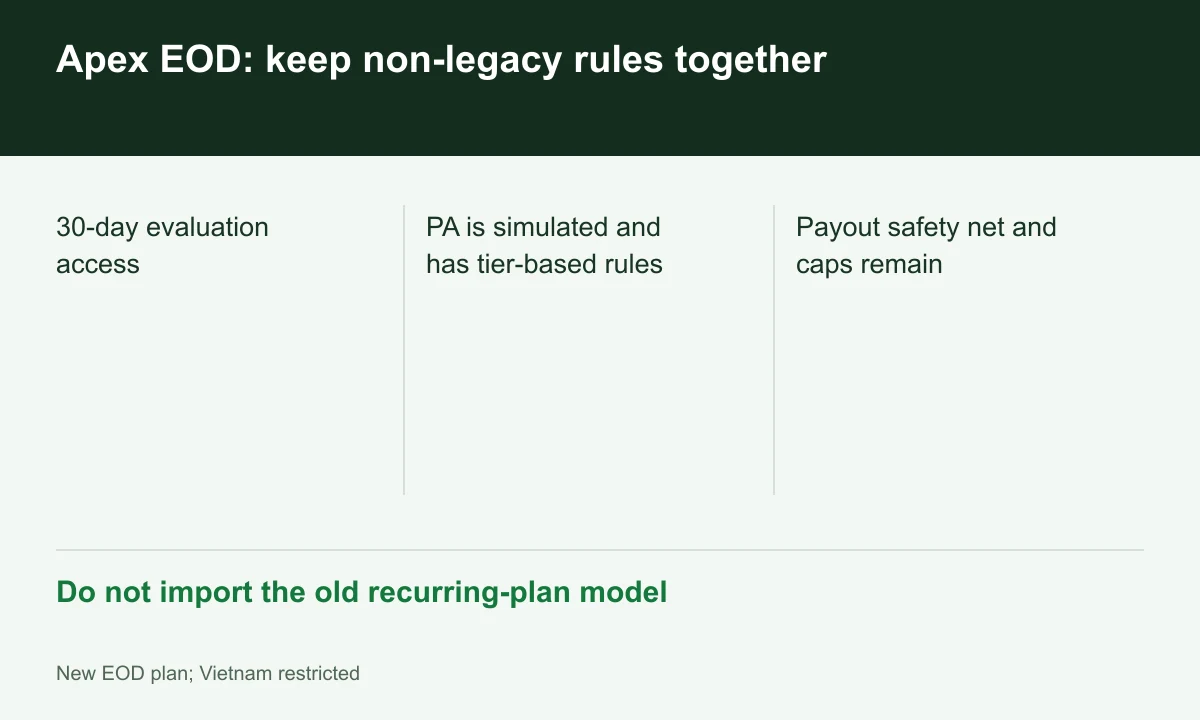
Provider guide
A program-specific Apex Trader Funding guide to evaluation rules, loss limits, fees, reward conditions and the contracting party. Confirm the exact plan before buying.
Read guide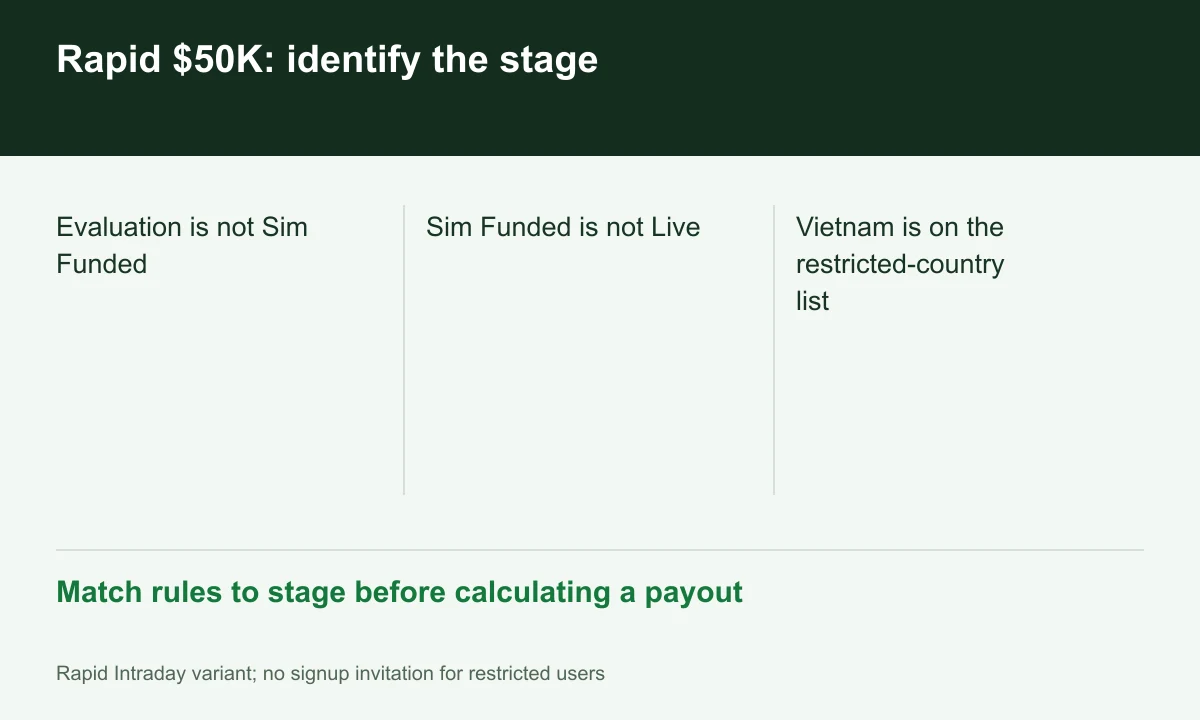
Provider guide
A program-specific MyFundedFutures guide to evaluation rules, loss limits, fees, reward conditions and the contracting party. Confirm the exact plan before buying.
Read guide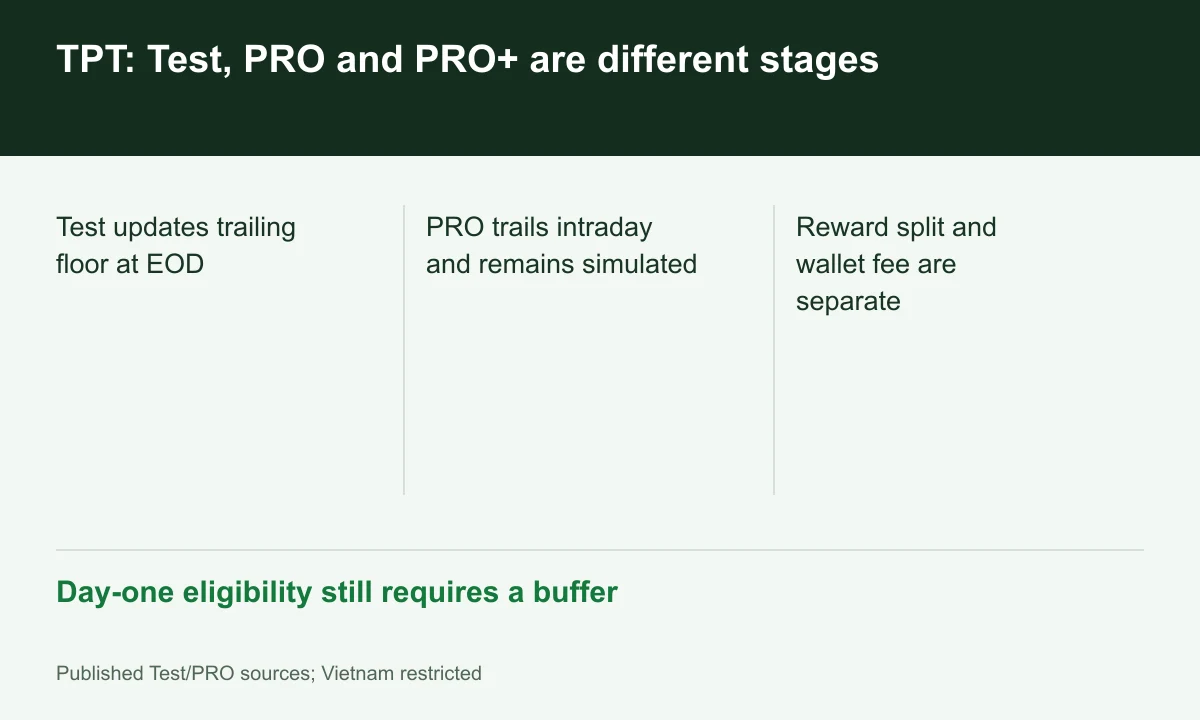
Provider guide
A program-specific Take Profit Trader guide to evaluation rules, loss limits, fees, reward conditions and the contracting party. Confirm the exact plan before buying.
Read guide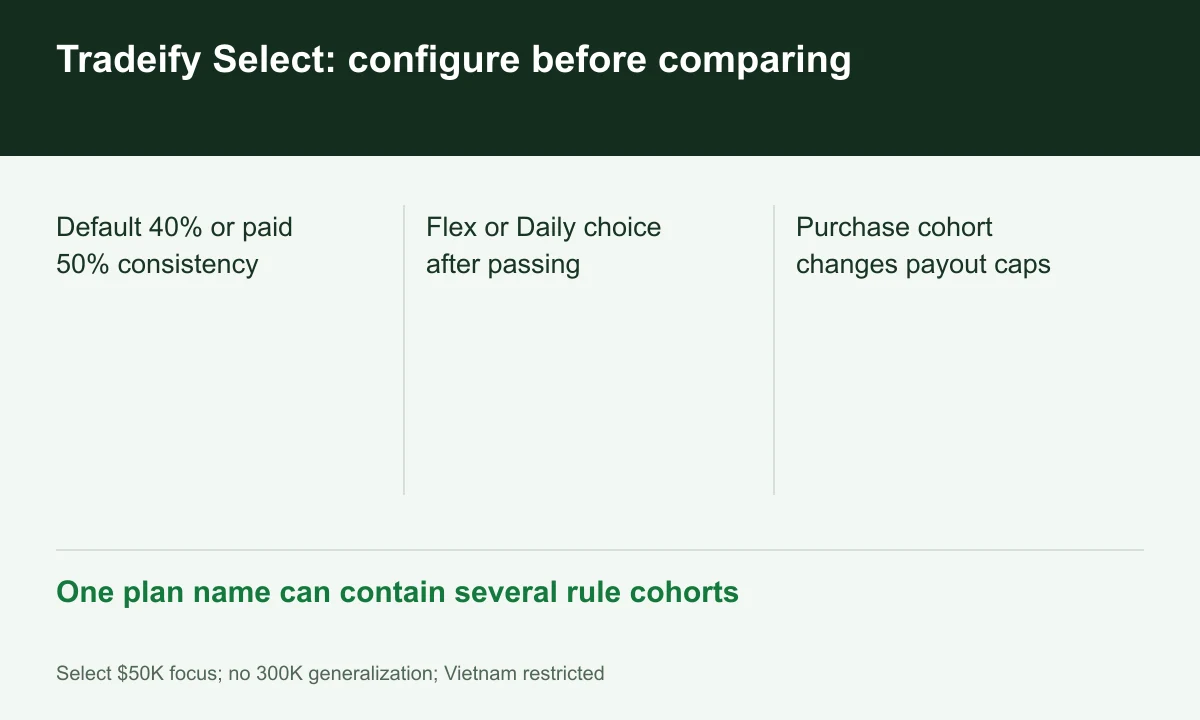
Provider guide
A program-specific Tradeify guide to evaluation rules, loss limits, fees, reward conditions and the contracting party. Confirm the exact plan before buying.
Read guide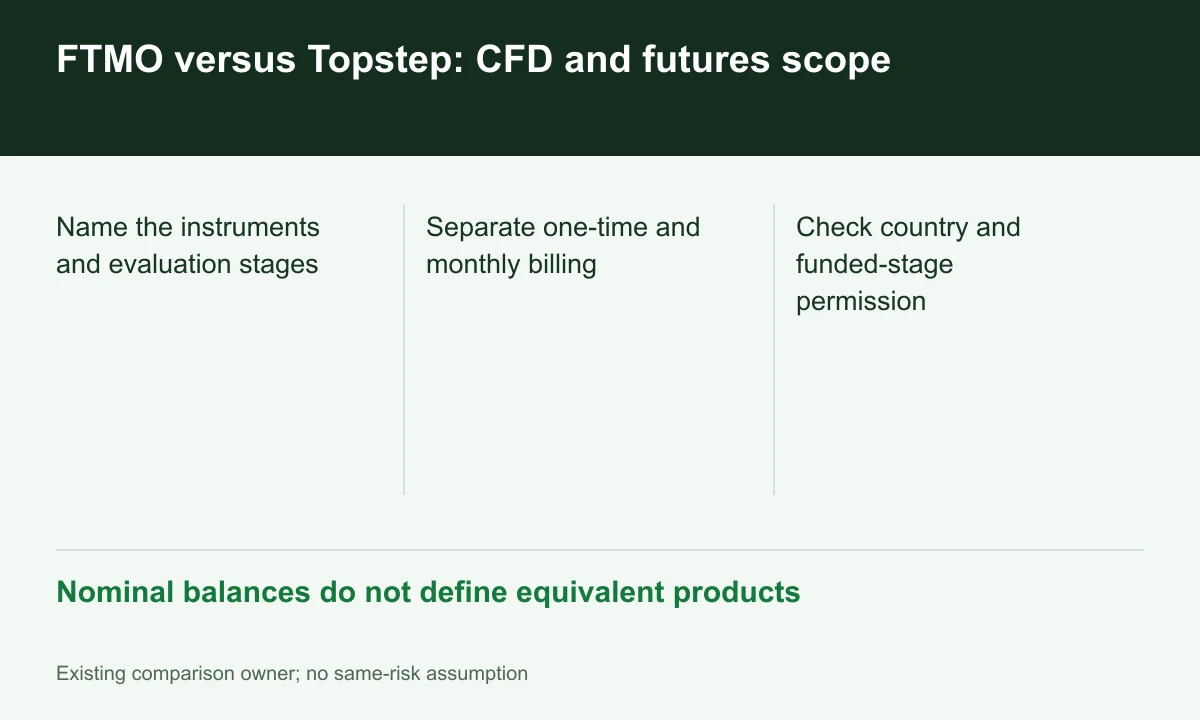
Comparison
A side-by-side, official-source comparison of FTMO and Topstep. Match the exact product, account or program and country before drawing a conclusion.
Read guide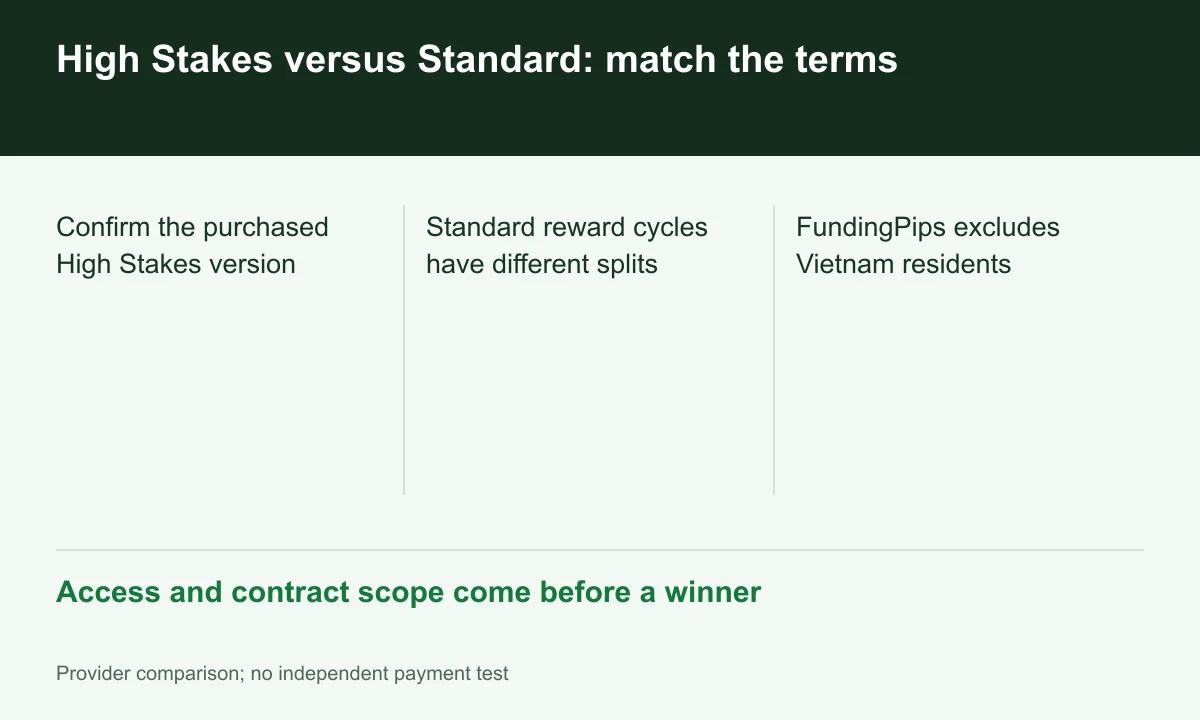
Comparison
A side-by-side, official-source comparison of The5ers and FundingPips. Match the exact product, account or program and country before drawing a conclusion.
Read guide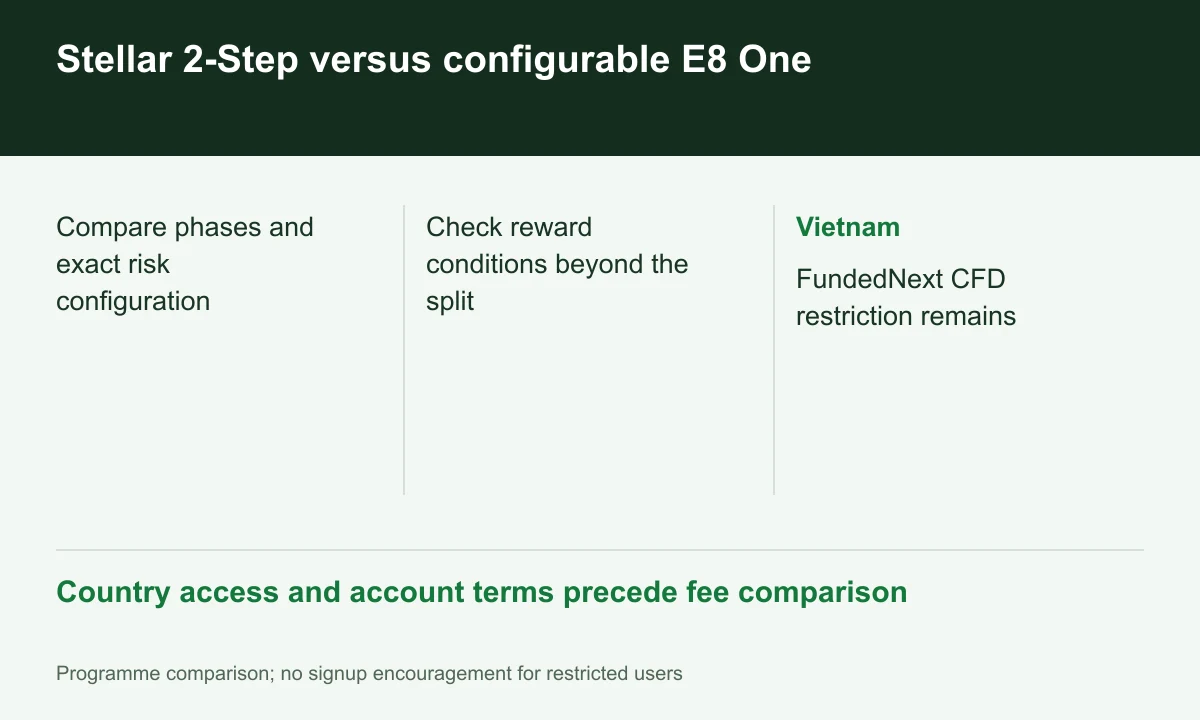
Comparison
A side-by-side, official-source comparison of FundedNext and E8 Markets. Match the exact product, account or program and country before drawing a conclusion.
Read guide
Comparison
A side-by-side, official-source comparison of Alpha Capital Group and FXIFY. Match the exact product, account or program and country before drawing a conclusion.
Read guide
Comparison
A side-by-side, official-source comparison of Blue Guardian and FundingPips. Match the exact product, account or program and country before drawing a conclusion.
Read guide
Comparison
A side-by-side, official-source comparison of Topstep and Apex Trader Funding. Match the exact product, account or program and country before drawing a conclusion.
Read guide
Comparison
A side-by-side, official-source comparison of MyFundedFutures and Tradeify. Match the exact product, account or program and country before drawing a conclusion.
Read guide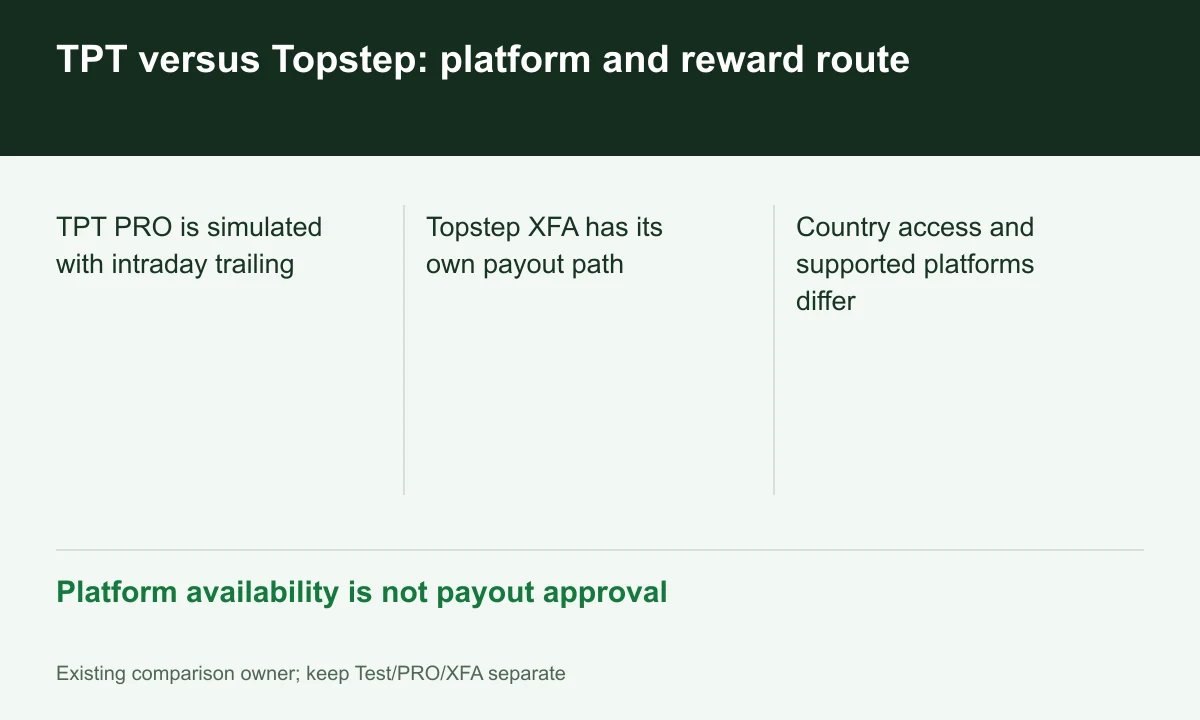
Comparison
A side-by-side, official-source comparison of Take Profit Trader and Topstep. Match the exact product, account or program and country before drawing a conclusion.
Read guide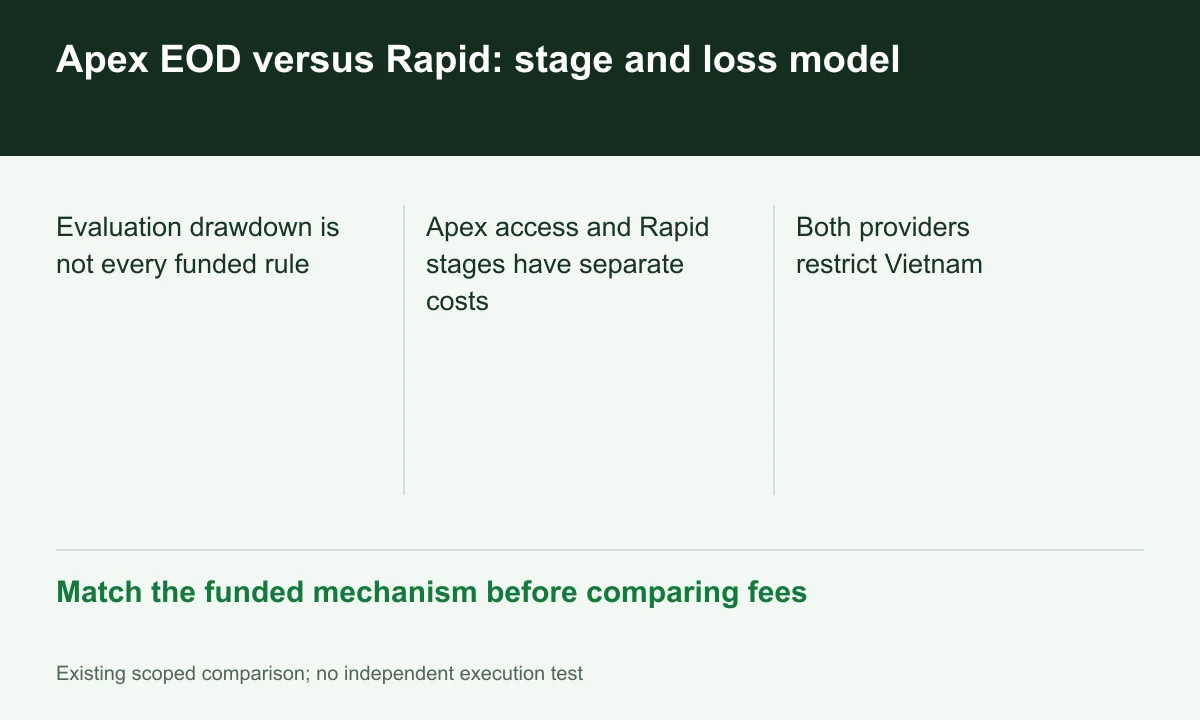
Comparison
A side-by-side, official-source comparison of Apex Trader Funding and MyFundedFutures. Match the exact product, account or program and country before drawing a conclusion.
Read guide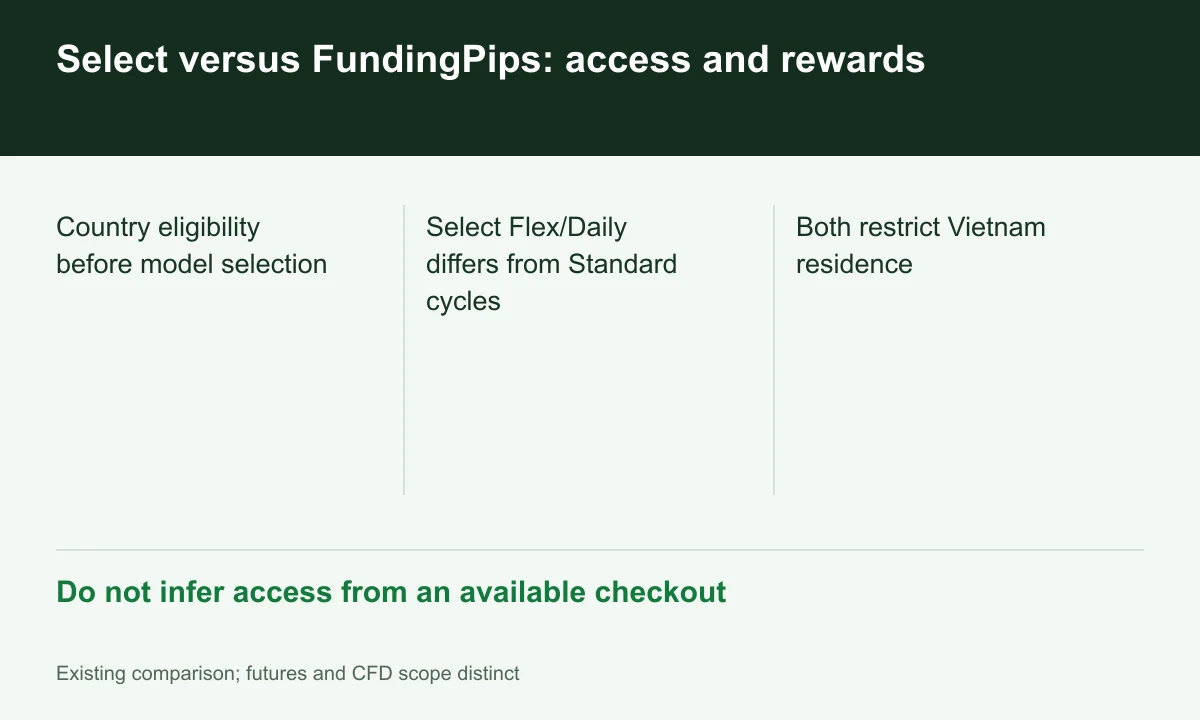
Comparison
A side-by-side, official-source comparison of Tradeify and FundingPips. Match the exact product, account or program and country before drawing a conclusion.
Read guide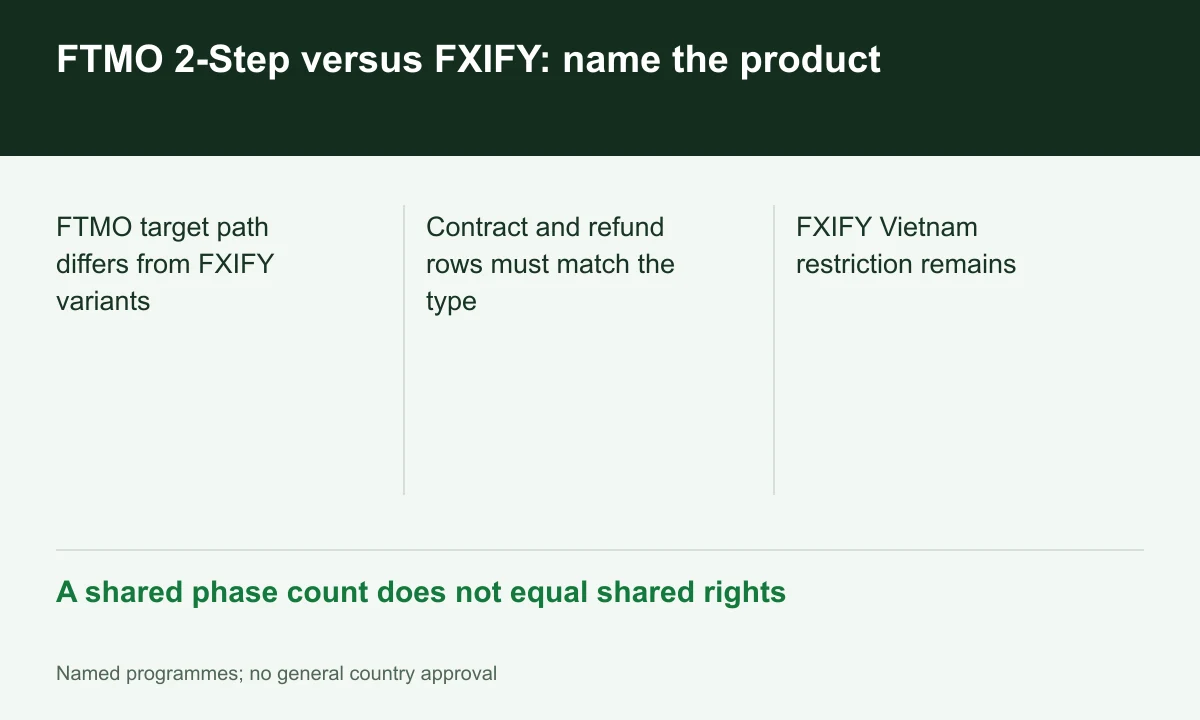
Comparison
A side-by-side, official-source comparison of FTMO and FXIFY. Match the exact product, account or program and country before drawing a conclusion.
Read guide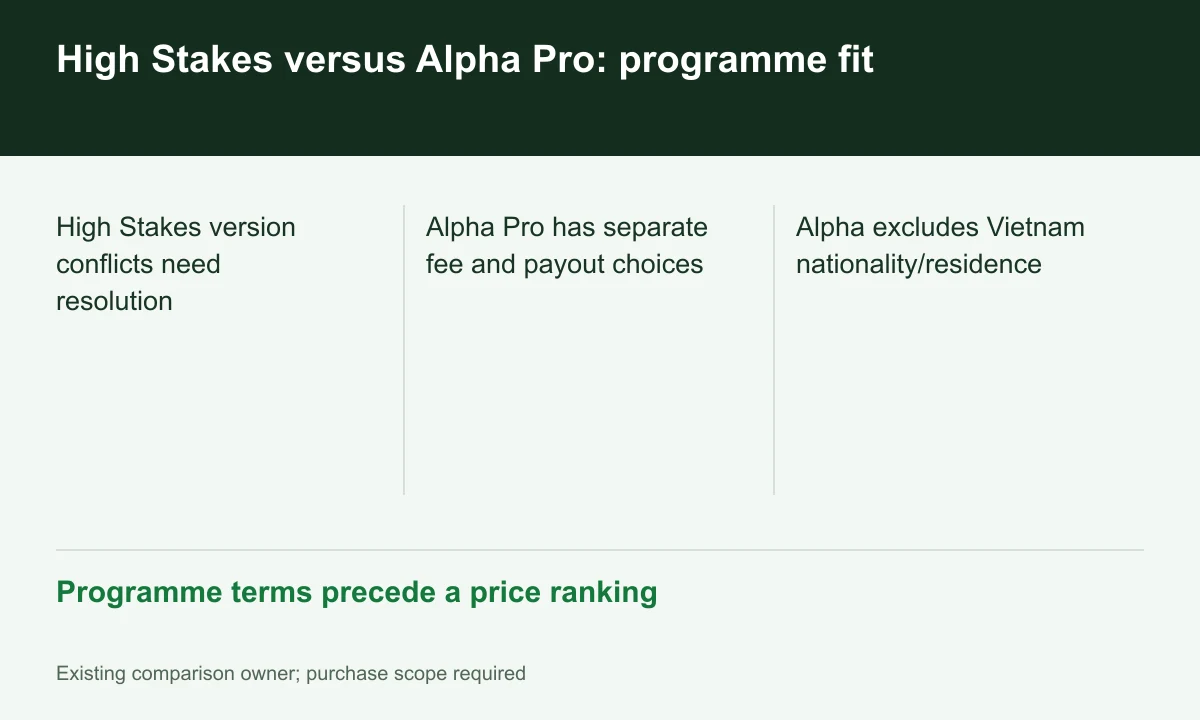
Comparison
A side-by-side, official-source comparison of The5ers and Alpha Capital Group. Match the exact product, account or program and country before drawing a conclusion.
Read guide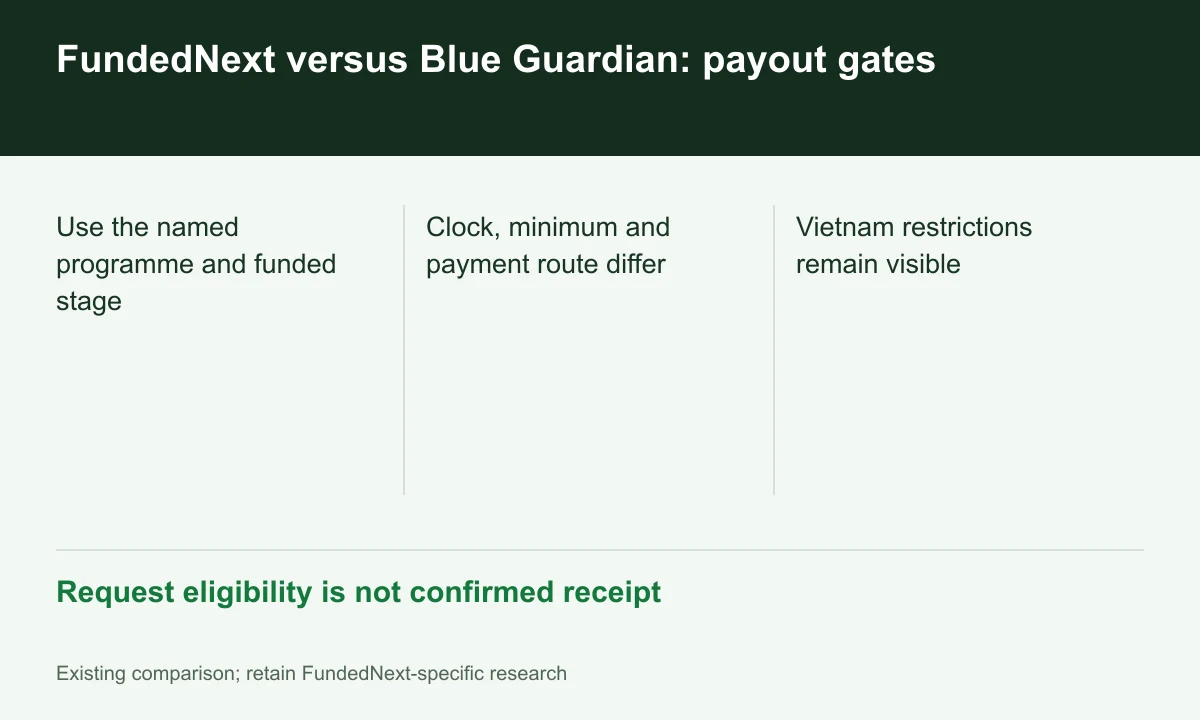
Comparison
A side-by-side, official-source comparison of FundedNext and Blue Guardian. Match the exact product, account or program and country before drawing a conclusion.
Read guide