A prop challenge fee is not the whole budget: a payout checklist
Separate purchase fees, optional costs, simulated profit and approved rewards using an illustrative cash calculation.
Budget the service you actually buy
A challenge fee buys access to a specified evaluation service; it should not be confused with the large account size shown in an advertisement. FTMO explicitly describes client accounts as simulated. Read other providers’ own environment disclosures rather than assuming the word funded always means the same thing. Keep the purchase payment, simulated account balance and potential real-money reward in separate columns.
FTMO simulated trading disclosure
List the base price, selected platform charges, add-ons, currency conversion and any external tools you plan to use. Some lines may be zero; record that rather than guessing. Use the final checkout total for the chosen product and date, not a discount headline from a different account size. A refund subject to future conditions is not cash already returned.
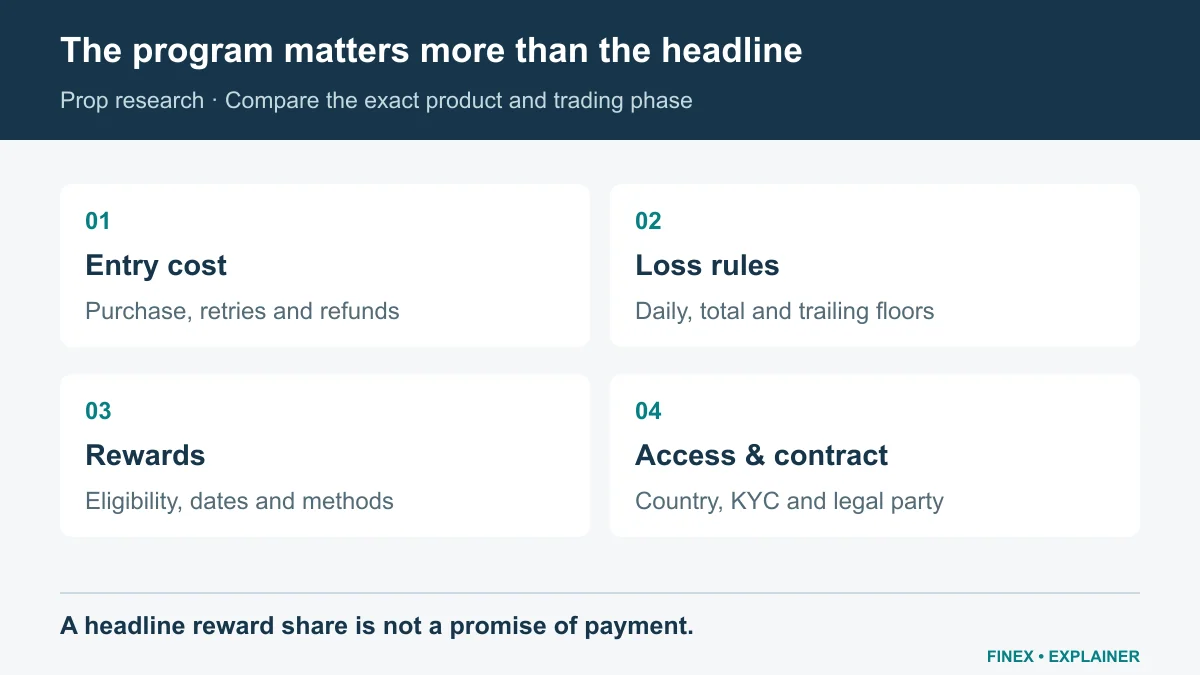
Diagram explained
A headline reward share is not a promise of payment.
- Match the exact program, size and phase. The purchase fee is not the same as a deposit or the displayed simulated capital.
- Read daily and total loss rules, trailing calculations, restricted strategies and news or weekend conditions.
- Check country eligibility, the contracting company, KYC, reward request dates and payment conditions. A payout headline alone does not answer these questions.
An illustrative cash calculation
Consider an entirely hypothetical programme costing $200 plus a $25 optional feature. Assume $1,000 of eligible simulated profit, an 80% reward share and a hypothetical 3% transfer charge applied to the trader’s reward. The gross reward would be $800 and the transfer charge $24, leaving $776 before taxes or currency conversion. Subtracting the $225 purchase outlay gives $551 of cumulative cash surplus in this simplified scenario.
These invented inputs are not the terms of FTMO, The5ers or FundedNext. Change one assumption at a time to understand the mechanism. If the fee is later refunded, enter the actual refund as a separate receipt when approved. Do not subtract the purchase price from every future payout: that would count the same expense repeatedly.
Eligibility comes before the arithmetic
A profit share applies only after the relevant conditions are met. For example, FTMO’s reward FAQ requires closed positions and pending orders before requesting a reward and describes account review. A percentage cannot replace those steps. Model the path from profit to request, approval and receipt; give each stage its own status rather than labelling an account screenshot as money received.
FTMO reward request and review process
Ask whether the minimum refers to total account profit, the trader’s share or the amount after charges. Check payout caps, the first eligible date, subsequent cycles and required identity checks. If a condition is unclear, a precise cash forecast is premature. A request can also have an expected processing period without being an unconditional arrival guarantee.
Set a spending limit before the first purchase
Decide how much you can spend on evaluation services without relying on a future reward to repay it. Include any planned repeat attempts in that limit rather than making the next purchase an emotional response to failure. Keep learning costs separate from essential living expenses. There is no reliable budget calculation that can turn an uncertain pass rate into guaranteed income.
A useful record ends with evidence: checkout receipt, programme version, agreement, account review outcome and actual payment confirmation. Keep hypothetical results visibly hypothetical. FINEX’s role is to make these distinctions easier to understand; the calculation above is education, not a tested payout record, a tax calculation or an income forecast.
Sources and scope
Sources are provider publications. Conditions may vary by entity, country, account and program. Recheck before signing up.