Forex trading costs: spread, commission and swap
Calculate illustrative Forex costs, compare Standard and Raw pricing, and understand commission units, overnight swaps and gold contract sizes.
This article includes partner links. FINEX may earn a commission.
Try the Standard/Raw cost calculator →
Use a complete cost model
A useful starting estimate for a completed trade is spread cost + commission for opening and closing + signed holding cost. Use the same lot size and account currency throughout. The calculator below compares two hypothetical accounts; replace every assumption with the terms for your own account. It estimates charges, not profit, execution quality or a broker’s suitability.
A spread is one component of trading cost. Your account can also charge commission, overnight financing, currency conversion or payment-related fees. Execution adds another uncertainty: the final fill can differ from the price you expected. Keep quoted account charges separate from realised execution differences so that you can investigate each one. A practical comparison uses the same instrument, position size, account currency and holding period. Without those inputs, a statement that one account is cheaper can be technically correct for one trade and misleading for another.
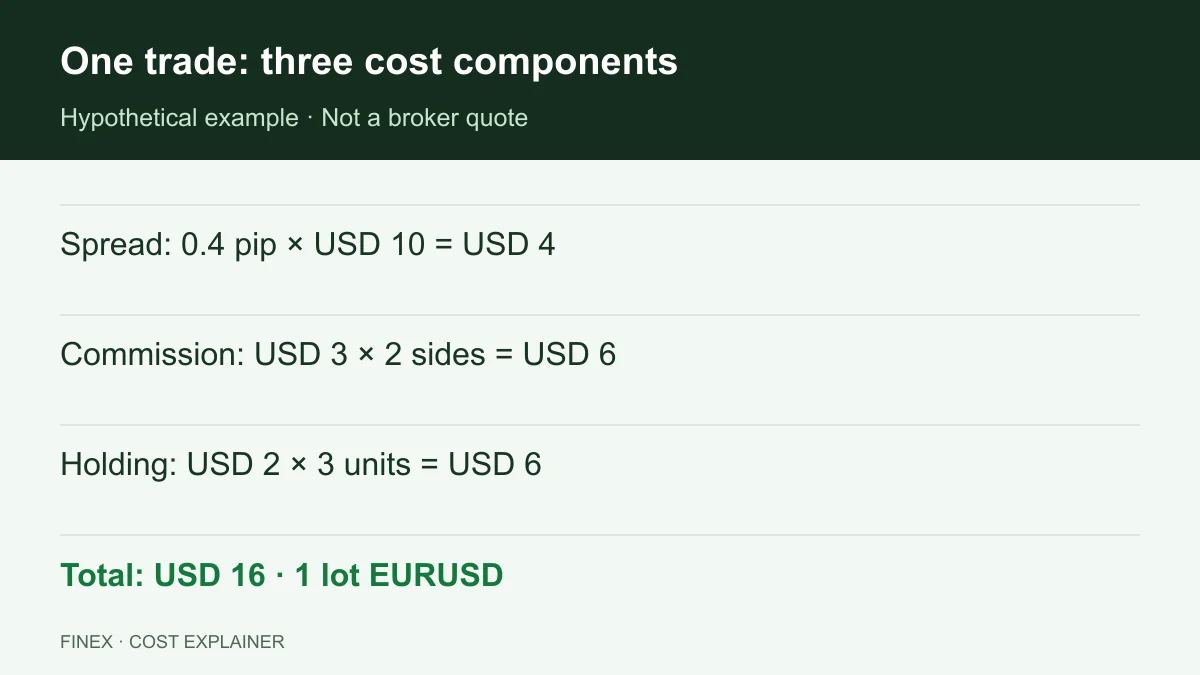
Diagram explained
Total: USD 16 · 1 lot EURUSD
- Spread: 0.4 pip × USD 10 = USD 4
- Commission: USD 3 × 2 sides = USD 6
- Holding: USD 2 × 3 units = USD 6
- Total: USD 16 · 1 lot EURUSD
Want to explore the account options?
Calculate: Standard or Raw costs less?
Defaults are a hypothetical EURUSD example with a USD account, not broker quotes. Enter charges converted to the same basis.
Convert spread and commission consistently
In a simplified example, assume a USD-denominated account trading one standard lot of EUR/USD, with a USD 10 pip value. A 0.4-pip spread represents USD 4. If commission is USD 3 per side, opening and closing adds USD 6, giving USD 10 before other items. At 0.1 lot, the same assumptions give USD 0.40 spread and USD 0.60 commission. These are hypothetical numbers; contract sizes, pip values and rounding rules must be checked for the actual instrument. Gold, indices and other currency pairs need their own specifications.
The important distinction is per side versus round turn. HFM's published Zero table labels selected Forex charges as round turn, while Exness Raw charges are quoted per side. A commission written beside a platform may instead be based on USD turnover. Read the unit before entering a number in your spreadsheet. A lower-looking number with a different denominator is not a valid saving.
HFM Zero commission units Exness per-side commission disclosures
Add the cost of holding and funding
Extend the example with an assumed USD 2 daily financing charge for three charged nights. The illustrative USD 10 trading cost becomes USD 16. This does not describe any broker's current swap schedule. Real financing can differ by direction, date and instrument; a swap-free label can also have eligibility conditions or other charges. Then inspect conversion at funding, profit conversion and withdrawal. Do not add a flat payment fee to every trade unless you explain how you allocated it. Dividing one USD 10 monthly transfer cost across ten trades produces a different estimate from dividing it across one hundred.
Record evidence and test your own assumptions
For your shortlist, save the dated fee schedule, the relevant contract specification and a sample statement from your own account if available. Mark an advertised minimum as a minimum, not an average. Make separate scenarios for a quiet session, a wider spread and an overnight hold; these are planning scenarios rather than predictions. Compare the resulting range against your expected frequency and risk budget. An account that saves a small amount per trade can still be unsuitable if its withdrawal route, legal terms or platform fails your requirements. Cost analysis supports the decision; it does not replace the rest of the review.
Three mistakes that distort a cost comparison
Do not double the spread mechanically when calculating one completed trade at an unchanged bid–ask gap: the entry and exit quotes already account for the gap. The simplified spread model is an estimate; changing spreads and slippage require your actual fill records. A statement may embed spread in profit/loss instead of showing it as a separate fee, so do not deduct it a second time.
Do not use EURUSD’s assumed USD 10 pip value for every symbol. Gold needs its own contract size and price unit; cross-currency pairs may need conversion into your account currency. Do not treat a commission quote per side as an opening-and-closing total. The four linked guides below work through each of these decisions separately.
Choose an account by total cost
Match the spread, commission and overnight charges to your trading approach before choosing an account.
Sources and scope
Sources are provider publications. Conditions may vary by entity, country, account and program. Recheck before signing up.