Swap and overnight financing: what to check before holding a position
Understand holding costs without assuming a swap-free label means every cost disappears.
This article includes partner links. FINEX may earn a commission.
Try the Standard/Raw cost calculator →
Separate entry cost from holding cost
A comparison based only on spread and commission can miss the cost of holding a position. Overnight financing may add a charge or a credit depending on the instrument, direction and applicable terms. Treat the current symbol specification and account conditions as inputs; a marketing headline is not a complete schedule.
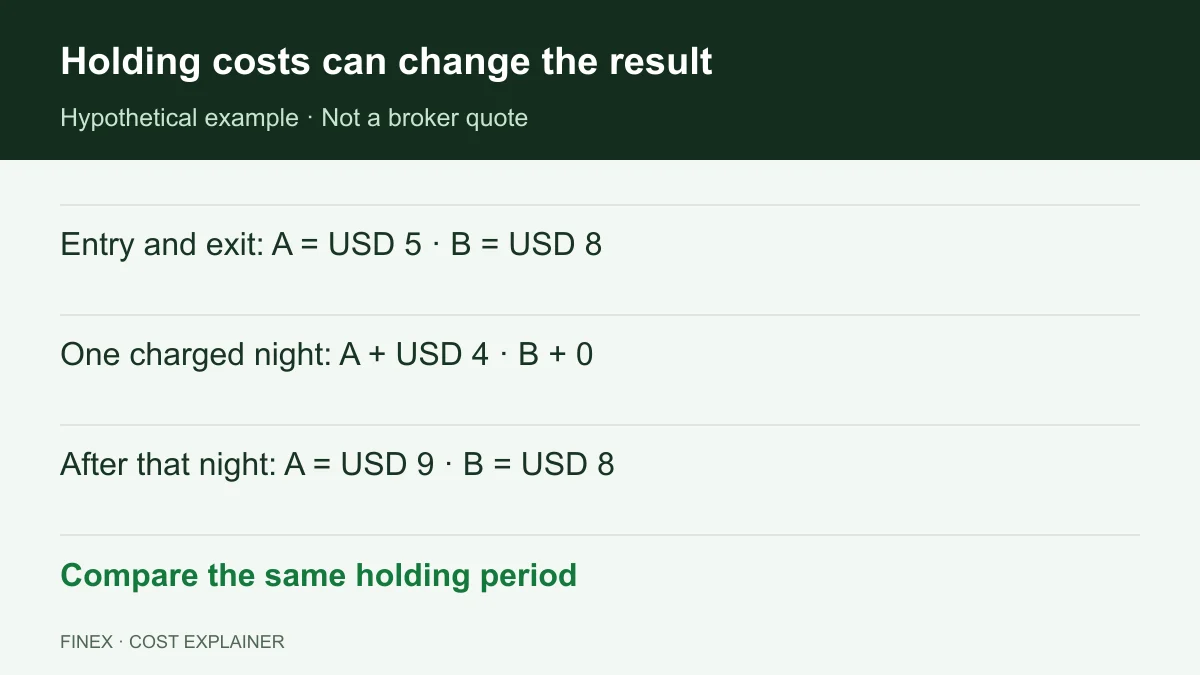
Diagram explained
Compare the same holding period
- Entry and exit: A = USD 5 · B = USD 8
- One charged night: A + USD 4 · B + 0
- After that night: A = USD 9 · B = USD 8
- Compare the same holding period
Use a holding-period scenario
Suppose two hypothetical accounts have opening-and-closing costs of USD 5 and USD 8. If the first incurs an illustrative USD 4 overnight charge while the second incurs none for that scenario, the comparison changes after one night: USD 9 versus USD 8. The numbers are invented to explain the method, not taken from a broker or intended as a quote.
Repeat the exercise for the period you actually expect to hold. Include the published rollover calendar, holidays, currency conversion and any administration charge. Do not assume a fixed weekday multiplier across all instruments or companies. A dated screenshot of the specification is more useful than a remembered rate from a previous month.
Want to explore the account options?
Read a swap-free label conditionally
Ask whether eligibility depends on residence, account type or trading behaviour; whether every symbol is included; and whether another holding charge can apply. FINEX does not establish one universal swap rate for the profiles linked below. Obtain the current schedule for your account before treating holding costs as zero.
Read the rollover unit before multiplying
A night on the calendar is not always one charged rollover unit. If an applicable schedule triples a charge, count three units for that rollover rather than one. For example, a hypothetical USD 2 per-lot charge, 0.5 lot and three charged units gives USD 3, not USD 1. If your platform already shows the final monetary charge, do not multiply it again.
IC Markets Global’s swap page distinguishes the triple-rate day by product group and directs users to Market Watch → Specification for current long and short rates. Read the schedule for the exact symbol and account; holidays can change the practical calculation. A positive credit reduces estimated net cost, but it is variable and should not be treated as guaranteed income.
Choose an account by total cost
Match the spread, commission and overnight charges to your trading approach before choosing an account.
Sources and scope
Sources are provider publications. Conditions may vary by entity, country, account and program. Recheck before signing up.