XAUUSD trading costs: spread, lot size and commission
Calculate gold CFD spread costs from the price gap and contract size, add commission and swap, and avoid confusing pips with points.
This article includes partner links. FINEX may earn a commission.
Try the Standard/Raw cost calculator →
Start with the price gap, not a pip shortcut
For a USD-quoted gold CFD, estimated spread cost in USD is the ask–bid price gap multiplied by ounces per lot and the lot size. Suppose the contract is 100 ounces per lot, the gap is USD 0.30 per ounce and the position is 0.1 lot. The illustrative spread cost is 0.30 × 100 × 0.1 = USD 3. These are hypothetical prices, not a current broker quote.
Gold pip and point conventions can differ between symbols and platforms. Reading a number such as “30 points” without its tick size can produce a tenfold error. Using the actual bid–ask price gap avoids that ambiguity, provided you still check the contract size. A USD 1 price movement is not automatically a USD 1 profit or loss.
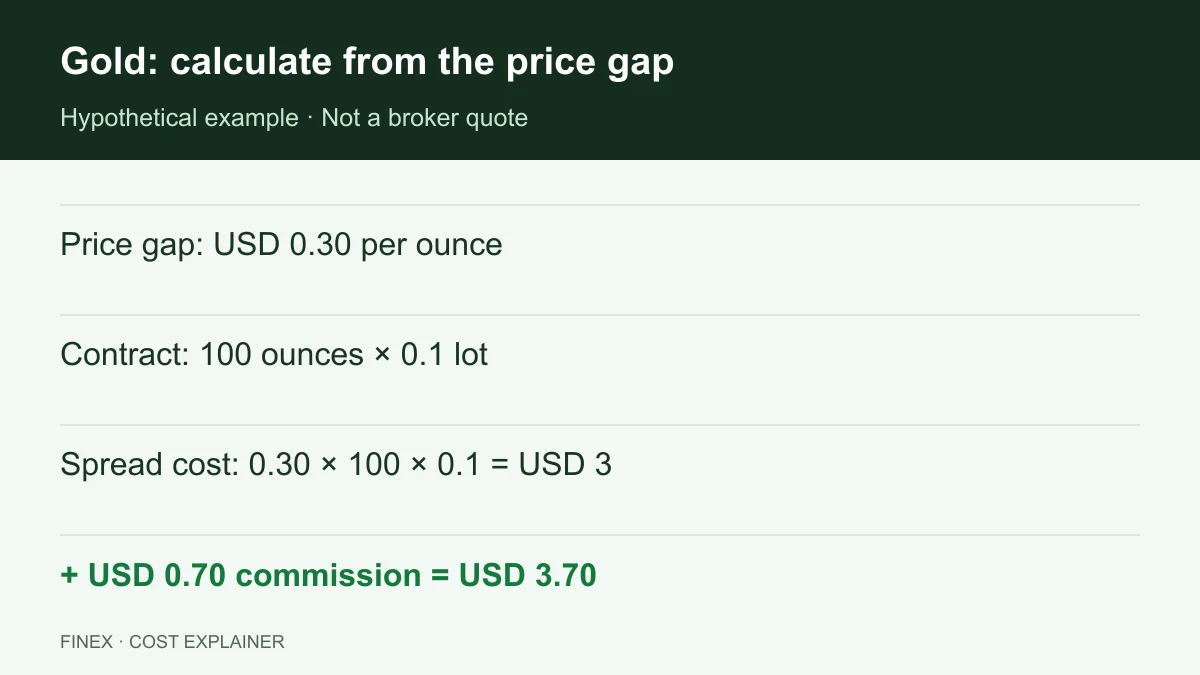
Diagram explained
+ USD 0.70 commission = USD 3.70
- Price gap: USD 0.30 per ounce
- Contract: 100 ounces × 0.1 lot
- Spread cost: 0.30 × 100 × 0.1 = USD 3
- + USD 0.70 commission = USD 3.70
Want to explore the account options?
Confirm the contract and the symbol suffix
Exness’s terminology page checked on 26 October 2026 lists gold XAU at 100 troy ounces per lot. This supports the example’s contract assumption for that published specification; it does not establish the size for every broker, micro contract or symbol suffix. Read Specification in your own platform for contract size, tick size and tick value.
With the 100-ounce assumption, 0.1 lot represents 10 ounces. A USD 1-per-ounce price move therefore changes gross position value by USD 10 before charges. Reducing leverage changes margin requirements, not this contract-size arithmetic for an unchanged position. Do not confuse the margin needed to open a trade with the trading cost.
Add the correct gold commission and holding charge
Continue the hypothetical USD 3 spread example with an invented USD 7-per-lot opening-and-closing commission. At 0.1 lot that adds USD 0.70, giving USD 3.70 before swap, conversion and execution differences. If the quote is per side, add both sides first. Do not automatically reuse the Forex commission row for metals.
For example, HFM’s international Zero page publishes a separate gold row and names the applicable symbol. It is evidence that product-specific fee rows matter, rather than proof of the fee for a different HFM account. Overnight charges also depend on direction, rollover units and eligibility; a swap-free label requires reading the actual conditions.
Compare the same trading session and size
To compare gold accounts, record the same symbol exposure, lot size, direction and holding period. Collect spreads in comparable sessions; a minimum advertised spread is not an observed average during news. Keep any slippage evidence separate from the fee estimate and do not claim an execution advantage without matched live records.
If your account is not in USD, convert the estimated USD charge using the applicable currency rate and conversion terms. Reconcile your estimate with the statement, remembering that spread may already be reflected in profit/loss. Then use the linked review and comparison pages to consider platforms, withdrawals and the contracting entity as well as cost.
Choose an account by total cost
Match the spread, commission and overnight charges to your trading approach before choosing an account.
Sources and scope
Sources are provider publications. Conditions may vary by entity, country, account and program. Recheck before signing up.