Standard vs Raw accounts: calculate your break-even spread
A hypothetical calculation helps compare spread-only and commission-based pricing without assuming one account is always cheaper.
This article includes partner links. FINEX may earn a commission.
Try the Standard/Raw cost calculator →
Compare pricing structures, not account labels
Standard usually places the trading charge in its spread; Raw adds an explicit commission to a narrower spread. Neither structure is automatically cheaper. With hypothetical EURUSD inputs of USD 10 per pip per lot, Standard at 1.2 pips costs USD 12 per lot; Raw at 0.2 pip plus USD 3.50 per side costs USD 9. The break-even Standard spread is 0.9 pip before holding costs and other charges.
Standard and Raw are marketing labels rather than a universal industry specification. One provider's Raw account need not match another's commission unit, execution setup or available instruments. Start by writing the actual schedule: spread, commission per side or round turn, overnight charges and account currency. IC's public overview illustrates separate Standard and Raw pricing, but the comparison method below uses invented numbers rather than observed market data. Keep the two offers within a comparable legal and product scope so that a price difference is not confused with a different service.
Example of separate Standard and Raw pricing structures
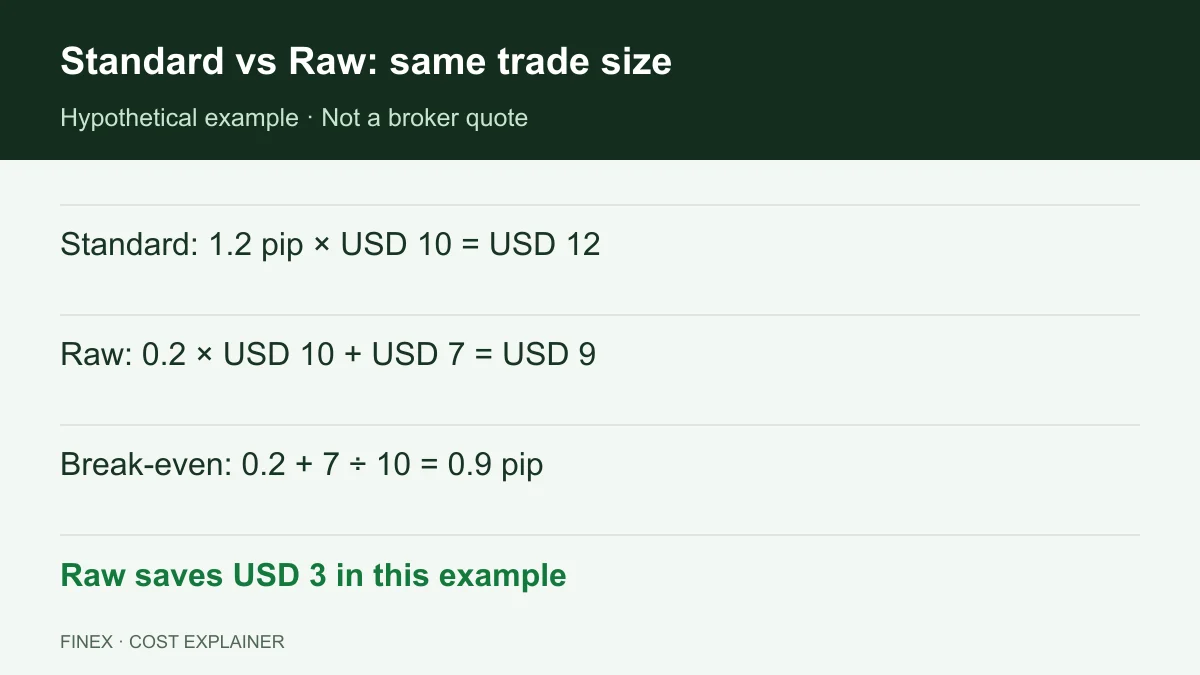
Diagram explained
Raw saves USD 3 in this example
- Standard: 1.2 pip × USD 10 = USD 12
- Raw: 0.2 × USD 10 + USD 7 = USD 9
- Break-even: 0.2 + 7 ÷ 10 = 0.9 pip
- Raw saves USD 3 in this example
Work through a simple break-even example
Use a hypothetical USD account, one standard lot of EURUSD and USD 10 per pip. Standard at 1.2 pips with no commission costs USD 12. Raw at 0.2 pip plus USD 3.50 per side costs USD 2 + USD 7 = USD 9. To find the Standard spread that matches Raw, divide Raw’s USD 9 total by USD 10 per pip: 0.9 pip. Below 0.9 pip, Standard is cheaper under these inputs; above it, Raw is cheaper. This is a planning example, not any broker’s current prices. At 0.1 lot, proportional costs are USD 1.20 and USD 0.90 respectively, before minimum fees, holding charges and rounding.
Want to explore the account options?
Change the inputs that matter to your routine
If you trade 0.1 lot and both commission and pip value scale proportionately, the illustrative costs become one tenth while the break-even spread stays the same. A minimum commission, different contract or rounding rule can break that shortcut. Holding overnight also adds a new comparison: financing may differ enough to reverse a small intraday saving. Repeat the calculation for each instrument and realistic holding period. Use several spread scenarios instead of only the advertised minimum, and label every unmeasured input as an assumption. Do not present an attractive scenario as your expected average.
Use the result as one part of the decision
Record the source and effective date for each real fee you eventually enter. If you have your own live statements, compare calculated charges with actual charges and investigate differences. Keep that evidence distinct from a hypothetical example or demo result. Then consider whether the platform, account agreement and withdrawal route satisfy your requirements. A few dollars of theoretical savings are not a complete reason to switch. Your conclusion should state the circumstances in which one structure is cheaper and the circumstances you have not checked, rather than announcing that Standard or Raw is universally better.
Choose an account by total cost
Match the spread, commission and overnight charges to your trading approach before choosing an account.
Sources and scope
Sources are provider publications. Conditions may vary by entity, country, account and program. Recheck before signing up.