FTMO 2-Step drawdown: understand the daily reset before trading
A practical explanation of daily and total loss limits, with a hypothetical $25,000 account and a rollover checklist.
Two limits answer different questions
This article covers the CFD FTMO Challenge 2-Step and its subsequent FTMO Account, not 1-Step, Instant or Futures. The daily loss allowance is 5% of initial simulated capital; the total loss limit is 10%. The daily equity floor is recalculated at 00:00 CE(S)T from the midnight balance. The total floor remains 90% of initial capital. Equity includes open trade results, swaps and commissions. These are account rules, not a suggestion to risk those amounts.
FTMO Trading Objectives — 2-Step section
Think of the daily rule as a moving checkpoint and the total rule as a fixed boundary. Passing one does not excuse breaching the other. A profitable account can still fail its daily limit, while a quiet trading day can still push an already depleted account through its total floor.
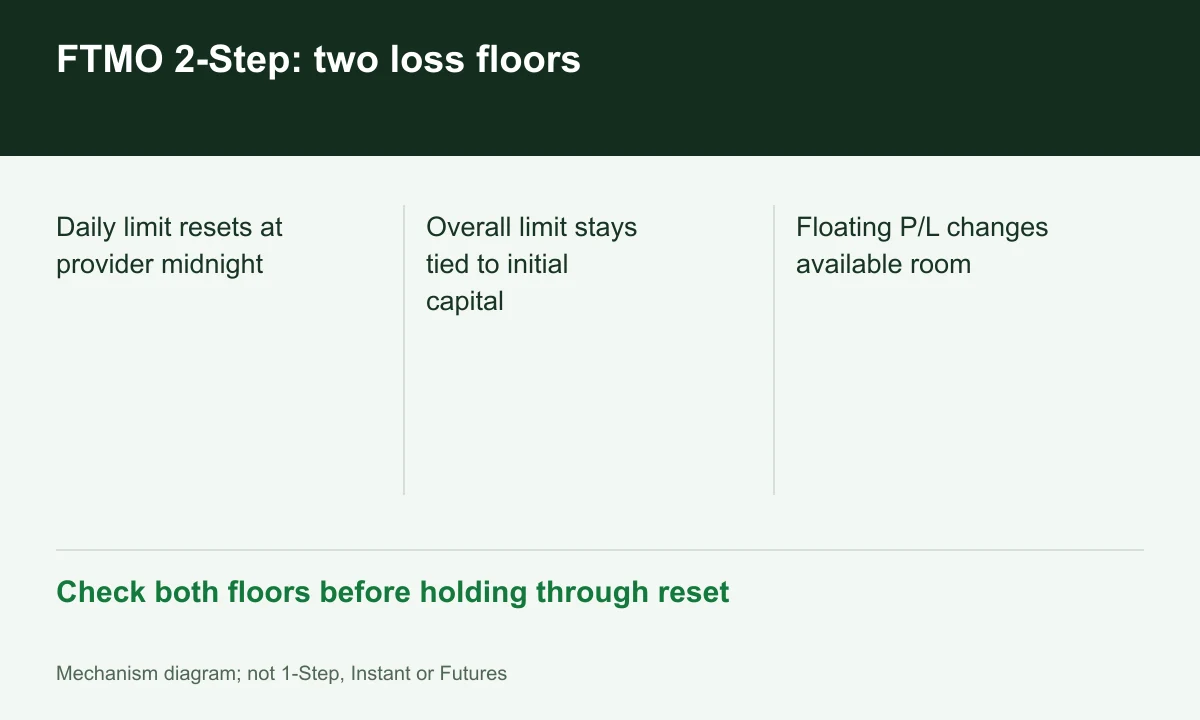
Diagram explained
Check both floors before holding through reset
- Daily limit resets at provider midnight
- Overall limit stays tied to initial capital
- Floating P/L changes available room
A hypothetical $25,000 calculation
Assume initial capital of $25,000 and a midnight balance of $25,500. Five percent of initial capital is $1,250, so the illustrative daily floor is $24,250. The separate total floor is $22,500. If current equity is $24,800, headroom to the daily floor is $550, although the balance remains above the initial $25,000. Balance alone therefore gives an incomplete picture of available room.
For this example, a trader considering another $300 of potential loss would have only $250 left before allowing for slippage, fees or changing open positions. Neither figure is a recommended risk budget. The practical question is whether the combined exposure of all positions could consume the remaining room, not whether a single order looks small.
Rollover changes the calculation
Imagine the next midnight balance is $26,000 while an open position has a $1,000 floating loss. Using the same illustrative allowance, the next daily floor becomes $24,750 and equity is $25,000: only $250 of room remains. Yesterday’s realised gain does not create a permanently larger daily allowance. Recalculate using the actual checkpoint and actual open exposure.
Put the provider’s clock next to your local clock rather than memorising one Vietnamese reset hour for the entire year. A scheduled reminder should trigger a review of equity and pending orders; it should not automatically trigger a trade. A spreadsheet can support the check, but the provider’s account dashboard and current agreement remain the operational reference.
A useful pre-trade check
Record the exact product, initial capital, midnight balance, current equity, daily floor and total floor. Include likely costs and every open position. Repeat the check after a large move and before rollover. If your own calculation disagrees with the dashboard, resolve the difference before increasing exposure. This example teaches the mechanism; it does not reproduce an account test or guarantee that an order will execute at its stop price.
Your next step
Sources and scope
Sources are provider publications. Conditions may vary by entity, country, account and program. Recheck before signing up.