The5ers High Stakes: how to check conflicting published rules
Understand the differences between named High Stakes pages and general 2-Step FAQs before relying on a drawdown or payout figure.
What FINEX found in official sources
On the verification date, the named High Stakes drawdown FAQ states a 5% daily limit using the higher previous-day closing balance or equity at 00:00 server time. A separate general 2-Step rules FAQ states 3%. These cannot both be treated as one universal rule. FINEX records a source conflict rather than choosing the more attractive number or assuming one page automatically supersedes another.
The5ers High Stakes drawdown FAQ — updated 15 September 2026 The5ers general 2-Step rules — updated 7 September 2026
This matters because a familiar brand name can cover several products, entry options and account stages. A comparison made from a generic FAQ may accidentally combine the price of one version with the loss allowance of another. A precise review must keep those facts attached to their original product and publication context.
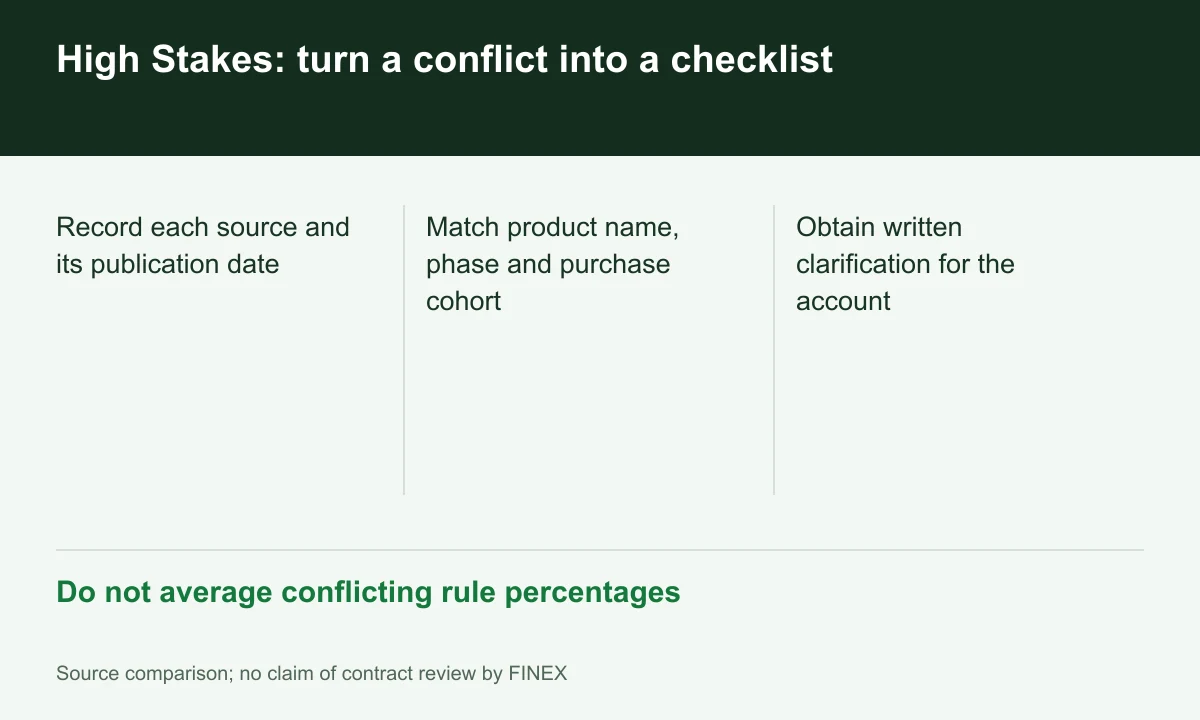
Diagram explained
Do not average conflicting rule percentages
- Record each source and its publication date
- Match product name, phase and purchase cohort
- Obtain written clarification for the account
Payout figures also need a version label
For a $100,000 account, the High Stakes general-rules FAQ gives a $500 minimum P&L and a $4,000 payout cap. The general 2-Step FAQ gives $250 and $2,000. A general withdrawals FAQ describes a $150 minimum. Record all three scopes; do not turn the lowest threshold into a promise for every account.
The5ers High Stakes general rules — updated 15 September 2026 The5ers general 2-Step rules — updated 7 September 2026 The5ers withdrawal methods and conditions
The distinction between account profit, an eligible payout request and money arriving in a bank is equally important. These are separate milestones. A screenshot showing a profitable account does not establish the amount eligible for withdrawal, and a submitted request does not establish that the payment has been approved or received.
Build a contract check before paying
Start with the exact product name shown at checkout: account size, New or Classic option, evaluation stage and intended country of residence. Save the displayed price, checkout conditions and applicable agreement with a date. Then put the disputed daily limit and payout rules beside those documents. If the wording still disagrees, ask the provider which numbered provision governs that specific purchase.
A useful support question is: ‘For this exact account and purchase date, what is the daily-loss calculation, when does it reset, and what minimum and cap apply to my first payout?’ Keep the written answer with the agreement. A sales message containing only ‘up to’ figures is not enough to settle a rule conflict.
What remains usable while a conflict is open
You can still compare the questions each programme requires you to answer: how much exposure you carry overnight, whether a strategy depends on news execution, and how payout limits affect cash planning. Use scenarios rather than an unsupported ranking. Where a key contractual rule remains unresolved, FINEX labels it clearly and avoids presenting a precise cash forecast. A transparent gap is more useful than a confident number applied to the wrong account.
Your next step
Sources and scope
Sources are provider publications. Conditions may vary by entity, country, account and program. Recheck before signing up.