Switching Forex brokers: a practical transition checklist
Compare the reason for switching, contracts, payment logistics and existing affiliate eligibility before making a commitment.
Define the problem you are trying to solve
Write down why you are considering a change: cost, platform limitations, unclear legal terms, payment availability or an unresolved service issue. Attach evidence from your own account where possible. A vague feeling that another provider is better is difficult to evaluate. Turn the reason into a measurable requirement, such as understanding the full charge on a typical trade or having a documented withdrawal route in your country. Then compare the proposed new account against that requirement. Avoid replacing a known inconvenience with several unknown conditions simply because a promotion looks attractive.
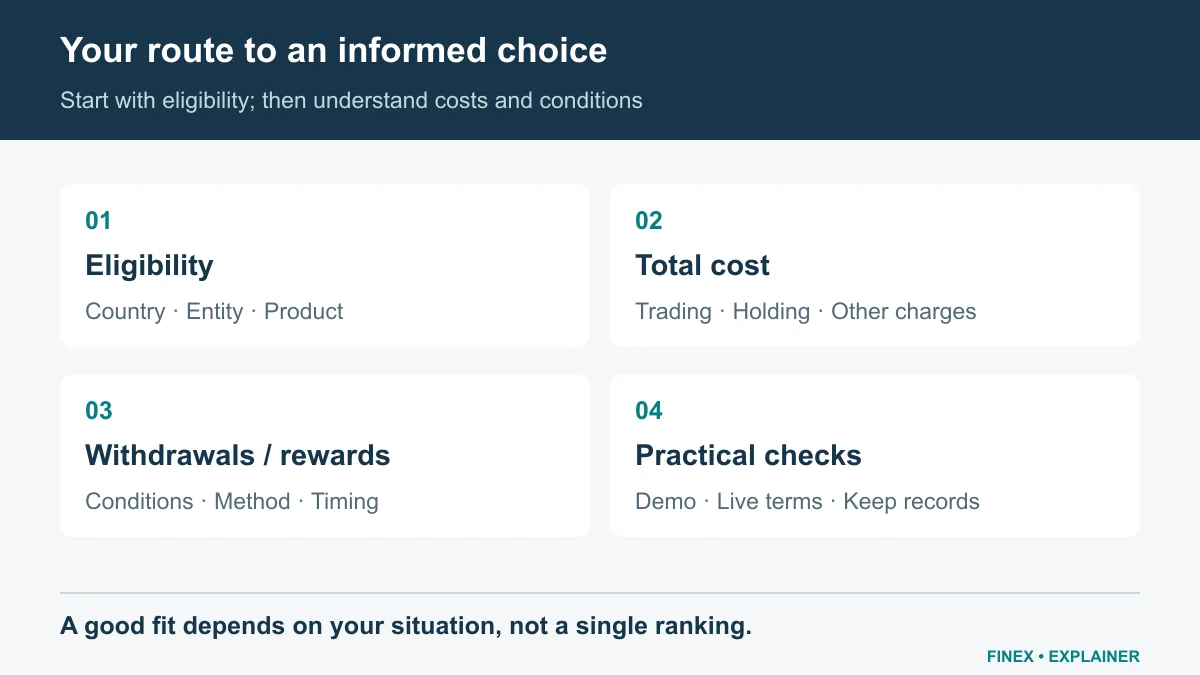
Diagram explained
A good fit depends on your situation, not a single ranking.
- Confirm that the entity and product are available for your residence, nationality and customer category.
- Compare the full cost and money-out rules for your expected trading style and payment method.
- Use a demo to learn mechanics, then check the live terms separately. Demo performance cannot prove live execution, withdrawal reliability or suitability.
Recheck the entire new account
Confirm the contracting entity, accepted residence, account type, base currency and platform. Calculate the proposed cost using the same instruments and holding periods as your existing account. Check whether any benefit has an expiry date or depends on volume, deposit size or another condition. Keep promotional savings separate from ongoing pricing. Read the complaint process and funding policy before depositing. Your earlier experience with a group name does not guarantee that a different company or account variant has the same rules. Save the agreement and source dates so the comparison can be revisited.
Plan funding and existing positions deliberately
Do not assume open positions, records, platform settings or payment routes can be transferred directly between providers. Ask what is actually supported, then plan around the answer. Keep enough records to understand previous activity and any outstanding request. Consider the cost and timing of withdrawal, conversion and new funding separately; do not double-count the same charge. A hypothetical lower commission at the new account may take time to offset a one-off transition cost. Any decision about closing a position should follow your own risk plan rather than an affiliate deadline or a marketing countdown.
Check existing-client and affiliate eligibility in writing
If support, rebates or an introducing-broker relationship forms part of your decision, ask whether an existing client can participate and what approval is required. Do not assume a referral link changes an established account's assignment or creates an entitlement to payment. Request the provider's written conditions, including the applicable account, region, start date and any exclusions. FINEX should clearly separate its assistance from the broker's contractual obligations. Decide only after the service change makes sense without an unconfirmed incentive. A successful transition solves the original problem and leaves you with terms you understand, rather than merely producing a new account.
Sources and scope
This is a FINEX editorial checklist, not a verification of a specific provider. Obtain current written terms from the provider before switching.