How to read a prop contract: eligibility, identity and changes
Build a short evidence record before paying, with clear questions about the counterparty, rules and identity requirements.
Identify who owes which obligation
Read a prop agreement as a map of responsibilities. Start with the legal name, registration details, service description and applicable product. Then separate the contractual provider from a payment processor, technology affiliate or brand owner. A familiar company name on a card statement may explain payment handling without identifying the party responsible for the evaluation service.
FundedNext’s Terms section 2 explicitly separates its contractual provider from affiliated operational and payment roles. That is a useful example of why several company names should not be collapsed into one undifferentiated label. It does not establish regulatory protection or settle a dispute by itself.
FundedNext Terms — provider roles and contractual structure
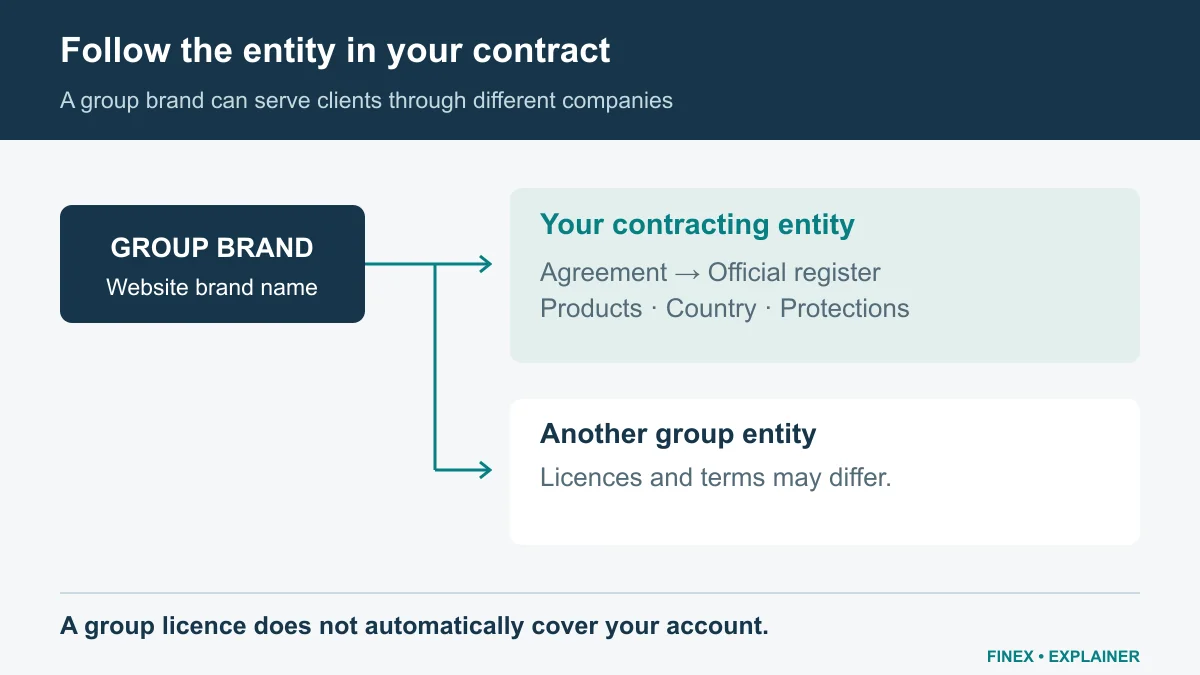
Diagram explained
A group licence does not automatically cover your account.
- Identify the legal name in your own client agreement, not only the logo or group name on the homepage.
- Match that name and licence number to the official register, then check product permissions, jurisdiction and any relevant investor protections.
- For a prop firm, company incorporation is not the same as a broker licence. A country not listed as prohibited is not, by itself, proof of acceptance.
Check eligibility before uploading documents
Look for age, residence, citizenship and product-specific restrictions. Treat an ambiguous answer as unresolved rather than using checkout availability as proof. Use only your own accurate identity information. Do not borrow an identity, conceal a country or ask an intermediary to bypass a restriction. Paying first can create an avoidable problem that a later document upload cannot solve.
Before supplying sensitive documents, confirm that you are on the provider’s official verification route and understand the stated purpose. Keep the document checklist and support case reference, but avoid publishing identity documents in a review or a public complaint. A comparison website should help you locate the requirement, not collect unnecessary passport copies.
Find the clauses that can change the outcome
Mark the loss calculation, pass criteria, prohibited practices, review process, reward entitlement, fees and refund conditions. Read what happens after a rule breach and how a disagreement can be raised. Look for amendment provisions and a statement about which document prevails if a FAQ differs from the contract. Do not assume that the shortest marketing page overrides the more detailed agreement.
When pages conflict, turn the discrepancy into a specific written question. Include the product, account size, purchase date and both source links. Ask which exact provision applies rather than requesting a vague reassurance that everything is fine. Keep the answer with the version you accepted; a later reader needs context to understand its scope.
Keep a compact evidence pack
Save the dated offer, final checkout, accepted agreement, applicable rule pages and important support responses. Record updates separately so you can distinguish an old purchase from a new rule version. Redact personal information before sharing anything. This is a reading and recordkeeping method, not legal advice or a guarantee of enforceability; a consequential contractual dispute may require qualified advice for the relevant jurisdiction.
Sources and scope
Sources are provider publications. Conditions may vary by entity, country, account and program. Recheck before signing up.