Prop firm or Forex broker: what are you actually opening?
Separate an evaluation service, simulated account size and a brokerage relationship before comparing providers.
Start with the contract, not the account number
Two dashboards can display the same $100,000 balance while representing very different relationships. Before choosing between a Forex broker and a prop evaluation programme, ask what service you are buying, whose money is involved and what gives you a right to receive a payment. An impressive account size does not answer those questions. The labels demo, challenge, funded and live need the provider’s own definitions.
FTMO’s explanation of its service describes simulated trading and educational tools. That is a specific model, not evidence that every business called a prop firm operates identically. Read the selected programme’s agreement before treating a displayed balance as capital you own, can transfer or can withdraw.
FTMO service and simulated trading explanation
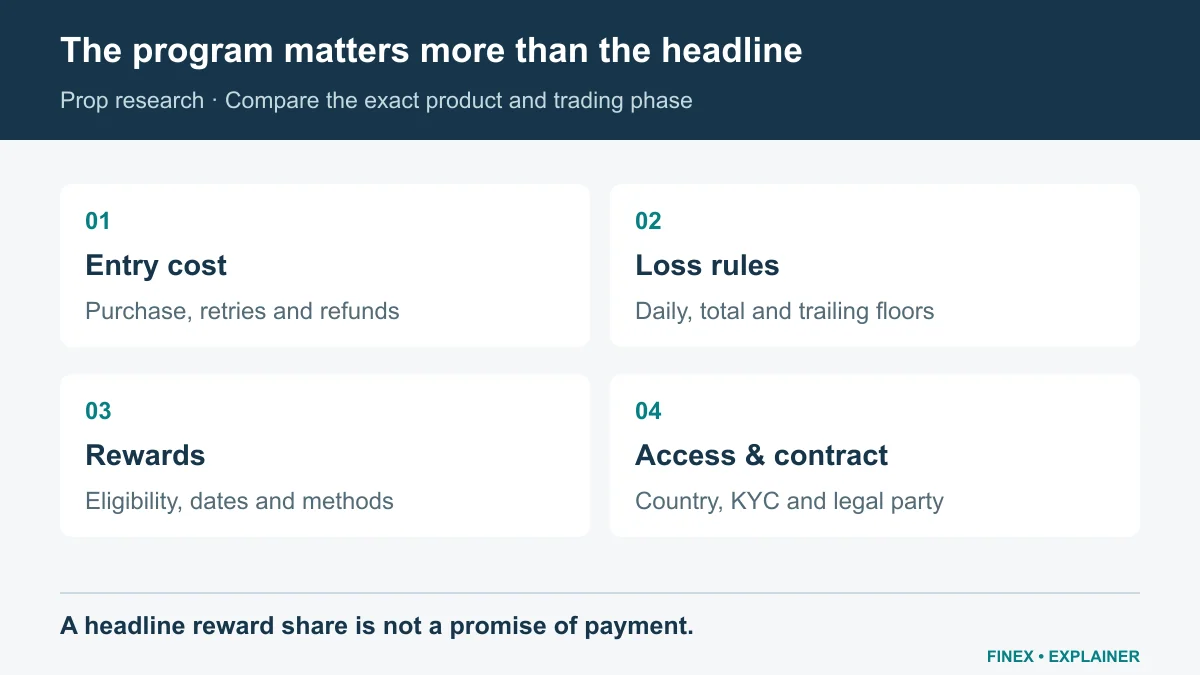
Diagram explained
A headline reward share is not a promise of payment.
- Match the exact program, size and phase. The purchase fee is not the same as a deposit or the displayed simulated capital.
- Read daily and total loss rules, trailing calculations, restricted strategies and news or weekend conditions.
- Check country eligibility, the contracting company, KYC, reward request dates and payment conditions. A payout headline alone does not answer these questions.
Follow three separate money flows
First record what you pay: an evaluation fee, a subscription, a deposit or another service charge. Next identify what the trading balance represents. Finally identify the legal basis of any money you could receive. Keeping those three lines separate helps prevent a common mistake: subtracting a challenge price from a large simulated balance and calling the difference available trading capital.
For example, paying a hypothetical $100 for access to a simulated $10,000 evaluation does not mean you deposited $10,000. Nor does a simulated $500 gain establish an unconditional $500 cash receivable. The agreement must explain whether rewards exist, how they are calculated and what review or eligibility conditions apply.
Compare the responsibilities you would take on
For a brokerage relationship, inspect the contracting entity, account terms, execution arrangements, charges and withdrawal policy. For an evaluation, add the pass conditions, prohibited practices, loss rules and reward terms. These are different research questions; a single generic trust score cannot replace them. Company registration and marketing partnerships should not be treated as interchangeable with permission to provide a particular financial service.
FundedNext’s own broker explanation says its Challenge and FundedNext Accounts are simulated and that it is not a retail broker. Its provider-specific disclosure is useful for understanding that profile, but should not be copied as the definition of a different firm’s product.
Use your need to choose the next research step
If you want to understand an evaluation, begin with its rules and a practice environment. If you want a brokerage account, begin with entity and account terms. If you are uncertain, compare the obligations side by side before considering an offer. FINEX separates these paths to reduce confusion; neither route guarantees profit, and this guide does not determine your suitability for leveraged trading.
Sources and scope
Sources are provider publications. Conditions may vary by entity, country, account and program. Recheck before signing up.