Valetax Cent versus Standard: the same lot label has a different size
Read Valetax Cent and Standard contract sizes before copying a lot amount, and use a transparent hypothetical size comparison without assuming pip value.
Start with units per lot
Valetax's account comparison gives Cent a 1,000-unit contract versus Standard's 100,000. Copying a numerical lot setting between them changes exposure. The Cent page also labels base currency USD; do not invent a USC display merely because the account is called Cent.
Sources for this section
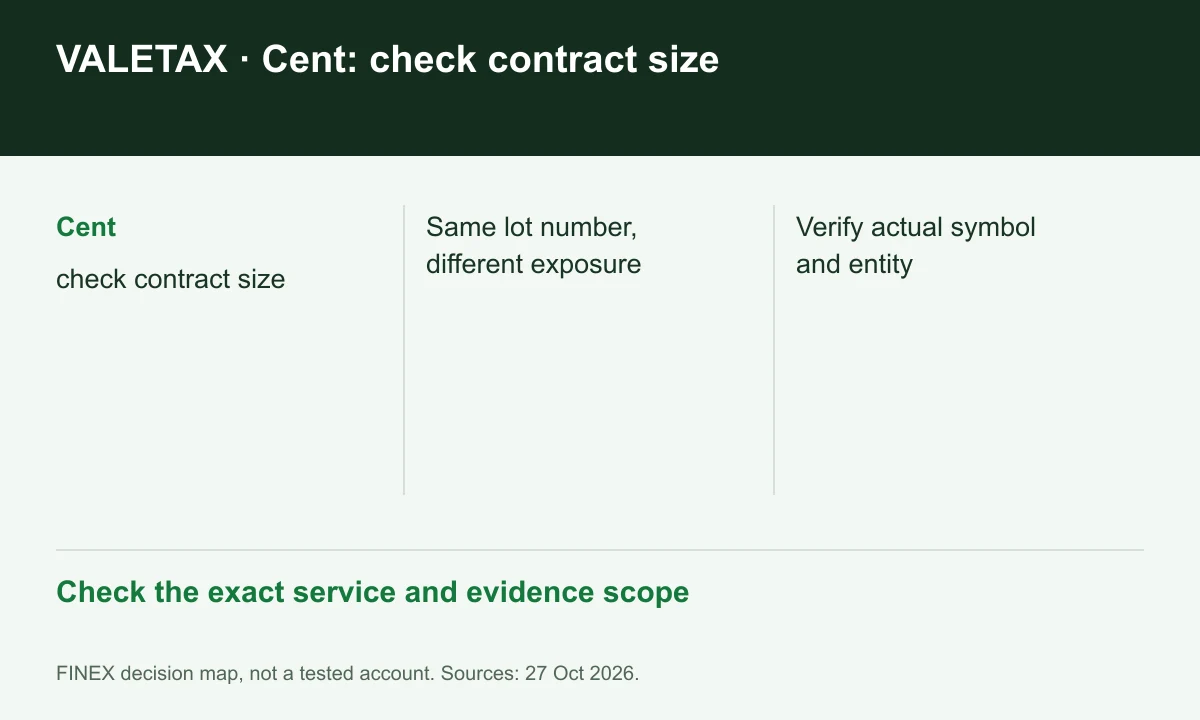
Diagram explained
Check the exact service and evidence scope
- Cent: check contract size
- Same lot number, different exposure
- Verify actual symbol and entity
Work through a hypothetical size, not a profit forecast
Assume those published FX contract sizes apply to the same intended pair. At 0.10 lot, Cent represents 100 base-currency units and Standard 10,000: a 100-fold difference. This is contract arithmetic, not margin, pip value or an expected return.
Sources for this section
Check the symbol before moving a strategy
On the intended server, inspect contract size, lot step and the instrument offered before reusing an EA input. Keep a small conversion worksheet beside the strategy settings. A matching MT4/MT5 interface does not establish identical trade sizes or instrument coverage.
Sources for this section
Keep the legal scope attached to the calculation
The opened terms concern Valetax Global Limited in Saint Vincent and the Grenadines; the website also names a Mauritius company. Match the actual agreement rather than assigning one company's permissions to both. FINEX has not tested order execution or confirmed individual onboarding eligibility.
Sources for this section
Register for up to 100% trading fee rebates
Rebate details
Contact FINEX to confirm the rebate rate, eligible fees and account conditions before registering. contact@finexbroker.com
Your next step
Sources and scope
Sources are provider publications. Conditions may vary by entity, country, account and program. Recheck before signing up.