IC Markets vs Exness: compare total cost and withdrawal rules
A practical comparison of Raw account commissions, payment processing and legal-entity checks, with a worked hypothetical trade.
This article includes partner links. FINEX may earn a commission.
Start with the account and entity
A useful comparison starts with two specific account offers. This article uses IC Markets Global's Seychelles offering and Exness's international public specifications. It does not combine the Australian IC Markets account with an international Exness account. Before opening either account, record the company named in your proposed agreement, your residence, the account currency and the platform. A familiar group name is not enough to establish your contractual rights. Save the agreement you actually accept; a marketing page can describe several companies while only one becomes your counterparty.
Compare commission on the same basis
IC's MetaTrader Raw schedule states USD 3.50 per standard lot per side, or USD 7 round turn. Exness Raw Spread states up to USD 3.50 per lot per side. These figures alone do not prove identical total costs. Compare the same instrument and trade size, then add the actual spread, any overnight financing and currency conversion. Exness's Zero starting commission is instrument-specific. IC's cTrader pricing uses USD turnover, so do not substitute it directly for a MetaTrader lot charge.
IC Global account overview Exness professional accounts
For illustration only, assume a one-lot EUR/USD trade in a USD account, a USD 10 pip value, a 0.2-pip spread and USD 7 round-turn commission. The simplified opening-and-closing cost is USD 9 before financing or slippage. At a 0.5-pip spread it becomes USD 12. These are invented inputs, not measured spreads at either broker. The exercise shows why a minimum advertised spread cannot decide the winner.
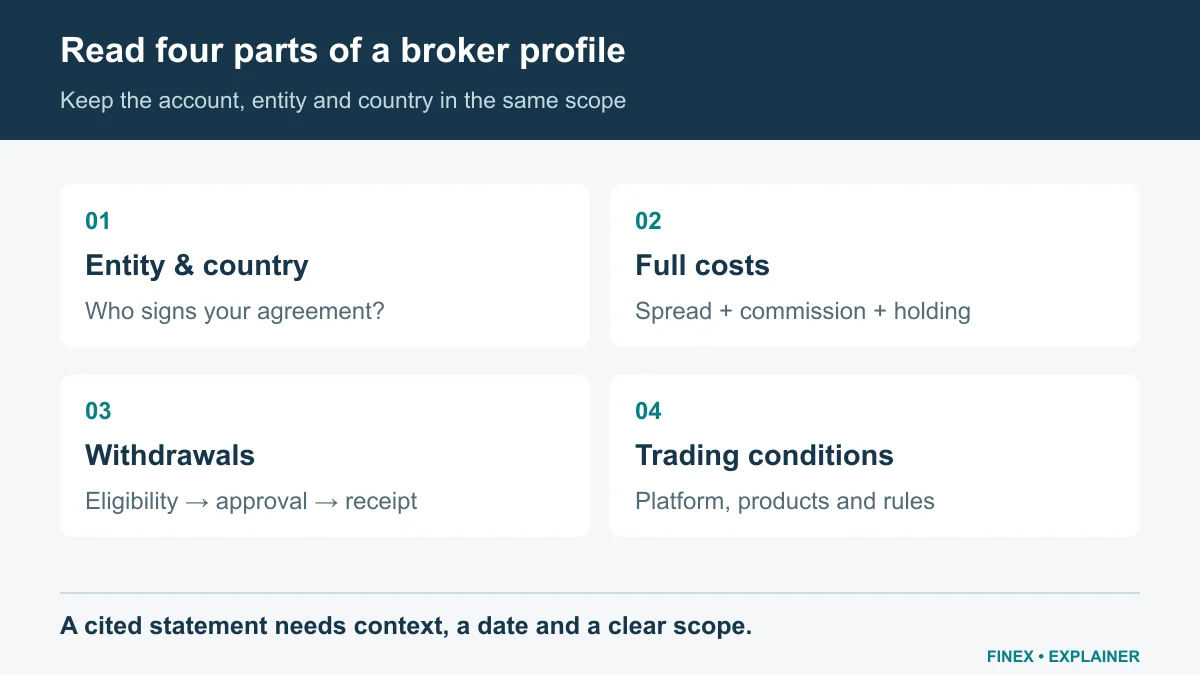
Diagram explained
A cited statement needs context, a date and a clear scope.
- Entity: identify the company signing your account, its permissions and applicable country restrictions.
- Costs and withdrawals: compare the full pricing schedule, supported methods, review time and receipt time.
- Trading conditions: check the supported platforms, instruments, account type and restrictions. Read the article’s linked sources for provider-specific statements.
Want to explore the account options?
Separate approval from receiving money
IC describes standard processing cut-offs and eligible instant requests. Exness explains that instant means automated approval; the receiving time still depends on the payment method. Neither description should become a promise that every withdrawal reaches every bank immediately. Ask both providers for the options shown for your verified account, the original funding-source rule, transaction limits and likely third-party costs. A card refund, local bank payment and international wire are different routes. Compare the full route you intend to use, rather than a headline about speed.
Make the choice reproducible
Build a small decision sheet with your usual trade size, holding period, platform and withdrawal route. For each broker, write the evidence beside the answer and mark anything that remains uncertain. A scalper can weight spread and commission more heavily; a position trader should inspect financing across their expected holding period. Someone funding in a different currency should calculate conversion twice if it occurs on deposit and withdrawal. Review the sheet after terms change. There is no universal winner: the better fit is the account whose verified terms suit your actual routine.
Found the broker that fits?
Match the spread, commission and overnight charges to your trading approach before choosing an account.
View the detailed comparisonRead the review: ic-marketsSources and scope
Sources are provider publications. Conditions may vary by entity, country, account and program. Recheck before signing up.