How to read a broker's withdrawal policy before depositing
Identify return-to-source rules, fee ownership, verification and exceptions using a structured policy-reading method.
This article includes partner links. FINEX may earn a commission.
Find the policy that applies to your company
First identify the company in your account agreement. Open its funding policy and save the date and document version if shown. A group homepage may link to several jurisdictions, so check the destination rather than trusting the link label. If a page redirects to a different entity or client category, do not silently use its table for your account. Record the discrepancy and ask for the applicable policy. This is especially important when a comparison article quotes a number without explaining whether it is a broker-processing estimate, bank-arrival estimate or account-opening condition.
Trace ownership and return-to-source rules
Mark every clause about the name on the payment account, original deposit method and documents needed to change a destination. Vantage's policy describes returning funds to the funding source and prohibits third-party payments. HFM's FAQ likewise explains returning the original deposit before another route is used. These rules can matter when your card is replaced, a wallet closes or you want profits sent elsewhere. Ask how your exact case is handled before making another deposit. Do not assume that being able to type a destination into a form means the destination satisfies the policy.
Vantage return-to-source and funding policy HFM withdrawal FAQ
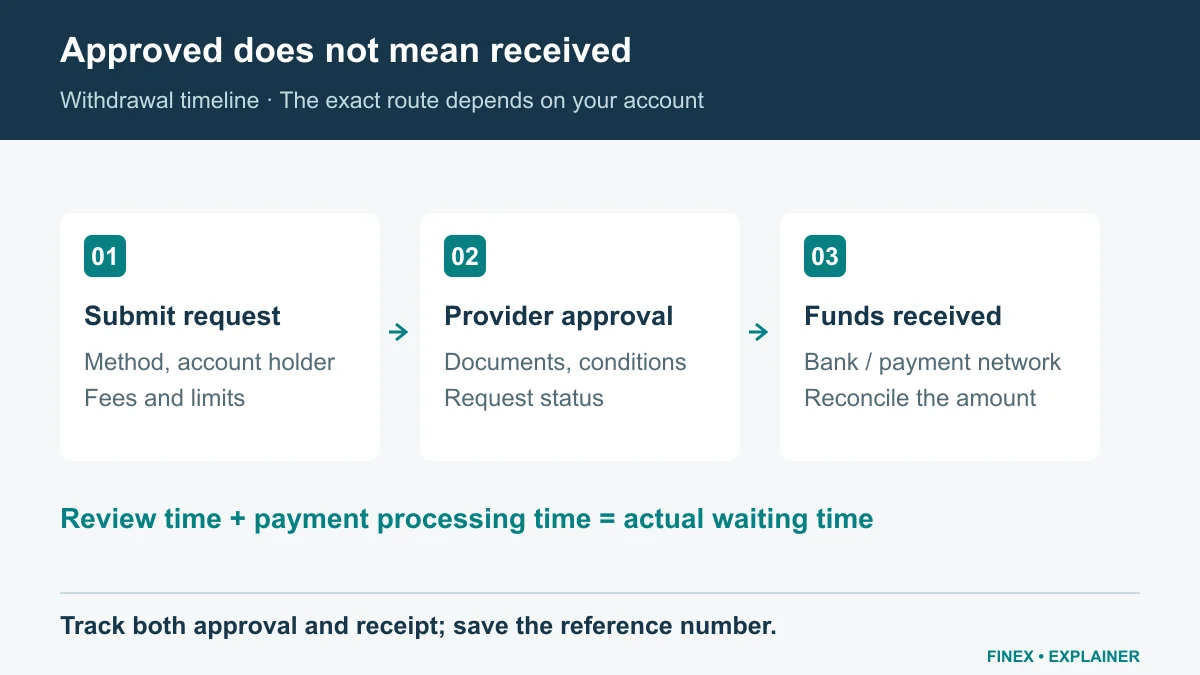
Diagram explained
Track both approval and receipt; save the reference number.
- Before submitting: check the supported withdrawal method, beneficiary name, fees, limits and return-to-source requirements.
- Provider approval and payment settlement are separate steps. A status such as “instant approval” does not guarantee instant receipt.
- Save the request time, transaction reference and payment evidence. For prop rewards, also check payout eligibility, the contract and any review requirements.
Want to explore the account options?
Ask who charges each fee
The phrase no withdrawal fee can refer only to the broker's own charge. Inspect separate references to sending banks, intermediary banks, receiving banks, payment processors and conversion. Build a simple table with the party, possible charge, currency and whether the amount is known before confirmation. Use unknown where evidence is missing. For example, a hypothetical USD 200 transfer with a USD 10 receiving charge would deliver USD 190 before other deductions, even if the broker takes nothing. This is an illustration, not a quote from either provider. Percentage charges and fixed minimums require separate calculations.
Read exceptions as part of the service
Look for verification requests, margin restrictions, cut-offs, unavailable methods and additional source-of-funds checks. Separate your obligations from the provider's discretion, and note any complaint route or written explanation process. You do not need to predict every possible delay; you need to know which information is required and who to contact if the normal path fails. Keep request identifiers and responses in a private record. Review the policy after a material account or residence change. A good decision is based on the full conditions you can accept, rather than the shortest advertised time or a fee-free headline alone.
Choose an account by total cost
Match the spread, commission and overnight charges to your trading approach before choosing an account.
Sources and scope
Sources are provider publications. Conditions may vary by entity, country, account and program. Recheck before signing up.