CMC boundary orders versus limits and stop entries
Understand when CMC UK's boundary range can reject an order, and distinguish that execution filter from a limit price or a guaranteed exit instruction.
Define the price objective
A buy limit seeks execution at or below its limit; a sell limit at or above. CMC states price control does not guarantee the order will fill.
Sources for this section
www.cmcmarkets.com — official documentation www.cmcmarkets.com — official documentation www.cmcmarkets.com — official documentation
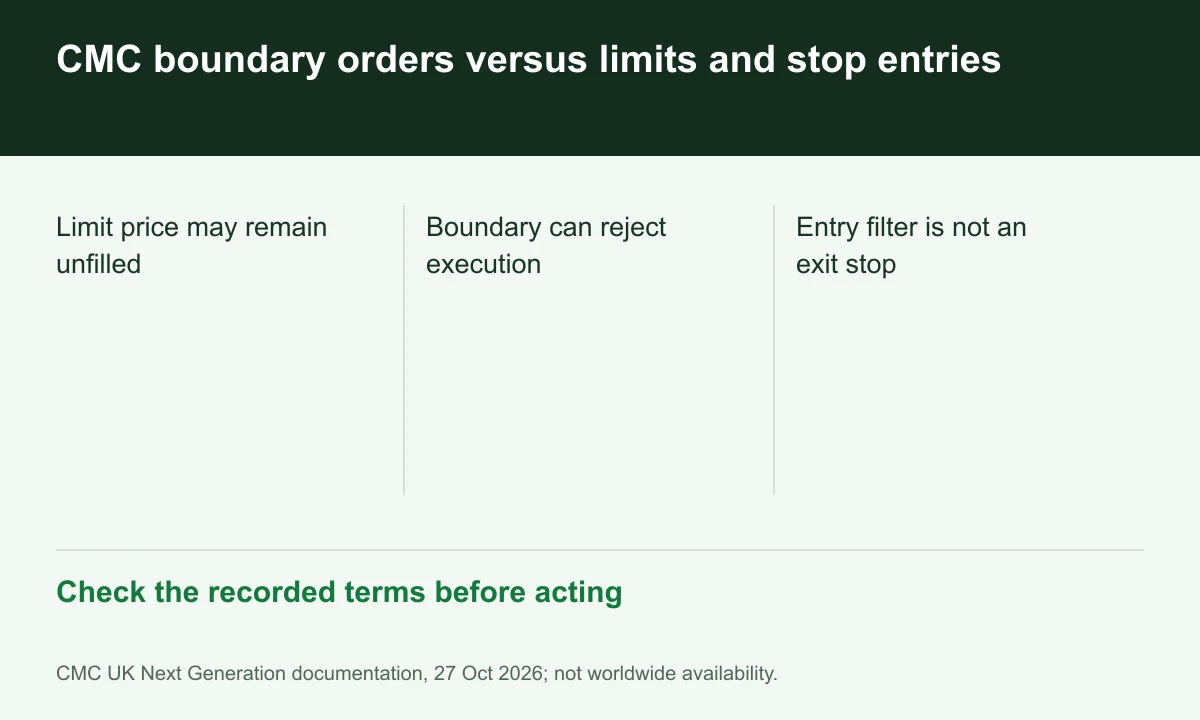
Diagram explained
Check the recorded terms before acting
- Limit price may remain unfilled
- Boundary can reject execution
- Entry filter is not an exit stop
Boundary means possible rejection
On the UK execution page, boundary ranges apply to market and stop-entry orders. An execution price outside the specified range results in rejection rather than an assured fill.
Use a hypothetical decision
Suppose a permitted buy range ends at 101 and the next executable price is 102. Rejection protects the selected entry constraint but leaves no position; it is not a profitable fill.
Keep exit controls separate
A boundary is an entry execution filter, not a GSLO attached to an open trade. Check pending-order duration and any attached stop separately before confirming.
Register for up to 100% trading fee rebates
Rebate details
Contact FINEX to confirm the rebate rate, eligible fees and account conditions before registering. contact@finexbroker.com
Your next step
Sources and scope
Sources are provider publications. Conditions may vary by entity, country, account and program. Recheck before signing up.